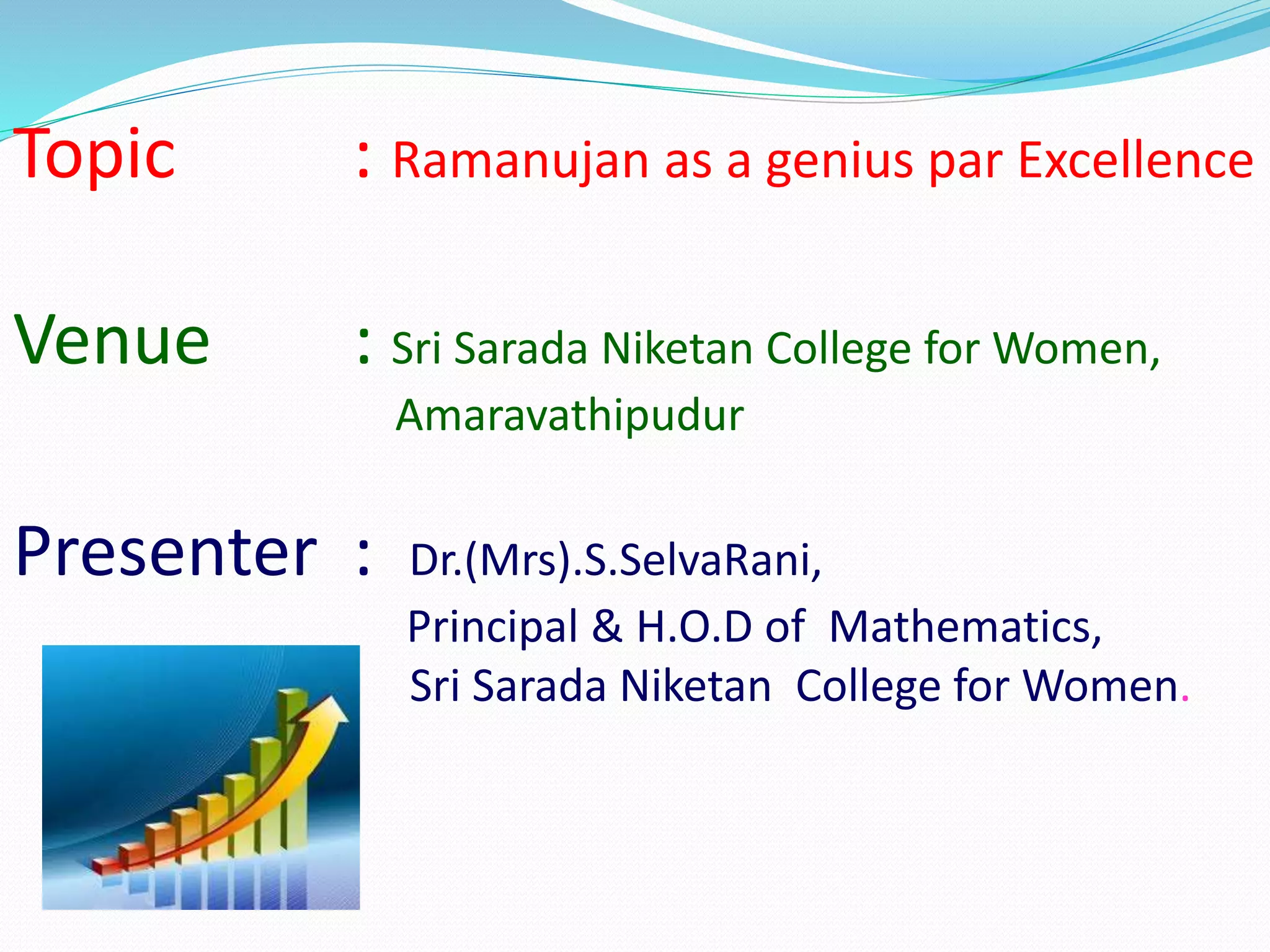
Welcome
to
125th Birth Anniversary Celebrations of
Genius Ramanujan
Topic : Ramanujan as a genius par Excellence
Venue : Sri Sarada Niketan College for Women,
Amaravathipudur
Presenter : Dr.(Mrs).S.SelvaRani,
Principal & H.O.D of Mathematics,
Sri Sarada Niketan College for Women.
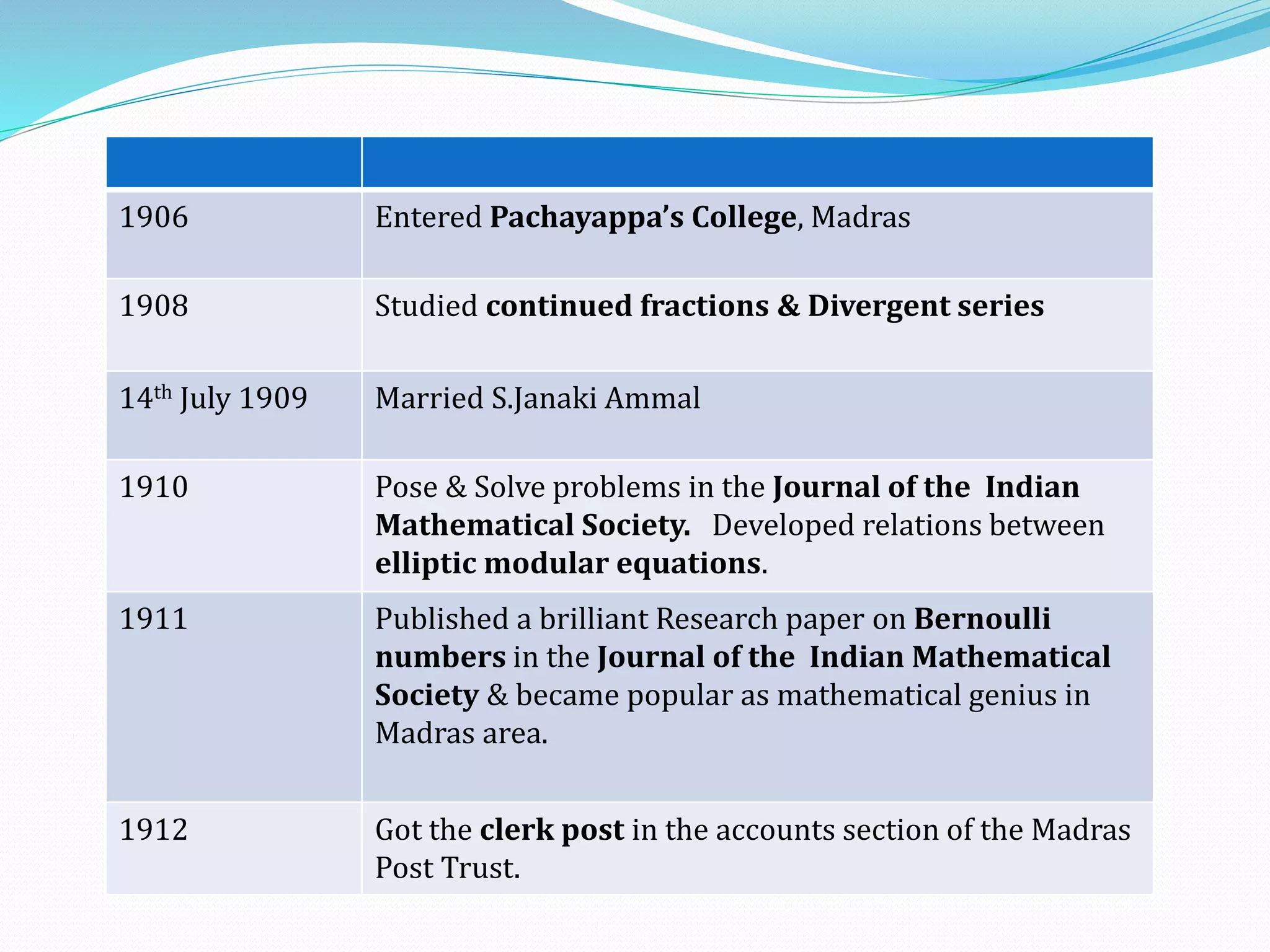
22nd
December
1887
Born in Erode
January
1898
Entering Town High School Kumbakonam.
Won Prizes for proficiency in Mathematics &
English.
1900 Began to work on his own Mathematics –
summing Geometric & Arithmetic series.
Inspiration : G.S Carr’s Book
1902 Solving Cubic Equations
1904 Involved in Deep research Investigated series
∑1/n & calculated Euler’s Constant to 15
decimal places began to study Bernoulle’s
Nos. Entered Government College
Kumbakonam.
Life History & his sojourn in Mathematics
1906 Entered Pachayappa’s College, Madras
1908 Studied continued fractions & Divergent series
14th July 1909 Married S.Janaki Ammal
1910 Pose & Solve problems in the Journal of the Indian
Mathematical Society. Developed relations between
elliptic modular equations.
1911 Published a brilliant Research paper on Bernoulli
numbers in the Journal of the Indian Mathematical
Society & became popular as mathematical genius in
Madras area.
1912 Got the clerk post in the accounts section of the Madras
Post Trust.
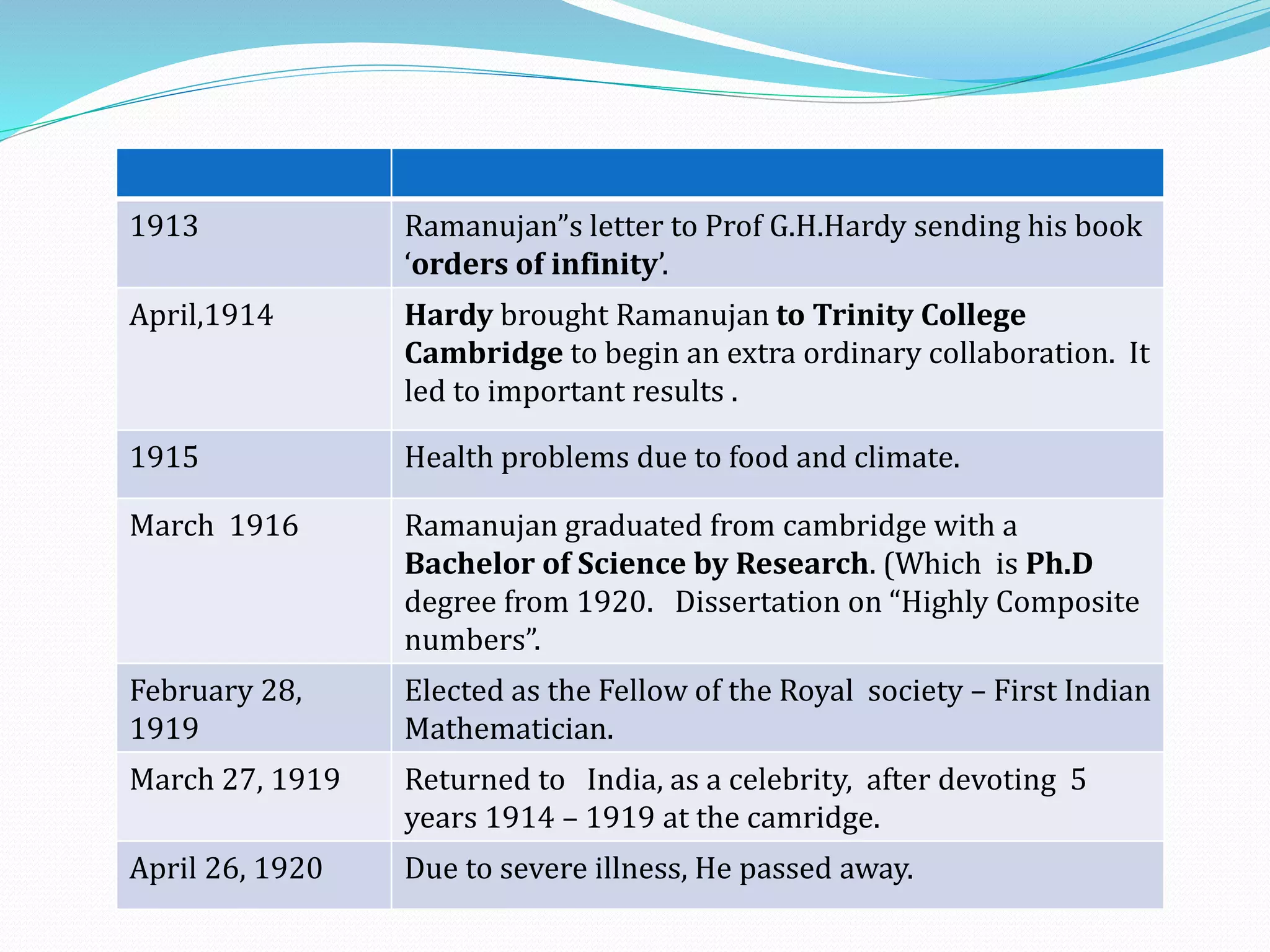
1913 Ramanujan”s letter to Prof G.H.Hardy sending his book
‘orders of infinity’.
April,1914 Hardy brought Ramanujan to Trinity College
Cambridge to begin an extra ordinary collaboration. It
led to important results .
1915 Health problems due to food and climate.
March 1916 Ramanujan graduated from cambridge with a
Bachelor of Science by Research. (Which is Ph.D
degree from 1920. Dissertation on “Highly Composite
numbers”.
February 28,
1919
Elected as the Fellow of the Royal society – First Indian
Mathematician.
March 27, 1919 Returned to India, as a celebrity, after devoting 5
years 1914 – 1919 at the camridge.
April 26, 1920 Due to severe illness, He passed away.
Some Memories in his Mathematics Sojourn
1. Mother – Smt.Komalathammal
2. Goddess Namagirithayar
School Anecdotes:
1) 0/0 cannot be determined.
2) Solving Simultaneous Equations in seconds.
3) Timetable ->Magic squares.
Well Wishers of Ramanujan
• GH Hardy Mentor of Ramanujan
• E.H.Nevellie Trinity College
• S.Narayana Iyer , Treasurer, port trust.
• V.Ramasami Iyer, Founder of IMS & JIMS
• Seshu Iyer Prof. of Maths, Kumbakonam.
Dewan Bahadur collector of Nellore.
• Sir Francis Spring, Chairman Madras Post Trust.
Ramanujan’s Infinite Series – the basis to compute
When k = 0, the result is 3.14159273,
k=1, it is 3.141592654.
The value of to 14 decimal places is
3.141592653589793.
The Value of
Ramanujan’s equation arises at value of Pi to large numbers of
decimals plus more rapidly than just about any other known
series.
 Ramanjuan’s also gave 17 other series formulas for .
 Even now, with the help of a mathematical tools such as computer
software, find it hard to generate the kind of identities that
Ramanujan already found.
 Even computer find it hard to generate such series.
Glimpses
of
Ramanujan’s
Work
Redefining Euler’s Constant
Ramanujan gave many beautiful formulas for π and .
Euler’s constant γ =-Γ (1) =0.57721566…,
which occurs in many well-known formulas involving
The Gamma function, the Riemann zeta function, the
divisor function d(n), etc.
Gamma Function
It is an infinite integral
T1 (n)
 T1(n) Converges for
 t1(n+1) = nT1(n), if
Euler’s identity
In analytical mathematics, Euler’s identity (also know as Euler’s
equation), named for the Swiss-German mathematician Leonhard Euler,
is the equality
Where
e is Euler’s number, the base of natural algorithms,
i is the imaginary unit, which satisfies , and
is pi, the ratio of the circumference of a circle to its diameter.
Euler’s formula from complexanalysis
Ramanujan’s Formula For , Euler’s Constant
At the top of page 276 in[13],Ramanujan writes
the last term of the nth group being
Let 0 be the centre & PR any diameter bisect op at H & trisect OR at T
Draw PK =PM &PL =MN
Draw CD parellel KL. Then, = Circle PQR
Ramanujan’s Notebook
Square the circle
To Construct a square equal to a given circle
The Hardy-Ramanujan Number : 1729
“The sum of two positive cubes in two different ways”.
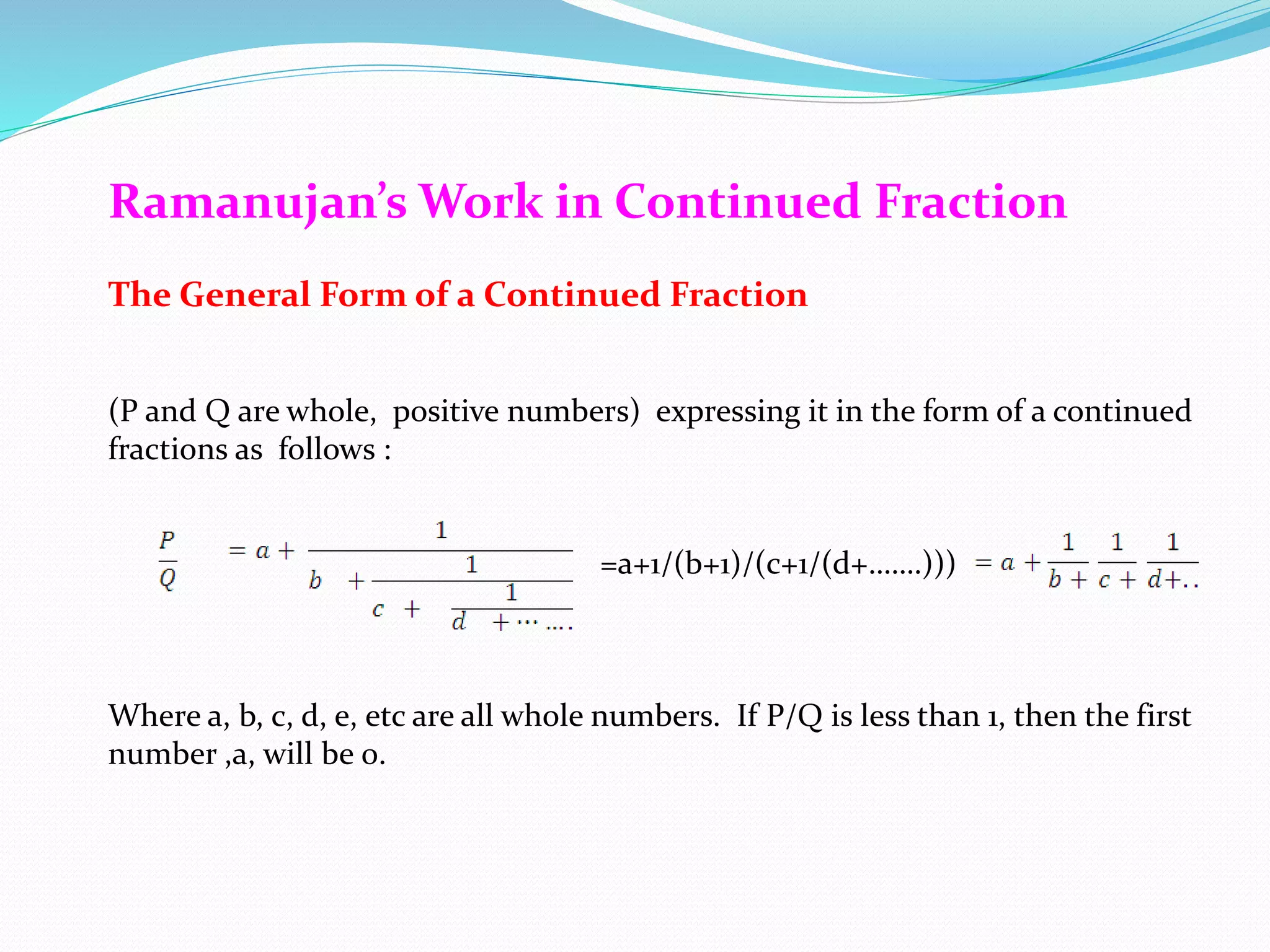
Ramanujan’s Work in Continued Fraction
The General Form of a Continued Fraction
(P and Q are whole, positive numbers) expressing it in the form of a continued
fractions as follows :
=a+1/(b+1)/(c+1/(d+…….)))
Where a, b, c, d, e, etc are all whole numbers. If P/Q is less than 1, then the first
number ,a, will be 0.
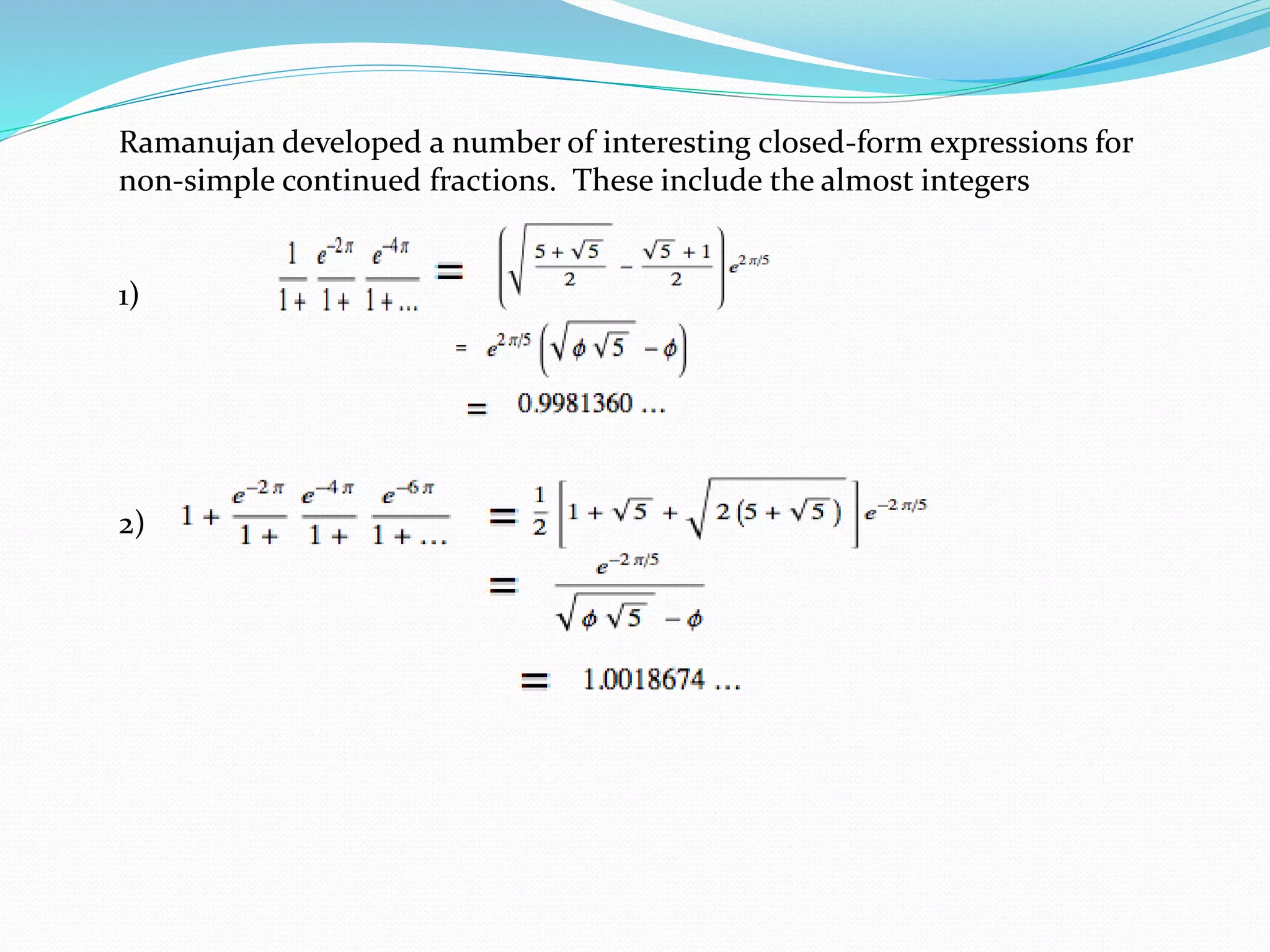
Ramanujan developed a number of interesting closed-form expressions for
non-simple continued fractions. These include the almost integers
1)
2)
3)
4)
Applications of Ramanujan’s work
•It has found applications in Polymer Chemistry, Computer
Science, Physics and even in Cancer Research.
•Ramanujan’s graphs have found applications in
Communication Engineering, characterizing certain efficient
networks.
•Ramanujan graphs for some problems in Coding Theory.
Thank You

Maths seminar i (1)

  • 1.
    Welcome to 125th Birth AnniversaryCelebrations of Genius Ramanujan
  • 2.
    Topic : Ramanujanas a genius par Excellence Venue : Sri Sarada Niketan College for Women, Amaravathipudur Presenter : Dr.(Mrs).S.SelvaRani, Principal & H.O.D of Mathematics, Sri Sarada Niketan College for Women.
  • 3.
    22nd December 1887 Born in Erode January 1898 EnteringTown High School Kumbakonam. Won Prizes for proficiency in Mathematics & English. 1900 Began to work on his own Mathematics – summing Geometric & Arithmetic series. Inspiration : G.S Carr’s Book 1902 Solving Cubic Equations 1904 Involved in Deep research Investigated series ∑1/n & calculated Euler’s Constant to 15 decimal places began to study Bernoulle’s Nos. Entered Government College Kumbakonam. Life History & his sojourn in Mathematics
  • 4.
    1906 Entered Pachayappa’sCollege, Madras 1908 Studied continued fractions & Divergent series 14th July 1909 Married S.Janaki Ammal 1910 Pose & Solve problems in the Journal of the Indian Mathematical Society. Developed relations between elliptic modular equations. 1911 Published a brilliant Research paper on Bernoulli numbers in the Journal of the Indian Mathematical Society & became popular as mathematical genius in Madras area. 1912 Got the clerk post in the accounts section of the Madras Post Trust.
  • 5.
    1913 Ramanujan”s letterto Prof G.H.Hardy sending his book ‘orders of infinity’. April,1914 Hardy brought Ramanujan to Trinity College Cambridge to begin an extra ordinary collaboration. It led to important results . 1915 Health problems due to food and climate. March 1916 Ramanujan graduated from cambridge with a Bachelor of Science by Research. (Which is Ph.D degree from 1920. Dissertation on “Highly Composite numbers”. February 28, 1919 Elected as the Fellow of the Royal society – First Indian Mathematician. March 27, 1919 Returned to India, as a celebrity, after devoting 5 years 1914 – 1919 at the camridge. April 26, 1920 Due to severe illness, He passed away.
  • 6.
    Some Memories inhis Mathematics Sojourn 1. Mother – Smt.Komalathammal 2. Goddess Namagirithayar
  • 7.
    School Anecdotes: 1) 0/0cannot be determined. 2) Solving Simultaneous Equations in seconds. 3) Timetable ->Magic squares.
  • 8.
    Well Wishers ofRamanujan • GH Hardy Mentor of Ramanujan • E.H.Nevellie Trinity College • S.Narayana Iyer , Treasurer, port trust. • V.Ramasami Iyer, Founder of IMS & JIMS • Seshu Iyer Prof. of Maths, Kumbakonam. Dewan Bahadur collector of Nellore. • Sir Francis Spring, Chairman Madras Post Trust.
  • 10.
    Ramanujan’s Infinite Series– the basis to compute When k = 0, the result is 3.14159273, k=1, it is 3.141592654. The value of to 14 decimal places is 3.141592653589793. The Value of
  • 11.
    Ramanujan’s equation arisesat value of Pi to large numbers of decimals plus more rapidly than just about any other known series.  Ramanjuan’s also gave 17 other series formulas for .  Even now, with the help of a mathematical tools such as computer software, find it hard to generate the kind of identities that Ramanujan already found.  Even computer find it hard to generate such series.
  • 12.
  • 13.
    Redefining Euler’s Constant Ramanujangave many beautiful formulas for π and . Euler’s constant γ =-Γ (1) =0.57721566…, which occurs in many well-known formulas involving The Gamma function, the Riemann zeta function, the divisor function d(n), etc.
  • 14.
    Gamma Function It isan infinite integral T1 (n)  T1(n) Converges for  t1(n+1) = nT1(n), if
  • 15.
    Euler’s identity In analyticalmathematics, Euler’s identity (also know as Euler’s equation), named for the Swiss-German mathematician Leonhard Euler, is the equality Where e is Euler’s number, the base of natural algorithms, i is the imaginary unit, which satisfies , and is pi, the ratio of the circumference of a circle to its diameter.
  • 16.
    Euler’s formula fromcomplexanalysis
  • 17.
    Ramanujan’s Formula For, Euler’s Constant At the top of page 276 in[13],Ramanujan writes the last term of the nth group being
  • 18.
    Let 0 bethe centre & PR any diameter bisect op at H & trisect OR at T Draw PK =PM &PL =MN Draw CD parellel KL. Then, = Circle PQR Ramanujan’s Notebook Square the circle To Construct a square equal to a given circle
  • 19.
    The Hardy-Ramanujan Number: 1729 “The sum of two positive cubes in two different ways”.
  • 20.
    Ramanujan’s Work inContinued Fraction The General Form of a Continued Fraction (P and Q are whole, positive numbers) expressing it in the form of a continued fractions as follows : =a+1/(b+1)/(c+1/(d+…….))) Where a, b, c, d, e, etc are all whole numbers. If P/Q is less than 1, then the first number ,a, will be 0.
  • 21.
    Ramanujan developed anumber of interesting closed-form expressions for non-simple continued fractions. These include the almost integers 1) 2)
  • 22.
  • 23.
    Applications of Ramanujan’swork •It has found applications in Polymer Chemistry, Computer Science, Physics and even in Cancer Research. •Ramanujan’s graphs have found applications in Communication Engineering, characterizing certain efficient networks. •Ramanujan graphs for some problems in Coding Theory.
  • 24.