ALL ABOUT MOTION
ALL ABOUT MOTION
LEARNING OUTCOMES
a.Differentiate between speed and velocity
b.Define acceleration
c. Discuss the graphical representation of
motion
d.Solve problems involving the equations of
motion
ALL ABOUT MOTION
What is Force?
It is a push or a pull.
Effect of Force on an object:
1. It can change velocity of an object.
2. It can change direction of the motion of an object.
3. It can stretch an elastic object to its limit or permanently
deform it.
4. It can make object float in water or airplane float in air.
ALL ABOUT MOTION
MECHANICS = It is the field of Physics that
specializes in the study of motion of objects.
Branches of Mechanics:
1.Kinematics = deals with the quantitative
description of motion.
2.Dynamics = focuses on the forces that affect
motion.
ALL ABOUT MOTION
Definition of motion
Motion is a continuous change of position
with respect to specific frame of reference.
Frame of reference = It is a point in space or an
object that you assume has a fixed position.
ALL ABOUT MOTION
ALL ABOUT MOTION
Description of Motion
1.Distance and displacement (d)
2.Speed and velocity (v)
3.Acceleration (a)
ALL ABOUT MOTION
Speed is the measure of how fast an object is
moving. The average speed is measured by
dividing the distance d traveled by the time t
taken to cover the distance. In mathematical
form,
ALL ABOUT MOTION
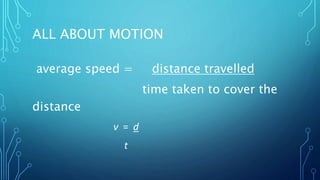
average speed = distance travelled
time taken to cover the
distance
ν = d
t
ALL ABOUT MOTION
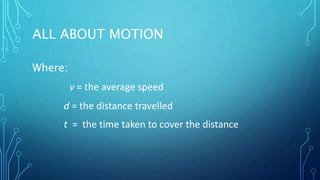
Where:
ν = the average speed
d = the distance travelled
t = the time taken to cover the distance
ALL ABOUT MOTION
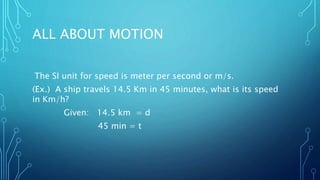
The SI unit for speed is meter per second or m/s.
(Ex.) A ship travels 14.5 Km in 45 minutes, what is its speed
in Km/h?
Given: 14.5 km = d
45 min = t
ALL ABOUT MOTION
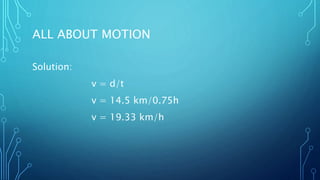
Solution:
v = d/t
v = 14.5 km/0.75h
v = 19.33 km/h
ALL ABOUT MOTION
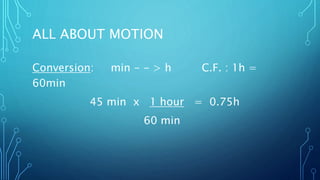
Conversion: min - - > h C.F. : 1h =
60min
45 min x 1 hour = 0.75h
60 min
ALL ABOUT MOTION
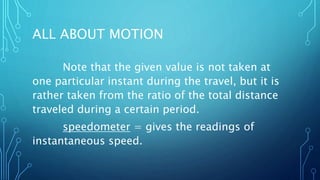
Note that the given value is not taken at
one particular instant during the travel, but it is
rather taken from the ratio of the total distance
traveled during a certain period.
speedometer = gives the readings of
instantaneous speed.
ALL ABOUT MOTION
Instantaneous speed = It is the speed of a body
at a certain instance of time.
Constant speed = It is the condition where the
instantaneous speed does not change.
ALL ABOUT MOTION
In case of an airplane pilot, the direction of
motion is just as important as the speed.
Velocity = it is the speed in a given direction.
Velocity is a vector quantity and is defined as the
rate of change of displacement.
ALL ABOUT MOTION
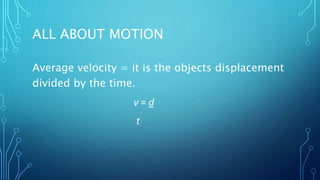
Average velocity = it is the objects displacement
divided by the time.
ν = d
t
ALL ABOUT MOTION
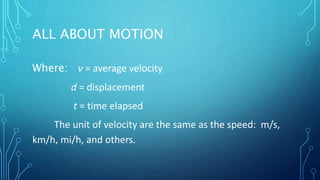
Where: ν = average velocity
d = displacement
t = time elapsed
The unit of velocity are the same as the speed: m/s,
km/h, mi/h, and others.
ALL ABOUT MOTION
A car traveling at 100 km/h north and a
car traveling at 100 km/h south have the same
speed but different velocities.
ALL ABOUT MOTION
Acceleration
An object in motion seldom moves at
constant speed, nor does it remain in the same
direction. When the velocity of an object is
changing, we say that the body is experiencing
acceleration. Acceleration is defined as the rate
of change in velocity with time.
ALL ABOUT MOTION
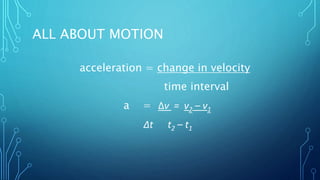
acceleration = change in velocity
time interval
a = ∆ν = ν2 – ν1
∆t t2 – t1
ALL ABOUT MOTION
Where: ν2 = final velocity
ν1 = initial velocity
t2 = time ends
t1 = time started
a = average acceleration
ALL ABOUT MOTION
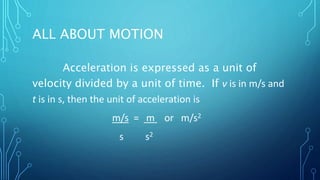
Acceleration is expressed as a unit of
velocity divided by a unit of time. If ν is in m/s and
t is in s, then the unit of acceleration is
m/s = m or m/s2
s s2
ALL ABOUT MOTION
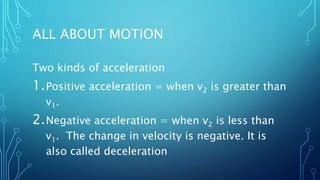
Two kinds of acceleration
1.Positive acceleration = when v2 is greater than
v1.
2.Negative acceleration = when v2 is less than
v1. The change in velocity is negative. It is
also called deceleration
ALL ABOUT MOTION
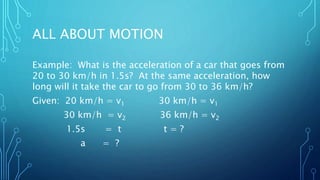
Example: What is the acceleration of a car that goes from
20 to 30 km/h in 1.5s? At the same acceleration, how
long will it take the car to go from 30 to 36 km/h?
Given: 20 km/h = v1 30 km/h = v1
30 km/h = v2 36 km/h = v2
1.5s = t t = ?
a = ?
ALL ABOUT MOTION
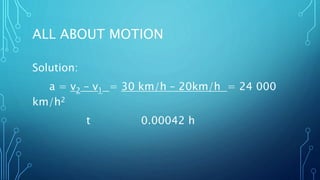
Solution:
a = v2 – v1 = 30 km/h – 20km/h = 24 000
km/h2
t 0.00042 h
ALL ABOUT MOTION
Conversion:
1 h = 3600 s
1.5 s x 1 h =
0.00041666
3600 s
ALL ABOUT MOTION
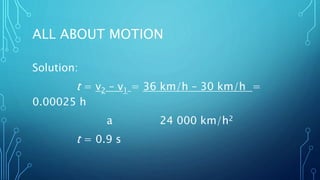
Solution:
t = v2 – v1 = 36 km/h – 30 km/h =
0.00025 h
a 24 000 km/h2
t = 0.9 s
ALL ABOUT MOTION
Distance-time Graph
Motion graphs are useful tools that can tell how far
a body has travelled, how fast it is moving, and all the
speed changes that take place.
To measure the distance covered by a moving body
from a starting position, say, every second, plot the
values of the distance covered against the corresponding
time readings.
ALL ABOUT MOTION
This will show a distance-time graph (d – t
graph).
ALL ABOUT MOTION
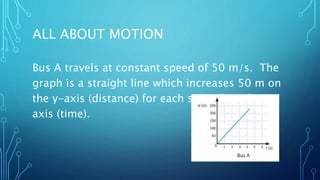
Bus A travels at constant speed of 50 m/s. The
graph is a straight line which increases 50 m on
the y-axis (distance) for each second on the x-
axis (time).
ALL ABOUT MOTION
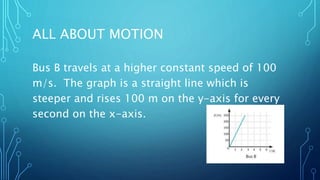
Bus B travels at a higher constant speed of 100
m/s. The graph is a straight line which is
steeper and rises 100 m on the y-axis for every
second on the x-axis.
ALL ABOUT MOTION
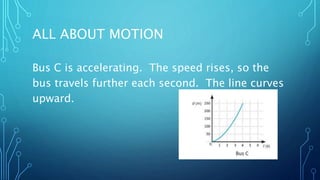
Bus C is accelerating. The speed rises, so the
bus travels further each second. The line curves
upward.
ALL ABOUT MOTION
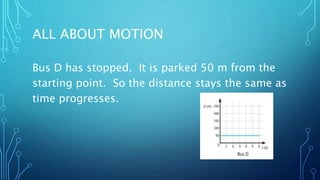
Bus D has stopped. It is parked 50 m from the
starting point. So the distance stays the same as
time progresses.
ALL ABOUT MOTION
slope of the graph = ∆y = ∆d
∆x ∆t
“TO GOD BE THE GLORY!”

ALL-ABOUT-MOTION (3).pptx

  • 1.
  • 2.
    ALL ABOUT MOTION LEARNINGOUTCOMES a.Differentiate between speed and velocity b.Define acceleration c. Discuss the graphical representation of motion d.Solve problems involving the equations of motion
  • 3.
    ALL ABOUT MOTION Whatis Force? It is a push or a pull. Effect of Force on an object: 1. It can change velocity of an object. 2. It can change direction of the motion of an object. 3. It can stretch an elastic object to its limit or permanently deform it. 4. It can make object float in water or airplane float in air.
  • 4.
    ALL ABOUT MOTION MECHANICS= It is the field of Physics that specializes in the study of motion of objects. Branches of Mechanics: 1.Kinematics = deals with the quantitative description of motion. 2.Dynamics = focuses on the forces that affect motion.
  • 5.
    ALL ABOUT MOTION Definitionof motion Motion is a continuous change of position with respect to specific frame of reference. Frame of reference = It is a point in space or an object that you assume has a fixed position.
  • 6.
  • 7.
    ALL ABOUT MOTION Descriptionof Motion 1.Distance and displacement (d) 2.Speed and velocity (v) 3.Acceleration (a)
  • 8.
    ALL ABOUT MOTION Speedis the measure of how fast an object is moving. The average speed is measured by dividing the distance d traveled by the time t taken to cover the distance. In mathematical form,
  • 9.
    ALL ABOUT MOTION averagespeed = distance travelled time taken to cover the distance ν = d t
  • 10.
    ALL ABOUT MOTION Where: ν= the average speed d = the distance travelled t = the time taken to cover the distance
  • 11.
    ALL ABOUT MOTION TheSI unit for speed is meter per second or m/s. (Ex.) A ship travels 14.5 Km in 45 minutes, what is its speed in Km/h? Given: 14.5 km = d 45 min = t
  • 12.
    ALL ABOUT MOTION Solution: v= d/t v = 14.5 km/0.75h v = 19.33 km/h
  • 13.
    ALL ABOUT MOTION Conversion:min - - > h C.F. : 1h = 60min 45 min x 1 hour = 0.75h 60 min
  • 14.
    ALL ABOUT MOTION Notethat the given value is not taken at one particular instant during the travel, but it is rather taken from the ratio of the total distance traveled during a certain period. speedometer = gives the readings of instantaneous speed.
  • 15.
    ALL ABOUT MOTION Instantaneousspeed = It is the speed of a body at a certain instance of time. Constant speed = It is the condition where the instantaneous speed does not change.
  • 16.
    ALL ABOUT MOTION Incase of an airplane pilot, the direction of motion is just as important as the speed. Velocity = it is the speed in a given direction. Velocity is a vector quantity and is defined as the rate of change of displacement.
  • 17.
    ALL ABOUT MOTION Averagevelocity = it is the objects displacement divided by the time. ν = d t
  • 18.
    ALL ABOUT MOTION Where:ν = average velocity d = displacement t = time elapsed The unit of velocity are the same as the speed: m/s, km/h, mi/h, and others.
  • 19.
    ALL ABOUT MOTION Acar traveling at 100 km/h north and a car traveling at 100 km/h south have the same speed but different velocities.
  • 20.
    ALL ABOUT MOTION Acceleration Anobject in motion seldom moves at constant speed, nor does it remain in the same direction. When the velocity of an object is changing, we say that the body is experiencing acceleration. Acceleration is defined as the rate of change in velocity with time.
  • 21.
    ALL ABOUT MOTION acceleration= change in velocity time interval a = ∆ν = ν2 – ν1 ∆t t2 – t1
  • 22.
    ALL ABOUT MOTION Where:ν2 = final velocity ν1 = initial velocity t2 = time ends t1 = time started a = average acceleration
  • 23.
    ALL ABOUT MOTION Accelerationis expressed as a unit of velocity divided by a unit of time. If ν is in m/s and t is in s, then the unit of acceleration is m/s = m or m/s2 s s2
  • 24.
    ALL ABOUT MOTION Twokinds of acceleration 1.Positive acceleration = when v2 is greater than v1. 2.Negative acceleration = when v2 is less than v1. The change in velocity is negative. It is also called deceleration
  • 25.
    ALL ABOUT MOTION Example:What is the acceleration of a car that goes from 20 to 30 km/h in 1.5s? At the same acceleration, how long will it take the car to go from 30 to 36 km/h? Given: 20 km/h = v1 30 km/h = v1 30 km/h = v2 36 km/h = v2 1.5s = t t = ? a = ?
  • 26.
    ALL ABOUT MOTION Solution: a= v2 – v1 = 30 km/h – 20km/h = 24 000 km/h2 t 0.00042 h
  • 27.
    ALL ABOUT MOTION Conversion: 1h = 3600 s 1.5 s x 1 h = 0.00041666 3600 s
  • 28.
    ALL ABOUT MOTION Solution: t= v2 – v1 = 36 km/h – 30 km/h = 0.00025 h a 24 000 km/h2 t = 0.9 s
  • 29.
    ALL ABOUT MOTION Distance-timeGraph Motion graphs are useful tools that can tell how far a body has travelled, how fast it is moving, and all the speed changes that take place. To measure the distance covered by a moving body from a starting position, say, every second, plot the values of the distance covered against the corresponding time readings.
  • 30.
    ALL ABOUT MOTION Thiswill show a distance-time graph (d – t graph).
  • 31.
    ALL ABOUT MOTION BusA travels at constant speed of 50 m/s. The graph is a straight line which increases 50 m on the y-axis (distance) for each second on the x- axis (time).
  • 32.
    ALL ABOUT MOTION BusB travels at a higher constant speed of 100 m/s. The graph is a straight line which is steeper and rises 100 m on the y-axis for every second on the x-axis.
  • 33.
    ALL ABOUT MOTION BusC is accelerating. The speed rises, so the bus travels further each second. The line curves upward.
  • 34.
    ALL ABOUT MOTION BusD has stopped. It is parked 50 m from the starting point. So the distance stays the same as time progresses.
  • 35.
    ALL ABOUT MOTION slopeof the graph = ∆y = ∆d ∆x ∆t
  • 36.
    “TO GOD BETHE GLORY!”