PEED
ISTANCE IME
R. P. SINGH
TSD INDEX
• Basics
• Average speed
• Relative speed
• Boats and streams
• Races
• Clock
• We use the concept of TSD in our daily life without
using any formulae….doubt it
• See… whenever we go to School/ College/ Coaching/
Office or Cinema…..we are expected to reach at certain
fixed time and we have to cover certain
distance….depending on the time at hand we decide
the way we will go there (i.e. speed at which things
move)…like Walking, Cycle, Car, Bus, Metro.
• So you should be happy to infer that you know this
concept already…
• 
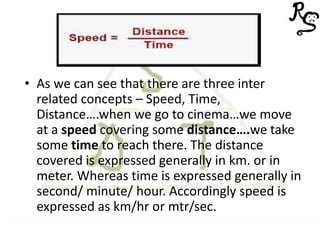
• As we can see that there are three inter
related concepts – Speed, Time,
Distance….when we go to cinema…we move
at a speed covering some distance….we take
some time to reach there. The distance
covered is expressed generally in km. or in
meter. Whereas time is expressed generally in
second/ minute/ hour. Accordingly speed is
expressed as km/hr or mtr/sec.
CONVERSION OF SPEED
• IF THE SPEED IS GIVEN IN KM/HR IT CAN BE
CONVERTED IN MTR/SEC OR VICE-A-VERSA.
– WE KNOW THAT 1 KM = 1000 METERS ;
– 1HOUR = 60 MINUTES &1 MINUTE = 60 SEC
– SO 1 HOUR = (60 X 60 ) SECONDS
– 1 KM/ HOUR= 1000 METERS/(60 X 60)SECONDS
– OR….1 KM/HR= 5/18 M/S
– OR….. 18/5 KM/HR = 1 M/S,
– i.e. 1 M/S = 18/5 KM/HR
USE IN QUESTION
1. AT A SPEED OF 72KM/HR, WHAT TIME A TRAIN
200 METERS LONG WILL TAKE TO CROSS A MAN
?
SOL: TO CROSS A MAN, TRAIN HAS TO COVER ITS
LENGTH OF 200 METERS.
AS THE LENGTH OF TRAIN IS IN METERS.... WE
NEED TO CONVERT TRAIN SPEED IN M/S.
72 KM/HR= (72 X 5 / 18 ) M/S = 20 M/S
SO THE TIME = 200/ 20 = 10 SECONDS.
ANOTHER EXAMPLE
2. AT A SPEED OF 90KM/HR, WHAT TIME A TRAIN
200 METERS LONG WILL TAKE TO CROSS A 150
METERS LONG PLATFORM ?
SOL.- HERE DISTANCE TO BE COVERED WILL BE
150 METERS OF PLATFORM + 200 METER LENGTH
OF TRAIN… 350 METERS.
SPEED OF THE TRAIN WILL BE (90 X 5/18) M/S
OR 25 M/S.
SO THE TRAIN WILL TAKE TIME …350/25=14 SEC.
It is important to understand this formula more in
detail before jumping on the questions, as all the
questions in this chapter are based on this
formula. Take out extra time to understand the
use of this formula, which will help to build your
thinking in ways this formula can be used and you
will be able to solve questions fast.
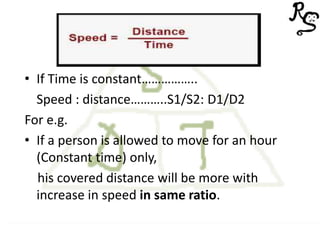
• If Time is constant……………..
Speed : distance………..S1/S2: D1/D2
For e.g.
• If a person is allowed to move for an hour
(Constant time) only,
his covered distance will be more with
increase in speed in same ratio.
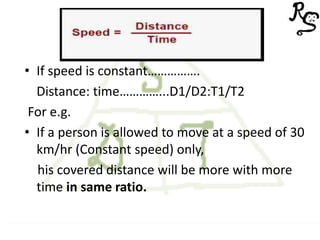
• If speed is constant…………….
Distance: time…………...D1/D2:T1/T2
For e.g.
• If a person is allowed to move at a speed of 30
km/hr (Constant speed) only,
his covered distance will be more with more
time in same ratio.
• If Distance is constant ………..
Speed : 1/ Time…………S1/S2:T2/T1
….important relation
For e.g.
• If a person moves from office to home
(Constant distance), increase in speed will
result into less in time in inverse ratio.
Practice Example
• a) Rohit, going from home to office at his 3/4th usual speed, is late
by 12 minutes. What is his usual time to go to office?
• Sol: Decreased speed is 3/4th
Distance is constant ……inverse relationship of speed and time.
Let usual speed is 1 unit and also time is 1 unit.
Speed gets reduced to ¾ unit and
Decreased speed will result into increase in time in inverse
proportion. So current time would be 4/3 of original time 1.
So increase in time over original is 4/3- 1 = 1/3.
As per question Rohit is late by 12 minutes i.e. increase in time. So
this 1/3 is equivalent to 12 minutes. So original time 1 will be
equivalent to 12 x 3 = 36 minutes.
ANOTHER EXAMPLE
• b) Surjeet goes to movie hall from house at 4 km/hr, gets late for the
movie by 20 minutes. If he goes at 6 km/hr, he reaches 10 minutes early.
What is the distance between movie hall and house?
• Sol: Ratio of speed is 4:6 i.e. 2:3. As Distance is constant there would be
Inverse relation of time and speed. So…
If speed increases from 2 to 3 …..time will decrease from 3 to 2 ( Inverse
ratio). If time was 3 units early, later it became 2 units with increase in
speed ( i.e. to 2 unit to 3 unit). So there was difference of 1 unit of time
between both situations.
As per question, there is difference of 20 + 10 = 30 minutes (20 minutes
late and 10 minutes early) between both situations. So 1 unit of time is
equivalent to 30 minutes i.e. 2 units of time is equivalent to 60 minutes.
As 2 units of time is taken at increased speed of 6 km/hr i.e. he covers
distance in 60 minutes at this speed is equal to 6km.
AVERAGE SPEED
• Have you ever noticed that most of the time while
going to college / office our speed is more than the
speed while returning. Suppose your college is 40 kms
away from your house. While going to college you
drive fast with a speed of 60 km/hr and you take 40
minutes to reach. However while returning your speed
is only 40 km/hr and you take 60 minutes to reach.
Your total time is 100 minutes.
• If you are asked to travel with constant speed to go and
come back taking same 100 minutes. The calculated
constant speed will be 48 km/hr . This speed is called
Average speed. It means that at this constant speed if
you go and come it will take same time as it took in the
first situation with 2 different speeds.
BASE METHOD FOR CALCULATING
AVERAGE SPEED
• This average speed can be calculated by
dividing total distance from total time to travel
that distance.
Average speed= total distance/ total time
• This is very easy method through which we
can solve almost all the questions related to
average speed. So we will learn this method.
AVERAGE SPEED – DIRECT METHOD
Say, a car travels at S1 kph on a trip and at S2 kph on return trip. What is
its average speed for the entire trip?
Solution:
*** Some of you may simply average the 2 speeds. Overall average speed
is not (S1+S2)/2. *** You may know its harmonic mean- however if you
don’t know, it’s not necessary to know to calculate Average speed.
Total average speed is simply = Total distance/Total time
Lets assume,
D = distance travelled by the car in each direction
t1 = time spent on onward trip
t2 = time spent on return trip
Thus, the total distance travelled by the car = D+D= 2D
And, by the formula, Speed = Distance/Time
S1 = D/t1 => t1 = D/S1
S2 = D/t2 => t2 = D/S2
Total average speed = Total Distance/Total time = 2D/(t1+t2) =
2D/(D/S1+D/S2) = 2S1*S2/(S1+S2)
AVERAGE SPEED – RATIO METHOD
• A car travels at 60 mph on a trip and at 100 mph on return trip. What was
its average speed for the entire trip?
Solution:
*** Total average speed is not (60+100)/2 = 80 ***
Total average speed = 2S1*S2/(S1+S2)
=2*60*100/(100+60) = 2*60*100/160
= 2*60*5/8 = 60*5/4 = 15*5 = 75
• RATIO METHOD-
Alternatively, you may want to check if the following saves your time.
Calculate the ratio of the speeds r1:r2. In our example it is 60:100 = 3:5
Then divide the difference between the speeds (s2-s1) by r1+r2 to get one
part. In our example (100-60)/(3+5) = 5 is one part
The required answer is r1 parts away from the lower speed. That is,
60+r1*5 = 60+3*5 = 75 mph
RELATIVE SPEED
• You must have noticed while travelling by car/
bike that vehicle coming from front seems in
very high speed. Almost we cant see the
passenger inside.
• Whereas when we overtake a vehicle that
seems very slow.
• This happens because of phenomenon of
relative speed between both the vehicles.
RELATIVE SPEED
• Cars approaching each other- As we can see
from the animation that both cars contribute
to cover the gap distance –
So Relative speed is addition of both speed.
RELATIVE SPEED
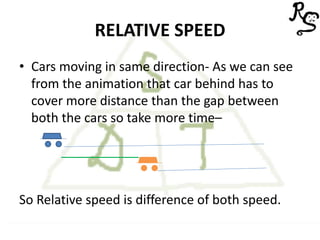
• Cars moving in same direction- As we can see
from the animation that car behind has to
cover more distance than the gap between
both the cars so take more time–
So Relative speed is difference of both speed.
RELATIVE SPEED
• Example : Two trains 100 m and 80 m in length
are running in same direction. The first runs at
the rate of 51 m/s and the second at the rate of
42 m/s. How long will they take to cross each
other?
Here Length of train I = 100, Length of train II = 80
And Speed of train I = 51 m/s,
Speed of train II = 42 m/s
Relative speed = 51 – 42 = 9 m/s
(since trains are moving in same direction)
As per the formula L1+L2/X- Y
=(100+80)/9= 20 seconds
RELATIVE SPEED
• Example : Two trains 100 m and 80 m in length
are running in opposite direction. The first runs at
the rate of 10 m/s and the second at the rate of
15 m/s. How long will they take to cross each
other?
Here Length of train I = 100, Length of train II = 80
And Speed of train I = 10 m/s,
Speed of train II = 15 m/s
Relative speed = 10 + 15 = 25 m/s (since trains are
in same direction)
As per the formula L1 + L2 / X+Y =100+80/25 =
7.2 seconds
Practice Question
• A man and a woman 81 miles apart from each
other, start travelling towards each other at the
same time. If the man covers 5 miles per hour to
the women's 4 miles per hour, how far will the
woman have travelled when they meet?
– 27
– 36
– 45
– None of these
BOATS AND STREAM
Downstream:
• In water, the direction along the stream is called
downstream.
• If the speed of a boat in still water is u km/hr and
the speed of the stream is v km/hr, then:
– Relative Speed downstream = (u + v) km/hr.
BOATS AND STREAM
Upstream:
• In water, the direction against the stream is
called upstream.
• If the speed of a boat in still water is u km/hr
and the speed of the stream is v km/hr, then:
-Relative Speed upstream = (u - v) km/hr.
BOATS AND STREAM
If the speed of boat, downstream is a km/hr and the
speed of boat, upstream is b km/hr, then-
• Speed of boaed in still water =
1 / 2 (a + b) km/hr.
• Rate of stream =
1 / 2 (a - b) km/hr.
Note- Rate of boat would be more than the rate of stream
only than boat will be able to move upstream.
BOATS AND STREAM
• A boat travels equal distance upstream and downstream,
the upstream speed of boat was 10 km/hr, whereas the
downstream speed is 20 km/hr, what is the speed of the
boat in still water? ( Ans- 15 km/hr)
• The speed of a motor boat itself is 20 km/h and the rate of
flow of the river is 4 km/h. Moving with the stream the
boat went 120 km. What distance will the boat cover
during the same time going against the stream?
– 80
– 180
– 60
– 100
BOATS AND STREAM
• A man takes 3 hours 45 minutes to row a
boat 15 km downstream of a river and 2
hours 30 minutes to cover a distance of 5 km
upstream. Find the speed of the current.
– 1 km/hr
– 2 km/hr
– 3 km/hr
– 4 km/hr
BOATS AND STREAM
• A man can row 50 km upstream and 72 km
downstream in 9 hours. He can also row 70 km
upstream and 90 km downstream in 12 hours.
Find the rate of current.
Sol : suppose upstream speed (u – v ) is x.
And downstream speed (u + v) is y.
equation 1 => 50/ x + 72/ y = 9
equation 2 => 70/x + 90/y = 12
Solving for x and y => y=54/3=18, x=10
So speed of current = (18-10)/2 = 4 km/hr
RACES
• Concept of Races: Race is a competition
between contestants in order to reach a point
fastest. There can be many kinds of races.
However, we will study linear and circular
races only.
Linear races (non-circular): The concepts of
time speed and distance are used in races,
which may be linear or circular or other types.
Although with the basic concepts given you
will be able to solve the races questions.
RACES- Terminology
• Imagine, X and Y are two contestants in a race:
1. Before the start of the race, if X is at the starting point and Y is ahead
of X by 10 meters, then X is said to give Y a start of 10 meters. 10 meter
here can be called as start distance or distance at start.
2. In a 100m race, If it is written “X can give Y 20 m start” or “X beats Y by
20 m”, it means that in the time X runs 100 m, Y runs 80 m. 20 meter here
can be called as beat distance.
3. Similarly, If it is written “X can give Y 20 second start” or “X beats Y by
20 seconds”, it means if the given distance is covered by X in ‘a’ seconds,
then Y will take (a + 20) seconds.
4. Winner’s distance – (start distance + beat distance) = loser’s distance.
5. Winner’s time + (start time + beat time) = loser’s time. (As you know
that the winner’s time is less than loser’s time, so something has to be
added to equate).
6. A dead heat means the contestants reached the end point at same
time.
RACES
• Example : Ram can give Hari 20 m start and Hari can give Ravi 10 m
start in a race of 200 m. By how much could Ram beat Hari in the
same race?
• Ram can give Hari a start of 20 m, that means in 200 meter race
ram can cover 200 meters in the same time as Hari covers 180
meters.
Hari can give Ravi a start of 10 m, which means in 200 meter race
Ravi can cover 200 meters in the same time as Hari covers 190
meters.
From second point, Ravi can cover 1 meter, when Hari covers
190/200 meters …..
Also, when Ravi cover 180 meter, Hari covers 180 x 19/20 = 171
meters
Also when Ravi covers 180 meters, Ram covers 200 meters, and in
this time Hari covers 171 meters.
Therefore Ram can give Hari a start distance of 29 meters.
RACES
• Circular races: In circular races, the race is in a
perfect circle. Here are some important points
on circular races, with two or more people
starting from same starting point and at same
time.
CIRCULAR RACES
• Example : Ravi and Ram run around a circular path of
circumference 1000 meters. Ravi runs at 4 m/s and
Ram runs at 2 m/s. If they start from the same point
and walk in the same direction, when will they be first
together again?
Ravi’s speed = 4 m/s, Ram’s speed = 2 m/s
Relative speed = 2 m/s
They will be together again when faster gains full circle
over the slower i.e. cover circumference distance with
relative speed.
Therefore time to gain full circle = 1000/2 = 500
seconds.
RACES
They will be first together at the starting point again after an
interval of time which is the LCM of the times in which each of
them makes one complete round.
• Example : Ravi and Ram run around a circular path of circumference
1000 meters. Ravi runs at 4 m/s and Ram runs at 2 m/s. If they start
from the same point and walk in the same direction. When will they
be first together again at the starting point?
Ravi’s speed = 4 m/s, Ram’s speed = 2 m/s
Time taken for Ravi to complete one lap
= 1000/4 = 250 seconds
Time taken for Ravi to complete one lap
= 1000/2 = 500 seconds
They will be together again at the starting point
= LCM of 250 and 500
This is 500 seconds.
RACES
The persons will be together again for the first time at the time
which is the LCM of the times taken by the fastest to gain a lap over
the others. This is a universal formula for any number of people
running.
• Example : Ravi, Bhuvan and Ram run around a circular path of
circumference 1000 meters. Ravi runs at 4 m/s, Bhuvan runs at 6
m/s and Ram runs at 2 m/s. If they start from the same point and
walk in the same direction. When will they be first together again?
Ravi’s speed = 4 m/s, Bhuvan’s speed = 6 m/s, Ram’s speed = 2 m/s
Time taken for Bhuvan to gain a lap over Ravi
= 1000 /6 - 4 = 500 seconds
Time taken for Bhuvan to gain a lap over Ram
= 1000/6 - 2= 250 seconds
Time taken for Ravi to gain a lap over Ram
= 1000/4 - 2 = 500 seconds
They will be together again = LCM of 500, 250 and 500 => 500 Sec
RACES
• Q In a race of 600m,Amar beats Bunty by 60m and in a race of 500 m Bunty beats
Chetan by 25m. By how many metres will Amar beat Chetan in a 400 m race?
1. 48m
2. 52m
3. 56m
4. 58m
This may look like TSD problem, but its a simple ratio problem.
Race between Amar and Bunty - Bunty covers 10% less of the distance i.e. in 600
m race, Bunty covers 60 m less than Amar. So in a 400 m race, Bunty would cover
40 m less than Amar i.e. 360 m
Race between Bunty and Chetan - Chetan covers 5% less distance than Bunty (In
500m race, Chetan covers 25 m less than Bunty). So when Bunty covers 360 m,
Chetan would cover 5 % less - i.e. 342 m.
Distance difference between Amar and Chetan in a 400 m race = 400 - 342 = 58 m.
CLOCK
• A clock has two hands, smaller hand is called short
hand or hour hand. While larger hand is called long
hand or minute hand.
• In each hour/ 60 minutes, the minute hand gains 55
minutes on the hour hand.
• Angle traced by minute hand in 60 minutes are 360 °.
• Speed of Minute hand- 60spaces/ hour or 1 space per
minute, in terms of degrees it would be 360 degree /
hr or 6 degree / minute.
• Speed of hour hand-5spaces/ hour or 1/12space per
minute, in terms of degrees it would be 30 degree / hr
or 1/2 degree / minute.
CLOCK
• Relative speed- 11/12 space per minute, 5 1/2 degree per
minute……..55 spaces per hour or 330 degree per hr.
• In 12 hours, they are at right angles 22 times. In 24 hours,
they are at right angles 44 times.
• The hands of a clock point in opposite directions (in the
same straight line) 11 times in every 12 hours. (Because
between 5 and 7 they point in opposite directions at 6
o'clcok only). So, in a day, the hands point in the opposite
directions 22 times.
• The hands of a clock coincide 11 times in every 12 hours
(Since between 11 and 1, they coincide only once, i.e., at 12
o'clock). The hands overlap about every 65 minutes, not
every 60 minutes. The hands coincide 22 times in a day.
CLOCK
• Clock problems can be broadly classified in
two categories:
• a) Problems on angles
• b) Problems on incorrect clocks
Problems on angles
Problems on angles
The questions based upon these could be of the following
types-
• Example : What is the angle between the hands of the clock
at 7:20
– At 7 o’ clock, the hour hand is at 210 degrees from the vertical.
– In 20 minutes,
– Hour hand = 210 + 20*(0.5) = 210 + 10 = 220 {The hour hand
moves at 0.5 dpm}
– Minute hand = 20*(6) = 120 {The minute hand moves at 6 dpm}
– Difference or angle between the hands = 220 – 120 = 100
degrees
Problems on angles
• Example : At what time do the hands of the clock meet
between 7:00 and 8:00
Ans: At 7 o’ clock, the hour hand is at 210 degrees from the
vertical.
In ‘t’ minutes
Hour hand = 210 + 0.5t
Relative speed of Minute hand = 6t
They should be meeting each other, so
210 + 0.5t = 6t
=> t = 210/5.5 = 420/11= 38 minutes 2/11th minute
Hands of the clock meet at 7 : 38 : 2/11th
Problems on angles
• Example 3: At what time do the hands of a clock between 7:00 and
8:00 form 90 degrees?
• Ans: At 7 o’ clock, the hour hand is at 210 degrees from the vertical.
In ‘t’ minutes-- Hour hand = 210 + 0.5t, Minute hand = 6t
The difference between them should be 90 degrees. Please note
that it can be both before the meeting or after the meeting. You will
get two answers in this case, one when hour hand is ahead and the
other one when the minute hand is ahead.
Case 1: 210 + 0.5t – 6t = 90 => 5.5t = 120
=> t = 240/11 = 21 minutes 9/11th of a minute
Case 2: 6t – (210 + 0.5t) = 90 => 5.5t = 300
=> t = 600/11 = 54 minutes 6/11th of a minute
So, the hands of the clock are at 90 degrees at the following timings:
7 : 21 : 9/11th and 7 : 54 : 6/11th
Problems on angles
Some other results which might be useful:
• Hands of a clock meet at a gap of 65 5/11 minutes.
• The meetings take place at 12:00:00, 1:05:5/11,
2:10:10/11 … and so on.
• Hands of a clock meet 11 times in 12 hours and 22
times in a day.
• Hands of a clock are perfectly opposite to each other
(i.e. 180 degrees) 11 times in 12 hours and 22 times a
day. {Same as above}
• Any other angle is made 22 times in 12 hours and 44
times in a day
Problems on angles
• Problems on incorrect clocks
Such sort of problems arise when a clock runs faster or slower than
expected pace. When solving these problems it is best to keep track
of the correct clock.
• Example : A watch gains 5 seconds in 3 minutes and was set right at
8 AM. What time will it show at 10 PM on the same day?
Ans: The watch gains 5 seconds in 3 minutes => 100 seconds in 1
hour.
From 8 AM to 10 PM on the same day, time passed is 14 hours.
In 14 hours, the watch would have gained 1400 seconds or 23
minutes 20 seconds.
So, when the correct time is 10 PM, the watch would show 10 : 23 :
20 PM
Problems on angles
• Example : A watch gains 5 seconds in 3 minutes and was set right at
8 AM. If it shows 5:15 in the afternoon on the same day, what is the
correct time?
Ans: The watch gains 5 seconds in 3 minutes => 1 minute in 36
minutes
From 8 AM to 5:15, the incorrect watch has moved 9 hours and 15
minutes = 555 minutes.
When the incorrect watch moves for 37 minutes, correct watch
moves for 36 minutes.
=> When the incorrect watch moves for 1 minute, correct watch
moves for 36/37 minutes
=> When the incorrect watch moves for 555 minutes, correct watch
moves for (36/37)*555 = 36*15 minutes = 9 hours
=> 9 hours from 8 AM is 5 PM. => The correct time is 5 PM.
Problems on angles
• You might have heard that even a broken clock is right twice a day.
However, a clock which gains or loses a few minutes might not be
right twice a day or even once a day. It would be right when it had
gained / lost exactly 12 hours.
Example 6: A watch loses 5 minutes every hour and was set right at
8 AM on a Monday. When will it show the correct time again?
Ans: For the watch to show the correct time again, it should lose 12
hours.
It loses 5 minutes in 1 hour => It loses 1 minute in 12 minutes
=> It will lose 12 hours (or 720 minutes) in 720*12 minutes = 144
hours = 6 days => It will show the correct time again at 8 AM on
Sunday.
Time Speed & Distance basics

Time Speed & Distance basics

  • 1.
  • 2.
    TSD INDEX • Basics •Average speed • Relative speed • Boats and streams • Races • Clock
  • 3.
    • We usethe concept of TSD in our daily life without using any formulae….doubt it • See… whenever we go to School/ College/ Coaching/ Office or Cinema…..we are expected to reach at certain fixed time and we have to cover certain distance….depending on the time at hand we decide the way we will go there (i.e. speed at which things move)…like Walking, Cycle, Car, Bus, Metro. • So you should be happy to infer that you know this concept already… • 
  • 4.
    • As wecan see that there are three inter related concepts – Speed, Time, Distance….when we go to cinema…we move at a speed covering some distance….we take some time to reach there. The distance covered is expressed generally in km. or in meter. Whereas time is expressed generally in second/ minute/ hour. Accordingly speed is expressed as km/hr or mtr/sec.
  • 5.
    CONVERSION OF SPEED •IF THE SPEED IS GIVEN IN KM/HR IT CAN BE CONVERTED IN MTR/SEC OR VICE-A-VERSA. – WE KNOW THAT 1 KM = 1000 METERS ; – 1HOUR = 60 MINUTES &1 MINUTE = 60 SEC – SO 1 HOUR = (60 X 60 ) SECONDS – 1 KM/ HOUR= 1000 METERS/(60 X 60)SECONDS – OR….1 KM/HR= 5/18 M/S – OR….. 18/5 KM/HR = 1 M/S, – i.e. 1 M/S = 18/5 KM/HR
  • 6.
    USE IN QUESTION 1.AT A SPEED OF 72KM/HR, WHAT TIME A TRAIN 200 METERS LONG WILL TAKE TO CROSS A MAN ? SOL: TO CROSS A MAN, TRAIN HAS TO COVER ITS LENGTH OF 200 METERS. AS THE LENGTH OF TRAIN IS IN METERS.... WE NEED TO CONVERT TRAIN SPEED IN M/S. 72 KM/HR= (72 X 5 / 18 ) M/S = 20 M/S SO THE TIME = 200/ 20 = 10 SECONDS.
  • 7.
    ANOTHER EXAMPLE 2. ATA SPEED OF 90KM/HR, WHAT TIME A TRAIN 200 METERS LONG WILL TAKE TO CROSS A 150 METERS LONG PLATFORM ? SOL.- HERE DISTANCE TO BE COVERED WILL BE 150 METERS OF PLATFORM + 200 METER LENGTH OF TRAIN… 350 METERS. SPEED OF THE TRAIN WILL BE (90 X 5/18) M/S OR 25 M/S. SO THE TRAIN WILL TAKE TIME …350/25=14 SEC.
  • 8.
    It is importantto understand this formula more in detail before jumping on the questions, as all the questions in this chapter are based on this formula. Take out extra time to understand the use of this formula, which will help to build your thinking in ways this formula can be used and you will be able to solve questions fast.
  • 9.
    • If Timeis constant…………….. Speed : distance………..S1/S2: D1/D2 For e.g. • If a person is allowed to move for an hour (Constant time) only, his covered distance will be more with increase in speed in same ratio.
  • 10.
    • If speedis constant……………. Distance: time…………...D1/D2:T1/T2 For e.g. • If a person is allowed to move at a speed of 30 km/hr (Constant speed) only, his covered distance will be more with more time in same ratio.
  • 11.
    • If Distanceis constant ……….. Speed : 1/ Time…………S1/S2:T2/T1 ….important relation For e.g. • If a person moves from office to home (Constant distance), increase in speed will result into less in time in inverse ratio.
  • 12.
    Practice Example • a)Rohit, going from home to office at his 3/4th usual speed, is late by 12 minutes. What is his usual time to go to office? • Sol: Decreased speed is 3/4th Distance is constant ……inverse relationship of speed and time. Let usual speed is 1 unit and also time is 1 unit. Speed gets reduced to ¾ unit and Decreased speed will result into increase in time in inverse proportion. So current time would be 4/3 of original time 1. So increase in time over original is 4/3- 1 = 1/3. As per question Rohit is late by 12 minutes i.e. increase in time. So this 1/3 is equivalent to 12 minutes. So original time 1 will be equivalent to 12 x 3 = 36 minutes.
  • 13.
    ANOTHER EXAMPLE • b)Surjeet goes to movie hall from house at 4 km/hr, gets late for the movie by 20 minutes. If he goes at 6 km/hr, he reaches 10 minutes early. What is the distance between movie hall and house? • Sol: Ratio of speed is 4:6 i.e. 2:3. As Distance is constant there would be Inverse relation of time and speed. So… If speed increases from 2 to 3 …..time will decrease from 3 to 2 ( Inverse ratio). If time was 3 units early, later it became 2 units with increase in speed ( i.e. to 2 unit to 3 unit). So there was difference of 1 unit of time between both situations. As per question, there is difference of 20 + 10 = 30 minutes (20 minutes late and 10 minutes early) between both situations. So 1 unit of time is equivalent to 30 minutes i.e. 2 units of time is equivalent to 60 minutes. As 2 units of time is taken at increased speed of 6 km/hr i.e. he covers distance in 60 minutes at this speed is equal to 6km.
  • 14.
    AVERAGE SPEED • Haveyou ever noticed that most of the time while going to college / office our speed is more than the speed while returning. Suppose your college is 40 kms away from your house. While going to college you drive fast with a speed of 60 km/hr and you take 40 minutes to reach. However while returning your speed is only 40 km/hr and you take 60 minutes to reach. Your total time is 100 minutes. • If you are asked to travel with constant speed to go and come back taking same 100 minutes. The calculated constant speed will be 48 km/hr . This speed is called Average speed. It means that at this constant speed if you go and come it will take same time as it took in the first situation with 2 different speeds.
  • 15.
    BASE METHOD FORCALCULATING AVERAGE SPEED • This average speed can be calculated by dividing total distance from total time to travel that distance. Average speed= total distance/ total time • This is very easy method through which we can solve almost all the questions related to average speed. So we will learn this method.
  • 16.
    AVERAGE SPEED –DIRECT METHOD Say, a car travels at S1 kph on a trip and at S2 kph on return trip. What is its average speed for the entire trip? Solution: *** Some of you may simply average the 2 speeds. Overall average speed is not (S1+S2)/2. *** You may know its harmonic mean- however if you don’t know, it’s not necessary to know to calculate Average speed. Total average speed is simply = Total distance/Total time Lets assume, D = distance travelled by the car in each direction t1 = time spent on onward trip t2 = time spent on return trip Thus, the total distance travelled by the car = D+D= 2D And, by the formula, Speed = Distance/Time S1 = D/t1 => t1 = D/S1 S2 = D/t2 => t2 = D/S2 Total average speed = Total Distance/Total time = 2D/(t1+t2) = 2D/(D/S1+D/S2) = 2S1*S2/(S1+S2)
  • 17.
    AVERAGE SPEED –RATIO METHOD • A car travels at 60 mph on a trip and at 100 mph on return trip. What was its average speed for the entire trip? Solution: *** Total average speed is not (60+100)/2 = 80 *** Total average speed = 2S1*S2/(S1+S2) =2*60*100/(100+60) = 2*60*100/160 = 2*60*5/8 = 60*5/4 = 15*5 = 75 • RATIO METHOD- Alternatively, you may want to check if the following saves your time. Calculate the ratio of the speeds r1:r2. In our example it is 60:100 = 3:5 Then divide the difference between the speeds (s2-s1) by r1+r2 to get one part. In our example (100-60)/(3+5) = 5 is one part The required answer is r1 parts away from the lower speed. That is, 60+r1*5 = 60+3*5 = 75 mph
  • 18.
    RELATIVE SPEED • Youmust have noticed while travelling by car/ bike that vehicle coming from front seems in very high speed. Almost we cant see the passenger inside. • Whereas when we overtake a vehicle that seems very slow. • This happens because of phenomenon of relative speed between both the vehicles.
  • 19.
    RELATIVE SPEED • Carsapproaching each other- As we can see from the animation that both cars contribute to cover the gap distance – So Relative speed is addition of both speed.
  • 20.
    RELATIVE SPEED • Carsmoving in same direction- As we can see from the animation that car behind has to cover more distance than the gap between both the cars so take more time– So Relative speed is difference of both speed.
  • 21.
    RELATIVE SPEED • Example: Two trains 100 m and 80 m in length are running in same direction. The first runs at the rate of 51 m/s and the second at the rate of 42 m/s. How long will they take to cross each other? Here Length of train I = 100, Length of train II = 80 And Speed of train I = 51 m/s, Speed of train II = 42 m/s Relative speed = 51 – 42 = 9 m/s (since trains are moving in same direction) As per the formula L1+L2/X- Y =(100+80)/9= 20 seconds
  • 22.
    RELATIVE SPEED • Example: Two trains 100 m and 80 m in length are running in opposite direction. The first runs at the rate of 10 m/s and the second at the rate of 15 m/s. How long will they take to cross each other? Here Length of train I = 100, Length of train II = 80 And Speed of train I = 10 m/s, Speed of train II = 15 m/s Relative speed = 10 + 15 = 25 m/s (since trains are in same direction) As per the formula L1 + L2 / X+Y =100+80/25 = 7.2 seconds
  • 23.
    Practice Question • Aman and a woman 81 miles apart from each other, start travelling towards each other at the same time. If the man covers 5 miles per hour to the women's 4 miles per hour, how far will the woman have travelled when they meet? – 27 – 36 – 45 – None of these
  • 24.
    BOATS AND STREAM Downstream: •In water, the direction along the stream is called downstream. • If the speed of a boat in still water is u km/hr and the speed of the stream is v km/hr, then: – Relative Speed downstream = (u + v) km/hr.
  • 25.
    BOATS AND STREAM Upstream: •In water, the direction against the stream is called upstream. • If the speed of a boat in still water is u km/hr and the speed of the stream is v km/hr, then: -Relative Speed upstream = (u - v) km/hr.
  • 26.
    BOATS AND STREAM Ifthe speed of boat, downstream is a km/hr and the speed of boat, upstream is b km/hr, then- • Speed of boaed in still water = 1 / 2 (a + b) km/hr. • Rate of stream = 1 / 2 (a - b) km/hr. Note- Rate of boat would be more than the rate of stream only than boat will be able to move upstream.
  • 27.
    BOATS AND STREAM •A boat travels equal distance upstream and downstream, the upstream speed of boat was 10 km/hr, whereas the downstream speed is 20 km/hr, what is the speed of the boat in still water? ( Ans- 15 km/hr) • The speed of a motor boat itself is 20 km/h and the rate of flow of the river is 4 km/h. Moving with the stream the boat went 120 km. What distance will the boat cover during the same time going against the stream? – 80 – 180 – 60 – 100
  • 28.
    BOATS AND STREAM •A man takes 3 hours 45 minutes to row a boat 15 km downstream of a river and 2 hours 30 minutes to cover a distance of 5 km upstream. Find the speed of the current. – 1 km/hr – 2 km/hr – 3 km/hr – 4 km/hr
  • 29.
    BOATS AND STREAM •A man can row 50 km upstream and 72 km downstream in 9 hours. He can also row 70 km upstream and 90 km downstream in 12 hours. Find the rate of current. Sol : suppose upstream speed (u – v ) is x. And downstream speed (u + v) is y. equation 1 => 50/ x + 72/ y = 9 equation 2 => 70/x + 90/y = 12 Solving for x and y => y=54/3=18, x=10 So speed of current = (18-10)/2 = 4 km/hr
  • 30.
    RACES • Concept ofRaces: Race is a competition between contestants in order to reach a point fastest. There can be many kinds of races. However, we will study linear and circular races only. Linear races (non-circular): The concepts of time speed and distance are used in races, which may be linear or circular or other types. Although with the basic concepts given you will be able to solve the races questions.
  • 31.
    RACES- Terminology • Imagine,X and Y are two contestants in a race: 1. Before the start of the race, if X is at the starting point and Y is ahead of X by 10 meters, then X is said to give Y a start of 10 meters. 10 meter here can be called as start distance or distance at start. 2. In a 100m race, If it is written “X can give Y 20 m start” or “X beats Y by 20 m”, it means that in the time X runs 100 m, Y runs 80 m. 20 meter here can be called as beat distance. 3. Similarly, If it is written “X can give Y 20 second start” or “X beats Y by 20 seconds”, it means if the given distance is covered by X in ‘a’ seconds, then Y will take (a + 20) seconds. 4. Winner’s distance – (start distance + beat distance) = loser’s distance. 5. Winner’s time + (start time + beat time) = loser’s time. (As you know that the winner’s time is less than loser’s time, so something has to be added to equate). 6. A dead heat means the contestants reached the end point at same time.
  • 32.
    RACES • Example :Ram can give Hari 20 m start and Hari can give Ravi 10 m start in a race of 200 m. By how much could Ram beat Hari in the same race? • Ram can give Hari a start of 20 m, that means in 200 meter race ram can cover 200 meters in the same time as Hari covers 180 meters. Hari can give Ravi a start of 10 m, which means in 200 meter race Ravi can cover 200 meters in the same time as Hari covers 190 meters. From second point, Ravi can cover 1 meter, when Hari covers 190/200 meters ….. Also, when Ravi cover 180 meter, Hari covers 180 x 19/20 = 171 meters Also when Ravi covers 180 meters, Ram covers 200 meters, and in this time Hari covers 171 meters. Therefore Ram can give Hari a start distance of 29 meters.
  • 33.
    RACES • Circular races:In circular races, the race is in a perfect circle. Here are some important points on circular races, with two or more people starting from same starting point and at same time.
  • 34.
    CIRCULAR RACES • Example: Ravi and Ram run around a circular path of circumference 1000 meters. Ravi runs at 4 m/s and Ram runs at 2 m/s. If they start from the same point and walk in the same direction, when will they be first together again? Ravi’s speed = 4 m/s, Ram’s speed = 2 m/s Relative speed = 2 m/s They will be together again when faster gains full circle over the slower i.e. cover circumference distance with relative speed. Therefore time to gain full circle = 1000/2 = 500 seconds.
  • 35.
    RACES They will befirst together at the starting point again after an interval of time which is the LCM of the times in which each of them makes one complete round. • Example : Ravi and Ram run around a circular path of circumference 1000 meters. Ravi runs at 4 m/s and Ram runs at 2 m/s. If they start from the same point and walk in the same direction. When will they be first together again at the starting point? Ravi’s speed = 4 m/s, Ram’s speed = 2 m/s Time taken for Ravi to complete one lap = 1000/4 = 250 seconds Time taken for Ravi to complete one lap = 1000/2 = 500 seconds They will be together again at the starting point = LCM of 250 and 500 This is 500 seconds.
  • 36.
    RACES The persons willbe together again for the first time at the time which is the LCM of the times taken by the fastest to gain a lap over the others. This is a universal formula for any number of people running. • Example : Ravi, Bhuvan and Ram run around a circular path of circumference 1000 meters. Ravi runs at 4 m/s, Bhuvan runs at 6 m/s and Ram runs at 2 m/s. If they start from the same point and walk in the same direction. When will they be first together again? Ravi’s speed = 4 m/s, Bhuvan’s speed = 6 m/s, Ram’s speed = 2 m/s Time taken for Bhuvan to gain a lap over Ravi = 1000 /6 - 4 = 500 seconds Time taken for Bhuvan to gain a lap over Ram = 1000/6 - 2= 250 seconds Time taken for Ravi to gain a lap over Ram = 1000/4 - 2 = 500 seconds They will be together again = LCM of 500, 250 and 500 => 500 Sec
  • 37.
    RACES • Q Ina race of 600m,Amar beats Bunty by 60m and in a race of 500 m Bunty beats Chetan by 25m. By how many metres will Amar beat Chetan in a 400 m race? 1. 48m 2. 52m 3. 56m 4. 58m This may look like TSD problem, but its a simple ratio problem. Race between Amar and Bunty - Bunty covers 10% less of the distance i.e. in 600 m race, Bunty covers 60 m less than Amar. So in a 400 m race, Bunty would cover 40 m less than Amar i.e. 360 m Race between Bunty and Chetan - Chetan covers 5% less distance than Bunty (In 500m race, Chetan covers 25 m less than Bunty). So when Bunty covers 360 m, Chetan would cover 5 % less - i.e. 342 m. Distance difference between Amar and Chetan in a 400 m race = 400 - 342 = 58 m.
  • 39.
    CLOCK • A clockhas two hands, smaller hand is called short hand or hour hand. While larger hand is called long hand or minute hand. • In each hour/ 60 minutes, the minute hand gains 55 minutes on the hour hand. • Angle traced by minute hand in 60 minutes are 360 °. • Speed of Minute hand- 60spaces/ hour or 1 space per minute, in terms of degrees it would be 360 degree / hr or 6 degree / minute. • Speed of hour hand-5spaces/ hour or 1/12space per minute, in terms of degrees it would be 30 degree / hr or 1/2 degree / minute.
  • 40.
    CLOCK • Relative speed-11/12 space per minute, 5 1/2 degree per minute……..55 spaces per hour or 330 degree per hr. • In 12 hours, they are at right angles 22 times. In 24 hours, they are at right angles 44 times. • The hands of a clock point in opposite directions (in the same straight line) 11 times in every 12 hours. (Because between 5 and 7 they point in opposite directions at 6 o'clcok only). So, in a day, the hands point in the opposite directions 22 times. • The hands of a clock coincide 11 times in every 12 hours (Since between 11 and 1, they coincide only once, i.e., at 12 o'clock). The hands overlap about every 65 minutes, not every 60 minutes. The hands coincide 22 times in a day.
  • 41.
    CLOCK • Clock problemscan be broadly classified in two categories: • a) Problems on angles • b) Problems on incorrect clocks
  • 42.
  • 43.
    Problems on angles Thequestions based upon these could be of the following types- • Example : What is the angle between the hands of the clock at 7:20 – At 7 o’ clock, the hour hand is at 210 degrees from the vertical. – In 20 minutes, – Hour hand = 210 + 20*(0.5) = 210 + 10 = 220 {The hour hand moves at 0.5 dpm} – Minute hand = 20*(6) = 120 {The minute hand moves at 6 dpm} – Difference or angle between the hands = 220 – 120 = 100 degrees
  • 44.
    Problems on angles •Example : At what time do the hands of the clock meet between 7:00 and 8:00 Ans: At 7 o’ clock, the hour hand is at 210 degrees from the vertical. In ‘t’ minutes Hour hand = 210 + 0.5t Relative speed of Minute hand = 6t They should be meeting each other, so 210 + 0.5t = 6t => t = 210/5.5 = 420/11= 38 minutes 2/11th minute Hands of the clock meet at 7 : 38 : 2/11th
  • 45.
    Problems on angles •Example 3: At what time do the hands of a clock between 7:00 and 8:00 form 90 degrees? • Ans: At 7 o’ clock, the hour hand is at 210 degrees from the vertical. In ‘t’ minutes-- Hour hand = 210 + 0.5t, Minute hand = 6t The difference between them should be 90 degrees. Please note that it can be both before the meeting or after the meeting. You will get two answers in this case, one when hour hand is ahead and the other one when the minute hand is ahead. Case 1: 210 + 0.5t – 6t = 90 => 5.5t = 120 => t = 240/11 = 21 minutes 9/11th of a minute Case 2: 6t – (210 + 0.5t) = 90 => 5.5t = 300 => t = 600/11 = 54 minutes 6/11th of a minute So, the hands of the clock are at 90 degrees at the following timings: 7 : 21 : 9/11th and 7 : 54 : 6/11th
  • 46.
    Problems on angles Someother results which might be useful: • Hands of a clock meet at a gap of 65 5/11 minutes. • The meetings take place at 12:00:00, 1:05:5/11, 2:10:10/11 … and so on. • Hands of a clock meet 11 times in 12 hours and 22 times in a day. • Hands of a clock are perfectly opposite to each other (i.e. 180 degrees) 11 times in 12 hours and 22 times a day. {Same as above} • Any other angle is made 22 times in 12 hours and 44 times in a day
  • 47.
    Problems on angles •Problems on incorrect clocks Such sort of problems arise when a clock runs faster or slower than expected pace. When solving these problems it is best to keep track of the correct clock. • Example : A watch gains 5 seconds in 3 minutes and was set right at 8 AM. What time will it show at 10 PM on the same day? Ans: The watch gains 5 seconds in 3 minutes => 100 seconds in 1 hour. From 8 AM to 10 PM on the same day, time passed is 14 hours. In 14 hours, the watch would have gained 1400 seconds or 23 minutes 20 seconds. So, when the correct time is 10 PM, the watch would show 10 : 23 : 20 PM
  • 48.
    Problems on angles •Example : A watch gains 5 seconds in 3 minutes and was set right at 8 AM. If it shows 5:15 in the afternoon on the same day, what is the correct time? Ans: The watch gains 5 seconds in 3 minutes => 1 minute in 36 minutes From 8 AM to 5:15, the incorrect watch has moved 9 hours and 15 minutes = 555 minutes. When the incorrect watch moves for 37 minutes, correct watch moves for 36 minutes. => When the incorrect watch moves for 1 minute, correct watch moves for 36/37 minutes => When the incorrect watch moves for 555 minutes, correct watch moves for (36/37)*555 = 36*15 minutes = 9 hours => 9 hours from 8 AM is 5 PM. => The correct time is 5 PM.
  • 49.
    Problems on angles •You might have heard that even a broken clock is right twice a day. However, a clock which gains or loses a few minutes might not be right twice a day or even once a day. It would be right when it had gained / lost exactly 12 hours. Example 6: A watch loses 5 minutes every hour and was set right at 8 AM on a Monday. When will it show the correct time again? Ans: For the watch to show the correct time again, it should lose 12 hours. It loses 5 minutes in 1 hour => It loses 1 minute in 12 minutes => It will lose 12 hours (or 720 minutes) in 720*12 minutes = 144 hours = 6 days => It will show the correct time again at 8 AM on Sunday.