Dr. P. Ravikanth Reddy
MVSc, PhD
Guest Faculty
KBR College of Agriculture and Horticulture
Acharya NG Ranga Agricultural University
Dr. YSR Horticulture University
 India has worlds highest milk production, but the productivity of
individual animal is less.
Problems:
 1) Low genetic potentiality
 2) Low feed resources
 Therefore, improving genetic merit is important
Systems of
Breeding
Inbreeding
Close breeding
Line breeding
Outbreeding
Out crossing
Cross breeding
Species hybridization
Grading up
Cross
breeding
Criss
crossing
Triple
crossing
Back
crossing
Inbreeding
 Mating of more closely related individuals
 Mating of
1. Sire to daughter
2. Sone to dam
3. Full sister to full brother
Close
breeding
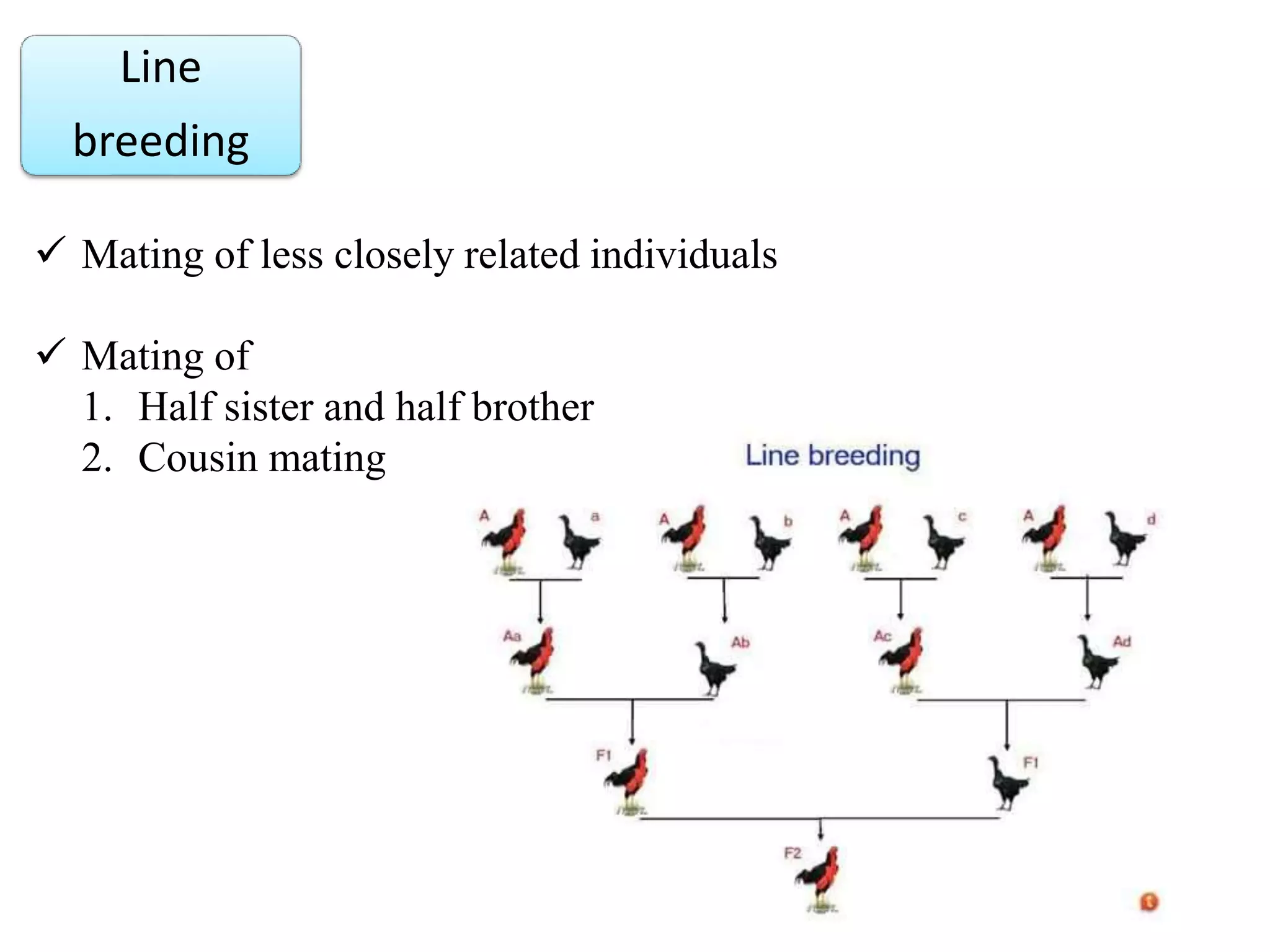
 Mating of less closely related individuals
 Mating of
1. Half sister and half brother
2. Cousin mating
Line
breeding
Out breeding
 Mating of unrelated pure-bred animals within the same breed
 To maintain purity of the breed
 Eg:- Mating of Ongole bull to Ongole cow
Out crossing
 Mating of animals of different breeds
 For production of new breeds
 Common in pigs and hybrid chickens
Cross
breeding
A1
milk
Criss
crossing
 Two breeds are crossed alternatively.
 Utilizes heterosis of both dams and progeny
Triple
crossing
 Three breeds are crossed in rotational manner.
 Also called as rotational crossing
Back
crossing
 Mating a crossbred animal back to one of the pure parent
races, which were used to produce it.
 Commonly used in genetic studies.
 Not followed for breeders.
 Crossing two different species
 Jack (male ass) x Mare (female horse) = Mule.
 Stallion (male horse) x Jannet (female ass) = Hinny.
Species
hybridization
Zonkey (Zebra and donkey)
Mule (Ass and Horse) Hinny (Horse and Ass)
Liger
 Bulls of a distinct breed are bred on non-descript cows from
generation to generation.
 Final animal resembles the breed of bull used.
 After 5-6 generations the off springs will have 96.9 & 98.3% of
the hereditary characters of Pure Breed.
Grading up
Non-descript cow x Jersey Bull
F1 - 50% ND + 50% Jersey x Jersey Bull
F2 - 25% ND + 75% Jersey x Jersey Bull
F3 - 12.5% ND + 87.5% Jersey x Jersey Bull
METHODS OF BREEDING IN CATTLE
 Artificial insemination (AI) –Where bull semen is introduced in
to the cow ‘s uterus artificially using artificial insemination gun.
Artificial insemination
gun
Liquid Nitrogen (-196oC)
 Natural mating – A healthy and proven bull is used to mate a cow.
 Multiple ovulation embryo transfer (MOET) – A method of
insemination where embryos (fertilized eggs) are transferred in to
the cow‘s uterus.
 Generally, one ovum is released from each ovary at the time of
ovulation. But by hormone injection, more ova can be produced
from the ovary. After artificial insemination 4 to 10 embryos are
collected at a time.
 Then each embryo is transplanted into a replacement mother
carrier cow. At very low temperature fetuses can be preserved for
several days.
Unit 14 Improvement of livestock and Poultry.pptx

Unit 14 Improvement of livestock and Poultry.pptx

  • 1.
    Dr. P. RavikanthReddy MVSc, PhD Guest Faculty KBR College of Agriculture and Horticulture Acharya NG Ranga Agricultural University Dr. YSR Horticulture University
  • 2.
     India hasworlds highest milk production, but the productivity of individual animal is less. Problems:  1) Low genetic potentiality  2) Low feed resources  Therefore, improving genetic merit is important
  • 6.
    Systems of Breeding Inbreeding Close breeding Linebreeding Outbreeding Out crossing Cross breeding Species hybridization Grading up
  • 7.
  • 8.
    Inbreeding  Mating ofmore closely related individuals  Mating of 1. Sire to daughter 2. Sone to dam 3. Full sister to full brother Close breeding
  • 9.
     Mating ofless closely related individuals  Mating of 1. Half sister and half brother 2. Cousin mating Line breeding
  • 10.
    Out breeding  Matingof unrelated pure-bred animals within the same breed  To maintain purity of the breed  Eg:- Mating of Ongole bull to Ongole cow Out crossing
  • 12.
     Mating ofanimals of different breeds  For production of new breeds  Common in pigs and hybrid chickens Cross breeding
  • 14.
  • 15.
    Criss crossing  Two breedsare crossed alternatively.  Utilizes heterosis of both dams and progeny
  • 17.
    Triple crossing  Three breedsare crossed in rotational manner.  Also called as rotational crossing
  • 19.
    Back crossing  Mating acrossbred animal back to one of the pure parent races, which were used to produce it.  Commonly used in genetic studies.  Not followed for breeders.
  • 21.
     Crossing twodifferent species  Jack (male ass) x Mare (female horse) = Mule.  Stallion (male horse) x Jannet (female ass) = Hinny. Species hybridization Zonkey (Zebra and donkey)
  • 22.
    Mule (Ass andHorse) Hinny (Horse and Ass) Liger
  • 23.
     Bulls ofa distinct breed are bred on non-descript cows from generation to generation.  Final animal resembles the breed of bull used.  After 5-6 generations the off springs will have 96.9 & 98.3% of the hereditary characters of Pure Breed. Grading up Non-descript cow x Jersey Bull F1 - 50% ND + 50% Jersey x Jersey Bull F2 - 25% ND + 75% Jersey x Jersey Bull F3 - 12.5% ND + 87.5% Jersey x Jersey Bull
  • 25.
    METHODS OF BREEDINGIN CATTLE  Artificial insemination (AI) –Where bull semen is introduced in to the cow ‘s uterus artificially using artificial insemination gun. Artificial insemination Artificial insemination gun
  • 26.
  • 27.
     Natural mating– A healthy and proven bull is used to mate a cow.  Multiple ovulation embryo transfer (MOET) – A method of insemination where embryos (fertilized eggs) are transferred in to the cow‘s uterus.  Generally, one ovum is released from each ovary at the time of ovulation. But by hormone injection, more ova can be produced from the ovary. After artificial insemination 4 to 10 embryos are collected at a time.  Then each embryo is transplanted into a replacement mother carrier cow. At very low temperature fetuses can be preserved for several days.