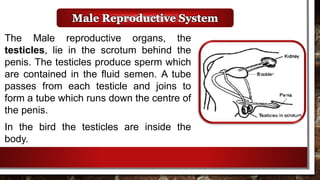
The Male reproductive organs, the
testicles, lie in the scrotum behind the
penis. The testicles produce sperm which
are contained in the fluid semen. A tube
passes from each testicle and joins to
form a tube which runs down the centre of
the penis.
In the bird the testicles are inside the
body.
The female reproductive organ consists
of two ovaries, one in each side of the
lower abdomen. The ovaries produce
eggs which pass into the uterus (or
womb). Below the uterus is the vagina
which opens to the outside surrounded
by the vulva. After birth the young are
fed on milk produced by the udder.
During mating (mounting) sperm passes from the male into the
uterus and joins with the eggs there. When the sperm joins the egg, it
forms the embryo which develops into the young animal inside the
uterus.
Reproduction is controlled by hormones (chemical messengers) which
are carried in the blood to the different organs. These hormones
control:
1. Puberty of the animal
2. Production of eggs
3. Birth
4. Production of semen
5. Development of the embryo
6. Milk production
Mating of good quality animals to produce
highly productive and suitable animals for
enhancement overall performance in the
subsequent generations and to augment
production and profitability.
There are two types of mating of animals for production of the
progenies. These are
1. Natural propagation/mating: Mating of animals by natural
means.
2. Artificial insemination (AI): Mating is done through artificial
means by collecting semen from male and then inseminating
the females. This method help in use of outstanding males for
mating of a large number of females thereby production of large
number of highly productive and performing progenies.
Basically, there are two methods of breeding which are as
follows:
1. Inbreeding: Breeding of the related animals as male and
female are known as inbreeding.
2. Out breeding: Out breeding of unrelated animals as male
and female is known as out breeding.
There are again two types of inbreeding which are:
A. Close breeding: This is most intensive breeding where
animals are very closely related and can be traced back
to more than one common ancestor, Examples:
Sire(father) to daughter, Son to dam(Mother), Brother to
sister.
B. Line breeding: Mating animals that are more distantly
related which can be traced back to one common
ancestor. Examples: Half-brother and sister, cousin
mating.
Inbreeding i.e. mating of related individuals often results in a
change in the mean of a trait. Performance of inbred animals
lowers down the reproductive efficiency and may have
several disorders. Hence, this method of breeding is not
practiced for livestock improvement. However, inbreeding is
intentionally practiced to create genetic uniformity of
laboratory stocks and to produce stocks for crossing (animal
and plant breeding).
But inbreeding is unintentionally generated by keeping small
populations for breeding and during selection.
Out breeding system i.e. breeding of unrelated animals is generally of
two types:
a) Crossbreeding: Crossbreeding is the mating of two animals of
different breeds. Superior traits that results in the crossbred
progeny from crossbreeding are called hybrid vigor or heterosis.
Grading up is the breeding of animals of two different breeds where
the animals of an indigenous breed/genetic group is mated by an
improved pure breed for several generations towards attaining the
superior traits of the improved breed. Grading up is continuous use of
purebred sires of the same breed in a grade herd. By fifth generation,
the graded animals may reach almost purebred levels.
By following out breeding system i.e., crossbreeding, selective breeding
and grading up according to the need results in improvement in production
performance of the crossbred/graded along with improvement in growth rate,
reproduction and production.
General Considerations Regarding Crossbreeding Systems:
a) Good record keeping of the animals is required for selection good quality of
male and females for breeding. Records on milk production and age at first
calving are two important characters besides others.
b) Calving difficulties may increase when crossing large breed sires with small
breed dams and hence selection of animals/breeds should be done
carefully.
c) Fewer calving problems if large breed dams are used. However, large
breed dams have higher maintenance costs.
d) Artificial insemination allows access to better bulls which may be practiced.
Selection of good quality improved animals for breeding is done by allowing some
animals to have offspring while preventing the animals with inferior quality from
reproducing. The process allows producing genetically superior animals. Emphasis
has to be given on several traits when selecting breeding stock.
Benefits and advantage of Selection and Breeding i.e., Selective breeding,
cross breeding, Grading up:
The advantage and benefits of selection and breeding are increase productivity
e.g., milk yield, fat yield, lowered age at first calving etc. in the subsequent
generations in cattle besides improvement in reproductive rates, growth rate of the
progenies. This increases income generation per animal.
1. How and why the crossing is done between two selected breeds.
2. Whether the participants able to understand the impact of breed improvements.
Breeding

Breeding

  • 2.
    The Male reproductiveorgans, the testicles, lie in the scrotum behind the penis. The testicles produce sperm which are contained in the fluid semen. A tube passes from each testicle and joins to form a tube which runs down the centre of the penis. In the bird the testicles are inside the body.
  • 3.
    The female reproductiveorgan consists of two ovaries, one in each side of the lower abdomen. The ovaries produce eggs which pass into the uterus (or womb). Below the uterus is the vagina which opens to the outside surrounded by the vulva. After birth the young are fed on milk produced by the udder.
  • 4.
    During mating (mounting)sperm passes from the male into the uterus and joins with the eggs there. When the sperm joins the egg, it forms the embryo which develops into the young animal inside the uterus. Reproduction is controlled by hormones (chemical messengers) which are carried in the blood to the different organs. These hormones control: 1. Puberty of the animal 2. Production of eggs 3. Birth 4. Production of semen 5. Development of the embryo 6. Milk production
  • 5.
    Mating of goodquality animals to produce highly productive and suitable animals for enhancement overall performance in the subsequent generations and to augment production and profitability.
  • 6.
    There are twotypes of mating of animals for production of the progenies. These are 1. Natural propagation/mating: Mating of animals by natural means. 2. Artificial insemination (AI): Mating is done through artificial means by collecting semen from male and then inseminating the females. This method help in use of outstanding males for mating of a large number of females thereby production of large number of highly productive and performing progenies.
  • 7.
    Basically, there aretwo methods of breeding which are as follows: 1. Inbreeding: Breeding of the related animals as male and female are known as inbreeding. 2. Out breeding: Out breeding of unrelated animals as male and female is known as out breeding.
  • 8.
    There are againtwo types of inbreeding which are: A. Close breeding: This is most intensive breeding where animals are very closely related and can be traced back to more than one common ancestor, Examples: Sire(father) to daughter, Son to dam(Mother), Brother to sister. B. Line breeding: Mating animals that are more distantly related which can be traced back to one common ancestor. Examples: Half-brother and sister, cousin mating.
  • 9.
    Inbreeding i.e. matingof related individuals often results in a change in the mean of a trait. Performance of inbred animals lowers down the reproductive efficiency and may have several disorders. Hence, this method of breeding is not practiced for livestock improvement. However, inbreeding is intentionally practiced to create genetic uniformity of laboratory stocks and to produce stocks for crossing (animal and plant breeding). But inbreeding is unintentionally generated by keeping small populations for breeding and during selection.
  • 10.
    Out breeding systemi.e. breeding of unrelated animals is generally of two types: a) Crossbreeding: Crossbreeding is the mating of two animals of different breeds. Superior traits that results in the crossbred progeny from crossbreeding are called hybrid vigor or heterosis. Grading up is the breeding of animals of two different breeds where the animals of an indigenous breed/genetic group is mated by an improved pure breed for several generations towards attaining the superior traits of the improved breed. Grading up is continuous use of purebred sires of the same breed in a grade herd. By fifth generation, the graded animals may reach almost purebred levels.
  • 11.
    By following outbreeding system i.e., crossbreeding, selective breeding and grading up according to the need results in improvement in production performance of the crossbred/graded along with improvement in growth rate, reproduction and production. General Considerations Regarding Crossbreeding Systems: a) Good record keeping of the animals is required for selection good quality of male and females for breeding. Records on milk production and age at first calving are two important characters besides others. b) Calving difficulties may increase when crossing large breed sires with small breed dams and hence selection of animals/breeds should be done carefully. c) Fewer calving problems if large breed dams are used. However, large breed dams have higher maintenance costs. d) Artificial insemination allows access to better bulls which may be practiced.
  • 12.
    Selection of goodquality improved animals for breeding is done by allowing some animals to have offspring while preventing the animals with inferior quality from reproducing. The process allows producing genetically superior animals. Emphasis has to be given on several traits when selecting breeding stock. Benefits and advantage of Selection and Breeding i.e., Selective breeding, cross breeding, Grading up: The advantage and benefits of selection and breeding are increase productivity e.g., milk yield, fat yield, lowered age at first calving etc. in the subsequent generations in cattle besides improvement in reproductive rates, growth rate of the progenies. This increases income generation per animal. 1. How and why the crossing is done between two selected breeds. 2. Whether the participants able to understand the impact of breed improvements.