PAGE 1


                                  Unit 1 - Nouns & Articles

                                                                ั
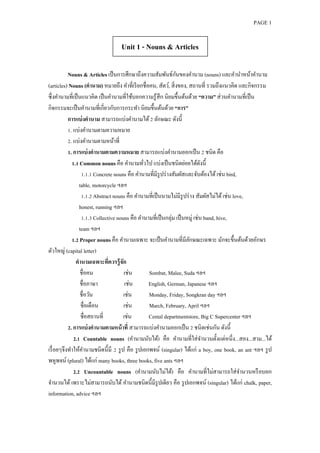
           Nouns & Articles เป็ นการศึกษาถึงความสัมพันธ์กนของคานาม (nouns) และคานาหน้าคานาม
(articles) Nouns (คานาม) หมายถึง คาที่เรี ยกชื่อคน, สัตว์, สิ่ งของ, สถานที่ รวมถึงแนวคิด และกิจกรรม
ซึ่ งคานามที่เป็ นแนวคิด เป็ นคานามที่ใช้บอกความรู ้สึก นิยมขึ้นต้นด้วย “ความ” ส่ วนคานามที่เป็ น
กิจกรรมจะเป็ นคานามที่เกี่ยวกับการกระทา นิยมขึ้นต้นด้วย “การ”
           การแบ่ งคานาม สามารถแบ่งคานามได้ 2 ลักษณะ ดังนี้
           1. แบ่งคานามตามความหมาย
           2. แบ่งคานามตามหน้าที่
           1. การแบ่ งคานามตามความหมาย สามารถแบ่งคานามออกเป็ น 2 ชนิด คือ
             1.1 Common nouns คือ คานามทัวไป แบ่งเป็ นชนิดย่อยได้ดงนี้
                                               ่                              ั
                  1.1.1 Concrete nouns คือ คานามที่มีรูปร่ างสัมผัสและจับต้องได้ เช่น bird,
                 table, motorcycle ฯลฯ
                  1.1.2 Abstract nouns คือ คานามที่เป็ นนามไม่มีรูปร่ าง สัมผัสไม่ได้ เช่น love,
                 honest, running ฯลฯ
                  1.1.3 Collective nouns คือ คานามที่เป็ นกลุ่ม เป็ นหมู่ เช่น band, hive,
                 team ฯลฯ
             1.2 Proper nouns คือ คานามเฉพาะ จะเป็ นคานามที่มีลกษณะเฉพาะ มักจะขึ้นต้นด้วยอักษร
                                                                      ั
ตัวใหญ่ (capital letter)
               คานามเฉพาะที่ควรรู้ จก ั
                  ชื่อคน                เช่น     Sombat, Malee, Suda ฯลฯ
                  ชื่อภาษา               เช่น    English, German, Japanese ฯลฯ
                  ชื่อวัน               เช่น     Monday, Friday, Songkran day ฯลฯ
                  ชื่อเดือน             เช่น     March, February, April ฯลฯ
                  ชื่อสถานที่         เช่น       Cental departmentstore, Big C Supercenter ฯลฯ
           2. การแบ่ งคานามตามหน้ าที่ สามารถแบ่งคานามออกเป็ น 2 ชนิดเช่นกัน ดังนี้
              2.1 Countable nouns (คานามนับได้) คือ คานามที่ใส่ จานวนตั้งแต่หนึ่ง...สอง...สาม...ได้
เรื่ อยๆจึงทาให้คานามชนิดนี้มี 2 รู ป คือ รู ปเอกพจน์ (singular) ได้แก่ a boy, one book, an ant ฯลฯ รู ป
พหูพจน์ (plural) ได้แก่ many books, three books, five ants ฯลฯ
              2.2 Uncountable nouns (คานามนับไม่ได้) คือ คานามที่ไม่สามารถใส่ จานวนหรื อบอก
จานวนได้ เพราะไม่สามารถนับได้ คานามชนิดนี้มีรูปเดียว คือ รู ปเอกพจน์ (singular) ได้แก่ chalk, paper,
information, advice ฯลฯ
PAGE 2


Nouns & Articles
                                                                    ั
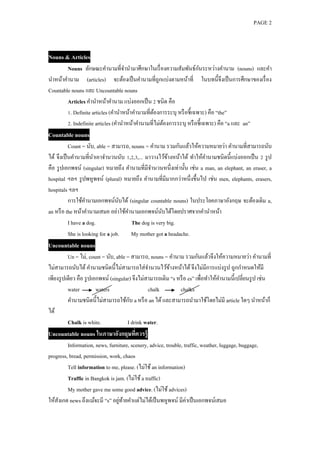
        Nouns ลักษณะคานามที่จานามาศึกษาในเรื่ องความสัมพันธ์กนระหว่างคานาม (nouns) และคา
นาหน้าคานาม (articles) จะต้องเป็ นคานามที่ถูกแบ่งตามหน้าที่ ในบทนี้จึงเป็ นการศึกษาของเรื่ อง
Countable nouns และ Uncountable nouns
        Articles คานาหน้าคานาม แบ่งออกเป็ น 2 ชนิด คือ
        1. Definite articles (คานาหน้าคานามที่ตองการระบุ หรื อชี้เฉพาะ) คือ “the”
                                                ้
        2. Indefinite articles (คานาหน้าคานามที่ไม่ตองการระบุ หรื อชี้เฉพาะ) คือ “a และ an”
                                                    ้
Countable nouns
           Count = นับ, able = สามารถ, nouns = คานาม รวมกันแล้วให้ความหมายว่า คานามที่สามารถนับ
ได้ จึงเป็ นคานามที่นาเอาจานวนนับ 1,2,3,... มาวางไว้ขางหน้าได้ ทาให้คานามชนิดนี้แบ่งออกเป็ น 2 รู ป
                                                       ้
คือ รู ปเอกพจน์ (singular) หมายถึง คานามที่มีจานวนหนึ่งเท่านั้น เช่น a man, an elephant, an eraser, a
hospital ฯลฯ รู ปพหูพจน์ (plural) หมายถึง คานามที่มีมากกว่าหนึ่งขึ้นไป เช่น men, elephants, erasers,
hospitals ฯลฯ
           การใช้คานามเอกพจน์นบได้ (singular countable nouns) ในประโยคภาษาอังกฤษ จะต้องเติม a,
                                   ั
an หรื อ the หน้าคานามเสมอ อย่าใช้คานามเอกพจน์นบได้โดยปราศจากคานาหน้า
                                                     ั
           I have a dog.               The dog is very big.
           She is looking for a job. My mother got a headache.
Uncountable nouns
          Un = ไม่, count = นับ, able = สามารถ, nouns = คานาม รวมกันแล้วจึงให้ความหมายว่า คานามที่
ไม่สามารถนับได้ คานามชนิดนี้ไม่สามารถใส่ จานวนไว้ขางหน้าได้ จึงไม่มีการแบ่งรู ป ถูกกาหนดให้มี
                                                          ้
เพียงรู ปเดียว คือ รู ปเอกพจน์ (singular) จึงไม่สามารถเติม “s หรื อ es” เพื่อทาให้คานามนี้เปลี่ยนรู ป เช่น
          water          waters                  chalk         chalks
                                        ั
          คานามชนิดนี้ไม่สามารถใช้กบ a หรื อ an ได้ และสามารถนามาใช้โดยไม่มี article ใดๆ นาหน้าก็
ได้
          Chalk is white.              I drink water.
Uncountable nouns ในภาษาอังกฤษทีควรรู้
                                ่
         Information, news, furniture, scenery, advice, trouble, traffic, weather, luggage, buggage,
progress, bread, permission, work, chaos
         Tell information to me, please. (ไม่ใช้ an information)
         Traffic in Bangkok is jam. (ไม่ใช้ a traffic)
         My mother gave me some good advice. (ไม่ใช้ advices)
ให้สงเกต news ถึงแม้จะมี “s” อยูทายคาแต่ไม่ได้เป็ นพหูพจน์ มีค่าเป็ นเอกพจน์เสมอ
    ั                            ่ ้
PAGE 3


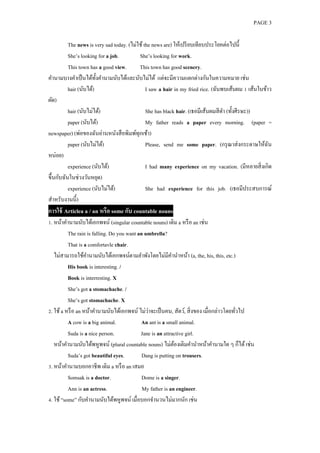
          The news is very sad today. (ไม่ใช้ the news are) ให้เปรี ยบเทียบประโยคต่อไปนี้
          She’s looking for a job.         She’s looking for work.
          This town has a good view.       This town has good scenery.
คานามบางคาเป็ นได้ท้ งคานามนับได้และนับไม่ได้ แต่จะมีความแตกต่างกันในความหมาย เช่น
                        ั
          hair (นับได้)                        I saw a hair in my fried rice. (ฉันพบเส้นผม 1 เส้นในข้าว
ผัด)
          hair (นับไม่ได้)                     She has black hair. (เธอมีเส้นผมสี ดา (ทั้งศีรษะ))
          paper (นับได้)                       My father reads a paper every morning. (paper =
newspaper) (พ่อของฉันอ่านหนังสื อพิมพ์ทุกเช้า)
          paper (นับไม่ได้)                    Please, send me some paper. (กรุ ณาส่ งกระดาษให้ฉน     ั
หน่อย)
          experience (นับได้)                  I had many experience on my vacation. (มีหลายสิ่ งเกิด
ขึ้นกับฉันในช่วงวันหยุด)
          experience (นับไม่ได้)               She had experience for this job. (เธอมีประสบการณ์
สาหรับงานนี้)
การใช้ Articlea a / an หรือ some กับ countable nouns
1. หน้าคานามนับได้เอกพจน์ (singular countable nouns) เติม a หรื อ an เช่น
          The rain is falling. Do you want an umbrella?
          That is a comfortavle chair.
   ไม่สามารถใช้คานามนับได้เอกพจน์ตามลาพังโดยไม่มีคานาหน้า (a, the, his, this, etc.)
          His book is interesting. /
          Book is interresting. X
          She’s got a stomachache. /
          She’s got stomachache. X
                                               ่
2. ใช้ a หรื อ an หน้าคานามนับได้เอกพจน์ ไม่วาจะเป็ นคน, สัตว์, สิ่ งของ เมื่อกล่าวโดยทัวไป
                                                                                        ่
          A cow is a big animal.            An ant is a small animal.
          Suda is a nice person.            Jane is an attractive girl.
   หน้าคานามนับได้พหูพจน์ (plural countable nouns) ไม่ตองเติมคานาหน้าคานามใด ๆ ก็ได้ เช่น
                                                            ้
          Suda’s got beautiful eyes.         Dang is putting on trousers.
3. หน้าคานามบอกอาชีพ เติม a หรื อ an เสมอ
          Somsak is a doctor.                Dome is a singer.
          Ann is an actress.                 My father is an engineer.
4. ใช้ “some” กับคานามนับได้พหูพจน์ เมื่อบอกจานวนไม่มากนัก เช่น
PAGE 4


          Some oranges are sweet. She has seen some romantic films.
   แต่ไม่ใช้ “some” เมื่อกล่าวถึงนามนับได้พหูพจน์ทวไป
                                                    ั่
          I like mangoes. (ไม่ใช้ some mangoes)
5. ใช้ “some” กับคานามนับได้พหูพจน์ เมื่อให้ความหมายว่า ไม่ท้ งหมด หรื อส่ วนหนึ่ง เช่น
                                                              ั
          Some children like playing sport. (เด็กบางคน)
การใช้ a / an และ the
1. ใช้ “a / an” กับคานามที่กล่าวถึงเป็ นครั้งแรก ใช้ “the” กับคานามที่กล่าวถึงในครั้งที่สอง และครั้งต่อมา
           There was a man knocking outside the door, the nam looks old.
           I have an orange for my breakfast, the orange is sweet and juicy and the orange is cheep, too.
2. ใช้ “a / an” ผูฟังจะไม่ทราบว่าผูพดหมายถึงสิ่ งไหน ใช้ “the” เมื่อต้องการให้เกิดความชัดเจนโดยการ
                  ้                  ้ ู
ขยายด้วยวลีหรื อประโยค
           My father is standing near a door. (ไม่ทราบว่าประตูใด)
           My father is standing near the door nearest the window. (ทราบว่าประตูใดเพราะกาหนดว่าอยู่
ใกล้หน้าต่าง)
                                                                           ่
3. ใช้ “the” หน้าคานามโดยไม่มีการขยายความเพื่อความชัดเจนได้ เมื่ออยูในสถานการณ์ที่มีความชัดเจน
เช่น
           Put some salt in the pot.         (ผูพดกับผูฟังเข้าใจตรงกันว่าต้องนาเกลือไปใส่ หม้อใด)
                                                ้ ู    ้
           Where is the toilet, please?       (ถามถึงห้องน้ าในอาคารไม่ใช่หองน้ าทัวไป)
                                                                             ้     ่
การใช้ “the” กับคานาม
1. ใช้ the กับสิ่ งที่มีเพียงหนึ่ งเดียว
          Bangkok is the capital of Thailand.
          The widest river in the world is AmaZon.
          The only T.V. programme my son watches is Network cartoon.
2. ใช้ the กับ the country, the ground, the sky
          Do you prefer living in a town to the country?
          The ground is wet, don’t sit on!
          There are many stars in the sky.
                                                                       ่
   แต่จะใช้ go to sea, be at sea เมื่อมีความหมายว่า “ไปทะเล” หรื อ “อยูที่ทะเล”
          She was at sea for 1 month.
3. ไม่ใช้ “the” หน้าชื่อมื้ออาหาร (name of meals) เช่น
          We had dinner ay Fuji restaurant.
          I have an egg and a piece of bread for breakfast.
   แต่จะเติม “a” หน้ามื้ออาหารหนึ่งมื้อ (meal)
PAGE 5


           I have a meal at a reataurant.
   และเติม “a” หรื อ “an” หน้าชื่ออาหารที่มี “adjective” มาขยาย
           I felt downsy because I had a big lunch with my friend.
4. หน้า radio, theatre, และ cinema เติม “the”
           I like listening to the radio.
           We often go to the theatre.
           Do you want to go to the cinema with me?
   หน้า television ถ้าในความหมายของการดูภาพยนตร์จะไม่เติม article แต่ถาใช้ในความหมายของการ
                                                                           ้
กระทา เช่น ปิ ด, เปิ ด จะเติม “the” เช่น
           She loves to watch television.
           Tell me how to turn off the television.
5. ใช้ “the” กับเครื่ องดนตรี ในความหมาย “การเรี ยน” หรื อ “การเล่น”
           Suda plays the piano well.
   ใช้ “the” กับชนิดของเครื่ องจักร หรื อ สิ่ งประดิษฐ์
           The telephone was invented by Alexander Greham bell.
           The bicycle has two wheels.
6. ใช้ “the + adjective” จะให้ความหมายเป็ นคานามพหูพจน์เสมอ เช่น
         the blind                      the old                 the sick         the disabled
          the deaf                     the poor                 the rich           the young
           The blind cannot see anything.
           We should give attention to the disabled.
7. ใช้ “the + สัญชาติ” จะให้ความหมายว่าเป็ นพลเมืองในประเทศนั้นๆ
       the Japanese                   the Turks               the Dutch          the English
        the Italians                   the Irish              the Frence          the chinese
           Most of the Japanese have the same skin color as the Chinese.
8. หน้าคานาม prison, school, university, college, church จะไม่เติม “the” ในความหมายทัวไปที่นิยมใช้
                                                                                       ่
เช่น
           The students go to school.
           We go to church on Sunday.
           He want to prison because he killed his brother.
   แต่คาในความหมายอื่นจะต้อง ใช้ “the” เช่น
           My rather go to the school to see my teacher.
           (พ่อของฉันไปโรงเรี ยนเพื่อไปพบครู (ไม่ได้ไปเรี ยนหนังสื อ))
PAGE 6


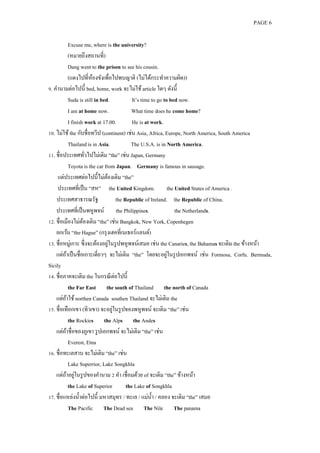
                 Excuse me, where is the university?
                 (หมายถึงสถานที่)
                 Dang went to the prison to see his cousin.
                 (แดงไปที่หองขังเพื่อไปพบญาติ (ไม่ได้กระทาความผิด))
                              ้
9. คานามต่อไปนี้ bed, home, work จะไม่ใช้ article ใดๆ ดังนี้
                 Suda is still in bed.             It’s time to go to bed now.
                 I am at home now.                What time does he come home?
                 I finish work at 17.00.           He is at work.
10. ไม่ใช้ the กับชื่อทวีป (continent) เช่น Asia, Africa, Europe, North America, South America
                 Thailand is in Asia.             The U.S.A. is in North America.
11. ชื่อประเทศทัวไปไม่เติม “the” เช่น Japan, Germany
                           ่
                 Toyota is the car from Japan. Germany is famous in sausage.
     แต่ประเทศต่อไปนี้ไม่ตองเติม “the”
                                     ้
     ประเทศที่เป็ น “สห” the United Kingdom. the United States of America .
    ประเทศสาธารณรัฐ                        the Republic of Ireland. the Republic of China.
    ประเทศที่เป็ นพหูพจน์ the Philippines.                              the Netherlands.
12. ชื่อเมืองไม่ตองเติม “the” เช่น Bangkok, New York, Copenhegen
                         ้
    ยกเว้น “the Hague” (กรุ งเฮคที่เนเธอร์แลนด์)
13. ชื่อหมู่เกาะ ซึ่ งจะต้องอยูในรู ปพหูพจน์เสมอ เช่น the Canaries, the Bahamas จะเติม the ข้างหน้า
                                       ่
                                                                     ่
    แต่ถาเป็ นชื่อเกาะเดี่ยวๆ จะไม่เติม “the” โดยจะอยูในรู ปเอกพจน์ เช่น Formosa, Corfu. Bermuda,
          ้
Sicily
14. ชื่อภาคจะเติม the ในกรณี ต่อไปนี้
                 the Far East the south of Thailand the north of Canada
    แต่ถาใช้ northen Canada southen Thailand จะไม่เติม the
            ้
                                         ่
15. ชื่อเทือกเขา (ทิวเขา) จะอยูในรู ปของพหูพจน์ จะเติม “the” เช่น
                 the Rockies the Alps the Andes
    แต่ถาชื่อของภูเขา รู ปเอกพจน์ จะไม่เติม “the” เช่น
              ้
                 Everest, Etna
16. ชื่อทะเลสาบ จะไม่เติม “the” เช่น
                 Lake Superrior, Lake Songkhla
                ้ ่
    แต่ถาอยูในรู ปของคานาม 2 คา เชื่อมด้วย of จะเติม “the” ข้างหน้า
                 the Lake of Superior           the Lake of Songkhla
17. ชื่อแหล่งน้ าต่อไปนี้ มหาสมุทร / ทะเล / แม่น้ า / คลอง จะเติม “the” เสมอ
                 The Pacific The Dead sea The Nile The panama
PAGE 7


18. หน้าชื่อ ถนน, สแควร์ จะไม่เติม “the”
         Rachadamnern Avenue                 Siam Square
19. นิยมวาง “the” หน้าคานามสองคาที่เชื่อมด้วย of โดยจะวางไว้หน้าคานามตัวแรก
         The Bank of England          The roof of the house
20. วาง “the” หน้าชื่อหนังสื อพิมพ์
         the Times        the Thairat      the Bangkok Post

Unit 1 nouns & articles

  • 1.
    PAGE 1 Unit 1 - Nouns & Articles ั Nouns & Articles เป็ นการศึกษาถึงความสัมพันธ์กนของคานาม (nouns) และคานาหน้าคานาม (articles) Nouns (คานาม) หมายถึง คาที่เรี ยกชื่อคน, สัตว์, สิ่ งของ, สถานที่ รวมถึงแนวคิด และกิจกรรม ซึ่ งคานามที่เป็ นแนวคิด เป็ นคานามที่ใช้บอกความรู ้สึก นิยมขึ้นต้นด้วย “ความ” ส่ วนคานามที่เป็ น กิจกรรมจะเป็ นคานามที่เกี่ยวกับการกระทา นิยมขึ้นต้นด้วย “การ” การแบ่ งคานาม สามารถแบ่งคานามได้ 2 ลักษณะ ดังนี้ 1. แบ่งคานามตามความหมาย 2. แบ่งคานามตามหน้าที่ 1. การแบ่ งคานามตามความหมาย สามารถแบ่งคานามออกเป็ น 2 ชนิด คือ 1.1 Common nouns คือ คานามทัวไป แบ่งเป็ นชนิดย่อยได้ดงนี้ ่ ั 1.1.1 Concrete nouns คือ คานามที่มีรูปร่ างสัมผัสและจับต้องได้ เช่น bird, table, motorcycle ฯลฯ 1.1.2 Abstract nouns คือ คานามที่เป็ นนามไม่มีรูปร่ าง สัมผัสไม่ได้ เช่น love, honest, running ฯลฯ 1.1.3 Collective nouns คือ คานามที่เป็ นกลุ่ม เป็ นหมู่ เช่น band, hive, team ฯลฯ 1.2 Proper nouns คือ คานามเฉพาะ จะเป็ นคานามที่มีลกษณะเฉพาะ มักจะขึ้นต้นด้วยอักษร ั ตัวใหญ่ (capital letter) คานามเฉพาะที่ควรรู้ จก ั ชื่อคน เช่น Sombat, Malee, Suda ฯลฯ ชื่อภาษา เช่น English, German, Japanese ฯลฯ ชื่อวัน เช่น Monday, Friday, Songkran day ฯลฯ ชื่อเดือน เช่น March, February, April ฯลฯ ชื่อสถานที่ เช่น Cental departmentstore, Big C Supercenter ฯลฯ 2. การแบ่ งคานามตามหน้ าที่ สามารถแบ่งคานามออกเป็ น 2 ชนิดเช่นกัน ดังนี้ 2.1 Countable nouns (คานามนับได้) คือ คานามที่ใส่ จานวนตั้งแต่หนึ่ง...สอง...สาม...ได้ เรื่ อยๆจึงทาให้คานามชนิดนี้มี 2 รู ป คือ รู ปเอกพจน์ (singular) ได้แก่ a boy, one book, an ant ฯลฯ รู ป พหูพจน์ (plural) ได้แก่ many books, three books, five ants ฯลฯ 2.2 Uncountable nouns (คานามนับไม่ได้) คือ คานามที่ไม่สามารถใส่ จานวนหรื อบอก จานวนได้ เพราะไม่สามารถนับได้ คานามชนิดนี้มีรูปเดียว คือ รู ปเอกพจน์ (singular) ได้แก่ chalk, paper, information, advice ฯลฯ
  • 2.
    PAGE 2 Nouns &Articles ั Nouns ลักษณะคานามที่จานามาศึกษาในเรื่ องความสัมพันธ์กนระหว่างคานาม (nouns) และคา นาหน้าคานาม (articles) จะต้องเป็ นคานามที่ถูกแบ่งตามหน้าที่ ในบทนี้จึงเป็ นการศึกษาของเรื่ อง Countable nouns และ Uncountable nouns Articles คานาหน้าคานาม แบ่งออกเป็ น 2 ชนิด คือ 1. Definite articles (คานาหน้าคานามที่ตองการระบุ หรื อชี้เฉพาะ) คือ “the” ้ 2. Indefinite articles (คานาหน้าคานามที่ไม่ตองการระบุ หรื อชี้เฉพาะ) คือ “a และ an” ้ Countable nouns Count = นับ, able = สามารถ, nouns = คานาม รวมกันแล้วให้ความหมายว่า คานามที่สามารถนับ ได้ จึงเป็ นคานามที่นาเอาจานวนนับ 1,2,3,... มาวางไว้ขางหน้าได้ ทาให้คานามชนิดนี้แบ่งออกเป็ น 2 รู ป ้ คือ รู ปเอกพจน์ (singular) หมายถึง คานามที่มีจานวนหนึ่งเท่านั้น เช่น a man, an elephant, an eraser, a hospital ฯลฯ รู ปพหูพจน์ (plural) หมายถึง คานามที่มีมากกว่าหนึ่งขึ้นไป เช่น men, elephants, erasers, hospitals ฯลฯ การใช้คานามเอกพจน์นบได้ (singular countable nouns) ในประโยคภาษาอังกฤษ จะต้องเติม a, ั an หรื อ the หน้าคานามเสมอ อย่าใช้คานามเอกพจน์นบได้โดยปราศจากคานาหน้า ั I have a dog. The dog is very big. She is looking for a job. My mother got a headache. Uncountable nouns Un = ไม่, count = นับ, able = สามารถ, nouns = คานาม รวมกันแล้วจึงให้ความหมายว่า คานามที่ ไม่สามารถนับได้ คานามชนิดนี้ไม่สามารถใส่ จานวนไว้ขางหน้าได้ จึงไม่มีการแบ่งรู ป ถูกกาหนดให้มี ้ เพียงรู ปเดียว คือ รู ปเอกพจน์ (singular) จึงไม่สามารถเติม “s หรื อ es” เพื่อทาให้คานามนี้เปลี่ยนรู ป เช่น water waters chalk chalks ั คานามชนิดนี้ไม่สามารถใช้กบ a หรื อ an ได้ และสามารถนามาใช้โดยไม่มี article ใดๆ นาหน้าก็ ได้ Chalk is white. I drink water. Uncountable nouns ในภาษาอังกฤษทีควรรู้ ่ Information, news, furniture, scenery, advice, trouble, traffic, weather, luggage, buggage, progress, bread, permission, work, chaos Tell information to me, please. (ไม่ใช้ an information) Traffic in Bangkok is jam. (ไม่ใช้ a traffic) My mother gave me some good advice. (ไม่ใช้ advices) ให้สงเกต news ถึงแม้จะมี “s” อยูทายคาแต่ไม่ได้เป็ นพหูพจน์ มีค่าเป็ นเอกพจน์เสมอ ั ่ ้
  • 3.
    PAGE 3 The news is very sad today. (ไม่ใช้ the news are) ให้เปรี ยบเทียบประโยคต่อไปนี้ She’s looking for a job. She’s looking for work. This town has a good view. This town has good scenery. คานามบางคาเป็ นได้ท้ งคานามนับได้และนับไม่ได้ แต่จะมีความแตกต่างกันในความหมาย เช่น ั hair (นับได้) I saw a hair in my fried rice. (ฉันพบเส้นผม 1 เส้นในข้าว ผัด) hair (นับไม่ได้) She has black hair. (เธอมีเส้นผมสี ดา (ทั้งศีรษะ)) paper (นับได้) My father reads a paper every morning. (paper = newspaper) (พ่อของฉันอ่านหนังสื อพิมพ์ทุกเช้า) paper (นับไม่ได้) Please, send me some paper. (กรุ ณาส่ งกระดาษให้ฉน ั หน่อย) experience (นับได้) I had many experience on my vacation. (มีหลายสิ่ งเกิด ขึ้นกับฉันในช่วงวันหยุด) experience (นับไม่ได้) She had experience for this job. (เธอมีประสบการณ์ สาหรับงานนี้) การใช้ Articlea a / an หรือ some กับ countable nouns 1. หน้าคานามนับได้เอกพจน์ (singular countable nouns) เติม a หรื อ an เช่น The rain is falling. Do you want an umbrella? That is a comfortavle chair. ไม่สามารถใช้คานามนับได้เอกพจน์ตามลาพังโดยไม่มีคานาหน้า (a, the, his, this, etc.) His book is interesting. / Book is interresting. X She’s got a stomachache. / She’s got stomachache. X ่ 2. ใช้ a หรื อ an หน้าคานามนับได้เอกพจน์ ไม่วาจะเป็ นคน, สัตว์, สิ่ งของ เมื่อกล่าวโดยทัวไป ่ A cow is a big animal. An ant is a small animal. Suda is a nice person. Jane is an attractive girl. หน้าคานามนับได้พหูพจน์ (plural countable nouns) ไม่ตองเติมคานาหน้าคานามใด ๆ ก็ได้ เช่น ้ Suda’s got beautiful eyes. Dang is putting on trousers. 3. หน้าคานามบอกอาชีพ เติม a หรื อ an เสมอ Somsak is a doctor. Dome is a singer. Ann is an actress. My father is an engineer. 4. ใช้ “some” กับคานามนับได้พหูพจน์ เมื่อบอกจานวนไม่มากนัก เช่น
  • 4.
    PAGE 4 Some oranges are sweet. She has seen some romantic films. แต่ไม่ใช้ “some” เมื่อกล่าวถึงนามนับได้พหูพจน์ทวไป ั่ I like mangoes. (ไม่ใช้ some mangoes) 5. ใช้ “some” กับคานามนับได้พหูพจน์ เมื่อให้ความหมายว่า ไม่ท้ งหมด หรื อส่ วนหนึ่ง เช่น ั Some children like playing sport. (เด็กบางคน) การใช้ a / an และ the 1. ใช้ “a / an” กับคานามที่กล่าวถึงเป็ นครั้งแรก ใช้ “the” กับคานามที่กล่าวถึงในครั้งที่สอง และครั้งต่อมา There was a man knocking outside the door, the nam looks old. I have an orange for my breakfast, the orange is sweet and juicy and the orange is cheep, too. 2. ใช้ “a / an” ผูฟังจะไม่ทราบว่าผูพดหมายถึงสิ่ งไหน ใช้ “the” เมื่อต้องการให้เกิดความชัดเจนโดยการ ้ ้ ู ขยายด้วยวลีหรื อประโยค My father is standing near a door. (ไม่ทราบว่าประตูใด) My father is standing near the door nearest the window. (ทราบว่าประตูใดเพราะกาหนดว่าอยู่ ใกล้หน้าต่าง) ่ 3. ใช้ “the” หน้าคานามโดยไม่มีการขยายความเพื่อความชัดเจนได้ เมื่ออยูในสถานการณ์ที่มีความชัดเจน เช่น Put some salt in the pot. (ผูพดกับผูฟังเข้าใจตรงกันว่าต้องนาเกลือไปใส่ หม้อใด) ้ ู ้ Where is the toilet, please? (ถามถึงห้องน้ าในอาคารไม่ใช่หองน้ าทัวไป) ้ ่ การใช้ “the” กับคานาม 1. ใช้ the กับสิ่ งที่มีเพียงหนึ่ งเดียว Bangkok is the capital of Thailand. The widest river in the world is AmaZon. The only T.V. programme my son watches is Network cartoon. 2. ใช้ the กับ the country, the ground, the sky Do you prefer living in a town to the country? The ground is wet, don’t sit on! There are many stars in the sky. ่ แต่จะใช้ go to sea, be at sea เมื่อมีความหมายว่า “ไปทะเล” หรื อ “อยูที่ทะเล” She was at sea for 1 month. 3. ไม่ใช้ “the” หน้าชื่อมื้ออาหาร (name of meals) เช่น We had dinner ay Fuji restaurant. I have an egg and a piece of bread for breakfast. แต่จะเติม “a” หน้ามื้ออาหารหนึ่งมื้อ (meal)
  • 5.
    PAGE 5 I have a meal at a reataurant. และเติม “a” หรื อ “an” หน้าชื่ออาหารที่มี “adjective” มาขยาย I felt downsy because I had a big lunch with my friend. 4. หน้า radio, theatre, และ cinema เติม “the” I like listening to the radio. We often go to the theatre. Do you want to go to the cinema with me? หน้า television ถ้าในความหมายของการดูภาพยนตร์จะไม่เติม article แต่ถาใช้ในความหมายของการ ้ กระทา เช่น ปิ ด, เปิ ด จะเติม “the” เช่น She loves to watch television. Tell me how to turn off the television. 5. ใช้ “the” กับเครื่ องดนตรี ในความหมาย “การเรี ยน” หรื อ “การเล่น” Suda plays the piano well. ใช้ “the” กับชนิดของเครื่ องจักร หรื อ สิ่ งประดิษฐ์ The telephone was invented by Alexander Greham bell. The bicycle has two wheels. 6. ใช้ “the + adjective” จะให้ความหมายเป็ นคานามพหูพจน์เสมอ เช่น the blind the old the sick the disabled the deaf the poor the rich the young The blind cannot see anything. We should give attention to the disabled. 7. ใช้ “the + สัญชาติ” จะให้ความหมายว่าเป็ นพลเมืองในประเทศนั้นๆ the Japanese the Turks the Dutch the English the Italians the Irish the Frence the chinese Most of the Japanese have the same skin color as the Chinese. 8. หน้าคานาม prison, school, university, college, church จะไม่เติม “the” ในความหมายทัวไปที่นิยมใช้ ่ เช่น The students go to school. We go to church on Sunday. He want to prison because he killed his brother. แต่คาในความหมายอื่นจะต้อง ใช้ “the” เช่น My rather go to the school to see my teacher. (พ่อของฉันไปโรงเรี ยนเพื่อไปพบครู (ไม่ได้ไปเรี ยนหนังสื อ))
  • 6.
    PAGE 6 Excuse me, where is the university? (หมายถึงสถานที่) Dang went to the prison to see his cousin. (แดงไปที่หองขังเพื่อไปพบญาติ (ไม่ได้กระทาความผิด)) ้ 9. คานามต่อไปนี้ bed, home, work จะไม่ใช้ article ใดๆ ดังนี้ Suda is still in bed. It’s time to go to bed now. I am at home now. What time does he come home? I finish work at 17.00. He is at work. 10. ไม่ใช้ the กับชื่อทวีป (continent) เช่น Asia, Africa, Europe, North America, South America Thailand is in Asia. The U.S.A. is in North America. 11. ชื่อประเทศทัวไปไม่เติม “the” เช่น Japan, Germany ่ Toyota is the car from Japan. Germany is famous in sausage. แต่ประเทศต่อไปนี้ไม่ตองเติม “the” ้ ประเทศที่เป็ น “สห” the United Kingdom. the United States of America . ประเทศสาธารณรัฐ the Republic of Ireland. the Republic of China. ประเทศที่เป็ นพหูพจน์ the Philippines. the Netherlands. 12. ชื่อเมืองไม่ตองเติม “the” เช่น Bangkok, New York, Copenhegen ้ ยกเว้น “the Hague” (กรุ งเฮคที่เนเธอร์แลนด์) 13. ชื่อหมู่เกาะ ซึ่ งจะต้องอยูในรู ปพหูพจน์เสมอ เช่น the Canaries, the Bahamas จะเติม the ข้างหน้า ่ ่ แต่ถาเป็ นชื่อเกาะเดี่ยวๆ จะไม่เติม “the” โดยจะอยูในรู ปเอกพจน์ เช่น Formosa, Corfu. Bermuda, ้ Sicily 14. ชื่อภาคจะเติม the ในกรณี ต่อไปนี้ the Far East the south of Thailand the north of Canada แต่ถาใช้ northen Canada southen Thailand จะไม่เติม the ้ ่ 15. ชื่อเทือกเขา (ทิวเขา) จะอยูในรู ปของพหูพจน์ จะเติม “the” เช่น the Rockies the Alps the Andes แต่ถาชื่อของภูเขา รู ปเอกพจน์ จะไม่เติม “the” เช่น ้ Everest, Etna 16. ชื่อทะเลสาบ จะไม่เติม “the” เช่น Lake Superrior, Lake Songkhla ้ ่ แต่ถาอยูในรู ปของคานาม 2 คา เชื่อมด้วย of จะเติม “the” ข้างหน้า the Lake of Superior the Lake of Songkhla 17. ชื่อแหล่งน้ าต่อไปนี้ มหาสมุทร / ทะเล / แม่น้ า / คลอง จะเติม “the” เสมอ The Pacific The Dead sea The Nile The panama
  • 7.
    PAGE 7 18. หน้าชื่อถนน, สแควร์ จะไม่เติม “the” Rachadamnern Avenue Siam Square 19. นิยมวาง “the” หน้าคานามสองคาที่เชื่อมด้วย of โดยจะวางไว้หน้าคานามตัวแรก The Bank of England The roof of the house 20. วาง “the” หน้าชื่อหนังสื อพิมพ์ the Times the Thairat the Bangkok Post