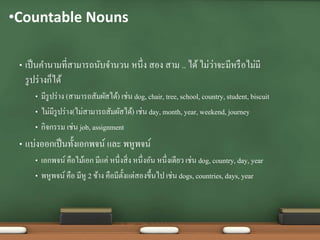
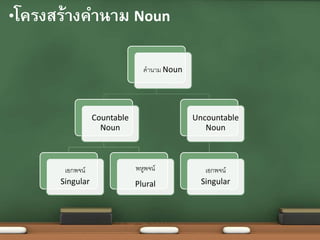
•Countable Nouns
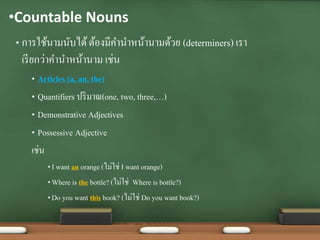
• การใช้นามนับได้ต้องมีคานาหน้านามด้วย(determiners) เรา
เรียกว่าคานาหน้านาม เช่น
• Articles (a, an, the)
• Quantifiers ปริมาณ(one, two, three,…)
• Demonstrative Adjectives
• Possessive Adjective
เช่น
• I want an orange (ไม่ใช่ I want orange)
• Where is the bottle?(ไม่ใช่ Where is bottle?)
• Do you want this book? (ไม่ใช่ Do you want book?)
4.
•Article
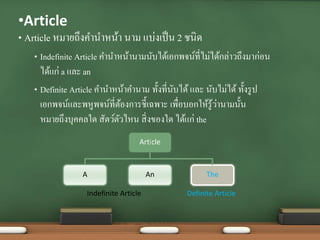
• Article หมายถึงคานาหน้านาม แบ่งเป็น 2 ชนิด
• Indefinite Article คานาหน้านามนับได้เอกพจน์ที่ไม่ได้กล่าวถึงมาก่อน
ได้แก่ a และ an
• Definite Article คานาหน้าคานาม ทั้งที่นับได้และ นับไม่ได้ทั้งรูป
เอกพจน์และพหูพจน์ที่ต้องการชี้เฉพาะ เพื่อบอกให้รู้ว่านามนั้น
หมายถึงบุคคลใด สัตว์ตัวไหน สิ่งของใด ได้แก่ the
Article
A An The
Indefinite Article Definite Article
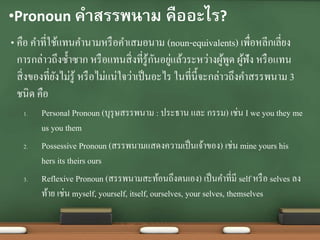
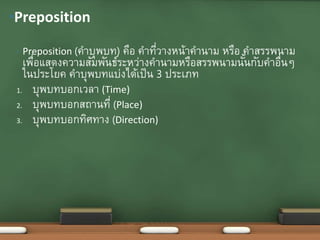
•Pronoun คาสรรพนาม คืออะไร?
•คือ คาที่ใช้แทนคานามหรือคาเสมอนาม (noun-equivalents) เพื่อหลีกเลี่ยง
การกล่าวถึงซ้าซาก หรือแทนสิ่งที่รู้กันอยู่แล้วระหว่างผู้พูด ผู้ฟัง หรือแทน
สิ่งของที่ยังไม่รู้ หรือไม่แน่ใจว่าเป็นอะไร ในที่นี้จะกล่าวถึงคาสรรพนาม 3
ชนิด คือ
1. Personal Pronoun (บุรุษสรรพนาม : ประธาน และ กรรม) เช่น I we you they me
us you them
2. Possessive Pronoun (สรรพนามแสดงความเป็นเจ้าของ) เช่น mine yours his
hers its theirs ours
3. Reflexive Pronoun (สรรพนามสะท้อนถึงตนเอง) เป็นคาที่มี self หรือ selves ลง
ท้าย เช่น myself, yourself, itself, ourselves, your selves, themselves
8.
• Adjective (คาคุณศัพท์)หมายถึง คาที่ทาหน้าที่ขยายคานาม หรือ
สรรพนาม
• ตาแหน่ง Adjective ในประโยค
1. นาหน้าคานาม เช่น She is a beautiful girl
2. อยู่หลัง Verb to be และ linking verb (become, seem, grow,
appear, taste, small, sound, look, feel)
1. This mango tastes sweet
2. This silk cloth feels soft.
3. She looks nice
•Adjective คืออะไร?
9.
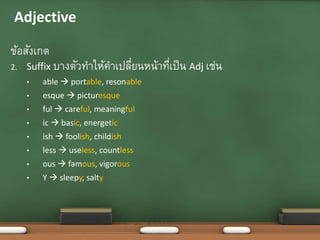
ข้อสังเกต
2. Suffix บางตัวทาให้คาเปลี่ยนหน้าที่เป็นAdj เช่น
• able portable, resonable
• esque picturesque
• ful careful, meaningful
• ic basic, energetic
• ish foolish, childish
• less useless, countless
• ous famous, vigorous
• Y sleepy, salty
•Adjective
10.
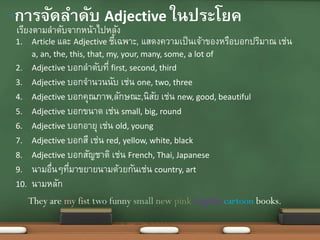
1. Article และAdjective ชี้เฉพาะ, แสดงความเป็นเจ้าของหรือบอกปริมาณ เช่น
a, an, the, this, that, my, your, many, some, a lot of
2. Adjective บอกลาดับที่ first, second, third
3. Adjective บอกจานวนนับ เช่น one, two, three
4. Adjective บอกคุณภาพ,ลักษณะ,นิสัย เช่น new, good, beautiful
5. Adjective บอกขนาด เช่น small, big, round
6. Adjective บอกอายุ เช่น old, young
7. Adjective บอกสี เช่น red, yellow, white, black
8. Adjective บอกสัญชาติ เช่น French, Thai, Japanese
9. นามอื่นๆที่มาขยายนามด้วยกันเช่น country, art
10. นามหลัก
เรียงตามลาดับจากหน้าไปหลัง
•การจัดลาดับ Adjective ในประโยค
They are my fist two funny small new pink English cartoon books.
11.
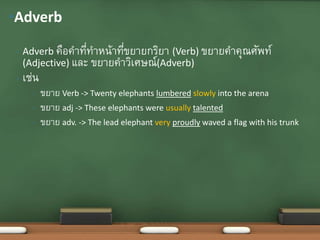
• Adverb คือคาที่ทาหน้าที่ขยายกริยา(Verb) ขยายคาคุณศัพท์
(Adjective) และ ขยายคาวิเศษณ์(Adverb)
• เช่น
• ขยาย Verb -> Twenty elephants lumbered slowly into the arena
• ขยาย adj -> These elephants were usually talented
• ขยาย adv. -> The lead elephant very proudly waved a flag with his trunk
•Adverb
12.
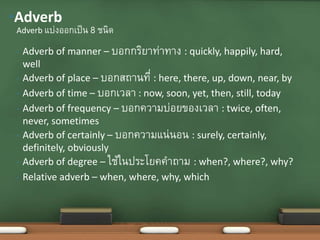
• Adverb ofmanner – บอกกริยาท่าทาง : quickly, happily, hard,
well
• Adverb of place – บอกสถานที่ : here, there, up, down, near, by
• Adverb of time – บอกเวลา : now, soon, yet, then, still, today
• Adverb of frequency – บอกความบ่อยของเวลา : twice, often,
never, sometimes
• Adverb of certainly – บอกความแน่นอน : surely, certainly,
definitely, obviously
• Adverb of degree – ใช้ในประโยคคาถาม : when?, where?, why?
• Relative adverb – when, where, why, which
Adverb แบ่งออกเป็น 8 ชนิด
•Adverb
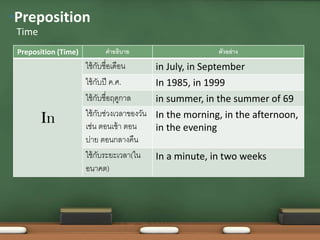
Preposition (Time) คำอธิบำยตัวอย่ำง
In
ใช้กับชื่อเดือน in July, in September
ใช้กับปี ค.ศ. In 1985, in 1999
ใช้กับชื่อฤดูกำล in summer, in the summer of 69
ใช้กับช่วงเวลำของวัน
เช่น ตอนเช้ำ ตอน
บ่ำย ตอนกลำงคืน
In the morning, in the afternoon,
in the evening
ใช้กับระยะเวลำ(ใน
อนำคต)
In a minute, in two weeks
Time
•Preposition
16.
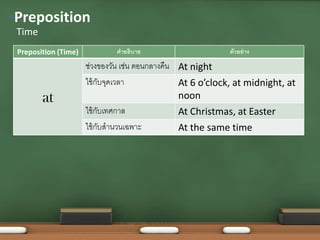
Preposition (Time) คำอธิบำยตัวอย่ำง
at
ช่วงของวัน เช่น ตอนกลำงคืน At night
ใช้กับจุดเวลำ At 6 o’clock, at midnight, at
noon
ใช้กับเทศกำล At Christmas, at Easter
ใช้กับสำนวนเฉพำะ At the same time
Time
•Preposition
17.
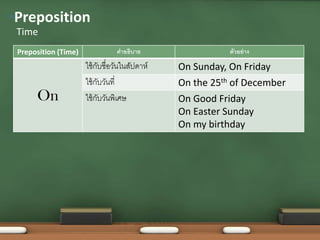
Preposition (Time) คำอธิบำยตัวอย่ำง
On
ใช้กับชื่อวันในสัปดำห์ On Sunday, On Friday
ใช้กับวันที่ On the 25th of December
ใช้กับวันพิเศษ On Good Friday
On Easter Sunday
On my birthday
Time
•Preposition
18.
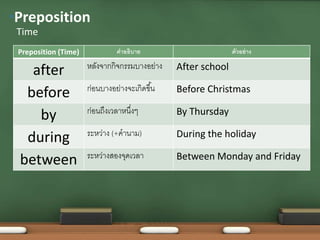
Preposition (Time) คำอธิบำยตัวอย่ำง
after หลังจำกกิจกรรมบำงอย่ำง After school
before ก่อนบำงอย่ำงจะเกิดขึ้น Before Christmas
by ก่อนถึงเวลำหนึ่งๆ By Thursday
during ระหว่ำง (+คำนำม) During the holiday
between ระหว่ำงสองจุดเวลำ Between Monday and Friday
Time
•Preposition
19.
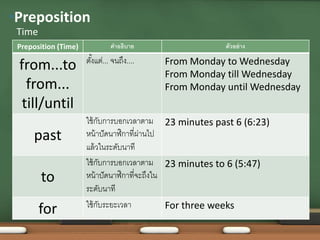
Preposition (Time) คำอธิบำยตัวอย่ำง
from...to
from...
till/until
ตั้งแต่... จนถึง.... From Monday to Wednesday
From Monday till Wednesday
From Monday until Wednesday
past
ใช้กับกำรบอกเวลำตำม
หน้ำปัดนำฬิกำที่ผ่ำนไป
แล้วในระดับนำที
23 minutes past 6 (6:23)
to
ใช้กับกำรบอกเวลำตำม
หน้ำปัดนำฬิกำที่จะถึงใน
ระดับนำที
23 minutes to 6 (5:47)
for ใช้กับระยะเวลำ For three weeks
Time
•Preposition
20.
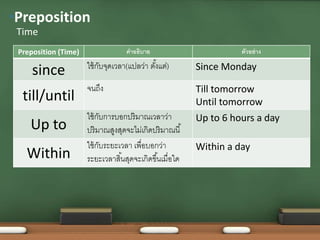
Preposition (Time) คำอธิบำยตัวอย่ำง
since ใช้กับจุดเวลำ(แปลว่ำ ตั้งแต่) Since Monday
till/until
จนถึง Till tomorrow
Until tomorrow
Up to
ใช้กับกำรบอกปริมำณเวลำว่ำ
ปริมำณสูงสุดจะไม่เกิดปริมำณนี้
Up to 6 hours a day
Within
ใช้กับระยะเวลำ เพื่อบอกว่ำ
ระยะเวลำสิ้นสุดจะเกิดขึ้นเมื่อใด
Within a day
Time
•Preposition
21.
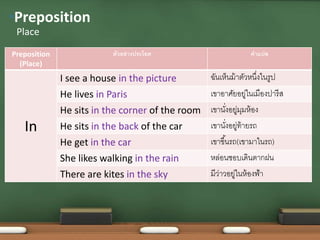
Preposition
(Place)
ตัวอย่ำงประโยค คำแปล
In
I seea house in the picture ฉันเห็นม้ำตัวหนึ่งในรูป
He lives in Paris เขำอำศัยอยู่ในเมืองปำรีส
He sits in the corner of the room เขำนั่งอยู่มุมห้อง
He sits in the back of the car เขำนั่งอยู่ท้ำยรถ
He get in the car เขำขึ้นรถ(เขำมำในรถ)
She likes walking in the rain หล่อนชอบเดินตำกฝน
There are kites in the sky มีว่ำวอยู่ในห้องฟ้ำ
Place
•Preposition
22.
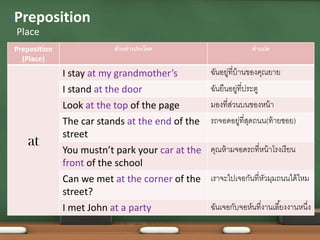
Preposition
(Place)
ตัวอย่ำงประโยค คำแปล
at
I stayat my grandmother’s ฉันอยู่ที่บ้ำนของคุณยำย
I stand at the door ฉันยืนอยู่ที่ประตู
Look at the top of the page มองที่ส่วนบนของหน้ำ
The car stands at the end of the
street
รถจอดอยู่ที่สุดถนน(ท้ำยซอย)
You mustn’t park your car at the
front of the school
คุณห้ำมจอดรถที่หน้ำโรงเรียน
Can we met at the corner of the
street?
เรำจะไปเจอกันที่หัวมุมถนนได้ไหม
I met John at a party ฉันเจอกับจอห์นที่งำนเลี้ยงงำนหนึ่ง
Place
•Preposition
23.
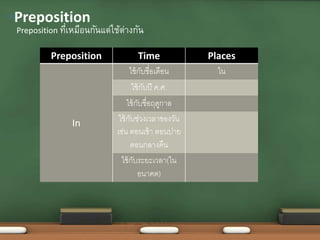
Preposition Time Places
In
ใช้กับชื่อเดือนใน
ใช้กับปี ค.ศ.
ใช้กับชื่อฤดูกำล
ใช้กับช่วงเวลำของวัน
เช่น ตอนเช้ำ ตอนบ่ำย
ตอนกลำงคืน
ใช้กับระยะเวลำ(ใน
อนำคต)
Preposition ที่เหมือนกันแต่ใช้ต่างกัน
•Preposition
24.
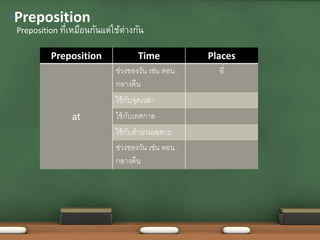
Preposition Time Places
at
ช่วงของวันเช่น ตอน
กลำงคืน
ที่
ใช้กับจุดเวลำ
ใช้กับเทศกำล
ใช้กับสำนวนเฉพำะ
ช่วงของวัน เช่น ตอน
กลำงคืน
Preposition ที่เหมือนกันแต่ใช้ต่างกัน
•Preposition
25.
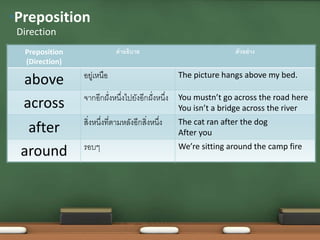
Preposition
(Direction)
คำอธิบำย ตัวอย่ำง
above อยู่เหนือThe picture hangs above my bed.
across จำกอีกฝั่งหนึ่งไปยังอีกฝั่งหนึ่ง You mustn’t go across the road here
You isn’t a bridge across the river
after สิ่งหนึ่งที่ตำมหลังอีกสิ่งหนึ่ง The cat ran after the dog
After you
around รอบๆ We’re sitting around the camp fire
Direction
•Preposition
26.
Preposition
(Direction)
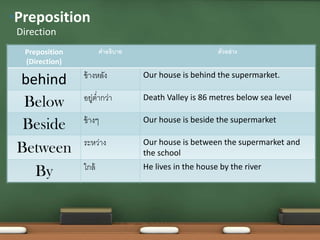
คำอธิบำย ตัวอย่ำง
behind ข้ำงหลังOur house is behind the supermarket.
Below อยู่ต่ำกว่ำ Death Valley is 86 metres below sea level
Beside ข้ำงๆ Our house is beside the supermarket
Between ระหว่ำง Our house is between the supermarket and
the school
By ใกล้ He lives in the house by the river
Direction
•Preposition
27.
Preposition
(Direction)
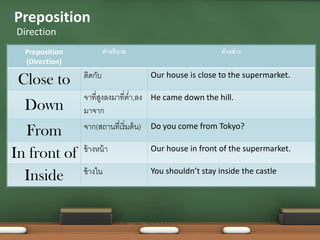
คำอธิบำย ตัวอย่ำง
Close toติดกับ Our house is close to the supermarket.
Down
จำที่สูงลงมำที่ต่ำ,ลง
มำจำก
He came down the hill.
From จำก(สถำนที่เริ่มต้น) Do you come from Tokyo?
In front of ข้ำงหน้ำ Our house in front of the supermarket.
Inside ข้ำงใน You shouldn’t stay inside the castle
Direction
•Preposition
28.
Preposition
(Direction)
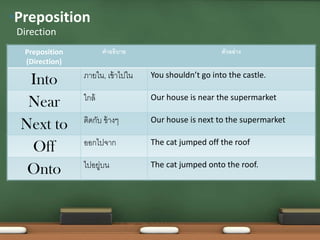
คำอธิบำย ตัวอย่ำง
Into ภำยใน,เข้ำไปใน You shouldn’t go into the castle.
Near ใกล้ Our house is near the supermarket
Next to ติดกับ ข้ำงๆ Our house is next to the supermarket
Off ออกไปจำก The cat jumped off the roof
Onto ไปอยู่บน The cat jumped onto the roof.
Direction
•Preposition
29.
Preposition
(Direction)
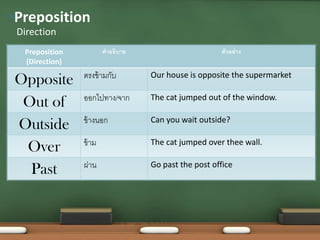
คำอธิบำย ตัวอย่ำง
Opposite ตรงข้ำมกับOur house is opposite the supermarket
Out of ออกไปทำง/จำก The cat jumped out of the window.
Outside ข้ำงนอก Can you wait outside?
Over ข้ำม The cat jumped over thee wall.
Past ผ่ำน Go past the post office
Direction
•Preposition
30.
Preposition
(Direction)
คำอธิบำย ตัวอย่ำง
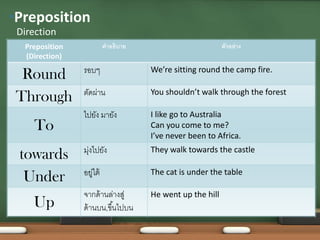
Round รอบๆWe’re sitting round the camp fire.
Through ตัดผ่ำน You shouldn’t walk through the forest
To
ไปยัง มำยัง I like go to Australia
Can you come to me?
I’ve never been to Africa.
towards มุ่งไปยัง They walk towards the castle
Under อยู่ใต้ The cat is under the table
Up
จำกด้ำนล่ำงสู่
ด้ำนบน,ขึ้นไปบน
He went up the hill
Direction
•Preposition
31.
Choose the correctpreposition to complete each blank
•แบบฝึกหัด
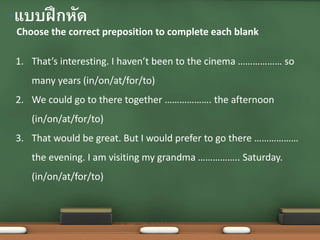
1. That’s interesting. I haven’t been to the cinema ……………… so
many years (in/on/at/for/to)
2. We could go to there together ………………. the afternoon
(in/on/at/for/to)
3. That would be great. But I would prefer to go there ………………
the evening. I am visiting my grandma …………….. Saturday.
(in/on/at/for/to)
32.
Choose the correctpreposition to complete each blank
•แบบฝึกหัด (เฉลย)
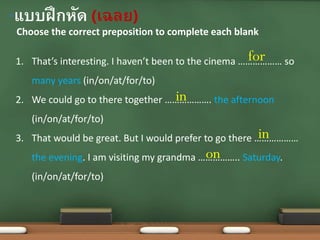
1. That’s interesting. I haven’t been to the cinema ……………… so
many years (in/on/at/for/to)
2. We could go to there together ………………. the afternoon
(in/on/at/for/to)
3. That would be great. But I would prefer to go there ………………
the evening. I am visiting my grandma …………….. Saturday.
(in/on/at/for/to)
for
in
in
on
33.
Choose the correctpreposition to complete each blank
•แบบฝึกหัด (เฉลย)
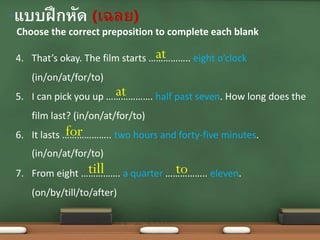
4. That’s okay. The film starts …………….. eight o’clock
(in/on/at/for/to)
5. I can pick you up ………………. half past seven. How long does the
film last? (in/on/at/for/to)
6. It lasts ……………….. two hours and forty-five minutes.
(in/on/at/for/to)
7. From eight ……………. a quarter …………….. eleven.
(on/by/till/to/after)
at
at
for
till to
34.
Choose the correctpreposition to complete each blank
•แบบฝึกหัด (เฉลย)
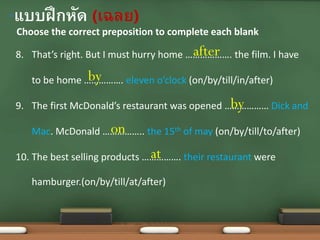
8. That’s right. But I must hurry home ………………. the film. I have
to be home ……………. eleven o’clock (on/by/till/in/after)
9. The first McDonald’s restaurant was opened ……………… Dick and
Mac. McDonald …………….. the 15th of may (on/by/till/to/after)
10. The best selling products ……………. their restaurant were
hamburger.(on/by/till/at/after)
after
by
by
on
at




![ไวยากรณ์ ภาษาอังกฤษเบื้องต้น ต้อนรับ AEC [Grammar]](https://cdn.slidesharecdn.com/ss_thumbnails/random-130217174255-phpapp01-thumbnail.jpg?width=640&height=640&fit=bounds)

