Nikom 3


        Nouns
Countable/Uncountable Nouns

               Miss Juthatip Sirinakorn
                  No. 54120803106
                   M.A. in TESOL 5
Nouns
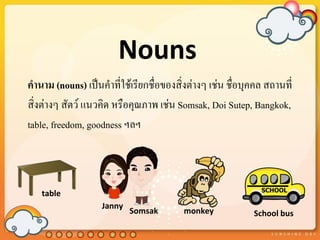
คานาม (nouns) เป็นคาที่ใช้เรียกชื่อของสิ่งต่างๆ เช่น ชื่อบุคคล สถานที่
สิ่งต่างๆ สัตว์ แนวคิด หรือคุณภาพ เช่น Somsak, Doi Sutep, Bangkok,
table, freedom, goodness ฯลฯ


   table
                   Janny
                           Somsak        monkey            School bus
1. Countable Nouns ( นามนับได้ )
  - เป็นนามที่สามารถแยกนับจานวนหนึ่ง สอง สาม... ได้ ไม่ว่าจะมีหรือไม่มีรูปร่างก็ได้
         มีรูปร่าง (สามารถสัมผัสได้)
           เช่น dog, chair , tree, school, country, student, biscuit
          ไม่มีรูปร่าง (ไม่สามารถสัมผัสได้)
            เช่น day , month, year, weekend, journey
          กิจกรรม : job, assignment
  - มีทั้งรูปเอกพจน์และพหูพจน์
           เอกพจน์: เช่น dog, country, day, year
           พหูพจน์: เช่น dogs, countries, days, years
การใช้นามนับได้เอกพจน์
        ต้องนาหน้าด้วย determiners    อย่างใดอย่างหนึ่ง เช่น
               I want an orange. (ไม่ใช่ I want orange.)
               Where is the bottle? ( ไม่ใช่ Where is bottle?)
               Do you want this book?

การใช้นามนับได้พหูพจน์
        อาจจะนาหน้าด้วย     articles หรือไม่ก็ได้ เช่น
               I like to feed the birds. ( เฉพาะเจาะจง ต้องมี articles )
               Cats are interesting pets. ( ไม่เฉพาะเจาะจง ไม่ต้องมี article )
               I want those books on the table. ( those เป็น determiners )
2. Uncountable Nouns ( นามนับไม่ได้ )
    - เป็นนามที่นับไม่ได้ เนื่องจากภาษาอังกฤษมองสิ่งนั้นในภาพรวมและคิดว่าไม่สามารถ
จะแยกเป็นส่วนได้ รวมทั้งความคิด การกระทาต่างๆที่เป็นรูปธรรม (abstract nouns) ด้วย เช่น
            Concrete            เช่น water, milk, butter, furniture, luggage, equipment, clothing
            Abstract            เช่น anger, courage, satisfaction, happiness, knowledge
            ชื่อภาษา            เช่น English, German, Spain
            กีฬาต่างๆ           เช่น hockey, football, tennis
            ชื่อวิชาต่างๆ       เช่น sociology, medicine, math
            กิจกรรมต่างๆ        เช่น swimming, eating, running
            อื่นๆ               เช่น news, money, mail, work, homework, gossip, education,
weather, difficulty, information, feminism, optimism, machinery, information, research,
traffic, scenery, breakfast, accommodation, advice, permission
- มีรูปเอกพจน์และเมื่อกล่าวถึงเป็นการทั่วๆไป หรือ ไม่ได้กล่าวถึงมาก่อน
  ไม่ต้องนาด้วย articles เช่น
         I have bread and butter for breakfast every morning.
         ( ฉันกินขนมปังและเนยเป็นอาหารเช้าทุกวัน )
         We cannot live without air and water.
         ( เราไม่สามารถมีชีวิตอยู่ได้โดยปราศจากอากาศและน้า )
         Information is often valuable.
         ( ข้อมูลข่าวสารมักจะมีคุณค่า )
         Sunlight and water are usually required for plants to grow.
         ( แสงแดดและน้าเป็นสิ่งจาเป็นสาหรับการเจริญเติบโตของพืช )
Uncountable nouns ที่ทาหน้าที่ประธานของประโยค จะต้องใช้
verb ด้วยหลักการเดียวกับคานามเอกพจน์ เช่น Butter is fattening. ( เนยทาให้อ้วน )
ปกติจะมีรูปเป็นเอกพจน์ แต่ทาให้เป็นพหูพจน์ได้โดยบอกจานวนตามภาชนะที่บรรจุ
กลุ่ม น้าหนัก และลักษณะนาม เช่น two cups of water, three pieces of information,
five patches of sunlight, three games of hockey, two lumps of sugar
    Example
        I need two lumps of sugar for my coffee.
        (ฉันกินกาแฟต้องใส่น้าตาล 2 ก้อน)
        Two glasses of milk are enough. (ใช้ are เนื่องจาก glasses เป็นพหูพจน์ )
        (นมสองแก้วก็เพียงพอแล้ว)
คานาม uncountable nouns ที่ไม่นิยมใช้เป็น countable ( ทาให้เป็น plural )
         alcohol ( แอลกอฮอล์)                  knowledge ( ความรู้ )
         clothing ( เสื้อผ้า )                 lighting ( ฟ้าแลบ )
         courage ( ความกล้าหาญ )               thunder ( ฟ้าผ่า )
         freedom (อิสระภาพ )                   machinery ( เครืองจักร )
                                                                ่
         fun ( ความสนุก )                      money ( เงิน )
         furniture ( เครื่องเรือน )            music ( ดนตรี)
         information ( ข้อมูล ข่าวสาร )        scenery ( ทิวทัศน์ )
         intelligence ( เชาวน์,ปัญญา)          traffic ( การจราจร )
ลักษณะพิเศษของนาม
         คานามมีลักษณะพิเศษอยู่ 2 ประการคือ การเปลี่ยนนามนับได้จากรูป
เอกพจน์เป็นพหูพจน์ และการสร้างนามให้อยู่ในรูปแสดงเจ้าของ ดังนี้
1. นามนับได้เอกพจน์-พหูพจน์ การเปลี่ยนนามนับได้จากรูปเอกพจน์เป็นพหูพจน์
   มีหลักเกณฑ์ดังนี้
          1.1 เติม s ท้ายนามเอกพจน์
                     เช่น book - books, pen - pens, car - cars
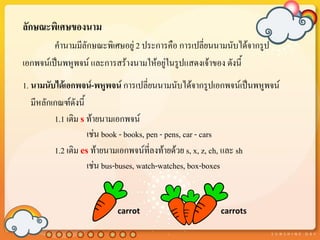
          1.2 เติม es ท้ายนามเอกพจน์ที่ลงท้ายด้วย s, x, z, ch, และ sh
                     เช่น bus-buses, watch-watches, box-boxes


                          carrot                       carrots
1.3 นามเอกพจน์ลงท้ายด้วย y การเปลี่ยนเป็นรูปพหูพจน์ขึ้นอยู่กับ
    กฎเกณฑ์ 2 ประการคือ
          1.3.1 หน้า y เป็นพยัญชนะ เปลี่ยน y เป็น i และเติม es
                 เช่น company-companies, city-cities, lady-ladies
          1.3.2 หน้า y เป็นสระ a, e, i, o, u คง y ไว้แล้วเติม s
                 เช่น day-days, key-keys, way-ways
1.4 นามเอกพจน์ลงท้ายด้วย o การเปลี่ยนเป็นรูปพหูพจน์ขึ้นอยู่กับกฎเกณฑ์ 2 ประการคือ
           1.4.1 หน้า o เป็นพยัญชนะเติม es
                  เช่น potato-potatoes, mango-mangoes,
           1.4.2 หน้า o เป็นสระ เติม s
                  เช่น radio-radios, studio-studios, zoo-zoos, cuckoo-cuckoos,
                        bamboo-bamboos, kangaroo-kangaroos
1.5 เปลี่ยนนามเอกพจน์ลงท้ายด้วย f หรือ fe เป็น v แล้วเติม es
           เช่น half-halves, wife-wives, life-lives, calf-calves
**ยกเว้น** นามบางคาเติม s โดยไม่มีการเปลี่ยน f หรือ fe แต่อย่างใด
           เช่น safe-safes, proof-proofs, chief-chiefs, brief-briefs
1.6 นามเอกพจน์บางคาเวลาเป็นพหูพจน์เปลี่ยนรูปต้องจา
         เช่น goose-geese, tooth-teeth, foot-feet, man-men, woman-women,
              child-children, mouse-mice, ox-oxen
1.7 นามบางคามีรูปเหมือนกันทั้งเอกพจน์และพหูพจน์
        เช่น deer-deer, sheep-sheep, species-species, series-series, trout-trout,
             means-means
1.8 นามบางตัวมีเพียงรูปเดียว คือ เอกพจน์ แม้ว่าจะเติม s
        เช่น news, statistics, mathematics, politics, mumps (คางทูม), ethics,
             economics, physics
1.9 นามต่อไปนี้เป็นพหูพจน์ตลอด
         เช่น glasses (แว่นตา) , tweezers (คีมเล็ก) ,tidings (ข่าวคราว) , shorts (กางเกง
              ขาสั้น), scissors (กรรไกร), saving (เงินออม), arms (อาวุธ), whiskers
              (หนวดเครา)
1.10 นามที่มาจากภาษาต่างประเทศ
           เช่น ละติน กรีก มีรูปพหูพจน์ต่างไปจากเดิม เช่น crisis-crises (วิกฤติการณ์)
criterion-criteria (เกณฑ์), parenthesis-parentheses (วงเล็บ) medium-media (เครืองมือ),
                                                                                  ่
datum-data (ข้อมูล) stimulus-stimuli (สิ่งเร้า), analysis-analyses (การวิเคราะห์)
2. นามแสดงเจ้าของ การสร้างคานามให้อยู่ในรูปของการแสดงความเป็น
   เจ้าของมีหลักเกณฑ์คือ
    2.1 นามเอกพจน์
           สามารถทาให้เป็นรูปแสดงการเป็นเจ้าของด้วยการเติม s ท้ายนาม Sunee's car,
ous nations's flag, Nipon's books.
    2.2 นามพหูพจน์
           นามพหูพจน์ที่ลงท้ายด้วย s หรือ es ทาเป็นรูปแสดงเจ้าของโดยการเติม ' ท้าย
นาม เช่น ladies' coats, girls' bicycles, soldiers' guns แต่หากนามพหูพจน์มิได้ลงท้ายด้วย
s หรือ es ให้เติม 's เมื่อแสดงเจ้าของ เช่น children's parents, women's dresses, men's jeans
    2.3 นามผสม
           ให้เติม 's ท้ายคานามนั้น เช่น son-in-law's, books, daughter-in-law's house
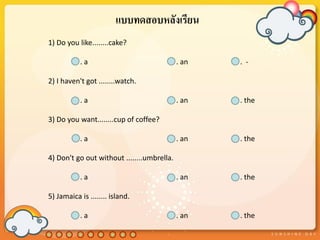
แบบทดสอบหลังเรียน
1) Do you like........cake?

           .a                               . an   . -

2) I haven't got ........watch.

           .a                               . an   . the

3) Do you want........cup of coffee?

           .a                               . an   . the

4) Don't go out without ........umbrella.

           .a                               . an   . the

5) Jamaica is ........ island.

           .a                               . an   . the
correct
Incorrect! Please Try Again.
THANK YOU

นางสาวจุฑาทิพย์ ศิรินคร เลขที่ 06 การสอนnouns

  • 1.
    Nikom 3 Nouns Countable/Uncountable Nouns Miss Juthatip Sirinakorn No. 54120803106 M.A. in TESOL 5
  • 2.
    Nouns คานาม (nouns) เป็นคาที่ใช้เรียกชื่อของสิ่งต่างๆเช่น ชื่อบุคคล สถานที่ สิ่งต่างๆ สัตว์ แนวคิด หรือคุณภาพ เช่น Somsak, Doi Sutep, Bangkok, table, freedom, goodness ฯลฯ table Janny Somsak monkey School bus
  • 3.
    1. Countable Nouns( นามนับได้ ) - เป็นนามที่สามารถแยกนับจานวนหนึ่ง สอง สาม... ได้ ไม่ว่าจะมีหรือไม่มีรูปร่างก็ได้  มีรูปร่าง (สามารถสัมผัสได้) เช่น dog, chair , tree, school, country, student, biscuit  ไม่มีรูปร่าง (ไม่สามารถสัมผัสได้) เช่น day , month, year, weekend, journey  กิจกรรม : job, assignment - มีทั้งรูปเอกพจน์และพหูพจน์  เอกพจน์: เช่น dog, country, day, year  พหูพจน์: เช่น dogs, countries, days, years
  • 4.
    การใช้นามนับได้เอกพจน์  ต้องนาหน้าด้วย determiners อย่างใดอย่างหนึ่ง เช่น I want an orange. (ไม่ใช่ I want orange.) Where is the bottle? ( ไม่ใช่ Where is bottle?) Do you want this book? การใช้นามนับได้พหูพจน์ อาจจะนาหน้าด้วย articles หรือไม่ก็ได้ เช่น I like to feed the birds. ( เฉพาะเจาะจง ต้องมี articles ) Cats are interesting pets. ( ไม่เฉพาะเจาะจง ไม่ต้องมี article ) I want those books on the table. ( those เป็น determiners )
  • 5.
    2. Uncountable Nouns( นามนับไม่ได้ ) - เป็นนามที่นับไม่ได้ เนื่องจากภาษาอังกฤษมองสิ่งนั้นในภาพรวมและคิดว่าไม่สามารถ จะแยกเป็นส่วนได้ รวมทั้งความคิด การกระทาต่างๆที่เป็นรูปธรรม (abstract nouns) ด้วย เช่น Concrete เช่น water, milk, butter, furniture, luggage, equipment, clothing Abstract เช่น anger, courage, satisfaction, happiness, knowledge ชื่อภาษา เช่น English, German, Spain กีฬาต่างๆ เช่น hockey, football, tennis ชื่อวิชาต่างๆ เช่น sociology, medicine, math กิจกรรมต่างๆ เช่น swimming, eating, running อื่นๆ เช่น news, money, mail, work, homework, gossip, education, weather, difficulty, information, feminism, optimism, machinery, information, research, traffic, scenery, breakfast, accommodation, advice, permission
  • 6.
    - มีรูปเอกพจน์และเมื่อกล่าวถึงเป็นการทั่วๆไป หรือไม่ได้กล่าวถึงมาก่อน ไม่ต้องนาด้วย articles เช่น I have bread and butter for breakfast every morning. ( ฉันกินขนมปังและเนยเป็นอาหารเช้าทุกวัน ) We cannot live without air and water. ( เราไม่สามารถมีชีวิตอยู่ได้โดยปราศจากอากาศและน้า ) Information is often valuable. ( ข้อมูลข่าวสารมักจะมีคุณค่า ) Sunlight and water are usually required for plants to grow. ( แสงแดดและน้าเป็นสิ่งจาเป็นสาหรับการเจริญเติบโตของพืช )
  • 7.
    Uncountable nouns ที่ทาหน้าที่ประธานของประโยคจะต้องใช้ verb ด้วยหลักการเดียวกับคานามเอกพจน์ เช่น Butter is fattening. ( เนยทาให้อ้วน ) ปกติจะมีรูปเป็นเอกพจน์ แต่ทาให้เป็นพหูพจน์ได้โดยบอกจานวนตามภาชนะที่บรรจุ กลุ่ม น้าหนัก และลักษณะนาม เช่น two cups of water, three pieces of information, five patches of sunlight, three games of hockey, two lumps of sugar Example I need two lumps of sugar for my coffee. (ฉันกินกาแฟต้องใส่น้าตาล 2 ก้อน) Two glasses of milk are enough. (ใช้ are เนื่องจาก glasses เป็นพหูพจน์ ) (นมสองแก้วก็เพียงพอแล้ว)
  • 8.
    คานาม uncountable nounsที่ไม่นิยมใช้เป็น countable ( ทาให้เป็น plural ) alcohol ( แอลกอฮอล์) knowledge ( ความรู้ ) clothing ( เสื้อผ้า ) lighting ( ฟ้าแลบ ) courage ( ความกล้าหาญ ) thunder ( ฟ้าผ่า ) freedom (อิสระภาพ ) machinery ( เครืองจักร ) ่ fun ( ความสนุก ) money ( เงิน ) furniture ( เครื่องเรือน ) music ( ดนตรี) information ( ข้อมูล ข่าวสาร ) scenery ( ทิวทัศน์ ) intelligence ( เชาวน์,ปัญญา) traffic ( การจราจร )
  • 9.
    ลักษณะพิเศษของนาม คานามมีลักษณะพิเศษอยู่ 2 ประการคือ การเปลี่ยนนามนับได้จากรูป เอกพจน์เป็นพหูพจน์ และการสร้างนามให้อยู่ในรูปแสดงเจ้าของ ดังนี้ 1. นามนับได้เอกพจน์-พหูพจน์ การเปลี่ยนนามนับได้จากรูปเอกพจน์เป็นพหูพจน์ มีหลักเกณฑ์ดังนี้ 1.1 เติม s ท้ายนามเอกพจน์ เช่น book - books, pen - pens, car - cars 1.2 เติม es ท้ายนามเอกพจน์ที่ลงท้ายด้วย s, x, z, ch, และ sh เช่น bus-buses, watch-watches, box-boxes carrot carrots
  • 10.
    1.3 นามเอกพจน์ลงท้ายด้วย yการเปลี่ยนเป็นรูปพหูพจน์ขึ้นอยู่กับ กฎเกณฑ์ 2 ประการคือ 1.3.1 หน้า y เป็นพยัญชนะ เปลี่ยน y เป็น i และเติม es เช่น company-companies, city-cities, lady-ladies 1.3.2 หน้า y เป็นสระ a, e, i, o, u คง y ไว้แล้วเติม s เช่น day-days, key-keys, way-ways 1.4 นามเอกพจน์ลงท้ายด้วย o การเปลี่ยนเป็นรูปพหูพจน์ขึ้นอยู่กับกฎเกณฑ์ 2 ประการคือ 1.4.1 หน้า o เป็นพยัญชนะเติม es เช่น potato-potatoes, mango-mangoes, 1.4.2 หน้า o เป็นสระ เติม s เช่น radio-radios, studio-studios, zoo-zoos, cuckoo-cuckoos, bamboo-bamboos, kangaroo-kangaroos
  • 11.
    1.5 เปลี่ยนนามเอกพจน์ลงท้ายด้วย fหรือ fe เป็น v แล้วเติม es เช่น half-halves, wife-wives, life-lives, calf-calves **ยกเว้น** นามบางคาเติม s โดยไม่มีการเปลี่ยน f หรือ fe แต่อย่างใด เช่น safe-safes, proof-proofs, chief-chiefs, brief-briefs 1.6 นามเอกพจน์บางคาเวลาเป็นพหูพจน์เปลี่ยนรูปต้องจา เช่น goose-geese, tooth-teeth, foot-feet, man-men, woman-women, child-children, mouse-mice, ox-oxen 1.7 นามบางคามีรูปเหมือนกันทั้งเอกพจน์และพหูพจน์ เช่น deer-deer, sheep-sheep, species-species, series-series, trout-trout, means-means
  • 12.
    1.8 นามบางตัวมีเพียงรูปเดียว คือเอกพจน์ แม้ว่าจะเติม s เช่น news, statistics, mathematics, politics, mumps (คางทูม), ethics, economics, physics 1.9 นามต่อไปนี้เป็นพหูพจน์ตลอด เช่น glasses (แว่นตา) , tweezers (คีมเล็ก) ,tidings (ข่าวคราว) , shorts (กางเกง ขาสั้น), scissors (กรรไกร), saving (เงินออม), arms (อาวุธ), whiskers (หนวดเครา) 1.10 นามที่มาจากภาษาต่างประเทศ เช่น ละติน กรีก มีรูปพหูพจน์ต่างไปจากเดิม เช่น crisis-crises (วิกฤติการณ์) criterion-criteria (เกณฑ์), parenthesis-parentheses (วงเล็บ) medium-media (เครืองมือ), ่ datum-data (ข้อมูล) stimulus-stimuli (สิ่งเร้า), analysis-analyses (การวิเคราะห์)
  • 13.
    2. นามแสดงเจ้าของ การสร้างคานามให้อยู่ในรูปของการแสดงความเป็น เจ้าของมีหลักเกณฑ์คือ 2.1 นามเอกพจน์ สามารถทาให้เป็นรูปแสดงการเป็นเจ้าของด้วยการเติม s ท้ายนาม Sunee's car, ous nations's flag, Nipon's books. 2.2 นามพหูพจน์ นามพหูพจน์ที่ลงท้ายด้วย s หรือ es ทาเป็นรูปแสดงเจ้าของโดยการเติม ' ท้าย นาม เช่น ladies' coats, girls' bicycles, soldiers' guns แต่หากนามพหูพจน์มิได้ลงท้ายด้วย s หรือ es ให้เติม 's เมื่อแสดงเจ้าของ เช่น children's parents, women's dresses, men's jeans 2.3 นามผสม ให้เติม 's ท้ายคานามนั้น เช่น son-in-law's, books, daughter-in-law's house
  • 14.
    แบบทดสอบหลังเรียน 1) Do youlike........cake? .a . an . - 2) I haven't got ........watch. .a . an . the 3) Do you want........cup of coffee? .a . an . the 4) Don't go out without ........umbrella. .a . an . the 5) Jamaica is ........ island. .a . an . the
  • 15.
  • 16.
  • 17.