UNIT 1 MATTER
1. WHAT IS MATTER?
 Matter is everything that has mass and
volume.
 The different types of matter are called
substances. Ex: iron, oil.
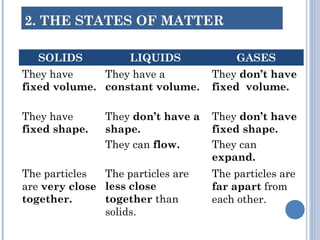
SOLIDS LIQUIDS GASES
They have
fixed volume.
They have a
constant volume.
They don’t have
fixed volume.
They have
fixed shape.
They don’t have a
shape.
They can flow.
They don’t have
fixed shape.
They can
expand.
The particles
are very close
together.
The particles are
less close
together than
solids.
The particles are
far apart from
each other.
2. THE STATES OF MATTER
3. CHANGE OF STATE
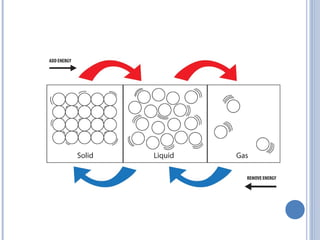
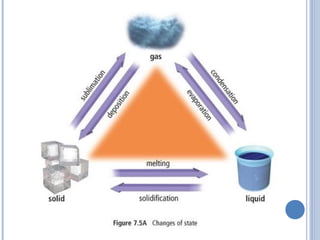
 The heat separates and disperses the particles.
a) Solid to liquid: Fusion.
b) Liquid to solid: Solidification.
c) Liquid to gas: Evaporation.
d) Gas to liquid: Condensation.
e) Solid to gas: Sublimation
f) Gas to solid: Inverse sublimation or deposition.
4. ATOMS AND MOLECULES
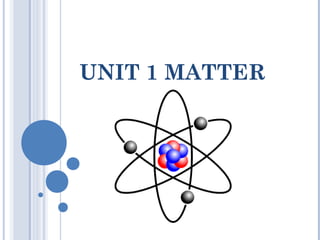
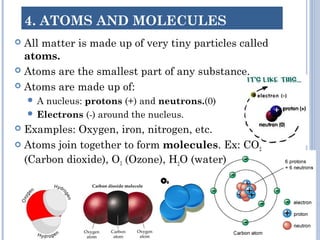
 All matter is made up of very tiny particles called
atoms.
 Atoms are the smallest part of any substance.
 Atoms are made up of:
 A nucleus: protons (+) and neutrons.(0)
 Electrons (-) around the nucleus.
 Examples: Oxygen, iron, nitrogen, etc.
 Atoms join together to form molecules. Ex: CO2
(Carbon dioxide), O3 (Ozone), H2O (water)
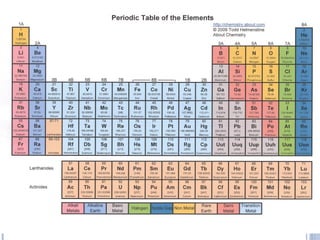
5. ELEMENTS AND COMPOUND
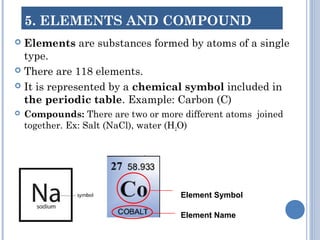
 Elements are substances formed by atoms of a single
type.
 There are 118 elements.
 It is represented by a chemical symbol included in
the periodic table. Example: Carbon (C)
 Compounds: There are two or more different atoms joined
together. Ex: Salt (NaCl), water (H2O)
Element Symbol
Element Name
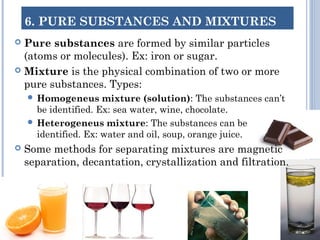
6. PURE SUBSTANCES AND MIXTURES
 Pure substances are formed by similar particles
(atoms or molecules). Ex: iron or sugar.
 Mixture is the physical combination of two or more
pure substances. Types:
 Homogeneus mixture (solution): The substances can’t
be identified. Ex: sea water, wine, chocolate.
 Heterogeneus mixture: The substances can be
identified. Ex: water and oil, soup, orange juice.
 Some methods for separating mixtures are magnetic
separation, decantation, crystallization and filtration.
ACTIVITIES
1. What is matter?
2. What is a substance?
3. State which of the following are matter: beauty,
water, liberty, trees, paper, glass, sadness.
4. Make a grid and classify the following thing
into solid, liquid or gas: rocks, river water, the air
we breath, ice, milk, a fork, an orange juice.
5. Why does the physical state of a substance
change?
6. The temperature of an imaginary substance at
fusion is 20ºC.
a) What state is that substance in if the room
temperature is 25ºC?
b)And if the temperature is 15ºC?
7. Match the two columns. (The items on the left can
be matched to one or more of the items on the right)
a) Atom 1. Fe
b) Chemical element 2. CH4
c) Compound 3. Mg
d) Molecules 4. N2
8. The formula of methane is CH4.What types of
atoms are there in this compound? How many of
each type?
9. Draw a nitrogen (N2) and an ammonia (NH3) with
coloured balls. Use a different colour for each
type of atom.
10. Make a list of five solutions used in daily life.
11. Classify as pure substance or mixture: sugar,
clouds, soup, aluminium.
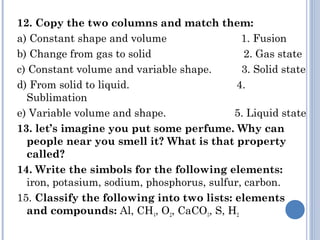
12. Copy the two columns and match them:
a) Constant shape and volume 1. Fusion
b) Change from gas to solid 2. Gas state
c) Constant volume and variable shape. 3. Solid state
d) From solid to liquid. 4.
Sublimation
e) Variable volume and shape. 5. Liquid state
13. let’s imagine you put some perfume. Why can
people near you smell it? What is that property
called?
14. Write the simbols for the following elements:
iron, potasium, sodium, phosphorus, sulfur, carbon.
15. Classify the following into two lists: elements
and compounds: Al, CH4, O2, CaCO3, S, H2
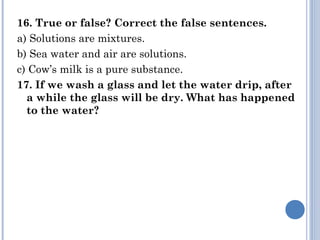
16. True or false? Correct the false sentences.
a) Solutions are mixtures.
b) Sea water and air are solutions.
c) Cow’s milk is a pure substance.
17. If we wash a glass and let the water drip, after
a while the glass will be dry. What has happened
to the water?

Unit 1: Matter

  • 1.
  • 2.
    1. WHAT ISMATTER?  Matter is everything that has mass and volume.  The different types of matter are called substances. Ex: iron, oil.
  • 3.
    SOLIDS LIQUIDS GASES Theyhave fixed volume. They have a constant volume. They don’t have fixed volume. They have fixed shape. They don’t have a shape. They can flow. They don’t have fixed shape. They can expand. The particles are very close together. The particles are less close together than solids. The particles are far apart from each other. 2. THE STATES OF MATTER
  • 5.
    3. CHANGE OFSTATE  The heat separates and disperses the particles. a) Solid to liquid: Fusion. b) Liquid to solid: Solidification. c) Liquid to gas: Evaporation. d) Gas to liquid: Condensation. e) Solid to gas: Sublimation f) Gas to solid: Inverse sublimation or deposition.
  • 7.
    4. ATOMS ANDMOLECULES  All matter is made up of very tiny particles called atoms.  Atoms are the smallest part of any substance.  Atoms are made up of:  A nucleus: protons (+) and neutrons.(0)  Electrons (-) around the nucleus.  Examples: Oxygen, iron, nitrogen, etc.  Atoms join together to form molecules. Ex: CO2 (Carbon dioxide), O3 (Ozone), H2O (water)
  • 8.
    5. ELEMENTS ANDCOMPOUND  Elements are substances formed by atoms of a single type.  There are 118 elements.  It is represented by a chemical symbol included in the periodic table. Example: Carbon (C)  Compounds: There are two or more different atoms joined together. Ex: Salt (NaCl), water (H2O) Element Symbol Element Name
  • 10.
    6. PURE SUBSTANCESAND MIXTURES  Pure substances are formed by similar particles (atoms or molecules). Ex: iron or sugar.  Mixture is the physical combination of two or more pure substances. Types:  Homogeneus mixture (solution): The substances can’t be identified. Ex: sea water, wine, chocolate.  Heterogeneus mixture: The substances can be identified. Ex: water and oil, soup, orange juice.  Some methods for separating mixtures are magnetic separation, decantation, crystallization and filtration.
  • 11.
    ACTIVITIES 1. What ismatter? 2. What is a substance? 3. State which of the following are matter: beauty, water, liberty, trees, paper, glass, sadness. 4. Make a grid and classify the following thing into solid, liquid or gas: rocks, river water, the air we breath, ice, milk, a fork, an orange juice. 5. Why does the physical state of a substance change? 6. The temperature of an imaginary substance at fusion is 20ºC. a) What state is that substance in if the room temperature is 25ºC? b)And if the temperature is 15ºC?
  • 12.
    7. Match thetwo columns. (The items on the left can be matched to one or more of the items on the right) a) Atom 1. Fe b) Chemical element 2. CH4 c) Compound 3. Mg d) Molecules 4. N2 8. The formula of methane is CH4.What types of atoms are there in this compound? How many of each type? 9. Draw a nitrogen (N2) and an ammonia (NH3) with coloured balls. Use a different colour for each type of atom. 10. Make a list of five solutions used in daily life. 11. Classify as pure substance or mixture: sugar, clouds, soup, aluminium.
  • 13.
    12. Copy thetwo columns and match them: a) Constant shape and volume 1. Fusion b) Change from gas to solid 2. Gas state c) Constant volume and variable shape. 3. Solid state d) From solid to liquid. 4. Sublimation e) Variable volume and shape. 5. Liquid state 13. let’s imagine you put some perfume. Why can people near you smell it? What is that property called? 14. Write the simbols for the following elements: iron, potasium, sodium, phosphorus, sulfur, carbon. 15. Classify the following into two lists: elements and compounds: Al, CH4, O2, CaCO3, S, H2
  • 14.
    16. True orfalse? Correct the false sentences. a) Solutions are mixtures. b) Sea water and air are solutions. c) Cow’s milk is a pure substance. 17. If we wash a glass and let the water drip, after a while the glass will be dry. What has happened to the water?