W
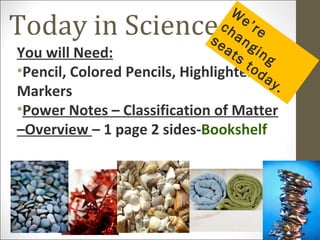
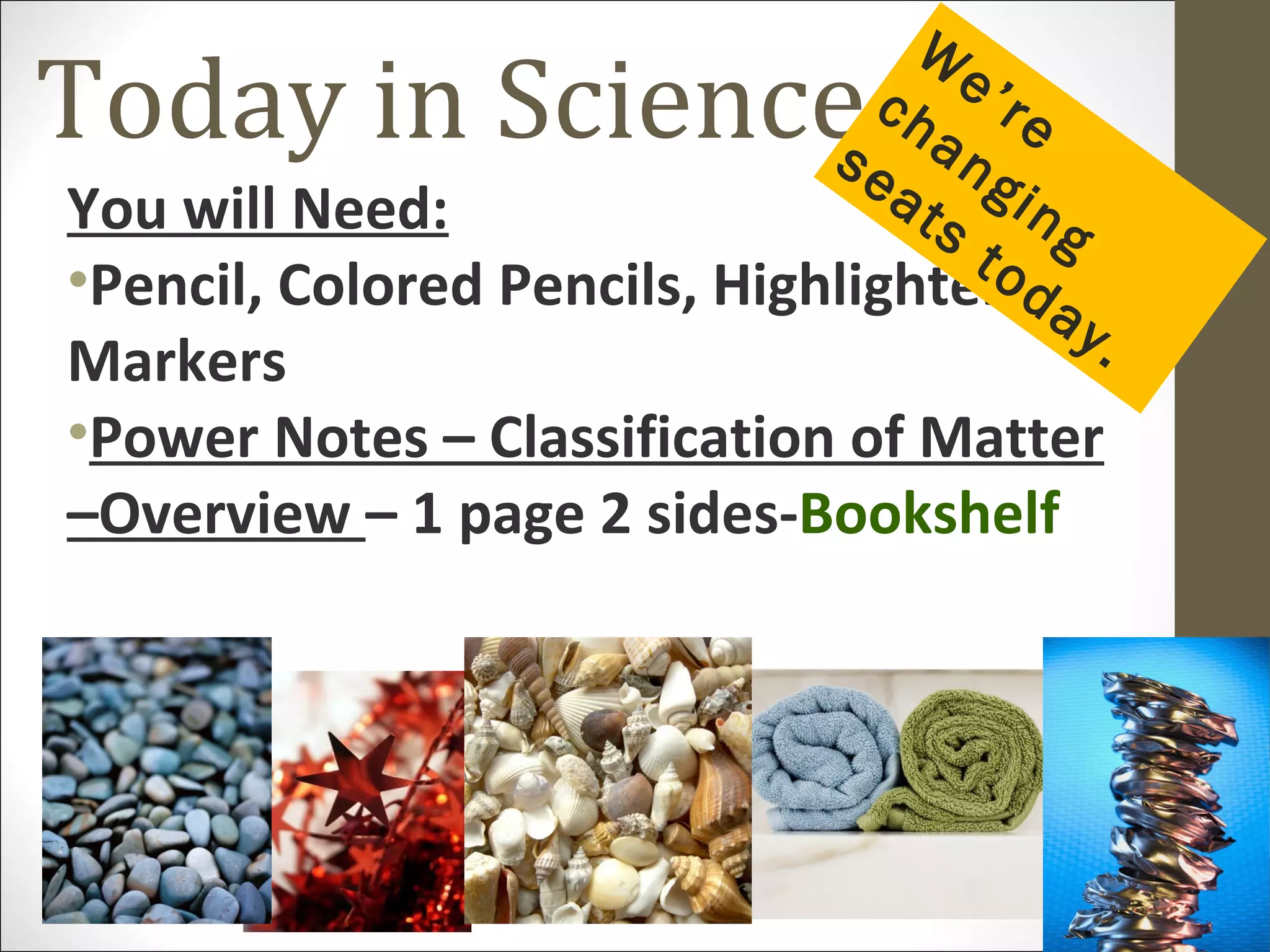
Today in Science                ch re
                              se ang
                                     e’

You will Need:                   at in
                                   s     g
                                      to
•Pencil, Colored Pencils, Highlightersdoray
Markers                                     .
•Power Notes – Classification of Matter
–Overview – 1 page 2 sides-Bookshelf
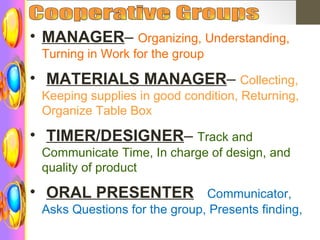
• MANAGER– Organizing, Understanding,
 Turning in Work for the group

• MATERIALS MANAGER– Collecting,
 Keeping supplies in good condition, Returning,
 Organize Table Box

• TIMER/DESIGNER– Track and
 Communicate Time, In charge of design, and
 quality of product

• ORAL PRESENTER– Communicator,
 Asks Questions for the group, Presents finding,
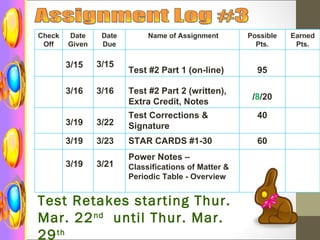
Check   Date     Date        Name of Assignment       Possible   Earned
 Off    Given    Due                                    Pts.      Pts.

        3/15    3/15
                        Test #2 Part 1 (on-line)        95

        3/16    3/16    Test #2 Part 2 (written),
                                                       /8/20
                        Extra Credit, Notes
                        Test Corrections &              40
        3/19    3/22    Signature
        3/19    3/23    STAR CARDS #1-30                60
                        Power Notes –
        3/19    3/21    Classifications of Matter &
                        Periodic Table - Overview


Test Retakes starting Thur.
Mar. 22 nd until Thur. Mar.
29 th
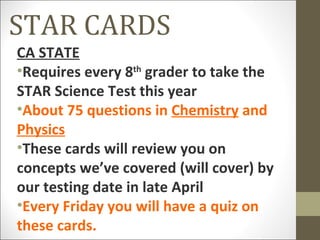
STAR CARDS
CA STATE
•Requires every 8th grader to take the
STAR Science Test this year
•About 75 questions in Chemistry and
Physics
•These cards will review you on
concepts we’ve covered (will cover) by
our testing date in late April
•Every Friday you will have a quiz on
these cards.
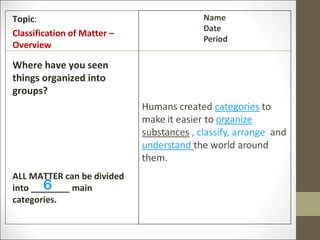
Topic:
Classification of Matter –
Overview

Where have you seen
things organized into
groups?


ALL MATTER can be divided
        6
into ________ main
categories.
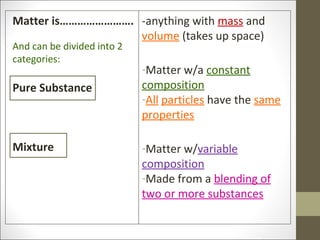
Matter is……………………. -anything with mass and
                   volume (takes up space)
And can be divided into 2
categories:
                            -Matter w/a constant
Pure Substance              composition
                            -All particles have the same
                            properties

Mixture                     -Matter w/variable
                            composition
                            -Made from a blending of
                            two or more substances
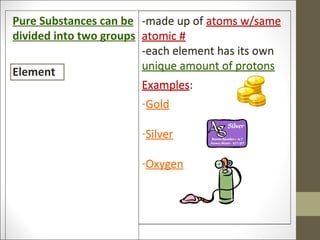
Pure Substances can be -made up of atoms w/same
divided into two groups atomic #
                        -each element has its own
Element                 unique amount of protons
                       Examples:
                       -Gold

                       -Silver

                       -Oxygen
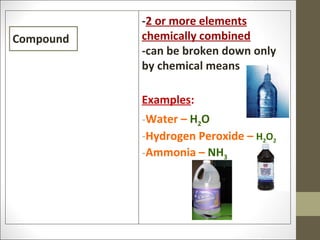
-2 or more elements
Compound   chemically combined
           -can be broken down only
           by chemical means

           Examples:
           -Water – H2O
           -Hydrogen Peroxide – H2O2
           -Ammonia – NH3
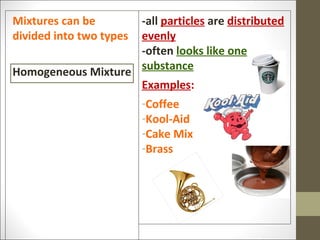
Mixtures can be     -all particles are distributed
divided into two types
                    evenly
                    -often looks like one
Homogeneous Mixture substance
                    Examples:
                    -Coffee
                    -Kool-Aid
                    -Cake Mix
                    -Brass
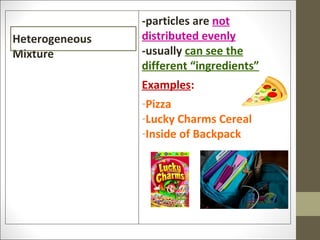
-particles are not
Heterogeneous   distributed evenly
Mixture         -usually can see the
                different “ingredients”
                Examples:
                -Pizza
                -Lucky Charms Cereal
                -Inside of Backpack
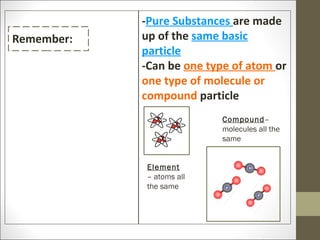
-Pure Substances are made
Remember:   up of the same basic
            particle
            -Can be one type of atom or
            one type of molecule or
            compound particle
                           Compound–
                           molecules all the
                           same


            Element
            – atoms all
            the same
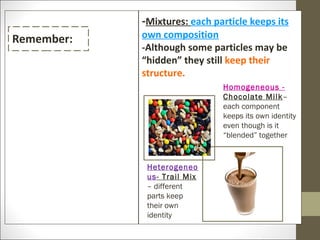
-Mixtures: each particle keeps its
Remember:   own composition
            -Although some particles may be
            “hidden” they still keep their
            structure.
                              Homogeneous -
                              Chocolate Milk–
                              each component
                              keeps its own identity
                              even though is it
                              “blended” together


             Heterogeneo
             us- Trail Mix
             – different
             parts keep
             their own
             identity
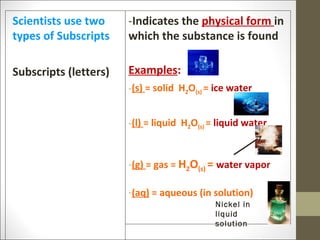
Scientists use two     -Indicates the physical form in
types of Subscripts    which the substance is found

Subscripts (letters)   Examples:
                       -(s) = solid H2O(s) = ice water


                       -(l) = liquid H2O(s) = liquid water


                       -(g) = gas = H2O(s) = water vapor

                       -(aq) = aqueous (in solution)
                                            Nickel in
                                            liquid
                                            solution
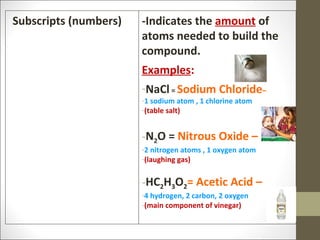
Subscripts (numbers)   -Indicates the amount of
                       atoms needed to build the
                       compound.
                       Examples:
                       -NaCl = Sodium Chloride–
                       -1 sodium atom , 1 chlorine atom
                       -(table salt)


                       -N2O = Nitrous Oxide –
                       -2 nitrogen atoms , 1 oxygen atom
                       -(laughing gas)


                       -HC2H3O2= Acetic Acid –
                       -4 hydrogen, 2 carbon, 2 oxygen
                       -(main component of vinegar)
Periodic Table
The concept of elements has been around since ancient times.
We now know that each element has its own unique number of
protons. You can also tell the elements apart because of their
different properties. However, you might notice there are more
similarities between iron and silver than iron and oxygen. Could
there be a way to organize the elements so you could tell at a
glance which ones had similar properties? YES!

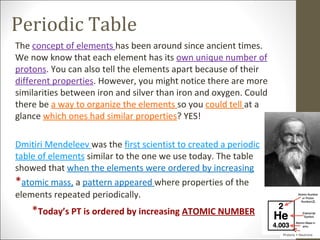
Dmitiri Mendeleev was the first scientist to created a periodic
table of elements similar to the one we use today. The table
showed that when the elements were ordered by increasing
*atomic mass, a pattern appeared where properties of the
elements repeated periodically.
    *Today’s PT is ordered by increasing ATOMIC NUMBER
                                                                   Protons + Neutrons
Periodic Table
The periodic table not only categorizes elements by their similar
properties but helps predict the properties of new elements to
be found. Today’s modern table is organized by increasing
atomic number, not increasing atomic mass.

Why was the table changed?

In 1914, Henry Moseley learned you could experimentally
determine the atomic number of elements. Since every element
has their own unique amount of protons, this number had
greater significance----so the periodic table was reorganized.
Before that, the atomic numbers were just the order of
elements based on increasing atomic mass.
Homework
 1) Complete Pgs. 1 & 2 of Overview
 We will be continuing with Part 2 of
 these Power Notes tomorrow.
 2) Test #2 Part 2 Corrections &
 Signature – Due Thursday
 3) STAR CARDS #1-30 – Due Friday
 at the beginning of class

Classification of Matter Overview- Spring 2012

  • 1.
    W Today in Science ch re se ang e’ You will Need: at in s g to •Pencil, Colored Pencils, Highlightersdoray Markers . •Power Notes – Classification of Matter –Overview – 1 page 2 sides-Bookshelf
  • 2.
    • MANAGER– Organizing,Understanding, Turning in Work for the group • MATERIALS MANAGER– Collecting, Keeping supplies in good condition, Returning, Organize Table Box • TIMER/DESIGNER– Track and Communicate Time, In charge of design, and quality of product • ORAL PRESENTER– Communicator, Asks Questions for the group, Presents finding,
  • 3.
    Check Date Date Name of Assignment Possible Earned Off Given Due Pts. Pts. 3/15 3/15 Test #2 Part 1 (on-line) 95 3/16 3/16 Test #2 Part 2 (written), /8/20 Extra Credit, Notes Test Corrections & 40 3/19 3/22 Signature 3/19 3/23 STAR CARDS #1-30 60 Power Notes – 3/19 3/21 Classifications of Matter & Periodic Table - Overview Test Retakes starting Thur. Mar. 22 nd until Thur. Mar. 29 th
  • 4.
    STAR CARDS CA STATE •Requiresevery 8th grader to take the STAR Science Test this year •About 75 questions in Chemistry and Physics •These cards will review you on concepts we’ve covered (will cover) by our testing date in late April •Every Friday you will have a quiz on these cards.
  • 5.
    Topic: Classification of Matter– Overview Where have you seen things organized into groups? ALL MATTER can be divided 6 into ________ main categories.
  • 6.
    Matter is……………………. -anythingwith mass and volume (takes up space) And can be divided into 2 categories: -Matter w/a constant Pure Substance composition -All particles have the same properties Mixture -Matter w/variable composition -Made from a blending of two or more substances
  • 7.
    Pure Substances canbe -made up of atoms w/same divided into two groups atomic # -each element has its own Element unique amount of protons Examples: -Gold -Silver -Oxygen
  • 8.
    -2 or moreelements Compound chemically combined -can be broken down only by chemical means Examples: -Water – H2O -Hydrogen Peroxide – H2O2 -Ammonia – NH3
  • 9.
    Mixtures can be -all particles are distributed divided into two types evenly -often looks like one Homogeneous Mixture substance Examples: -Coffee -Kool-Aid -Cake Mix -Brass
  • 10.
    -particles are not Heterogeneous distributed evenly Mixture -usually can see the different “ingredients” Examples: -Pizza -Lucky Charms Cereal -Inside of Backpack
  • 11.
    -Pure Substances aremade Remember: up of the same basic particle -Can be one type of atom or one type of molecule or compound particle Compound– molecules all the same Element – atoms all the same
  • 12.
    -Mixtures: each particlekeeps its Remember: own composition -Although some particles may be “hidden” they still keep their structure. Homogeneous - Chocolate Milk– each component keeps its own identity even though is it “blended” together Heterogeneo us- Trail Mix – different parts keep their own identity
  • 13.
    Scientists use two -Indicates the physical form in types of Subscripts which the substance is found Subscripts (letters) Examples: -(s) = solid H2O(s) = ice water -(l) = liquid H2O(s) = liquid water -(g) = gas = H2O(s) = water vapor -(aq) = aqueous (in solution) Nickel in liquid solution
  • 14.
    Subscripts (numbers) -Indicates the amount of atoms needed to build the compound. Examples: -NaCl = Sodium Chloride– -1 sodium atom , 1 chlorine atom -(table salt) -N2O = Nitrous Oxide – -2 nitrogen atoms , 1 oxygen atom -(laughing gas) -HC2H3O2= Acetic Acid – -4 hydrogen, 2 carbon, 2 oxygen -(main component of vinegar)
  • 15.
    Periodic Table The conceptof elements has been around since ancient times. We now know that each element has its own unique number of protons. You can also tell the elements apart because of their different properties. However, you might notice there are more similarities between iron and silver than iron and oxygen. Could there be a way to organize the elements so you could tell at a glance which ones had similar properties? YES! Dmitiri Mendeleev was the first scientist to created a periodic table of elements similar to the one we use today. The table showed that when the elements were ordered by increasing *atomic mass, a pattern appeared where properties of the elements repeated periodically. *Today’s PT is ordered by increasing ATOMIC NUMBER Protons + Neutrons
  • 16.
    Periodic Table The periodictable not only categorizes elements by their similar properties but helps predict the properties of new elements to be found. Today’s modern table is organized by increasing atomic number, not increasing atomic mass. Why was the table changed? In 1914, Henry Moseley learned you could experimentally determine the atomic number of elements. Since every element has their own unique amount of protons, this number had greater significance----so the periodic table was reorganized. Before that, the atomic numbers were just the order of elements based on increasing atomic mass.
  • 17.
    Homework 1) CompletePgs. 1 & 2 of Overview We will be continuing with Part 2 of these Power Notes tomorrow. 2) Test #2 Part 2 Corrections & Signature – Due Thursday 3) STAR CARDS #1-30 – Due Friday at the beginning of class