Introduction
Introduction to Cyberspace & it’s
Architecture
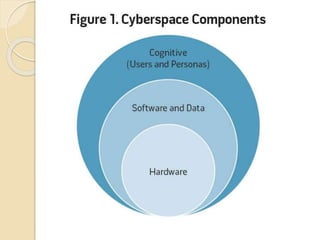
 Cyberspace
It can be defined as an intricate environment that involves
interactions between people, software, and services. It is
maintained by the worldwide distribution of information and
communication technology devices and networks. With the
benefits carried by the technological advancements, the
cyberspace today has become a common pool used by citizens,
businesses, critical information infrastructure, military and
governments in a fashion that makes it hard to induce clear
boundaries among these different groups.
The cyberspace is anticipated to become
even more complex in the upcoming years, with the increase in
networks and devices connected to it.
Cybersecurity
 Cybersecurity denotes the technologies and procedures
intended to safeguard computers, networks, and data from
unlawful admittance, weaknesses, and attacks transported
through the Internet by cyber delinquents.
 ISO 27001 (ISO27001) is the international Cybersecurity
Standard that delivers a model for creating, applying,
functioning, monitoring, reviewing, preserving, and improving
an Information Security Management System.
 The Ministry of Communication and Information Technology
under the government of India provides a strategy outline
called the National Cybersecurity Policy. The purpose of this
government body is to protect the public and private
infrastructure from cyber-attacks.
EVOLUTION AND BASIC CONCEPTS OF
INTERNET:
 There are so many networks exiting in the world,
often with different hardware and software. But
Internet is a term which is very common to all
irrespective to any age group. Perhaps there is no
such human being in the universes, who is
unaware of the term Internet.
HISTORY OF THE INTERNET
 The Internet has a glorious history. It has come across a long way to
reach its current position.When traditional circuit-switched telephone
networks were considered too vulnerable, DoD (Department of
Defence of USA) turned to its research arm, Advanced Research
projects Agency (ARPA).
 ARPA was created in response to the Soviet Union’s
launching Sputnik in 1957 and had the mission of advancing
technology that might be useful to the military. This network is
popularly known as ARPANET.
 In the late 1970s, NSF (The U.S. National Science Foundation)
found the enormous impact the ARPANET was having on University
research, allowing scientists across the contry to share data and
collaborate on research projects. However, to get on the ARPANET,
a University had to have a research contact with the DoD, which
many did not have. This lack of Universal access prompted NSF to
set up a virtual network, CSNET, centered around a single machine
at BBN that supported Dial-up lines and had connections to the
ARPANET and other networks.
SERVICES PROVIDED BY THE
INTERNET
 Communication Service
-Electronic Mail(E-mail)
-USENET newsgroup (forums)
-Chatting
-Instant Messaging
-Telnet
-Internet Telephony
-Internet Fax
Internet Ownership &
Management
Internet is the network of networks
around the globe or interconnections of Networks.
Lakhs of computers are connected through Internet
so the term “Internet ownership” is very critical in
terms of language. But from the maintenance point
of view, these must be maintained by humans by,
machine or with the help of technology, within a
legal framework.
Everyone understands that the
internet is crucial for the functioning of modern
economecs, societies, and even governments, and
everybody it should to be reliable and secure. But
internet possesses such a decentralized status that
there is no authority to control over cyberspace
INTERNET OWNERSHIP
 Any network needs some centralized control to function.
The Global Phone system, for example, is administered
by the world’s oldest international treaty organization,
the International Telecommunication Union, founded in
1865 and now a part of the UN family.
 Similarly, the Internet should be administered under a
multilateral treaty. ICANN (Internet Corporation for
Assigned Names and Numbers), coordinated by a
private sector non-profit organization which was set up
by the Unites States in 1998, took the activities
performed for 30 years , amazingly , by a single pony
tailed professor in California.
 It has the responsibility for internet protocol (IP) address
space allocation, protocol identifier assignment, generic
(GTLD) and country code (CCTLD) Top level Domain
name system management and root server system
management function. It supports the United States only,
though Governmental Advisory Committee, composed of
delegates from other nations, having no real powers.
 Firstly, there are domain names such as
www.careindia.org. Somebody must decide who will
operate the database of generic names ending with
suffixes such as “.com”, “.org” and others. Also someone
must appoint the operators of two-letter countrycode
suffixes (such as “.in.” for India)
 Secondly, there are internet protocol numbers, of up to
12 digit codes, and invisible to users, that every machine
on the networks needs to have in order to be recognized
by other machines
 Thirdly, what is the meaning of Root servers? Somebody
must decide who should operate the root servers. Where
will those operators be based?
INTERNET SERVICE
PROVIDER (ISP)
 An ISP (Internet Service Provider) is a service
provider company that collects a monthly or yearly
fee in exchange for providing the subscriber with
Internet access or remote access as per
Government prescribed framework.
 An ISP might provide dial-up service, cable, ADSL,
TI, leased line or other types of Internet access.
Some ISPs are local while others are national. A
national ISP will provide access throughout most of
the nation, while a local ISP will only serve
subscribers in a limited geographical region.
WORKING OF INTERNET AND ROLE
OF ISP
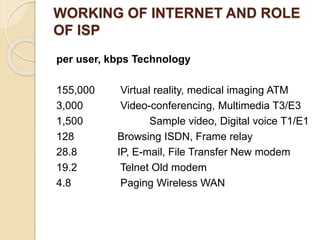
per user, kbps Technology
155,000 Virtual reality, medical imaging ATM
3,000 Video-conferencing, Multimedia T3/E3
1,500 Sample video, Digital voice T1/E1
128 Browsing ISDN, Frame relay
28.8 IP, E-mail, File Transfer New modem
19.2 Telnet Old modem
4.8 Paging Wireless WAN
VALUE ADDED SERVICES
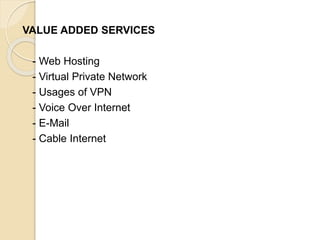
- Web Hosting
- Virtual Private Network
- Usages of VPN
- Voice Over Internet
- E-Mail
- Cable Internet
DATA SECURITY AND MANAGEMENT
During the first few decades of
their existence, computer networks were primarily
used by defense personnel for security by
university researchers for research purposes and
by corporate employees for sharing printers and
other peripherals. Under these conditions, security
of data transmission did not get much attention as
there were very few people using the networks.
SECURITY PROBLEM VIS-À-VIS
INTERNET
Threats to Computing System
There are basically two types of threats
to a computing system.
Program Threats:
-Trojan Horse
- Trap doors
What Makes a Good Security Policy?
1. It must be implementable through system administration
procedures, publishing of acceptable use guidelines, or
other appropriate methods.
2 . It must be enforceable with security tools, where
appropriate, and with sanctions, where actual prevention is
not technically feasible.
3 . It must clearly define the areas of responsibility for the users,
administrators, and management.
DATA ENCRYPTION
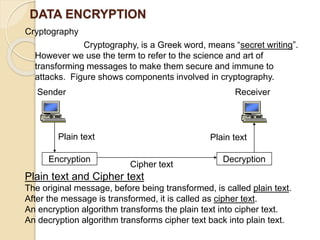
Cryptography
Cryptography, is a Greek word, means “secret writing”.
However we use the term to refer to the science and art of
transforming messages to make them secure and immune to
attacks. Figure shows components involved in cryptography.
Sender Receiver
Encryption Decryption
Cipher text
Plain text Plain text
Plain text and Cipher text
The original message, before being transformed, is called plain text.
After the message is transformed, it is called as cipher text.
An encryption algorithm transforms the plain text into cipher text.
An decryption algorithm transforms cipher text back into plain text.
Cryptography
Cipher
The term cipher is also used to refer to different categories of
algorithms used in cryptography.
Key
A key is number (or set of numbers) that the cipher (an algorithm),
operates on.
Two categories
The cryptography algorithms (ciphers) divided into two groups
Symmetric Key (also called Secret Key) cryptography algorithms.
Asymmetric Key (also called Public Key) cryptography algorithms.
Symmetric Key Asymmetric Key
Cryptography
Symmetric-Key Cryptography
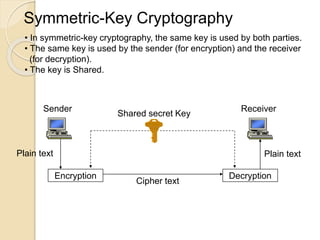
• In symmetric-key cryptography, the same key is used by both parties.
• The same key is used by the sender (for encryption) and the receiver
(for decryption).
• The key is Shared.
Sender Receiver
Encryption Decryption
Cipher text
Plain text Plain text
Shared secret Key
Asymmetric-Key Cryptography
• In asymmetric-key cryptography, there are two types of keys.
• The private key is kept by the receiver.
• The public key is announced to the public.
Alice Bob
Encryption Decryption
Cipher text
Plain text Plain text
Bob’s public
key
Bob’s private
key
To the Public
Symmetric-Key Cryptography
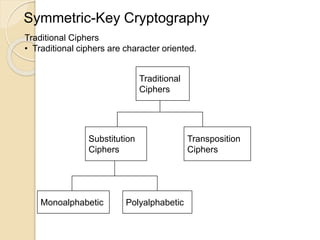
Traditional Ciphers
• Traditional ciphers are character oriented.
Traditional
Ciphers
Substitution
Ciphers
Transposition
Ciphers
Monoalphabetic Polyalphabetic
Digital Signature
 A digital signature is a technique to validate the legitimacy of
a digital message or a document. A valid digital signature
provides the surety to the recipient that the message was
generated by a known sender, such that the sender cannot
deny having sent the message.
 Digital signatures are mostly used for software distribution,
financial transactions, and in other cases where there is a risk
of forgery.
Electronic Signature
 An electronic signature or e-signature, indicates
either that a person who demands to have
created a message is the one who created it.
 A signature can be defined as a schematic script
related with a person. A signature on a document is
a sign that the person accepts the purposes
recorded in the document. In many engineering
companies digital seals are also required for
another layer of authentication and security. Digital
seals and signatures are same as handwritten
signatures and stamped seals.
United Nations Commission on International
Trade Law
(UNCITRAL)
->Digital Signature was the term defined in the old
I.T. Act, 2000.
->Electronic Signature is the term defined by the
amended act (I.T. Act, 2008).
The concept of Electronic Signature is
broader than Digital Signature. Section 3 of the Act
delivers for the verification of Electronic Records by
affixing Digital Signature.
As per the amendment, verification of
electronic record by electronic signature or
electronic authentication technique shall be
considered reliable.
According to the United Nations Commission on
International Trade Law (UNCITRAL), electronic authentication
and signature methods may be classified into the following
categories:
-> Those based on the knowledge of the user or the recipient, i.e.,
passwords, personal identification numbers (PINs), etc.
-> Those bases on the physical features of the user, i.e., biometrics.
-> Those based on the possession of an object by the user, i.e.,
codes or
other information stored on a magnetic card.
-> Types of authentication and signature methods that, without
falling under
any of the above categories might also be used to indicate the
originator
of an electronic communication (Such as a facsimile of a
handwritten
signature, or a name typed at the bottom of an electronic
message).
According to the UNCITRAL MODEL LAW on Electronic
Signatures, the following technologies are presently in use:
- Digital Signature within a public key infrastructure (PKI)
-Biometric Device
- PINs
- Passwords
- Scanned handwritten signature
- Signature by Digital Pen
- Clickable “OK” or “I Accept” or “I Agree” click boxes
References
 www. wikipedia.com
 www.cybersecureasia.com/

Unit 1 Introducation

  • 1.
  • 2.
    Introduction to Cyberspace& it’s Architecture  Cyberspace It can be defined as an intricate environment that involves interactions between people, software, and services. It is maintained by the worldwide distribution of information and communication technology devices and networks. With the benefits carried by the technological advancements, the cyberspace today has become a common pool used by citizens, businesses, critical information infrastructure, military and governments in a fashion that makes it hard to induce clear boundaries among these different groups. The cyberspace is anticipated to become even more complex in the upcoming years, with the increase in networks and devices connected to it.
  • 4.
    Cybersecurity  Cybersecurity denotesthe technologies and procedures intended to safeguard computers, networks, and data from unlawful admittance, weaknesses, and attacks transported through the Internet by cyber delinquents.  ISO 27001 (ISO27001) is the international Cybersecurity Standard that delivers a model for creating, applying, functioning, monitoring, reviewing, preserving, and improving an Information Security Management System.  The Ministry of Communication and Information Technology under the government of India provides a strategy outline called the National Cybersecurity Policy. The purpose of this government body is to protect the public and private infrastructure from cyber-attacks.
  • 5.
    EVOLUTION AND BASICCONCEPTS OF INTERNET:  There are so many networks exiting in the world, often with different hardware and software. But Internet is a term which is very common to all irrespective to any age group. Perhaps there is no such human being in the universes, who is unaware of the term Internet.
  • 6.
    HISTORY OF THEINTERNET  The Internet has a glorious history. It has come across a long way to reach its current position.When traditional circuit-switched telephone networks were considered too vulnerable, DoD (Department of Defence of USA) turned to its research arm, Advanced Research projects Agency (ARPA).  ARPA was created in response to the Soviet Union’s launching Sputnik in 1957 and had the mission of advancing technology that might be useful to the military. This network is popularly known as ARPANET.  In the late 1970s, NSF (The U.S. National Science Foundation) found the enormous impact the ARPANET was having on University research, allowing scientists across the contry to share data and collaborate on research projects. However, to get on the ARPANET, a University had to have a research contact with the DoD, which many did not have. This lack of Universal access prompted NSF to set up a virtual network, CSNET, centered around a single machine at BBN that supported Dial-up lines and had connections to the ARPANET and other networks.
  • 7.
    SERVICES PROVIDED BYTHE INTERNET  Communication Service -Electronic Mail(E-mail) -USENET newsgroup (forums) -Chatting -Instant Messaging -Telnet -Internet Telephony -Internet Fax
  • 8.
    Internet Ownership & Management Internetis the network of networks around the globe or interconnections of Networks. Lakhs of computers are connected through Internet so the term “Internet ownership” is very critical in terms of language. But from the maintenance point of view, these must be maintained by humans by, machine or with the help of technology, within a legal framework. Everyone understands that the internet is crucial for the functioning of modern economecs, societies, and even governments, and everybody it should to be reliable and secure. But internet possesses such a decentralized status that there is no authority to control over cyberspace
  • 9.
    INTERNET OWNERSHIP  Anynetwork needs some centralized control to function. The Global Phone system, for example, is administered by the world’s oldest international treaty organization, the International Telecommunication Union, founded in 1865 and now a part of the UN family.  Similarly, the Internet should be administered under a multilateral treaty. ICANN (Internet Corporation for Assigned Names and Numbers), coordinated by a private sector non-profit organization which was set up by the Unites States in 1998, took the activities performed for 30 years , amazingly , by a single pony tailed professor in California.
  • 10.
     It hasthe responsibility for internet protocol (IP) address space allocation, protocol identifier assignment, generic (GTLD) and country code (CCTLD) Top level Domain name system management and root server system management function. It supports the United States only, though Governmental Advisory Committee, composed of delegates from other nations, having no real powers.  Firstly, there are domain names such as www.careindia.org. Somebody must decide who will operate the database of generic names ending with suffixes such as “.com”, “.org” and others. Also someone must appoint the operators of two-letter countrycode suffixes (such as “.in.” for India)  Secondly, there are internet protocol numbers, of up to 12 digit codes, and invisible to users, that every machine on the networks needs to have in order to be recognized by other machines  Thirdly, what is the meaning of Root servers? Somebody must decide who should operate the root servers. Where will those operators be based?
  • 11.
    INTERNET SERVICE PROVIDER (ISP) An ISP (Internet Service Provider) is a service provider company that collects a monthly or yearly fee in exchange for providing the subscriber with Internet access or remote access as per Government prescribed framework.  An ISP might provide dial-up service, cable, ADSL, TI, leased line or other types of Internet access. Some ISPs are local while others are national. A national ISP will provide access throughout most of the nation, while a local ISP will only serve subscribers in a limited geographical region.
  • 12.
    WORKING OF INTERNETAND ROLE OF ISP per user, kbps Technology 155,000 Virtual reality, medical imaging ATM 3,000 Video-conferencing, Multimedia T3/E3 1,500 Sample video, Digital voice T1/E1 128 Browsing ISDN, Frame relay 28.8 IP, E-mail, File Transfer New modem 19.2 Telnet Old modem 4.8 Paging Wireless WAN
  • 13.
    VALUE ADDED SERVICES -Web Hosting - Virtual Private Network - Usages of VPN - Voice Over Internet - E-Mail - Cable Internet
  • 14.
    DATA SECURITY ANDMANAGEMENT During the first few decades of their existence, computer networks were primarily used by defense personnel for security by university researchers for research purposes and by corporate employees for sharing printers and other peripherals. Under these conditions, security of data transmission did not get much attention as there were very few people using the networks.
  • 15.
    SECURITY PROBLEM VIS-À-VIS INTERNET Threatsto Computing System There are basically two types of threats to a computing system. Program Threats: -Trojan Horse - Trap doors
  • 16.
    What Makes aGood Security Policy? 1. It must be implementable through system administration procedures, publishing of acceptable use guidelines, or other appropriate methods. 2 . It must be enforceable with security tools, where appropriate, and with sanctions, where actual prevention is not technically feasible. 3 . It must clearly define the areas of responsibility for the users, administrators, and management.
  • 17.
    DATA ENCRYPTION Cryptography Cryptography, isa Greek word, means “secret writing”. However we use the term to refer to the science and art of transforming messages to make them secure and immune to attacks. Figure shows components involved in cryptography. Sender Receiver Encryption Decryption Cipher text Plain text Plain text Plain text and Cipher text The original message, before being transformed, is called plain text. After the message is transformed, it is called as cipher text. An encryption algorithm transforms the plain text into cipher text. An decryption algorithm transforms cipher text back into plain text.
  • 18.
    Cryptography Cipher The term cipheris also used to refer to different categories of algorithms used in cryptography. Key A key is number (or set of numbers) that the cipher (an algorithm), operates on. Two categories The cryptography algorithms (ciphers) divided into two groups Symmetric Key (also called Secret Key) cryptography algorithms. Asymmetric Key (also called Public Key) cryptography algorithms. Symmetric Key Asymmetric Key Cryptography
  • 19.
    Symmetric-Key Cryptography • Insymmetric-key cryptography, the same key is used by both parties. • The same key is used by the sender (for encryption) and the receiver (for decryption). • The key is Shared. Sender Receiver Encryption Decryption Cipher text Plain text Plain text Shared secret Key
  • 20.
    Asymmetric-Key Cryptography • Inasymmetric-key cryptography, there are two types of keys. • The private key is kept by the receiver. • The public key is announced to the public. Alice Bob Encryption Decryption Cipher text Plain text Plain text Bob’s public key Bob’s private key To the Public
  • 21.
    Symmetric-Key Cryptography Traditional Ciphers •Traditional ciphers are character oriented. Traditional Ciphers Substitution Ciphers Transposition Ciphers Monoalphabetic Polyalphabetic
  • 22.
    Digital Signature  Adigital signature is a technique to validate the legitimacy of a digital message or a document. A valid digital signature provides the surety to the recipient that the message was generated by a known sender, such that the sender cannot deny having sent the message.  Digital signatures are mostly used for software distribution, financial transactions, and in other cases where there is a risk of forgery.
  • 23.
    Electronic Signature  Anelectronic signature or e-signature, indicates either that a person who demands to have created a message is the one who created it.  A signature can be defined as a schematic script related with a person. A signature on a document is a sign that the person accepts the purposes recorded in the document. In many engineering companies digital seals are also required for another layer of authentication and security. Digital seals and signatures are same as handwritten signatures and stamped seals.
  • 24.
    United Nations Commissionon International Trade Law (UNCITRAL) ->Digital Signature was the term defined in the old I.T. Act, 2000. ->Electronic Signature is the term defined by the amended act (I.T. Act, 2008). The concept of Electronic Signature is broader than Digital Signature. Section 3 of the Act delivers for the verification of Electronic Records by affixing Digital Signature. As per the amendment, verification of electronic record by electronic signature or electronic authentication technique shall be considered reliable.
  • 25.
    According to theUnited Nations Commission on International Trade Law (UNCITRAL), electronic authentication and signature methods may be classified into the following categories: -> Those based on the knowledge of the user or the recipient, i.e., passwords, personal identification numbers (PINs), etc. -> Those bases on the physical features of the user, i.e., biometrics. -> Those based on the possession of an object by the user, i.e., codes or other information stored on a magnetic card. -> Types of authentication and signature methods that, without falling under any of the above categories might also be used to indicate the originator of an electronic communication (Such as a facsimile of a handwritten signature, or a name typed at the bottom of an electronic message).
  • 26.
    According to theUNCITRAL MODEL LAW on Electronic Signatures, the following technologies are presently in use: - Digital Signature within a public key infrastructure (PKI) -Biometric Device - PINs - Passwords - Scanned handwritten signature - Signature by Digital Pen - Clickable “OK” or “I Accept” or “I Agree” click boxes
  • 27.
    References  www. wikipedia.com www.cybersecureasia.com/