Privacy and Data Protection
Right to Privacy and its Legal Framework
 The right of privacy is well established in international law.
The core privacy principle in modern law may be found in
the Universal Declaration of Human Rights. Article 12 of the
UDHR states ""No one shall be subjected to arbitrary
interference with his privacy, family, home or
correspondence, nor to attacks upon his honour and
reputation. Everyone has the right to the protection of the
law against such interference or attacks."
 The UN Guidelines for the Regulation of Computerized
Personal Data Files (1990) set out Fair Information
Practices and recommend the adoption of national
guidelines to protect personal privacy. Appropriately, the UN
Guidelines note that a derogation from these principles
"may be specifically provided for when the purpose of the
file is the protection of human rights and fundamental
freedoms of the individual concerned or humanitarian
The Concept of Privacy
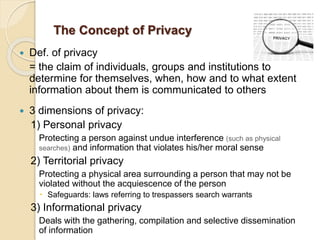
 Def. of privacy
= the claim of individuals, groups and institutions to
determine for themselves, when, how and to what extent
information about them is communicated to others
 3 dimensions of privacy:
1) Personal privacy
Protecting a person against undue interference (such as physical
searches) and information that violates his/her moral sense
2) Territorial privacy
Protecting a physical area surrounding a person that may not be
violated without the acquiescence of the person
 Safeguards: laws referring to trespassers search warrants
3) Informational privacy
Deals with the gathering, compilation and selective dissemination
of information
 Basic privacy principles
◦ Lawfulness and fairness
◦ Necessity of data collection and processing
◦ Purpose specification and purpose binding
 There are no "non-sensitive" data
◦ Transparency
 Data subject´s right to information correction, erasure or blocking of
incorrect/ illegally stored data
◦ Supervision (= control by independent data protection authority) & sanctions
◦ Adequate organizational and technical safeguards
 Privacy protection can be undertaken by:
◦ Privacy and data protection laws promoted by government
◦ Self-regulation for fair information practices by codes of conducts
promoted by businesses
◦ Privacy-enhancing technologies (PETs) adopted by individuals
◦ Privacy education of consumers and IT professionals
International Privacy Standards
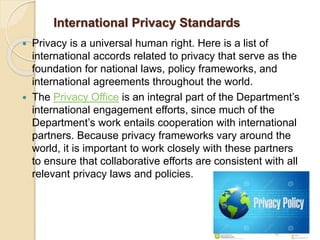
 Privacy is a universal human right. Here is a list of
international accords related to privacy that serve as the
foundation for national laws, policy frameworks, and
international agreements throughout the world.
 The Privacy Office is an integral part of the Department’s
international engagement efforts, since much of the
Department’s work entails cooperation with international
partners. Because privacy frameworks vary around the
world, it is important to work closely with these partners
to ensure that collaborative efforts are consistent with all
relevant privacy laws and policies.
Privacy's Role in the International Privacy
Arena
In support of the Department’s mission, the Privacy
Office:
 Provides counsel on international agreements
related to personal information collection and
sharing;
 Offers educational outreach and leadership on the
Department’s privacy policies and emerging
international privacy issues;
 Interprets international data protection frameworks
to aid in interaction with international partners; and
 Counsels the Department and other agency
partners on global privacy practices and policy
approaches.
Privacy Related Wrongs and Remedies
 William Prosser had reviewed the court decisions on
privacy cases after the WarrenBrandeis article on
privacy and he had opined that the classes of tort
actions in relation to privacy matters could be broadly be
classified into four heads which are all regarded .These
are –
 1. Intrusion upon the plaintiff’s seclusion or solitude, or
into his private affairs.
 2. Public disclosure of embarrassing private facts about
the plaintiffas different torts.
 3. Publicity which places the plaintiff in a false light in the
public eye.
 4. Commercial appropriation of the plaintiff’s likeness or
name.
The Concept of Security in Cyberspace
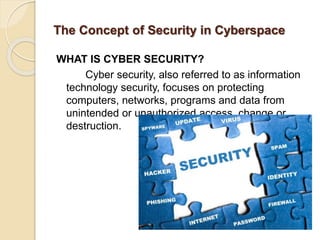
WHAT IS CYBER SECURITY?
Cyber security, also referred to as information
technology security, focuses on protecting
computers, networks, programs and data from
unintended or unauthorized access, change or
destruction.
WHY IS CYBER SECURITY IMPORTANT?
Governments, military, corporations, financial
institutions, hospitals and other businesses collect,
process and store a great deal of confidential information
on computers and transmit that data across networks to
other computers. With the growing volume and
sophistication of cyber attacks, ongoing attention is
required to protect sensitive business and personal
information, as well as safeguard national security.
During a Senate hearing in March 2013, the nation's
top intelligence officials warned that cyber attacks and
digital spying are the top threat to national security,
eclipsing terrorism.
Technological Vulnerability
 In computer security, a vulnerability is a weakness
which allows an attacker to reduce a
system's information assurance.
 Vulnerability is the intersection of three elements:
a system susceptibility or flaw, attacker access to
the flaw, and attacker capability to exploit the flaw.
 To exploit a vulnerability, an attacker must have at
least one applicable tool or technique that can
connect to a system weakness. In this frame,
vulnerability is also known as the attack surface.
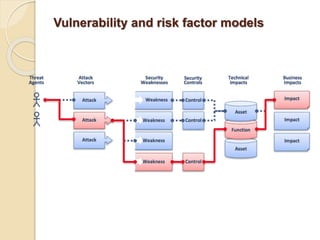
Vulnerability and risk factor models
Information Security Audit
Vulnerability Assessment and Penetration Testing
Services (VAPT)
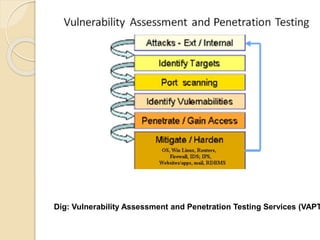
 Vulnerability Assessments are a process of identifying,
quantifying, and prioritizing vulnerabilities in a system. A
vulnerability refers to the inability of the system to
withstand the effects of a hostile environment.
 Penetration Tests are a method of evaluating computer
and network security simulating attacks on a computer
system or network from external and internal
threats.They are usually defined by a given test
objective.
NEED OF VAPT
 VAPT is a process in which the Information &
Communication Technologies (ICT) infrastructure
consists of computers, networks, servers, operating
systems and application software are scanned in
order to identify the presence of known and
unknown vulnerabilities.
 As many as 70% of web sites have vulnerabilities
that could lead to the theft of sensitive corporate
data such as credit card information, product IP,
customer lists etc. Hackers are concentrating their
efforts on web-based applications - shopping carts,
forms, login pages, dynamic content, etc.
Dig: Vulnerability Assessment and Penetration Testing Services (VAPT
Data Protection Position in India
 Data protection law in India (Present status):-
Data Protection law in India is included in the Act under
specific provisions. Both civil and criminal liabilities are
imposed for violation of data protection.
(1) Section 43 deals with penalties for damage to
computer, computer system etc.
(2) Section 65 deals with tampering with computer
source documents.
(3) Section 66 deals with hacking with computer system.
(4) Section 72 deals with penalty for breach of
confidentiality and privacy. Call centers can be included
in the definition of ‘intermediary’ and a ‘network service
provider’ and can be penalized under this section.
BPOs AND THE LEGAL REGIME IN INDIA:
 Business Process Outsourcing (“BPO”) has
emerged as the most challenging sector that has
not only generated employment potential in India,
but has also brought huge inflow of foreign
exchange into the country. Today, India is home to
some of the world’s leading BPO companies.
 In this context, it is becoming increasingly
important to study and examine the legal regime in
India pertaining to BPOs and to undertake an
examination of data protection laws in the light of
the growing concern that data transferred to India
may not be adequately protected.
 A BPO takes within its fold various elements such as
finance and accounting, customer relationship
management, human resources, business process,
transcription, and so on. A parent company instead of
performing these operations delegates them to a BPO.
 It may be an in house operation or a different company
may be engaged to perform a particular task. It may be
in the same country or in a different country.
 The BPO sector in India has an extremely advantageous
position because of its low cost structure and large pool
of skilled manpower
Child’s Privacy Online
 As a parent, you have control over the personal
information companies collect online from your kids
under 13.
 The Children’s Online Privacy Protection Act gives you
tools to do that.
 The Federal Trade Commission, the nation’s consumer
protection agency, enforces the COPPA Rule. If a site or
service is covered by COPPA, it has to get your consent
before collecting personal information from your child
and it has to honor your choices about how that
information is used.
What is COPPA?
 The COPPA Rule was put in place to protect kids’
personal information on websites and online services —
including apps — that are directed to children under 13.
The Rule also applies to a general audience site that
knows it’s collecting personal information from kids that
age.
 COPPA requires those sites and services to notify
parents directly and get their approval before they
collect, use, or disclose a child’s personal information.
Personal information in the world of COPPA includes a
kid’s name, address, phone number or email address;
their physical whereabouts; photos, videos and audio
recordings of the child, and persistent identifiers, like IP
addresses, that can be used to track a child’s activities
over time and across different websites and online
EVOLVING TRENDS IN DATA PROTECTION
AND
INFORMATION SECURITY:
 The legal systems which deal with them, have
been forced to evolve rapidly. Though the changes
in law have had to deal with a number of issues in
the broad area of cyber laws, the most vibrant of
those have been concerned with privacy,
information security, information warfare,
egovernance, e-commerce and crimes on the
Internet.
 E-GOVERNANCE
 INFORMATION WARFARE
 DATA TRANSFER REGIME
 PRIVACY

Unit 6 Privacy and Data Protection 8 hr

  • 1.
    Privacy and DataProtection
  • 2.
    Right to Privacyand its Legal Framework  The right of privacy is well established in international law. The core privacy principle in modern law may be found in the Universal Declaration of Human Rights. Article 12 of the UDHR states ""No one shall be subjected to arbitrary interference with his privacy, family, home or correspondence, nor to attacks upon his honour and reputation. Everyone has the right to the protection of the law against such interference or attacks."  The UN Guidelines for the Regulation of Computerized Personal Data Files (1990) set out Fair Information Practices and recommend the adoption of national guidelines to protect personal privacy. Appropriately, the UN Guidelines note that a derogation from these principles "may be specifically provided for when the purpose of the file is the protection of human rights and fundamental freedoms of the individual concerned or humanitarian
  • 3.
    The Concept ofPrivacy  Def. of privacy = the claim of individuals, groups and institutions to determine for themselves, when, how and to what extent information about them is communicated to others  3 dimensions of privacy: 1) Personal privacy Protecting a person against undue interference (such as physical searches) and information that violates his/her moral sense 2) Territorial privacy Protecting a physical area surrounding a person that may not be violated without the acquiescence of the person  Safeguards: laws referring to trespassers search warrants 3) Informational privacy Deals with the gathering, compilation and selective dissemination of information
  • 4.
     Basic privacyprinciples ◦ Lawfulness and fairness ◦ Necessity of data collection and processing ◦ Purpose specification and purpose binding  There are no "non-sensitive" data ◦ Transparency  Data subject´s right to information correction, erasure or blocking of incorrect/ illegally stored data ◦ Supervision (= control by independent data protection authority) & sanctions ◦ Adequate organizational and technical safeguards  Privacy protection can be undertaken by: ◦ Privacy and data protection laws promoted by government ◦ Self-regulation for fair information practices by codes of conducts promoted by businesses ◦ Privacy-enhancing technologies (PETs) adopted by individuals ◦ Privacy education of consumers and IT professionals
  • 5.
    International Privacy Standards Privacy is a universal human right. Here is a list of international accords related to privacy that serve as the foundation for national laws, policy frameworks, and international agreements throughout the world.  The Privacy Office is an integral part of the Department’s international engagement efforts, since much of the Department’s work entails cooperation with international partners. Because privacy frameworks vary around the world, it is important to work closely with these partners to ensure that collaborative efforts are consistent with all relevant privacy laws and policies.
  • 6.
    Privacy's Role inthe International Privacy Arena In support of the Department’s mission, the Privacy Office:  Provides counsel on international agreements related to personal information collection and sharing;  Offers educational outreach and leadership on the Department’s privacy policies and emerging international privacy issues;  Interprets international data protection frameworks to aid in interaction with international partners; and  Counsels the Department and other agency partners on global privacy practices and policy approaches.
  • 7.
    Privacy Related Wrongsand Remedies  William Prosser had reviewed the court decisions on privacy cases after the WarrenBrandeis article on privacy and he had opined that the classes of tort actions in relation to privacy matters could be broadly be classified into four heads which are all regarded .These are –  1. Intrusion upon the plaintiff’s seclusion or solitude, or into his private affairs.  2. Public disclosure of embarrassing private facts about the plaintiffas different torts.  3. Publicity which places the plaintiff in a false light in the public eye.  4. Commercial appropriation of the plaintiff’s likeness or name.
  • 8.
    The Concept ofSecurity in Cyberspace WHAT IS CYBER SECURITY? Cyber security, also referred to as information technology security, focuses on protecting computers, networks, programs and data from unintended or unauthorized access, change or destruction.
  • 9.
    WHY IS CYBERSECURITY IMPORTANT? Governments, military, corporations, financial institutions, hospitals and other businesses collect, process and store a great deal of confidential information on computers and transmit that data across networks to other computers. With the growing volume and sophistication of cyber attacks, ongoing attention is required to protect sensitive business and personal information, as well as safeguard national security. During a Senate hearing in March 2013, the nation's top intelligence officials warned that cyber attacks and digital spying are the top threat to national security, eclipsing terrorism.
  • 10.
    Technological Vulnerability  Incomputer security, a vulnerability is a weakness which allows an attacker to reduce a system's information assurance.  Vulnerability is the intersection of three elements: a system susceptibility or flaw, attacker access to the flaw, and attacker capability to exploit the flaw.  To exploit a vulnerability, an attacker must have at least one applicable tool or technique that can connect to a system weakness. In this frame, vulnerability is also known as the attack surface.
  • 11.
  • 12.
    Information Security Audit VulnerabilityAssessment and Penetration Testing Services (VAPT)  Vulnerability Assessments are a process of identifying, quantifying, and prioritizing vulnerabilities in a system. A vulnerability refers to the inability of the system to withstand the effects of a hostile environment.  Penetration Tests are a method of evaluating computer and network security simulating attacks on a computer system or network from external and internal threats.They are usually defined by a given test objective.
  • 13.
    NEED OF VAPT VAPT is a process in which the Information & Communication Technologies (ICT) infrastructure consists of computers, networks, servers, operating systems and application software are scanned in order to identify the presence of known and unknown vulnerabilities.  As many as 70% of web sites have vulnerabilities that could lead to the theft of sensitive corporate data such as credit card information, product IP, customer lists etc. Hackers are concentrating their efforts on web-based applications - shopping carts, forms, login pages, dynamic content, etc.
  • 14.
    Dig: Vulnerability Assessmentand Penetration Testing Services (VAPT
  • 15.
    Data Protection Positionin India  Data protection law in India (Present status):- Data Protection law in India is included in the Act under specific provisions. Both civil and criminal liabilities are imposed for violation of data protection. (1) Section 43 deals with penalties for damage to computer, computer system etc. (2) Section 65 deals with tampering with computer source documents. (3) Section 66 deals with hacking with computer system. (4) Section 72 deals with penalty for breach of confidentiality and privacy. Call centers can be included in the definition of ‘intermediary’ and a ‘network service provider’ and can be penalized under this section.
  • 16.
    BPOs AND THELEGAL REGIME IN INDIA:  Business Process Outsourcing (“BPO”) has emerged as the most challenging sector that has not only generated employment potential in India, but has also brought huge inflow of foreign exchange into the country. Today, India is home to some of the world’s leading BPO companies.  In this context, it is becoming increasingly important to study and examine the legal regime in India pertaining to BPOs and to undertake an examination of data protection laws in the light of the growing concern that data transferred to India may not be adequately protected.
  • 17.
     A BPOtakes within its fold various elements such as finance and accounting, customer relationship management, human resources, business process, transcription, and so on. A parent company instead of performing these operations delegates them to a BPO.  It may be an in house operation or a different company may be engaged to perform a particular task. It may be in the same country or in a different country.  The BPO sector in India has an extremely advantageous position because of its low cost structure and large pool of skilled manpower
  • 18.
    Child’s Privacy Online As a parent, you have control over the personal information companies collect online from your kids under 13.  The Children’s Online Privacy Protection Act gives you tools to do that.  The Federal Trade Commission, the nation’s consumer protection agency, enforces the COPPA Rule. If a site or service is covered by COPPA, it has to get your consent before collecting personal information from your child and it has to honor your choices about how that information is used.
  • 19.
    What is COPPA? The COPPA Rule was put in place to protect kids’ personal information on websites and online services — including apps — that are directed to children under 13. The Rule also applies to a general audience site that knows it’s collecting personal information from kids that age.  COPPA requires those sites and services to notify parents directly and get their approval before they collect, use, or disclose a child’s personal information. Personal information in the world of COPPA includes a kid’s name, address, phone number or email address; their physical whereabouts; photos, videos and audio recordings of the child, and persistent identifiers, like IP addresses, that can be used to track a child’s activities over time and across different websites and online
  • 20.
    EVOLVING TRENDS INDATA PROTECTION AND INFORMATION SECURITY:  The legal systems which deal with them, have been forced to evolve rapidly. Though the changes in law have had to deal with a number of issues in the broad area of cyber laws, the most vibrant of those have been concerned with privacy, information security, information warfare, egovernance, e-commerce and crimes on the Internet.  E-GOVERNANCE  INFORMATION WARFARE  DATA TRANSFER REGIME  PRIVACY