Nature of Inter-national Business Environment • The environment of inter-national business is  regarded as the sum total of all the external forces working upon the firm as it goes about its affairs in  foreign & domestic markets. • The environmental factors are divided into :  1. Political –legal  2. Economic 3. Cultural, & 4. Technological Groups
International Business Political - Legal Cultural Economic Technological Environment of Inter-national Business
Political Environment • Political environment refers to the influence of the  system of government & judiciary in a nation on  inter-national business • The system of government in a nation wields  considerable impact on its business • The type & structure of government prevailing in a country decides, promotes, fosters, encourages,  shelters, directs, & controls the business of that country  • A political system (another name for the type of  government) that is stable, honest, efficient, &
dynamic & which ensures political participation to the people, & assures personal security to the  citizens, is a primary factor for economic develop- ment  • The developed economies of to-day owe their success to a  large extent to the political system they richly  enjoyed “there is to-day”, comments John Kenneth Galbraith, “no country with a stable & honest  government that does not have or has not had a  reasonably satisfactory state of economic progress”
Democracy   • Two basic political systems are in existence all over the world, namely, democracy & totalitarianism • In its pure sense, democracy refers to a political  arrangement in which the supreme power is vested  in the people  • Democracy may manifest itself in any of two funda- mental manners • If each individual is given the right to rule & vote on every matter, the result is pure democracy which is  not, however workable in a complex society with a  large constituency
• Hence the republican form of government follows  whereby the public, in a democratic manner, elect their representatives who do the ruling. • A representative democracy rests on the assumption  that should the elected representatives fail to  perform adequately they will be voted down at the  next election  • Democracies maintain stable business environments primarily through laws protecting individual  property rights • In theory, business prospers when the private sector enjoys freedom to decide, freedom to earn, &  freedom to spend • But in practice free markets, property rights, &  democracies do not guarantee economic growth
  • India, for example, is the world’s largest democracy   yet experienced slow economic growth till recently  • Meanwhile, countries under near totalitarian  regimes achieved rapid economic growth • The so-called Asian Tigers – Hong Kong, Singapore, South Korea, & Taiwan – for example, built strong  market economies in the absence of democratic  practices.
Totalitarianism • In totalitarianism, also called authoritarianism,  individual freedom is completely sub-ordinated to  the power of the authority of state & concentrated in the hands of one person or in a small group,  which is not constitutionally accountable to the  people • Societies ruled by  pressure clique – political,  economic or military or by a dictator, plus most  oligarchies & monarchies – belong to this category • The doctrines of fascism & erstwhile communism are examples of totalitarianism
• During the First & Second World Wars, the  authoritarian governments began to appear in most mature economies • Even after the Second War, the totalitarian system became most common in newly independent nations • Administrative efficiency of the dictators was often cited as an advantage for coping with the problems of new-born states  • Surprisingly many nations are ruled by dictators    or monarchies even to-day  • Nazi Germany (under Adolf Hitler) & the former  Soviet Union under (under Joseph Stalin) are  historic examples of totalitarian governments
• To-day, Cambodia, Myanmar, China, Cuba, Congo,  & Iraq are prominent examples of totalitarian  governments
Types of Totalitarianism Totalitarianism, in itself is of four types : a) Theocratic Totalitarianism b) Secular Totalitarianism c) Tribal Totalitarianism d) Right-Wing Totalitarianism
Theocratic Totalitarianism • When a country’s religious leaders are also its  political leaders, its political system is called a  theocracy • Religious leaders frame & enforce laws &  regulations that are based on religious beliefs • A political system that is under the control of  religious leaders is theocratic totalitarianism • Afghanistan, some Sheikhs of the Middle East &  Iran are the countries which have such political dispensation
Secular Totalitarianism • A political system in which political leaders are  guided by military & bureaucratic power is called secular totalitarianism • In such a system, the military controls the govern- ment & makes decisions which it deems to be in the  best interest of the country  • An example is Pakistan • Until the early 1980’s secular totalitarianism were common throughout Latin America • They were also found in several Asian countries,  particularly South Korea, Taiwan, Singapore,
& the Philippines • Since the early 1980’s, however, this form of govern- ment has been losing its ground • The majority of Latin American countries are now genuine democracies, while significant political  freedom has been granted to the political opposition in countries such as South Korea, Taiwan  & the  Philippines
Tribal Totalitarianism • A third form of totalitarianism is the tribal  totalitarianism  • This exists principally in African countries, such as Zimbabwe, Tanzania, Uganda, & Kenya • Tribal totalitarianism occurs when a political party  that represents the interests of a particular tribe  monopolises power
Right-Wing Totalitarianism • Here, private ownership of property is endorsed by government, market forces are also allowed free  play, but political freedom are rarely granted • Argentina, Brazil, Chile, & Paraguay were under  right-wing totalitarian governments in the 1980’s • China is classic example of polity which though  communist by definition, is pursuing right-wing policies •  The country is privatising state-owned enterprises,
attracting FDI, pursuing pro-business policies & is registering a hefty growth rate • The country  appears to be an open & free society, but is essentially totalitarian • As between democracy & totalitarianism, which political system is ideal for business growth is a  relevant question  • It may be stated that democracy does not guarantee high rates of economic growth, nor does  totalitarianism drive a country to slow economic  growth • Rate of growth – the increase in the amount of goods & services produced by a nation – is influenced by  many variables other than political & civil liberties
• These include a country’s tax system, policy towards foreign & domestic investment, political stability, judiciary, & the like.
Political Risk • Corporates face political risk when they conduct business with the outside world • Political risk is any governmental action or  politically motivated event that could adversely affect the long-term profitability or value of a firm • Political risk affects different firms in different ways • It can threaten the market of an exporter, the  production facilities of a manufacturer, or the  ability of a firm to repatriate its profits from a host country to its home country
Examples of Political Risks & their Impact on  International Business A)  Macro Risks Impact Expropriation of corporate   Loss of future profits assets without prompt &  adequate compensation Barriers to repatriation of No motivation to improve  profits  efficiency  Confiscation of properties Loss of assets & future  profits Loss of technology or other Loss of future profits intellectual property  Campaigns against foreign Loss of sales & increased  goods costs of public relations  campaigns
Mandatory labour legislations Increased operating costs Civil wars Destruction of property  loss of sales, increased  security costs, disrupted production runs Inflation  Increased operating costs Currency devaluations Reduced values of  repatriated earnings  Micro Risks i) Kidnappings, terrorist, Disrupted production,  threats, etc. higher security costs,  reduced productivity ii) Increased taxation  Reduced after tax profits iii) Officials’ dishonesty  Loss of business, increased operating costs
Type of Risks Distinction is often made between Macro & Micro risks: A) Macro Political Risk B) Micro Political Risk
Macro Political Risk • A macro political risk affects all inter-national  businesses in the same way • Expropriation, the seizure of privately owned assets, as for example, a farm or a factory, by government with little or no compensation to the owners, is a  macro political risk • The taking of ownership of an entire industry that had been generated privately, as a part of a plan to restructure an entire economy, is called national- isation, again a macro political risk • Communist governments in eastern Europe &  China expropriated private firms following
World War II • Fidel Castro did the same in Cuba during 1958-59 • Recently, governments in Angola, Chile, Ethiopia, Peru, & Zambia have expropriated private firms  • Field Marshall Ayub Khan nationalised four hotels of M.S Oberoi without paying any compensation • In all these cases, inter-national businesses were hard hit  • Political boycotts also result in macro political risk • Since 1955, a number of Arab countries have  boycotted firms with branches in Israel or  companies that have allowed the use of their trade name there
• Macro political risk can also come about because of  indigenisation laws which bind inter-national  businesses to accept equity participation by local citizens.
Micro Political Risk   • A micro political risk affects specific foreign business • Micro  political risk include industry regulations, taxes, kidnapping, & terrorist threats • India’s decision in 1975 to reduce foreign equity to  40 per cent & Peru’s decision to nationalise its  copper mines are example of micro political risks • The US decision to tax textile imports is another  instance • Firms which have high visibility in host countries are targets of micro political risk • If agitations are caused by animosity between
factions in the host country & the government of a  foreign country, agitators may target only the most visible companies from that foreign country, like  KFC.
Political Risk Assessment • Inter-national business must conduct some form of  political risk assessment in order to manage risks • Typically, managers in host countries assess the  potentially destabilising issues & evaluate their  future impact on the firm, making suggestions for  handling problems • Top management at the head office will then  establish guidelines for each host country managers to solve such problems  • Risk assessment by inter-national businesses usually takes two forms
• One is through the use of experts or consultant  familiar with the host country or region under  consideration  • Such, consultants, advisors, or committees usually  monitor important indicators that may portend  political change • They then assess the likelihood of  political change & develop several scenarios to describe alternative political conditions in the future • A second & increasingly common means of political risk assessment used by inter-national businesses is through the development of their internal staff & in-house capabilities
• This type of assessment may be accomplished by  having staff assigned to foreign subsidiaries or  affiliates monitor local political activities or by  hiring people with expertise in the political &  economic conditions in regions critical to the firm’s operations • Whatever the method, timely information from the  people in the front line should not be missed • Experts of consultants are no substitute for the line  managers in the foreign subsidiaries, many of whom are host country nationals • These managers represent the most important  resource for current information on the political
• environment & how it might affect their firm  because they are uniquely situated at the meeting point of the firm & the host country  • Prudent inter-national businesses, however weigh  the subjectivity of these managers’ assessments &  also realise that similar events will have different  effects in different countries • Some inter-national businesses try to quantify the  political risks associated with different countries • Using these criteria countries are ranked as being  high or low in political risks • The criteria generally used include the political- economic environment, domestic economic
conditions, & external economic relations  •   Russia & Turkey rank high on risk &  Singapore & the Netherlands have very low risk •   Eurasia Group, a political & economic risk analysis firm, has composed Global Political Risk Index (GPRI) • The index is a composite measure of the state of a  country’s government, security, society & economy  • All indicators are scored on a scale of 0 to 100 • The higher the number, the greater the political stability • Table (below) contains ranking of countries on  GPRI by Eurasia
• The ranking relates to 2006 & 2007 • The safest countries are Hungary, South Korea,  Poland & Bulgaria • Pakistan, Nigeria, Venezuela & Iran are the  countries with least safety  • India stays at 62 both in 2006 & 2007 • China has improved its ranking from 61 in 2006 to 66 in 2007
Table  Composite Score 2006 2007 Hungary   78   77 S. Korea   76   75 Poland   74   72 Bulgaria   70   69 Mexico   67   67 China   66   61 Brazil   66   64 Turkey   65   64 Argentina   66   66 S. Africa   64   65 Russia   63   61 India   62   62 Thailand   61   60
Egypt 60 58 Algeria 59 59 Saudi Arabia 57 57 Indonesia 57 55 Colombia 56 55 Ukrain 56 57 Philippines 55 56 Iran 51 49 Venezuela 50 52 Nigeria 48 47 Pakistan 45 50
Managing Political Risks • Inter-national businesses employ different methods for managing political risks ( see the Table under  Political Risk • As the table shows, an MNC involves itself in each of  these either directly or indirectly. Similarly, its  actions can be defensive or proactive 1. Avoiding Investment 2. Adaptation 3. Threat 4. Lobbying 5. Terrorism Consultants
Direct    Indirect Reactive Proactive Managing Risks Host operations dependent on home control 2.  Diversification Risk insurance Home country government pressuring host country government   Joint venture Licensing agreements Promote host goals Lobbying home &  host governments Corporate citizenship in host country
Avoiding Investment • The simplest way to manage political risks is to  avoid investing in a country ranked high on such  risks • Where investment has already been made, plants may be wound up or transferred to some other country which is considered to be relatively safe • This may be a poor choice as the opportunity to do business in a country will be lost
Adaptation • Another way of managing political risk is adaptation  • Adaptation means incorporating risk into business strategies • MNCs incorporate risk by means of the following  three strategies: a) Local Equity & Debt b) Development Assistance c) Insurance
Local Equity & Debt • This involves financing subsidiaries with the help of  local firms, trade unions, financial institutions, &  government • As partners in local businesses, these groups ensure that political developments do not disturb operations • Localisation entails modifying operations, product mix, or any such activity to suit local taste & culture • When McDonald’s commenced franchisee  operations in India, it ensured that sandwiches did not contains any beef.
Development Assistance • Offering development assistance allows an inter- national business to assist the host country in  improving its quality of life • Since the firm & the nation become partners, both stand to gain • In Myanmar, for instance, the US oil company  Unocal & France’s Total have invested billions of  dollars to develop natural gas fields & also spent $ 6 million on local education, medical care, & other improvements.
c)  Insurance • This is the last means of adaptation  • Companies buy insurance against the potential  effects of political risk • Some policies protect companies when host  government restrict the convertibility of their  currency into parent country currency  • Other insure against losses created by violence  events including war & terrorism • Most developed countries have created agencies to  ensure the firms against risks
• These agencies are generally state owned/sponsored • The  Overseas   Private Investment Corporation  (OPIC)  for instance, insures US overseas  investments against nationalisation, revolutions & foreign exchange inconvertibility  • Similarly, the  Multilateral Investment Guarantee  Agency (MIGA),  a subsidiary of the World Bank, provides insurance against political risks • Private insurance firms, such as Lloyd's of London, also underwrites political risk insurance
Threat • Political risks can also be managed by trying to  prove to the host country that it cannot do without the activities of the firm • This may be done by trying to control raw materials, technology & distribution channels in the host country  • The firm may threaten the host country that the  supply of materials, products, or technology would be stopped if its functioning is disrupted.
Lobbying • Influencing local politics through lobbying is another way of managing political risks • Lobbying is the policy of hiring people to represent a firm’s business interest as also its views on local  political matters • Lobbyists meet with local public officials & try to  influence their position on issues relevant to the firm • Their ultimate goal is getting favourable legislation  passed & unfavourable ones rejected  • Lobbyists render variety of services for fees
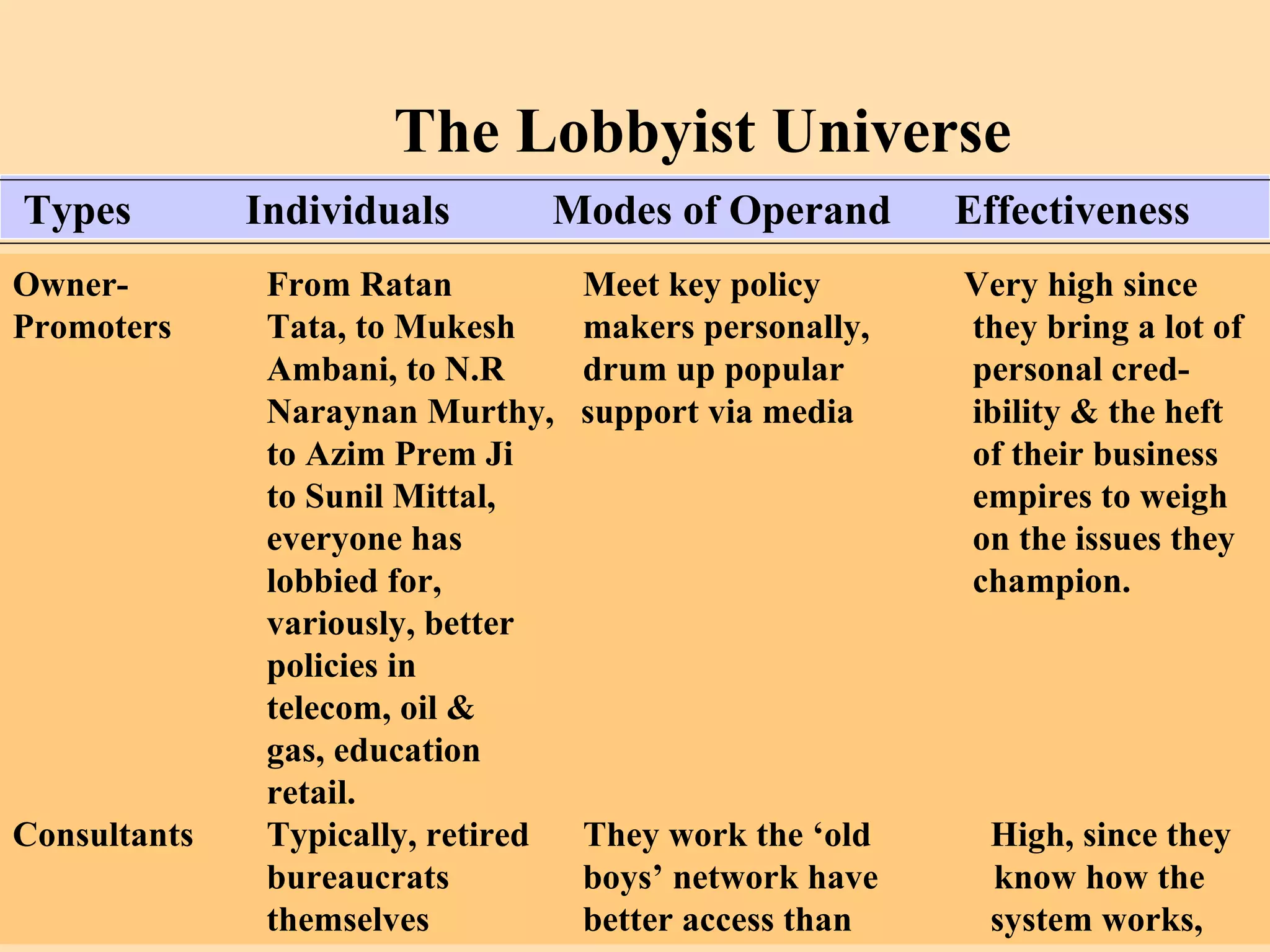
• Whether brokering a deal relating to merger or  acquisition, obtaining a refund from government developments or getting clearances to start new  projects, services of lobbyists are always available • Several sectors of the economy are not thrown open to FDI • Such sectors offer plenty of scope for lobbying Lobbyists come from different hues as exhibit  (below) shows
The Lobbyist Universe   Types   Individuals   Modes of Operand   Effectiveness Owner- From Ratan    Meet key policy   Very high since  Promoters Tata, to Mukesh   makers personally,   they bring a lot of Ambani, to N.R   drum up popular   personal cred- Naraynan Murthy,  support via media   ibility & the heft to Azim Prem Ji   of their business to Sunil Mittal,   empires to weigh everyone has    on the issues they lobbied for,    champion. variously, better policies in  telecom, oil & gas, education  retail.  Consultants Typically, retired  They work the ‘old    High, since they bureaucrats   boys’ network have  know how the  themselves   better access than    system works,
such as Pradip   employee-   & which the Baijal, former   lobbyists, &   levers to pull. TRAI chairman,   know the lay of & C.M Vasudeva,   the land better former Expenditure   than most. Secretary in the  Ministry of Finance PR firms Increasingly being   They work    Medium to  used to do more   through in-   low, because than just public   formal channels  they have relations, PR firms   & media.  Limited  offer ‘back office’   access to support Perfect   both the Relations, Genesis   bureaucracy & IPAN are some   & the media. such firms.
Professional   Reliance Industries’  Mostly interact  High, since Employees   Shankar Adawal,   with key  they know   ITC’s K. S Vidya-   bureaucrats, the innards   nathan, Renbaxy   or lobby via of their   laboratories’   industry  industries &   Ramesh Adige, are  associations. can make   some senior  compelling,   executives who have fact-based   extensive domain arguments.   knowledge &   champion specific   issues. Politicos   Usually, members   They try to Medium,    of Parliament or   appeal to the they are   those embedded    party high  typically
  in the organisational  commands or the  used in      machinery.   concerned  addition to   S. Gurumurthy &   ministers direct- other    Salman Khurshid   ly.  Lobbyists.   are two examples. Agents   Dime a dozen,    They keep  Medium,to    these are largely   track of bids, high, this is   fixers & do not   file status,  an ‘ever-   have the domain   work through green’    knowledge or the   lower level species.   credibility of other   bureaucracy   lobbyists.   & grease palms.
Terrorism Consultants • To manage terrorism risk, MNCs hire consultants in counter-terrorism to train employees to cope with  the threat of terrorism.
Bargaining & Integrative Approaches • The five strategies of managing political risk which have been discussed above fall under two broad  approaches : i) Relative Bargaining Power, & ii) Integrative as well as Protective &  Defensive Techniques
Relative Bargaining Power • This theory is simple – an MNC has more  bargaining power than the host country  • In other words, the firm has the power & position to do business in a host country on its own terms &  conditions  • Initiating investment in a host country, possessing proprietary technology, & owning critical raw  materials will enable a firm to enjoy high bargaining  power
Integrative as well as Protective & Defensive   Techniques • Another means by which an  international business seeks to avoid political risk is by integration & the  implementation of protective & defensive techniques • Integrative techniques  are designed to help the  subsidiary to become one with the host country’s needs & culture • The adaptation strategies discussed earlier belong to this category  • Protective & defensive techniques  are designed to  discourage the host government from interfering  in
operations  • In contrast to the interactive techniques, these  actually encourage non-integration of the subsidiary  in the host country environment  Examples Include :  1) Doing as little local manufacturing as possible &  conducting all research & development outside the host country ; 2) Limiting the responsibility of local personnel & hiring only those who are vital to the operation ; 3) Raising capital from local banks & the host  government as well as outside sources ;& 4) Dispersing production of the product among a
number of countries  • When should a firm use integrative techniques &  when should it use protective & defensive strategies? • Answers to these questions depend on the technology  being used, expertise & skills, logistics, & labour transmission of the MNC  • In all, four basic types of firms are said to use these  techniques • The first type comprises dynamic, high technology  MNCs which possess the unique knowledge that the host country needs • Computer companies are a good example • As seen from Fig.(below), these firms may not use
integrative techniques • They keep distance from host country governments & rely heavily on protective & defensive techniques • The second type consists of MNCs with low or stable technology  • These firms use relatively unsophisticated  technology • Steel companies are one such example • As seen from Fig.(below), these MNCs use both high  integration & high protective & defensive strategies, although they tend to rely more on integration than on defensive approach
• The third type consists of inter-national businesses  whose managers  need to be highly skilled • For example, food production firms require  advanced marketing & management skills to be  competitive • These firms typically use a balanced approach of integration & protective & defensive techniques, but they are less concerned with either than low or  stable technology companies do • The last type comprises firms characterised by  highly labour-intensive products, high value in  relation to weight &/or volume, & need for a strong global marketing systems for selling the product
• Firms manufacturing sewing machines are an  appropriate example • Companies in this category tend to rely more  heavily on protective & defensive measures than any of the other three groups & employ only a moderate concern for integrative techniques
Low 1 1 10   20 Low   Moderate   High   Protective/ defensive techniques (11, 14)  • Low or stable technology   • Unified logistic (7, 10) labour transmission Advanced management   (16, 6) skill   • (14, 3)  • Dynamic high technology Moderate  10 Integrative techniques High 20 Fig. Use of Integrative & Protective   & Defensive Techniques by Firms in Select  Industries
 

Business environment

  • 1.
    Nature of Inter-nationalBusiness Environment • The environment of inter-national business is regarded as the sum total of all the external forces working upon the firm as it goes about its affairs in foreign & domestic markets. • The environmental factors are divided into : 1. Political –legal 2. Economic 3. Cultural, & 4. Technological Groups
  • 2.
    International Business Political- Legal Cultural Economic Technological Environment of Inter-national Business
  • 3.
    Political Environment •Political environment refers to the influence of the system of government & judiciary in a nation on inter-national business • The system of government in a nation wields considerable impact on its business • The type & structure of government prevailing in a country decides, promotes, fosters, encourages, shelters, directs, & controls the business of that country • A political system (another name for the type of government) that is stable, honest, efficient, &
  • 4.
    dynamic & whichensures political participation to the people, & assures personal security to the citizens, is a primary factor for economic develop- ment • The developed economies of to-day owe their success to a large extent to the political system they richly enjoyed “there is to-day”, comments John Kenneth Galbraith, “no country with a stable & honest government that does not have or has not had a reasonably satisfactory state of economic progress”
  • 5.
    Democracy • Two basic political systems are in existence all over the world, namely, democracy & totalitarianism • In its pure sense, democracy refers to a political arrangement in which the supreme power is vested in the people • Democracy may manifest itself in any of two funda- mental manners • If each individual is given the right to rule & vote on every matter, the result is pure democracy which is not, however workable in a complex society with a large constituency
  • 6.
    • Hence therepublican form of government follows whereby the public, in a democratic manner, elect their representatives who do the ruling. • A representative democracy rests on the assumption that should the elected representatives fail to perform adequately they will be voted down at the next election • Democracies maintain stable business environments primarily through laws protecting individual property rights • In theory, business prospers when the private sector enjoys freedom to decide, freedom to earn, & freedom to spend • But in practice free markets, property rights, & democracies do not guarantee economic growth
  • 7.
    India, for example, is the world’s largest democracy yet experienced slow economic growth till recently • Meanwhile, countries under near totalitarian regimes achieved rapid economic growth • The so-called Asian Tigers – Hong Kong, Singapore, South Korea, & Taiwan – for example, built strong market economies in the absence of democratic practices.
  • 8.
    Totalitarianism • Intotalitarianism, also called authoritarianism, individual freedom is completely sub-ordinated to the power of the authority of state & concentrated in the hands of one person or in a small group, which is not constitutionally accountable to the people • Societies ruled by pressure clique – political, economic or military or by a dictator, plus most oligarchies & monarchies – belong to this category • The doctrines of fascism & erstwhile communism are examples of totalitarianism
  • 9.
    • During theFirst & Second World Wars, the authoritarian governments began to appear in most mature economies • Even after the Second War, the totalitarian system became most common in newly independent nations • Administrative efficiency of the dictators was often cited as an advantage for coping with the problems of new-born states • Surprisingly many nations are ruled by dictators or monarchies even to-day • Nazi Germany (under Adolf Hitler) & the former Soviet Union under (under Joseph Stalin) are historic examples of totalitarian governments
  • 10.
    • To-day, Cambodia,Myanmar, China, Cuba, Congo, & Iraq are prominent examples of totalitarian governments
  • 11.
    Types of TotalitarianismTotalitarianism, in itself is of four types : a) Theocratic Totalitarianism b) Secular Totalitarianism c) Tribal Totalitarianism d) Right-Wing Totalitarianism
  • 12.
    Theocratic Totalitarianism •When a country’s religious leaders are also its political leaders, its political system is called a theocracy • Religious leaders frame & enforce laws & regulations that are based on religious beliefs • A political system that is under the control of religious leaders is theocratic totalitarianism • Afghanistan, some Sheikhs of the Middle East & Iran are the countries which have such political dispensation
  • 13.
    Secular Totalitarianism •A political system in which political leaders are guided by military & bureaucratic power is called secular totalitarianism • In such a system, the military controls the govern- ment & makes decisions which it deems to be in the best interest of the country • An example is Pakistan • Until the early 1980’s secular totalitarianism were common throughout Latin America • They were also found in several Asian countries, particularly South Korea, Taiwan, Singapore,
  • 14.
    & the Philippines• Since the early 1980’s, however, this form of govern- ment has been losing its ground • The majority of Latin American countries are now genuine democracies, while significant political freedom has been granted to the political opposition in countries such as South Korea, Taiwan & the Philippines
  • 15.
    Tribal Totalitarianism •A third form of totalitarianism is the tribal totalitarianism • This exists principally in African countries, such as Zimbabwe, Tanzania, Uganda, & Kenya • Tribal totalitarianism occurs when a political party that represents the interests of a particular tribe monopolises power
  • 16.
    Right-Wing Totalitarianism •Here, private ownership of property is endorsed by government, market forces are also allowed free play, but political freedom are rarely granted • Argentina, Brazil, Chile, & Paraguay were under right-wing totalitarian governments in the 1980’s • China is classic example of polity which though communist by definition, is pursuing right-wing policies • The country is privatising state-owned enterprises,
  • 17.
    attracting FDI, pursuingpro-business policies & is registering a hefty growth rate • The country appears to be an open & free society, but is essentially totalitarian • As between democracy & totalitarianism, which political system is ideal for business growth is a relevant question • It may be stated that democracy does not guarantee high rates of economic growth, nor does totalitarianism drive a country to slow economic growth • Rate of growth – the increase in the amount of goods & services produced by a nation – is influenced by many variables other than political & civil liberties
  • 18.
    • These includea country’s tax system, policy towards foreign & domestic investment, political stability, judiciary, & the like.
  • 19.
    Political Risk •Corporates face political risk when they conduct business with the outside world • Political risk is any governmental action or politically motivated event that could adversely affect the long-term profitability or value of a firm • Political risk affects different firms in different ways • It can threaten the market of an exporter, the production facilities of a manufacturer, or the ability of a firm to repatriate its profits from a host country to its home country
  • 20.
    Examples of PoliticalRisks & their Impact on International Business A) Macro Risks Impact Expropriation of corporate Loss of future profits assets without prompt & adequate compensation Barriers to repatriation of No motivation to improve profits efficiency Confiscation of properties Loss of assets & future profits Loss of technology or other Loss of future profits intellectual property Campaigns against foreign Loss of sales & increased goods costs of public relations campaigns
  • 21.
    Mandatory labour legislationsIncreased operating costs Civil wars Destruction of property loss of sales, increased security costs, disrupted production runs Inflation Increased operating costs Currency devaluations Reduced values of repatriated earnings Micro Risks i) Kidnappings, terrorist, Disrupted production, threats, etc. higher security costs, reduced productivity ii) Increased taxation Reduced after tax profits iii) Officials’ dishonesty Loss of business, increased operating costs
  • 22.
    Type of RisksDistinction is often made between Macro & Micro risks: A) Macro Political Risk B) Micro Political Risk
  • 23.
    Macro Political Risk• A macro political risk affects all inter-national businesses in the same way • Expropriation, the seizure of privately owned assets, as for example, a farm or a factory, by government with little or no compensation to the owners, is a macro political risk • The taking of ownership of an entire industry that had been generated privately, as a part of a plan to restructure an entire economy, is called national- isation, again a macro political risk • Communist governments in eastern Europe & China expropriated private firms following
  • 24.
    World War II• Fidel Castro did the same in Cuba during 1958-59 • Recently, governments in Angola, Chile, Ethiopia, Peru, & Zambia have expropriated private firms • Field Marshall Ayub Khan nationalised four hotels of M.S Oberoi without paying any compensation • In all these cases, inter-national businesses were hard hit • Political boycotts also result in macro political risk • Since 1955, a number of Arab countries have boycotted firms with branches in Israel or companies that have allowed the use of their trade name there
  • 25.
    • Macro politicalrisk can also come about because of indigenisation laws which bind inter-national businesses to accept equity participation by local citizens.
  • 26.
    Micro Political Risk • A micro political risk affects specific foreign business • Micro political risk include industry regulations, taxes, kidnapping, & terrorist threats • India’s decision in 1975 to reduce foreign equity to 40 per cent & Peru’s decision to nationalise its copper mines are example of micro political risks • The US decision to tax textile imports is another instance • Firms which have high visibility in host countries are targets of micro political risk • If agitations are caused by animosity between
  • 27.
    factions in thehost country & the government of a foreign country, agitators may target only the most visible companies from that foreign country, like KFC.
  • 28.
    Political Risk Assessment• Inter-national business must conduct some form of political risk assessment in order to manage risks • Typically, managers in host countries assess the potentially destabilising issues & evaluate their future impact on the firm, making suggestions for handling problems • Top management at the head office will then establish guidelines for each host country managers to solve such problems • Risk assessment by inter-national businesses usually takes two forms
  • 29.
    • One isthrough the use of experts or consultant familiar with the host country or region under consideration • Such, consultants, advisors, or committees usually monitor important indicators that may portend political change • They then assess the likelihood of political change & develop several scenarios to describe alternative political conditions in the future • A second & increasingly common means of political risk assessment used by inter-national businesses is through the development of their internal staff & in-house capabilities
  • 30.
    • This typeof assessment may be accomplished by having staff assigned to foreign subsidiaries or affiliates monitor local political activities or by hiring people with expertise in the political & economic conditions in regions critical to the firm’s operations • Whatever the method, timely information from the people in the front line should not be missed • Experts of consultants are no substitute for the line managers in the foreign subsidiaries, many of whom are host country nationals • These managers represent the most important resource for current information on the political
  • 31.
    • environment &how it might affect their firm because they are uniquely situated at the meeting point of the firm & the host country • Prudent inter-national businesses, however weigh the subjectivity of these managers’ assessments & also realise that similar events will have different effects in different countries • Some inter-national businesses try to quantify the political risks associated with different countries • Using these criteria countries are ranked as being high or low in political risks • The criteria generally used include the political- economic environment, domestic economic
  • 32.
    conditions, & externaleconomic relations • Russia & Turkey rank high on risk & Singapore & the Netherlands have very low risk • Eurasia Group, a political & economic risk analysis firm, has composed Global Political Risk Index (GPRI) • The index is a composite measure of the state of a country’s government, security, society & economy • All indicators are scored on a scale of 0 to 100 • The higher the number, the greater the political stability • Table (below) contains ranking of countries on GPRI by Eurasia
  • 33.
    • The rankingrelates to 2006 & 2007 • The safest countries are Hungary, South Korea, Poland & Bulgaria • Pakistan, Nigeria, Venezuela & Iran are the countries with least safety • India stays at 62 both in 2006 & 2007 • China has improved its ranking from 61 in 2006 to 66 in 2007
  • 34.
    Table CompositeScore 2006 2007 Hungary 78 77 S. Korea 76 75 Poland 74 72 Bulgaria 70 69 Mexico 67 67 China 66 61 Brazil 66 64 Turkey 65 64 Argentina 66 66 S. Africa 64 65 Russia 63 61 India 62 62 Thailand 61 60
  • 35.
    Egypt 60 58Algeria 59 59 Saudi Arabia 57 57 Indonesia 57 55 Colombia 56 55 Ukrain 56 57 Philippines 55 56 Iran 51 49 Venezuela 50 52 Nigeria 48 47 Pakistan 45 50
  • 36.
    Managing Political Risks• Inter-national businesses employ different methods for managing political risks ( see the Table under Political Risk • As the table shows, an MNC involves itself in each of these either directly or indirectly. Similarly, its actions can be defensive or proactive 1. Avoiding Investment 2. Adaptation 3. Threat 4. Lobbying 5. Terrorism Consultants
  • 37.
    Direct Indirect Reactive Proactive Managing Risks Host operations dependent on home control 2. Diversification Risk insurance Home country government pressuring host country government Joint venture Licensing agreements Promote host goals Lobbying home & host governments Corporate citizenship in host country
  • 38.
    Avoiding Investment •The simplest way to manage political risks is to avoid investing in a country ranked high on such risks • Where investment has already been made, plants may be wound up or transferred to some other country which is considered to be relatively safe • This may be a poor choice as the opportunity to do business in a country will be lost
  • 39.
    Adaptation • Anotherway of managing political risk is adaptation • Adaptation means incorporating risk into business strategies • MNCs incorporate risk by means of the following three strategies: a) Local Equity & Debt b) Development Assistance c) Insurance
  • 40.
    Local Equity &Debt • This involves financing subsidiaries with the help of local firms, trade unions, financial institutions, & government • As partners in local businesses, these groups ensure that political developments do not disturb operations • Localisation entails modifying operations, product mix, or any such activity to suit local taste & culture • When McDonald’s commenced franchisee operations in India, it ensured that sandwiches did not contains any beef.
  • 41.
    Development Assistance •Offering development assistance allows an inter- national business to assist the host country in improving its quality of life • Since the firm & the nation become partners, both stand to gain • In Myanmar, for instance, the US oil company Unocal & France’s Total have invested billions of dollars to develop natural gas fields & also spent $ 6 million on local education, medical care, & other improvements.
  • 42.
    c) Insurance• This is the last means of adaptation • Companies buy insurance against the potential effects of political risk • Some policies protect companies when host government restrict the convertibility of their currency into parent country currency • Other insure against losses created by violence events including war & terrorism • Most developed countries have created agencies to ensure the firms against risks
  • 43.
    • These agenciesare generally state owned/sponsored • The Overseas Private Investment Corporation (OPIC) for instance, insures US overseas investments against nationalisation, revolutions & foreign exchange inconvertibility • Similarly, the Multilateral Investment Guarantee Agency (MIGA), a subsidiary of the World Bank, provides insurance against political risks • Private insurance firms, such as Lloyd's of London, also underwrites political risk insurance
  • 44.
    Threat • Politicalrisks can also be managed by trying to prove to the host country that it cannot do without the activities of the firm • This may be done by trying to control raw materials, technology & distribution channels in the host country • The firm may threaten the host country that the supply of materials, products, or technology would be stopped if its functioning is disrupted.
  • 45.
    Lobbying • Influencinglocal politics through lobbying is another way of managing political risks • Lobbying is the policy of hiring people to represent a firm’s business interest as also its views on local political matters • Lobbyists meet with local public officials & try to influence their position on issues relevant to the firm • Their ultimate goal is getting favourable legislation passed & unfavourable ones rejected • Lobbyists render variety of services for fees
  • 46.
    • Whether brokeringa deal relating to merger or acquisition, obtaining a refund from government developments or getting clearances to start new projects, services of lobbyists are always available • Several sectors of the economy are not thrown open to FDI • Such sectors offer plenty of scope for lobbying Lobbyists come from different hues as exhibit (below) shows
  • 47.
    The Lobbyist Universe Types Individuals Modes of Operand Effectiveness Owner- From Ratan Meet key policy Very high since Promoters Tata, to Mukesh makers personally, they bring a lot of Ambani, to N.R drum up popular personal cred- Naraynan Murthy, support via media ibility & the heft to Azim Prem Ji of their business to Sunil Mittal, empires to weigh everyone has on the issues they lobbied for, champion. variously, better policies in telecom, oil & gas, education retail. Consultants Typically, retired They work the ‘old High, since they bureaucrats boys’ network have know how the themselves better access than system works,
  • 48.
    such as Pradip employee- & which the Baijal, former lobbyists, & levers to pull. TRAI chairman, know the lay of & C.M Vasudeva, the land better former Expenditure than most. Secretary in the Ministry of Finance PR firms Increasingly being They work Medium to used to do more through in- low, because than just public formal channels they have relations, PR firms & media. Limited offer ‘back office’ access to support Perfect both the Relations, Genesis bureaucracy & IPAN are some & the media. such firms.
  • 49.
    Professional Reliance Industries’ Mostly interact High, since Employees Shankar Adawal, with key they know ITC’s K. S Vidya- bureaucrats, the innards nathan, Renbaxy or lobby via of their laboratories’ industry industries & Ramesh Adige, are associations. can make some senior compelling, executives who have fact-based extensive domain arguments. knowledge & champion specific issues. Politicos Usually, members They try to Medium, of Parliament or appeal to the they are those embedded party high typically
  • 50.
    inthe organisational commands or the used in machinery. concerned addition to S. Gurumurthy & ministers direct- other Salman Khurshid ly. Lobbyists. are two examples. Agents Dime a dozen, They keep Medium,to these are largely track of bids, high, this is fixers & do not file status, an ‘ever- have the domain work through green’ knowledge or the lower level species. credibility of other bureaucracy lobbyists. & grease palms.
  • 51.
    Terrorism Consultants •To manage terrorism risk, MNCs hire consultants in counter-terrorism to train employees to cope with the threat of terrorism.
  • 52.
    Bargaining & IntegrativeApproaches • The five strategies of managing political risk which have been discussed above fall under two broad approaches : i) Relative Bargaining Power, & ii) Integrative as well as Protective & Defensive Techniques
  • 53.
    Relative Bargaining Power• This theory is simple – an MNC has more bargaining power than the host country • In other words, the firm has the power & position to do business in a host country on its own terms & conditions • Initiating investment in a host country, possessing proprietary technology, & owning critical raw materials will enable a firm to enjoy high bargaining power
  • 54.
    Integrative as wellas Protective & Defensive Techniques • Another means by which an international business seeks to avoid political risk is by integration & the implementation of protective & defensive techniques • Integrative techniques are designed to help the subsidiary to become one with the host country’s needs & culture • The adaptation strategies discussed earlier belong to this category • Protective & defensive techniques are designed to discourage the host government from interfering in
  • 55.
    operations •In contrast to the interactive techniques, these actually encourage non-integration of the subsidiary in the host country environment Examples Include : 1) Doing as little local manufacturing as possible & conducting all research & development outside the host country ; 2) Limiting the responsibility of local personnel & hiring only those who are vital to the operation ; 3) Raising capital from local banks & the host government as well as outside sources ;& 4) Dispersing production of the product among a
  • 56.
    number of countries • When should a firm use integrative techniques & when should it use protective & defensive strategies? • Answers to these questions depend on the technology being used, expertise & skills, logistics, & labour transmission of the MNC • In all, four basic types of firms are said to use these techniques • The first type comprises dynamic, high technology MNCs which possess the unique knowledge that the host country needs • Computer companies are a good example • As seen from Fig.(below), these firms may not use
  • 57.
    integrative techniques •They keep distance from host country governments & rely heavily on protective & defensive techniques • The second type consists of MNCs with low or stable technology • These firms use relatively unsophisticated technology • Steel companies are one such example • As seen from Fig.(below), these MNCs use both high integration & high protective & defensive strategies, although they tend to rely more on integration than on defensive approach
  • 58.
    • The thirdtype consists of inter-national businesses whose managers need to be highly skilled • For example, food production firms require advanced marketing & management skills to be competitive • These firms typically use a balanced approach of integration & protective & defensive techniques, but they are less concerned with either than low or stable technology companies do • The last type comprises firms characterised by highly labour-intensive products, high value in relation to weight &/or volume, & need for a strong global marketing systems for selling the product
  • 59.
    • Firms manufacturingsewing machines are an appropriate example • Companies in this category tend to rely more heavily on protective & defensive measures than any of the other three groups & employ only a moderate concern for integrative techniques
  • 60.
    Low 1 110 20 Low Moderate High Protective/ defensive techniques (11, 14) • Low or stable technology • Unified logistic (7, 10) labour transmission Advanced management (16, 6) skill • (14, 3) • Dynamic high technology Moderate 10 Integrative techniques High 20 Fig. Use of Integrative & Protective & Defensive Techniques by Firms in Select Industries
  • 61.