




Unified theory of acceptance and use of
technology (UTAUT) is a technology acceptance
model formulated by Venkatesh and others in "User
acceptance of information technology: Toward a
unified view“ Unified theory of acceptance and
use of technology (UTAUT) is a technology
acceptance model formulated by Venkatesh and
others in "User acceptance of information
technology: Toward a unified view"
The UTAUT aims to explain user intentions to use
an information system and subsequent usage
behavior.
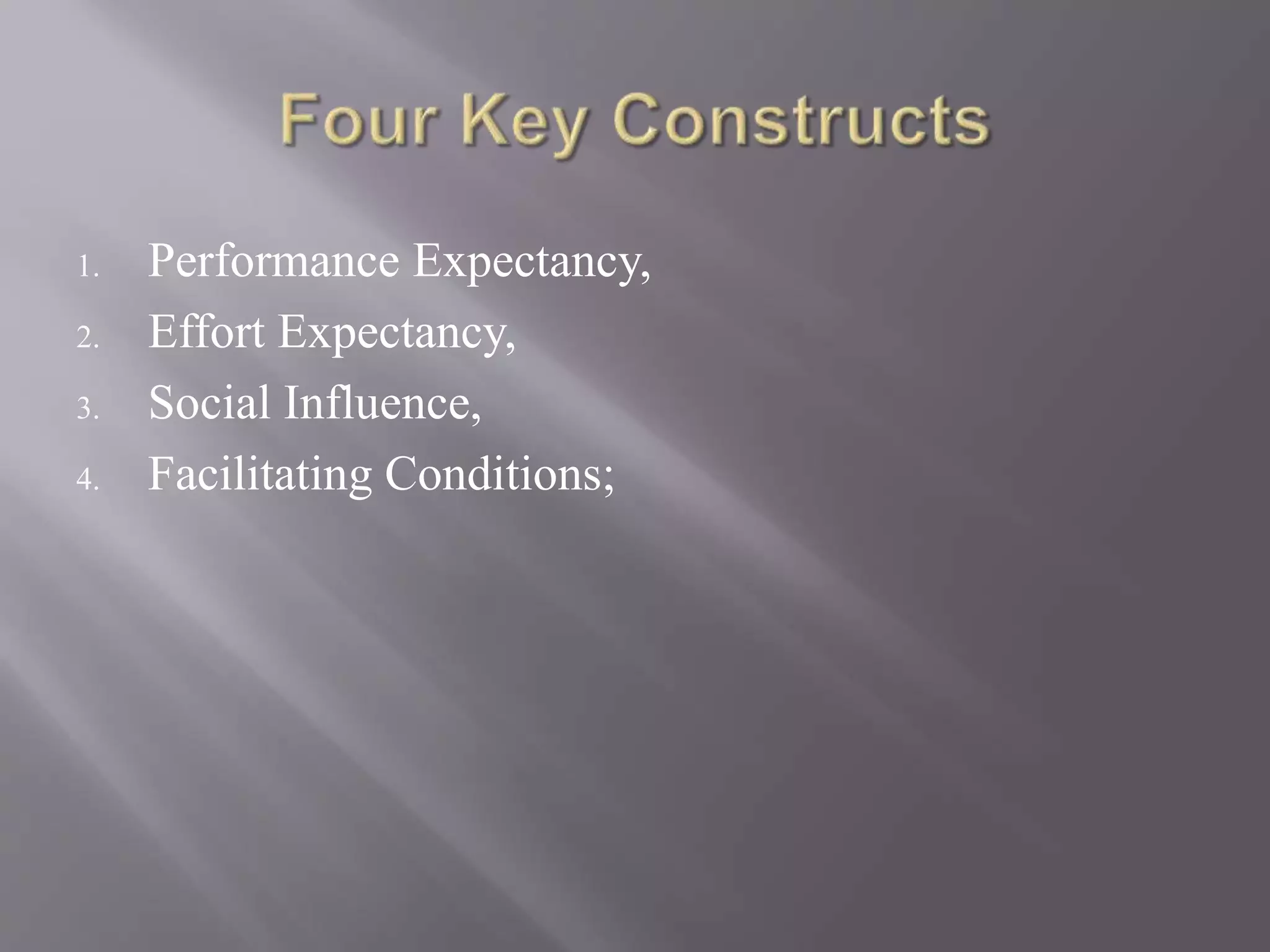
1. Performance Expectancy,
2. Effort Expectancy,
3. Social Influence,
4. Facilitating Conditions;
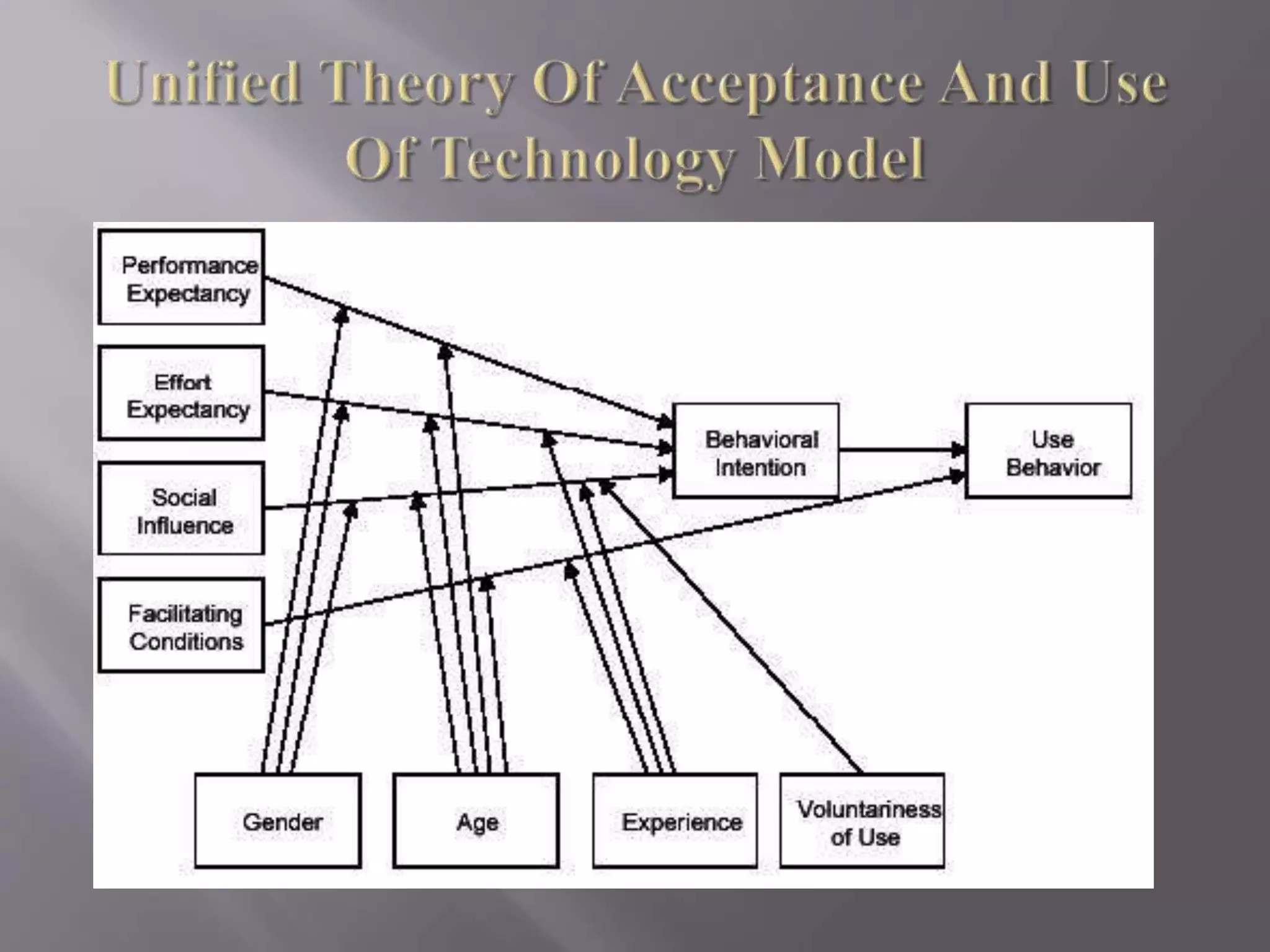
The first three being direct determinants of usage
intention and behavior, and the fourth a direct
determinant of use behavior.
Gender,
Age,
Experience,
And voluntariness
Of use are posited to moderate the impact of the four
key constructs on usage intention and behavior.
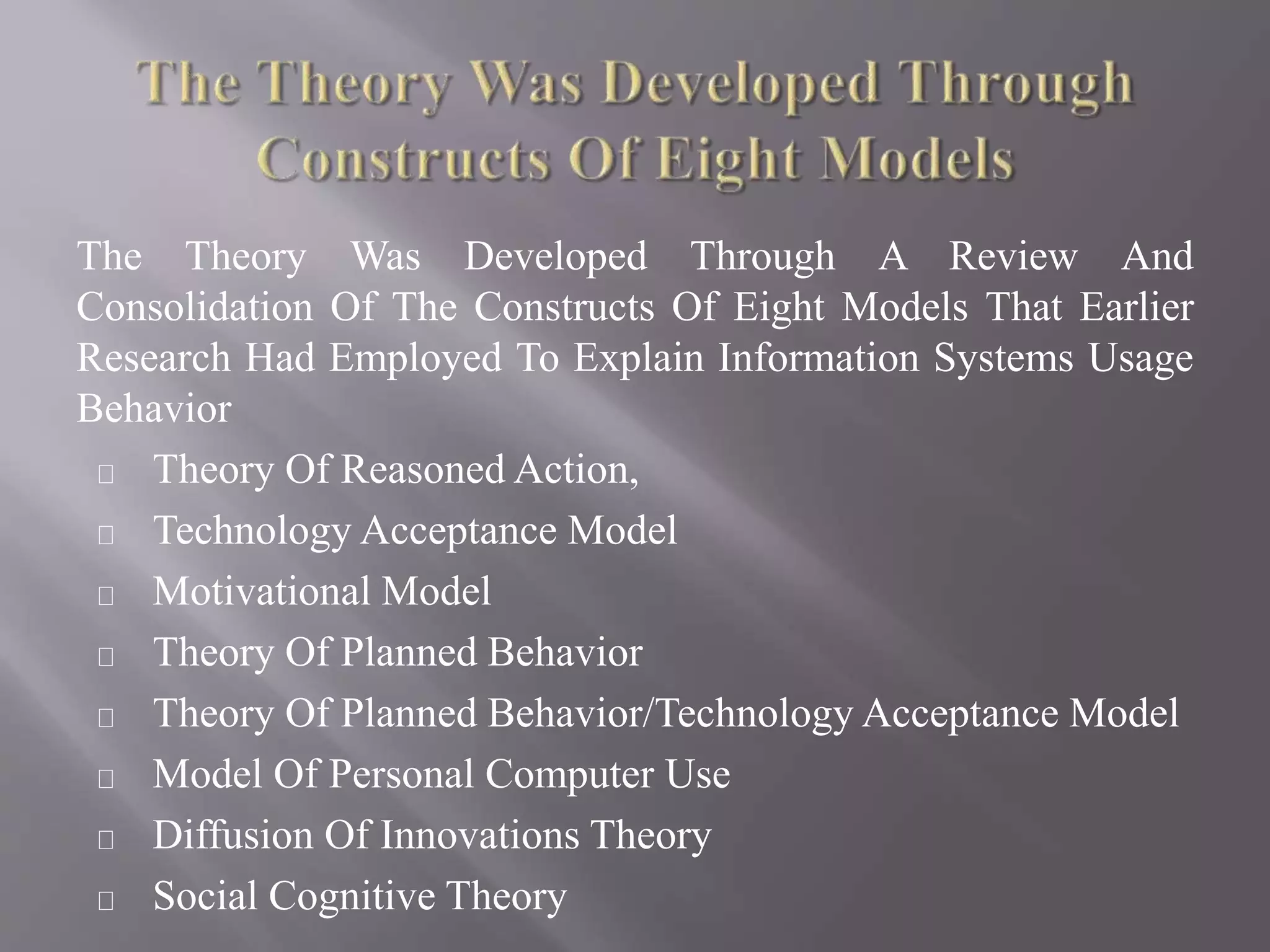
The Theory Was Developed Through A Review And
Consolidation Of The Constructs Of Eight Models That Earlier
Research Had Employed To Explain Information Systems Usage
Behavior
Theory Of Reasoned Action,
Technology Acceptance Model
Motivational Model
Theory Of Planned Behavior
Theory Of Planned Behavior/Technology Acceptance Model
Model Of Personal Computer Use
Diffusion Of Innovations Theory
Social Cognitive Theory
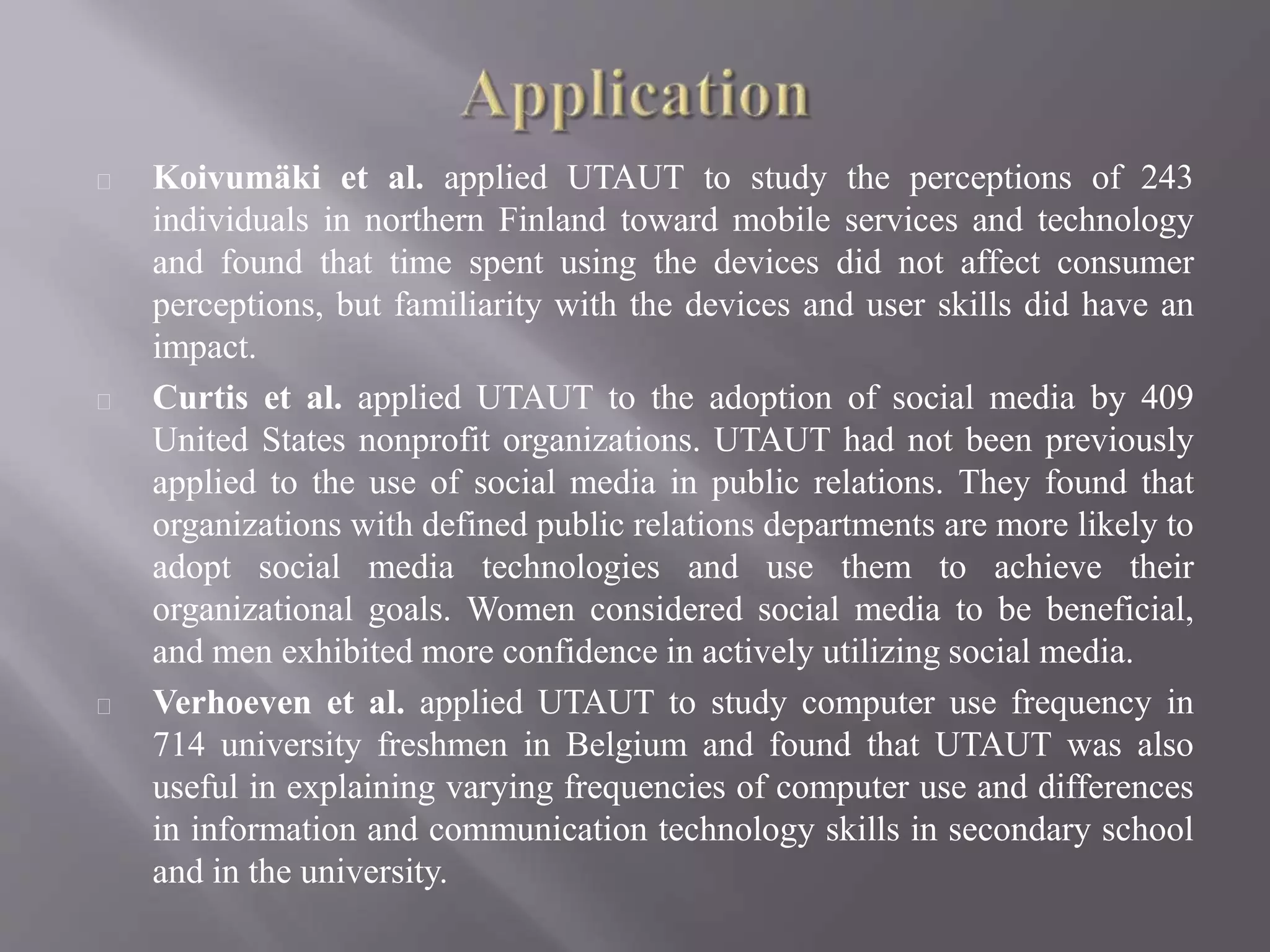
Koivumäki et al. applied UTAUT to study the perceptions of 243
individuals in northern Finland toward mobile services and technology
and found that time spent using the devices did not affect consumer
perceptions, but familiarity with the devices and user skills did have an
impact.
Curtis et al. applied UTAUT to the adoption of social media by 409
United States nonprofit organizations. UTAUT had not been previously
applied to the use of social media in public relations. They found that
organizations with defined public relations departments are more likely to
adopt social media technologies and use them to achieve their
organizational goals. Women considered social media to be beneficial,
and men exhibited more confidence in actively utilizing social media.
Verhoeven et al. applied UTAUT to study computer use frequency in
714 university freshmen in Belgium and found that UTAUT was also
useful in explaining varying frequencies of computer use and differences
in information and communication technology skills in secondary school
and in the university.
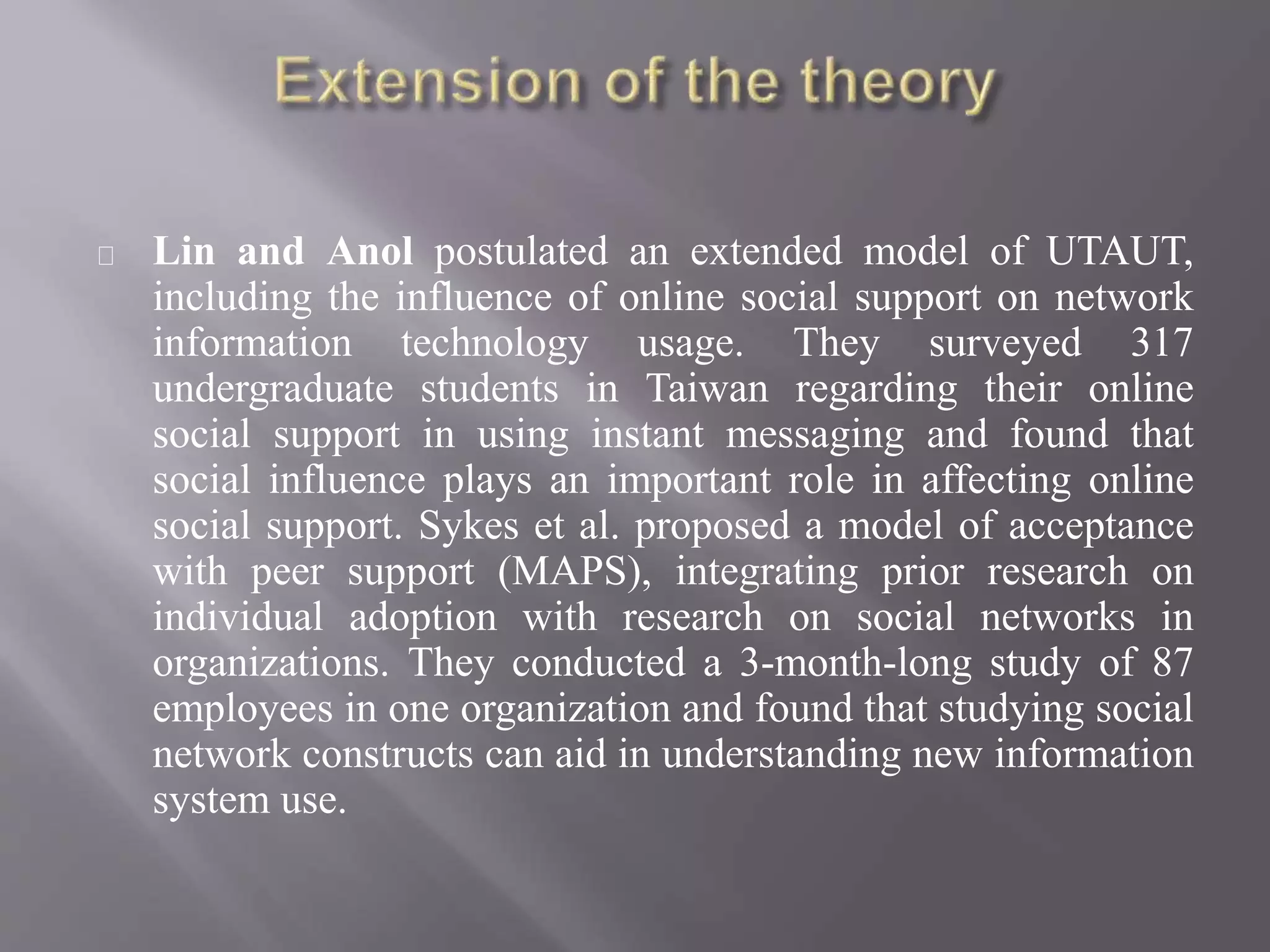
Lin and Anol postulated an extended model of UTAUT,
including the influence of online social support on network
information technology usage. They surveyed 317
undergraduate students in Taiwan regarding their online
social support in using instant messaging and found that
social influence plays an important role in affecting online
social support. Sykes et al. proposed a model of acceptance
with peer support (MAPS), integrating prior research on
individual adoption with research on social networks in
organizations. They conducted a 3-month-long study of 87
employees in one organization and found that studying social
network constructs can aid in understanding new information
system use.
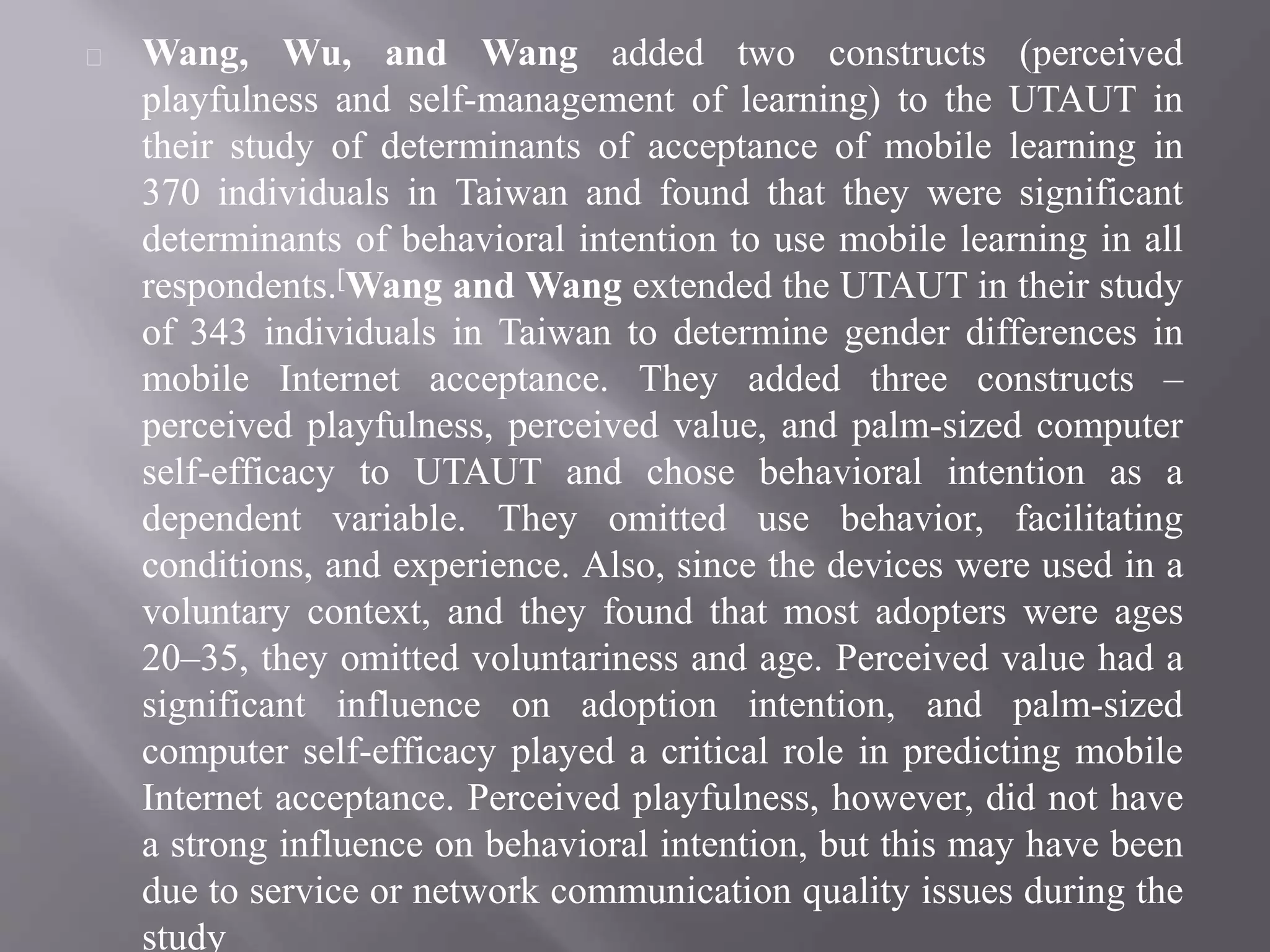
Wang, Wu, and Wang added two constructs (perceived
playfulness and self-management of learning) to the UTAUT in
their study of determinants of acceptance of mobile learning in
370 individuals in Taiwan and found that they were significant
determinants of behavioral intention to use mobile learning in all
respondents.[Wang and Wang extended the UTAUT in their study
of 343 individuals in Taiwan to determine gender differences in
mobile Internet acceptance. They added three constructs –
perceived playfulness, perceived value, and palm-sized computer
self-efficacy to UTAUT and chose behavioral intention as a
dependent variable. They omitted use behavior, facilitating
conditions, and experience. Also, since the devices were used in a
voluntary context, and they found that most adopters were ages
20–35, they omitted voluntariness and age. Perceived value had a
significant influence on adoption intention, and palm-sized
computer self-efficacy played a critical role in predicting mobile
Internet acceptance. Perceived playfulness, however, did not have
a strong influence on behavioral intention, but this may have been
due to service or network communication quality issues during the
study
Bagozzi critiqued the model and its subsequent extensions, stating
“UTAUT is a well-meaning and thoughtful presentation,” but that
it presents a model with 41 independent variables for predicting
intentions and at least 8 independent variables for predicting
behavior,” and that it contributed to the study of technology
adoption “reaching a stage of chaos.” He proposed instead a
unified theory that coheres the “many splinters of knowledge” to
explain decision making. van raaij and schepers criticized the
UTAUT as being less parsimonious than the previous technology
acceptance model and TAM2 because its high R2 is only achieved
when moderating key relationships with up to four variables. They
also called the grouping and labeling of items and constructs
problematic because a variety of disparate items were combined to
reflect a single psychometric construct.
Unified theory of acceptance and use of technology

Unified theory of acceptance and use of technology

  • 3.
    Unified theory ofacceptance and use of technology (UTAUT) is a technology acceptance model formulated by Venkatesh and others in "User acceptance of information technology: Toward a unified view“ Unified theory of acceptance and use of technology (UTAUT) is a technology acceptance model formulated by Venkatesh and others in "User acceptance of information technology: Toward a unified view"
  • 5.
    The UTAUT aimsto explain user intentions to use an information system and subsequent usage behavior.
  • 6.
    1. Performance Expectancy, 2.Effort Expectancy, 3. Social Influence, 4. Facilitating Conditions;
  • 7.
    The first threebeing direct determinants of usage intention and behavior, and the fourth a direct determinant of use behavior. Gender, Age, Experience, And voluntariness Of use are posited to moderate the impact of the four key constructs on usage intention and behavior.
  • 8.
    The Theory WasDeveloped Through A Review And Consolidation Of The Constructs Of Eight Models That Earlier Research Had Employed To Explain Information Systems Usage Behavior Theory Of Reasoned Action, Technology Acceptance Model Motivational Model Theory Of Planned Behavior Theory Of Planned Behavior/Technology Acceptance Model Model Of Personal Computer Use Diffusion Of Innovations Theory Social Cognitive Theory
  • 9.
    Koivumäki et al.applied UTAUT to study the perceptions of 243 individuals in northern Finland toward mobile services and technology and found that time spent using the devices did not affect consumer perceptions, but familiarity with the devices and user skills did have an impact. Curtis et al. applied UTAUT to the adoption of social media by 409 United States nonprofit organizations. UTAUT had not been previously applied to the use of social media in public relations. They found that organizations with defined public relations departments are more likely to adopt social media technologies and use them to achieve their organizational goals. Women considered social media to be beneficial, and men exhibited more confidence in actively utilizing social media. Verhoeven et al. applied UTAUT to study computer use frequency in 714 university freshmen in Belgium and found that UTAUT was also useful in explaining varying frequencies of computer use and differences in information and communication technology skills in secondary school and in the university.
  • 10.
    Lin and Anolpostulated an extended model of UTAUT, including the influence of online social support on network information technology usage. They surveyed 317 undergraduate students in Taiwan regarding their online social support in using instant messaging and found that social influence plays an important role in affecting online social support. Sykes et al. proposed a model of acceptance with peer support (MAPS), integrating prior research on individual adoption with research on social networks in organizations. They conducted a 3-month-long study of 87 employees in one organization and found that studying social network constructs can aid in understanding new information system use.
  • 11.
    Wang, Wu, andWang added two constructs (perceived playfulness and self-management of learning) to the UTAUT in their study of determinants of acceptance of mobile learning in 370 individuals in Taiwan and found that they were significant determinants of behavioral intention to use mobile learning in all respondents.[Wang and Wang extended the UTAUT in their study of 343 individuals in Taiwan to determine gender differences in mobile Internet acceptance. They added three constructs – perceived playfulness, perceived value, and palm-sized computer self-efficacy to UTAUT and chose behavioral intention as a dependent variable. They omitted use behavior, facilitating conditions, and experience. Also, since the devices were used in a voluntary context, and they found that most adopters were ages 20–35, they omitted voluntariness and age. Perceived value had a significant influence on adoption intention, and palm-sized computer self-efficacy played a critical role in predicting mobile Internet acceptance. Perceived playfulness, however, did not have a strong influence on behavioral intention, but this may have been due to service or network communication quality issues during the study
  • 12.
    Bagozzi critiqued themodel and its subsequent extensions, stating “UTAUT is a well-meaning and thoughtful presentation,” but that it presents a model with 41 independent variables for predicting intentions and at least 8 independent variables for predicting behavior,” and that it contributed to the study of technology adoption “reaching a stage of chaos.” He proposed instead a unified theory that coheres the “many splinters of knowledge” to explain decision making. van raaij and schepers criticized the UTAUT as being less parsimonious than the previous technology acceptance model and TAM2 because its high R2 is only achieved when moderating key relationships with up to four variables. They also called the grouping and labeling of items and constructs problematic because a variety of disparate items were combined to reflect a single psychometric construct.