THEORY : UNIFIED THEORY OF
ACCEPTANCE USE OF TECHNOLOGY
(UTAUT) FACTORS INFLUENCING
TECHNOLOGY
GGGE 6313
PSYCHOLINGUISTICS AND LANGUAGE TEACHING
ASSESSMENT
SUBMIT TO : DR.MASLAWATI MOHAMAD
GROUP MEMBERS :
VANESSA JILL ANAK JAMES BEROK (GP05736)
LOH WEI YIN (GP0566)
PRISLA DEVI A/P R.KRISHNAN (GP05711)
TRACEY ANG (GP05734)
SUBAHSHNINY A/P KRISHNAMURTY (GP05991)
BY:
VANESSA JILL ANAK JAMES BEROK (GP05736)
LOH WEI YIN (GP0566)
PRISLA DEVI A/P R.KRISHNAN (GP05711)
TRACEY ANG (GP05734)
SUBAHSHNINY A/P KRISHNAMURTY (GP05991)
The UTAUT aims to explain user
intentions to use an information
system and subsequent usage
behavior.
Develop by in 2003 by:
Viswanath Venkatesh (Primary)
Michael G. Morris
Gordon B. Morris
Fred D. Davis
Viswanath
Venkatesh
(Sisney, 2016)
Unified Theory of Acceptance Use of Technology
(UTAUT)
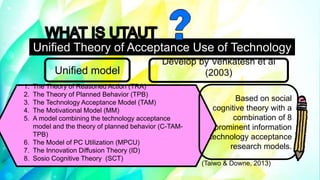
1. The Theory of Reasoned Action (TRA)
2. The Theory of Planned Behavior (TPB)
3. The Technology Acceptance Model (TAM)
4. The Motivational Model (MM)
5. A model combining the technology acceptance
model and the theory of planned behavior (C-TAM-
TPB)
6. The Model of PC Utilization (MPCU)
7. The Innovation Diffusion Theory (ID)
8. Sosio Cognitive Theory (SCT)
Unified model
Develop by Venkatesh et al
(2003)
Based on social
cognitive theory with a
combination of 8
prominent information
technology acceptance
research models.
(Taiwo & Downe, 2013)
UTAUT
UTAUT UTAUT2
Unified Theory of Acceptance Use of Technology
(UTAUT)
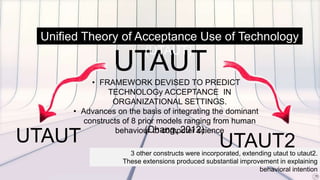
• FRAMEWORK DEVISED TO PREDICT
TECHNOLOGy ACCEPTANCE IN
ORGANIZATIONAL SETTINGS.
• Advances on the basis of integrating the dominant
constructs of 8 prior models ranging from human
behaviour to computer science(Chang, 2012)
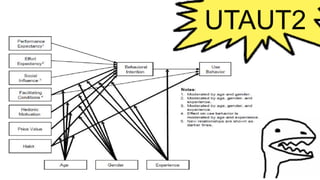
3 other constructs were incorporated, extending utaut to utaut2.
These extensions produced substantial improvement in explaining
behavioral intention
UTAUT
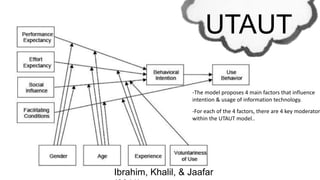
Ibrahim, Khalil, & Jaafar
-The model proposes 4 main factors that influence
intention & usage of information technology.
-For each of the 4 factors, there are 4 key moderators
within the UTAUT model..
UTAU
T
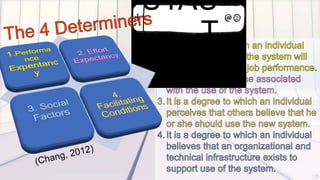
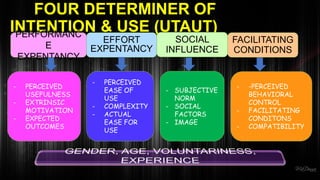
FOUR DETERMINER OF
INTENTION & USE (UTAUT)PERFORMANC
E
EXPENTANCY
EFFORT
EXPENTANCY
SOCIAL
INFLUENCE
FACILITATING
CONDITIONS
- PERCEIVED
USEFULNESS
- EXTRINSIC
MOTIVATION
- EXPECTED
OUTCOMES
- PERCEIVED
EASE OF
USE
- COMPLEXITY
- ACTUAL
EASE FOR
USE
- SUBJECTIVE
NORM
- SOCIAL
FACTORS
- IMAGE
- -PERCEIVED
BEHAVIORAL
CONTROL
- FACILITATING
CONDITONS
- COMPATIBILITY
UTAUT2
UTAUT
2
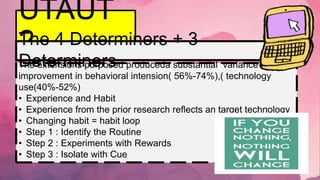
The extensions purposed produceda substantial variance
improvement in behavioral intension( 56%-74%),( technology
use(40%-52%)
• Experience and Habit
• Experience from the prior research reflects an target technology
• Changing habit = habit loop
• Step 1 : Identify the Routine
• Step 2 : Experiments with Rewards
• Step 3 : Isolate with Cue
The 4 Determiners + 3
Determiners
The cost and pricing structure have a significant impact on
consumers technology use.
Consumer acceptance and use of Information
Technology.
Positive when the benefits of using a technology
are perceived to be greater than the monetary cost.
PRICE VALUE
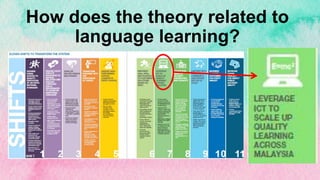
How does the theory related to
language learning?
How do you apply the theory in
your own classroom activity
1. Share information and notes
2. Create quiz and exercises using ICT
3. Introduce online learning games and apps
games
4. Integrate videos in the lessons
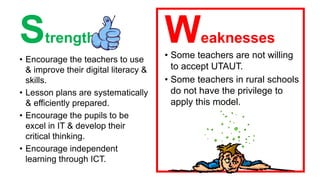
Strengths
• Encourage the teachers to use
& improve their digital literacy &
skills.
• Lesson plans are systematically
& efficiently prepared.
• Encourage the pupils to be
excel in IT & develop their
critical thinking.
• Encourage independent
learning through ICT.
Weaknesses
• Some teachers are not willing
to accept UTAUT.
• Some teachers in rural schools
do not have the privilege to
apply this model.
REFFERENCE
• Taiwo, A. A., & Downe, A. G. (2013, March). The Theory Of User
Acceptance and Use Of Technology (UTAUT): A Meta-Analytics
Review of Empirical Findings. Journal of Theoretical and Applied
Information Technology, 49(1), 48-58.
• Chang, A. (2012). UTAUT and UTAUT2: A Review and Agenda for
Future Research. Journal THE WINNERS, 106-114.
• Ibrahim, R., Khalil, K., & Jaafar, A. (2011). Towards Educational
Games Acceptance Model (EGAM): A Revised Unified Theory of
Acceptance and Use of Technology. International Journal of
Research and Reviews in Computer Science (IJRRCS), 839-846.
Retrieved from http://www.vvenkatesh.com/default.asp
• Sisney, T. (2016, June 26). The Unified Theory of Acceptance and
Use of Technology Model. Prezi.
THAN
K
YOU

Utaut ppt presentation group 10

  • 1.
    THEORY : UNIFIEDTHEORY OF ACCEPTANCE USE OF TECHNOLOGY (UTAUT) FACTORS INFLUENCING TECHNOLOGY GGGE 6313 PSYCHOLINGUISTICS AND LANGUAGE TEACHING ASSESSMENT SUBMIT TO : DR.MASLAWATI MOHAMAD GROUP MEMBERS : VANESSA JILL ANAK JAMES BEROK (GP05736) LOH WEI YIN (GP0566) PRISLA DEVI A/P R.KRISHNAN (GP05711) TRACEY ANG (GP05734) SUBAHSHNINY A/P KRISHNAMURTY (GP05991)
  • 2.
    BY: VANESSA JILL ANAKJAMES BEROK (GP05736) LOH WEI YIN (GP0566) PRISLA DEVI A/P R.KRISHNAN (GP05711) TRACEY ANG (GP05734) SUBAHSHNINY A/P KRISHNAMURTY (GP05991)
  • 4.
    The UTAUT aimsto explain user intentions to use an information system and subsequent usage behavior. Develop by in 2003 by: Viswanath Venkatesh (Primary) Michael G. Morris Gordon B. Morris Fred D. Davis
  • 5.
  • 6.
    Unified Theory ofAcceptance Use of Technology (UTAUT) 1. The Theory of Reasoned Action (TRA) 2. The Theory of Planned Behavior (TPB) 3. The Technology Acceptance Model (TAM) 4. The Motivational Model (MM) 5. A model combining the technology acceptance model and the theory of planned behavior (C-TAM- TPB) 6. The Model of PC Utilization (MPCU) 7. The Innovation Diffusion Theory (ID) 8. Sosio Cognitive Theory (SCT) Unified model Develop by Venkatesh et al (2003) Based on social cognitive theory with a combination of 8 prominent information technology acceptance research models. (Taiwo & Downe, 2013)
  • 7.
    UTAUT UTAUT UTAUT2 Unified Theoryof Acceptance Use of Technology (UTAUT) • FRAMEWORK DEVISED TO PREDICT TECHNOLOGy ACCEPTANCE IN ORGANIZATIONAL SETTINGS. • Advances on the basis of integrating the dominant constructs of 8 prior models ranging from human behaviour to computer science(Chang, 2012) 3 other constructs were incorporated, extending utaut to utaut2. These extensions produced substantial improvement in explaining behavioral intention
  • 8.
    UTAUT Ibrahim, Khalil, &Jaafar -The model proposes 4 main factors that influence intention & usage of information technology. -For each of the 4 factors, there are 4 key moderators within the UTAUT model..
  • 9.
  • 10.
    FOUR DETERMINER OF INTENTION& USE (UTAUT)PERFORMANC E EXPENTANCY EFFORT EXPENTANCY SOCIAL INFLUENCE FACILITATING CONDITIONS - PERCEIVED USEFULNESS - EXTRINSIC MOTIVATION - EXPECTED OUTCOMES - PERCEIVED EASE OF USE - COMPLEXITY - ACTUAL EASE FOR USE - SUBJECTIVE NORM - SOCIAL FACTORS - IMAGE - -PERCEIVED BEHAVIORAL CONTROL - FACILITATING CONDITONS - COMPATIBILITY
  • 11.
  • 12.
    UTAUT 2 The extensions purposedproduceda substantial variance improvement in behavioral intension( 56%-74%),( technology use(40%-52%) • Experience and Habit • Experience from the prior research reflects an target technology • Changing habit = habit loop • Step 1 : Identify the Routine • Step 2 : Experiments with Rewards • Step 3 : Isolate with Cue The 4 Determiners + 3 Determiners
  • 14.
    The cost andpricing structure have a significant impact on consumers technology use. Consumer acceptance and use of Information Technology. Positive when the benefits of using a technology are perceived to be greater than the monetary cost. PRICE VALUE
  • 16.
    How does thetheory related to language learning?
  • 17.
    How do youapply the theory in your own classroom activity 1. Share information and notes 2. Create quiz and exercises using ICT 3. Introduce online learning games and apps games 4. Integrate videos in the lessons
  • 18.
    Strengths • Encourage theteachers to use & improve their digital literacy & skills. • Lesson plans are systematically & efficiently prepared. • Encourage the pupils to be excel in IT & develop their critical thinking. • Encourage independent learning through ICT. Weaknesses • Some teachers are not willing to accept UTAUT. • Some teachers in rural schools do not have the privilege to apply this model.
  • 19.
    REFFERENCE • Taiwo, A.A., & Downe, A. G. (2013, March). The Theory Of User Acceptance and Use Of Technology (UTAUT): A Meta-Analytics Review of Empirical Findings. Journal of Theoretical and Applied Information Technology, 49(1), 48-58. • Chang, A. (2012). UTAUT and UTAUT2: A Review and Agenda for Future Research. Journal THE WINNERS, 106-114. • Ibrahim, R., Khalil, K., & Jaafar, A. (2011). Towards Educational Games Acceptance Model (EGAM): A Revised Unified Theory of Acceptance and Use of Technology. International Journal of Research and Reviews in Computer Science (IJRRCS), 839-846. Retrieved from http://www.vvenkatesh.com/default.asp • Sisney, T. (2016, June 26). The Unified Theory of Acceptance and Use of Technology Model. Prezi.
  • 21.

Editor's Notes

  • #17 Provide internet access and virtual learning environment via 1BestariNet for all 10,000 schools Augment online content to share best practices starting with a video library of the best teachers delivering lessons in Science, Mathematics, Bahasa Malaysia and English language Maximise use of ICT for distance and self paced learning to expand access to high-quality teaching regardless of location or student skill level
  • #18 VLE frog – notes sharing, quiz Chromebooks Online learning games – Kahoot! Apps Games – Wordsearch Youtube – videos