GROUNDED THEORY
RESEARCH
Merra Mae Ramos
AEF 6003 student
Overview
 What is Grounded Theory?
 When do we use Grounded
Theory?
 How do we use Grounded
Theory?
What are the dominant
Grounded Theory Designs?
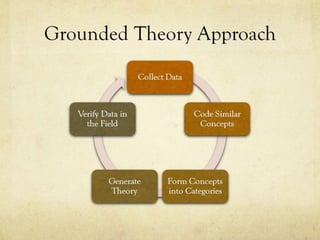
What is Grounded Theory?
Grounded Theory Research
is a qualitative approach to
generating and developing a
theory from the data collected in
a research study (Abadiano,
2016).
A grounded theory design is a
systematic, qualitative procedure
used to generate a theory that
explains, at a broad conceptual
level, a process, an action, or an
interaction about a substantive
topic (Creswell, 2008).
Grounded Theory is the most
common, widely used and
popular analytic technique in
qualitative analysis (Gibbs,
2010).
When do we use Grounded
Theory?
 when you need a broad theory
or explanation of a process;
 especially helpful when current
theories about a phenomenon are
either inadequate or nonexistent;
and
 when you wish to study some
process, such as how students
develop as writers (Neff, 1998) or
how high-achieving African
American and Caucasian
women’s career develop
How do we use Grounded Theory?
Unlike many other qualitative
methods we have some idea:
 how to start the research
(identifying area of interest,
avoiding theoretical
preconceptions and using
theoretical sensitivity)
 how to do it (through analytical
procedures and sampling
strategies)
 how to stop (when theoretical
saturation is reached)
What are the dominant Grounded
Theory Designs?
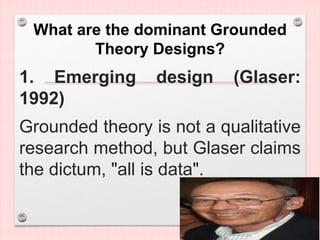
1. Emerging design (Glaser:
1992)
Grounded theory is not a qualitative
research method, but Glaser claims
the dictum, "all is data".
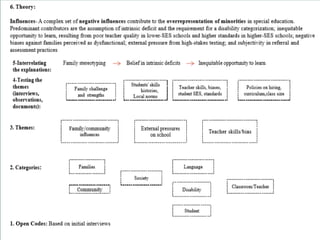
2. Systematic design (Strauss
and Corbin: 1998). It emphasizes
the use of data analysis steps of
open, axial and selective coding
and the development of a logic
paradigm or a visual picture of the
theory generated.
A. Open coding is a process of
reducing the data to a small set
of themes that appear to
describe the phenomenon
under investigation.
For example, in data collected for
article, a teacher, distressed about
the large number of children in her
class, exclaimed, "Oh, no! So
many kids!"
They compared the properties of
the situation to which she was
referring with a statement by
another teacher: "There are 23
[exceptional education] kids
lined up at my door."
Noting that both teachers were
complaining about the number of
children they were expected to
teach, authors assigned both
statements the code Class Size.
B. Axial coding is grouping the
discrete codes according to
conceptual categories that
reflect commonalities among
codes.
For example, they decided that the
code Class Size fit into a category
of codes that they called
Classroom/Teacher, which
referred to classroom issues that
were challenging to the teacher.
C. Selective coding is treating the
various code clusters in a selective
fashion, deciding how they relate to
each other and what stories they
tell.
3. Constructivist approach
(Charmaz: 1990, 2000, 2006)
Applying active codes, the researcher
looks at the participants’ thoughts,
feelings, values, viewpoints, assertions
etc. rather than gathering facts and
describing acts.
References
Abadiano, M. N. (2016).
Research in Daily Life 1.
Qualitative Research Method.
Cronica.
Bugday, S. (2012). Grounded
theory designs in qualitative
analysis. Retrieved from
https://www.slideshare.net/Seh
ribanBugday/grounded-theory-
11487784
Calman , L. (n.d.). What is
Grounded Theory?. Manchester.
Retrieved from http://hummedia.
manchester.ac.uk/institutes/meth
ods-manchester/docs/gt.pdf
Jones, A. and Weas, L. (2011).
Grounded Theory. Retrieved
from https://www.slideshare.net/
larryweas/grounded-theory-
presentation-10065410

Grounded Theory

  • 1.
    GROUNDED THEORY RESEARCH Merra MaeRamos AEF 6003 student
  • 2.
    Overview  What isGrounded Theory?  When do we use Grounded Theory?
  • 3.
     How dowe use Grounded Theory? What are the dominant Grounded Theory Designs?
  • 4.
    What is GroundedTheory? Grounded Theory Research is a qualitative approach to generating and developing a theory from the data collected in a research study (Abadiano, 2016).
  • 5.
    A grounded theorydesign is a systematic, qualitative procedure used to generate a theory that explains, at a broad conceptual level, a process, an action, or an interaction about a substantive topic (Creswell, 2008).
  • 6.
    Grounded Theory isthe most common, widely used and popular analytic technique in qualitative analysis (Gibbs, 2010).
  • 7.
    When do weuse Grounded Theory?  when you need a broad theory or explanation of a process;  especially helpful when current theories about a phenomenon are either inadequate or nonexistent; and
  • 8.
     when youwish to study some process, such as how students develop as writers (Neff, 1998) or how high-achieving African American and Caucasian women’s career develop
  • 9.
    How do weuse Grounded Theory? Unlike many other qualitative methods we have some idea:  how to start the research (identifying area of interest, avoiding theoretical preconceptions and using theoretical sensitivity)
  • 10.
     how todo it (through analytical procedures and sampling strategies)  how to stop (when theoretical saturation is reached)
  • 13.
    What are thedominant Grounded Theory Designs? 1. Emerging design (Glaser: 1992) Grounded theory is not a qualitative research method, but Glaser claims the dictum, "all is data".
  • 14.
    2. Systematic design(Strauss and Corbin: 1998). It emphasizes the use of data analysis steps of open, axial and selective coding and the development of a logic paradigm or a visual picture of the theory generated.
  • 15.
    A. Open codingis a process of reducing the data to a small set of themes that appear to describe the phenomenon under investigation.
  • 16.
    For example, indata collected for article, a teacher, distressed about the large number of children in her class, exclaimed, "Oh, no! So many kids!"
  • 17.
    They compared theproperties of the situation to which she was referring with a statement by another teacher: "There are 23 [exceptional education] kids lined up at my door."
  • 18.
    Noting that bothteachers were complaining about the number of children they were expected to teach, authors assigned both statements the code Class Size.
  • 19.
    B. Axial codingis grouping the discrete codes according to conceptual categories that reflect commonalities among codes.
  • 20.
    For example, theydecided that the code Class Size fit into a category of codes that they called Classroom/Teacher, which referred to classroom issues that were challenging to the teacher.
  • 21.
    C. Selective codingis treating the various code clusters in a selective fashion, deciding how they relate to each other and what stories they tell.
  • 23.
    3. Constructivist approach (Charmaz:1990, 2000, 2006) Applying active codes, the researcher looks at the participants’ thoughts, feelings, values, viewpoints, assertions etc. rather than gathering facts and describing acts.
  • 24.
    References Abadiano, M. N.(2016). Research in Daily Life 1. Qualitative Research Method. Cronica.
  • 25.
    Bugday, S. (2012).Grounded theory designs in qualitative analysis. Retrieved from https://www.slideshare.net/Seh ribanBugday/grounded-theory- 11487784
  • 26.
    Calman , L.(n.d.). What is Grounded Theory?. Manchester. Retrieved from http://hummedia. manchester.ac.uk/institutes/meth ods-manchester/docs/gt.pdf
  • 27.
    Jones, A. andWeas, L. (2011). Grounded Theory. Retrieved from https://www.slideshare.net/ larryweas/grounded-theory- presentation-10065410