

Technology
Acceptance Model
Aouriaza Intik Anak Pingan (GP05632)
Cleopatra Charles Banyi (GP05640)
Dadyana Dominic Kajan (GP05642)
Elizabeth Daniel (GP05645)
Nuraina Yusuf (GP05700)
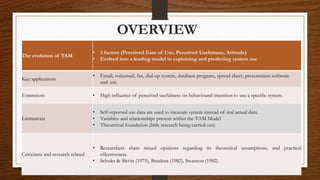
The evolution of TAM
• 3 factors (Perceived Ease of Use, Perceived Usefulness, Attitude)
• Evolved into a leading model in explaining and predicting system use
Key applications
• Email, voicemail, fax, dial-up system, database program, spread sheet, presentation software
and etc.
Extensions • High influence of perceived usefulness on behavioural intention to use a specific system.
Limitations
• Self-reported use data are used to measure system instead of real actual data.
• Variables and relationships present within the TAM Model
• Theoretical foundation (little research being carried out)
Criticisms and research related
• Researchers share mixed opinions regarding its theoretical assumptions, and practical
effectiveness.
• Schultz & Slevin (1975), Bandura (1982), Swanson (1982)
OVERVIEW
OVERVIEW
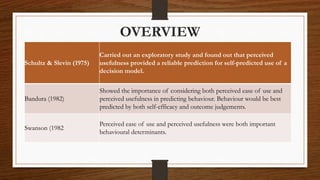
Schultz & Slevin (1975)
Carried out an exploratory study and found out that perceived
usefulness provided a reliable prediction for self-predicted use of a
decision model.
Bandura (1982)
Showed the importance of considering both perceived ease of use and
perceived usefulness in predicting behaviour. Behaviour would be best
predicted by both self-efficacy and outcome judgements.
Swanson (1982
Perceived ease of use and perceived usefulness were both important
behavioural determinants.
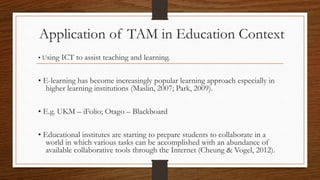
Application of TAM in Education Context
• Using ICT to assist teaching and learning.
• E-learning has become increasingly popular learning approach especially in
higher learning institutions (Maslin, 2007; Park, 2009).
• E.g. UKM – iFolio; Otago – Blackboard
• Educational institutes are starting to prepare students to collaborate in a
world in which various tasks can be accomplished with an abundance of
available collaborative tools through the Internet (Cheung & Vogel, 2012).
• In a study conducted by Maslin (2007) on 198 students of a
university on their acceptance of e-learning. The study found that
perceive usefulness is more important in determining intention to
use the technology than attitude towards using it.
• Cheung & Vogel (2012) conducted a study on 136 undergraduates
found that perceived ease of use will positively influence perceived
usefulness. Perceived usefulness and perceived ease of use will
positively influence attitudes towards the Google Applications
platform.
• Selim (2007) outlined there are 4 main categories in critical
success factor of e-learning: instructor, student, information
technology, and university technical support. Selim also
highlighted competency of both instructor and student, e-learning
mindset of both instructor and student, level of collaboration,
and perceived information technology infrastructure.
How about at school level?
• The Ministry of Education, through the latest Education Blue print
(2013-2025), insights the importance of technology-based teaching and
learning into the schools’ national curriculum (Simin & Wan, 2015). At
school level, ICT to assist teaching and learning has been introduced for
years and provides links to help teachers and students access educational
information readily. E.g. FrogVLE, MySchoolNet, 1BestariNet.
• Teachers (key players) in using ICT in their daily classrooms. This is due
to the capability of ICT in providing dynamic and proactive teaching-
learning environment (Arnseth & Hatlevik, 2012).
Implementation Strategies
The Ministry is committed to utilise the following multi-prong strategies to ensure that the
objectives of ICT in education are achieved.
• The preparation of sufficient and up-to-date tested ICT infrastructure and equipment to
all educational institutions
• The roll-out of ICT curriculum and assessment and the emphasis of integration of ICT
in teaching and learning
• The upgrading of ICT knowledge and skills in students and teachers
• Increased use of ICT in educational management
• The upgrading of the maintenance and management of ICT equipment in all educational
institutions
(Chan, 2002)
• So far no there is no study conducted using the TAM model to
look at teachers’ and students’ acceptance of
the programme introduced.
• Questions:
• Do you perceived Facebook as useful?
• Do you think Facebook is easy to use?
• Your answer will determine your intention and your usage of
Facebook in classroom.
Strengths
1. Understand human behaviour towards
technology through external variables
• Nikola and Granic (2015) stated that technology has becoming so crucial to human’s
every day life today, therefore it is imperative for us to fathom why technology is used or
rejected.
• Not only technology is crucial in our everyday life, it is also imperative to 21st century
teaching and learning.
• Dorululu (2016) further advocated that TAM help to expand behaviour variables in
understanding the acceptance and rejection towards a technology.
• Thus, this model allows us to understand the behaviour why one reject or accept a
technology.
2. TAM is easy to apply across different
research settings (Lai, 2017)
• This is supported by Han (2003), Lai (2014) and Zainal (2015).
• It is not only applicable to the technology related domain
• It is also proven to be useful for Health Care (Holden &
Karsh, 2015) and Literacy Skill (Dorululu, 2016).
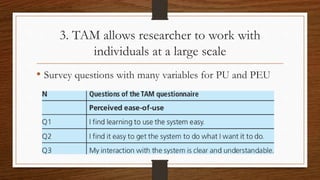
3. TAM allows researcher to work with
individuals at a large scale
• Survey questions with many variables for PU and PEU
4. This model is simple and robust
• PU and PEU to identify the variables.
• TAM is sturdy as it has been used across different subjects too
including setting, person, and times. Satisfactory predictive
validity has been yielded from most of studies that are using TAM
(M. Alamgir, Yogesh K. Dwivedi & Percy, 2015)
5. TAM is used most widely among the theories
related to technology
• Paul, John and Pierre (2003), Lee, Kozar and Larsen (2013) and Chau (2015)
posited that TAM model by Davis is the most popular framework for
technology acceptance.
• Therefore, this theory has been used extensively over the years and this
proves its credibility, validity and reliability in understand human behaviour
towards technology.
Weaknesses
• Limited amount of research on the model had been
carried out in the primary and secondary school setting.
• Hall (2006) found that faculty and K-12 teachers successfully
modeled technology standards for student teachers, but
many activities were focused on lower cognitive skills. Thus,
it remains crucial that teacher technology adoption and
acceptance issues be researched to better thoroughly
understand teachers’ behavior for using technology.
• To carry out the model proper infrastructure must be
available.
•Setting of primary and secondary school in Malaysia
widely varies. Some with no proper infrastructure in
terms of high seed internet and computers.
• High cost – to upgrade all the infrastructures.
• Users/ participants need to have basic skills for the
researchers to have a good sense of whether the model
really works.
• Model relies on perceive ease of use (PEU) and perceive use (PU).
• It will be very broad as each individual will have different views.
• The Technology Acceptance Model assumes that beliefs
about usefulness and ease of use are always the primary
determinants of use decisions. The disadvantage of the
approach is that this reference point may not apply to all
individuals. (Abiola J.O & Oshula T, 2017)
• Some research using the model found that perceived
usefulness and ease of use had no direct effect on university
students’ intention to use e-learning, these constructs were
related to the attitudes toward e-learning (Park S.Y. ,2009)
References
• Arnseth, H. C., & Hatlevik, O. E. (2010). Challenges in aligning pedagogical practices and pupils’ competencies with the
Information Society’s demands: The case of Norway. In S. Mukerji & P. Triphati (Eds.), Cases on technological adaptability
and transnational learning: Issues and challenges. Hershey: IGI global.
• Abiola J.O & Olushola T (2017). The Efficacy Of Technology Accpetance Model: A Review Of Applicable Theoritical
Models In Information Technology Research. Quest Journal, Journal Of Research In Business And Management, 4(11), 70-
83.
• Cheung, R., & Vogel, D. (2013). Predicting user acceptance of collaborative technologies: An extension of the technology
acceptance model for e-learning. Computers & Education, 63, 160-175.
• Dorululu, O. O. 2016. Technology Acceptance Model as a predictor of Using Information System to Acquire Information
Literacy Skills. Library Philosophy and Practice :1-27
• Ghavifekr, S. & Rosdy, W.A.W. (2015). Teaching and learning with technology: Effectiveness of ICT integration in schools.
International Journal of Research in Education and Science (IJRES), 1(2), 175-191.
• Hall, L. (2006). Modeling technology integration for preservice teachers: A PT3 case study.
Contemporary Issues in Technology and Teacher Education, 6(4), 436–455.
• Lai, P. C. 2017. The Literature Review of Technology Adoption Models and Theories for
the noverlty Technology. Journal of Information System and Technology Management 14(1): 21-38
• Masrom, M. (2007). Technology acceptance model and e-learning. Technology, 21(24), 81.
• Park, S. Y. (2009). An Analysis of the Technology Acceptance Model in Understanding
University Students' Behavioral Intention to Use e-Learning. Educational Technology &
Society, 12 (3), 150–162.
• Selim, H. M. (2007). Critical success factors for e-learning acceptance: Confirmatory factor
models. Computers & Education, 49(2), 396-413.

TAM

  • 1.
    Technology Acceptance Model Aouriaza IntikAnak Pingan (GP05632) Cleopatra Charles Banyi (GP05640) Dadyana Dominic Kajan (GP05642) Elizabeth Daniel (GP05645) Nuraina Yusuf (GP05700)
  • 2.
    The evolution ofTAM • 3 factors (Perceived Ease of Use, Perceived Usefulness, Attitude) • Evolved into a leading model in explaining and predicting system use Key applications • Email, voicemail, fax, dial-up system, database program, spread sheet, presentation software and etc. Extensions • High influence of perceived usefulness on behavioural intention to use a specific system. Limitations • Self-reported use data are used to measure system instead of real actual data. • Variables and relationships present within the TAM Model • Theoretical foundation (little research being carried out) Criticisms and research related • Researchers share mixed opinions regarding its theoretical assumptions, and practical effectiveness. • Schultz & Slevin (1975), Bandura (1982), Swanson (1982) OVERVIEW
  • 3.
    OVERVIEW Schultz & Slevin(1975) Carried out an exploratory study and found out that perceived usefulness provided a reliable prediction for self-predicted use of a decision model. Bandura (1982) Showed the importance of considering both perceived ease of use and perceived usefulness in predicting behaviour. Behaviour would be best predicted by both self-efficacy and outcome judgements. Swanson (1982 Perceived ease of use and perceived usefulness were both important behavioural determinants.
  • 4.
    Application of TAMin Education Context • Using ICT to assist teaching and learning. • E-learning has become increasingly popular learning approach especially in higher learning institutions (Maslin, 2007; Park, 2009). • E.g. UKM – iFolio; Otago – Blackboard • Educational institutes are starting to prepare students to collaborate in a world in which various tasks can be accomplished with an abundance of available collaborative tools through the Internet (Cheung & Vogel, 2012).
  • 5.
    • In astudy conducted by Maslin (2007) on 198 students of a university on their acceptance of e-learning. The study found that perceive usefulness is more important in determining intention to use the technology than attitude towards using it. • Cheung & Vogel (2012) conducted a study on 136 undergraduates found that perceived ease of use will positively influence perceived usefulness. Perceived usefulness and perceived ease of use will positively influence attitudes towards the Google Applications platform.
  • 6.
    • Selim (2007)outlined there are 4 main categories in critical success factor of e-learning: instructor, student, information technology, and university technical support. Selim also highlighted competency of both instructor and student, e-learning mindset of both instructor and student, level of collaboration, and perceived information technology infrastructure.
  • 7.
    How about atschool level? • The Ministry of Education, through the latest Education Blue print (2013-2025), insights the importance of technology-based teaching and learning into the schools’ national curriculum (Simin & Wan, 2015). At school level, ICT to assist teaching and learning has been introduced for years and provides links to help teachers and students access educational information readily. E.g. FrogVLE, MySchoolNet, 1BestariNet. • Teachers (key players) in using ICT in their daily classrooms. This is due to the capability of ICT in providing dynamic and proactive teaching- learning environment (Arnseth & Hatlevik, 2012).
  • 8.
    Implementation Strategies The Ministryis committed to utilise the following multi-prong strategies to ensure that the objectives of ICT in education are achieved. • The preparation of sufficient and up-to-date tested ICT infrastructure and equipment to all educational institutions • The roll-out of ICT curriculum and assessment and the emphasis of integration of ICT in teaching and learning • The upgrading of ICT knowledge and skills in students and teachers • Increased use of ICT in educational management • The upgrading of the maintenance and management of ICT equipment in all educational institutions (Chan, 2002)
  • 9.
    • So farno there is no study conducted using the TAM model to look at teachers’ and students’ acceptance of the programme introduced.
  • 10.
    • Questions: • Doyou perceived Facebook as useful? • Do you think Facebook is easy to use? • Your answer will determine your intention and your usage of Facebook in classroom.
  • 11.
  • 12.
    1. Understand humanbehaviour towards technology through external variables • Nikola and Granic (2015) stated that technology has becoming so crucial to human’s every day life today, therefore it is imperative for us to fathom why technology is used or rejected. • Not only technology is crucial in our everyday life, it is also imperative to 21st century teaching and learning. • Dorululu (2016) further advocated that TAM help to expand behaviour variables in understanding the acceptance and rejection towards a technology. • Thus, this model allows us to understand the behaviour why one reject or accept a technology.
  • 13.
    2. TAM iseasy to apply across different research settings (Lai, 2017) • This is supported by Han (2003), Lai (2014) and Zainal (2015). • It is not only applicable to the technology related domain • It is also proven to be useful for Health Care (Holden & Karsh, 2015) and Literacy Skill (Dorululu, 2016).
  • 14.
    3. TAM allowsresearcher to work with individuals at a large scale • Survey questions with many variables for PU and PEU
  • 15.
    4. This modelis simple and robust • PU and PEU to identify the variables. • TAM is sturdy as it has been used across different subjects too including setting, person, and times. Satisfactory predictive validity has been yielded from most of studies that are using TAM (M. Alamgir, Yogesh K. Dwivedi & Percy, 2015)
  • 16.
    5. TAM isused most widely among the theories related to technology • Paul, John and Pierre (2003), Lee, Kozar and Larsen (2013) and Chau (2015) posited that TAM model by Davis is the most popular framework for technology acceptance. • Therefore, this theory has been used extensively over the years and this proves its credibility, validity and reliability in understand human behaviour towards technology.
  • 17.
  • 18.
    • Limited amountof research on the model had been carried out in the primary and secondary school setting. • Hall (2006) found that faculty and K-12 teachers successfully modeled technology standards for student teachers, but many activities were focused on lower cognitive skills. Thus, it remains crucial that teacher technology adoption and acceptance issues be researched to better thoroughly understand teachers’ behavior for using technology.
  • 19.
    • To carryout the model proper infrastructure must be available. •Setting of primary and secondary school in Malaysia widely varies. Some with no proper infrastructure in terms of high seed internet and computers. • High cost – to upgrade all the infrastructures. • Users/ participants need to have basic skills for the researchers to have a good sense of whether the model really works.
  • 20.
    • Model relieson perceive ease of use (PEU) and perceive use (PU). • It will be very broad as each individual will have different views. • The Technology Acceptance Model assumes that beliefs about usefulness and ease of use are always the primary determinants of use decisions. The disadvantage of the approach is that this reference point may not apply to all individuals. (Abiola J.O & Oshula T, 2017) • Some research using the model found that perceived usefulness and ease of use had no direct effect on university students’ intention to use e-learning, these constructs were related to the attitudes toward e-learning (Park S.Y. ,2009)
  • 21.
    References • Arnseth, H.C., & Hatlevik, O. E. (2010). Challenges in aligning pedagogical practices and pupils’ competencies with the Information Society’s demands: The case of Norway. In S. Mukerji & P. Triphati (Eds.), Cases on technological adaptability and transnational learning: Issues and challenges. Hershey: IGI global. • Abiola J.O & Olushola T (2017). The Efficacy Of Technology Accpetance Model: A Review Of Applicable Theoritical Models In Information Technology Research. Quest Journal, Journal Of Research In Business And Management, 4(11), 70- 83. • Cheung, R., & Vogel, D. (2013). Predicting user acceptance of collaborative technologies: An extension of the technology acceptance model for e-learning. Computers & Education, 63, 160-175. • Dorululu, O. O. 2016. Technology Acceptance Model as a predictor of Using Information System to Acquire Information Literacy Skills. Library Philosophy and Practice :1-27 • Ghavifekr, S. & Rosdy, W.A.W. (2015). Teaching and learning with technology: Effectiveness of ICT integration in schools. International Journal of Research in Education and Science (IJRES), 1(2), 175-191.
  • 22.
    • Hall, L.(2006). Modeling technology integration for preservice teachers: A PT3 case study. Contemporary Issues in Technology and Teacher Education, 6(4), 436–455. • Lai, P. C. 2017. The Literature Review of Technology Adoption Models and Theories for the noverlty Technology. Journal of Information System and Technology Management 14(1): 21-38 • Masrom, M. (2007). Technology acceptance model and e-learning. Technology, 21(24), 81. • Park, S. Y. (2009). An Analysis of the Technology Acceptance Model in Understanding University Students' Behavioral Intention to Use e-Learning. Educational Technology & Society, 12 (3), 150–162. • Selim, H. M. (2007). Critical success factors for e-learning acceptance: Confirmatory factor models. Computers & Education, 49(2), 396-413.

Editor's Notes

  • #13 Thus, this model allows us to understand the behaviour why one reject or accept a technology. After identifying the reasons why one rejects the technology, we can address the behaviour and find a way out of it so that the technology is then accepted. If the technology is accepted, the variables identified can be used as references the next time a technology is created.
  • #14 Therefore, TAM is almost universal and flexible for other domains to use. This is another reason of its stability.
  • #15 This is example how questions/variables under PEU
  • #16 PU and PEU to identify the variables. These perceptions have been proven to be helpful in understanding human’s acceptance and rejection towards technology. PU particularly has been helpful in understanding behaviour. TAM is sturdy as it has been used across different subjects too Including setting, person, and times. Satisfactory predictive validity has been yielded from most of   studies that are using TAM (M. Alamgir, Yogesh K. Dwivedi & Percy, 2015)
  • #17 Paul, John and Pierre (2003), Lee, Kozar and Larsen (2013) and Chau (2015) posited that TAM model by Davis is the most popular framework for technology acceptance.  Therefore, this theory has been used extensively over the years and this proves its credibility, validity and reliability in understand human behaviour towards technology.