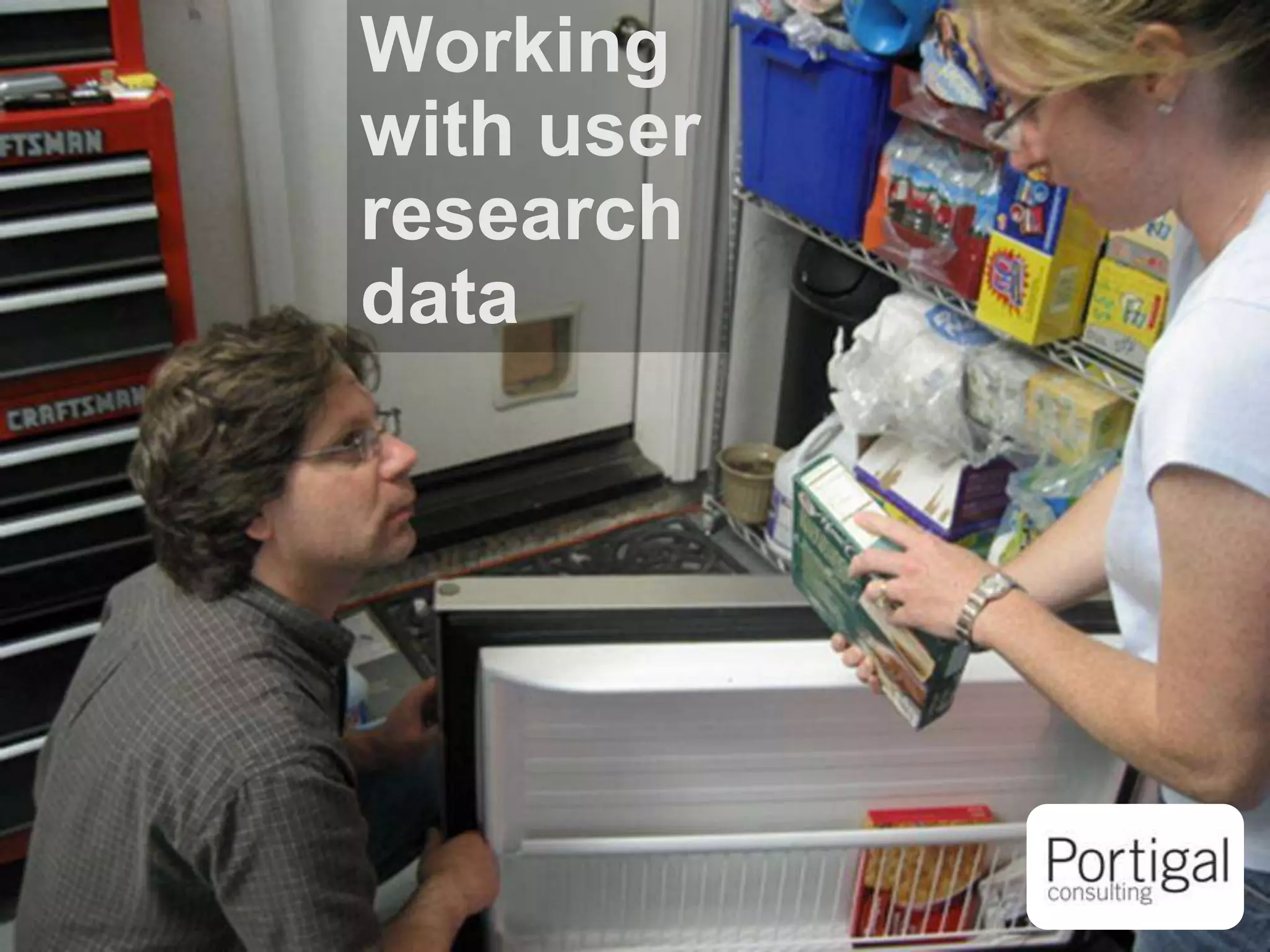


Working with user research data
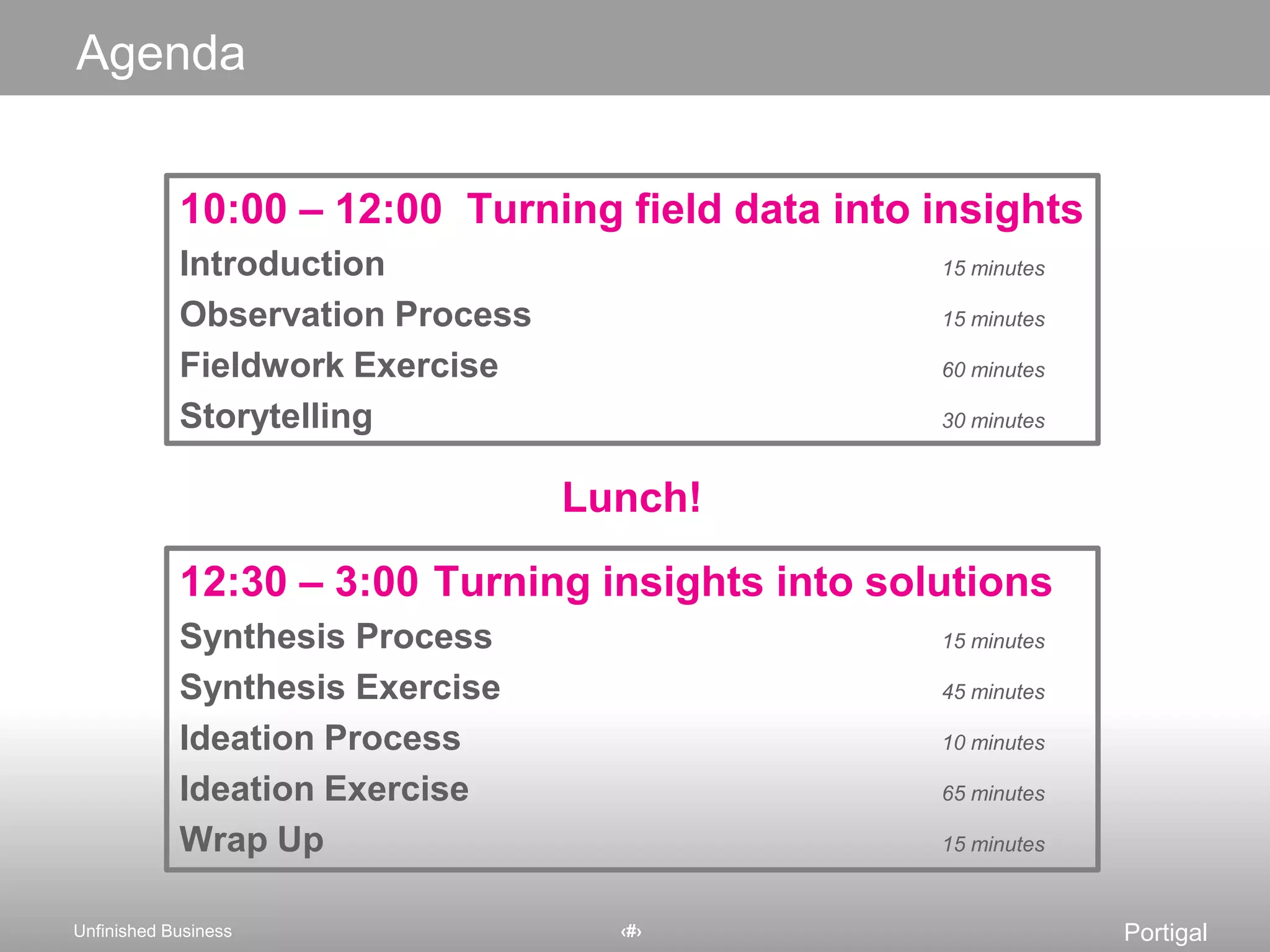
Agenda10:00 โ€“ 12:00  Turning field data into insightsIntroduction					15 minutes Observation Process				15 minutes  Fieldwork Exercise				60 minutesStorytelling	30 minutes Lunch!12:30 โ€“ 3:00 	Turning insights into solutionsSynthesis Process 				15 minutes Synthesis Exercise 				45 minutes Ideation Process 				10 minutes Ideation Exercise 				65 minutes Wrap Up 					15 minutes
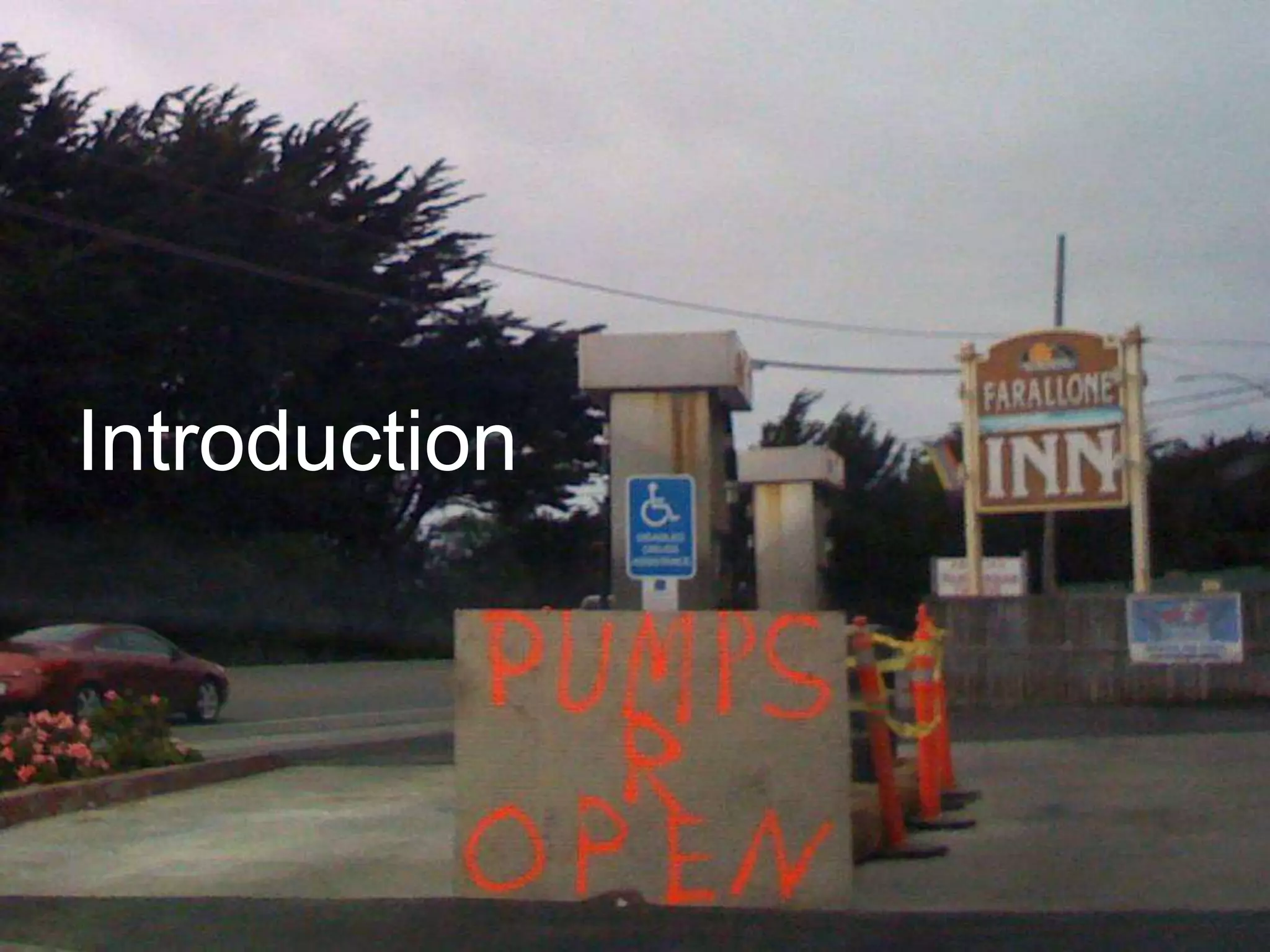
Introduction
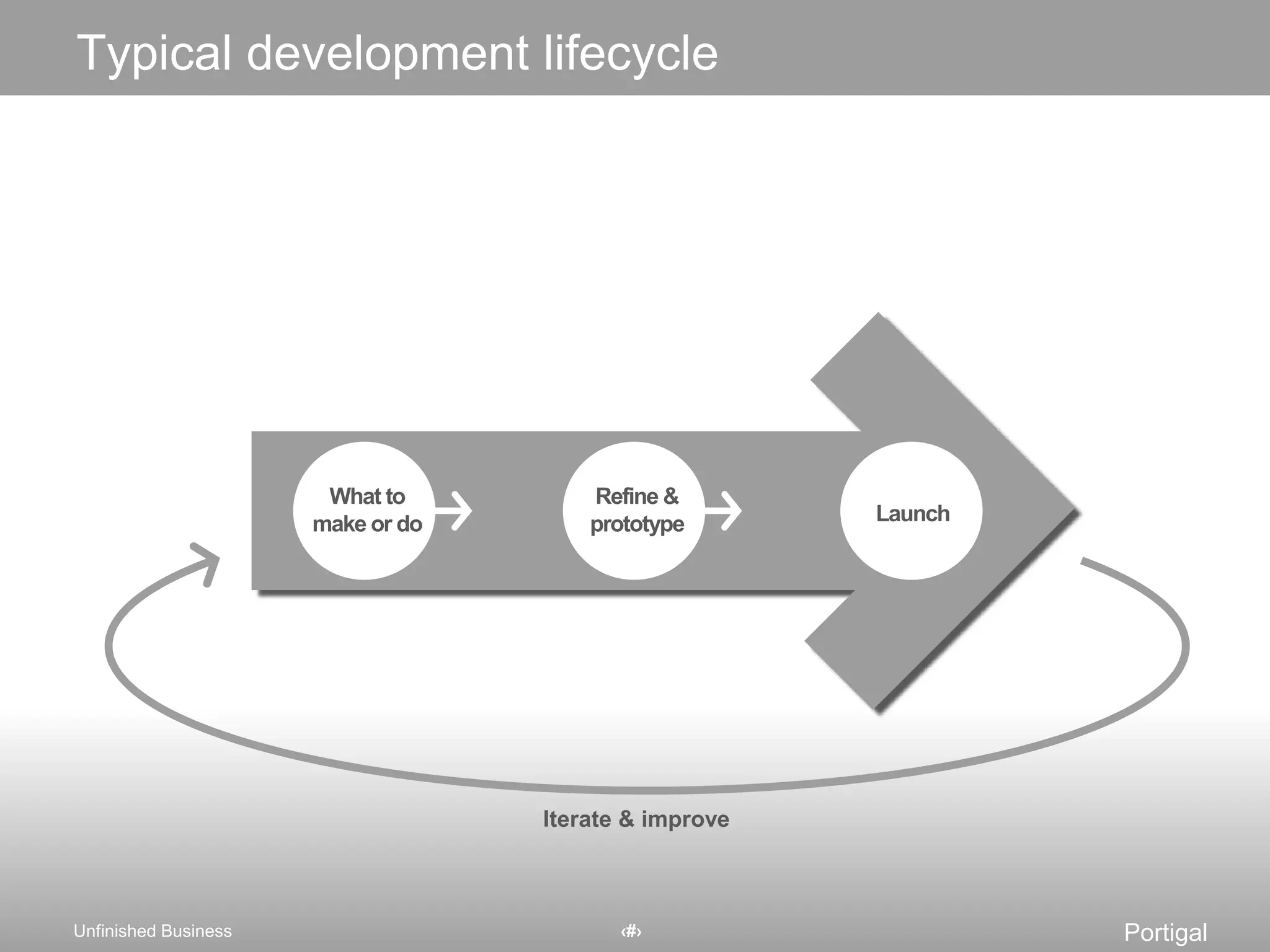
Typical development lifecycleWhat to make or doRefine & prototypeLaunchIterate & improve
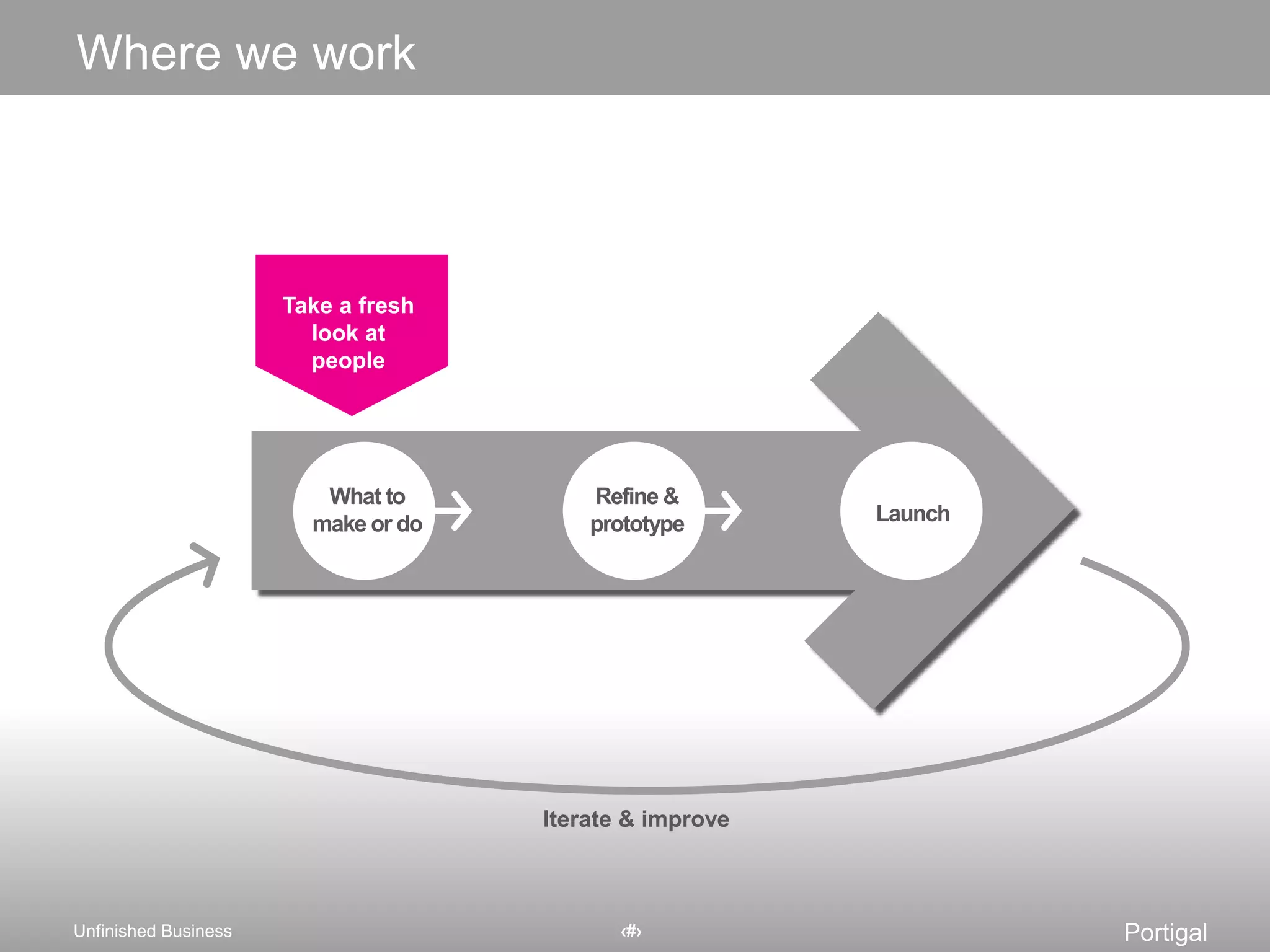
Where we workTake a fresh look at peopleWhat to make or doRefine & prototypeLaunchIterate & improve
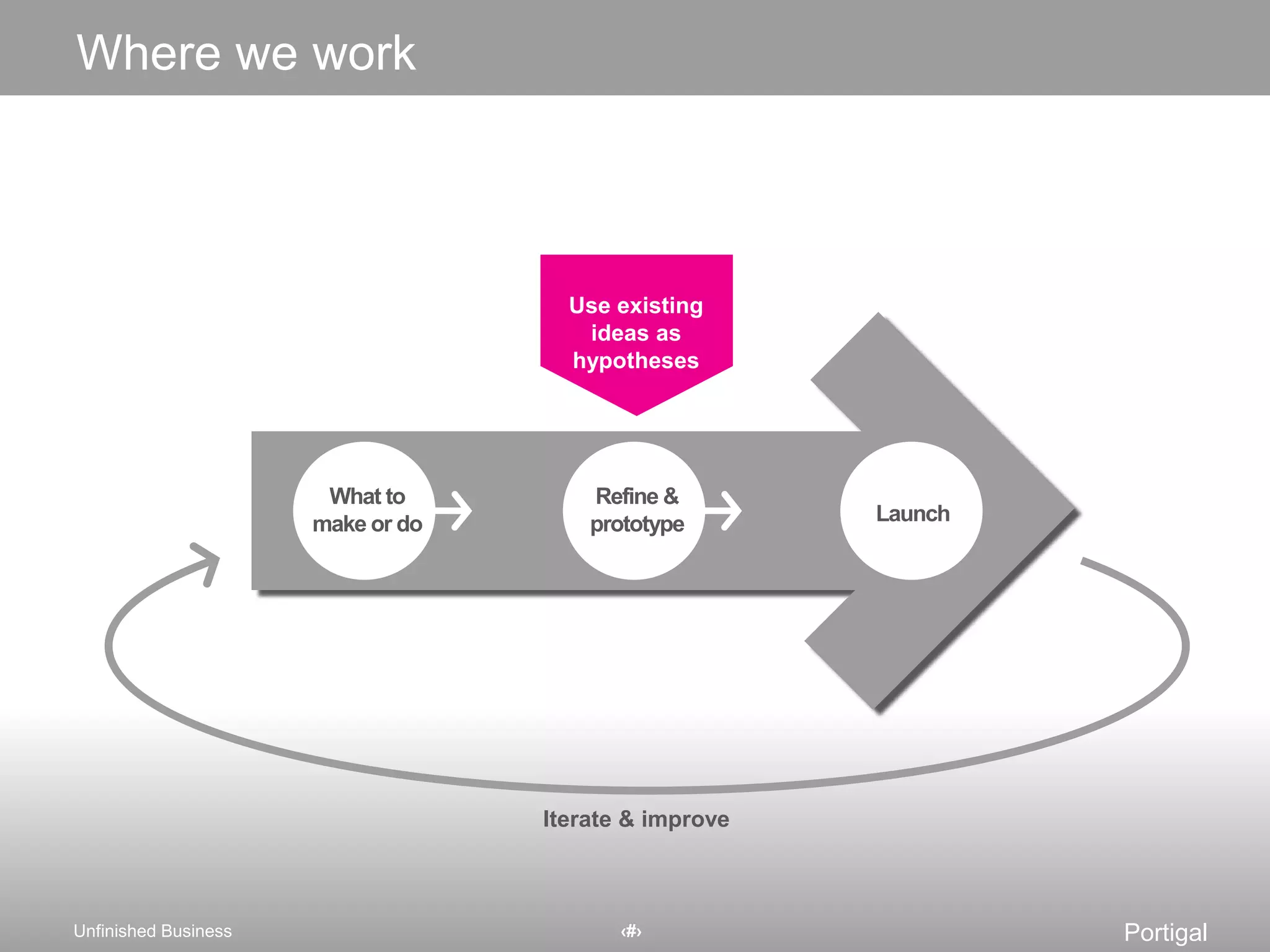
Where we workUse existing ideas as hypothesesWhat to make or doRefine & prototypeLaunchIterate & improve
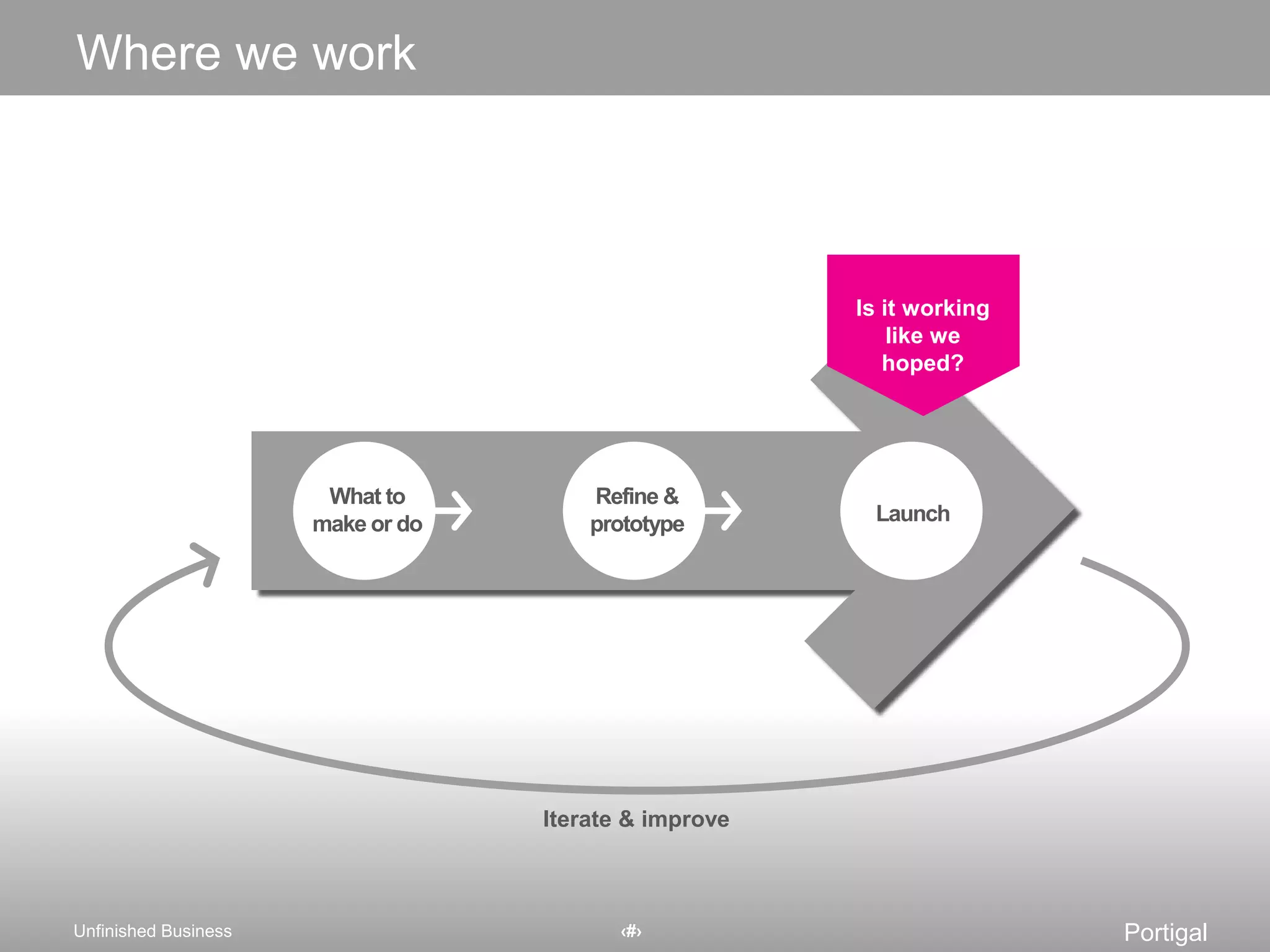
Where we workIs it working like we hoped?What to make or doRefine & prototypeLaunchIterate & improve
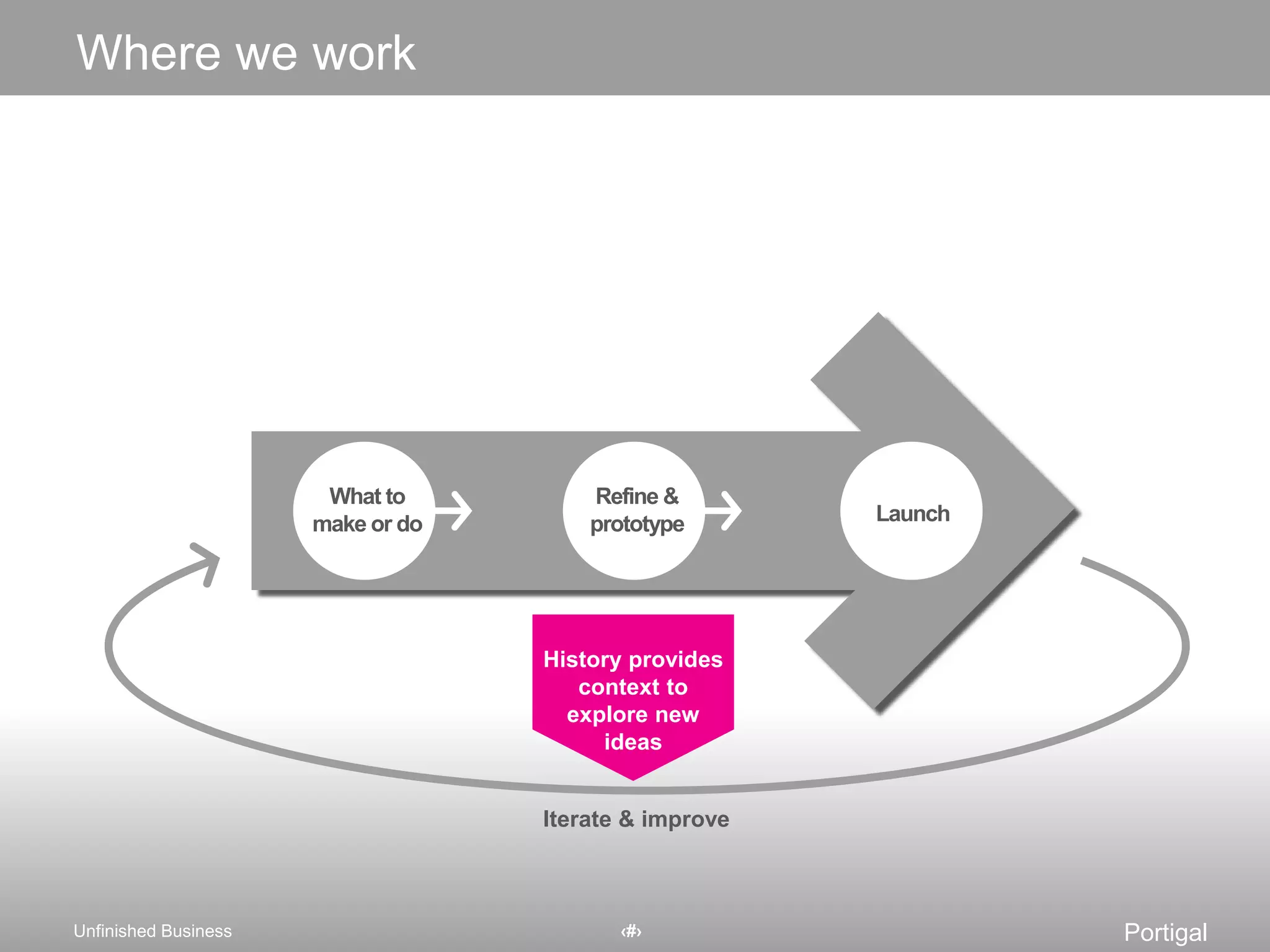
Where we workWhat to make or doRefine & prototypeLaunchHistory provides context to explore new ideasIterate & improve
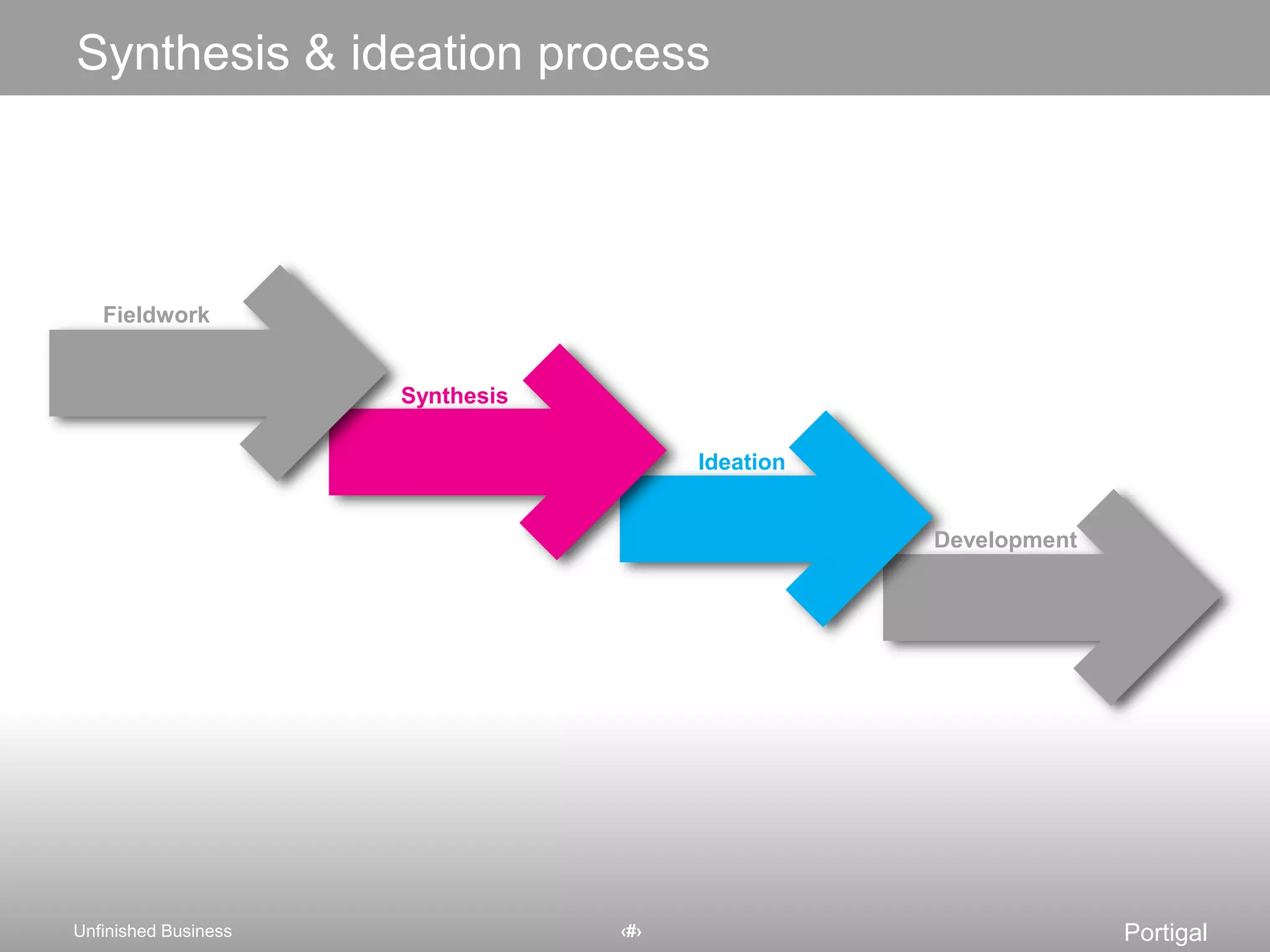
Synthesis & ideation processFieldworkSynthesisIdeationDevelopment
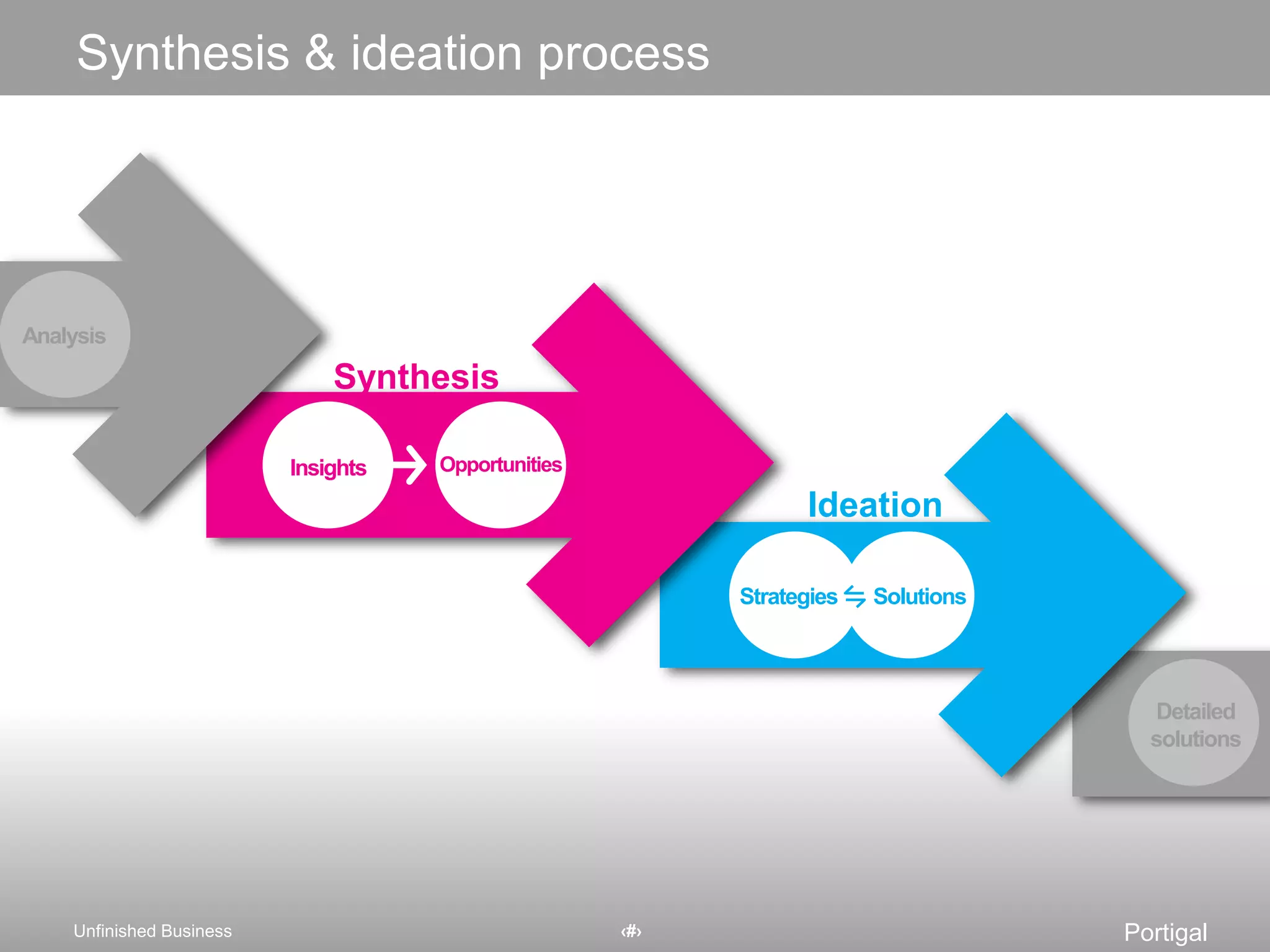
AnalysisSynthesisIdeationSolutionsStrategiesOpportunitiesDetailed solutionsInsightsSynthesis & ideation process
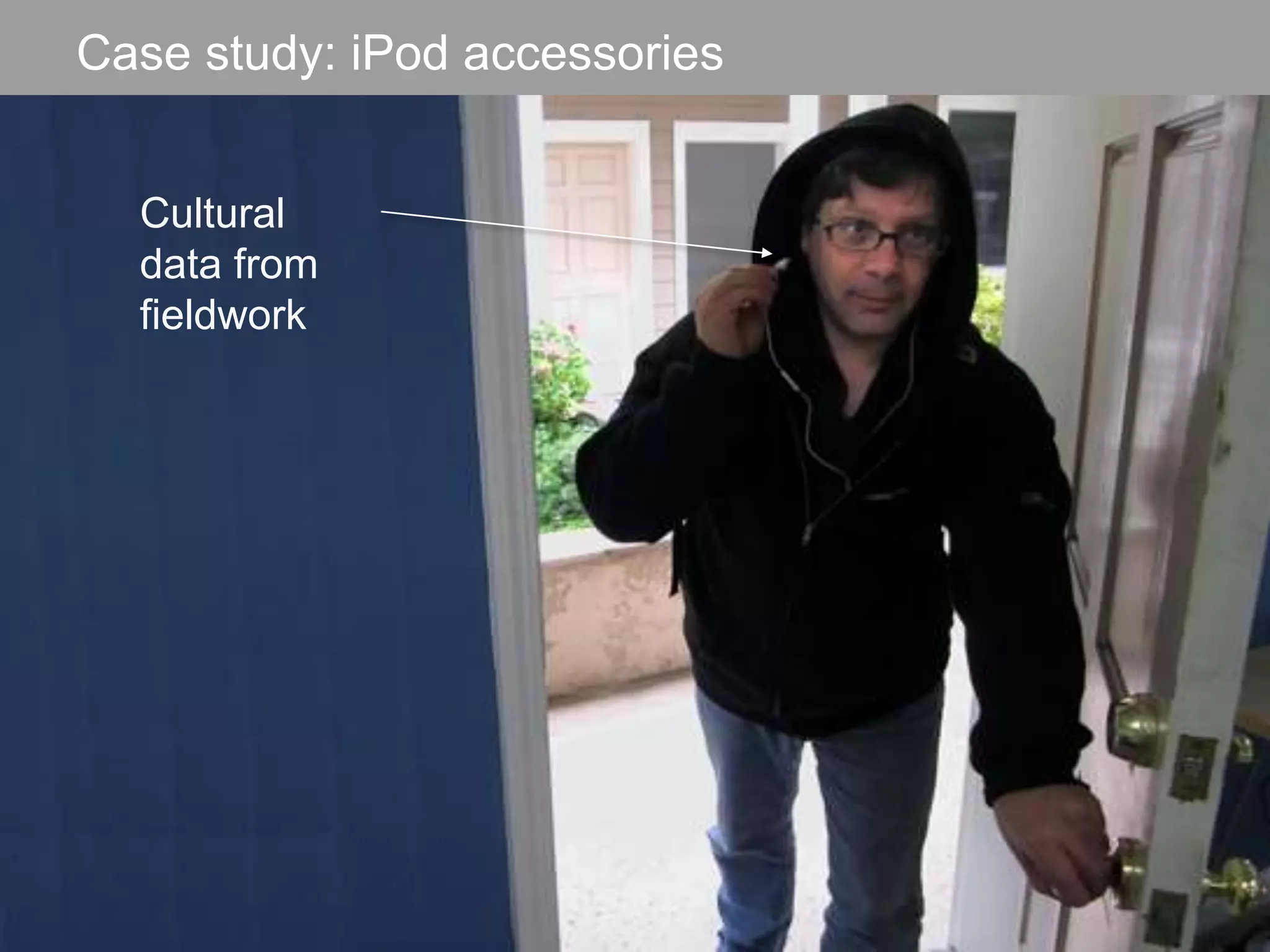
Cultural data from fieldworkCase study: iPod accessories
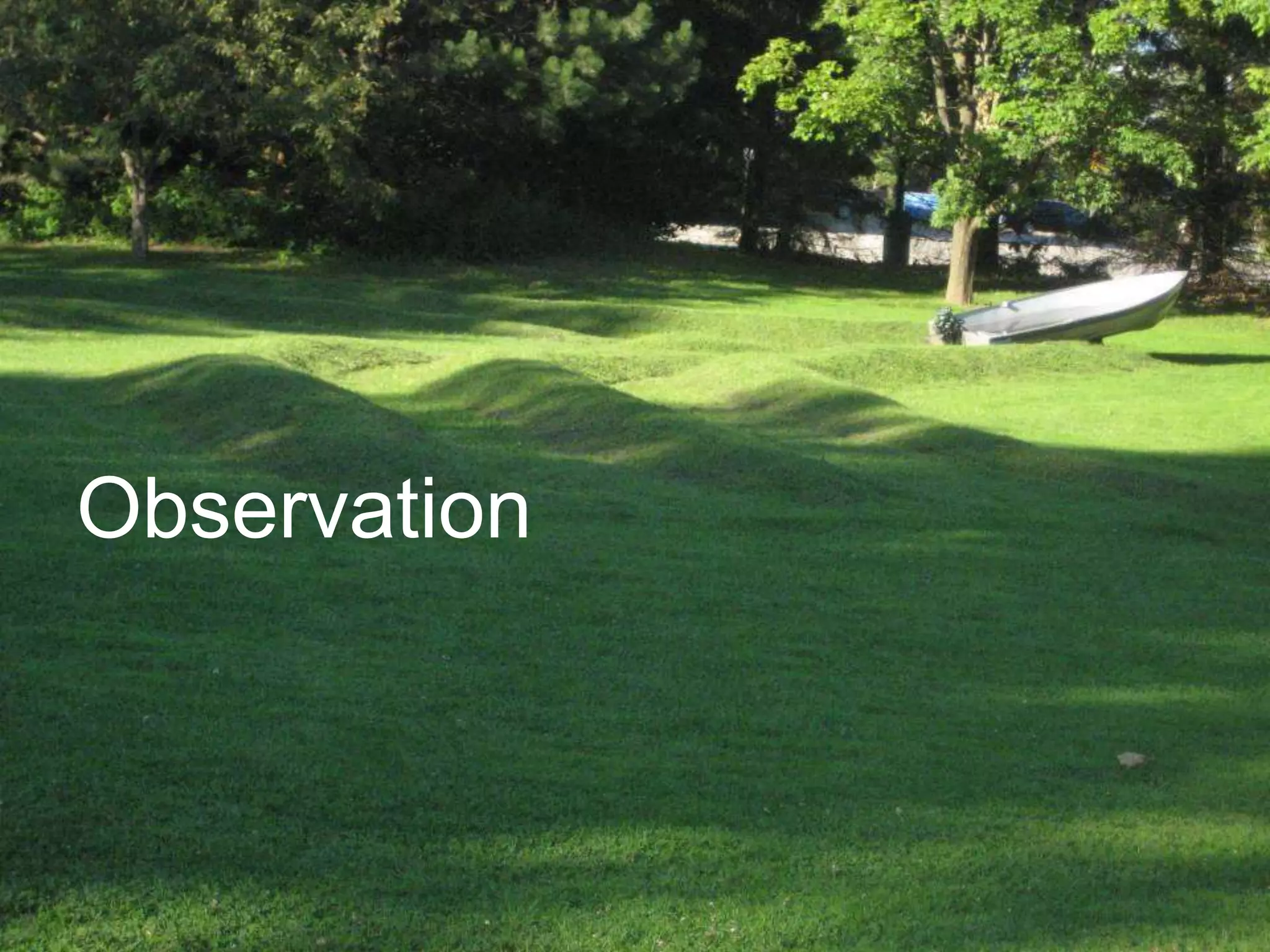
Observation
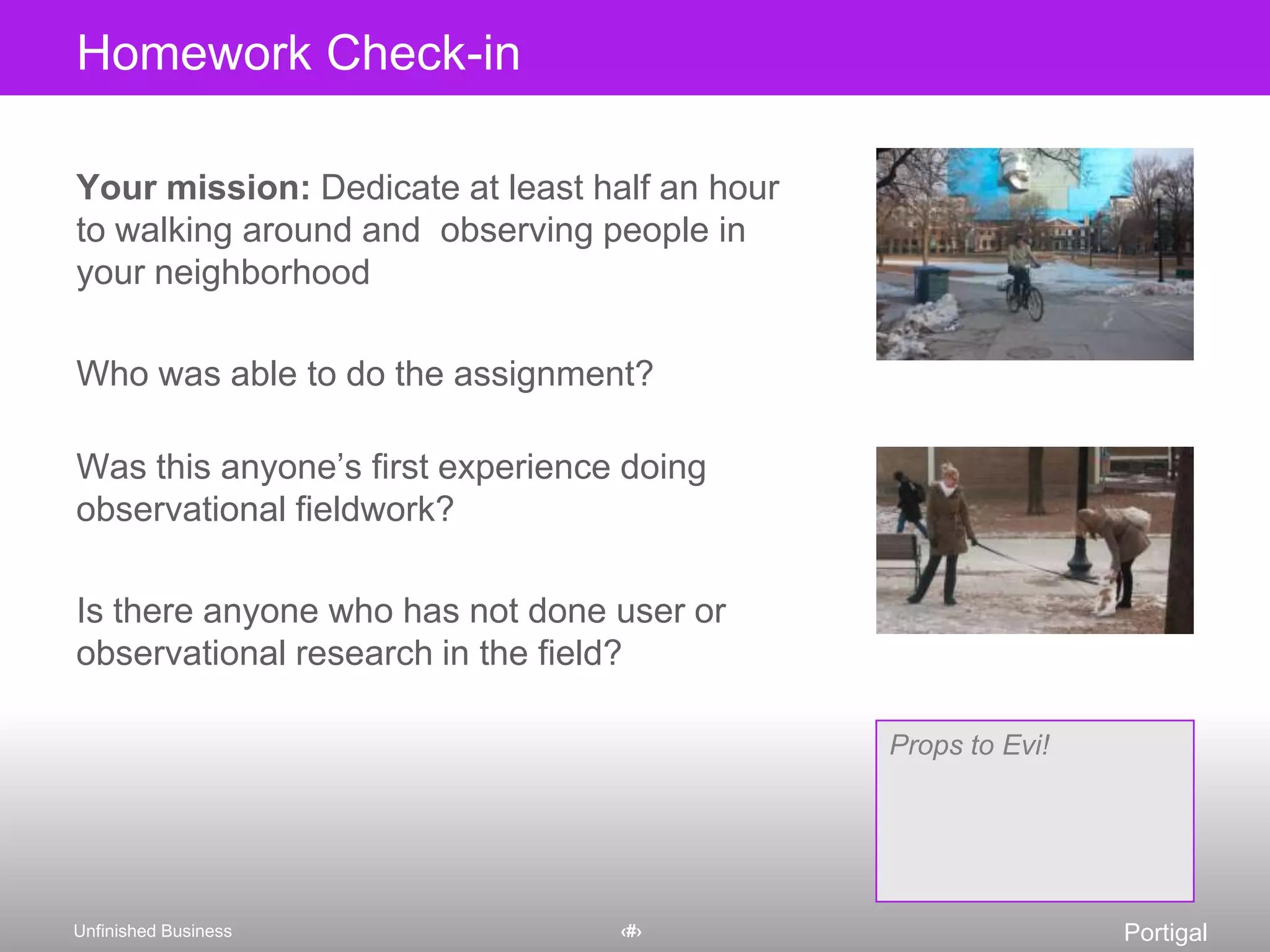
Homework Check-inYour mission: Dedicate at least half an hour to walking around and  observing people in your neighborhoodWho was able to do the assignment?Was this anyoneโ€™s first experience doing observational fieldwork?Is there anyone who has not done user or observational research in the field?Props to Evi!
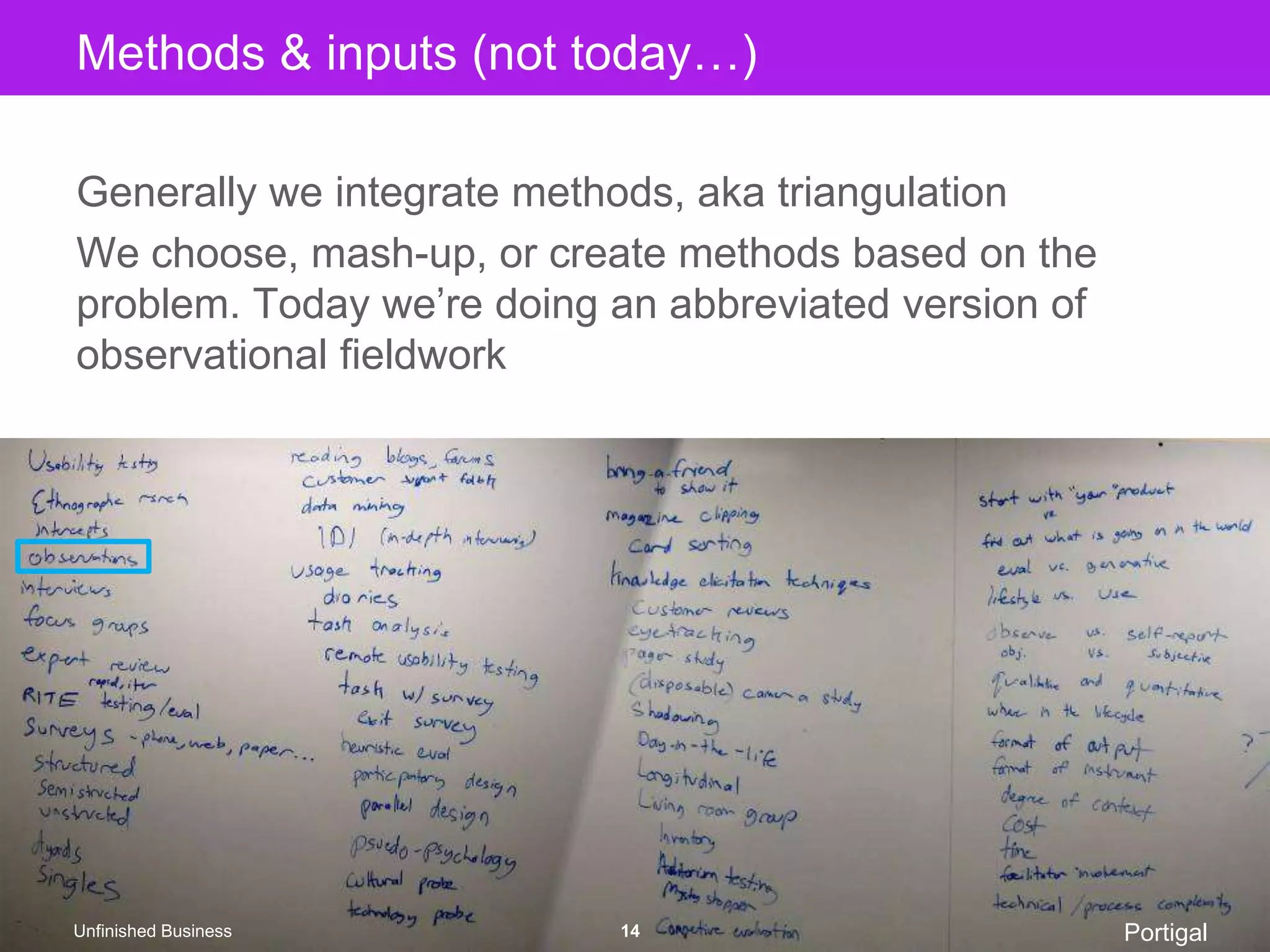
Methods & inputs (not todayโ€ฆ)Generally we integrate methods, aka triangulationWe choose, mash-up, or create methods based on the problem. Today weโ€™re doing an abbreviated version of observational fieldworkPortigalUnfinished Business14
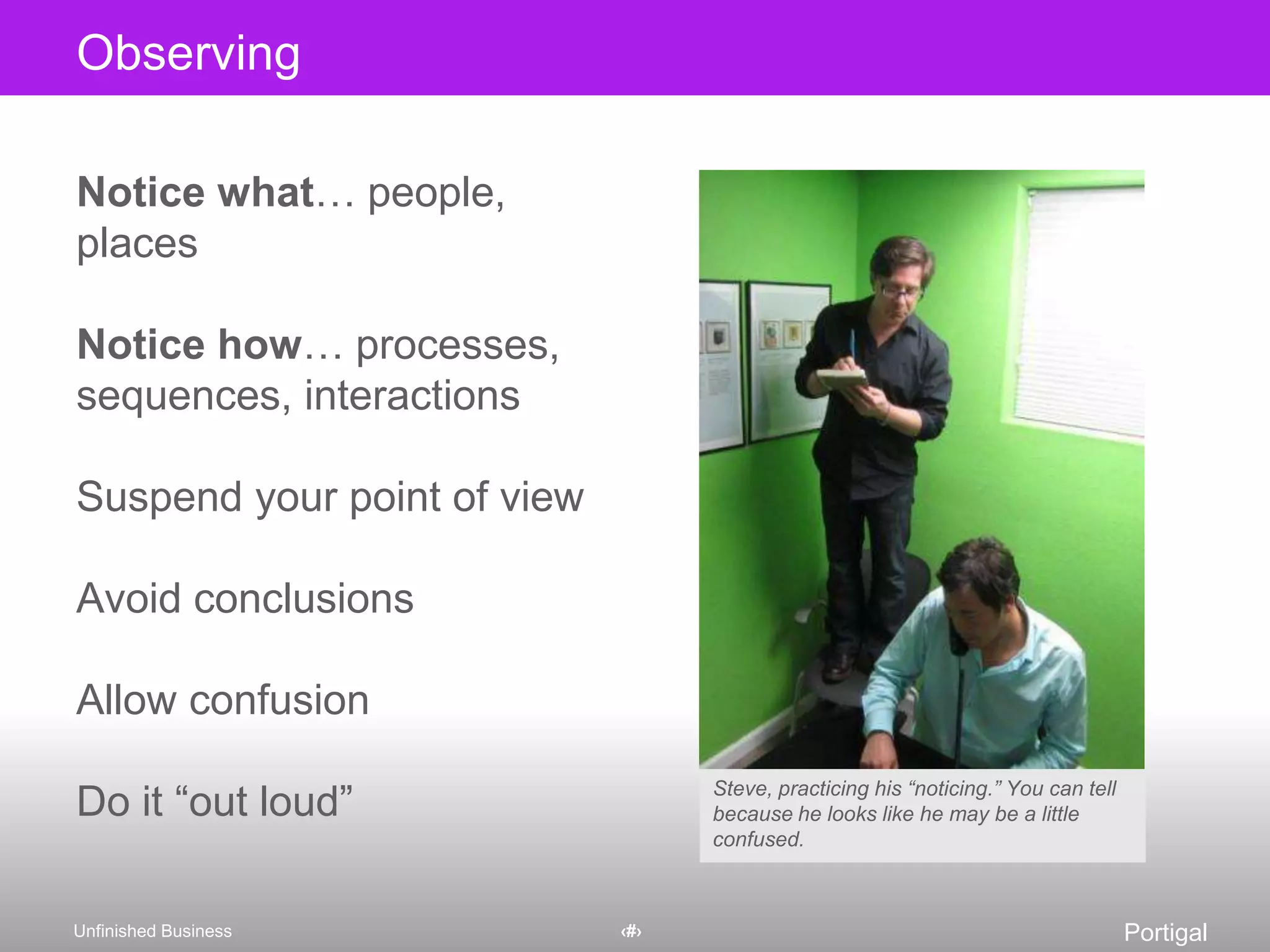
ObservingNotice whatโ€ฆ people, placesNotice howโ€ฆ processes, sequences, interactionsSuspend your point of viewAvoid conclusionsAllow confusionDo it โ€œout loudโ€Steve, practicing his โ€œnoticing.โ€ You can tell because he looks like he may be a little confused.
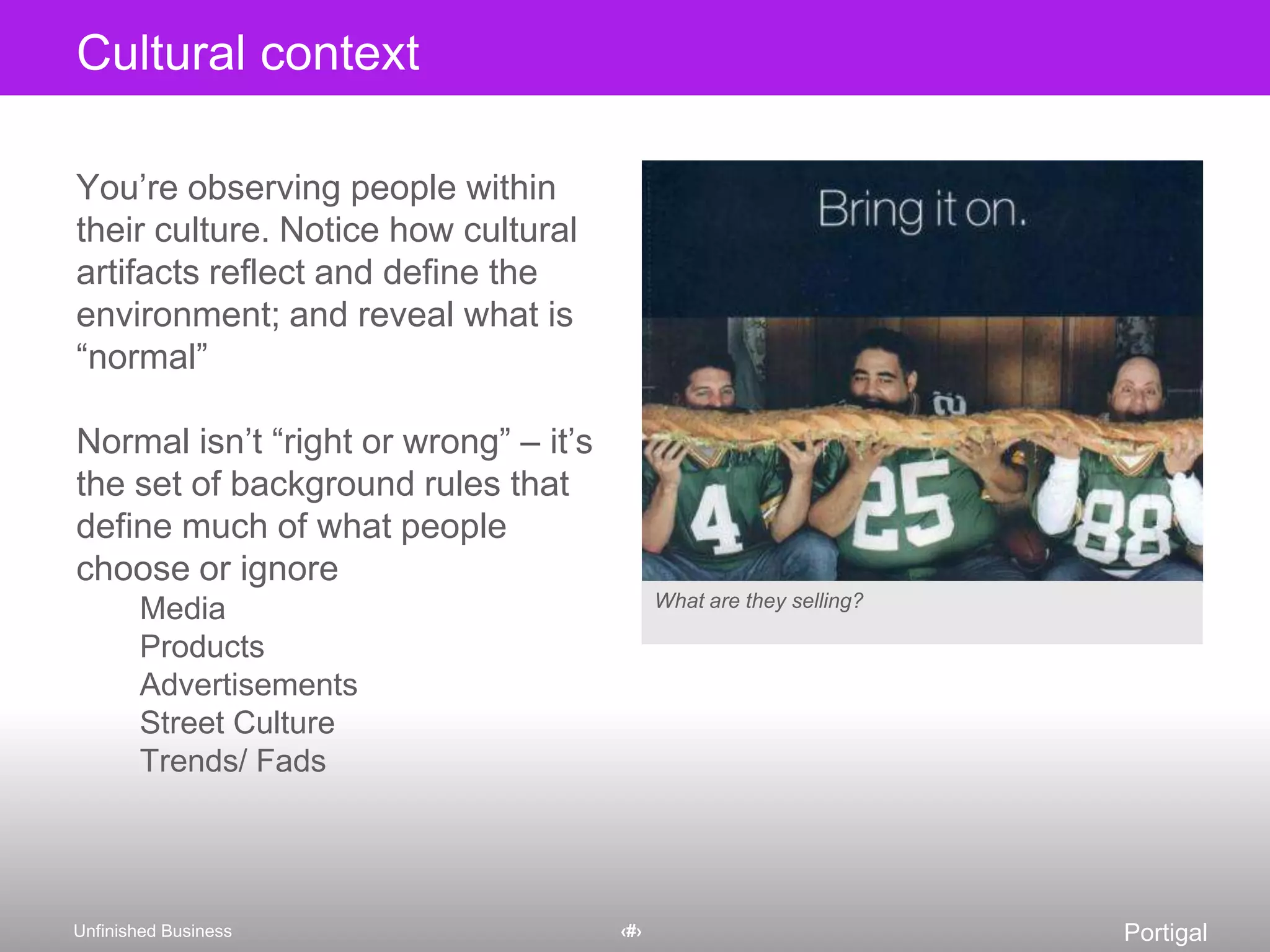
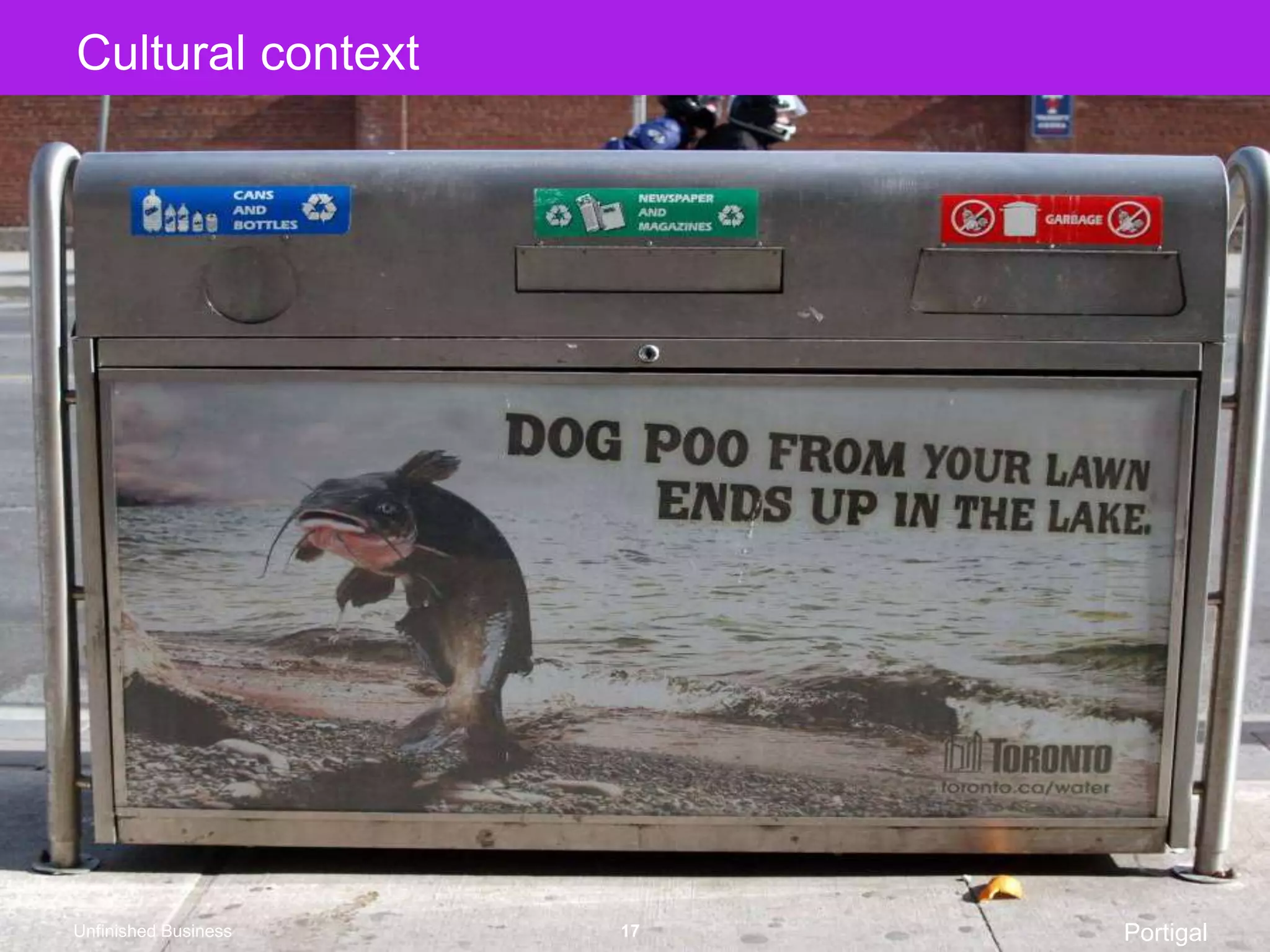
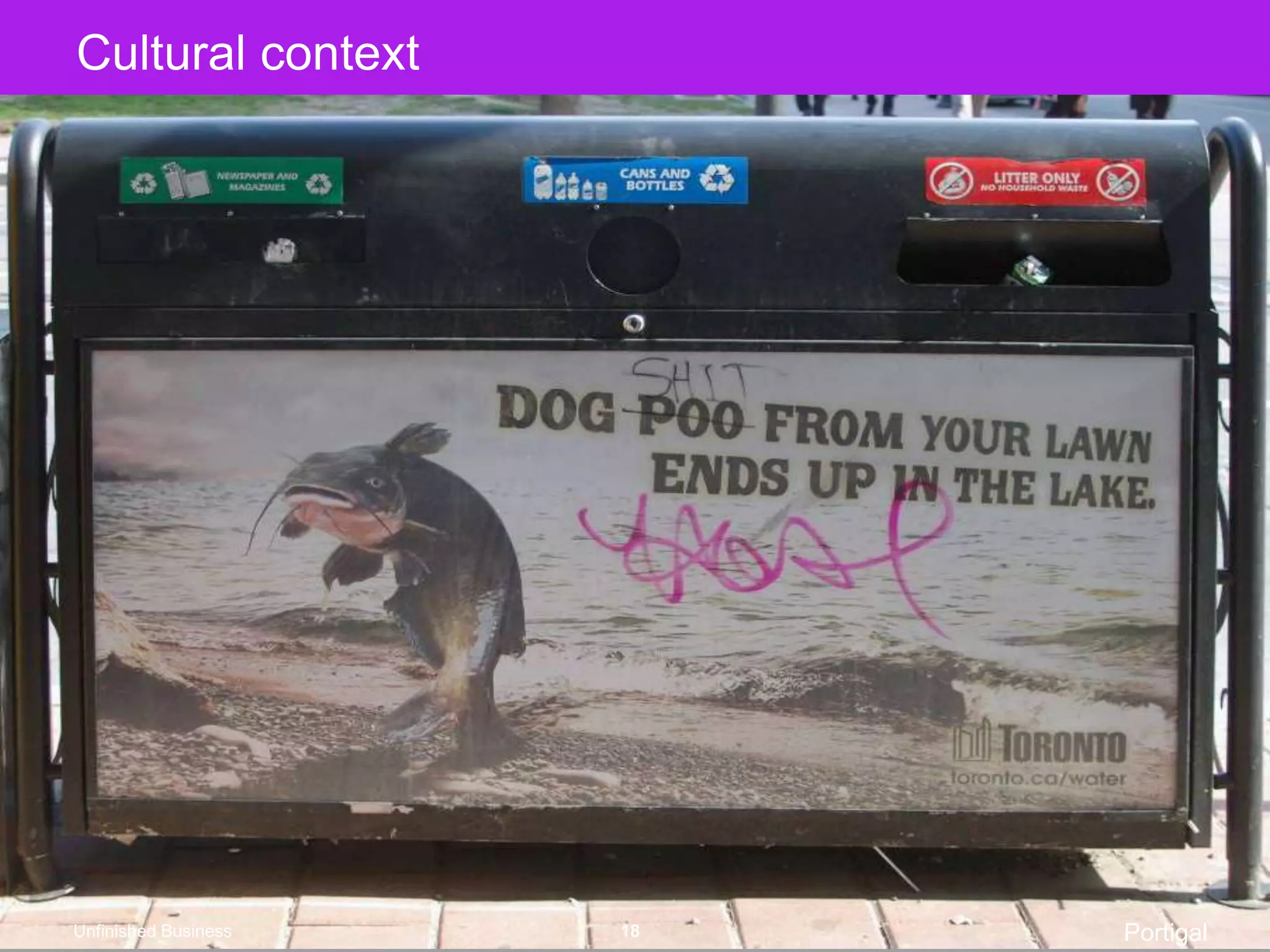
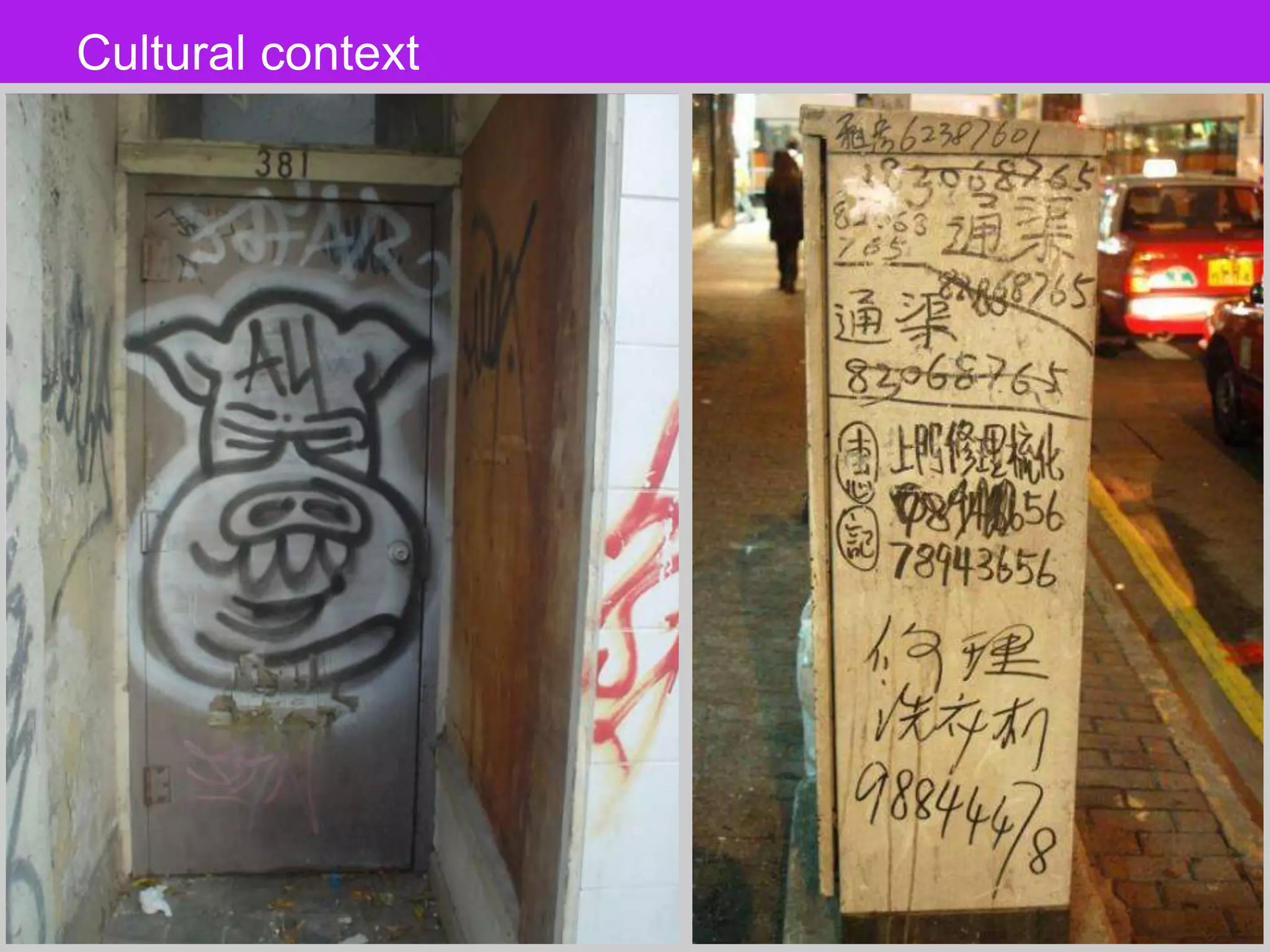
Youโ€™re observing people within their culture. Notice how cultural artifacts reflect and define the environment; and reveal what is โ€œnormalโ€Normal isnโ€™t โ€œright or wrongโ€ โ€“ itโ€™s the set of background rules that define much of what people choose or ignoreMediaProductsAdvertisementsStreet CultureTrends/FadsCultural contextWhat are they selling?
Cultural contextPortigalUnfinished Business17
Cultural contextPortigalUnfinished Business18
Cultural context
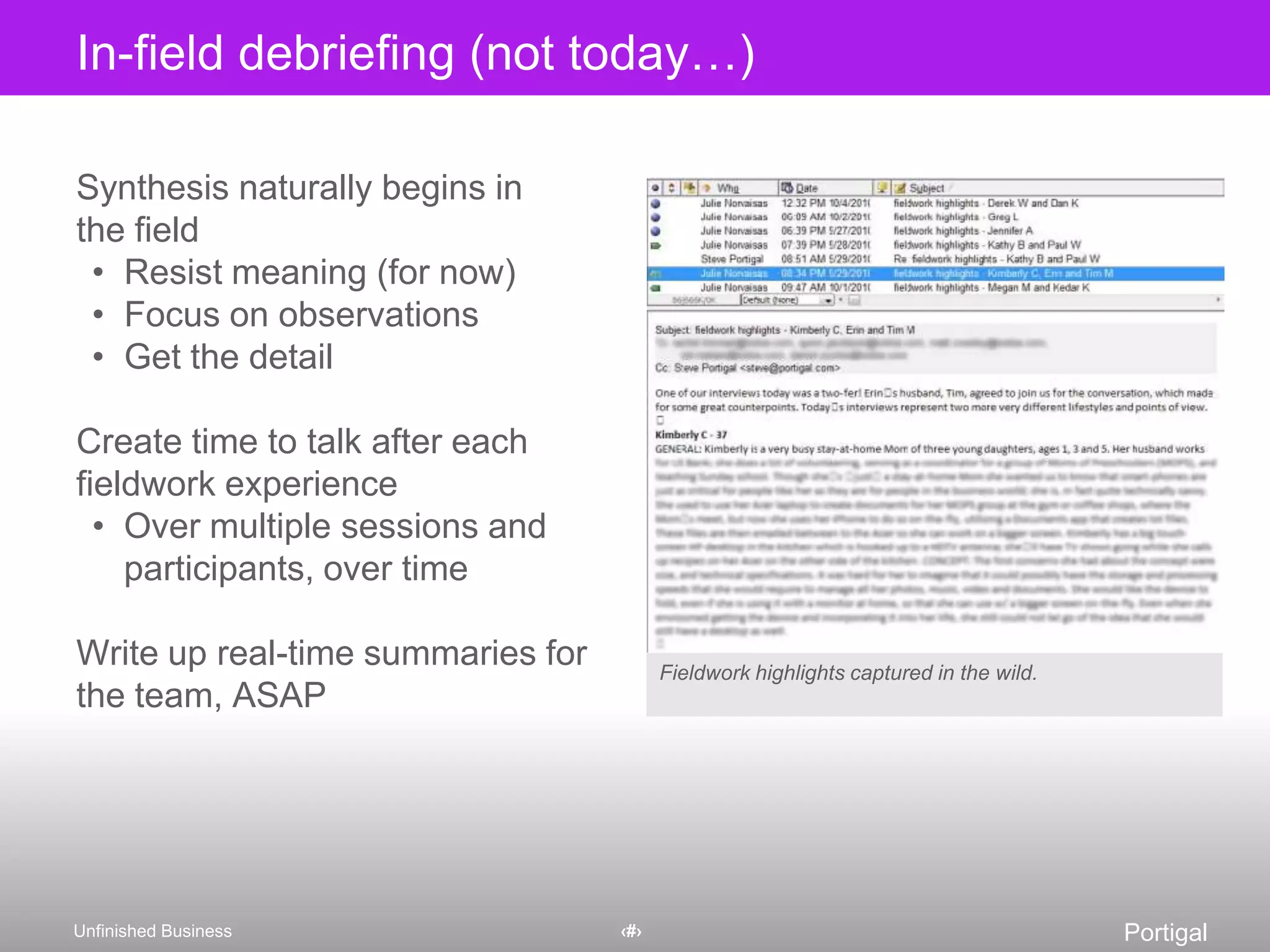
Synthesis naturally begins inthe fieldResist meaning (for now)Focus on observationsGet the detailCreate time to talk after each fieldwork experienceOver multiple sessions and participants, over timeWrite up real-timesummaries for the team, ASAPIn-field debriefing (not todayโ€ฆ)Fieldwork highlights captured in the wild.
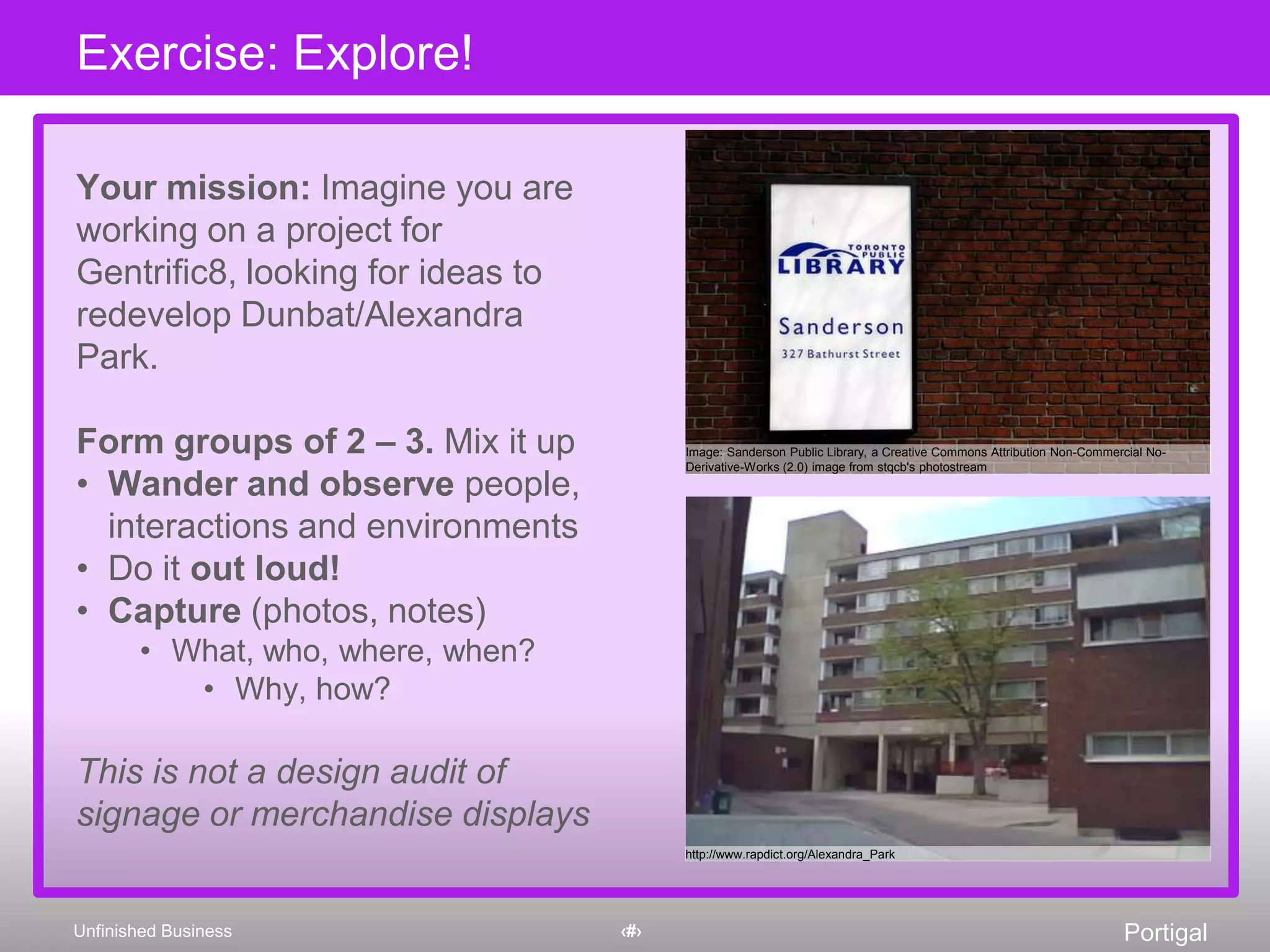
Your mission: Imagine you are working on a project for Gentrific8, looking for ideas to redevelop Dunbat/Alexandra Park.Form groups of 2 โ€“ 3. Mix it upWander and observe people, interactions and environmentsDo it out loud!Capture (photos, notes)What, who, where, when?Why, how?This is not a design audit of signage or merchandise displaysExercise: Explore! Image: Sanderson Public Library, a Creative Commons Attribution Non-Commercial No-Derivative-Works (2.0) image from stqcb'sphotostreamhttp://www.rapdict.org/Alexandra_Park
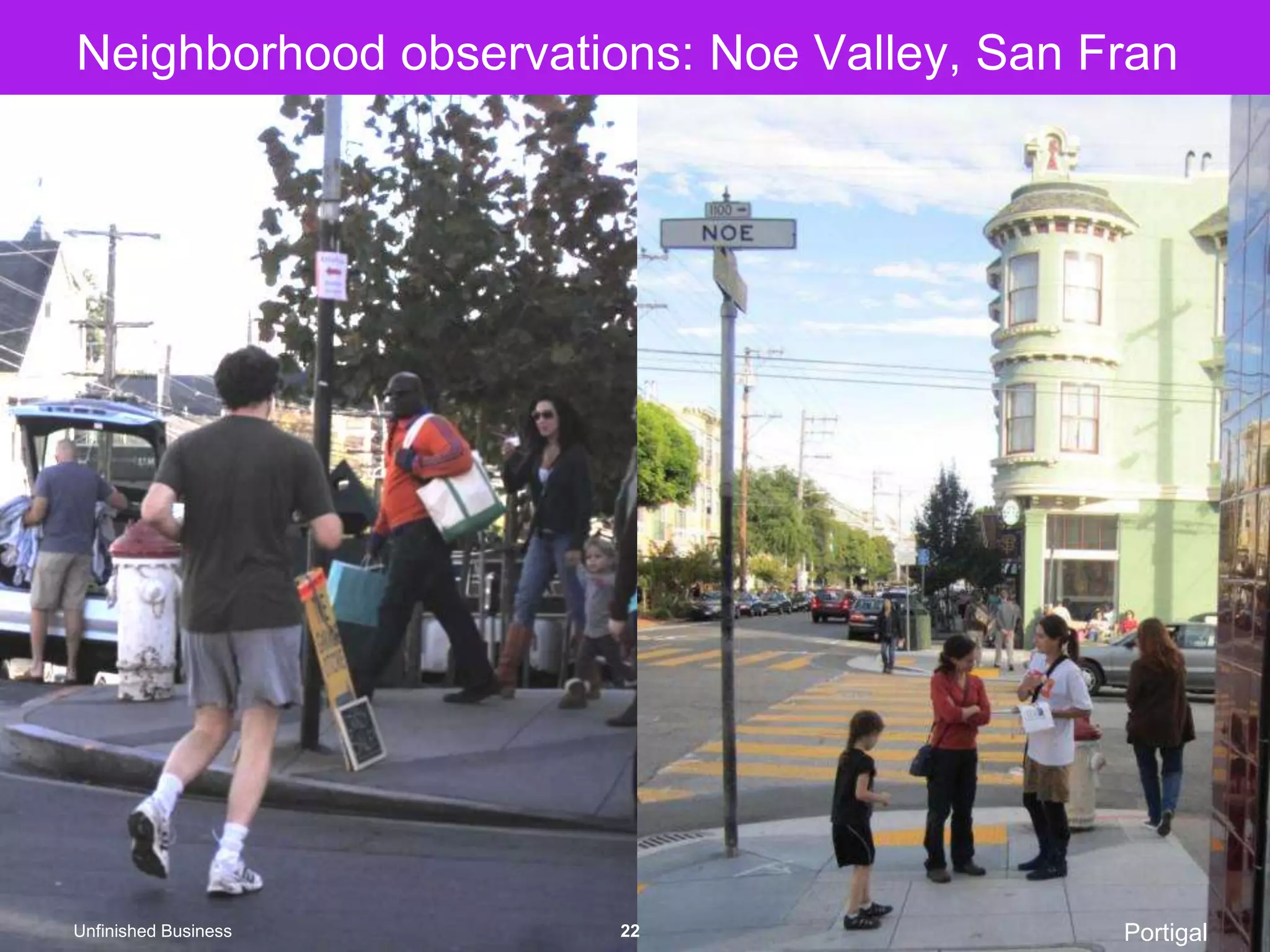
Neighborhood observations: Noe Valley, San FranPortigalUnfinished Business22
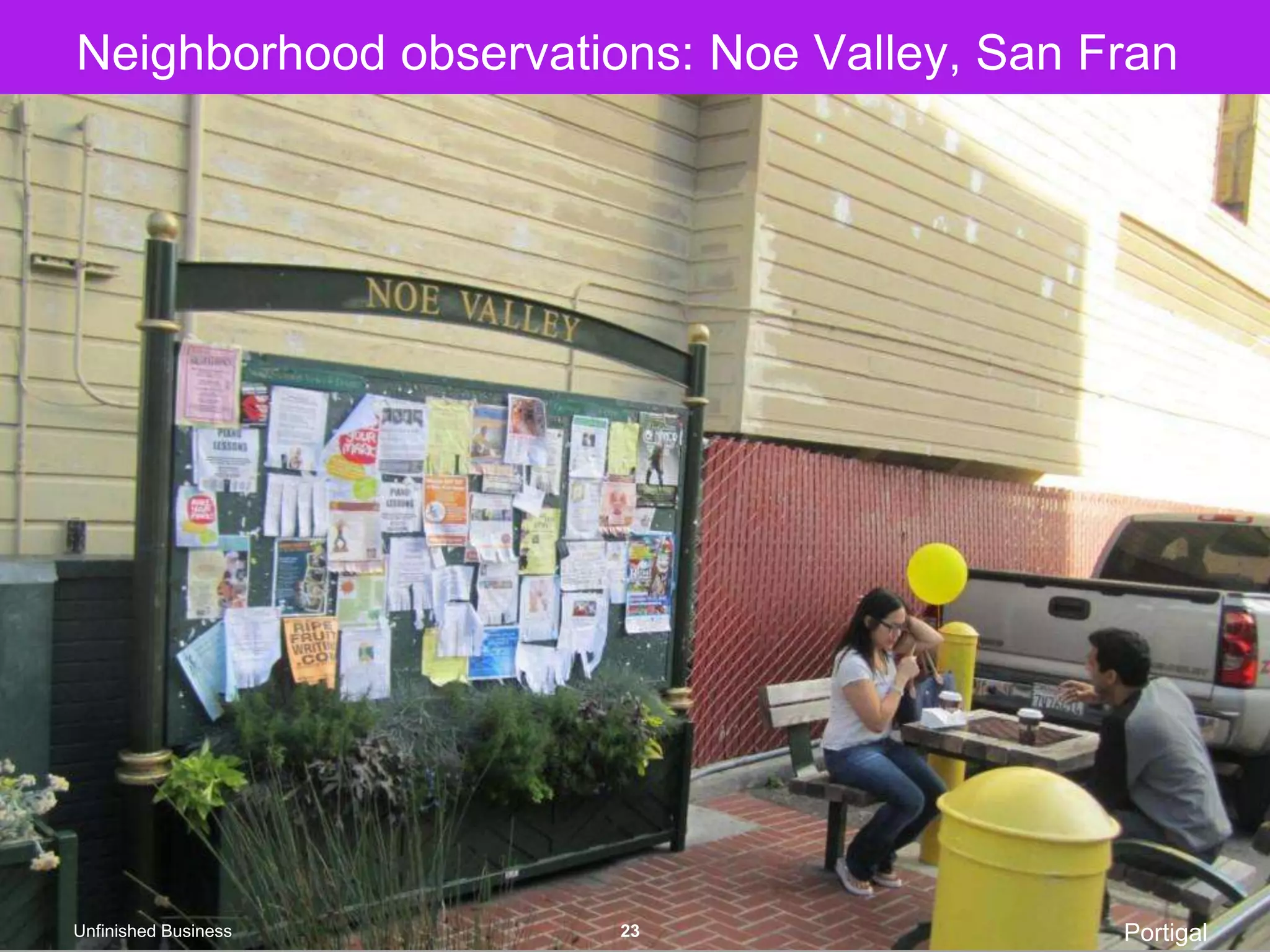
Neighborhood observations: Noe Valley, San FranPortigalUnfinished Business23
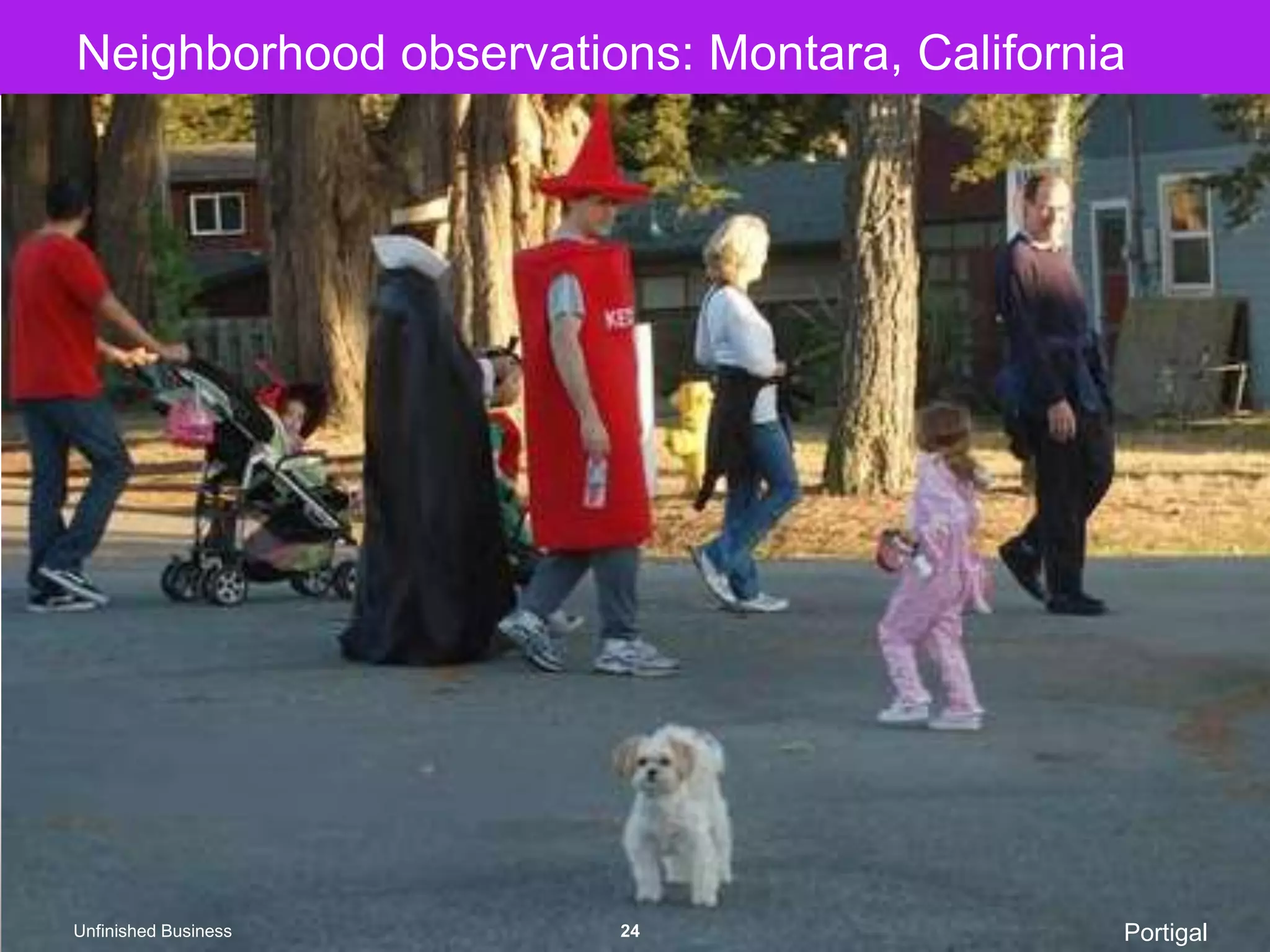
Neighborhood observations: Montara, CaliforniaPortigalUnfinished Business24
Be back by 11:30 to share some stories!Exercise: Explore!
What happened? What did you see? What did you feel?Tell stories
Synthesis
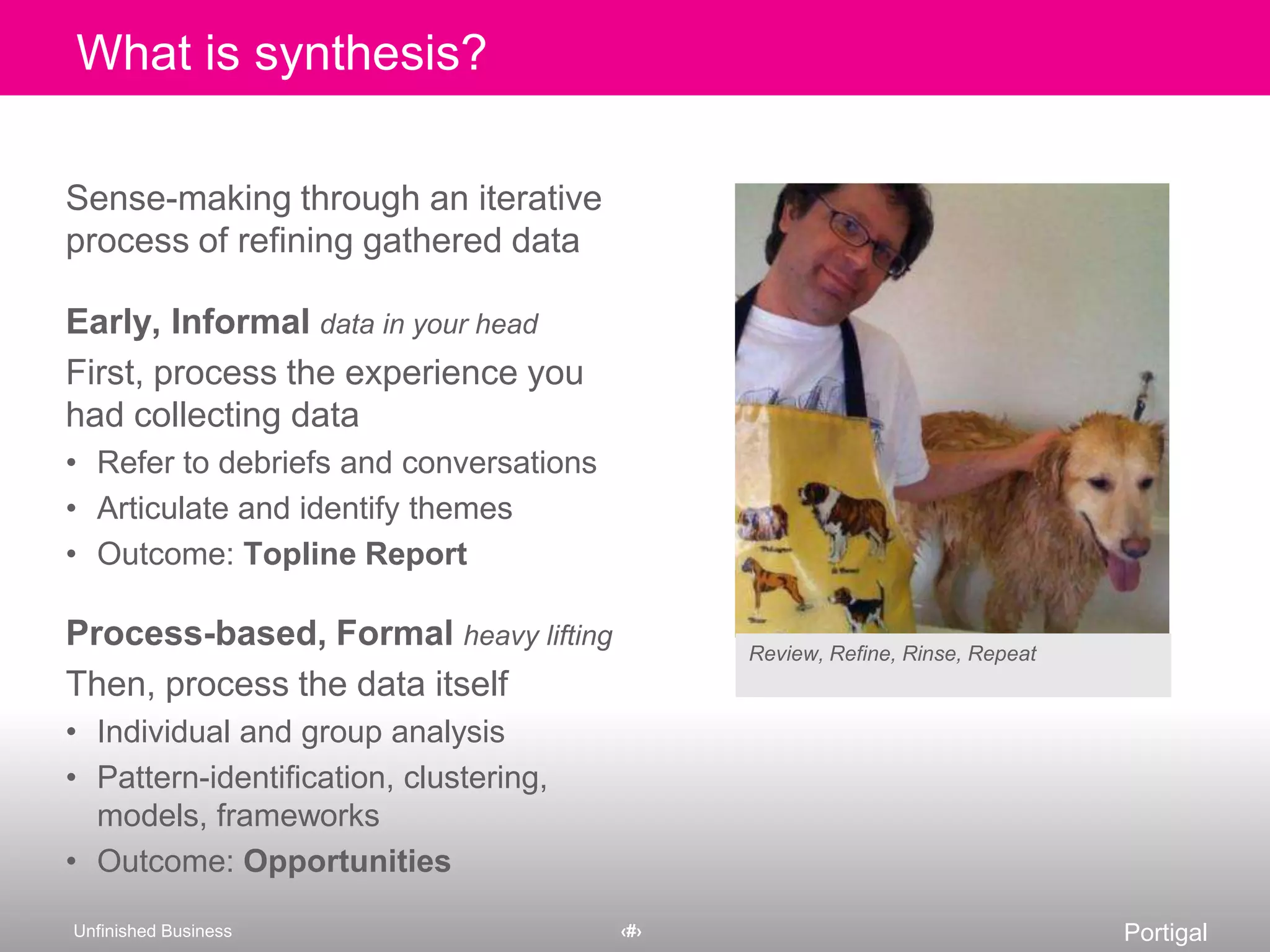
Sense-making through an iterative process of refining gathered dataEarly, Informaldata in your headFirst, process the experience you had collecting dataRefer to debriefs and conversationsArticulate and identify themesOutcome: Topline ReportProcess-based, Formalheavy liftingThen, process the data itselfIndividual and group analysisPattern-identification, clustering, models, frameworksOutcome: OpportunitiesWhat is synthesis?Review, Refine, Rinse, Repeat
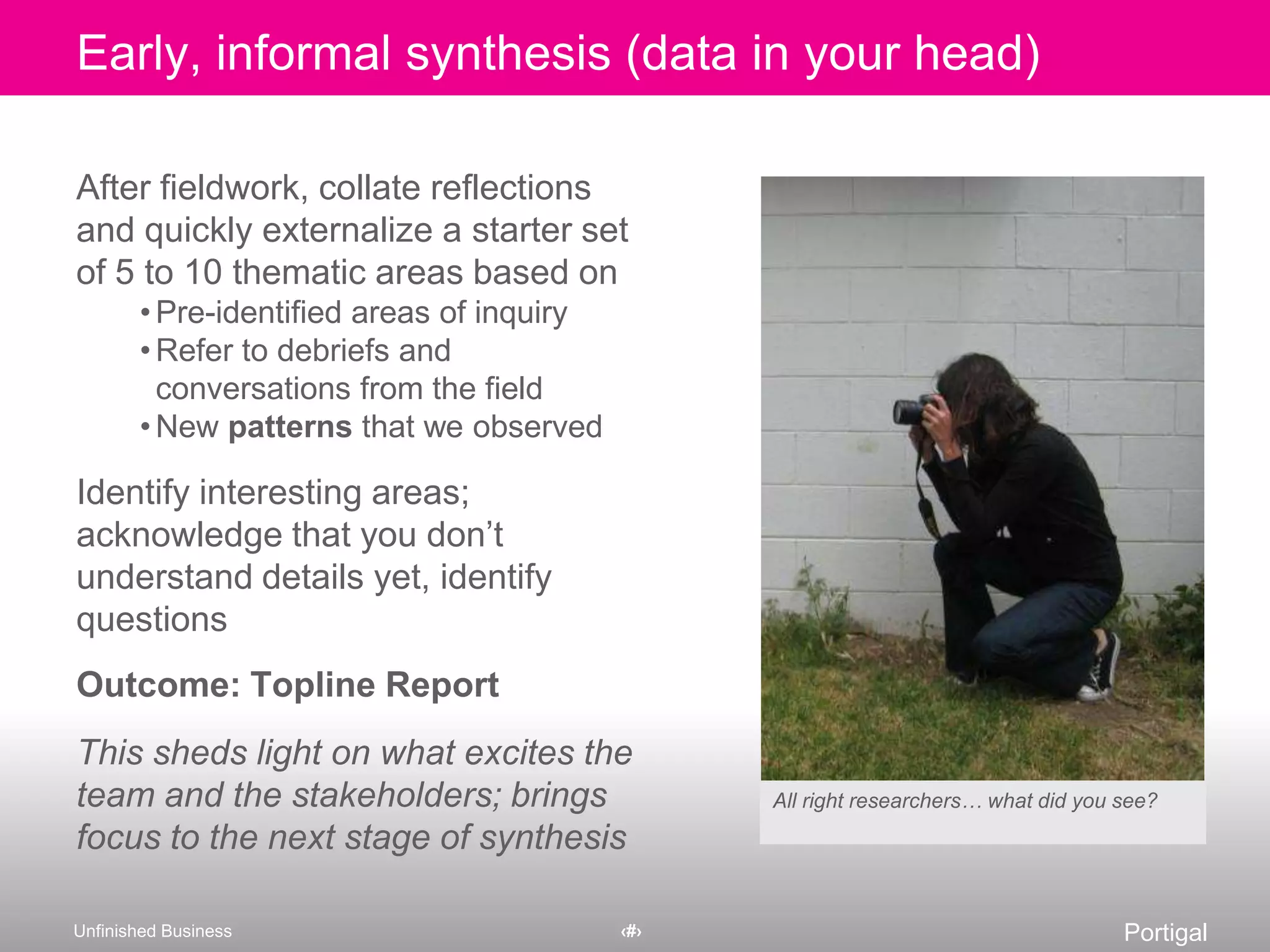
After fieldwork, collate reflections and quickly externalize a starter set of 5 to 10 thematic areas based onPre-identified areas of inquiryRefer to debriefs and conversations from the fieldNew patterns that we observedIdentify interesting areas; acknowledge that you donโ€™t understand details yet, identify questionsOutcome: Topline ReportThis sheds light on what excites the team and the stakeholders; brings focus to the next stage of synthesisAll right researchersโ€ฆ what did you see?Early, informal synthesis (data in your head)
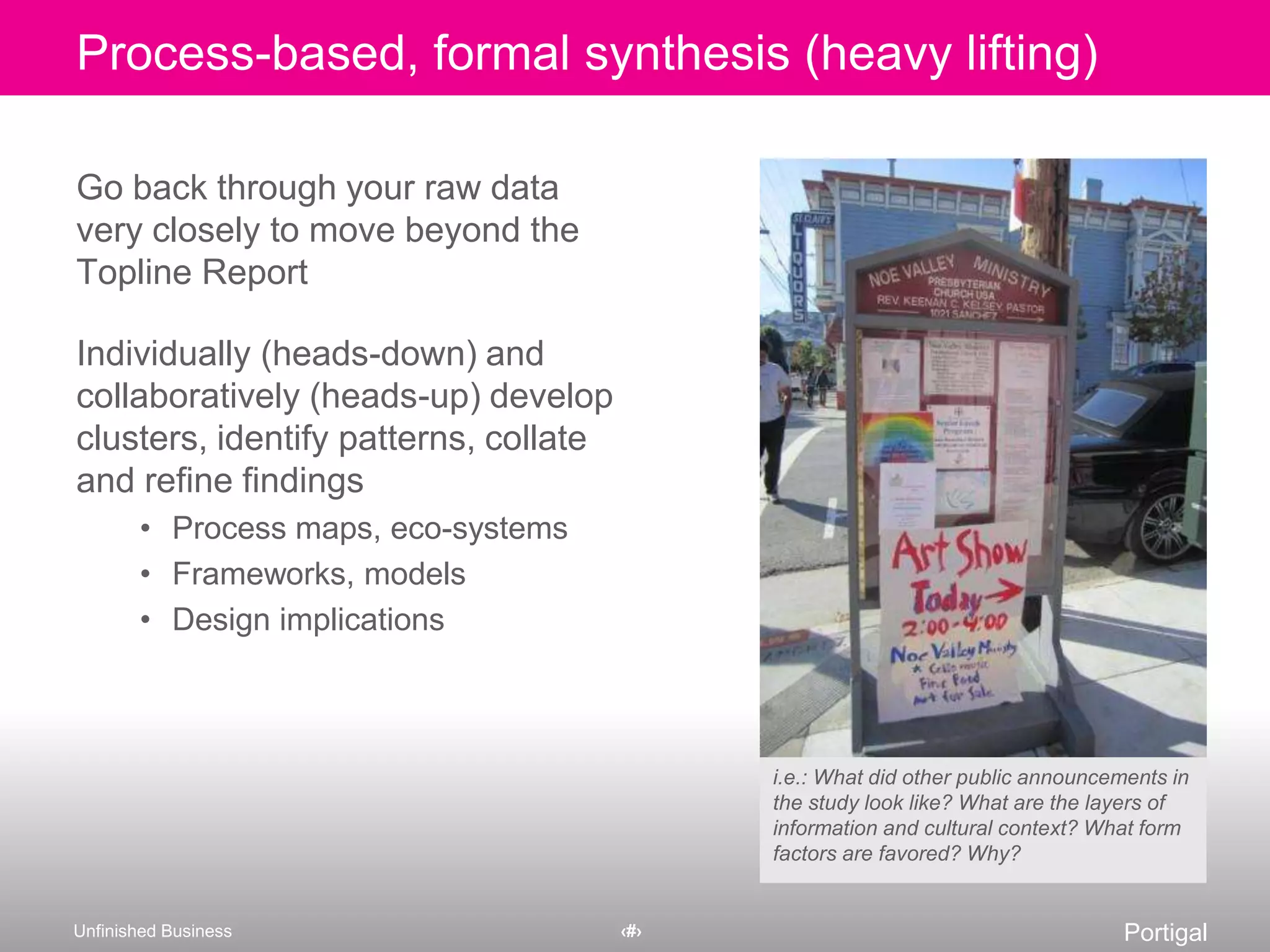
Go back through your raw data very closely to move beyond the Topline Report Individually (heads-down) and collaboratively (heads-up) develop clusters, identify patterns, collate and refine findingsProcess maps, eco-systemsFrameworks, modelsDesign implicationsi.e.: What did other public announcements in the study look like? What are the layers of information and cultural context? What form factors are favored? Why?Process-based, formal synthesis (heavy lifting)
Heads down!Video
Photos, field artifacts
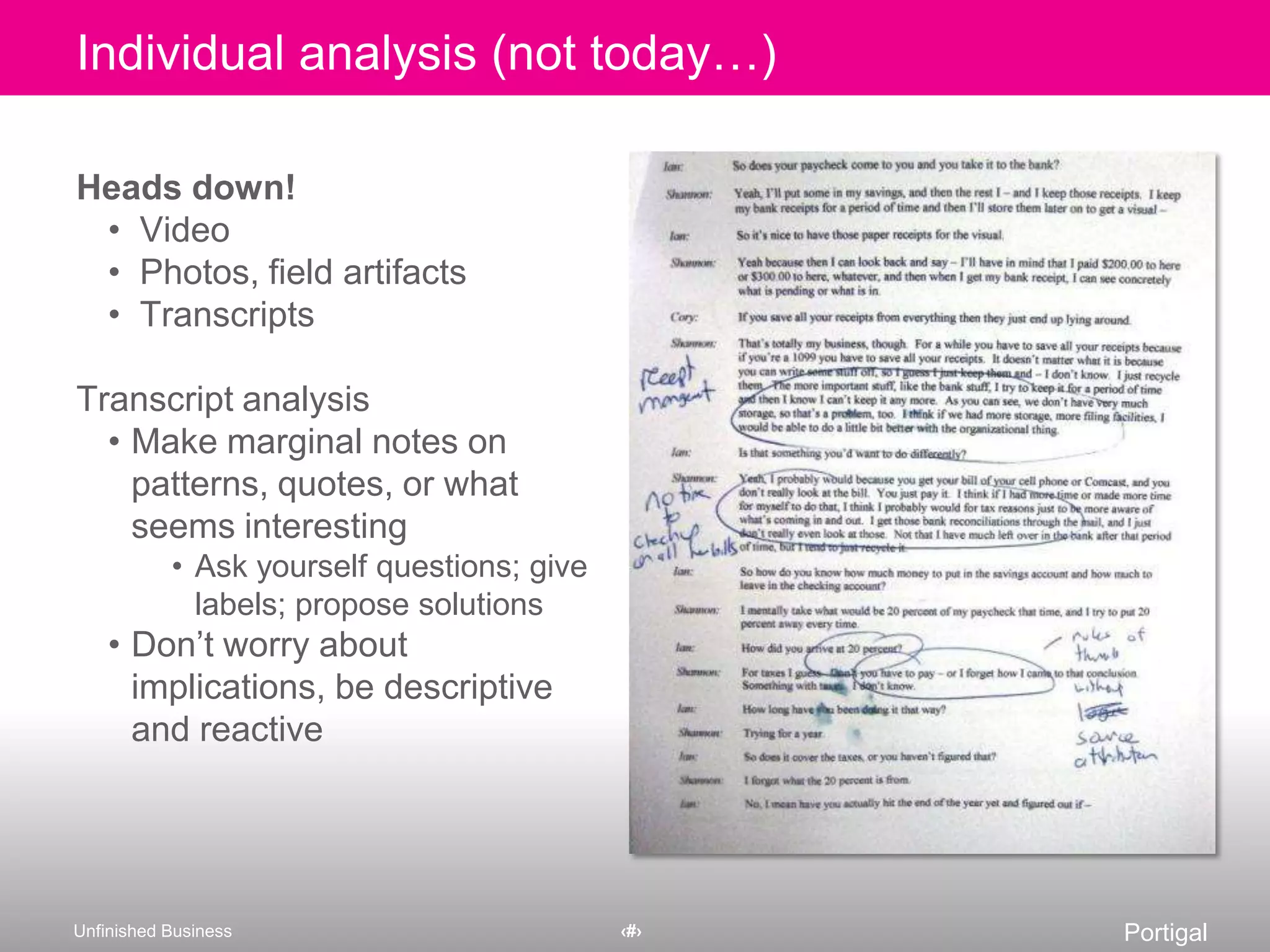
TranscriptsTranscript analysisMake marginal notes on patterns, quotes, or what seems interesting
Ask yourself questions; give labels; propose solutions
Donโ€™t worry about implications, be descriptive and reactiveIndividual analysis (not todayโ€ฆ)
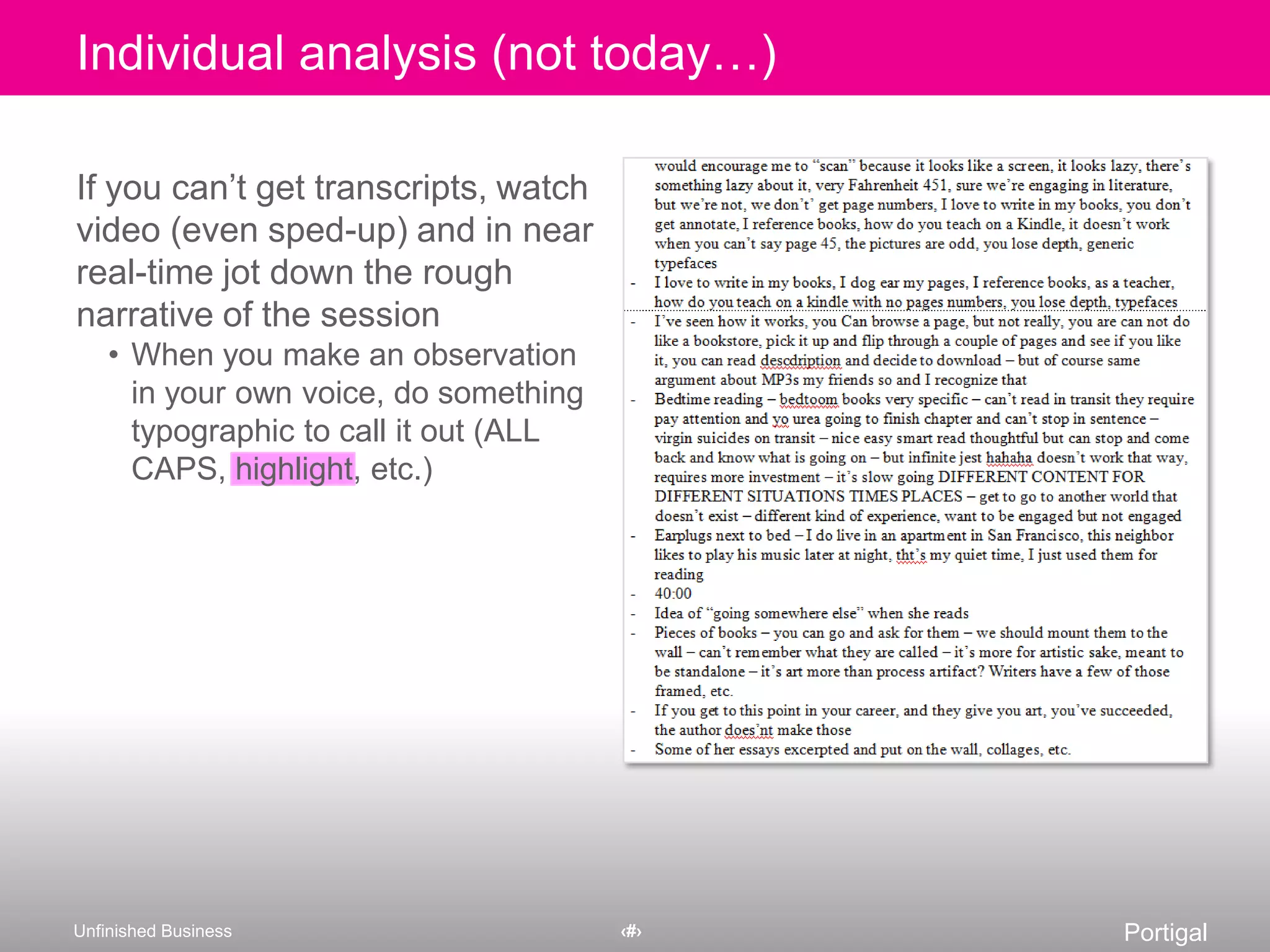
If you canโ€™t get transcripts, watch video (even sped-up) and in near real-time jot down the rough narrative of the sessionWhen you make an observation in your own voice, do something typographic to call it out (ALL CAPS, highlight, etc.)Individual analysis (not todayโ€ฆ)
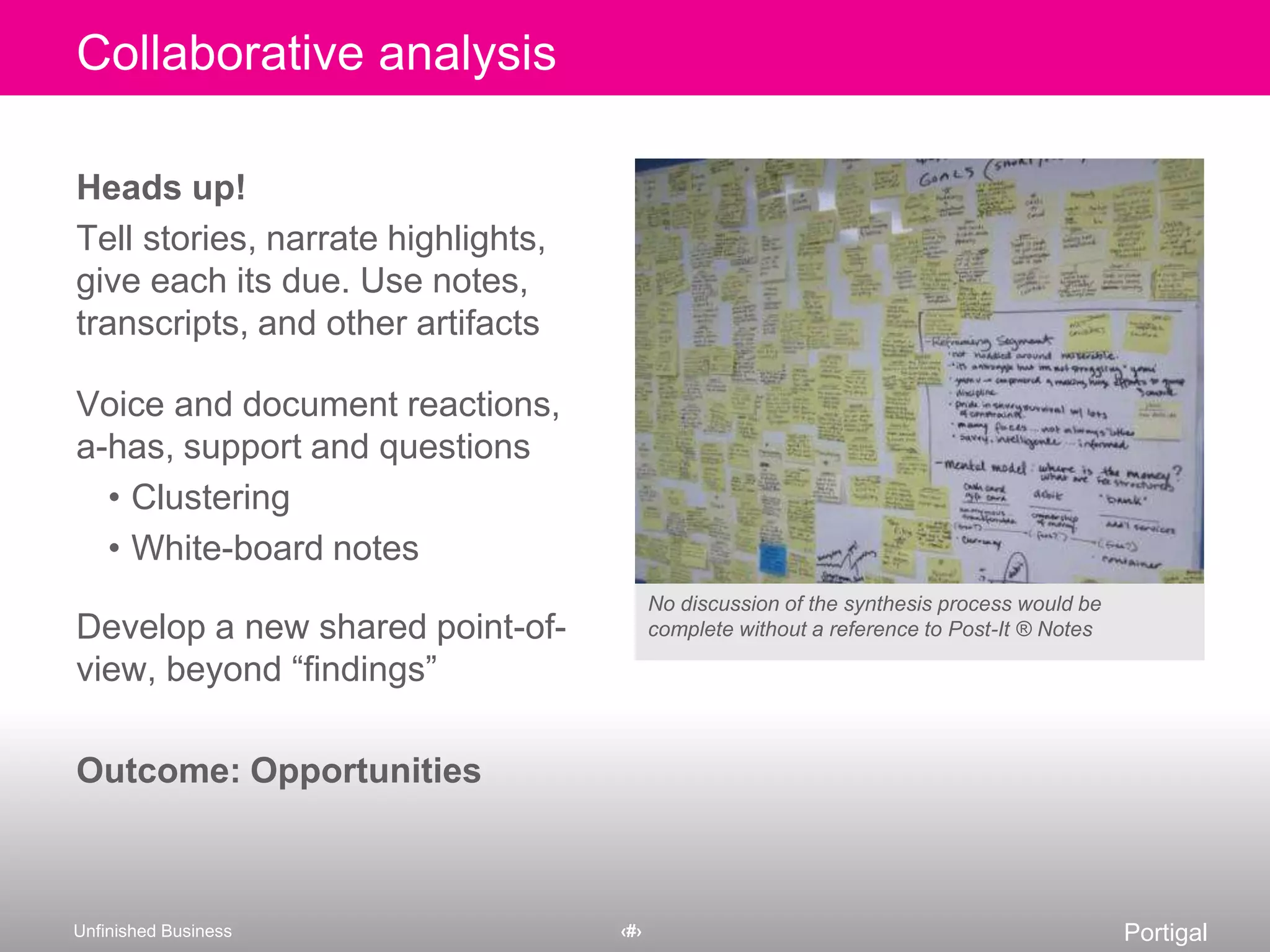
Heads up! Tell stories, narrate highlights, give each its due. Use notes, transcripts, and other artifacts Voice and document reactions, a-has, support and questionsClusteringWhite-board notesDevelop a new shared point-of-view, beyond โ€œfindingsโ€Outcome: OpportunitiesNo discussion of the synthesis process would be complete without a reference to Post-It ยฎ NotesCollaborative analysis
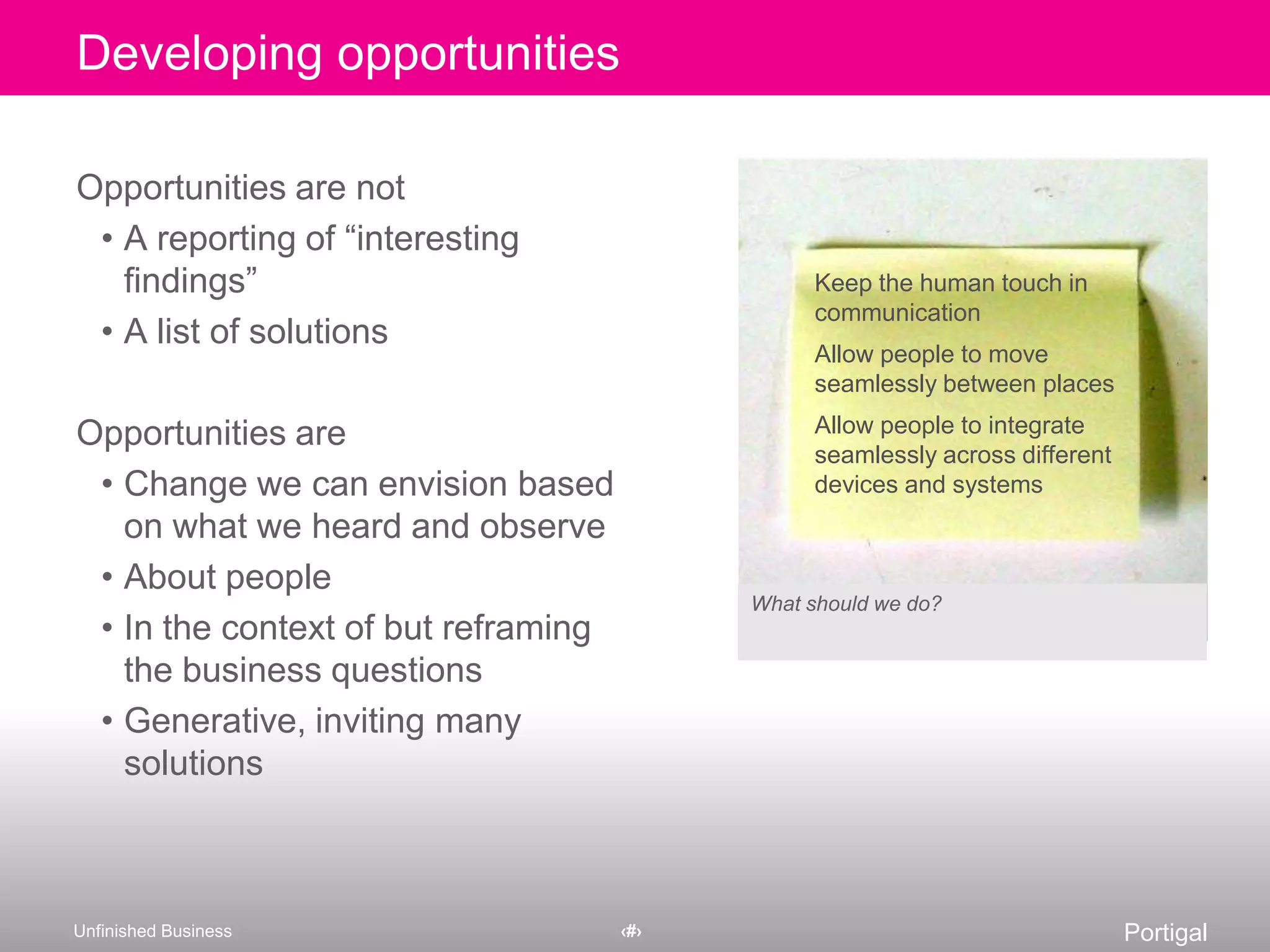
Opportunities are not A reporting of โ€œinteresting findingsโ€ A list of solutionsOpportunities areChange we can envision based on what we heard and observeAbout peopleIn the context of but reframing the business questionsGenerative, inviting many solutionsKeep the human touch in communicationAllow people to move seamlessly between placesAllow people to integrate seamlessly across different devices and systemsDeveloping opportunitiesWhat should we do?
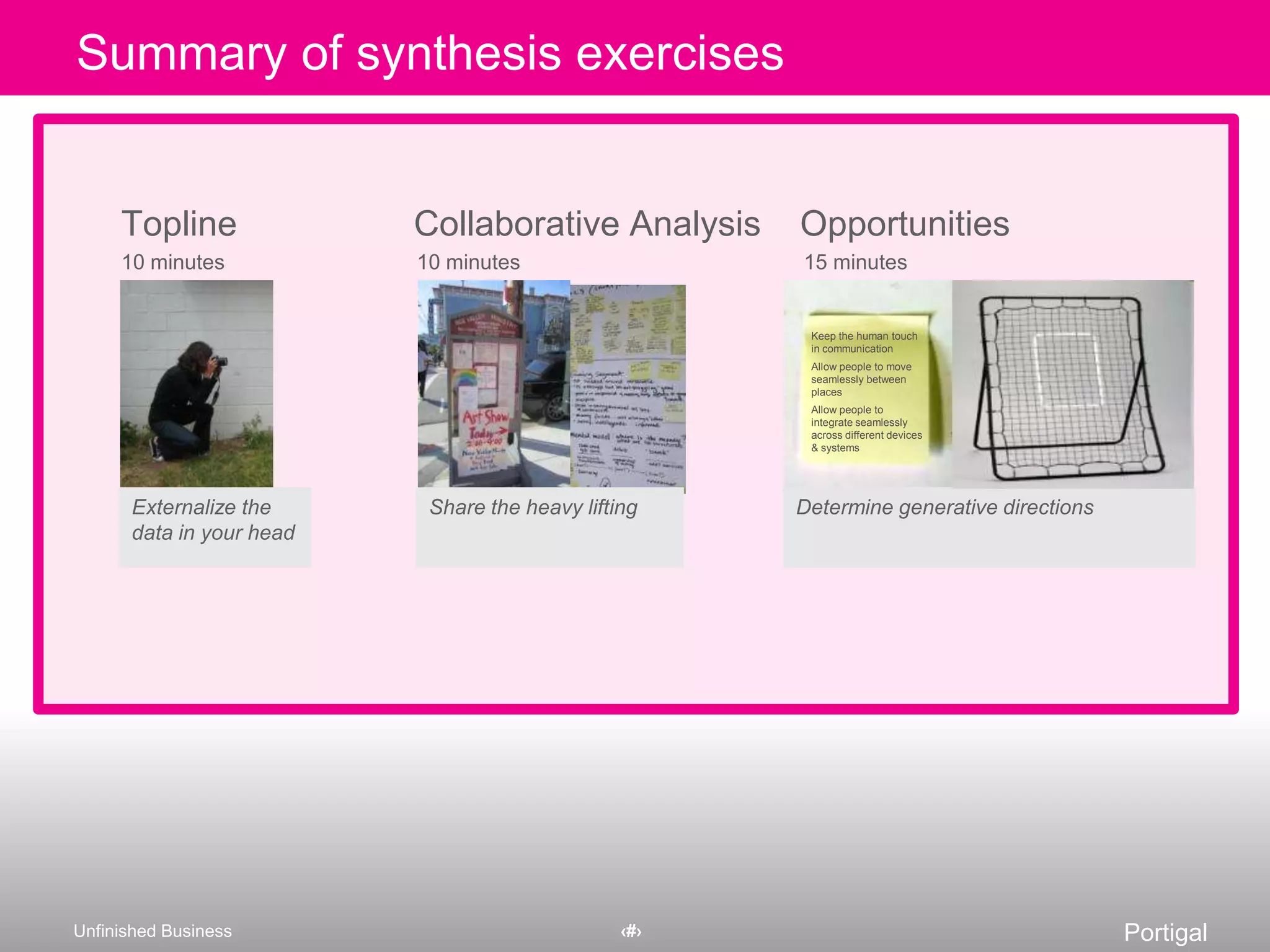
Topline    	    Collaborative Analysis    Opportunities10 minutes		       10 minutes		        15 minutesKeep the human touch in communicationAllow people to move seamlessly between placesAllow people to integrate seamlessly across different devices & systemsSummary of synthesis exercisesExternalize the data in your headShare the heavy liftingDetermine generative directions
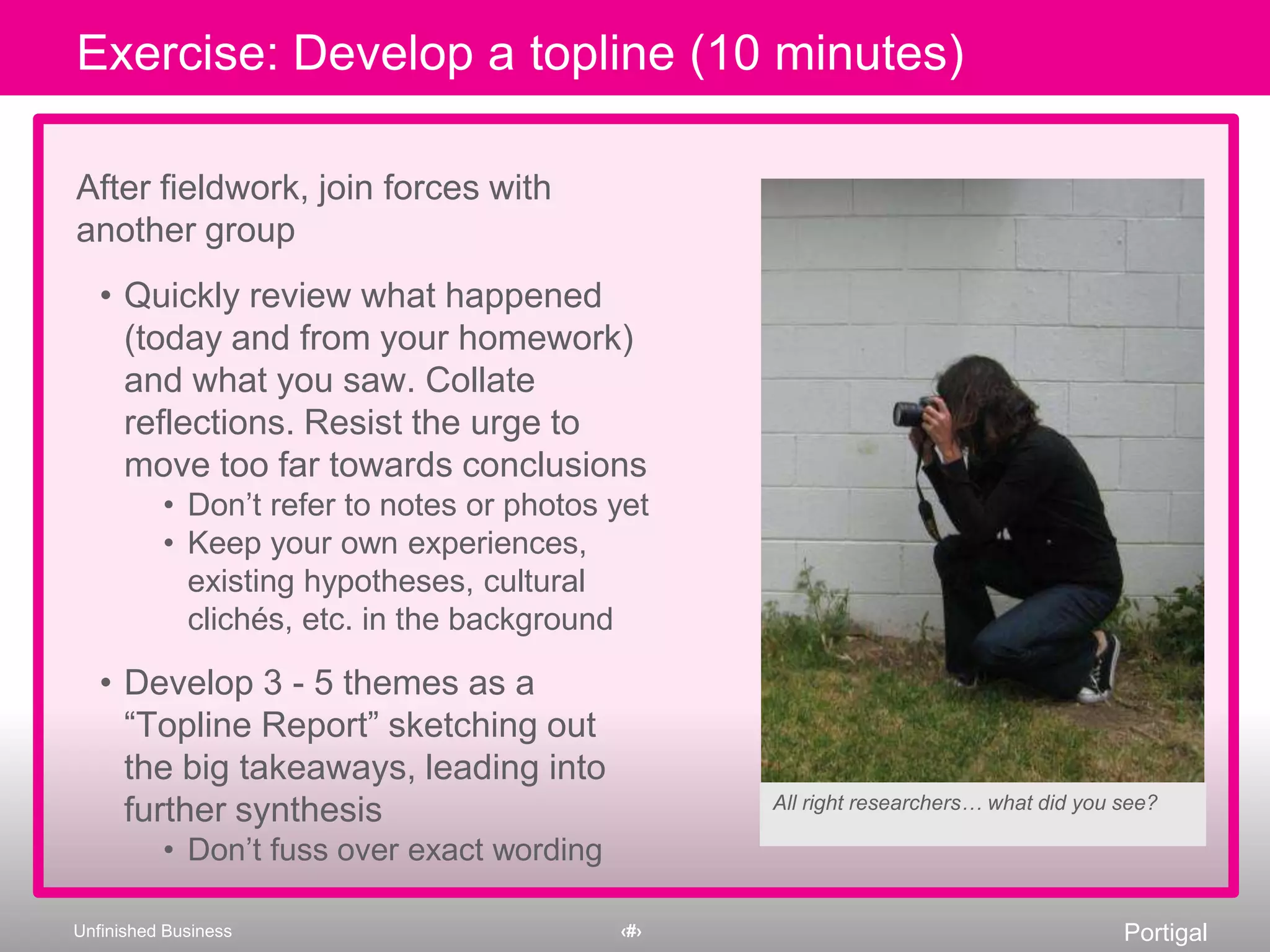
After fieldwork, join forces with another groupQuickly review what happened (today and from your homework) and what you saw. Collate reflections. Resist the urge to move too far towards conclusionsDonโ€™t refer to notes or photos yetKeep your own experiences, existing hypotheses, cultural clichรฉs, etc. in the backgroundDevelop 3 - 5 themes as a โ€œTopline Reportโ€ sketching out the big takeaways, leading into further synthesisDonโ€™t fuss over exact wordingExercise: Develop a topline (10 minutes)All right researchersโ€ฆ what did you see?
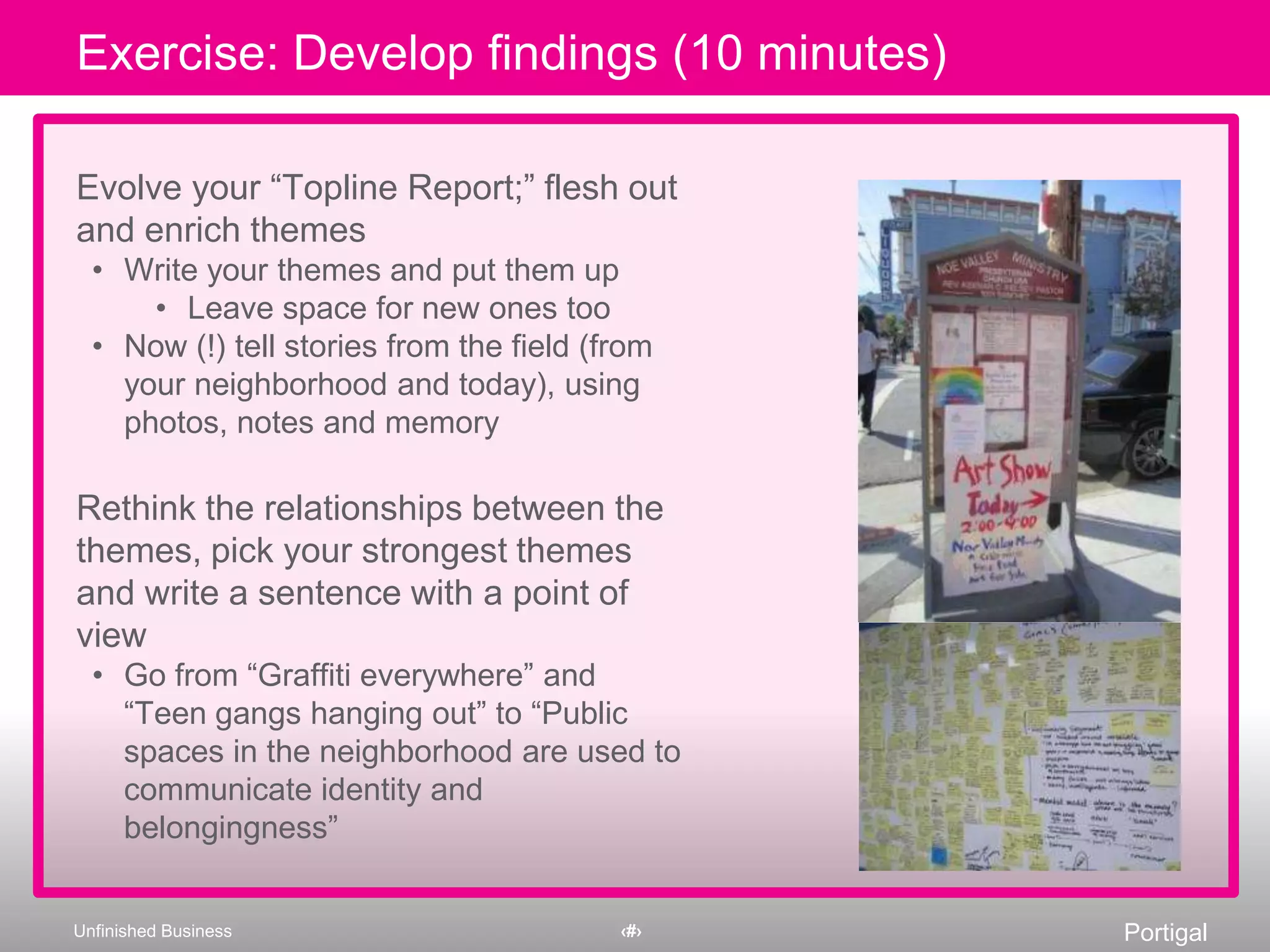
Evolve your โ€œTopline Report;โ€ flesh out and enrich themesWrite your themes and put them upLeave space for new ones tooNow (!) tell stories from the field (from your neighborhood and today), using photos, notes and memoryRethink the relationships between the themes, pick your strongest themes and write a sentence with a point of viewGo from โ€œGraffiti everywhereโ€ and โ€œTeen gangs hanging outโ€ to โ€œPublic spaces in the neighborhood are used to communicate identity and belongingnessโ€Exercise: Develop findings (10 minutes)
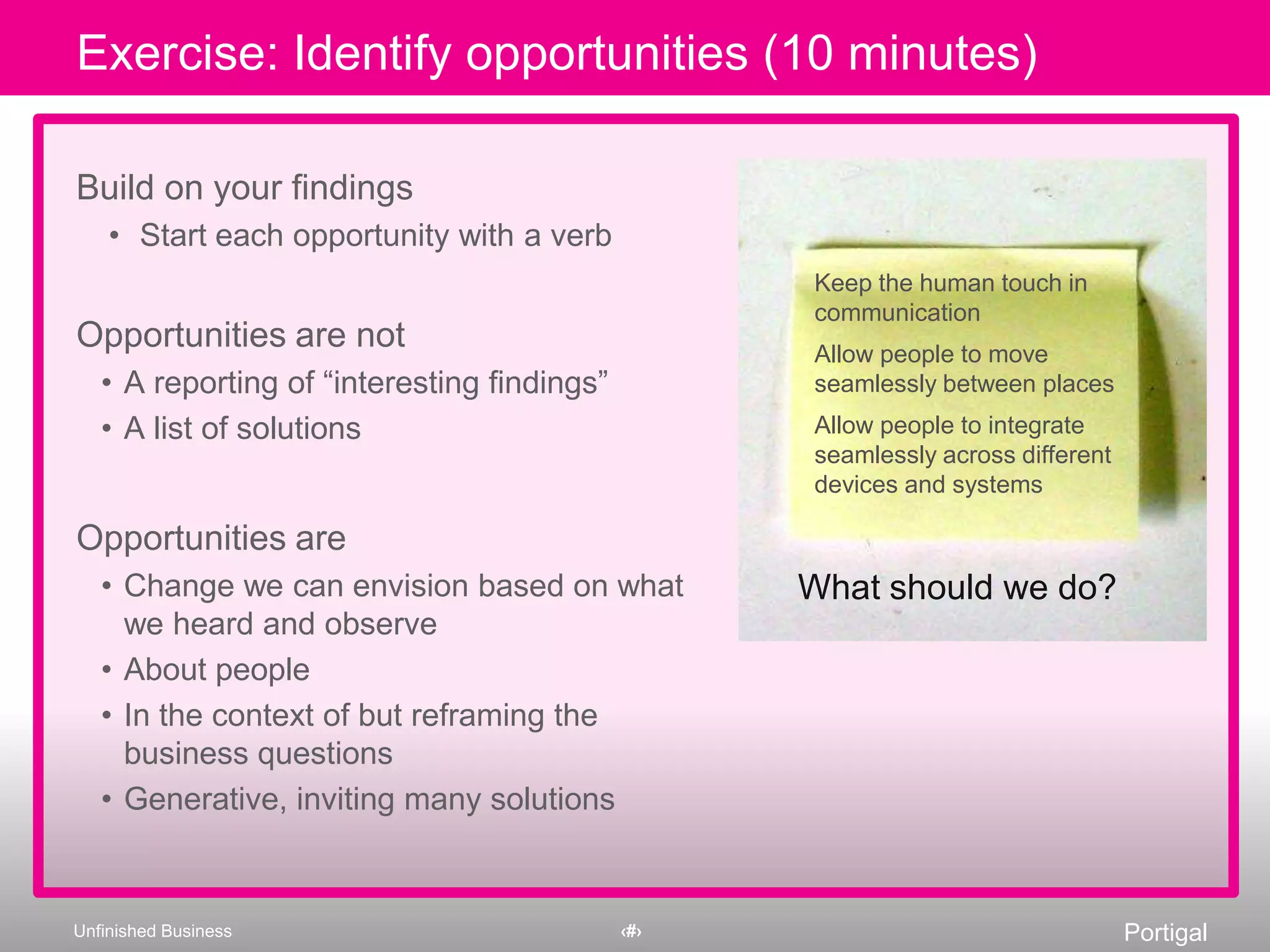
Build on your findingsStart each opportunity with a verbOpportunities are not A reporting of โ€œinteresting findingsโ€ A list of solutionsOpportunities areChange we can envision based on what we heard and observeAbout peopleIn the context of but reframing the business questionsGenerative, inviting many solutionsExercise: Identify opportunities (10 minutes)Keep the human touch in communicationAllow people to move seamlessly between placesAllow people to integrate seamlessly across different devices and systemsKeep the human touch in communicationAllow people to move seamlessly between placesAllow people to integrate seamlessly across different devices and systemsWhat should we do?What should we do?
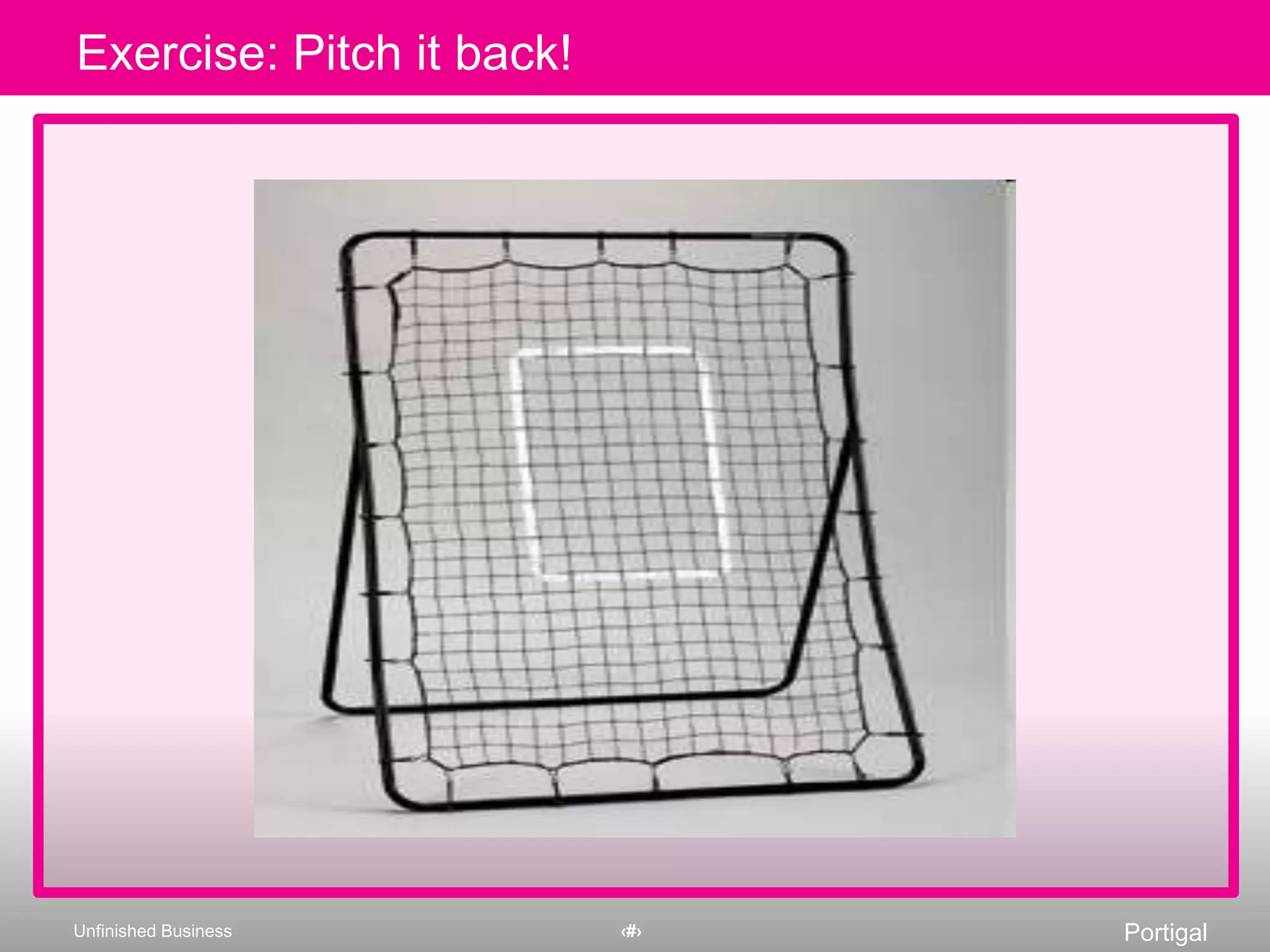
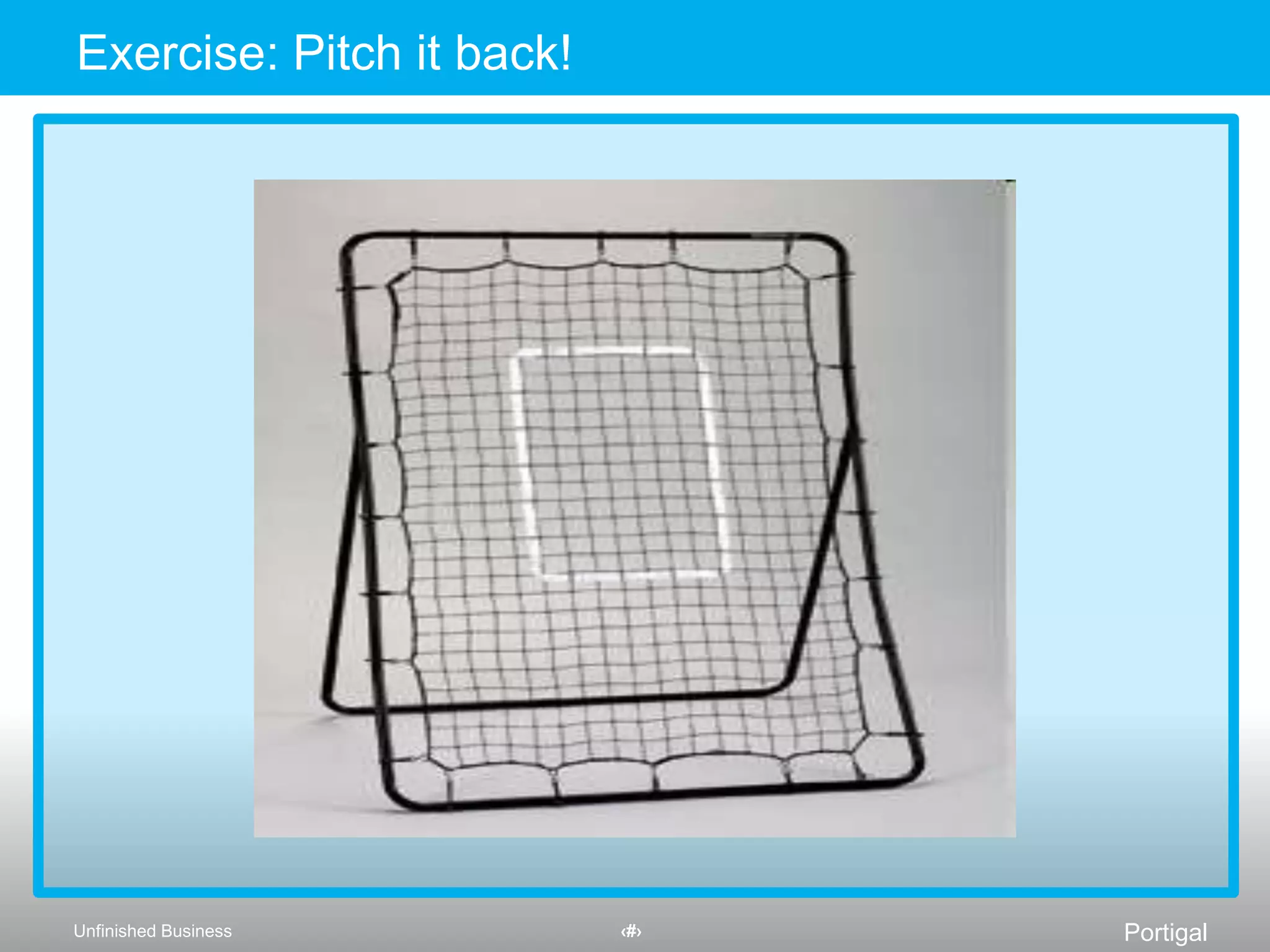
Exercise: Pitch it back!
Ideation
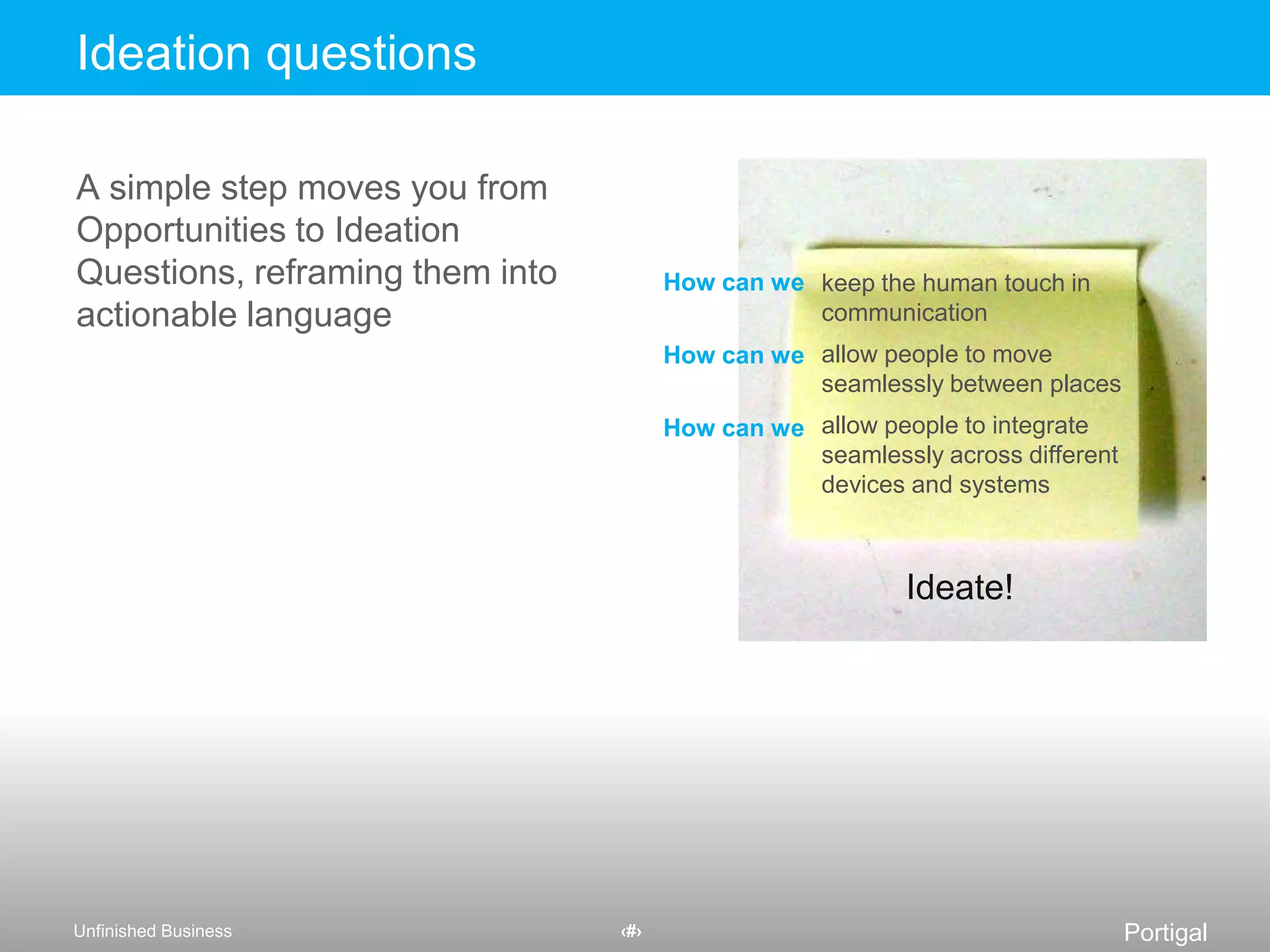
A simple step moves you from Opportunities to Ideation Questions, reframing them into actionable language How can wekeep the human touch in communicationallow people to move seamlessly between placesallow people to integrate seamlessly across different devices and systemsHow can weHow can weIdeate!Ideation questions
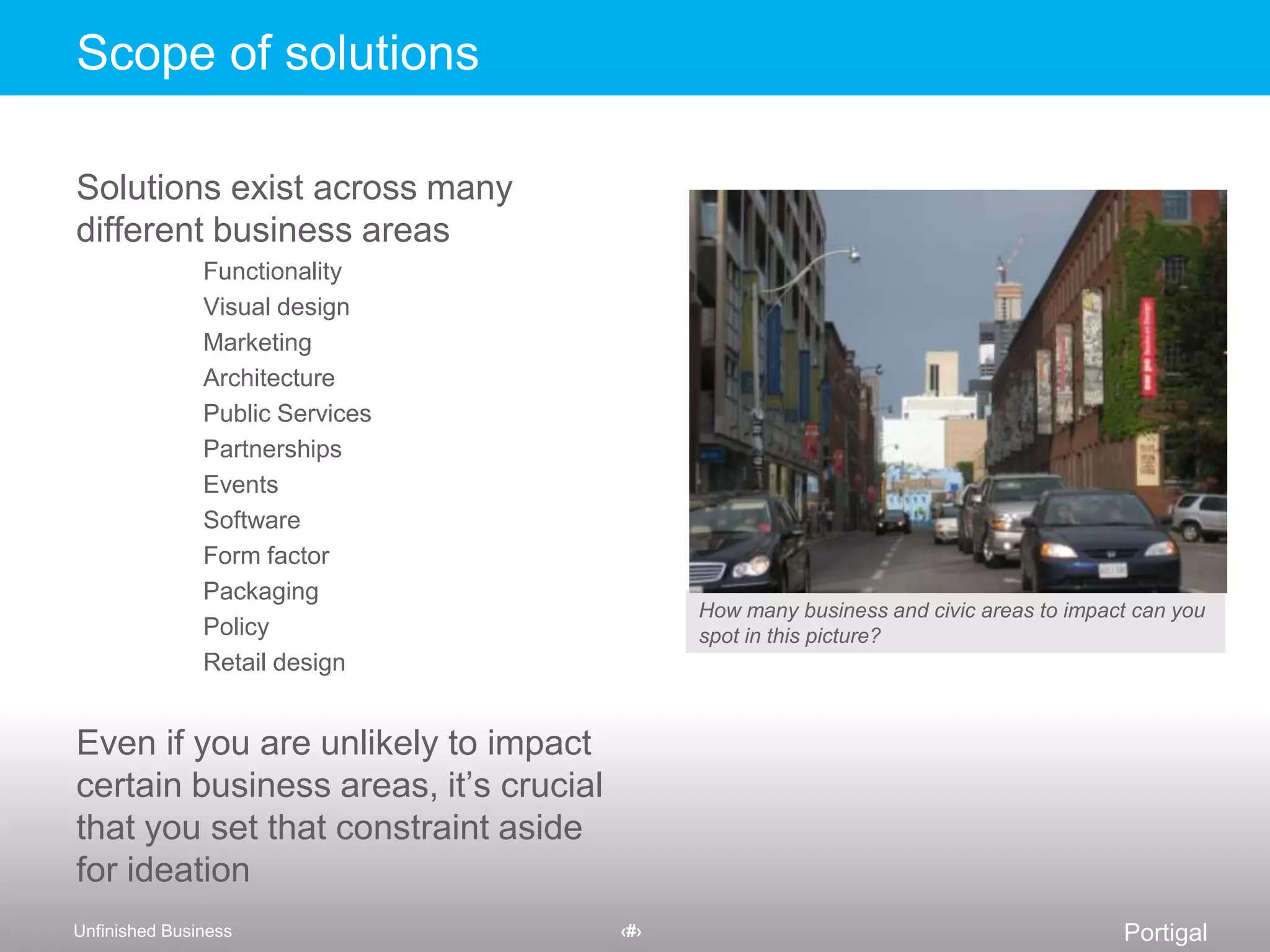
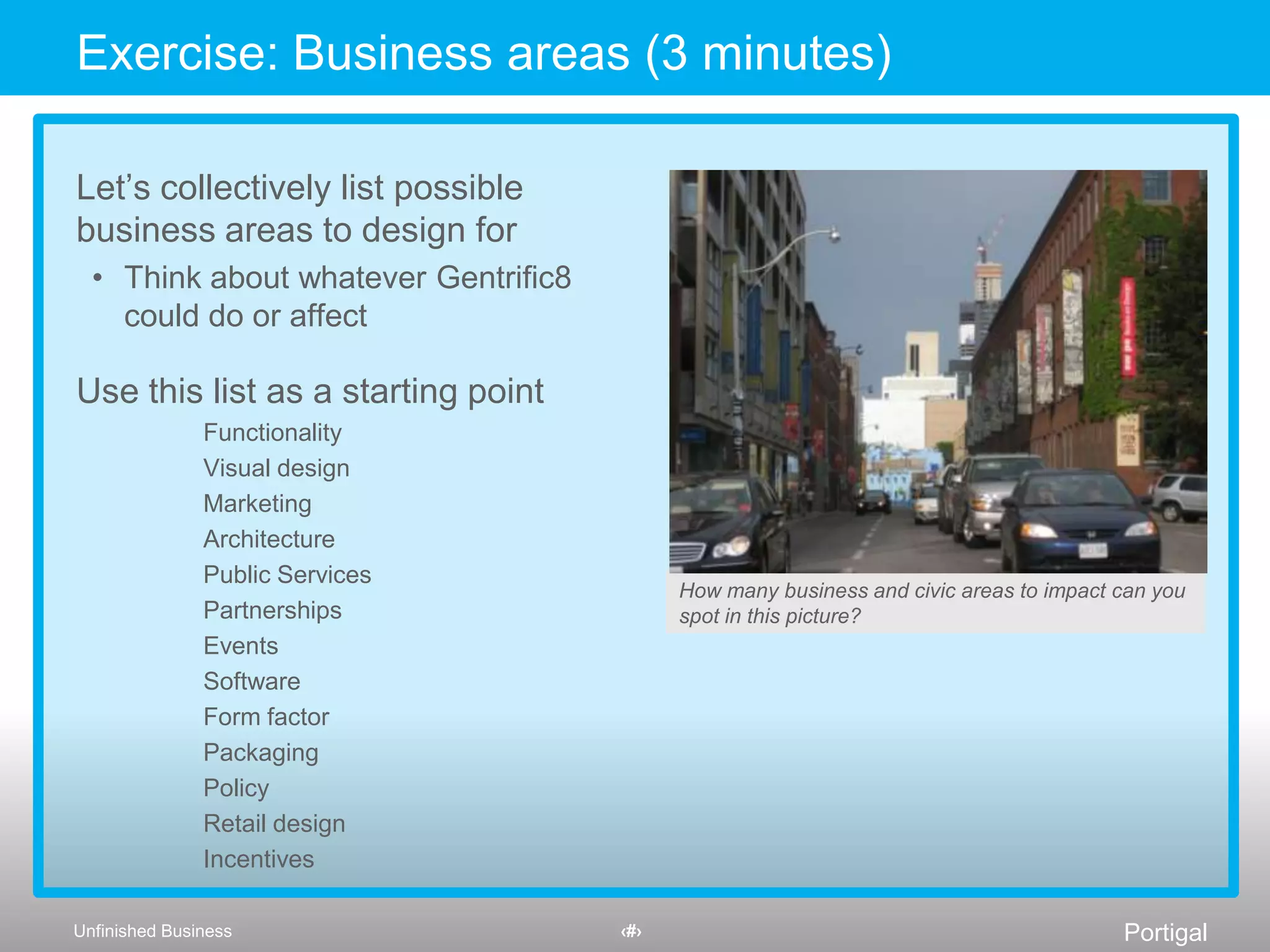
Scope of solutionsSolutions exist across many different business areas FunctionalityVisual designMarketingArchitecturePublic ServicesPartnershipsEventsSoftwareForm factorPackagingPolicyRetail designEven if you are unlikely to impact certain business areas, itโ€™s crucial that you set that constraint aside for ideationHow many business and civic areas to impact can you spot in this picture?
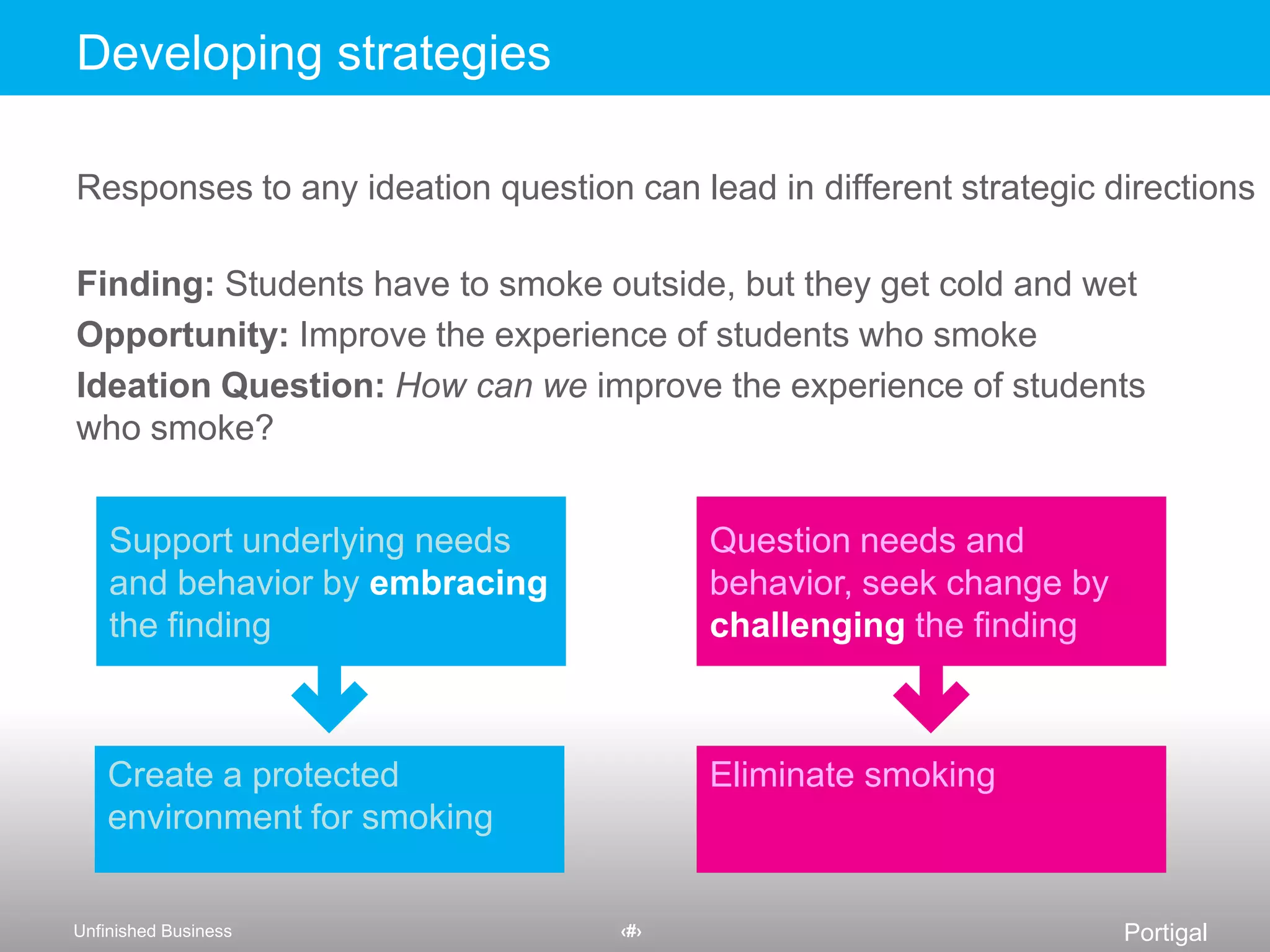
Developing strategiesResponses to any ideation question can lead in different strategic directionsFinding:Students have to smoke outside, but they get cold and wet Opportunity: Improve the experience of students who smokeIdeation Question:How can we improve the experience of students who smoke?Support underlying needs and behavior by embracing the findingQuestion needs and behavior, seek change by challenging the findingCreate a protected environment for smokingEliminate smoking
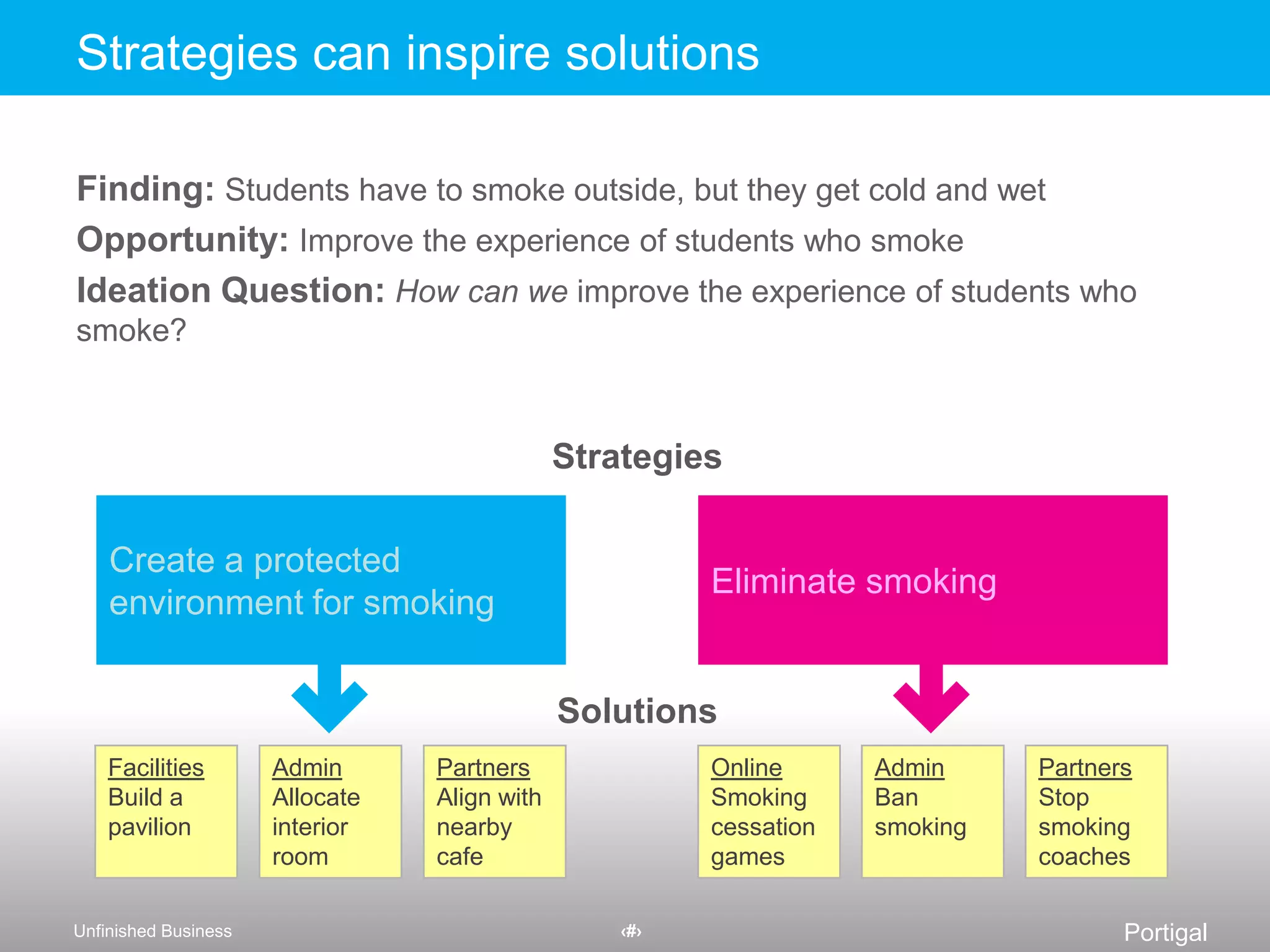
Strategies can inspire solutionsFinding:Students have to smoke outside, but they get cold and wet Opportunity: Improve the experience of students who smokeIdeation Question:How can we improve the experience of students who smoke?StrategiesCreate a protected environment for smokingEliminate smokingSolutionsFacilitiesBuild a pavilionAdminAllocate interior roomPartnersAlign with nearby cafeOnlineSmoking cessation gamesAdminBan smokingPartnersStop smoking coaches
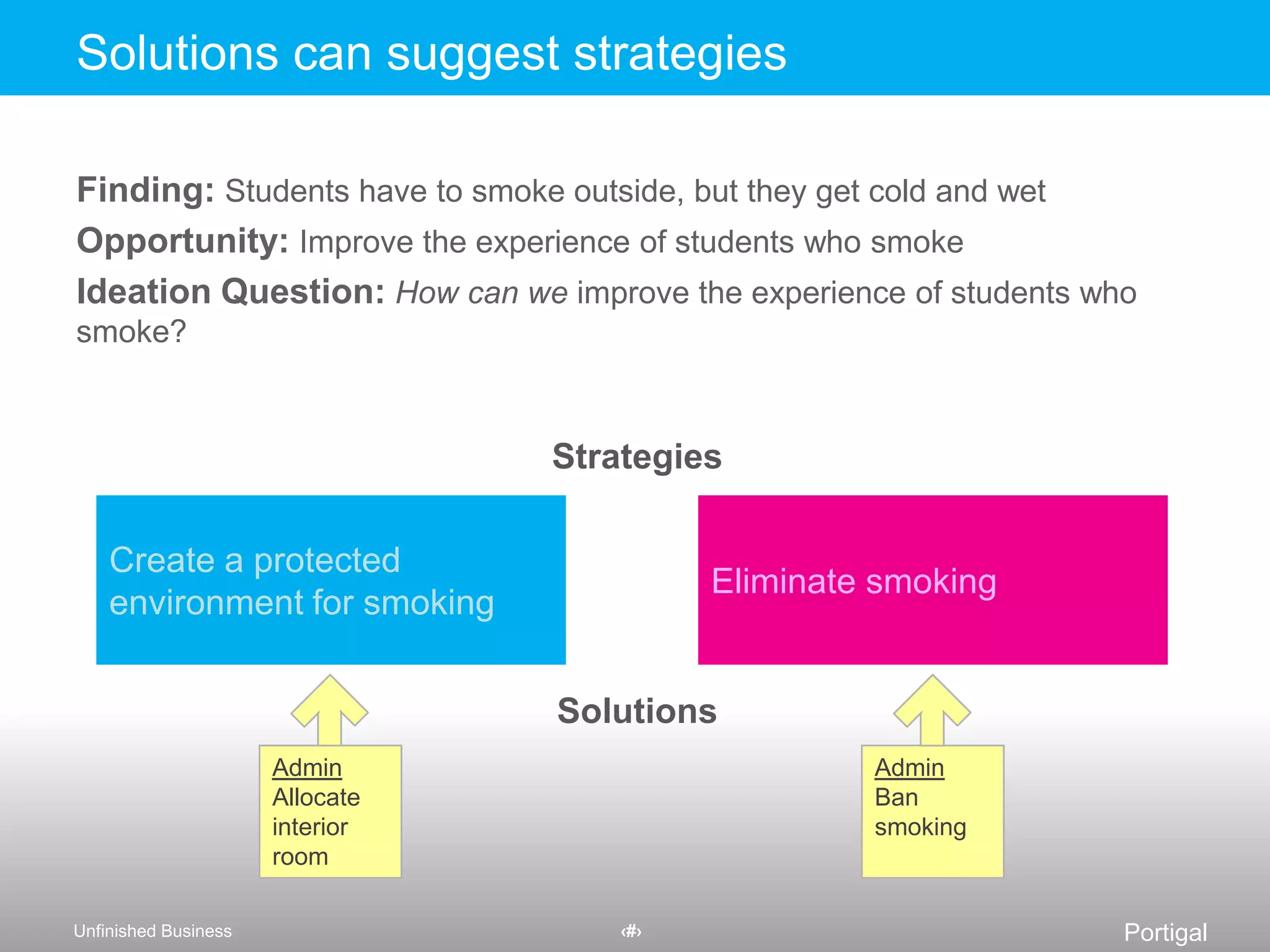
Solutions can suggest strategiesFinding:Students have to smoke outside, but they get cold and wet Opportunity: Improve the experience of students who smokeIdeation Question:How can we improve the experience of students who smoke?StrategiesCreate a protected environment for smokingEliminate smokingSolutionsAdminAllocate interior roomAdminBan smoking
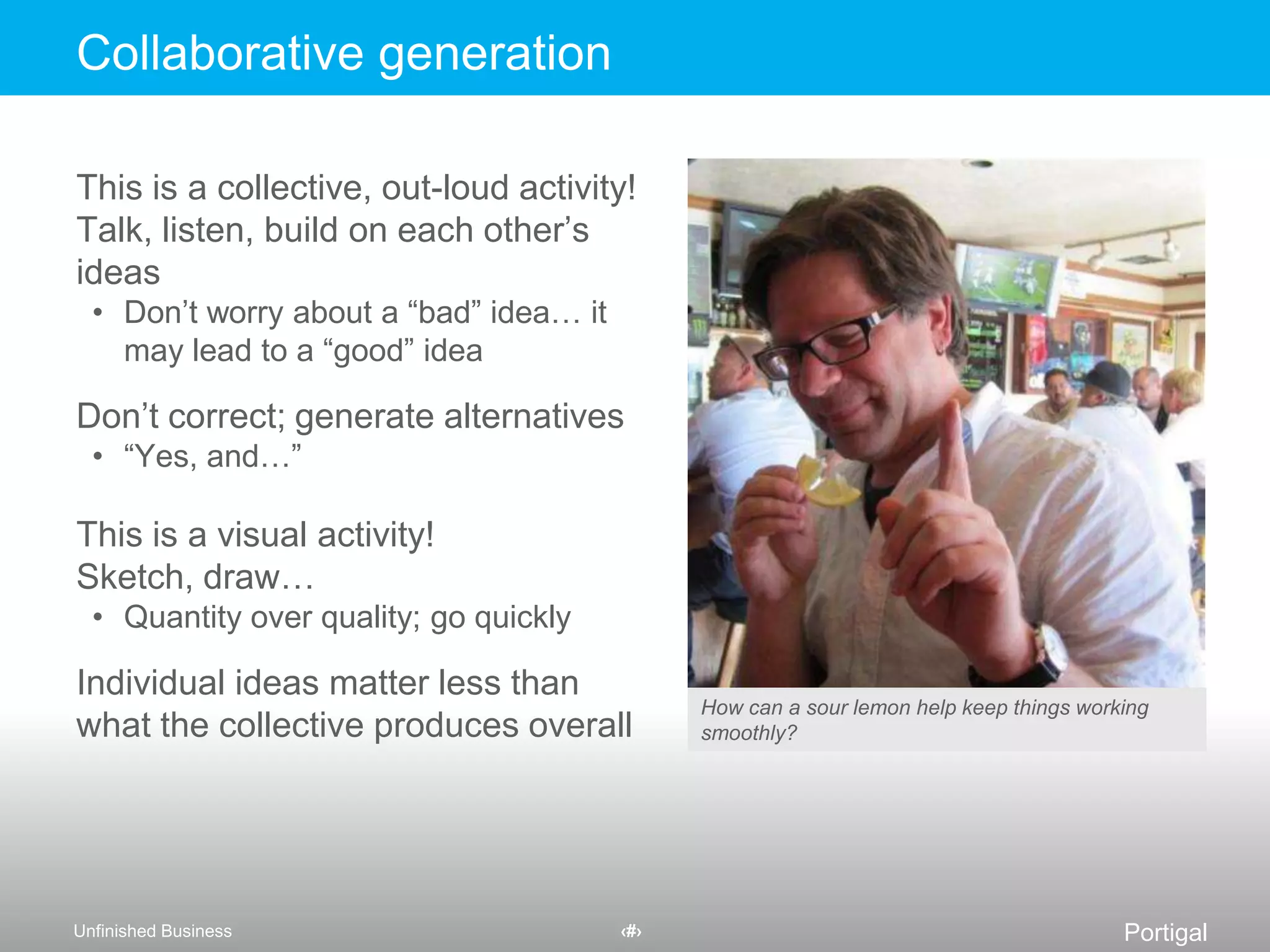
Collaborative generationThis is a collective, out-loud activity! Talk, listen, build on each otherโ€™s ideasDonโ€™t worry about a โ€œbadโ€ ideaโ€ฆ it may lead to a โ€œgoodโ€ ideaDonโ€™t correct; generate alternativesโ€œYes, andโ€ฆโ€This is a visual activity! Sketch, drawโ€ฆQuantity over quality; go quicklyIndividual ideas matter less than what the collective produces overallHow can a sour lemon help keep things working smoothly?
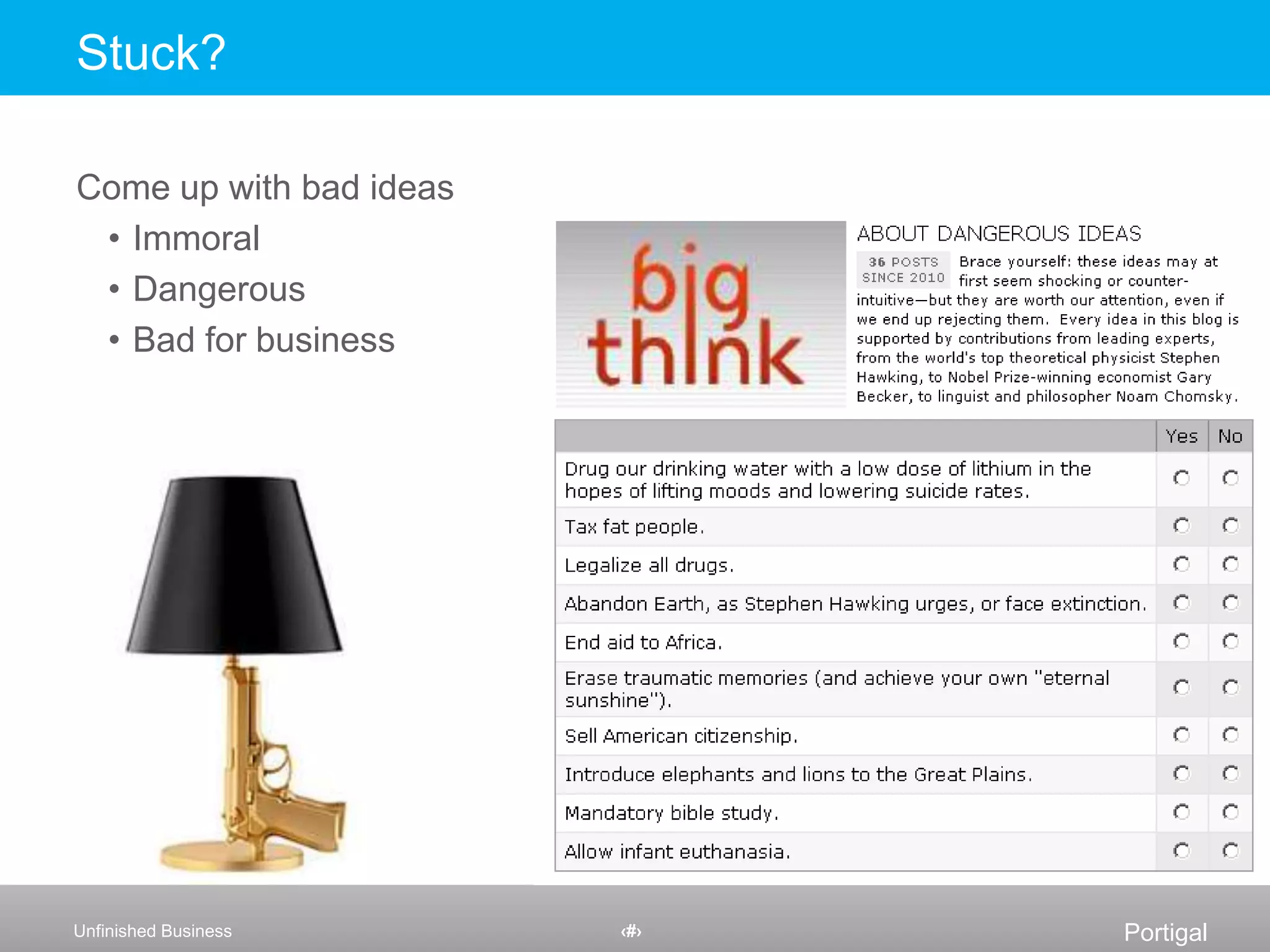
Stuck?Come up with bad ideasImmoralDangerousBad for business
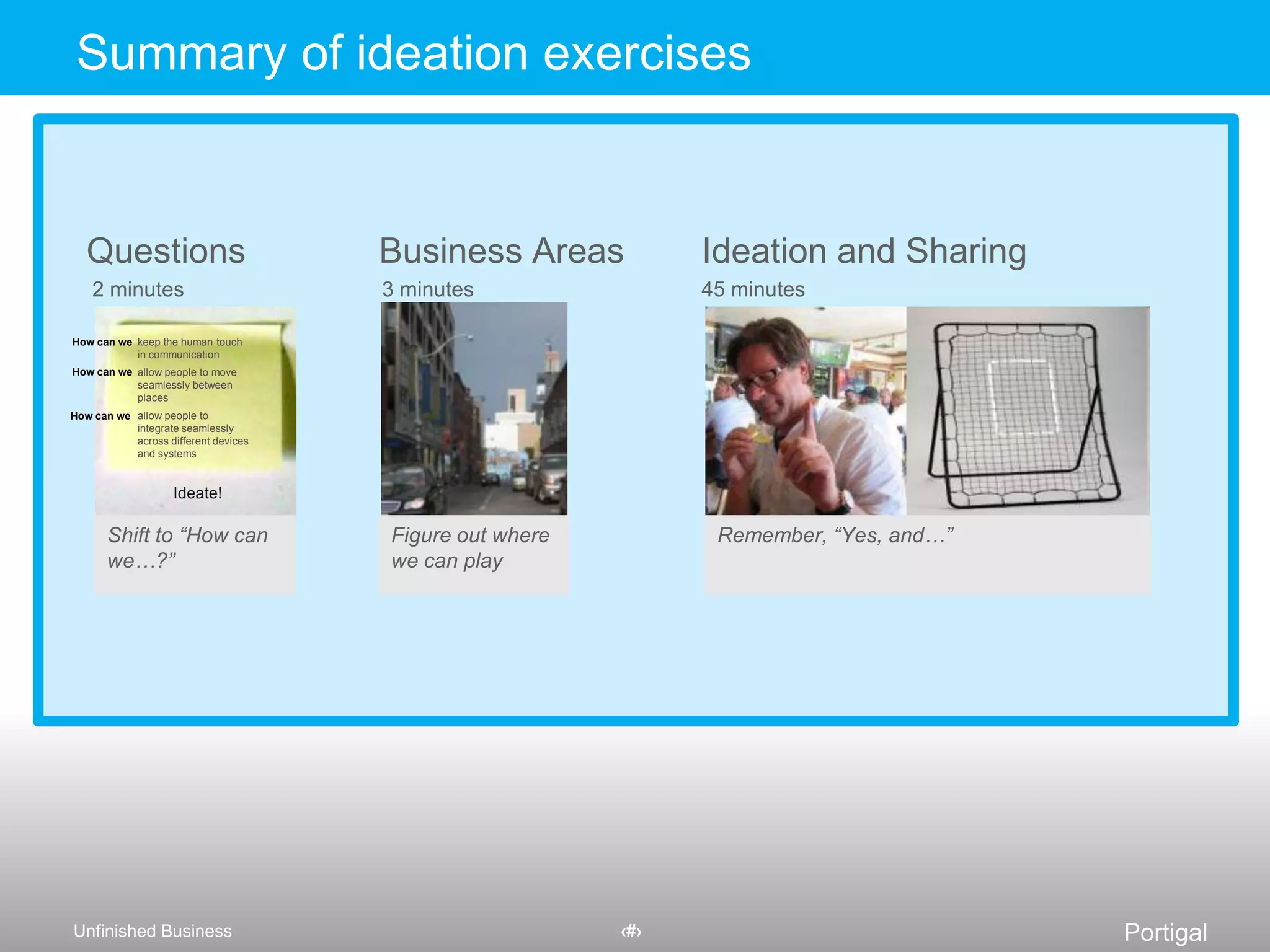
Summary of ideation exercisesQuestions    	    Business Areas        Ideation and Sharing 2 minutes		       3 minutes	                  45 minutesHow can wekeep the human touch in communicationallow people to move seamlessly between placesallow people to integrate seamlessly across different devices and systemsHow can weHow can weIdeate!Shift to โ€œHow can weโ€ฆ?โ€Figure out where we can playRemember, โ€œYes, andโ€ฆโ€
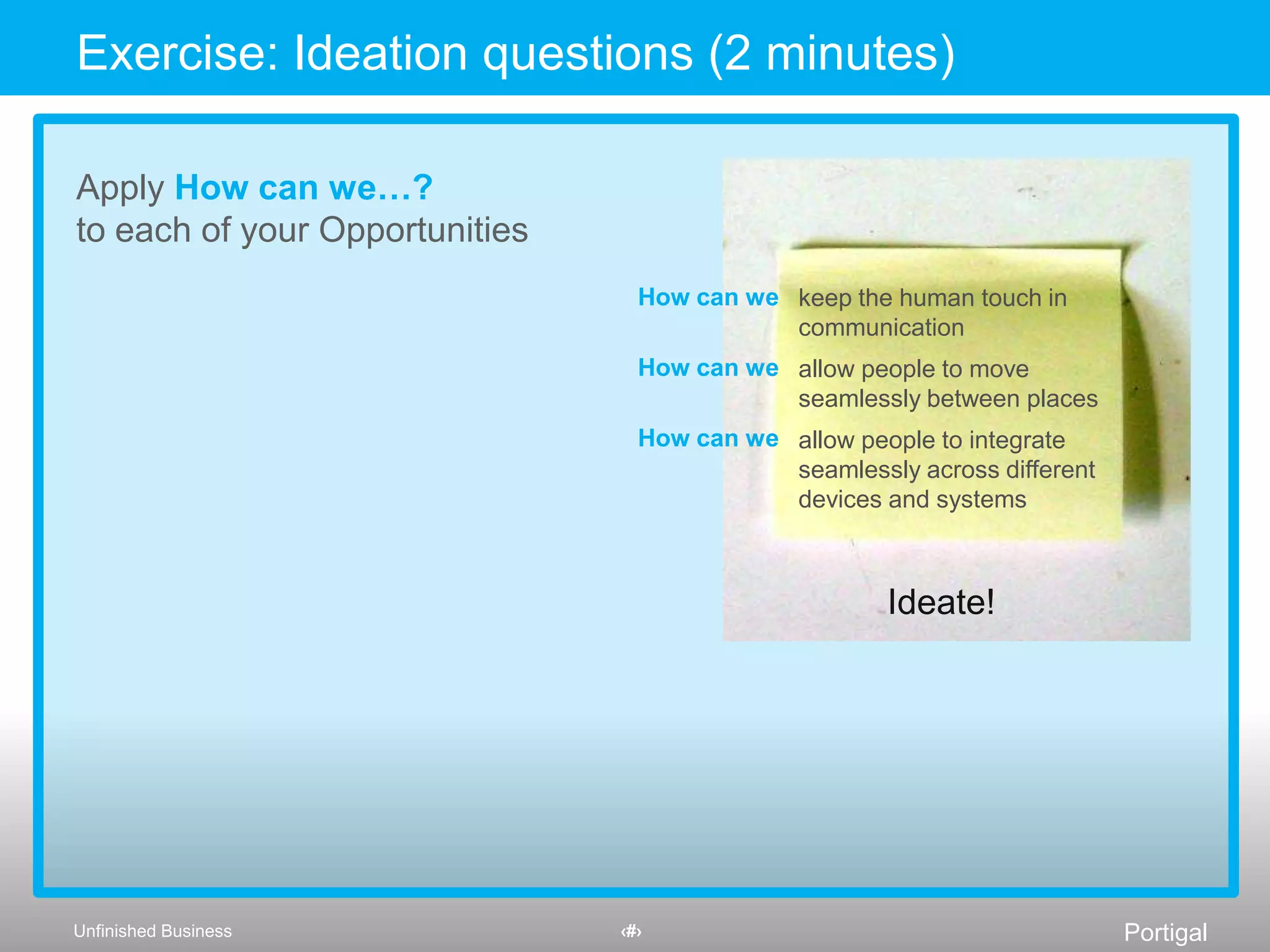
Exercise: Ideation questions (2 minutes)Apply How can weโ€ฆ? to each of your OpportunitiesHow can wekeep the human touch in communicationallow people to move seamlessly between placesallow people to integrate seamlessly across different devices and systemsHow can weHow can weIdeate!
Exercise: Business areas (3 minutes)Letโ€™s collectively list possible business areas to design forThink about whatever Gentrific8 could do or affectUse this list as a starting pointFunctionalityVisual designMarketingArchitecturePublic ServicesPartnershipsEventsSoftwareForm factorPackagingPolicyRetail designIncentivesHow many business and civic areas to impact can you spot in this picture?
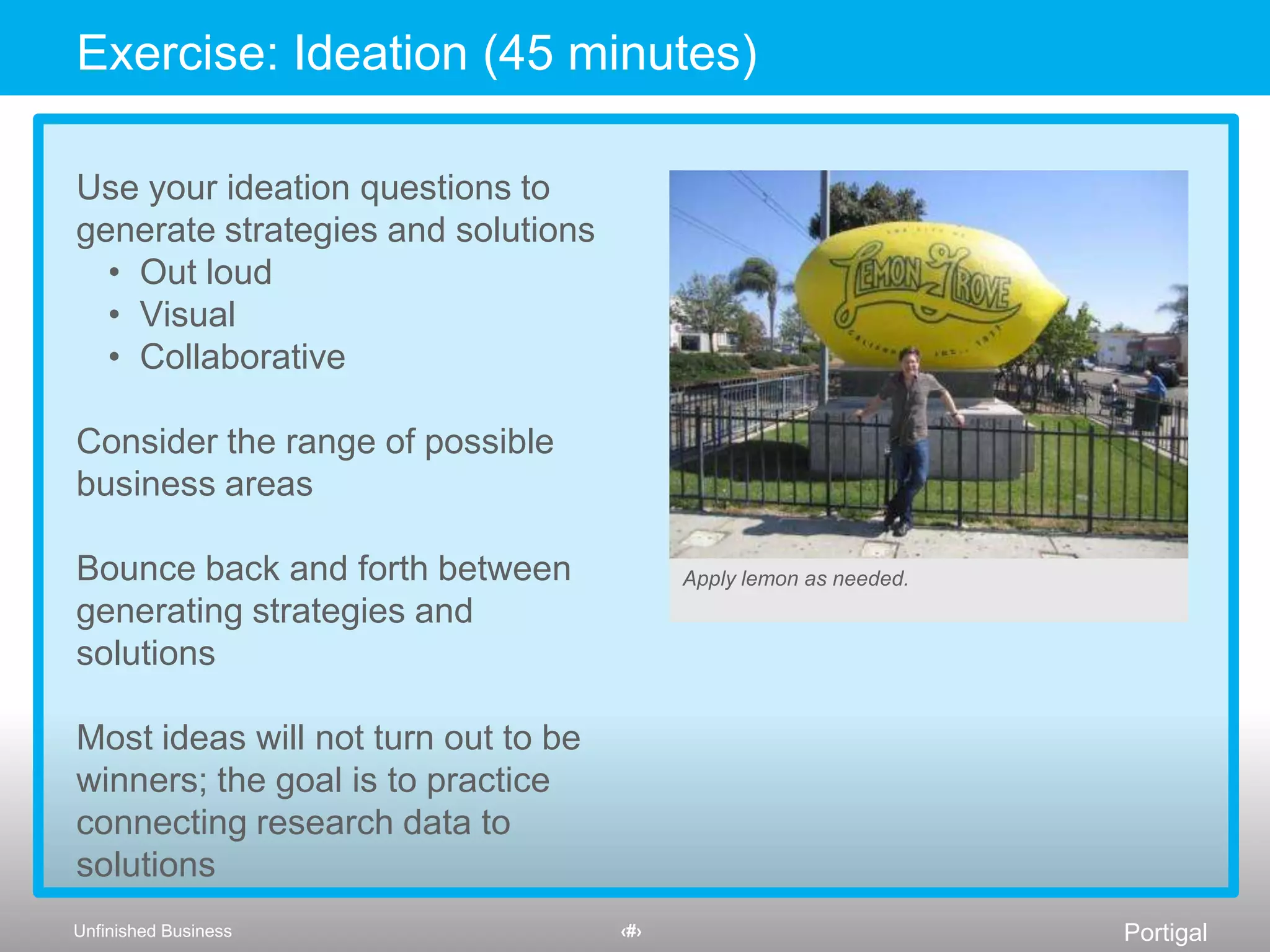
Exercise: Ideation (45 minutes)Use your ideation questions to generate strategies and solutionsOut loudVisualCollaborativeConsider the range of possible business areasBounce back and forth between generating strategies and solutionsMost ideas will not turn out to be winners; the goal is to practice connecting research data to solutionsApply lemon as needed.
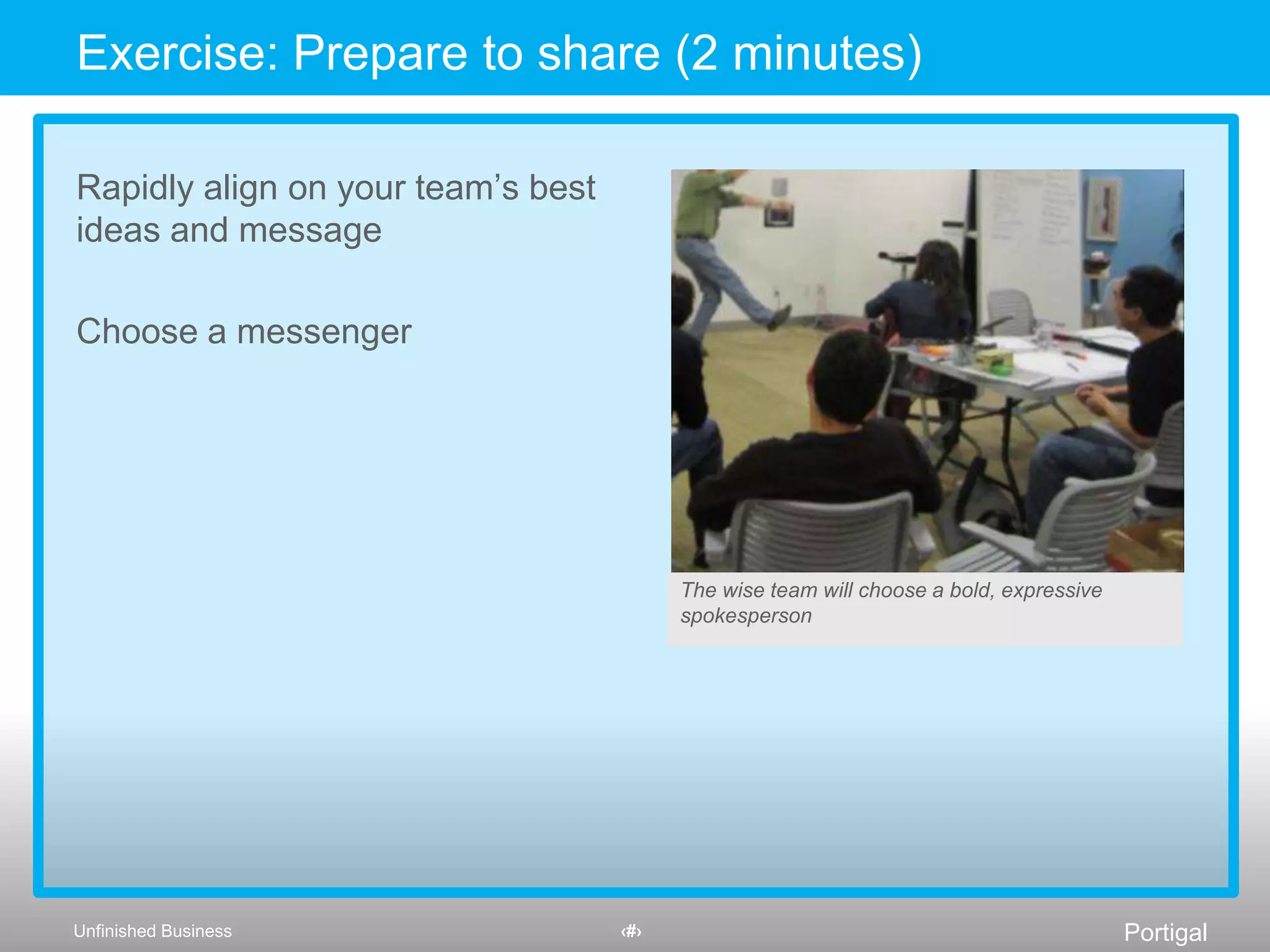
Exercise: Prepare to share (2 minutes)Rapidly align on your teamโ€™s best ideas and messageChoose a messengerThe wise team will choose a bold, expressive spokesperson
Exercise: Pitch it back!

Unfinished Business Workshop: Working with user research data

  • 1.
    Working with userresearch data
  • 2.
    Agenda10:00 โ€“ 12:00 Turning field data into insightsIntroduction 15 minutes Observation Process 15 minutes Fieldwork Exercise 60 minutesStorytelling 30 minutes Lunch!12:30 โ€“ 3:00 Turning insights into solutionsSynthesis Process 15 minutes Synthesis Exercise 45 minutes Ideation Process 10 minutes Ideation Exercise 65 minutes Wrap Up 15 minutes
  • 3.
  • 4.
    Typical development lifecycleWhatto make or doRefine & prototypeLaunchIterate & improve
  • 5.
    Where we workTakea fresh look at peopleWhat to make or doRefine & prototypeLaunchIterate & improve
  • 6.
    Where we workUseexisting ideas as hypothesesWhat to make or doRefine & prototypeLaunchIterate & improve
  • 7.
    Where we workIsit working like we hoped?What to make or doRefine & prototypeLaunchIterate & improve
  • 8.
    Where we workWhatto make or doRefine & prototypeLaunchHistory provides context to explore new ideasIterate & improve
  • 9.
    Synthesis & ideationprocessFieldworkSynthesisIdeationDevelopment
  • 10.
  • 11.
    Cultural data fromfieldworkCase study: iPod accessories
  • 12.
  • 13.
    Homework Check-inYour mission:Dedicate at least half an hour to walking around and observing people in your neighborhoodWho was able to do the assignment?Was this anyoneโ€™s first experience doing observational fieldwork?Is there anyone who has not done user or observational research in the field?Props to Evi!
  • 14.
    Methods & inputs(not todayโ€ฆ)Generally we integrate methods, aka triangulationWe choose, mash-up, or create methods based on the problem. Today weโ€™re doing an abbreviated version of observational fieldworkPortigalUnfinished Business14
  • 15.
    ObservingNotice whatโ€ฆ people,placesNotice howโ€ฆ processes, sequences, interactionsSuspend your point of viewAvoid conclusionsAllow confusionDo it โ€œout loudโ€Steve, practicing his โ€œnoticing.โ€ You can tell because he looks like he may be a little confused.
  • 16.
    Youโ€™re observing peoplewithin their culture. Notice how cultural artifacts reflect and define the environment; and reveal what is โ€œnormalโ€Normal isnโ€™t โ€œright or wrongโ€ โ€“ itโ€™s the set of background rules that define much of what people choose or ignoreMediaProductsAdvertisementsStreet CultureTrends/FadsCultural contextWhat are they selling?
  • 17.
  • 18.
  • 19.
  • 20.
    Synthesis naturally beginsinthe fieldResist meaning (for now)Focus on observationsGet the detailCreate time to talk after each fieldwork experienceOver multiple sessions and participants, over timeWrite up real-timesummaries for the team, ASAPIn-field debriefing (not todayโ€ฆ)Fieldwork highlights captured in the wild.
  • 21.
    Your mission: Imagineyou are working on a project for Gentrific8, looking for ideas to redevelop Dunbat/Alexandra Park.Form groups of 2 โ€“ 3. Mix it upWander and observe people, interactions and environmentsDo it out loud!Capture (photos, notes)What, who, where, when?Why, how?This is not a design audit of signage or merchandise displaysExercise: Explore! Image: Sanderson Public Library, a Creative Commons Attribution Non-Commercial No-Derivative-Works (2.0) image from stqcb'sphotostreamhttp://www.rapdict.org/Alexandra_Park
  • 22.
    Neighborhood observations: NoeValley, San FranPortigalUnfinished Business22
  • 23.
    Neighborhood observations: NoeValley, San FranPortigalUnfinished Business23
  • 24.
    Neighborhood observations: Montara,CaliforniaPortigalUnfinished Business24
  • 25.
    Be back by11:30 to share some stories!Exercise: Explore!
  • 26.
    What happened? Whatdid you see? What did you feel?Tell stories
  • 27.
  • 28.
    Sense-making through aniterative process of refining gathered dataEarly, Informaldata in your headFirst, process the experience you had collecting dataRefer to debriefs and conversationsArticulate and identify themesOutcome: Topline ReportProcess-based, Formalheavy liftingThen, process the data itselfIndividual and group analysisPattern-identification, clustering, models, frameworksOutcome: OpportunitiesWhat is synthesis?Review, Refine, Rinse, Repeat
  • 29.
    After fieldwork, collatereflections and quickly externalize a starter set of 5 to 10 thematic areas based onPre-identified areas of inquiryRefer to debriefs and conversations from the fieldNew patterns that we observedIdentify interesting areas; acknowledge that you donโ€™t understand details yet, identify questionsOutcome: Topline ReportThis sheds light on what excites the team and the stakeholders; brings focus to the next stage of synthesisAll right researchersโ€ฆ what did you see?Early, informal synthesis (data in your head)
  • 30.
    Go back throughyour raw data very closely to move beyond the Topline Report Individually (heads-down) and collaboratively (heads-up) develop clusters, identify patterns, collate and refine findingsProcess maps, eco-systemsFrameworks, modelsDesign implicationsi.e.: What did other public announcements in the study look like? What are the layers of information and cultural context? What form factors are favored? Why?Process-based, formal synthesis (heavy lifting)
  • 31.
  • 32.
  • 33.
    TranscriptsTranscript analysisMake marginalnotes on patterns, quotes, or what seems interesting
  • 34.
    Ask yourself questions;give labels; propose solutions
  • 35.
    Donโ€™t worry aboutimplications, be descriptive and reactiveIndividual analysis (not todayโ€ฆ)
  • 36.
    If you canโ€™tget transcripts, watch video (even sped-up) and in near real-time jot down the rough narrative of the sessionWhen you make an observation in your own voice, do something typographic to call it out (ALL CAPS, highlight, etc.)Individual analysis (not todayโ€ฆ)
  • 37.
    Heads up! Tellstories, narrate highlights, give each its due. Use notes, transcripts, and other artifacts Voice and document reactions, a-has, support and questionsClusteringWhite-board notesDevelop a new shared point-of-view, beyond โ€œfindingsโ€Outcome: OpportunitiesNo discussion of the synthesis process would be complete without a reference to Post-It ยฎ NotesCollaborative analysis
  • 38.
    Opportunities are notA reporting of โ€œinteresting findingsโ€ A list of solutionsOpportunities areChange we can envision based on what we heard and observeAbout peopleIn the context of but reframing the business questionsGenerative, inviting many solutionsKeep the human touch in communicationAllow people to move seamlessly between placesAllow people to integrate seamlessly across different devices and systemsDeveloping opportunitiesWhat should we do?
  • 39.
    Topline Collaborative Analysis Opportunities10 minutes 10 minutes 15 minutesKeep the human touch in communicationAllow people to move seamlessly between placesAllow people to integrate seamlessly across different devices & systemsSummary of synthesis exercisesExternalize the data in your headShare the heavy liftingDetermine generative directions
  • 40.
    After fieldwork, joinforces with another groupQuickly review what happened (today and from your homework) and what you saw. Collate reflections. Resist the urge to move too far towards conclusionsDonโ€™t refer to notes or photos yetKeep your own experiences, existing hypotheses, cultural clichรฉs, etc. in the backgroundDevelop 3 - 5 themes as a โ€œTopline Reportโ€ sketching out the big takeaways, leading into further synthesisDonโ€™t fuss over exact wordingExercise: Develop a topline (10 minutes)All right researchersโ€ฆ what did you see?
  • 41.
    Evolve your โ€œToplineReport;โ€ flesh out and enrich themesWrite your themes and put them upLeave space for new ones tooNow (!) tell stories from the field (from your neighborhood and today), using photos, notes and memoryRethink the relationships between the themes, pick your strongest themes and write a sentence with a point of viewGo from โ€œGraffiti everywhereโ€ and โ€œTeen gangs hanging outโ€ to โ€œPublic spaces in the neighborhood are used to communicate identity and belongingnessโ€Exercise: Develop findings (10 minutes)
  • 42.
    Build on yourfindingsStart each opportunity with a verbOpportunities are not A reporting of โ€œinteresting findingsโ€ A list of solutionsOpportunities areChange we can envision based on what we heard and observeAbout peopleIn the context of but reframing the business questionsGenerative, inviting many solutionsExercise: Identify opportunities (10 minutes)Keep the human touch in communicationAllow people to move seamlessly between placesAllow people to integrate seamlessly across different devices and systemsKeep the human touch in communicationAllow people to move seamlessly between placesAllow people to integrate seamlessly across different devices and systemsWhat should we do?What should we do?
  • 43.
  • 44.
  • 45.
    A simple stepmoves you from Opportunities to Ideation Questions, reframing them into actionable language How can wekeep the human touch in communicationallow people to move seamlessly between placesallow people to integrate seamlessly across different devices and systemsHow can weHow can weIdeate!Ideation questions
  • 46.
    Scope of solutionsSolutionsexist across many different business areas FunctionalityVisual designMarketingArchitecturePublic ServicesPartnershipsEventsSoftwareForm factorPackagingPolicyRetail designEven if you are unlikely to impact certain business areas, itโ€™s crucial that you set that constraint aside for ideationHow many business and civic areas to impact can you spot in this picture?
  • 47.
    Developing strategiesResponses toany ideation question can lead in different strategic directionsFinding:Students have to smoke outside, but they get cold and wet Opportunity: Improve the experience of students who smokeIdeation Question:How can we improve the experience of students who smoke?Support underlying needs and behavior by embracing the findingQuestion needs and behavior, seek change by challenging the findingCreate a protected environment for smokingEliminate smoking
  • 48.
    Strategies can inspiresolutionsFinding:Students have to smoke outside, but they get cold and wet Opportunity: Improve the experience of students who smokeIdeation Question:How can we improve the experience of students who smoke?StrategiesCreate a protected environment for smokingEliminate smokingSolutionsFacilitiesBuild a pavilionAdminAllocate interior roomPartnersAlign with nearby cafeOnlineSmoking cessation gamesAdminBan smokingPartnersStop smoking coaches
  • 49.
    Solutions can suggeststrategiesFinding:Students have to smoke outside, but they get cold and wet Opportunity: Improve the experience of students who smokeIdeation Question:How can we improve the experience of students who smoke?StrategiesCreate a protected environment for smokingEliminate smokingSolutionsAdminAllocate interior roomAdminBan smoking
  • 50.
    Collaborative generationThis isa collective, out-loud activity! Talk, listen, build on each otherโ€™s ideasDonโ€™t worry about a โ€œbadโ€ ideaโ€ฆ it may lead to a โ€œgoodโ€ ideaDonโ€™t correct; generate alternativesโ€œYes, andโ€ฆโ€This is a visual activity! Sketch, drawโ€ฆQuantity over quality; go quicklyIndividual ideas matter less than what the collective produces overallHow can a sour lemon help keep things working smoothly?
  • 51.
    Stuck?Come up withbad ideasImmoralDangerousBad for business
  • 52.
    Summary of ideationexercisesQuestions Business Areas Ideation and Sharing 2 minutes 3 minutes 45 minutesHow can wekeep the human touch in communicationallow people to move seamlessly between placesallow people to integrate seamlessly across different devices and systemsHow can weHow can weIdeate!Shift to โ€œHow can weโ€ฆ?โ€Figure out where we can playRemember, โ€œYes, andโ€ฆโ€
  • 53.
    Exercise: Ideation questions(2 minutes)Apply How can weโ€ฆ? to each of your OpportunitiesHow can wekeep the human touch in communicationallow people to move seamlessly between placesallow people to integrate seamlessly across different devices and systemsHow can weHow can weIdeate!
  • 54.
    Exercise: Business areas(3 minutes)Letโ€™s collectively list possible business areas to design forThink about whatever Gentrific8 could do or affectUse this list as a starting pointFunctionalityVisual designMarketingArchitecturePublic ServicesPartnershipsEventsSoftwareForm factorPackagingPolicyRetail designIncentivesHow many business and civic areas to impact can you spot in this picture?
  • 55.
    Exercise: Ideation (45minutes)Use your ideation questions to generate strategies and solutionsOut loudVisualCollaborativeConsider the range of possible business areasBounce back and forth between generating strategies and solutionsMost ideas will not turn out to be winners; the goal is to practice connecting research data to solutionsApply lemon as needed.
  • 56.
    Exercise: Prepare toshare (2 minutes)Rapidly align on your teamโ€™s best ideas and messageChoose a messengerThe wise team will choose a bold, expressive spokesperson
  • 57.
  • 58.
  • 59.
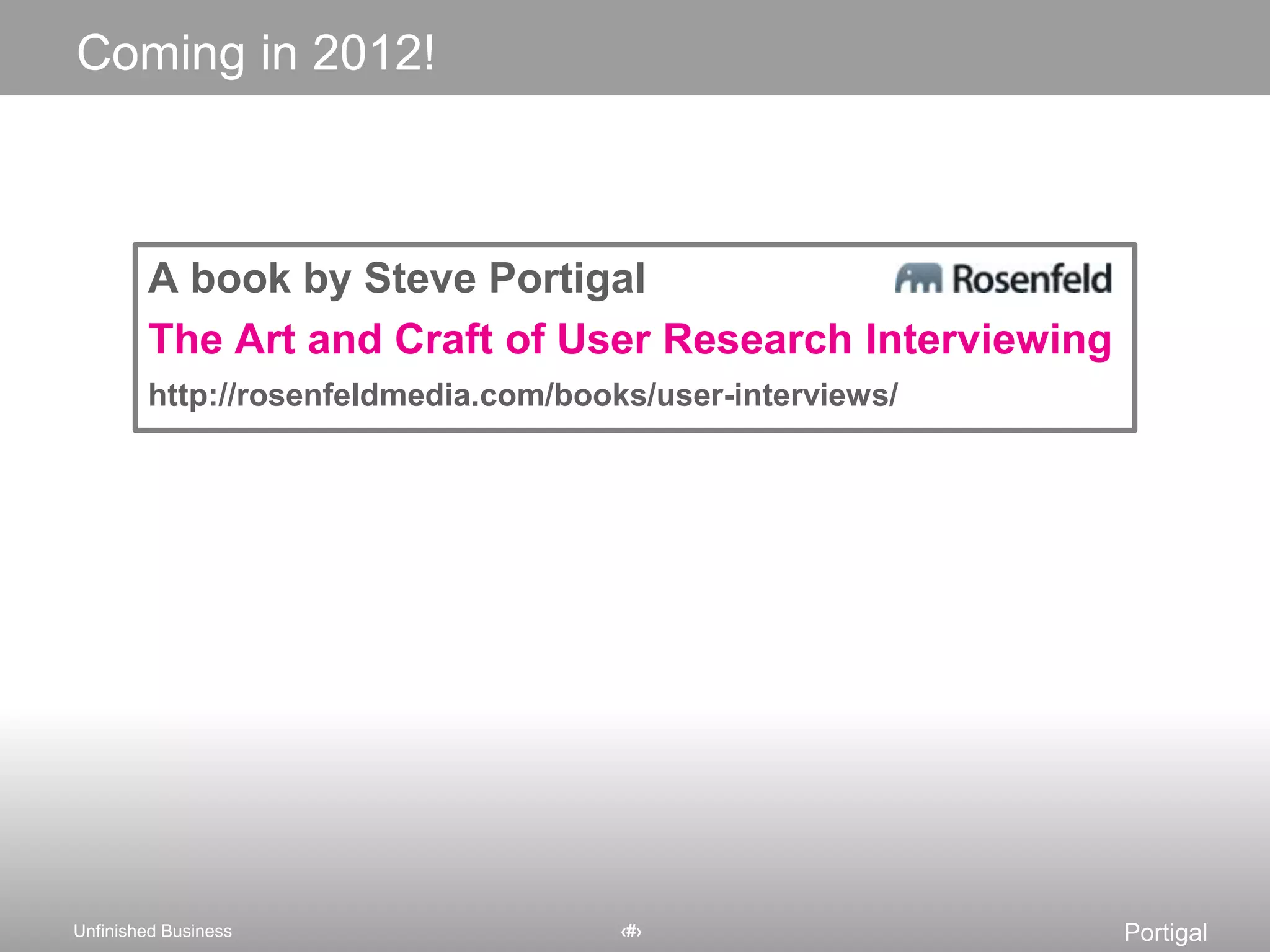
    Coming in 2012!Abook by Steve PortigalThe Art and Craft of User Research Interviewinghttp://rosenfeldmedia.com/books/user-interviews/
  • 60.
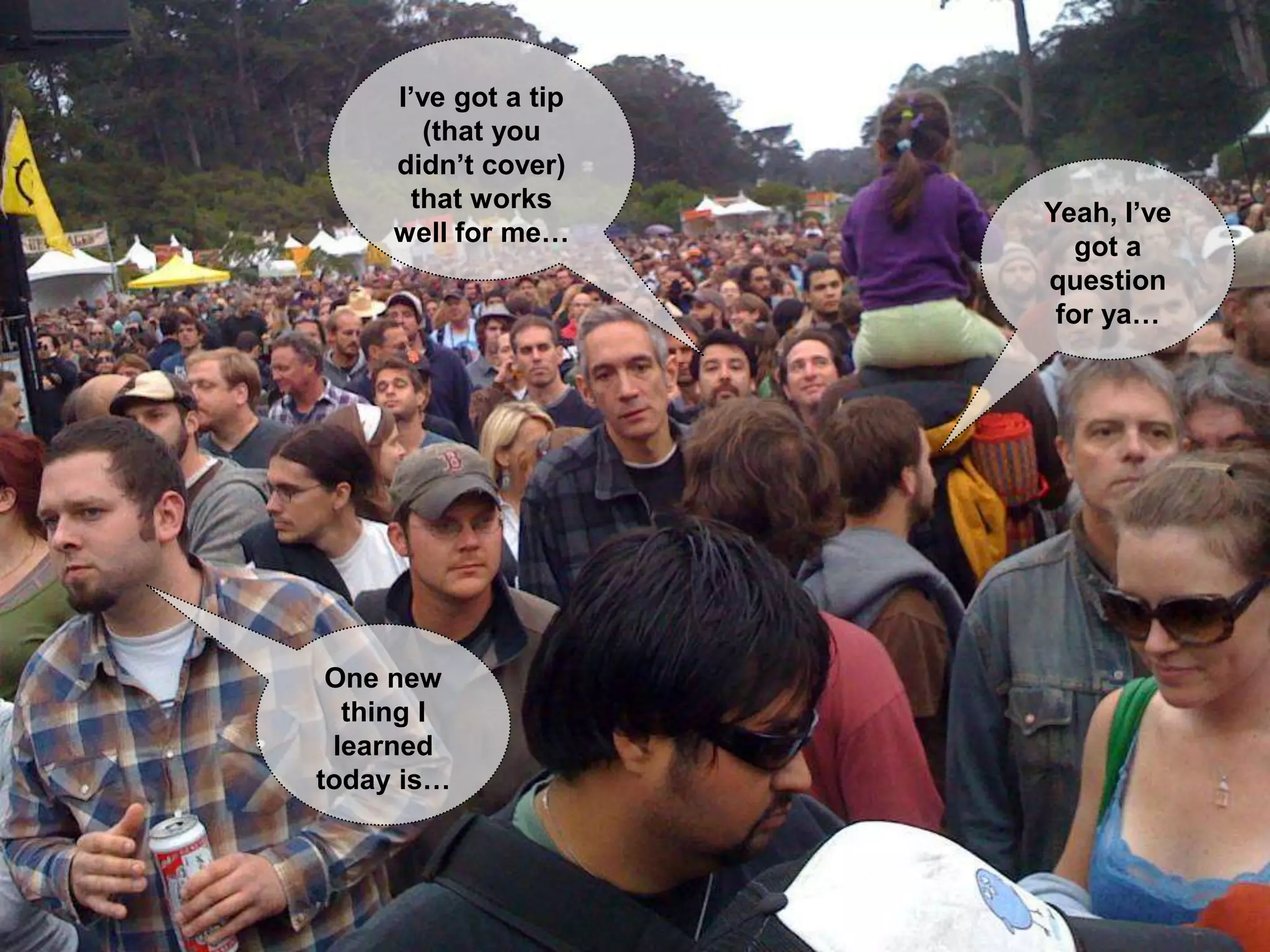
    Iโ€™ve got atip (that you didnโ€™t cover) that works well for meโ€ฆYeah, Iโ€™ve got a question for yaโ€ฆOne new thing I learned today isโ€ฆ
  • 61.