




1
Interviewing Users How to Uncover Compelling Insights
Steve Portigal
@steveportigal
www.portigal.com2 @steveportigal
We help companies discover and
act on new insights about their
customers and themselves
Portigal
www.portigal.com3 @steveportigal
Resources, presentations and to purchase
http://rosenfeldmedia.com/books/interviewing-users/
Interviewing Users book now available
www.portigal.com4 @steveportigal
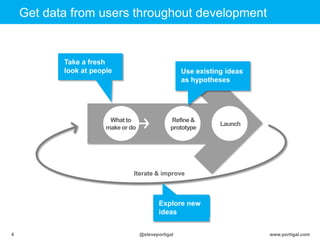
What to
make or do
Refine&
prototype
Launch
Iterate & improve
Get data from users throughout development
Take a fresh
look at people Use existing ideas
as hypotheses
Explore new
ideas
www.portigal.com5 @steveportigal
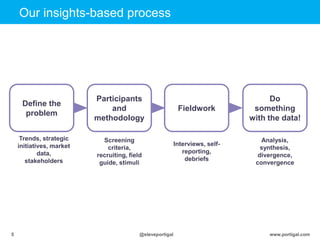
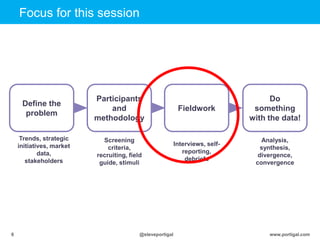
Define the
problem
Participants
and
methodology
Do
something
with the data!
Our insights-based process
Screening
criteria,
recruiting, field
guide, stimuli
Analysis,
synthesis,
divergence,
convergence
Fieldwork
Interviews, self-
reporting,
debriefs
Trends, strategic
initiatives, market
data,
stakeholders
www.portigal.com6 @steveportigal
Define the
problem
Participants
and
methodology
Do
something
with the data!
Focus for this session
Screening
criteria,
recruiting, field
guide, stimuli
Analysis,
synthesis,
divergence,
convergence
Fieldwork
Interviews, self-
reporting,
debriefs
Trends, strategic
initiatives, market
data,
stakeholders
www.portigal.com7 @steveportigal
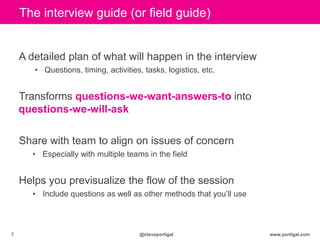
The interview guide (or field guide)
A detailed plan of what will happen in the interview
โ€ข Questions, timing, activities, tasks, logistics, etc.
Transforms questions-we-want-answers-to into
questions-we-will-ask
Share with team to align on issues of concern
โ€ข Especially with multiple teams in the field
Helps you previsualize the flow of the session
โ€ข Include questions as well as other methods that youโ€Ÿll use
www.portigal.com8 @steveportigal
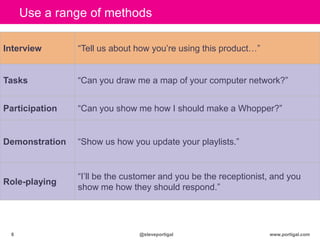
Use a range of methods
Interview โ€œTell us about how youโ€Ÿre using this productโ€ฆโ€
Tasks โ€œCan you draw me a map of your computer network?โ€
Participation โ€œCan you show me how I should make a Whopper?โ€
Demonstration โ€œShow us how you update your playlists.โ€
Role-playing
โ€œIโ€Ÿll be the customer and you be the receptionist, and you
show me how they should respond.โ€
www.portigal.com9 @steveportigal
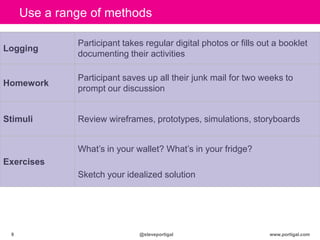
Use a range of methods
Logging
Participant takes regular digital photos or fills out a booklet
documenting their activities
Homework
Participant saves up all their junk mail for two weeks to
prompt our discussion
Stimuli Review wireframes, prototypes, simulations, storyboards
Exercises
Whatโ€Ÿs in your wallet? Whatโ€Ÿs in your fridge?
Sketch your idealized solution
www.portigal.com10 @steveportigal
Observing
Notice whatโ€ฆ people, places
Notice howโ€ฆ processes,
sequences, interactions
Suspend your point of view
Avoid conclusions
Allow confusion
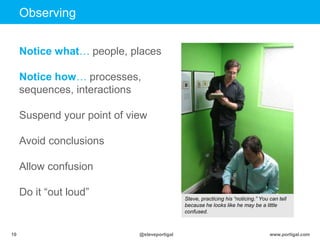
Do it โ€œout loudโ€ Steve, practicing his โ€œnoticing.โ€ You can tell
because he looks like he may be a little
confused.
www.portigal.com11 @steveportigal
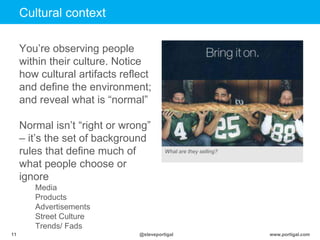
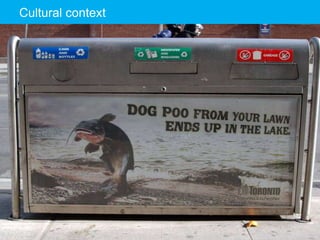
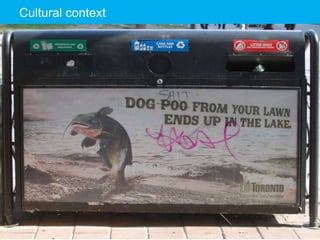
Youโ€Ÿre observing people
within their culture. Notice
how cultural artifacts reflect
and define the environment;
and reveal what is โ€œnormalโ€
Normal isnโ€Ÿt โ€œright or wrongโ€
โ€“ itโ€Ÿs the set of background
rules that define much of
what people choose or
ignore
Media
Products
Advertisements
Street Culture
Trends/ Fads
Cultural context
What are they selling?
www.portigal.com12 @steveportigal
Cultural context
www.portigal.com13 @steveportigal
Cultural context
www.portigal.com14 @steveportigal
Cultural context
www.portigal.com15 @steveportigal
Explore solutions in the field
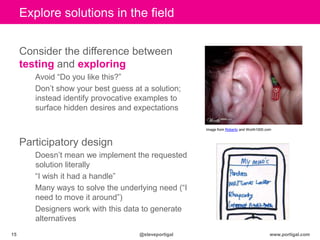
Consider the difference between
testing and exploring
Avoid โ€œDo you like this?โ€
Donโ€Ÿt show your best guess at a solution;
instead identify provocative examples to
surface hidden desires and expectations
Participatory design
Doesnโ€Ÿt mean we implement the requested
solution literally
โ€œI wish it had a handleโ€
Many ways to solve the underlying need (โ€œI
need to move it aroundโ€)
Designers work with this data to generate
alternatives
Image from Roberto and Worth1000.com
Click to edit Master title style
www.portigal.com16 @steveportigal
Principles inform tactics
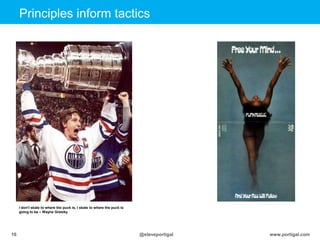
I don't skate to where the puck is, I skate to where the puck is
going to be โ€“ Wayne Gretzky
Click to edit Master title style
www.portigal.com17 @steveportigal
Interviewing principles
Check your worldview at the door
Embrace how other people see the world
Build rapport
Listen
Click to edit Master title style
www.portigal.com18 @steveportigal
Check your worldview at the door
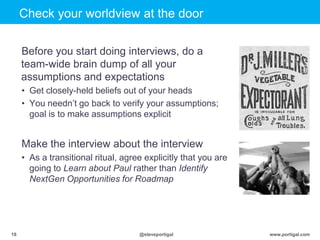
Before you start doing interviews, do a
team-wide brain dump of all your
assumptions and expectations
โ€ข Get closely-held beliefs out of your heads
โ€ข You neednโ€Ÿt go back to verify your assumptions;
goal is to make assumptions explicit
Make the interview about the interview
โ€ข As a transitional ritual, agree explicitly that you are
going to Learn about Paul rather than Identify
NextGen Opportunities for Roadmap
Click to edit Master title style
www.portigal.com19 @steveportigal
Embrace how other people see the world
Go to where your users are rather than asking them to
come to you
Nip distractions in the bud
โ€ข Eat!
โ€ข Leave plenty of time so you arenโ€Ÿt rushed when you arrive
โ€ข Find a bathroom beforehand
Be ready to ask questions you (think you) know the
answers to
โ€ข Think about: โ€œWhen are your taxes due?โ€
โ€ข What do you know? What are you afraid theyโ€Ÿll say? What might you
learn?
Click to edit Master title style
www.portigal.com20 @steveportigal
Build rapport
Be selective about social graces
โ€ข Just enough small talk
โ€ข Accept what youโ€Ÿre offered
Be selective about talking about yourself
โ€ข Reveal personal information to give them permission to share
โ€ข Otherwise, think โ€œOMG! Me too!โ€ without saying it
Work towards the tipping point
โ€ข From question-answer to question-story
โ€ข You wonโ€Ÿt know when itโ€Ÿs coming; be patient
Acknowledge the interview as somethingโ€ฆunusual
โ€ข โ€œWhat I want to learn todayโ€ฆโ€ over friendly chat
Click to edit Master title style
www.portigal.com21 @steveportigal
Listen
You can demonstrate that you are listening by asking
questions!
โ€ข Follow-up, follow-up, follow-up
โ€ข โ€œEarlier, you told us thatโ€ฆโ€
โ€ข โ€œI want to go back to something else you saidโ€ฆโ€
Signal your transitions: โ€œGreat, now Iโ€Ÿd like to move onto a
totally different topicโ€
This level of listening is not how we normally talk to each
other
โ€ข Remember that you are interviewing, not having a conversation
โ€ข This is really hard
Click to edit Master title style
www.portigal.com22 @steveportigal
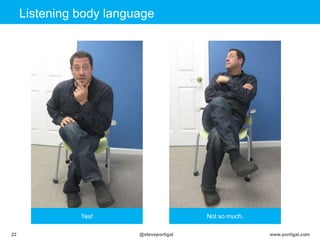
Listening body language
Yes! Not so much.
Click to edit Master title style
www.portigal.com23 @steveportigal
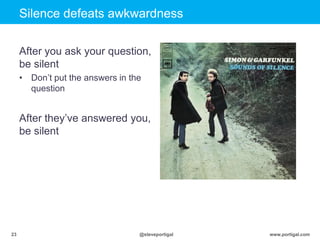
Silence defeats awkwardness
After you ask your question,
be silent
โ€ข Donโ€Ÿt put the answers in the
question
After theyโ€Ÿve answered you,
be silent
Click to edit Master title style
www.portigal.com24 @steveportigal
Use natural language
Talk like your
subject talks!
Click to edit Master title style
www.portigal.com25 @steveportigal
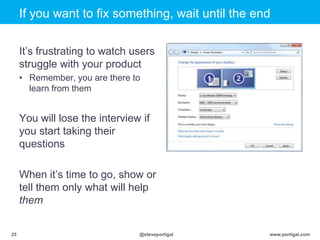
If you want to fix something, wait until the end
Itโ€Ÿs frustrating to watch users
struggle with your product
โ€ข Remember, you are there to
learn from them
You will lose the interview if
you start taking their
questions
When itโ€Ÿs time to go, show or
tell them only what will help
them
Click to edit Master title style
www.portigal.com26 @steveportigal
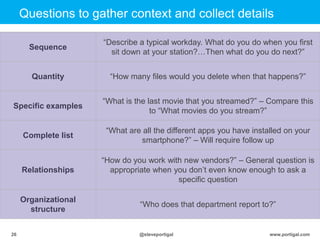
Questions to gather context and collect details
Sequence
โ€œDescribe a typical workday. What do you do when you first
sit down at your station?โ€ฆThen what do you do next?โ€
Quantity โ€œHow many files would you delete when that happens?โ€
Specific examples
โ€œWhat is the last movie that you streamed?โ€ โ€“ Compare this
to โ€œWhat movies do you stream?โ€
Complete list
โ€œWhat are all the different apps you have installed on your
smartphone?โ€ โ€“ Will require follow up
Relationships
โ€œHow do you work with new vendors?โ€ โ€“ General question is
appropriate when you donโ€Ÿt even know enough to ask a
specific question
Organizational
structure
โ€œWho does that department report to?โ€
Click to edit Master title style
www.portigal.com27 @steveportigal
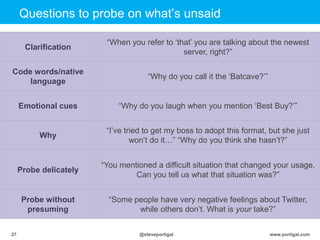
Questions to probe on whatโ€Ÿs unsaid
Clarification
โ€œWhen you refer to โ€žthatโ€Ÿ you are talking about the newest
server, right?โ€
Code words/native
language
โ€œWhy do you call it the โ€žBatcave?โ€Ÿโ€
Emotional cues โ€œWhy do you laugh when you mention โ€žBest Buy?โ€Ÿโ€
Why
โ€œIโ€Ÿve tried to get my boss to adopt this format, but she just
wonโ€Ÿt do itโ€ฆโ€ โ€œWhy do you think she hasnโ€Ÿt?โ€
Probe delicately
โ€œYou mentioned a difficult situation that changed your usage.
Can you tell us what that situation was?โ€
Probe without
presuming
โ€œSome people have very negative feelings about Twitter,
while others donโ€Ÿt. What is your take?โ€
Click to edit Master title style
www.portigal.com28 @steveportigal
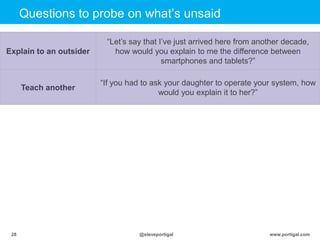
Questions to probe on whatโ€Ÿs unsaid
Explain to an outsider
โ€œLetโ€Ÿs say that Iโ€Ÿve just arrived here from another decade,
how would you explain to me the difference between
smartphones and tablets?โ€
Teach another
โ€œIf you had to ask your daughter to operate your system, how
would you explain it to her?โ€
Click to edit Master title style
www.portigal.com29 @steveportigal
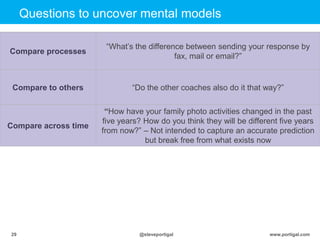
Questions to uncover mental models
Compare processes
โ€œWhatโ€Ÿs the difference between sending your response by
fax, mail or email?โ€
Compare to others โ€œDo the other coaches also do it that way?โ€
Compare across time
โ€œHow have your family photo activities changed in the past
five years? How do you think they will be different five years
from now?โ€ โ€“ Not intended to capture an accurate prediction
but break free from what exists now
Click to edit Master title style
www.portigal.com30 @steveportigal
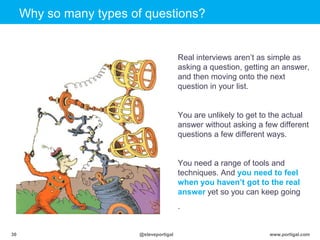
Why so many types of questions?
Real interviews arenโ€Ÿt as simple as
asking a question, getting an answer,
and then moving onto the next
question in your list.
You are unlikely to get to the actual
answer without asking a few different
questions a few different ways.
You need a range of tools and
techniques. And you need to feel
when you havenโ€™t got to the real
answer yet so you can keep going
.
Click to edit Master title style
www.portigal.com31 @steveportigal
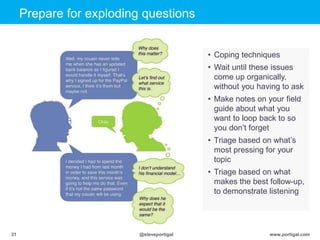
Prepare for exploding questions
โ€ข Coping techniques
โ€ข Wait until these issues
come up organically,
without you having to ask
โ€ข Make notes on your field
guide about what you
want to loop back to so
you donโ€Ÿt forget
โ€ข Triage based on whatโ€Ÿs
most pressing for your
topic
โ€ข Triage based on what
makes the best follow-up,
to demonstrate listening
Click to edit Master title style
www.portigal.com32 @steveportigal
Exploding questions can lead to a flow state
Click to edit Master title style
www.portigal.com33 @steveportigal
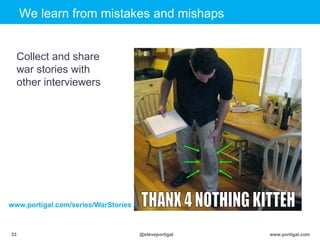
We learn from mistakes and mishaps
Collect and share
war stories with
other interviewers
www.portigal.com/series/WarStories
Click to edit Master title style
www.portigal.com34 @steveportigal
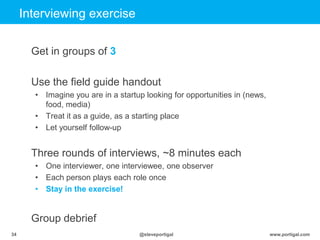
Interviewing exercise
Get in groups of 3
Use the field guide handout
โ€ข Imagine you are in a startup looking for opportunities in (news,
food, media)
โ€ข Treat it as a guide, as a starting place
โ€ข Let yourself follow-up
Three rounds of interviews, ~8 minutes each
โ€ข One interviewer, one interviewee, one observer
โ€ข Each person plays each role once
โ€ข Stay in the exercise!
Group debrief
www.portigal.com35 @steveportigal
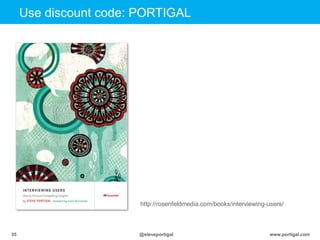
http://rosenfeldmedia.com/books/interviewing-users/
Use discount code: PORTIGAL
www.portigal.com36 @steveportigal
Portigal Consulting
www.portigal.com
@steveportigal
steve@portigal.com
+1-415-894-2001
Thank you!

Interviewing Users (Catapult Labs event)

  • 1.
    1 Interviewing Users Howto Uncover Compelling Insights Steve Portigal @steveportigal
  • 2.
    www.portigal.com2 @steveportigal We helpcompanies discover and act on new insights about their customers and themselves Portigal
  • 3.
    www.portigal.com3 @steveportigal Resources, presentationsand to purchase http://rosenfeldmedia.com/books/interviewing-users/ Interviewing Users book now available
  • 4.
    www.portigal.com4 @steveportigal What to makeor do Refine& prototype Launch Iterate & improve Get data from users throughout development Take a fresh look at people Use existing ideas as hypotheses Explore new ideas
  • 5.
    www.portigal.com5 @steveportigal Define the problem Participants and methodology Do something withthe data! Our insights-based process Screening criteria, recruiting, field guide, stimuli Analysis, synthesis, divergence, convergence Fieldwork Interviews, self- reporting, debriefs Trends, strategic initiatives, market data, stakeholders
  • 6.
    www.portigal.com6 @steveportigal Define the problem Participants and methodology Do something withthe data! Focus for this session Screening criteria, recruiting, field guide, stimuli Analysis, synthesis, divergence, convergence Fieldwork Interviews, self- reporting, debriefs Trends, strategic initiatives, market data, stakeholders
  • 7.
    www.portigal.com7 @steveportigal The interviewguide (or field guide) A detailed plan of what will happen in the interview โ€ข Questions, timing, activities, tasks, logistics, etc. Transforms questions-we-want-answers-to into questions-we-will-ask Share with team to align on issues of concern โ€ข Especially with multiple teams in the field Helps you previsualize the flow of the session โ€ข Include questions as well as other methods that youโ€Ÿll use
  • 8.
    www.portigal.com8 @steveportigal Use arange of methods Interview โ€œTell us about how youโ€Ÿre using this productโ€ฆโ€ Tasks โ€œCan you draw me a map of your computer network?โ€ Participation โ€œCan you show me how I should make a Whopper?โ€ Demonstration โ€œShow us how you update your playlists.โ€ Role-playing โ€œIโ€Ÿll be the customer and you be the receptionist, and you show me how they should respond.โ€
  • 9.
    www.portigal.com9 @steveportigal Use arange of methods Logging Participant takes regular digital photos or fills out a booklet documenting their activities Homework Participant saves up all their junk mail for two weeks to prompt our discussion Stimuli Review wireframes, prototypes, simulations, storyboards Exercises Whatโ€Ÿs in your wallet? Whatโ€Ÿs in your fridge? Sketch your idealized solution
  • 10.
    www.portigal.com10 @steveportigal Observing Notice whatโ€ฆpeople, places Notice howโ€ฆ processes, sequences, interactions Suspend your point of view Avoid conclusions Allow confusion Do it โ€œout loudโ€ Steve, practicing his โ€œnoticing.โ€ You can tell because he looks like he may be a little confused.
  • 11.
    www.portigal.com11 @steveportigal Youโ€Ÿre observingpeople within their culture. Notice how cultural artifacts reflect and define the environment; and reveal what is โ€œnormalโ€ Normal isnโ€Ÿt โ€œright or wrongโ€ โ€“ itโ€Ÿs the set of background rules that define much of what people choose or ignore Media Products Advertisements Street Culture Trends/ Fads Cultural context What are they selling?
  • 12.
  • 13.
  • 14.
  • 15.
    www.portigal.com15 @steveportigal Explore solutionsin the field Consider the difference between testing and exploring Avoid โ€œDo you like this?โ€ Donโ€Ÿt show your best guess at a solution; instead identify provocative examples to surface hidden desires and expectations Participatory design Doesnโ€Ÿt mean we implement the requested solution literally โ€œI wish it had a handleโ€ Many ways to solve the underlying need (โ€œI need to move it aroundโ€) Designers work with this data to generate alternatives Image from Roberto and Worth1000.com
  • 16.
    Click to editMaster title style www.portigal.com16 @steveportigal Principles inform tactics I don't skate to where the puck is, I skate to where the puck is going to be โ€“ Wayne Gretzky
  • 17.
    Click to editMaster title style www.portigal.com17 @steveportigal Interviewing principles Check your worldview at the door Embrace how other people see the world Build rapport Listen
  • 18.
    Click to editMaster title style www.portigal.com18 @steveportigal Check your worldview at the door Before you start doing interviews, do a team-wide brain dump of all your assumptions and expectations โ€ข Get closely-held beliefs out of your heads โ€ข You neednโ€Ÿt go back to verify your assumptions; goal is to make assumptions explicit Make the interview about the interview โ€ข As a transitional ritual, agree explicitly that you are going to Learn about Paul rather than Identify NextGen Opportunities for Roadmap
  • 19.
    Click to editMaster title style www.portigal.com19 @steveportigal Embrace how other people see the world Go to where your users are rather than asking them to come to you Nip distractions in the bud โ€ข Eat! โ€ข Leave plenty of time so you arenโ€Ÿt rushed when you arrive โ€ข Find a bathroom beforehand Be ready to ask questions you (think you) know the answers to โ€ข Think about: โ€œWhen are your taxes due?โ€ โ€ข What do you know? What are you afraid theyโ€Ÿll say? What might you learn?
  • 20.
    Click to editMaster title style www.portigal.com20 @steveportigal Build rapport Be selective about social graces โ€ข Just enough small talk โ€ข Accept what youโ€Ÿre offered Be selective about talking about yourself โ€ข Reveal personal information to give them permission to share โ€ข Otherwise, think โ€œOMG! Me too!โ€ without saying it Work towards the tipping point โ€ข From question-answer to question-story โ€ข You wonโ€Ÿt know when itโ€Ÿs coming; be patient Acknowledge the interview as somethingโ€ฆunusual โ€ข โ€œWhat I want to learn todayโ€ฆโ€ over friendly chat
  • 21.
    Click to editMaster title style www.portigal.com21 @steveportigal Listen You can demonstrate that you are listening by asking questions! โ€ข Follow-up, follow-up, follow-up โ€ข โ€œEarlier, you told us thatโ€ฆโ€ โ€ข โ€œI want to go back to something else you saidโ€ฆโ€ Signal your transitions: โ€œGreat, now Iโ€Ÿd like to move onto a totally different topicโ€ This level of listening is not how we normally talk to each other โ€ข Remember that you are interviewing, not having a conversation โ€ข This is really hard
  • 22.
    Click to editMaster title style www.portigal.com22 @steveportigal Listening body language Yes! Not so much.
  • 23.
    Click to editMaster title style www.portigal.com23 @steveportigal Silence defeats awkwardness After you ask your question, be silent โ€ข Donโ€Ÿt put the answers in the question After theyโ€Ÿve answered you, be silent
  • 24.
    Click to editMaster title style www.portigal.com24 @steveportigal Use natural language Talk like your subject talks!
  • 25.
    Click to editMaster title style www.portigal.com25 @steveportigal If you want to fix something, wait until the end Itโ€Ÿs frustrating to watch users struggle with your product โ€ข Remember, you are there to learn from them You will lose the interview if you start taking their questions When itโ€Ÿs time to go, show or tell them only what will help them
  • 26.
    Click to editMaster title style www.portigal.com26 @steveportigal Questions to gather context and collect details Sequence โ€œDescribe a typical workday. What do you do when you first sit down at your station?โ€ฆThen what do you do next?โ€ Quantity โ€œHow many files would you delete when that happens?โ€ Specific examples โ€œWhat is the last movie that you streamed?โ€ โ€“ Compare this to โ€œWhat movies do you stream?โ€ Complete list โ€œWhat are all the different apps you have installed on your smartphone?โ€ โ€“ Will require follow up Relationships โ€œHow do you work with new vendors?โ€ โ€“ General question is appropriate when you donโ€Ÿt even know enough to ask a specific question Organizational structure โ€œWho does that department report to?โ€
  • 27.
    Click to editMaster title style www.portigal.com27 @steveportigal Questions to probe on whatโ€Ÿs unsaid Clarification โ€œWhen you refer to โ€žthatโ€Ÿ you are talking about the newest server, right?โ€ Code words/native language โ€œWhy do you call it the โ€žBatcave?โ€Ÿโ€ Emotional cues โ€œWhy do you laugh when you mention โ€žBest Buy?โ€Ÿโ€ Why โ€œIโ€Ÿve tried to get my boss to adopt this format, but she just wonโ€Ÿt do itโ€ฆโ€ โ€œWhy do you think she hasnโ€Ÿt?โ€ Probe delicately โ€œYou mentioned a difficult situation that changed your usage. Can you tell us what that situation was?โ€ Probe without presuming โ€œSome people have very negative feelings about Twitter, while others donโ€Ÿt. What is your take?โ€
  • 28.
    Click to editMaster title style www.portigal.com28 @steveportigal Questions to probe on whatโ€Ÿs unsaid Explain to an outsider โ€œLetโ€Ÿs say that Iโ€Ÿve just arrived here from another decade, how would you explain to me the difference between smartphones and tablets?โ€ Teach another โ€œIf you had to ask your daughter to operate your system, how would you explain it to her?โ€
  • 29.
    Click to editMaster title style www.portigal.com29 @steveportigal Questions to uncover mental models Compare processes โ€œWhatโ€Ÿs the difference between sending your response by fax, mail or email?โ€ Compare to others โ€œDo the other coaches also do it that way?โ€ Compare across time โ€œHow have your family photo activities changed in the past five years? How do you think they will be different five years from now?โ€ โ€“ Not intended to capture an accurate prediction but break free from what exists now
  • 30.
    Click to editMaster title style www.portigal.com30 @steveportigal Why so many types of questions? Real interviews arenโ€Ÿt as simple as asking a question, getting an answer, and then moving onto the next question in your list. You are unlikely to get to the actual answer without asking a few different questions a few different ways. You need a range of tools and techniques. And you need to feel when you havenโ€™t got to the real answer yet so you can keep going .
  • 31.
    Click to editMaster title style www.portigal.com31 @steveportigal Prepare for exploding questions โ€ข Coping techniques โ€ข Wait until these issues come up organically, without you having to ask โ€ข Make notes on your field guide about what you want to loop back to so you donโ€Ÿt forget โ€ข Triage based on whatโ€Ÿs most pressing for your topic โ€ข Triage based on what makes the best follow-up, to demonstrate listening
  • 32.
    Click to editMaster title style www.portigal.com32 @steveportigal Exploding questions can lead to a flow state
  • 33.
    Click to editMaster title style www.portigal.com33 @steveportigal We learn from mistakes and mishaps Collect and share war stories with other interviewers www.portigal.com/series/WarStories
  • 34.
    Click to editMaster title style www.portigal.com34 @steveportigal Interviewing exercise Get in groups of 3 Use the field guide handout โ€ข Imagine you are in a startup looking for opportunities in (news, food, media) โ€ข Treat it as a guide, as a starting place โ€ข Let yourself follow-up Three rounds of interviews, ~8 minutes each โ€ข One interviewer, one interviewee, one observer โ€ข Each person plays each role once โ€ข Stay in the exercise! Group debrief
  • 35.
  • 36.