
Know When Your Challenges Are In the Zone of ComplexityReflexive monitoring in action
Marlen Arkesteijn (WUR)
Humidtropics capacity development workshop,
Nairobi, 29 April – 2 May 2014
http://humidtropics.cgiar.org/
Objectives of the day
 Getting a basic understanding of simple,
complicated and complex situations and their
related M&E approaches/methods;
 Getting acquainted with the principles of Reflexive
Monitoring in Action;
 Learning to work with some of the reflexive tools
Outline of the day
08.30-08.45 Introduction
08.45- 09.45 Introduction on Reflexive Monitoring in
Action (Video around 09.30)
09.45-10.00 Explanation ‘Learning-change
framework’
10.00-10.30 Coffee break
10.30- 12.00 Working session: Learning-change
framework
12.00- 13.00 Lunch
Outline of the day
13.00-13.30 E-mail time
13.30-14.00 Explanation timeline
14.00-15.00 Working session timeline
15.00-15.30 Coffee break
15.30-16.00 Reflection on RMA and tools
16.00-17.00 Post workshop quiz
17.00-17.30 Wrap up
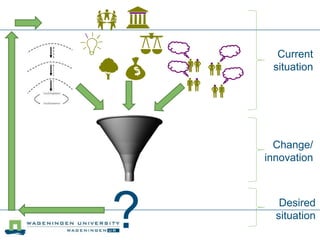
?
Current
situation
Desired
situation
Change/
innovation
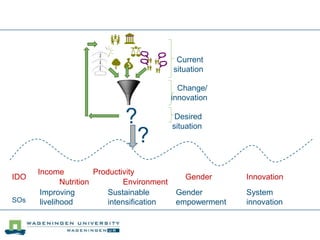
?
Current
situation
Desired
situation
Change/
innovation
Improving
livelihood
Sustainable
intensification
Gender
empowerment
System
innovation
IDO
SOs
Income
Nutrition
Productivity
Environment
Gender Innovation
?
Michael Quinn Patton
May, 2008
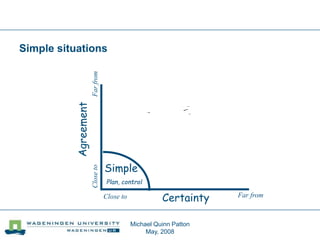
Simple situations
CertaintyClose to Far from
Closeto
Simple
Plan, control
Michael Quinn Patton
May, 2008
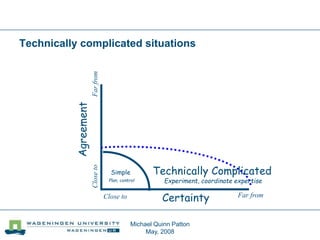
Technically complicated situations
CertaintyClose to Far from
Closeto
Simple
Plan, control
Technically Complicated
Experiment, coordinate expertise
Michael Quinn Patton
May, 2008
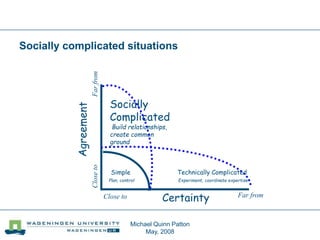
Socially complicated situations
CertaintyClose to Far from
Closeto
Simple
Plan, control
Technically Complicated
Experiment, coordinate expertise
Socially
Complicated
Build relationships,
create common
ground
Michael Quinn Patton
May, 2008
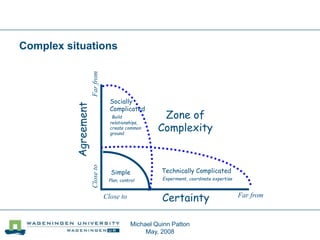
Complex situations
CertaintyClose to Far from
Closeto
Simple
Plan, control
Zone of
Complexity
Technically Complicated
Experiment, coordinate expertise
Socially
Complicated
Build
relationships,
create common
ground
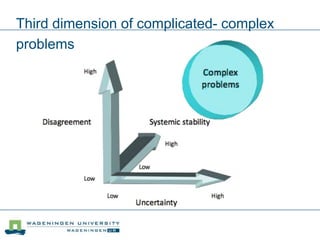
Third dimension of complicated- complex
problems
Systemic stability
At least three mechanisms that provide stability to an agricultural
system:
1. The rules in the system: Ways of thinking, norms and values,
formal laws and regulations, market structures, that guide our
actions and perceptions.
2. Strong interactions/mutual dependence between actors.
3. Infrastructure, investments in technology etc.
(adapted from Geels, 2004; Klein Woolthuis et al, 2005)
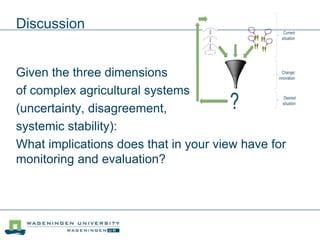
Discussion
Given the three dimensions
of complex agricultural systems
(uncertainty, disagreement,
systemic stability):
What implications does that in your view have for
monitoring and evaluation?
Implications for monitoring and evaluation for
interventions in complicated and complex
situations
 Dynamic indicators, process and proxy indicators
 Multi- dimensional indicators
 Different methods/ approaches
 Process
 Flexible proces/planning/ approach
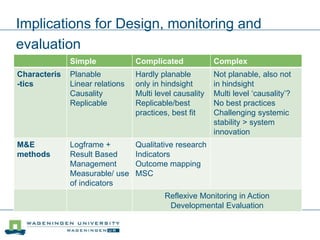
Implications for Design, monitoring and
evaluation
Simple Complicated Complex
Characteris
-tics
Planable
Linear relations
Causality
Replicable
Hardly planable
only in hindsight
Multi level causality
Replicable/best
practices, best fit
Not planable, also not
in hindsight
Multi level ‘causality’?
No best practices
Challenging systemic
stability > system
innovation
M&E
methods
Logframe +
Result Based
Management
Measurable/ use
of indicators
Qualitative research
Indicators
Outcome mapping
MSC
Reflexive Monitoring in Action
Developmental Evaluation
Reflexive Monitoring in Action
A short introduction
Reflexivity
 Reflect – Looking back and thinking about what
happened, what does it mean, how to proceed?
 Reflexive- Challenging rules, practices,
assumptions, modes of thinking, of ‘others’ and
self.
Reflexivity
 Video Overview
What is RMA?
 Monitoring and evaluation of processes of
collective learning for (system) innovation
 to keep the focus on long term, ambitious aims
(involving institutional change)
• by supporting collective learning and change
• by stimulating regular reflection on activities, results
and the institutional setting
Principles
 RMA is more a way of thinking and
acting, than the application of tools
 RMA is embedded in collective
platform activities
 Many RMA activities are carried out
collectively
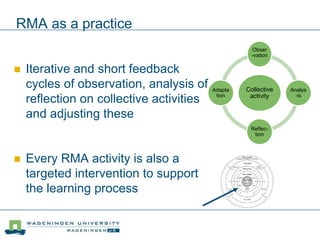
RMA as a practice
 Iterative and short feedback
cycles of observation, analysis of,
reflection on collective activities
and adjusting these
 Every RMA activity is also a
targeted intervention to support
the learning process
Collective
activity
Obser
-vation
Analys
-is
Reflec-
tion
Adapta
tion
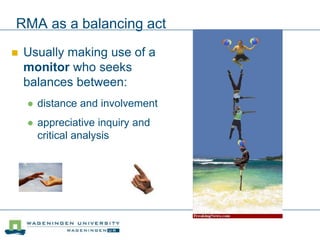
RMA as a balancing act
 Usually making use of a
monitor who seeks
balances between:
 distance and involvement
 appreciative inquiry and
critical analysis
Role of the monitor
• Keeps asking the basic questions to keep long term
system innovation in the basket, to align short term
activities with the long term (system) innovation goals
• Asks questions about systemic challenges/
opportunities, also those present within the network
and its members.
• Contributes to keeping ambitions high
• And other more regular M&E tasks
Questions till so far?
 Any questions till so far?
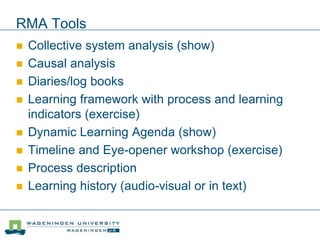
RMA Tools
 Collective system analysis (show)
 Causal analysis
 Diaries/log books
 Learning framework with process and learning
indicators (exercise)
 Dynamic Learning Agenda (show)
 Timeline and Eye-opener workshop (exercise)
 Process description
 Learning history (audio-visual or in text)
Collective System Analysis
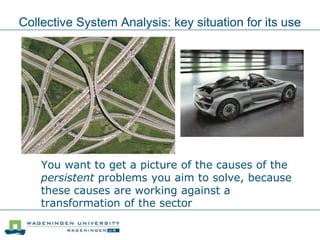
Collective System Analysis: key situation for its use
You want to get a picture of the causes of the
persistent problems you aim to solve, because
these causes are working against a
transformation of the sector
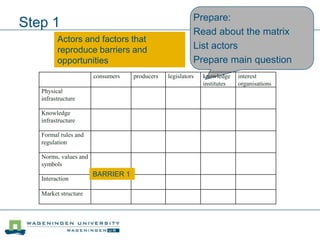
Step 1 Prepare:
Read about the matrix
List actors
Prepare main question
consumers producers legislators knowledge
institutes
interest
organisations
Physical
infrastructure
Knowledge
infrastructure
Formal rules and
regulation
Norms, values and
symbols
Interaction
Market structure
Actors and factors that
reproduce barriers and
opportunities
BARRIER 1
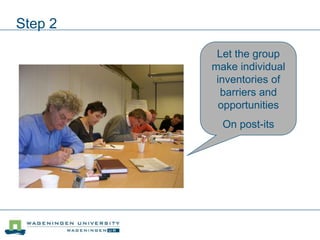
Step 2
Let the group
make individual
inventories of
barriers and
opportunities
On post-its
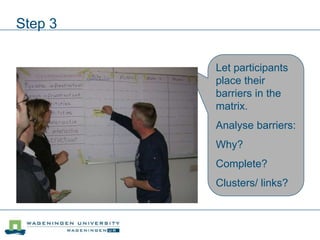
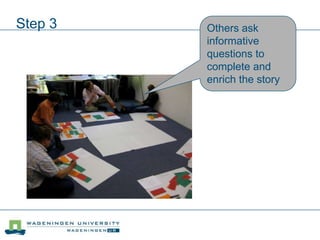
Step 3
Let participants
place their
barriers in the
matrix.
Analyse barriers:
Why?
Complete?
Clusters/ links?
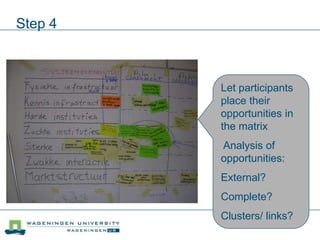
Step 4
Let participants
place their
opportunities in
the matrix
Analysis of
opportunities:
External?
Complete?
Clusters/ links?
Consumers Producers Regulators Knowledge
institutes
Interest
organisations
Infrastructure
Hard
institutions
Soft
institutions
Strong
interaction
Weak
interaction
Capacities
Market
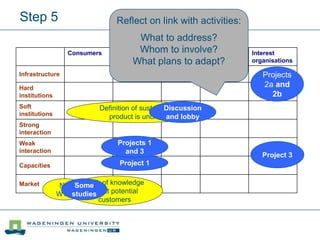
Step 5
Definition of sustainable
product is unclear
Lack of knowledge
about potential
customers
No
WTP
Some
studies
Project 1
Projects 1
and 3
Discussion
and lobby
Projects
2a and
2b
Project 3
Reflect on link with activities:
What to address?
Whom to involve?
What plans to adapt?
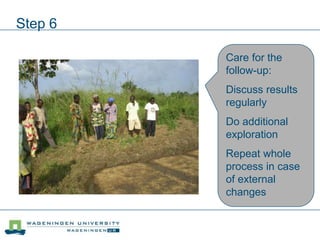
Step 6
Care for the
follow-up:
Discuss results
regularly
Do additional
exploration
Repeat whole
process in case
of external
changes
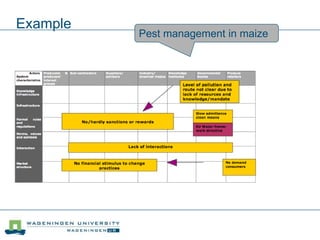
Example
Pest management in maize
Learning and change framework
Key situation for using the learning + change
framework and/or stories of change
Reflect with network members on the
quality of learning and change
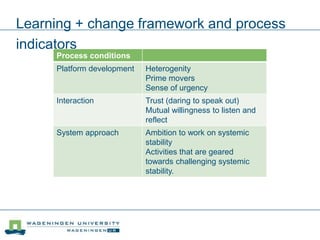
Learning + change framework and process
indicators
Process conditions
Platform development Heterogenity
Prime movers
Sense of urgency
Interaction Trust (daring to speak out)
Mutual willingness to listen and
reflect
System approach Ambition to work on systemic
stability
Activities that are geared
towards challenging systemic
stability.
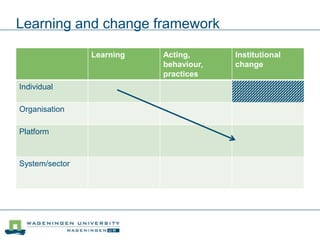
Learning and change framework
Learning Acting,
behaviour,
practices
Institutional
change
Individual
Organisation
Platform
System/sector
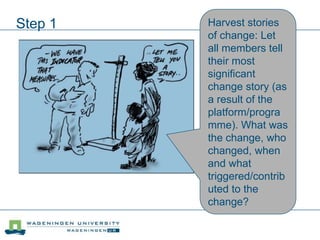
Step 1 Harvest stories
of change: Let
all members tell
their most
significant
change story (as
a result of the
platform/progra
mme). What was
the change, who
changed, when
and what
triggered/contrib
uted to the
change?
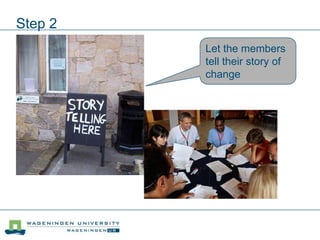
Step 2
Let the members
tell their story of
change
Step 3 Others ask
informative
questions to
complete and
enrich the story
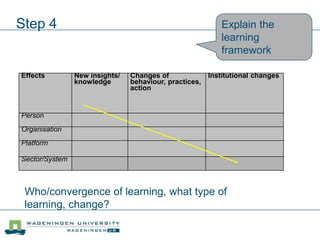
Step 4 Explain the
learning
framework
Effects New insights/
knowledge
Changes of
behaviour, practices,
action
Institutional changes
Person
Organisation
Platform
Sector/System
Who/convergence of learning, what type of
learning, change?
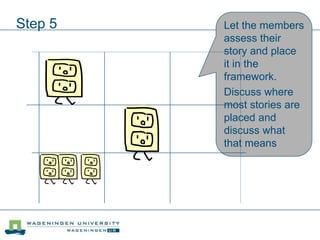
Step 5 Let the members
assess their
story and place
it in the
framework.
Discuss where
most stories are
placed and
discuss what
that means
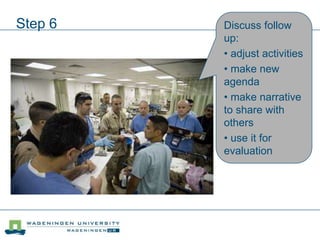
Step 6 Discuss follow
up:
• adjust activities
• make new
agenda
• make narrative
to share with
others
• use it for
evaluation
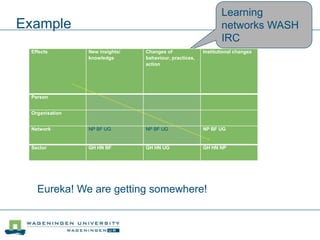
Example
Learning
networks WASH
IRC
Effects New insights/
knowledge
Changes of
behaviour, practices,
action
Institutional changes
Person
Organisation
Network NP BF UG NP BF UG NP BF UG
Sector GH HN BF GH HN UG GH HN NP
Eureka! We are getting somewhere!
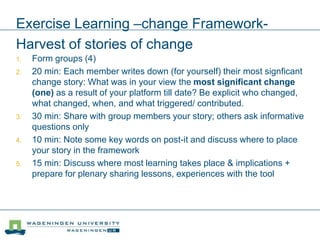
Exercise Learning –change Framework-
Harvest of stories of change
1. Form groups (4)
2. 20 min: Each member writes down (for yourself) their most signficant
change story: What was in your view the most significant change
(one) as a result of your platform till date? Be explicit who changed,
what changed, when, and what triggered/ contributed.
3. 30 min: Share with group members your story; others ask informative
questions only
4. 10 min: Note some key words on post-it and discuss where to place
your story in the framework
5. 15 min: Discuss where most learning takes place & implications +
prepare for plenary sharing lessons, experiences with the tool
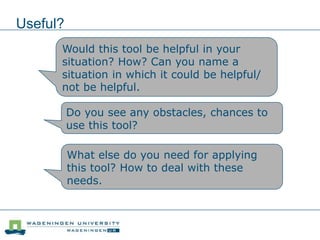
Useful?
Would this tool be helpful in your
situation? How? Can you name a
situation in which it could be helpful/
not be helpful.
Do you see any obstacles, chances to
use this tool?
What else do you need for applying
this tool? How to deal with these
needs.
Dynamic Learning Agenda
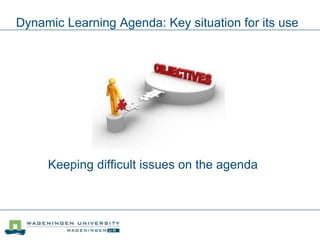
Dynamic Learning Agenda: Key situation for its use
Keeping difficult issues on the agenda
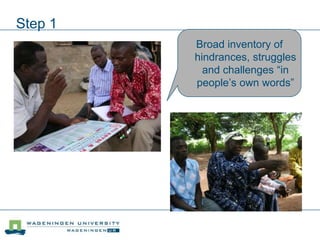
Step 1
Broad inventory of
hindrances, struggles
and challenges “in
people’s own words”
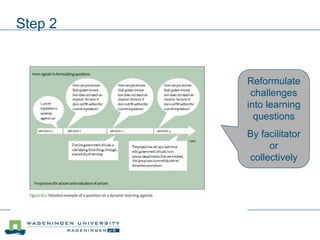
Step 2
QuickTime™ and a
TIFF(ongecomprimeerd) decompressor
are needed to see this picture.
Reformulate
challenges
into learning
questions
By facilitator
or
collectively
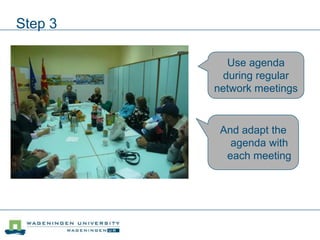
Step 3
Use agenda
during regular
network meetings
And adapt the
agenda with
each meeting
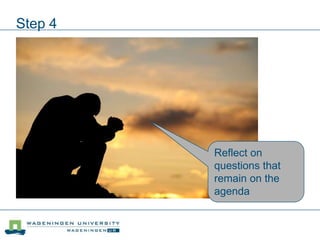
Step 4
Reflect on
questions that
remain on the
agenda
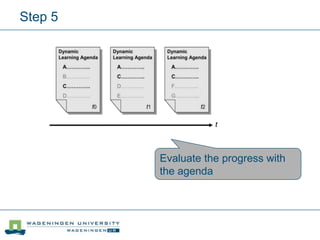
Step 5
Evaluate the progress with
the agenda
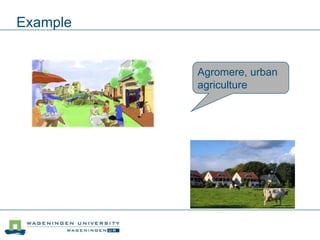
Example
Agromere, urban
agriculture
Useful?
Would this tool be helpful in your
situation? How? Name a situation in
which it could be helpful/ not be
helpful.
Do you see any obstacles, chances to
use this tool?
What else do you need for applying
this tool? How to deal with these
needs?
Timeline
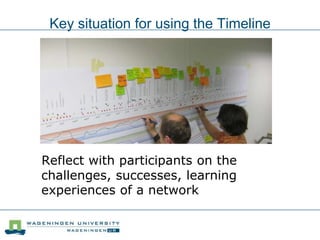
Key situation for using the Timeline
Reflect with participants on the
challenges, successes, learning
experiences of a network
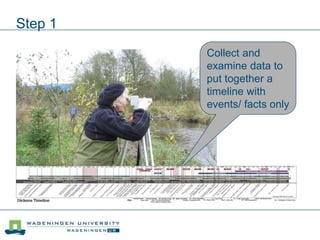
Step 1
Collect and
examine data to
put together a
timeline with
events/ facts only
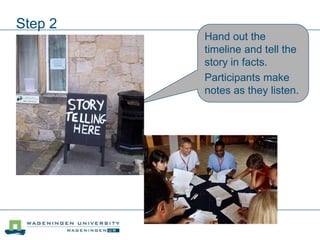
Step 2
Hand out the
timeline and tell the
story in facts.
Participants make
notes as they listen.
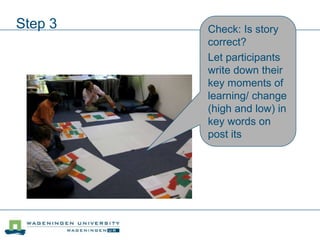
Step 3 Check: Is story
correct?
Let participants
write down their
key moments of
learning/ change
(high and low) in
key words on
post its
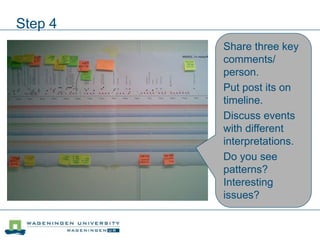
Step 4
Share three key
comments/
person.
Put post its on
timeline.
Discuss events
with different
interpretations.
Do you see
patterns?
Interesting
issues?
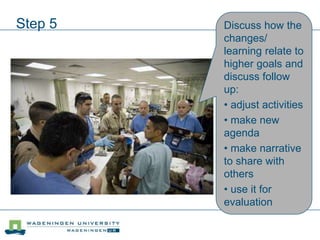
Step 5 Discuss how the
changes/
learning relate to
higher goals and
discuss follow
up:
• adjust activities
• make new
agenda
• make narrative
to share with
others
• use it for
evaluation
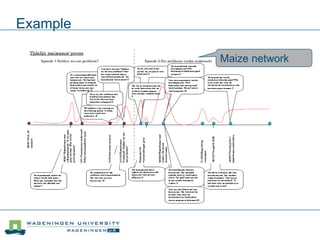
Example
Maize network
Self-organised exercise timeline
One experience we all share:This workshop
1. Make a timeline with days and sessions as events
2. All participants write down their highs and lows (on
learning, insights) on post-its
3. Each participant selects her/his three most important.
4. Hang them in the timeline (highs above, lows below)
5. Discuss differences and implications for future
6. Formulate advice to facilitators
(Facilitators will leave the room to give you space)
HAVE FUN!
Useful?
Would this tool be helpful in your
situation? How? Can you name a
situation in which it could be helpful/
not be helpful.
Do you see any obstacles, chances to
use this tool?
What else do you need for applying
this tool? How to deal with these
needs.
Free download & in Dropbox
 http://www.wageningenur.nl/nl/show/Reflexive-
Monitoring-in-Action.htm

Reflexive monitoring in action

  • 1.
    Know When YourChallenges Are In the Zone of ComplexityReflexive monitoring in action Marlen Arkesteijn (WUR) Humidtropics capacity development workshop, Nairobi, 29 April – 2 May 2014 http://humidtropics.cgiar.org/
  • 2.
    Objectives of theday  Getting a basic understanding of simple, complicated and complex situations and their related M&E approaches/methods;  Getting acquainted with the principles of Reflexive Monitoring in Action;  Learning to work with some of the reflexive tools
  • 3.
    Outline of theday 08.30-08.45 Introduction 08.45- 09.45 Introduction on Reflexive Monitoring in Action (Video around 09.30) 09.45-10.00 Explanation ‘Learning-change framework’ 10.00-10.30 Coffee break 10.30- 12.00 Working session: Learning-change framework 12.00- 13.00 Lunch
  • 4.
    Outline of theday 13.00-13.30 E-mail time 13.30-14.00 Explanation timeline 14.00-15.00 Working session timeline 15.00-15.30 Coffee break 15.30-16.00 Reflection on RMA and tools 16.00-17.00 Post workshop quiz 17.00-17.30 Wrap up
  • 5.
  • 6.
  • 7.
    Michael Quinn Patton May,2008 Simple situations CertaintyClose to Far from Closeto Simple Plan, control
  • 8.
    Michael Quinn Patton May,2008 Technically complicated situations CertaintyClose to Far from Closeto Simple Plan, control Technically Complicated Experiment, coordinate expertise
  • 9.
    Michael Quinn Patton May,2008 Socially complicated situations CertaintyClose to Far from Closeto Simple Plan, control Technically Complicated Experiment, coordinate expertise Socially Complicated Build relationships, create common ground
  • 10.
    Michael Quinn Patton May,2008 Complex situations CertaintyClose to Far from Closeto Simple Plan, control Zone of Complexity Technically Complicated Experiment, coordinate expertise Socially Complicated Build relationships, create common ground
  • 11.
    Third dimension ofcomplicated- complex problems
  • 12.
    Systemic stability At leastthree mechanisms that provide stability to an agricultural system: 1. The rules in the system: Ways of thinking, norms and values, formal laws and regulations, market structures, that guide our actions and perceptions. 2. Strong interactions/mutual dependence between actors. 3. Infrastructure, investments in technology etc. (adapted from Geels, 2004; Klein Woolthuis et al, 2005)
  • 13.
    Discussion Given the threedimensions of complex agricultural systems (uncertainty, disagreement, systemic stability): What implications does that in your view have for monitoring and evaluation?
  • 14.
    Implications for monitoringand evaluation for interventions in complicated and complex situations  Dynamic indicators, process and proxy indicators  Multi- dimensional indicators  Different methods/ approaches  Process  Flexible proces/planning/ approach
  • 15.
    Implications for Design,monitoring and evaluation Simple Complicated Complex Characteris -tics Planable Linear relations Causality Replicable Hardly planable only in hindsight Multi level causality Replicable/best practices, best fit Not planable, also not in hindsight Multi level ‘causality’? No best practices Challenging systemic stability > system innovation M&E methods Logframe + Result Based Management Measurable/ use of indicators Qualitative research Indicators Outcome mapping MSC Reflexive Monitoring in Action Developmental Evaluation
  • 16.
    Reflexive Monitoring inAction A short introduction
  • 17.
    Reflexivity  Reflect –Looking back and thinking about what happened, what does it mean, how to proceed?  Reflexive- Challenging rules, practices, assumptions, modes of thinking, of ‘others’ and self.
  • 18.
  • 19.
    What is RMA? Monitoring and evaluation of processes of collective learning for (system) innovation  to keep the focus on long term, ambitious aims (involving institutional change) • by supporting collective learning and change • by stimulating regular reflection on activities, results and the institutional setting
  • 20.
    Principles  RMA ismore a way of thinking and acting, than the application of tools  RMA is embedded in collective platform activities  Many RMA activities are carried out collectively
  • 21.
    RMA as apractice  Iterative and short feedback cycles of observation, analysis of, reflection on collective activities and adjusting these  Every RMA activity is also a targeted intervention to support the learning process Collective activity Obser -vation Analys -is Reflec- tion Adapta tion
  • 22.
    RMA as abalancing act  Usually making use of a monitor who seeks balances between:  distance and involvement  appreciative inquiry and critical analysis
  • 23.
    Role of themonitor • Keeps asking the basic questions to keep long term system innovation in the basket, to align short term activities with the long term (system) innovation goals • Asks questions about systemic challenges/ opportunities, also those present within the network and its members. • Contributes to keeping ambitions high • And other more regular M&E tasks
  • 24.
    Questions till sofar?  Any questions till so far?
  • 25.
    RMA Tools  Collectivesystem analysis (show)  Causal analysis  Diaries/log books  Learning framework with process and learning indicators (exercise)  Dynamic Learning Agenda (show)  Timeline and Eye-opener workshop (exercise)  Process description  Learning history (audio-visual or in text)
  • 26.
  • 27.
    Collective System Analysis:key situation for its use You want to get a picture of the causes of the persistent problems you aim to solve, because these causes are working against a transformation of the sector
  • 28.
    Step 1 Prepare: Readabout the matrix List actors Prepare main question consumers producers legislators knowledge institutes interest organisations Physical infrastructure Knowledge infrastructure Formal rules and regulation Norms, values and symbols Interaction Market structure Actors and factors that reproduce barriers and opportunities BARRIER 1
  • 29.
    Step 2 Let thegroup make individual inventories of barriers and opportunities On post-its
  • 30.
    Step 3 Let participants placetheir barriers in the matrix. Analyse barriers: Why? Complete? Clusters/ links?
  • 31.
    Step 4 Let participants placetheir opportunities in the matrix Analysis of opportunities: External? Complete? Clusters/ links?
  • 32.
    Consumers Producers RegulatorsKnowledge institutes Interest organisations Infrastructure Hard institutions Soft institutions Strong interaction Weak interaction Capacities Market Step 5 Definition of sustainable product is unclear Lack of knowledge about potential customers No WTP Some studies Project 1 Projects 1 and 3 Discussion and lobby Projects 2a and 2b Project 3 Reflect on link with activities: What to address? Whom to involve? What plans to adapt?
  • 33.
    Step 6 Care forthe follow-up: Discuss results regularly Do additional exploration Repeat whole process in case of external changes
  • 34.
  • 35.
  • 36.
    Key situation forusing the learning + change framework and/or stories of change Reflect with network members on the quality of learning and change
  • 37.
    Learning + changeframework and process indicators Process conditions Platform development Heterogenity Prime movers Sense of urgency Interaction Trust (daring to speak out) Mutual willingness to listen and reflect System approach Ambition to work on systemic stability Activities that are geared towards challenging systemic stability.
  • 38.
    Learning and changeframework Learning Acting, behaviour, practices Institutional change Individual Organisation Platform System/sector
  • 39.
    Step 1 Harveststories of change: Let all members tell their most significant change story (as a result of the platform/progra mme). What was the change, who changed, when and what triggered/contrib uted to the change?
  • 40.
    Step 2 Let themembers tell their story of change
  • 41.
    Step 3 Othersask informative questions to complete and enrich the story
  • 42.
    Step 4 Explainthe learning framework Effects New insights/ knowledge Changes of behaviour, practices, action Institutional changes Person Organisation Platform Sector/System Who/convergence of learning, what type of learning, change?
  • 43.
    Step 5 Letthe members assess their story and place it in the framework. Discuss where most stories are placed and discuss what that means
  • 44.
    Step 6 Discussfollow up: • adjust activities • make new agenda • make narrative to share with others • use it for evaluation
  • 45.
    Example Learning networks WASH IRC Effects Newinsights/ knowledge Changes of behaviour, practices, action Institutional changes Person Organisation Network NP BF UG NP BF UG NP BF UG Sector GH HN BF GH HN UG GH HN NP Eureka! We are getting somewhere!
  • 46.
    Exercise Learning –changeFramework- Harvest of stories of change 1. Form groups (4) 2. 20 min: Each member writes down (for yourself) their most signficant change story: What was in your view the most significant change (one) as a result of your platform till date? Be explicit who changed, what changed, when, and what triggered/ contributed. 3. 30 min: Share with group members your story; others ask informative questions only 4. 10 min: Note some key words on post-it and discuss where to place your story in the framework 5. 15 min: Discuss where most learning takes place & implications + prepare for plenary sharing lessons, experiences with the tool
  • 47.
    Useful? Would this toolbe helpful in your situation? How? Can you name a situation in which it could be helpful/ not be helpful. Do you see any obstacles, chances to use this tool? What else do you need for applying this tool? How to deal with these needs.
  • 48.
  • 49.
    Dynamic Learning Agenda:Key situation for its use Keeping difficult issues on the agenda
  • 50.
    Step 1 Broad inventoryof hindrances, struggles and challenges “in people’s own words”
  • 51.
    Step 2 QuickTime™ anda TIFF(ongecomprimeerd) decompressor are needed to see this picture. Reformulate challenges into learning questions By facilitator or collectively
  • 52.
    Step 3 Use agenda duringregular network meetings And adapt the agenda with each meeting
  • 53.
    Step 4 Reflect on questionsthat remain on the agenda
  • 54.
    Step 5 Evaluate theprogress with the agenda
  • 55.
  • 56.
    Useful? Would this toolbe helpful in your situation? How? Name a situation in which it could be helpful/ not be helpful. Do you see any obstacles, chances to use this tool? What else do you need for applying this tool? How to deal with these needs?
  • 57.
  • 58.
    Key situation forusing the Timeline Reflect with participants on the challenges, successes, learning experiences of a network
  • 59.
    Step 1 Collect and examinedata to put together a timeline with events/ facts only
  • 60.
    Step 2 Hand outthe timeline and tell the story in facts. Participants make notes as they listen.
  • 61.
    Step 3 Check:Is story correct? Let participants write down their key moments of learning/ change (high and low) in key words on post its
  • 62.
    Step 4 Share threekey comments/ person. Put post its on timeline. Discuss events with different interpretations. Do you see patterns? Interesting issues?
  • 63.
    Step 5 Discusshow the changes/ learning relate to higher goals and discuss follow up: • adjust activities • make new agenda • make narrative to share with others • use it for evaluation
  • 64.
  • 65.
    Self-organised exercise timeline Oneexperience we all share:This workshop 1. Make a timeline with days and sessions as events 2. All participants write down their highs and lows (on learning, insights) on post-its 3. Each participant selects her/his three most important. 4. Hang them in the timeline (highs above, lows below) 5. Discuss differences and implications for future 6. Formulate advice to facilitators (Facilitators will leave the room to give you space) HAVE FUN!
  • 66.
    Useful? Would this toolbe helpful in your situation? How? Can you name a situation in which it could be helpful/ not be helpful. Do you see any obstacles, chances to use this tool? What else do you need for applying this tool? How to deal with these needs.
  • 67.
    Free download &in Dropbox  http://www.wageningenur.nl/nl/show/Reflexive- Monitoring-in-Action.htm