Brought to you by
Introduction
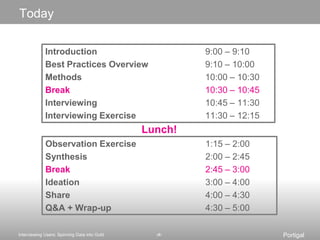
TodayIntroduction				9:00 – 9:10Best Practices Overview		9:10 – 10:00Methods10:00 – 10:30Break10:30 – 10:45Interviewing			10:45 – 11:30Interviewing Exercise11:30 – 12:15Lunch!Observation Exercise			1:15 – 2:00Synthesis				2:00 – 2:45Break2:45 – 3:00Ideation3:00 – 4:00Share4:00 – 4:30Q&A + Wrap-up	4:30 – 5:00
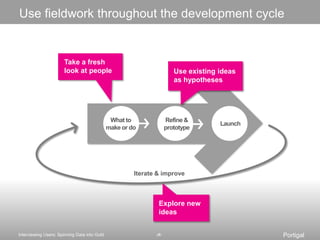
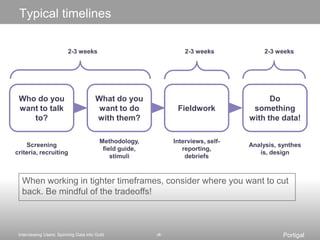
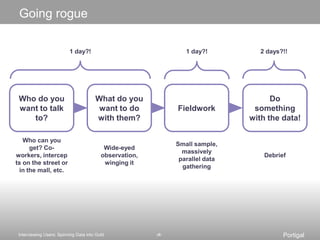
Take a fresh look at peopleUse existing ideas as hypothesesWhat to make or doRefine & prototypeLaunchIterate & improveUse fieldwork throughout the development cycleExplore new ideas
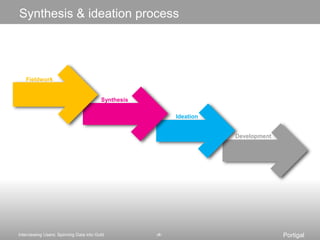
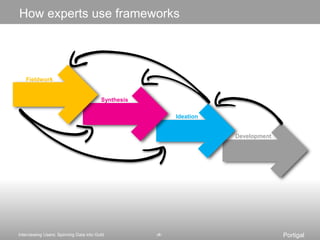
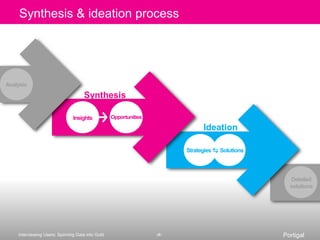
Synthesis & ideation processFieldworkSynthesisIdeationDevelopment
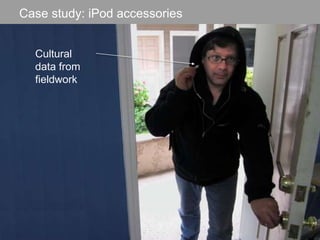
Cultural data from fieldworkCase study: iPod accessories
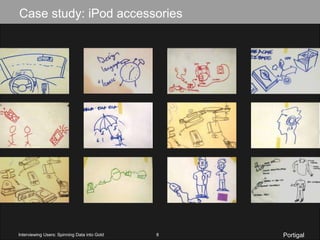
Case study: iPod accessoriesPortigalInterviewing Users: Spinning Data into Gold8
Research Project – Best Practices Overview
What do I mean by “research?”EthnographyEthnographic interviews Video ethnographyDepth-interviewsContextual researchHome visitsSite visitsExperience modelingDesign researchUser researchUser-centered designOne-on-onesCamera studies User safaris
What do I mean by “research?”EthnographyEthnographic interviews Video ethnographyDepth-interviewsContextual researchHome visitsSite visitsExperience modelingDesign researchUser researchUser-centered designOne-on-onesCamera studies User safaris What-ever!
Beyond our terminology, what are we doing?Examine people in their own contextWhat are they doing?
What does it mean?Infer (interpret/synthesize/etc.)Find the connections
The researcher is the “apparatus”Apply to business or design problemsUse products, services, packaging, design to tell the right story
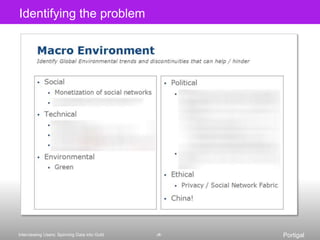
More possible types of solutions than we started out withIdentifying the problem
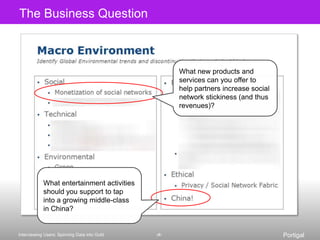
The Business QuestionWhat new products and services can you offer to help partners increase social network stickiness (and thus revenues)?What entertainment activities should you support to tap into a growing middle-class in China?
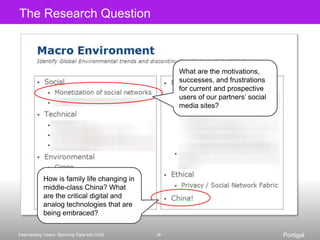
The Research QuestionWhat are the motivations, successes, and frustrations for current and prospective users of our partners’ social media sites?How is family life changing in middle-class China? What are the critical digital and analog technologies that are being embraced?
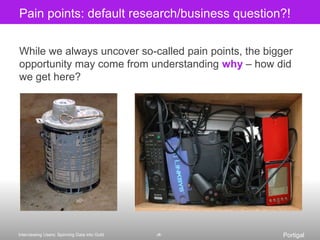
Pain points: default research/business question?!While we always uncover so-called pain points, the bigger opportunity may come from understanding why– how did we get here?
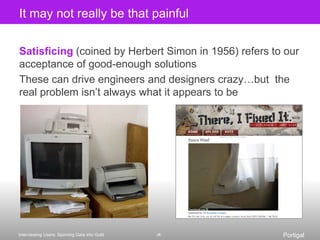
It may not really be that painfulSatisficing(coined by Herbert Simon in 1956) refers to our acceptance of good-enough solutionsThese can drive engineers and designers crazy…but  the real problem isn’t always what it appears to be
Finding the right participants (aka recruiting)Often an afterthought in project planningBut the right customers are crucial to get the right insights
This takes time to plan and to executePointless interviews waste time and challenge the credibility of the workPerson doesn’t really want to talk to you
They don’t have the desired relationship with the product/brandEpic FAILS will happen anywayIdentifyWhat type of people you want to find (criteria, screener)
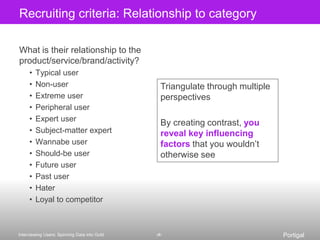
How you will find those peopleRecruiting criteria: Relationship to categoryWhat is their relationship to the product/service/brand/activity? Typical user
Non-user
Extreme user
Peripheral user
Expert user
Subject-matter expert
Wannabe user
Should-be user
Future user
Past user
Hater
Loyal to competitorTriangulate through multiple perspectivesBy creating contrast, you reveal key influencing factorsthat you wouldn’t otherwise see
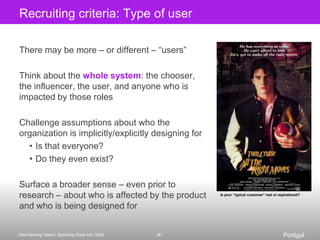
Recruiting criteria: Type of userThere may be more – or different – “users”Think about the whole system: the chooser, the influencer, the user, and anyone who is impacted by those rolesChallenge assumptions about who the organization is implicitly/explicitly designing forIs that everyone?
Do they even exist?Surface a broader sense – even prior to research – about who is affected by the product and who is being designed forIs your “typical customer” real or aspirational?
Recruiting criteria: DemographicsGenderAgeLife stage/lifestyleMarried
Stage of family
Retirement
Not in the middle of a major life-change (unless that’s of interest)DwellingSuburban/urban/rural
Apartment/living alone/ roommates/single family homeRaceReflect the population
Reflect the user baseOccupationFrom outside the industries in questionIncomeCan afford the product in questionDemographic factors are typically secondarywhen defining the sample
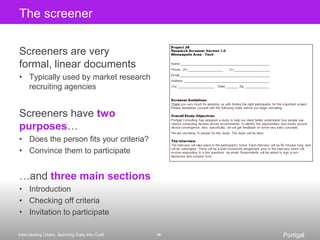
The screenerScreeners are very formal, linear documentsTypically used by market research recruiting agenciesScreeners havetwo purposes…Does the person fits your criteria?
Convince them to participate…and three main sectionsIntroduction
Checking off criteria
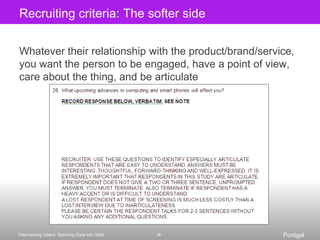
Invitation to participateRecruiting criteria: The softer sideWhatever their relationship with the product/brand/service, you want the person to be engaged, have a point of view, care about the thing, and be articulate
Creative recruitingOutside of the traditional method of working with a recruiting agency, there are other approachesFriends and family/Social networks
Snowball recruiting (participants find more participants)
Craigslist
Intercepts
Etc.Pros and consCheap but time-consuming
Quick but harder to control and manage
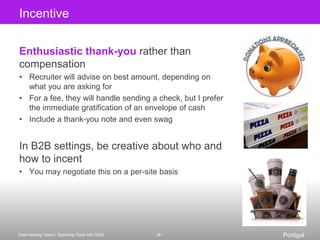
Likely to find “pure” participants but they might be too close to youIncentiveEnthusiastic thank-you rather than compensationRecruiter will advise on best amount, depending on what you are asking for
For a fee, they will handle sending a check, but I prefer the immediate gratification of an envelope of cash
Include a thank-you note and even swagIn B2B settings, be creative about who and how to incentYou may negotiate this on a per-site basisThe interview guide (or field guide)A detailed plan of what will happen in the interviewQuestions, timing, activities, tasks, logistics, etc.Transforms questions-we-want-answers-to into questions-we-will-askShare with team to align on issues of concernEspecially with multiple teams in the fieldHelps you previsualizethe flow of the sessionInclude questions as well as other methods that you’ll usePrepping an interview guide means that you may not need to use the interview guideThis is counter-intuitive
It does come in handy during freeze-up moments – scan it over to see what else you want to coverFour sections to the field guideIntroduction and Participant BackgroundLogistics, timing, objectivesThe Main BodySubsections for each area you plan to explore (e.g., configuration, learning about new features, etc.)Projection/Dream QuestionsBe audacious and ask about predictions for the future or ideal experiencesWrap UpLogistics, ask about anything they want to tell you that you didn’t ask about
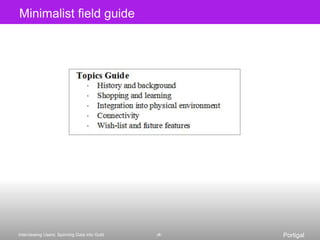
Minimalist field guide
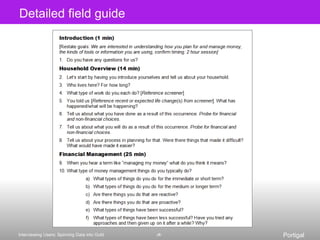
Detailed field guide
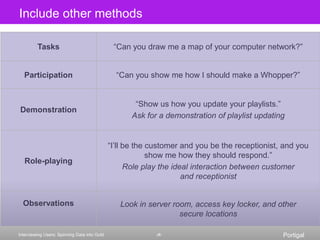
Include other methods
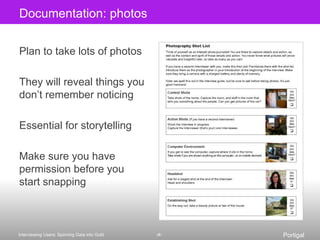
Documentation: photosPlan to take lots of photosThey will reveal things you don’t remember noticingEssential for storytellingMake sure you have permission before you start snapping
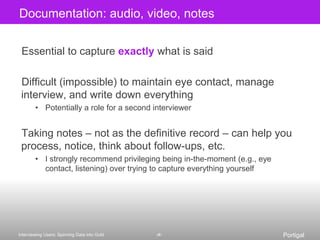
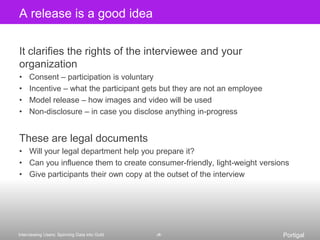
Documentation: audio, video, notesEssential to capture exactly what is saidDifficult (impossible) to maintain eye contact, manage interview, and write down everythingPotentially a role for a second interviewerTaking notes – not as the definitive record – can help you process, notice, think about follow-ups, etc.I strongly recommend privileging being in-the-moment (e.g., eye contact, listening) over trying to capture everything yourselfA release is a good ideaIt clarifies the rights of the interviewee and your organization Consent – participation is voluntary
Incentive – what the participant gets but they are not an employee
Model release – how images and video will be used
Non-disclosure – in case you disclose anything in-progressThese are legal documentsWill your legal department help you prepare it?
Can you influence them to create consumer-friendly, light-weight versions
Give participants their own copy at the outset of the interviewMethods
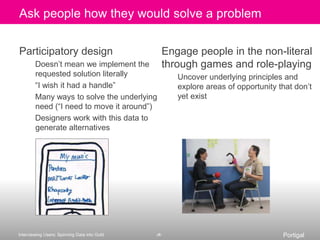
Ask people how they would solve a problemParticipatory designDoesn’t mean we implement the requested solution literally“I wish it had a handle”Many ways to solve the underlying need (“I need to move it around”)Designers work with this data to generate alternativesEngage people in the non-literal through games and role-playingUncover underlying principles and explore areas of opportunity that don’t yet exist
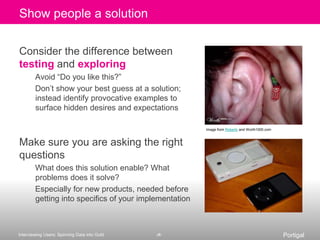
Show people a solutionConsider the difference betweentestingandexploringAvoid “Do you like this?”Don’t show your best guess at a solution; instead identify provocative examples to surface hidden desires and expectationsMake sure you are asking the right questionsWhat does this solution enable? What problems does it solve?Especially for new products, needed before getting into specifics of your implementationImage from Roberto and Worth1000.com
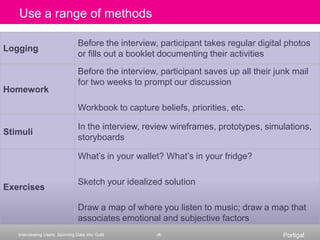
Use a range of methods
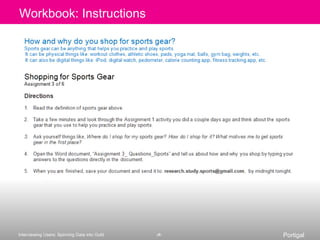
Workbook: Instructions
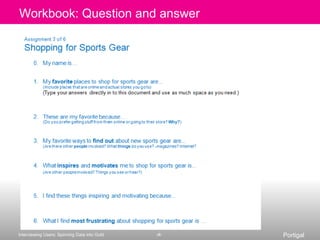
Workbook: Question and answer
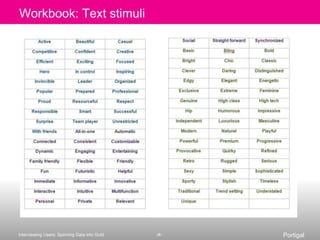
Workbook: Text stimuli
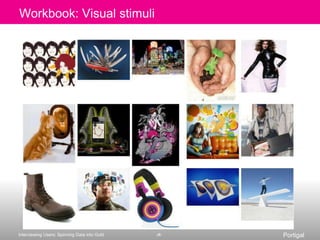
Workbook: Visual stimuli
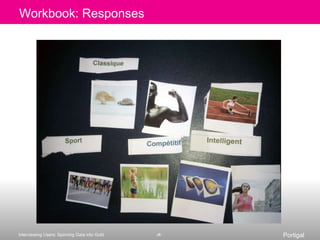
Workbook: Responses
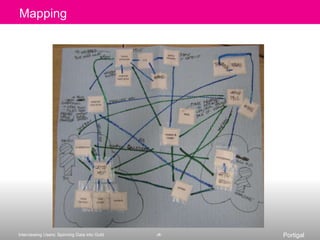
Mapping
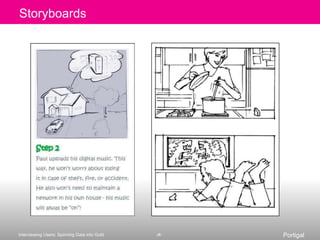
Storyboards
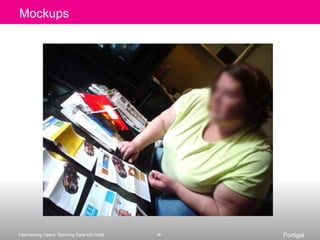
Mockups
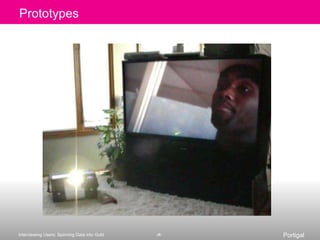
Prototypes
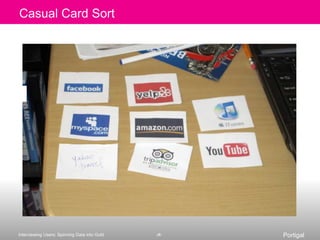
Casual Card Sort
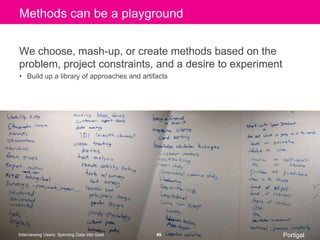
Methods can be a playgroundWe choose, mash-up, or create methods based on the problem, project constraints, and a desire to experimentBuild up a library of approaches and artifactsPortigalInterviewing Users: Spinning Data into Gold49
Break!
Interviewing
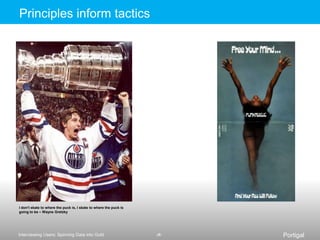
Principles inform tacticsI don't skate to where the puck is, I skate to where the puck is going to be – Wayne Gretzky
Fieldwork principlesCheck your worldview at the doorEmbrace how other people see the worldBuild rapportListen
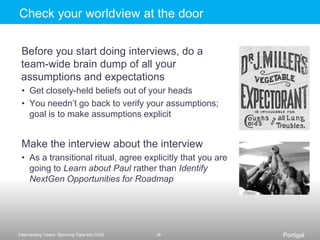
Check your worldview at the doorBefore you start doing interviews, do a team-wide brain dump of all your assumptions and expectationsGet closely-held beliefs out of your heads
You needn’t go back to verify your assumptions; goal is to make assumptions explicitMake the interview about the interviewAs a transitional ritual, agree explicitly that you are going to Learn about Paul rather than Identify NextGen Opportunities for RoadmapEmbrace how other people see the worldGo to where your users are rather than asking them to come to youNip distractions in the budEat!
Leave plenty of time so you aren’t rushed when you arrive
Find a bathroom beforehandBe ready to ask questions you (think you) know the answers toThink about: “When are your taxes due?”
What do you know? What are you afraid they’ll say? What might you learn?Build rapportBe selective about social gracesJust enough small talk
Accept what you’re offeredBe selective about talking about yourselfReveal personal information to give them permission to share
Otherwise, think “OMG! Me too!” without saying itWork towards the tipping pointFrom question-answer to question-story
You won’t know when it’s coming; be patientAcknowledge the interview as something…unusual“What I want to learn today…” over friendly chatListenYou can demonstrate that you are listening by asking questions!Follow-up, follow-up, follow-up
“Earlier, you told us that…”
“I want to go back to something else you said…”Signal your transitions: “Great, now I’d like to move onto a totally different topic”This level of listening is not how we normally talk to each otherRemember that you are interviewing, not having a conversation
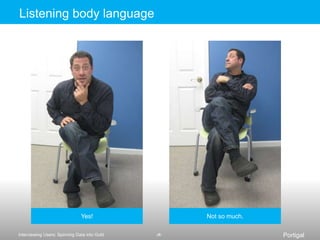
This is really hardListening body languageYes!Not so much.
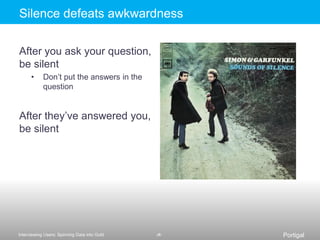
Silence defeats awkwardnessAfter you ask your question, be silentDon’t put the answers in the questionAfter they’ve answered you, be silent
Use natural languageTalk like your subject talks!
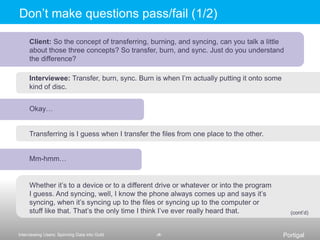
Don’t make questions pass/fail (1/2)Client: So the concept of transferring, burning, and syncing, can you talk a little about those three concepts? So transfer, burn, and sync. Just do you understand the difference?Interviewee: Transfer, burn, sync. Burn is when I’m actually putting it onto some kind of disc.Okay…Transferring is I guess when I transfer the files from one place to the other.Mm-hmm…Whether it’s to a device or to a different drive or whatever or into the program I guess. And syncing, well, I know the phone always comes up and says it’s syncing, when it’s syncing up to the files or syncing up to the computer or stuff like that. That’s the only time I think I’ve ever really heard that.(cont’d)
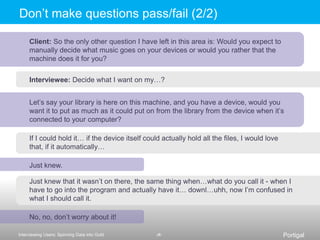
Don’t make questions pass/fail (2/2)Client: So the only other question I have left in this area is: Would you expect to manually decide what music goes on your devices or would you rather that the machine does it for you?Interviewee: Decide what I want on my…?Let’s say your library is here on this machine, and you have a device, would you want it to put as much as it could put on from the library from the device when it’s connected to your computer?If I could hold it… if the device itself could actually hold all the files, I would love that, if it automatically…Just knew.Just knew that it wasn’t on there, the same thing when…what do you call it - when I have to go into the program and actually have it… downl…uhh, now I’m confused in what I should call it.No, no, don’t worry about it!
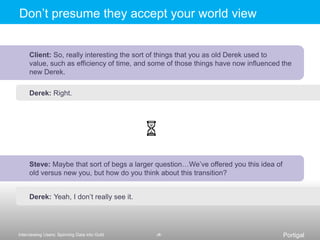
Don’t presume they accept your world viewClient: So, really interesting the sort of things that you as old Derek used to value, such as efficiency of time, and some of those things have now influenced the new Derek.Derek: Right.Steve: Maybe that sort of begs a larger question…We’ve offered you this idea of old versus new you, but how do you think about this transition?Derek:Yeah, I don’t really see it.
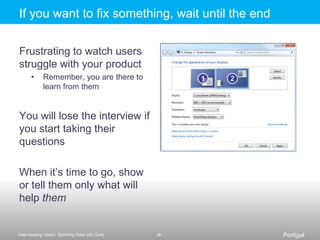
If you want to fix something, wait until the endFrustrating to watch users struggle with your productRemember, you are there to learn from themYou will lose the interview if you start taking their questionsWhen it’s time to go, show or tell them only what will help them
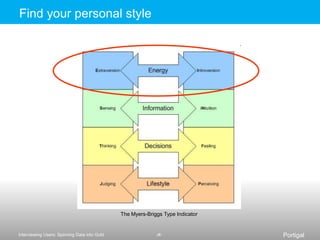
Find your personal styleThe Myers-Briggs Type Indicator
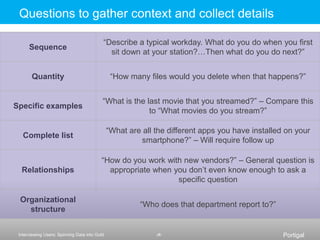
Questions to gather context and collect details
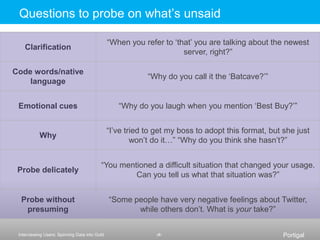
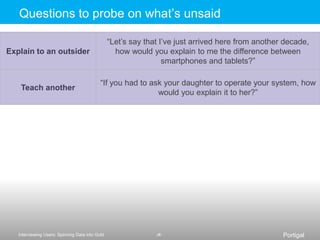
Questions to probe on what’s unsaid
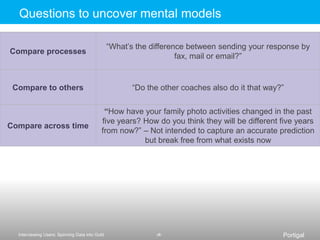
Questions to uncover mental models
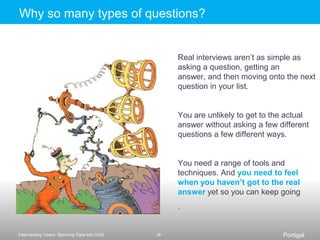
Why so many types of questions?Real interviews aren’t as simple as asking a question, getting an answer, and then moving onto the next question in your list. You are unlikely to get to the actual answer without asking a few different questions a few different ways. You need a range of tools and techniques. And you need to feel when you haven’t got to the real answer yet so you can keep going.
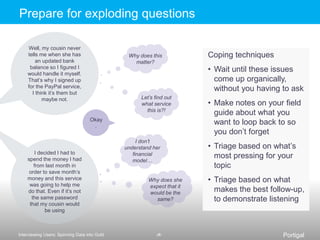
Prepare for exploding questionsWell, my cousin never tells me when she has an updated bank balance so I figured I would handle it myself. That’s why I signed up for the PayPal service, I think it’s them but maybe not.Coping techniquesWait until these issues come up organically, without you having to askMake notes on your field guide about what you want to loop back to so you don’t forgetTriage based on what’s most pressing for your topicTriage based on what makes the best follow-up, to demonstrate listeningWhy does this matter?Let’s find out what service this is?!Okay.I decided I had to spend the money I had from last month in order to save month’s money and this service was going to help me do that. Even if it’s not the same password that my cousin would be usingI don’t understand her financial model…Why does she expect that it would be the same?
Exploding questions can lead to a flow state
Managing others in the fieldWe lead a thirty-minute training session for everyone who will join us in the fieldField teams are ideally 2, at most 3Ensure one person leads the interview and clarify the role of the “second interviewer”They should ask questions, but stay in the “chapter” that we’re inDuring our debriefs, we offer feedback and coaching about the process, if possible
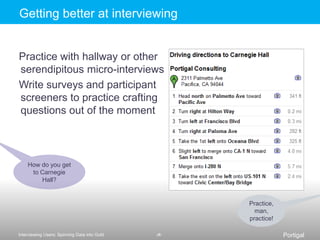
Getting better at interviewingPractice with hallway or other serendipitous micro-interviewsWrite surveys and participant screeners to practice crafting questions out of the moment How do you get to Carnegie Hall?Practice, man, practice!
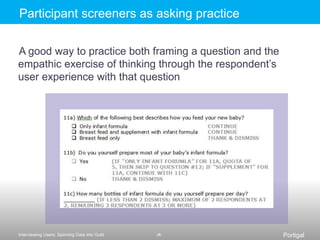
Participant screeners as asking practiceA good way to practice both framing a question and the empathic exercise of thinking through the respondent’s user experience with that question
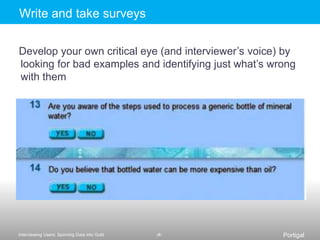
Write and take surveysDevelop your own critical eye (and interviewer’s voice) by looking for bad examples and identifying just what’s wrong with them
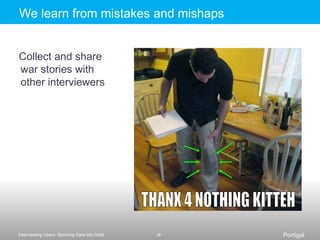
We learn from mistakes and mishapsCollect and share war stories with other interviewersTHANX 4 NOTHING KITTEH
Interviewing ExerciseGet in groups of 3You are in a startup looking for opportunities in…Music – purpose/role/interests, technology, devices Food, groceries, meals, nutritionNews – media, information, sources, purposeReview sample interview guidesImagine the flow
Background, depth, reflectionThree rounds of interviews, 10-12 minutes each One interviewer, one interviewee, one observer
Each person plays each role once
Stay in the exercise!Group debrief
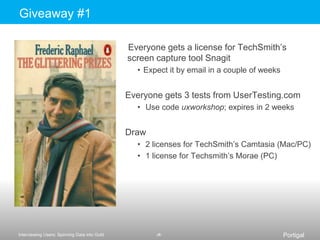
Giveaway #1Everyone gets a license for TechSmith’s screen capture tool SnagitExpect it by email in a couple of weeksEveryone gets 3 tests from UserTesting.comUse code uxworkshop; expires in 2 weeksDraw2 licenses for TechSmith’sCamtasia (Mac/PC)1 license for Techsmith’sMorae (PC)
Lunch
(The rest of) todayIntroduction				9:00 – 9:10Best Practices Overview		9:10 – 10:00Methods10:00 – 10:30Break10:30 – 10:45Interviewing			10:45 – 11:30Interviewing Exercise11:30 – 12:15Lunch!Observation Exercise			1:15 – 2:00Synthesis				2:00 – 2:45Break2:45 – 3:00Ideation3:00 – 4:00Share4:00 – 4:30Q&A + Wrap-up	4:30 – 5:00
Homework/Observation Exercise
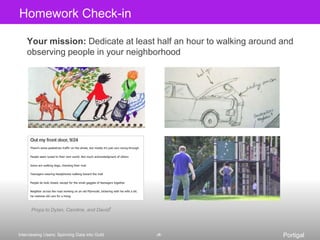
Homework Check-inYour mission: Dedicate at least half an hour to walking around and  observing people in your neighborhoodProps to Dylan, Caroline, and David!
Homework Check-inWho was able to do the assignment?Was this anyone’s first experience doing observational fieldwork?Is there anyone who has not done user or observational research in the field?
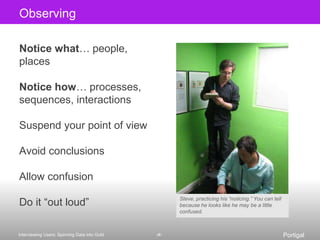
ObservingNotice what… people, placesNotice how… processes, sequences, interactionsSuspend your point of viewAvoid conclusionsAllow confusionDo it “out loud”Steve, practicing his “noticing.” You can tell because he looks like he may be a little confused.
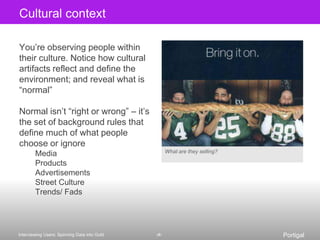
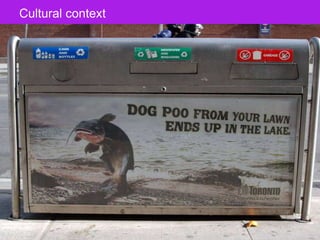
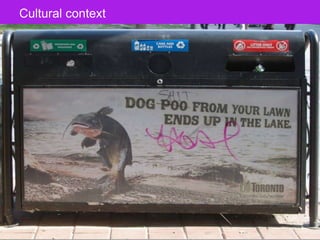
You’re observing people within their culture. Notice how cultural artifacts reflect and define the environment; and reveal what is “normal”Normal isn’t “right or wrong” – it’s the set of background rules that define much of what people choose or ignoreMediaProductsAdvertisementsStreet CultureTrends/FadsCultural contextWhat are they selling?
Cultural context
Cultural context
Cultural context
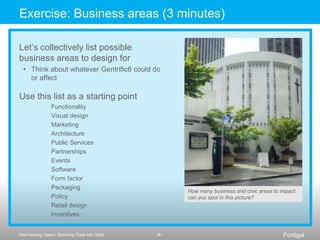
Your mission: Imagine you are working on a project for Gentrific8, looking for ideas to redevelop parts Seattle around downtown and the Central Library.Form groups of 2 – 3. Mix it upWander and observe people, interactions and environmentsDo it out loud!Capture (photos, notes)What, who, where, when?Why, how?This is not a design audit of signage or merchandise displaysExercise: Explore!
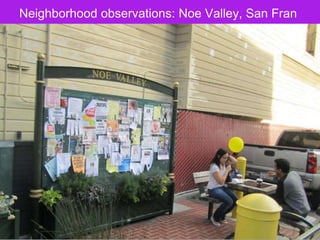
Neighborhood observations: Noe Valley, San Fran
Neighborhood observations: Montara, California
Be back by 2:25!Exercise: Explore!
Synthesis: From data to insights
AnalysisSynthesisIdeationSolutionsStrategiesOpportunitiesDetailed solutionsInsightsSynthesis & ideation process
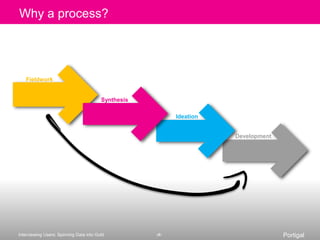
FieldworkSynthesisIdeationDevelopmentWhy a process?
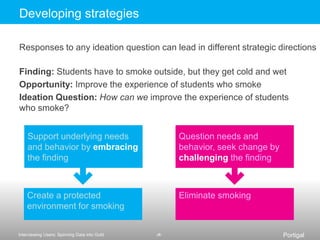
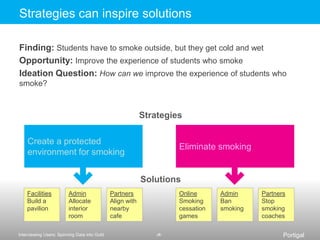
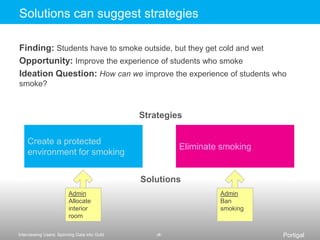
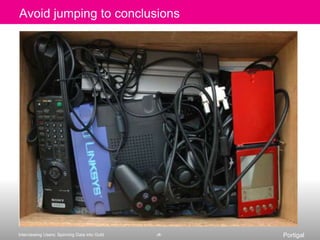
Avoid jumping to conclusions
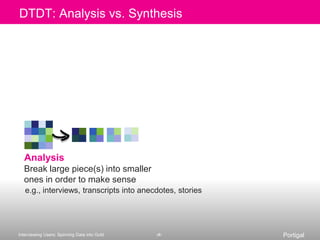
DTDT: Analysis vs. SynthesisAnalysisBreak large piece(s) into smaller ones in order to make sensee.g., interviews, transcripts into anecdotes, stories
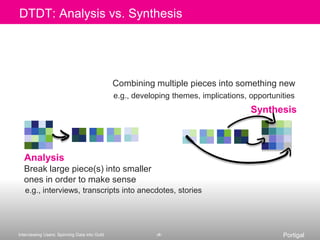
DTDT: Analysis vs. SynthesisCombining multiple pieces into something new e.g., developing themes, implications, opportunitiesSynthesisAnalysisBreak large piece(s) into smaller ones in order to make sensee.g., interviews, transcripts into anecdotes, stories
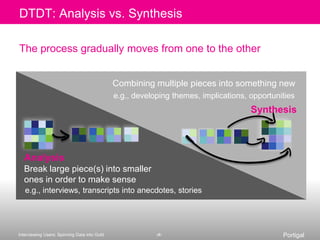
DTDT: Analysis vs. SynthesisThe process gradually moves from one to the otherCombining multiple pieces into something new e.g., developing themes, implications, opportunitiesSynthesisAnalysisBreak large piece(s) into smaller ones in order to make sensee.g., interviews, transcripts into anecdotes, stories
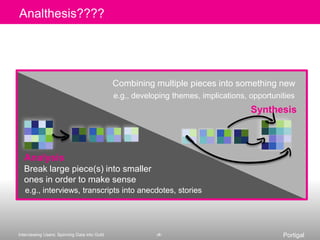
Analthesis????Combining multiple pieces into something new e.g., developing themes, implications, opportunitiesSynthesisAnalysisBreak large piece(s) into smaller ones in order to make sensee.g., interviews, transcripts into anecdotes, stories
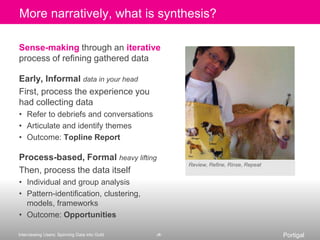
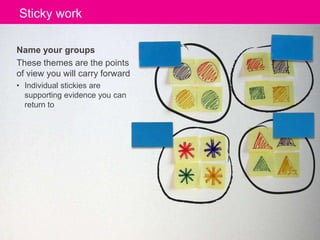
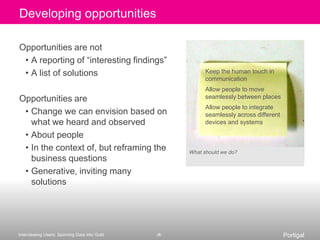
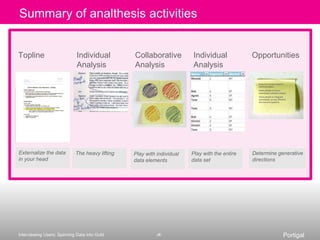
Sense-makingthrough an iterativeprocess of refining gathered dataEarly, Informaldata in your headFirst, process the experience you had collecting dataRefer to debriefs and conversationsArticulate and identify themesOutcome: Topline ReportProcess-based, Formalheavy liftingThen, process the data itselfIndividual and group analysisPattern-identification, clustering, models, frameworksOutcome: OpportunitiesMore narratively, what is synthesis?Review, Refine, Rinse, Repeat
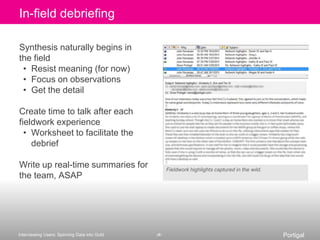
Synthesis naturally begins inthe fieldResist meaning (for now)Focus on observationsGet the detailCreate time to talk after each fieldwork experienceWorksheet to facilitate the debriefWrite up real-timesummaries for the team, ASAPIn-field debriefingFieldwork highlights captured in the wild.
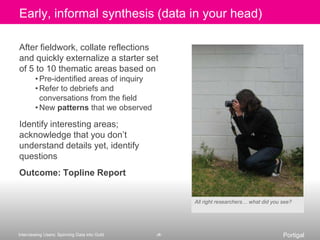
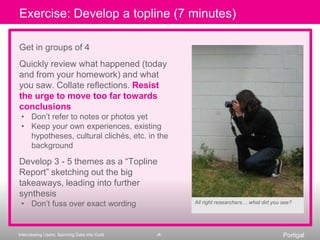
After fieldwork, collate reflections and quickly externalize a starter set of 5 to 10 thematic areas based onPre-identified areas of inquiryRefer to debriefs and conversations from the fieldNew patterns that we observedIdentify interesting areas; acknowledge that you don’t understand details yet, identify questionsOutcome: Topline ReportAll right researchers… what did you see?Early, informal synthesis (data in your head)
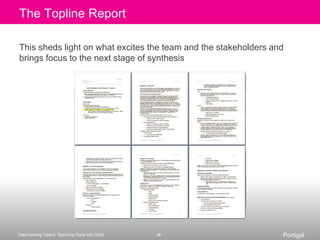
This sheds light on what excites the team and the stakeholders and brings focus to the next stage of synthesisThe Topline Report
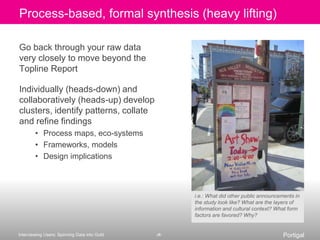
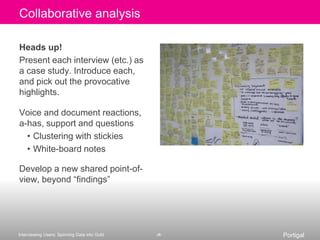
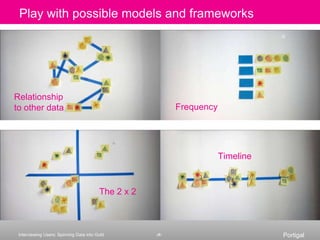
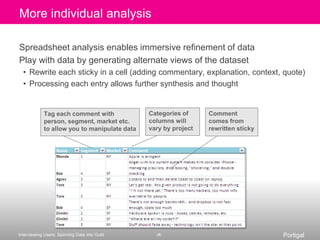
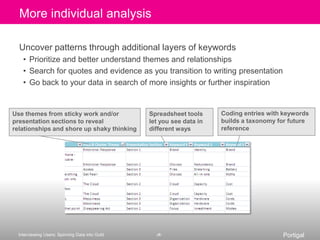
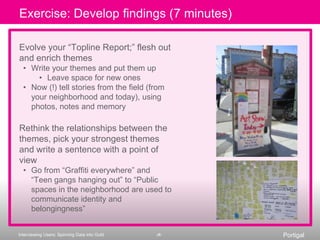
Go back through your raw data very closely to move beyond the Topline Report Individually (heads-down) and collaboratively (heads-up) develop clusters, identify patterns, collate and refine findingsProcess maps, eco-systemsFrameworks, modelsDesign implicationsi.e.: What did other public announcements in the study look like? What are the layers of information and cultural context? What form factors are favored? Why?Process-based, formal synthesis (heavy lifting)
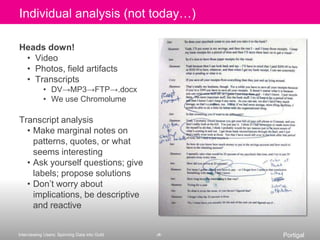
Heads down!Video
Photos, field artifacts
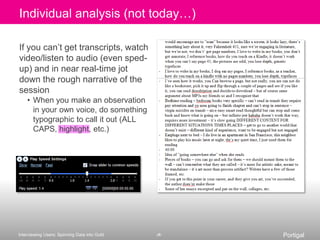
Transcripts
DV->MP3->FTP->.docx

Interviewing Users: Spinning Data Into Gold

  • 2.
  • 3.
  • 4.
    TodayIntroduction 9:00 – 9:10BestPractices Overview 9:10 – 10:00Methods10:00 – 10:30Break10:30 – 10:45Interviewing 10:45 – 11:30Interviewing Exercise11:30 – 12:15Lunch!Observation Exercise 1:15 – 2:00Synthesis 2:00 – 2:45Break2:45 – 3:00Ideation3:00 – 4:00Share4:00 – 4:30Q&A + Wrap-up 4:30 – 5:00
  • 5.
    Take a freshlook at peopleUse existing ideas as hypothesesWhat to make or doRefine & prototypeLaunchIterate & improveUse fieldwork throughout the development cycleExplore new ideas
  • 6.
    Synthesis & ideationprocessFieldworkSynthesisIdeationDevelopment
  • 7.
    Cultural data fromfieldworkCase study: iPod accessories
  • 8.
    Case study: iPodaccessoriesPortigalInterviewing Users: Spinning Data into Gold8
  • 9.
    Research Project –Best Practices Overview
  • 10.
    What do Imean by “research?”EthnographyEthnographic interviews Video ethnographyDepth-interviewsContextual researchHome visitsSite visitsExperience modelingDesign researchUser researchUser-centered designOne-on-onesCamera studies User safaris
  • 11.
    What do Imean by “research?”EthnographyEthnographic interviews Video ethnographyDepth-interviewsContextual researchHome visitsSite visitsExperience modelingDesign researchUser researchUser-centered designOne-on-onesCamera studies User safaris What-ever!
  • 12.
    Beyond our terminology,what are we doing?Examine people in their own contextWhat are they doing?
  • 13.
    What does itmean?Infer (interpret/synthesize/etc.)Find the connections
  • 14.
    The researcher isthe “apparatus”Apply to business or design problemsUse products, services, packaging, design to tell the right story
  • 15.
    More possible typesof solutions than we started out withIdentifying the problem
  • 16.
    The Business QuestionWhatnew products and services can you offer to help partners increase social network stickiness (and thus revenues)?What entertainment activities should you support to tap into a growing middle-class in China?
  • 17.
    The Research QuestionWhatare the motivations, successes, and frustrations for current and prospective users of our partners’ social media sites?How is family life changing in middle-class China? What are the critical digital and analog technologies that are being embraced?
  • 18.
    Pain points: defaultresearch/business question?!While we always uncover so-called pain points, the bigger opportunity may come from understanding why– how did we get here?
  • 19.
    It may notreally be that painfulSatisficing(coined by Herbert Simon in 1956) refers to our acceptance of good-enough solutionsThese can drive engineers and designers crazy…but the real problem isn’t always what it appears to be
  • 21.
    Finding the rightparticipants (aka recruiting)Often an afterthought in project planningBut the right customers are crucial to get the right insights
  • 22.
    This takes timeto plan and to executePointless interviews waste time and challenge the credibility of the workPerson doesn’t really want to talk to you
  • 23.
    They don’t havethe desired relationship with the product/brandEpic FAILS will happen anywayIdentifyWhat type of people you want to find (criteria, screener)
  • 24.
    How you willfind those peopleRecruiting criteria: Relationship to categoryWhat is their relationship to the product/service/brand/activity? Typical user
  • 25.
  • 26.
  • 27.
  • 28.
  • 29.
  • 30.
  • 31.
  • 32.
  • 33.
  • 34.
  • 35.
    Loyal to competitorTriangulatethrough multiple perspectivesBy creating contrast, you reveal key influencing factorsthat you wouldn’t otherwise see
  • 36.
    Recruiting criteria: Typeof userThere may be more – or different – “users”Think about the whole system: the chooser, the influencer, the user, and anyone who is impacted by those rolesChallenge assumptions about who the organization is implicitly/explicitly designing forIs that everyone?
  • 37.
    Do they evenexist?Surface a broader sense – even prior to research – about who is affected by the product and who is being designed forIs your “typical customer” real or aspirational?
  • 38.
  • 39.
  • 40.
  • 41.
    Not in themiddle of a major life-change (unless that’s of interest)DwellingSuburban/urban/rural
  • 42.
    Apartment/living alone/ roommates/singlefamily homeRaceReflect the population
  • 43.
    Reflect the userbaseOccupationFrom outside the industries in questionIncomeCan afford the product in questionDemographic factors are typically secondarywhen defining the sample
  • 44.
    The screenerScreeners arevery formal, linear documentsTypically used by market research recruiting agenciesScreeners havetwo purposes…Does the person fits your criteria?
  • 45.
    Convince them toparticipate…and three main sectionsIntroduction
  • 46.
  • 47.
    Invitation to participateRecruitingcriteria: The softer sideWhatever their relationship with the product/brand/service, you want the person to be engaged, have a point of view, care about the thing, and be articulate
  • 48.
    Creative recruitingOutside ofthe traditional method of working with a recruiting agency, there are other approachesFriends and family/Social networks
  • 49.
    Snowball recruiting (participantsfind more participants)
  • 50.
  • 51.
  • 52.
    Etc.Pros and consCheapbut time-consuming
  • 53.
    Quick but harderto control and manage
  • 54.
    Likely to find“pure” participants but they might be too close to youIncentiveEnthusiastic thank-you rather than compensationRecruiter will advise on best amount, depending on what you are asking for
  • 55.
    For a fee,they will handle sending a check, but I prefer the immediate gratification of an envelope of cash
  • 56.
    Include a thank-younote and even swagIn B2B settings, be creative about who and how to incentYou may negotiate this on a per-site basisThe interview guide (or field guide)A detailed plan of what will happen in the interviewQuestions, timing, activities, tasks, logistics, etc.Transforms questions-we-want-answers-to into questions-we-will-askShare with team to align on issues of concernEspecially with multiple teams in the fieldHelps you previsualizethe flow of the sessionInclude questions as well as other methods that you’ll usePrepping an interview guide means that you may not need to use the interview guideThis is counter-intuitive
  • 57.
    It does comein handy during freeze-up moments – scan it over to see what else you want to coverFour sections to the field guideIntroduction and Participant BackgroundLogistics, timing, objectivesThe Main BodySubsections for each area you plan to explore (e.g., configuration, learning about new features, etc.)Projection/Dream QuestionsBe audacious and ask about predictions for the future or ideal experiencesWrap UpLogistics, ask about anything they want to tell you that you didn’t ask about
  • 58.
  • 59.
  • 60.
  • 61.
    Documentation: photosPlan totake lots of photosThey will reveal things you don’t remember noticingEssential for storytellingMake sure you have permission before you start snapping
  • 62.
    Documentation: audio, video,notesEssential to capture exactly what is saidDifficult (impossible) to maintain eye contact, manage interview, and write down everythingPotentially a role for a second interviewerTaking notes – not as the definitive record – can help you process, notice, think about follow-ups, etc.I strongly recommend privileging being in-the-moment (e.g., eye contact, listening) over trying to capture everything yourselfA release is a good ideaIt clarifies the rights of the interviewee and your organization Consent – participation is voluntary
  • 63.
    Incentive – whatthe participant gets but they are not an employee
  • 64.
    Model release –how images and video will be used
  • 65.
    Non-disclosure – incase you disclose anything in-progressThese are legal documentsWill your legal department help you prepare it?
  • 66.
    Can you influencethem to create consumer-friendly, light-weight versions
  • 67.
    Give participants theirown copy at the outset of the interviewMethods
  • 68.
    Ask people howthey would solve a problemParticipatory designDoesn’t mean we implement the requested solution literally“I wish it had a handle”Many ways to solve the underlying need (“I need to move it around”)Designers work with this data to generate alternativesEngage people in the non-literal through games and role-playingUncover underlying principles and explore areas of opportunity that don’t yet exist
  • 69.
    Show people asolutionConsider the difference betweentestingandexploringAvoid “Do you like this?”Don’t show your best guess at a solution; instead identify provocative examples to surface hidden desires and expectationsMake sure you are asking the right questionsWhat does this solution enable? What problems does it solve?Especially for new products, needed before getting into specifics of your implementationImage from Roberto and Worth1000.com
  • 70.
    Use a rangeof methods
  • 71.
  • 72.
  • 73.
  • 74.
  • 75.
  • 76.
  • 77.
  • 78.
  • 79.
  • 80.
  • 81.
    Methods can bea playgroundWe choose, mash-up, or create methods based on the problem, project constraints, and a desire to experimentBuild up a library of approaches and artifactsPortigalInterviewing Users: Spinning Data into Gold49
  • 82.
  • 83.
  • 84.
    Principles inform tacticsIdon't skate to where the puck is, I skate to where the puck is going to be – Wayne Gretzky
  • 85.
    Fieldwork principlesCheck yourworldview at the doorEmbrace how other people see the worldBuild rapportListen
  • 86.
    Check your worldviewat the doorBefore you start doing interviews, do a team-wide brain dump of all your assumptions and expectationsGet closely-held beliefs out of your heads
  • 87.
    You needn’t goback to verify your assumptions; goal is to make assumptions explicitMake the interview about the interviewAs a transitional ritual, agree explicitly that you are going to Learn about Paul rather than Identify NextGen Opportunities for RoadmapEmbrace how other people see the worldGo to where your users are rather than asking them to come to youNip distractions in the budEat!
  • 88.
    Leave plenty oftime so you aren’t rushed when you arrive
  • 89.
    Find a bathroombeforehandBe ready to ask questions you (think you) know the answers toThink about: “When are your taxes due?”
  • 90.
    What do youknow? What are you afraid they’ll say? What might you learn?Build rapportBe selective about social gracesJust enough small talk
  • 91.
    Accept what you’reofferedBe selective about talking about yourselfReveal personal information to give them permission to share
  • 92.
    Otherwise, think “OMG!Me too!” without saying itWork towards the tipping pointFrom question-answer to question-story
  • 93.
    You won’t knowwhen it’s coming; be patientAcknowledge the interview as something…unusual“What I want to learn today…” over friendly chatListenYou can demonstrate that you are listening by asking questions!Follow-up, follow-up, follow-up
  • 94.
  • 95.
    “I want togo back to something else you said…”Signal your transitions: “Great, now I’d like to move onto a totally different topic”This level of listening is not how we normally talk to each otherRemember that you are interviewing, not having a conversation
  • 96.
    This is reallyhardListening body languageYes!Not so much.
  • 97.
    Silence defeats awkwardnessAfteryou ask your question, be silentDon’t put the answers in the questionAfter they’ve answered you, be silent
  • 98.
    Use natural languageTalklike your subject talks!
  • 99.
    Don’t make questionspass/fail (1/2)Client: So the concept of transferring, burning, and syncing, can you talk a little about those three concepts? So transfer, burn, and sync. Just do you understand the difference?Interviewee: Transfer, burn, sync. Burn is when I’m actually putting it onto some kind of disc.Okay…Transferring is I guess when I transfer the files from one place to the other.Mm-hmm…Whether it’s to a device or to a different drive or whatever or into the program I guess. And syncing, well, I know the phone always comes up and says it’s syncing, when it’s syncing up to the files or syncing up to the computer or stuff like that. That’s the only time I think I’ve ever really heard that.(cont’d)
  • 100.
    Don’t make questionspass/fail (2/2)Client: So the only other question I have left in this area is: Would you expect to manually decide what music goes on your devices or would you rather that the machine does it for you?Interviewee: Decide what I want on my…?Let’s say your library is here on this machine, and you have a device, would you want it to put as much as it could put on from the library from the device when it’s connected to your computer?If I could hold it… if the device itself could actually hold all the files, I would love that, if it automatically…Just knew.Just knew that it wasn’t on there, the same thing when…what do you call it - when I have to go into the program and actually have it… downl…uhh, now I’m confused in what I should call it.No, no, don’t worry about it!
  • 101.
    Don’t presume theyaccept your world viewClient: So, really interesting the sort of things that you as old Derek used to value, such as efficiency of time, and some of those things have now influenced the new Derek.Derek: Right.Steve: Maybe that sort of begs a larger question…We’ve offered you this idea of old versus new you, but how do you think about this transition?Derek:Yeah, I don’t really see it.
  • 102.
    If you wantto fix something, wait until the endFrustrating to watch users struggle with your productRemember, you are there to learn from themYou will lose the interview if you start taking their questionsWhen it’s time to go, show or tell them only what will help them
  • 103.
    Find your personalstyleThe Myers-Briggs Type Indicator
  • 104.
    Questions to gathercontext and collect details
  • 105.
    Questions to probeon what’s unsaid
  • 106.
    Questions to probeon what’s unsaid
  • 107.
  • 108.
    Why so manytypes of questions?Real interviews aren’t as simple as asking a question, getting an answer, and then moving onto the next question in your list. You are unlikely to get to the actual answer without asking a few different questions a few different ways. You need a range of tools and techniques. And you need to feel when you haven’t got to the real answer yet so you can keep going.
  • 109.
    Prepare for explodingquestionsWell, my cousin never tells me when she has an updated bank balance so I figured I would handle it myself. That’s why I signed up for the PayPal service, I think it’s them but maybe not.Coping techniquesWait until these issues come up organically, without you having to askMake notes on your field guide about what you want to loop back to so you don’t forgetTriage based on what’s most pressing for your topicTriage based on what makes the best follow-up, to demonstrate listeningWhy does this matter?Let’s find out what service this is?!Okay.I decided I had to spend the money I had from last month in order to save month’s money and this service was going to help me do that. Even if it’s not the same password that my cousin would be usingI don’t understand her financial model…Why does she expect that it would be the same?
  • 110.
    Exploding questions canlead to a flow state
  • 111.
    Managing others inthe fieldWe lead a thirty-minute training session for everyone who will join us in the fieldField teams are ideally 2, at most 3Ensure one person leads the interview and clarify the role of the “second interviewer”They should ask questions, but stay in the “chapter” that we’re inDuring our debriefs, we offer feedback and coaching about the process, if possible
  • 112.
    Getting better atinterviewingPractice with hallway or other serendipitous micro-interviewsWrite surveys and participant screeners to practice crafting questions out of the moment How do you get to Carnegie Hall?Practice, man, practice!
  • 113.
    Participant screeners asasking practiceA good way to practice both framing a question and the empathic exercise of thinking through the respondent’s user experience with that question
  • 114.
    Write and takesurveysDevelop your own critical eye (and interviewer’s voice) by looking for bad examples and identifying just what’s wrong with them
  • 115.
    We learn frommistakes and mishapsCollect and share war stories with other interviewersTHANX 4 NOTHING KITTEH
  • 116.
    Interviewing ExerciseGet ingroups of 3You are in a startup looking for opportunities in…Music – purpose/role/interests, technology, devices Food, groceries, meals, nutritionNews – media, information, sources, purposeReview sample interview guidesImagine the flow
  • 117.
    Background, depth, reflectionThreerounds of interviews, 10-12 minutes each One interviewer, one interviewee, one observer
  • 118.
    Each person playseach role once
  • 119.
    Stay in theexercise!Group debrief
  • 120.
    Giveaway #1Everyone getsa license for TechSmith’s screen capture tool SnagitExpect it by email in a couple of weeksEveryone gets 3 tests from UserTesting.comUse code uxworkshop; expires in 2 weeksDraw2 licenses for TechSmith’sCamtasia (Mac/PC)1 license for Techsmith’sMorae (PC)
  • 121.
  • 122.
    (The rest of)todayIntroduction 9:00 – 9:10Best Practices Overview 9:10 – 10:00Methods10:00 – 10:30Break10:30 – 10:45Interviewing 10:45 – 11:30Interviewing Exercise11:30 – 12:15Lunch!Observation Exercise 1:15 – 2:00Synthesis 2:00 – 2:45Break2:45 – 3:00Ideation3:00 – 4:00Share4:00 – 4:30Q&A + Wrap-up 4:30 – 5:00
  • 123.
  • 124.
    Homework Check-inYour mission:Dedicate at least half an hour to walking around and observing people in your neighborhoodProps to Dylan, Caroline, and David!
  • 125.
    Homework Check-inWho wasable to do the assignment?Was this anyone’s first experience doing observational fieldwork?Is there anyone who has not done user or observational research in the field?
  • 126.
    ObservingNotice what… people,placesNotice how… processes, sequences, interactionsSuspend your point of viewAvoid conclusionsAllow confusionDo it “out loud”Steve, practicing his “noticing.” You can tell because he looks like he may be a little confused.
  • 127.
    You’re observing peoplewithin their culture. Notice how cultural artifacts reflect and define the environment; and reveal what is “normal”Normal isn’t “right or wrong” – it’s the set of background rules that define much of what people choose or ignoreMediaProductsAdvertisementsStreet CultureTrends/FadsCultural contextWhat are they selling?
  • 128.
  • 129.
  • 130.
  • 131.
    Your mission: Imagineyou are working on a project for Gentrific8, looking for ideas to redevelop parts Seattle around downtown and the Central Library.Form groups of 2 – 3. Mix it upWander and observe people, interactions and environmentsDo it out loud!Capture (photos, notes)What, who, where, when?Why, how?This is not a design audit of signage or merchandise displaysExercise: Explore!
  • 132.
  • 133.
  • 134.
  • 135.
    Be back by2:25!Exercise: Explore!
  • 136.
  • 137.
  • 138.
  • 139.
    Avoid jumping toconclusions
  • 140.
    DTDT: Analysis vs.SynthesisAnalysisBreak large piece(s) into smaller ones in order to make sensee.g., interviews, transcripts into anecdotes, stories
  • 141.
    DTDT: Analysis vs.SynthesisCombining multiple pieces into something new e.g., developing themes, implications, opportunitiesSynthesisAnalysisBreak large piece(s) into smaller ones in order to make sensee.g., interviews, transcripts into anecdotes, stories
  • 142.
    DTDT: Analysis vs.SynthesisThe process gradually moves from one to the otherCombining multiple pieces into something new e.g., developing themes, implications, opportunitiesSynthesisAnalysisBreak large piece(s) into smaller ones in order to make sensee.g., interviews, transcripts into anecdotes, stories
  • 143.
    Analthesis????Combining multiple piecesinto something new e.g., developing themes, implications, opportunitiesSynthesisAnalysisBreak large piece(s) into smaller ones in order to make sensee.g., interviews, transcripts into anecdotes, stories
  • 144.
    Sense-makingthrough an iterativeprocessof refining gathered dataEarly, Informaldata in your headFirst, process the experience you had collecting dataRefer to debriefs and conversationsArticulate and identify themesOutcome: Topline ReportProcess-based, Formalheavy liftingThen, process the data itselfIndividual and group analysisPattern-identification, clustering, models, frameworksOutcome: OpportunitiesMore narratively, what is synthesis?Review, Refine, Rinse, Repeat
  • 145.
    Synthesis naturally beginsinthe fieldResist meaning (for now)Focus on observationsGet the detailCreate time to talk after each fieldwork experienceWorksheet to facilitate the debriefWrite up real-timesummaries for the team, ASAPIn-field debriefingFieldwork highlights captured in the wild.
  • 146.
    After fieldwork, collatereflections and quickly externalize a starter set of 5 to 10 thematic areas based onPre-identified areas of inquiryRefer to debriefs and conversations from the fieldNew patterns that we observedIdentify interesting areas; acknowledge that you don’t understand details yet, identify questionsOutcome: Topline ReportAll right researchers… what did you see?Early, informal synthesis (data in your head)
  • 147.
    This sheds lighton what excites the team and the stakeholders and brings focus to the next stage of synthesisThe Topline Report
  • 148.
    Go back throughyour raw data very closely to move beyond the Topline Report Individually (heads-down) and collaboratively (heads-up) develop clusters, identify patterns, collate and refine findingsProcess maps, eco-systemsFrameworks, modelsDesign implicationsi.e.: What did other public announcements in the study look like? What are the layers of information and cultural context? What form factors are favored? Why?Process-based, formal synthesis (heavy lifting)
  • 149.
  • 150.
  • 151.
  • 152.

Editor's Notes

  • #6 At each point in the development process, the questions you have are different, and so the ways you utilize research are different. But get out there and talk to customers regularly!
  • #17 This came up for us in a project where we looked at infant formula – the bottle technology was all about systems, innovation, solving problems. The formula was just power-in-a-can and needed to get out of that frame on their business.
  • #21 You might pick users that aren’t typical but can speak to the issues you want to address
  • #24 Accumulate a set of recruiting methods that you can deploy based on the constraints of your project
  • #86 Try multiple viewpoints (i.e., customer vs. worker)Give it timeAllow yourself to be confused for a whileIdentify what you want to know more aboutWhy?
  • #115 Avoid: Grouping by solutions to problems.