WIRELESS CHARGING OF MOBILE PHONES USING 
MICROWAVES 
For 
MASTER OF TECHNOLOGY 
IN 
ELECTRONICS AND COMMUNICATION ENGINEERING
ABSTRACT 
In the modern era mobile phones are basic need of every person as these are the fastest 
and the easiest medium of communication. The charging of mobile phone batteries has always 
been a problem. Battery lifetime is dependent of the manufacturer Company and also price of 
phone. Many people complain that their phone’s battery don’t have long lifetime and they have 
to charge it several times in a day. To overcome this problem wireless charging of mobile 
phones using micro-waves is a very important and useful technique. With this technique you 
can use your mobile phone without thinking about the battery stand by. This technique works 
on microwaves. Microwave is sent with the message by the transmitter using antenna at the 
frequency of 2.45GHz. There are some additions in mobile phone to apply this technique as a 
sensor, a rectenna circuit and a filer. 
Keywords: Electromagnetic spectrum, Microwave region, Microwave generator, 
Rectenna, Sensor circuitry
1. INTRODUCTION 
There are two main concepts which are the base of this technique, first one is Electromagnetic 
Spectrum and second is Microwave Region. 
1.1 Electromagnetic Spectrum When white light is shone through a prism it is separated out 
into all the colors of the rainbow this is called the visible spectrum. According to some 
physicians light consists of tiny particles called photons. Photons are bundle of energy. The 
speed of light is about 300,000,000 meters per second as light hit something that means it 
may be bounce off, go right through or get absorbed. If they bounce off something and then 
go into your eye you will see the thing they have bounced off. 
1.2 Microwave Region Microwaves are the Radio wave which has the wave length range of 1 
mm to 1 meter and the frequency is 300MHz to 300GHz. Each and every object on the earth 
absorb different amount of microwave energy. In a microwave oven, the radio waves 
generated are tuned to frequencies that can be. Microwaves are good for transmitting 
information from one place to another because microwave energy can Microwave waves 
are used in the communication industry and in the kitchen as a way to cook foods. 
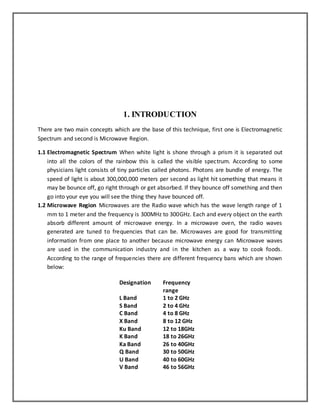
According to the range of frequencies there are different frequency bans which are shown 
below: 
Designation Frequency 
range 
L Band 1 to 2 GHz 
S Band 2 to 4 GHz 
C Band 4 to 8 GHz 
X Band 8 to 12 GHz 
Ku Band 12 to 18GHz 
K Band 18 to 26GHz 
Ka Band 26 to 40GHz 
Q Band 30 to 50GHz 
U Band 40 to 60GHz 
V Band 46 to 56GHz
W Band 56 to100GHz 
The frequency selection is another important aspect in GHz ISM band for our purpose. As Indus - 
trial, Scientific and Medical (ISM) some bands are reserve for some specific purpose. So we 
can’t use it. Here S band 2.45 GHz is freely available band which we can use for experiment. 
2. WIRELESS POWER TRASMISSION 
Nikolas Tesla first transmitted electricity without wire and known as the father of 
wireless electricity transmission. Wireless power transmission works on the principle of 
Magnetic induction. As we put one coil carrying current through it, it creates a magnetic field 
near to it. And if we put other coil over there than it is induce by the first coil and it carry 
current from it. This is the principle of magnetic induction. 
2.1 Wireless Power Transmission System 
William C. Brown gives the principle that how the power can be transfer through space 
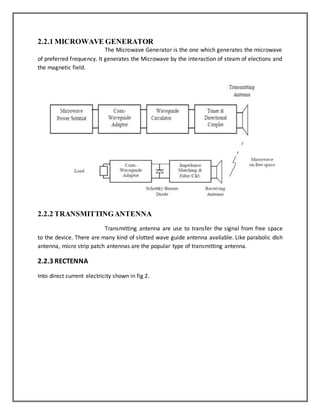
using microwaves. This principle of wireless power is shown by the block diagram below: The 
block diagram shown above in fig 1 consists of two parts One is transmitting part and the other 
is the Receiving part. At the transmitting end there is one microwave power source which is 
actually producing microwaves. 
2.2 Components of wireless power transmission system 
There are three important components of this system are Microwave generator, 
Transmitting antenna, and the receiving antenna.
2.2.1 MICROWAVE GENERATOR 
The Microwave Generator is the one which generates the microwave 
of preferred frequency. It generates the Microwave by the interaction of steam of elections and 
the magnetic field. 
2.2.2 TRANSMITTING ANTENNA 
Transmitting antenna are use to transfer the signal from free space 
to the device. There are many kind of slotted wave guide antenna available. Like parabolic dish 
antenna, micro strip patch antennas are the popular type of transmitting antenna. 
2.2.3 RECTENNA 
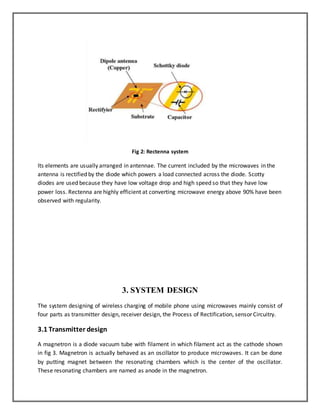
Into direct current electricity shown in fig 2.
Fig 2: Rectenna system 
Its elements are usually arranged in antennae. The current included by the microwaves in the 
antenna is rectified by the diode which powers a load connected across the diode. Scotty 
diodes are used because they have low voltage drop and high speed so that they have low 
power loss. Rectenna are highly efficient at converting microwave energy above 90% have been 
observed with regularity. 
3. SYSTEM DESIGN 
The system designing of wireless charging of mobile phone using microwaves mainly consist of 
four parts as transmitter design, receiver design, the Process of Rectification, sensor Circuitry. 
3.1 Transmitter design 
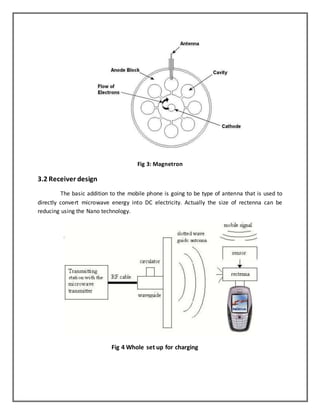
A magnetron is a diode vacuum tube with filament in which filament act as the cathode shown 
in fig 3. Magnetron is actually behaved as an oscillator to produce microwaves. It can be done 
by putting magnet between the resonating chambers which is the center of the oscillator. 
These resonating chambers are named as anode in the magnetron.
Fig 3: Magnetron 
3.2 Receiver design 
The basic addition to the mobile phone is going to be type of antenna that is used to 
directly convert microwave energy into DC electricity. Actually the size of rectenna can be 
reducing using the Nano technology. 
Fig 4 Whole set up for charging
We also have to add a sensor at receiver side. As we know we are going to charge the phone 
while a person is talking. So here sensor is used to detect wither the phone is using microwaves 
or not. 
3.3 The Process of Rectification 
Microwave can easily travel through the media but it also loses some energy. So our key 
objective is to rectify the circuit and to rectify the waves at the low cost. And also we have to 
make the detection more sensitive. As we know that bridge rectification is more efficient than 
the single diode we use this for the better performance. We use the Schottky diode to get the 
batter impedance. The Schottky barrier diode is an ideal diode, such as for a 1 ampere limited 
current PN interface. Another advantage of the Schottky barrier diode is a very low noise index 
that is very important for a communication receiver; its working scope may reach20GHz. 
3.4 Sensor Circuitry:- 
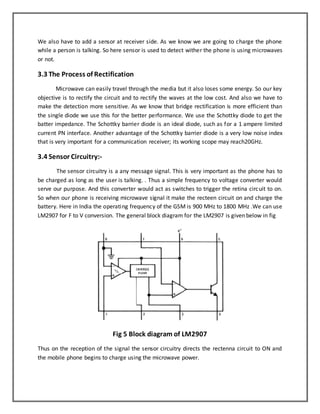
The sensor circuitry is a any message signal. This is very important as the phone has to 
be charged as long as the user is talking. . Thus a simple frequency to voltage converter would 
serve our purpose. And this converter would act as switches to trigger the retina circuit to on. 
So when our phone is receiving microwave signal it make the recteen circuit on and charge the 
battery. Here in India the operating frequency of the GSM is 900 MHz to 1800 MHz .We can use 
LM2907 for F to V conversion. The general block diagram for the LM2907 is given below in fig 
Fig 5 Block diagram of LM2907 
Thus on the reception of the signal the sensor circuitry directs the rectenna circuit to ON and 
the mobile phone begins to charge using the microwave power.
4. REFERENCES 
[1] Theoretical and experimental development of 10 and 35 GHz rectennas IEEE Transactions on 
Microwave Theory and Techniques, vol. 40, no. 6, June 1992. Research supported by NASA and 
U.S. Army. 
[2] Pozar, David M. (1993). Microwave Engineering Addison–Wesley Publishing Company 
[3]http://en.wikipedia.org/wiki/Rectenna 
[4]http://computer.yourdictionary.com/magnetron 
[5]http://www.engineeringexpert.net/EngineeringExpert-Witness-Blog/?tag=magnetron-tube 
[6] Wireless Power Transmission – A Next Generation Power Transmission System, 
International-al Journal of Computer Applications Volume 1 – No. 13 
[7] Lander, Cyril W. (1993). "2. Rectifying Circuits". Power electronics (3rd ed. ed.). London: 
McGraw-Hill. .

Seminar Report on Wireless Mobile Charger

  • 1.
    WIRELESS CHARGING OFMOBILE PHONES USING MICROWAVES For MASTER OF TECHNOLOGY IN ELECTRONICS AND COMMUNICATION ENGINEERING
  • 2.
    ABSTRACT In themodern era mobile phones are basic need of every person as these are the fastest and the easiest medium of communication. The charging of mobile phone batteries has always been a problem. Battery lifetime is dependent of the manufacturer Company and also price of phone. Many people complain that their phone’s battery don’t have long lifetime and they have to charge it several times in a day. To overcome this problem wireless charging of mobile phones using micro-waves is a very important and useful technique. With this technique you can use your mobile phone without thinking about the battery stand by. This technique works on microwaves. Microwave is sent with the message by the transmitter using antenna at the frequency of 2.45GHz. There are some additions in mobile phone to apply this technique as a sensor, a rectenna circuit and a filer. Keywords: Electromagnetic spectrum, Microwave region, Microwave generator, Rectenna, Sensor circuitry
  • 3.
    1. INTRODUCTION Thereare two main concepts which are the base of this technique, first one is Electromagnetic Spectrum and second is Microwave Region. 1.1 Electromagnetic Spectrum When white light is shone through a prism it is separated out into all the colors of the rainbow this is called the visible spectrum. According to some physicians light consists of tiny particles called photons. Photons are bundle of energy. The speed of light is about 300,000,000 meters per second as light hit something that means it may be bounce off, go right through or get absorbed. If they bounce off something and then go into your eye you will see the thing they have bounced off. 1.2 Microwave Region Microwaves are the Radio wave which has the wave length range of 1 mm to 1 meter and the frequency is 300MHz to 300GHz. Each and every object on the earth absorb different amount of microwave energy. In a microwave oven, the radio waves generated are tuned to frequencies that can be. Microwaves are good for transmitting information from one place to another because microwave energy can Microwave waves are used in the communication industry and in the kitchen as a way to cook foods. According to the range of frequencies there are different frequency bans which are shown below: Designation Frequency range L Band 1 to 2 GHz S Band 2 to 4 GHz C Band 4 to 8 GHz X Band 8 to 12 GHz Ku Band 12 to 18GHz K Band 18 to 26GHz Ka Band 26 to 40GHz Q Band 30 to 50GHz U Band 40 to 60GHz V Band 46 to 56GHz
  • 4.
    W Band 56to100GHz The frequency selection is another important aspect in GHz ISM band for our purpose. As Indus - trial, Scientific and Medical (ISM) some bands are reserve for some specific purpose. So we can’t use it. Here S band 2.45 GHz is freely available band which we can use for experiment. 2. WIRELESS POWER TRASMISSION Nikolas Tesla first transmitted electricity without wire and known as the father of wireless electricity transmission. Wireless power transmission works on the principle of Magnetic induction. As we put one coil carrying current through it, it creates a magnetic field near to it. And if we put other coil over there than it is induce by the first coil and it carry current from it. This is the principle of magnetic induction. 2.1 Wireless Power Transmission System William C. Brown gives the principle that how the power can be transfer through space using microwaves. This principle of wireless power is shown by the block diagram below: The block diagram shown above in fig 1 consists of two parts One is transmitting part and the other is the Receiving part. At the transmitting end there is one microwave power source which is actually producing microwaves. 2.2 Components of wireless power transmission system There are three important components of this system are Microwave generator, Transmitting antenna, and the receiving antenna.
  • 5.
    2.2.1 MICROWAVE GENERATOR The Microwave Generator is the one which generates the microwave of preferred frequency. It generates the Microwave by the interaction of steam of elections and the magnetic field. 2.2.2 TRANSMITTING ANTENNA Transmitting antenna are use to transfer the signal from free space to the device. There are many kind of slotted wave guide antenna available. Like parabolic dish antenna, micro strip patch antennas are the popular type of transmitting antenna. 2.2.3 RECTENNA Into direct current electricity shown in fig 2.
  • 6.
    Fig 2: Rectennasystem Its elements are usually arranged in antennae. The current included by the microwaves in the antenna is rectified by the diode which powers a load connected across the diode. Scotty diodes are used because they have low voltage drop and high speed so that they have low power loss. Rectenna are highly efficient at converting microwave energy above 90% have been observed with regularity. 3. SYSTEM DESIGN The system designing of wireless charging of mobile phone using microwaves mainly consist of four parts as transmitter design, receiver design, the Process of Rectification, sensor Circuitry. 3.1 Transmitter design A magnetron is a diode vacuum tube with filament in which filament act as the cathode shown in fig 3. Magnetron is actually behaved as an oscillator to produce microwaves. It can be done by putting magnet between the resonating chambers which is the center of the oscillator. These resonating chambers are named as anode in the magnetron.
  • 7.
    Fig 3: Magnetron 3.2 Receiver design The basic addition to the mobile phone is going to be type of antenna that is used to directly convert microwave energy into DC electricity. Actually the size of rectenna can be reducing using the Nano technology. Fig 4 Whole set up for charging
  • 8.
    We also haveto add a sensor at receiver side. As we know we are going to charge the phone while a person is talking. So here sensor is used to detect wither the phone is using microwaves or not. 3.3 The Process of Rectification Microwave can easily travel through the media but it also loses some energy. So our key objective is to rectify the circuit and to rectify the waves at the low cost. And also we have to make the detection more sensitive. As we know that bridge rectification is more efficient than the single diode we use this for the better performance. We use the Schottky diode to get the batter impedance. The Schottky barrier diode is an ideal diode, such as for a 1 ampere limited current PN interface. Another advantage of the Schottky barrier diode is a very low noise index that is very important for a communication receiver; its working scope may reach20GHz. 3.4 Sensor Circuitry:- The sensor circuitry is a any message signal. This is very important as the phone has to be charged as long as the user is talking. . Thus a simple frequency to voltage converter would serve our purpose. And this converter would act as switches to trigger the retina circuit to on. So when our phone is receiving microwave signal it make the recteen circuit on and charge the battery. Here in India the operating frequency of the GSM is 900 MHz to 1800 MHz .We can use LM2907 for F to V conversion. The general block diagram for the LM2907 is given below in fig Fig 5 Block diagram of LM2907 Thus on the reception of the signal the sensor circuitry directs the rectenna circuit to ON and the mobile phone begins to charge using the microwave power.
  • 9.
    4. REFERENCES [1]Theoretical and experimental development of 10 and 35 GHz rectennas IEEE Transactions on Microwave Theory and Techniques, vol. 40, no. 6, June 1992. Research supported by NASA and U.S. Army. [2] Pozar, David M. (1993). Microwave Engineering Addison–Wesley Publishing Company [3]http://en.wikipedia.org/wiki/Rectenna [4]http://computer.yourdictionary.com/magnetron [5]http://www.engineeringexpert.net/EngineeringExpert-Witness-Blog/?tag=magnetron-tube [6] Wireless Power Transmission – A Next Generation Power Transmission System, International-al Journal of Computer Applications Volume 1 – No. 13 [7] Lander, Cyril W. (1993). "2. Rectifying Circuits". Power electronics (3rd ed. ed.). London: McGraw-Hill. .