We Present You..
INDIAN INSTITUTE OF INFORMATION TECHNOLOGY
DESIGN AND MANAGEMENT
BY : MECOTRIX TEAM
Customer Needs..
o COLLECTING UNDER WATER SAMPLES.
o DETECTING POISONOUS GASES.
o WATER POLLUTION CONTROL IN PORTS.
o BLOCKAGE DETECTION IN DRAINAGES.
o DOMESTIC SPYING (in a FISH TANK).
o CATCHING FISHES.
o LEAKAGE DETECTION IN DEEP SEA OIL PIPES.
o RECOVERING LOST OBJECTS.
o CLEANING TANK.
o MONITORING POPULATION AND GROWTH OF EXTINCT
AND ENDANGERED UNDER WATER SPECIES.
Vision..
Developing A Design For Diving Into An Unknown Water-body To Explore
It’s Human Accessibility With An Application Specific (Chemical Or
Electronic) Processing Unit .Developing A Prototype For 10 Feet Water
Tank And Thereby Proposing A Design For Real-time Applications
(“Trench”).
ADAPTIVE DESIGN….
This Is An Adaptive Design Wherein We Have
Incorporated The Main Features Of The
Following Existing Designs.
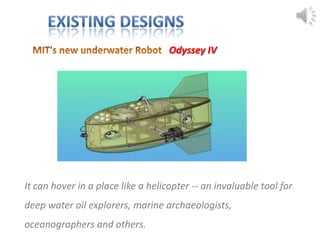
It can hover in a place like a helicopter -- an invaluable tool for
deep water oil explorers, marine archaeologists,
oceanographers and others.
Odyssey IV
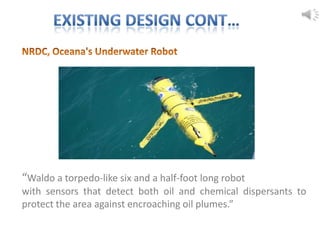
“Waldo a torpedo-like six and a half-foot long robot
with sensors that detect both oil and chemical dispersants to
protect the area against encroaching oil plumes.”
Design Methodology..
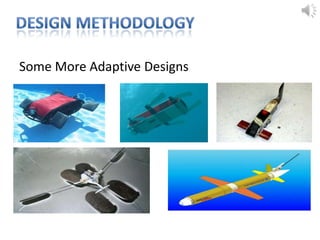
Some More Adaptive Designs
Product Features..
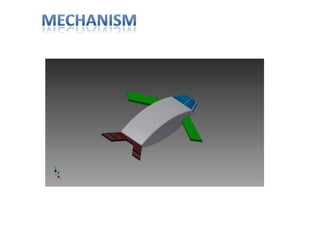
• Aquabot Imbibes Bio-mimicry With Robotics.
• It Has A Stream-lined Shape, With Fin-like Structures For Changing
Direction.
• It Can Dive Upto A Depth Of 10 Feet (With Provision For Greater Depths In
The Proposed Design).
• Aquabot Can View Upto 3 Feet Using High Resolution Digital Camera.
• It Has A Provision For Including An Application SPECIFIC PROCESSING
Unit(for E.G. Chemical Processing Unit For Poisonous Gas Detection).
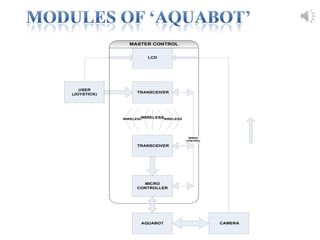
Functional Flow Block Diagram..
LCD
TRANSCEIVER
TRANSCEIVER
MICRO
CONTROLLER
AQUABOT
USER
(JOYSTICK)
WIRELESSWIRELESSWIRELESS
MASTER CONTROL
CAMERA
WIRED
CONTROL
Structure Mechanism..
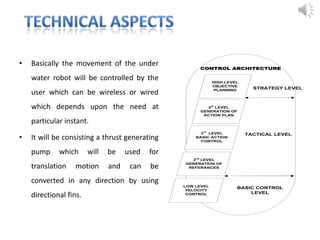
• Basically the movement of the under
water robot will be controlled by the
user which can be wireless or wired
which depends upon the need at
particular instant.
• It will be consisting a thrust generating
pump which will be used for
translation motion and can be
converted in any direction by using
directional fins.
HIGH LEVEL
OBJECTIVE
PLANNING
4th
LEVEL
GENERATION OF
ACTION PLAN
3rd
LEVEL
BASIC ACTION
CONTROL
2nd
LEVEL
GENERATION OF
REFERANCES
LOW LEVEL
VELOCITY
CONTROL
TACTICAL LEVEL
BASIC CONTROL
LEVEL
STRATEGY LEVEL
CONTROL ARCHITECTURE
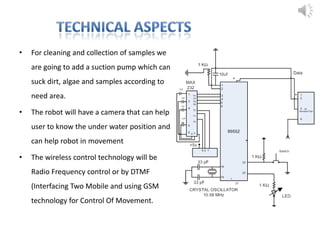
• For cleaning and collection of samples we
are going to add a suction pump which can
suck dirt, algae and samples according to
need area.
• The robot will have a camera that can help
user to know the under water position and
can help robot in movement
• The wireless control technology will be
Radio Frequency control or by DTMF
(Interfacing Two Mobile and using GSM
technology for Control Of Movement.
 A Fish Like Structure, Powered By Microcontroller.
 High Resolution Camera With 2*pi Radian Visibility
(One Degree Of Freedom).
 Wireless Motion Control And Image Transmission.
FAULT ANALYSIS IN SOPHISTICATED
UNDERWATER SYSTEMS(LIKE GEOTHERMAL
POWER PROJECTS)
CAPTURING HIGH RESOLUTION IMAGES OF
DEEP WATER FLORA AND FAUNA
Temperature Measurement.
Diving into unknown water body (“Trench”)
explore human accessibility
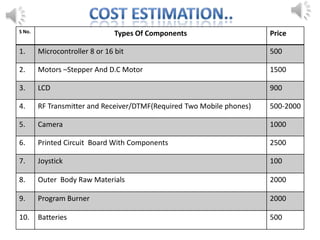
Cost And Component Estimation
S No. Types Of Components Price
1. Microcontroller 8 or 16 bit 500
2. Motors –Stepper And D.C Motor 1500
3. LCD 900
4. RF Transmitter and Receiver/DTMF(Required Two Mobile phones) 500-2000
5. Camera 1000
6. Printed Circuit Board With Components 2500
7. Joystick 100
8. Outer Body Raw Materials 2000
9. Program Burner 2000
10. Batteries 500
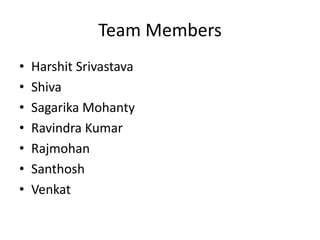
Team Members
• Harshit Srivastava
• Shiva
• Sagarika Mohanty
• Ravindra Kumar
• Rajmohan
• Santhosh
• Venkat

Underwater robot

  • 1.
  • 2.
    INDIAN INSTITUTE OFINFORMATION TECHNOLOGY DESIGN AND MANAGEMENT BY : MECOTRIX TEAM
  • 3.
  • 4.
    o COLLECTING UNDERWATER SAMPLES. o DETECTING POISONOUS GASES. o WATER POLLUTION CONTROL IN PORTS. o BLOCKAGE DETECTION IN DRAINAGES. o DOMESTIC SPYING (in a FISH TANK). o CATCHING FISHES.
  • 5.
    o LEAKAGE DETECTIONIN DEEP SEA OIL PIPES. o RECOVERING LOST OBJECTS. o CLEANING TANK. o MONITORING POPULATION AND GROWTH OF EXTINCT AND ENDANGERED UNDER WATER SPECIES.
  • 6.
  • 7.
    Developing A DesignFor Diving Into An Unknown Water-body To Explore It’s Human Accessibility With An Application Specific (Chemical Or Electronic) Processing Unit .Developing A Prototype For 10 Feet Water Tank And Thereby Proposing A Design For Real-time Applications (“Trench”).
  • 8.
    ADAPTIVE DESIGN…. This IsAn Adaptive Design Wherein We Have Incorporated The Main Features Of The Following Existing Designs.
  • 9.
    It can hoverin a place like a helicopter -- an invaluable tool for deep water oil explorers, marine archaeologists, oceanographers and others. Odyssey IV
  • 10.
    “Waldo a torpedo-likesix and a half-foot long robot with sensors that detect both oil and chemical dispersants to protect the area against encroaching oil plumes.”
  • 11.
  • 12.
  • 13.
  • 14.
    • Aquabot ImbibesBio-mimicry With Robotics. • It Has A Stream-lined Shape, With Fin-like Structures For Changing Direction. • It Can Dive Upto A Depth Of 10 Feet (With Provision For Greater Depths In The Proposed Design). • Aquabot Can View Upto 3 Feet Using High Resolution Digital Camera. • It Has A Provision For Including An Application SPECIFIC PROCESSING Unit(for E.G. Chemical Processing Unit For Poisonous Gas Detection).
  • 15.
  • 16.
  • 17.
  • 20.
    • Basically themovement of the under water robot will be controlled by the user which can be wireless or wired which depends upon the need at particular instant. • It will be consisting a thrust generating pump which will be used for translation motion and can be converted in any direction by using directional fins. HIGH LEVEL OBJECTIVE PLANNING 4th LEVEL GENERATION OF ACTION PLAN 3rd LEVEL BASIC ACTION CONTROL 2nd LEVEL GENERATION OF REFERANCES LOW LEVEL VELOCITY CONTROL TACTICAL LEVEL BASIC CONTROL LEVEL STRATEGY LEVEL CONTROL ARCHITECTURE
  • 21.
    • For cleaningand collection of samples we are going to add a suction pump which can suck dirt, algae and samples according to need area. • The robot will have a camera that can help user to know the under water position and can help robot in movement • The wireless control technology will be Radio Frequency control or by DTMF (Interfacing Two Mobile and using GSM technology for Control Of Movement.
  • 23.
     A FishLike Structure, Powered By Microcontroller.  High Resolution Camera With 2*pi Radian Visibility (One Degree Of Freedom).  Wireless Motion Control And Image Transmission.
  • 25.
    FAULT ANALYSIS INSOPHISTICATED UNDERWATER SYSTEMS(LIKE GEOTHERMAL POWER PROJECTS) CAPTURING HIGH RESOLUTION IMAGES OF DEEP WATER FLORA AND FAUNA Temperature Measurement. Diving into unknown water body (“Trench”) explore human accessibility
  • 26.
  • 27.
    S No. TypesOf Components Price 1. Microcontroller 8 or 16 bit 500 2. Motors –Stepper And D.C Motor 1500 3. LCD 900 4. RF Transmitter and Receiver/DTMF(Required Two Mobile phones) 500-2000 5. Camera 1000 6. Printed Circuit Board With Components 2500 7. Joystick 100 8. Outer Body Raw Materials 2000 9. Program Burner 2000 10. Batteries 500
  • 29.
    Team Members • HarshitSrivastava • Shiva • Sagarika Mohanty • Ravindra Kumar • Rajmohan • Santhosh • Venkat