Module Learning Outcomes
ThePSSDR module is designed to provide you with an opportunity to
demonstrate your achievement of the following module learning
outcomes:
1) Demonstrate effective communication skills, applicable to
academic and professional contexts.
2) Work effectively with others in the delivery of a group project
3) Identify own academic and professional development needs and
create an action plan.
4) Demonstrate an awareness of the global context of higher
education and employment.
4.
At the endof the lesson learners will be able to:
1) Define the concept of a Team;
2) Differentiate between a “Group” and a “Team”;
3) Explain how Teams are formed;
4) Outline the purpose of a Team;
5) Identify advantages and disadvantages of Teams;
6) List characteristics of a good Team; and those of a poor
Team;
7) Distinguish between “Teamwork” and “Group-work”;
8) Engage in a ‘Teams and Teamwork’ Activity.
Learning Objectives
5.
Definition of aTeam
A Team is defined as a group of people who perform
interdependent tasks to work toward accomplishing a common
mission or specific objective (ASQ, n.d.).
The Business Dictionary defines a “Team” as a group of people
with a full set of complementary skills required to complete a task,
job, or project.
6.
Definition of aTeam
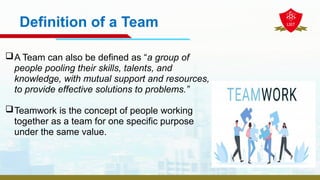
A Team can also be defined as “a group of
people pooling their skills, talents, and
knowledge, with mutual support and resources,
to provide effective solutions to problems.”
Teamwork is the concept of people working
together as a team for one specific purpose
under the same value.
7.
Definition of aTeam (cont.)
Team members:
operate with a high degree of interdependence,
share authority and responsibility for self-management,
are accountable for the collective performance, and
work toward a common goal and shared rewards(s).
A team becomes more than just a collection of people when a
strong sense of mutual commitment creates synergy,
Thus, generating performance greater than the sum of the
performance of its individual members.
8.
What is Group?
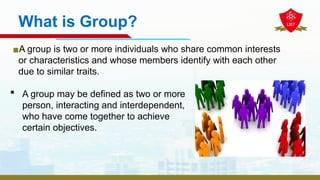
▪Agroup is two or more individuals who share common interests
or characteristics and whose members identify with each other
due to similar traits.
A group may be defined as two or more
person, interacting and interdependent,
who have come together to achieve
certain objectives.
9.
Classification of Groups
▪FormalGroup
A formal group is an officially recognized and structured group within
an organization, created to achieve specific objectives. It follows a
defined hierarchy, roles, and responsibilities as outlined by the
organization. Examples include departments, project teams, and
committees within a company.
▪Informal Group:
An informal group forms naturally based on social interactions,
shared interests, or personal relationships rather than organizational
directives. These groups exist to fulfill emotional, social, or support
needs rather than work-related goals.
10.
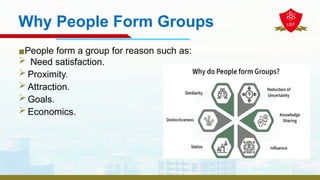
Why People FormGroups
▪People form a group for reason such as:
Need satisfaction.
Proximity.
Attraction.
Goals.
Economics.
11.
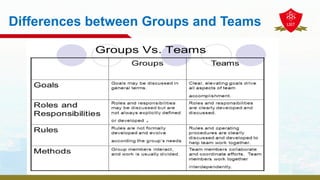
Difference between aTeam and a Group
Teams and groups differ in five keyways, namely:
task orientation,
purpose,
interdependence,
formal structure, and
familiarity among members.
A group is a collection of individuals who coordinate their
individual efforts. On the other hand, at team is a group of people
who share a common team purpose and challenging goals.
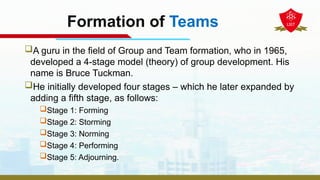
Formation of Teams
Aguru in the field of Group and Team formation, who in 1965,
developed a 4-stage model (theory) of group development. His
name is Bruce Tuckman.
He initially developed four stages – which he later expanded by
adding a fifth stage, as follows:
Stage 1: Forming
Stage 2: Storming
Stage 3: Norming
Stage 4: Performing
Stage 5: Adjourning.
14.
Group / TeamFormation
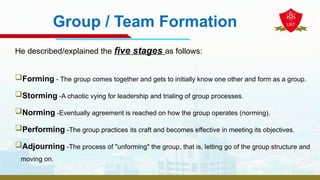
He described/explained the five stages as follows:
Forming - The group comes together and gets to initially know one other and form as a group.
Storming -A chaotic vying for leadership and trialing of group processes.
Norming -Eventually agreement is reached on how the group operates (norming).
Performing -The group practices its craft and becomes effective in meeting its objectives.
Adjourning -The process of "unforming" the group, that is, letting go of the group structure and
moving on.
15.
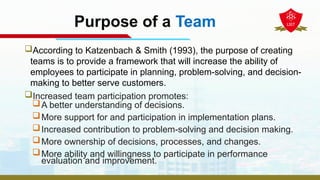
Purpose of aTeam
According to Katzenbach & Smith (1993), the purpose of creating
teams is to provide a framework that will increase the ability of
employees to participate in planning, problem-solving, and decision-
making to better serve customers.
Increased team participation promotes:
A better understanding of decisions.
More support for and participation in implementation plans.
Increased contribution to problem-solving and decision making.
More ownership of decisions, processes, and changes.
More ability and willingness to participate in performance
evaluation and improvement.
16.
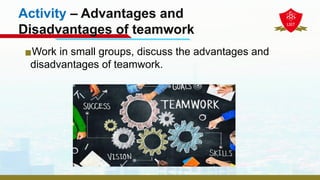
Activity – Advantagesand
Disadvantages of teamwork
▪Work in small groups, discuss the advantages and
disadvantages of teamwork.
Some disadvantages ofTeams
Some of the disadvantages of Teams are as follows:
The bonus is shared by all irrespective of the comparative
efficiency of the workers in the team;
Team members can compete among one another;
Successful team members can be tempted to resist change;
Team members can allow conflict to creep in;
Key team members can decide to move on, leaving the team in
a limp or disarray.
19.
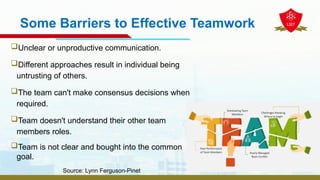
Some Barriers toEffective Teamwork
Unclear or unproductive communication.
Different approaches result in individual being
untrusting of others.
The team can't make consensus decisions when
required.
Team doesn't understand their other team
members roles.
Team is not clear and bought into the common
goal.
Source: Lynn Ferguson-Pinet
20.
Characteristics of effectiveTeams
There is high commitment to the achievements of targets and
organizational goals.
High output and productivity.
The group is good at generation new ideas.
Individual targets are achieved.
There are few stoppages and interruptions to work.
The group is sufficiently motivated to be able to carry on working in
the absence of its leader.
21.
Characteristics of ineffective-poorTeams
There is low commitment to targets;
Low output and productivity;
The group does not generate any good ideas;
Individual targets are not achieved;
Much time is wasted due to disruption of work;
The group needs its leader there to get work done.
22.
ACTIVITY- How tobecome an effective
team member?
Activity: 5-minute paper, students work individually, a
timer should be set up.
Within 5 minutes, write down key characteristics of an
effective team member using keywords or short phrases.
23.
How to becomean effective team
member?
▪Effectively play your part: having the courage and make the effort
to contribute.
▪Listen to others: Your member deserve respectful attention.
▪Know how to create supportive group atmosphere: Be aware of
other's feelings, be constructive in your comments.
▪Clarify the team's purpose: Keep the team focused on what was
set up to achieve.
▪Check progress: Think about what could be done to improve
issues.
▪Giving/receiving criticism in a constructive way.
Cottrell (2013)
24.
ASQ (n.d.). Whatis a Team? Types of Teams & Processes | ASQ.
[online] asq.org. Available at:
https://asq.org/quality-resources/teams#:~:text=A%20team%20is%20
defined%20as
.
Cottrell, S. (2013). The Study Skills Handbook. 4th ed. Basingstoke:
Palgrave Macmillan.
Katzenbach, J. R., & Smith, D. K. (1993). The wisdom of teams:
Creating the high-performance organization. Harvard Business
References:


![ASQ (n.d.). What is a Team? Types of Teams & Processes | ASQ.
[online] asq.org. Available at:
https://asq.org/quality-resources/teams#:~:text=A%20team%20is%20
defined%20as
.
Cottrell, S. (2013). The Study Skills Handbook. 4th ed. Basingstoke:
Palgrave Macmillan.
Katzenbach, J. R., & Smith, D. K. (1993). The wisdom of teams:
Creating the high-performance organization. Harvard Business
References:](https://image.slidesharecdn.com/week4-lecture-teamworkandgroupwork-250327075055-0bf335de/85/Week-4-Lecture-Team-work-and-Group-work-pptx-24-320.jpg)
![Useful links
1) http://ezinearticles.com/?Teams---The-Five-Common-Barriers-to-Effective-Teamwork&id=1053194
2) https://www.wcupa.edu/coral/tuckmanStagesGroupDelvelopment.aspx#:~:text=These%20stages%20are%2
0commonly%20known,more%20collaborative%20or%20shared%20leadership
.
3) https://www.forbes.com/sites/forbeshumanresourcescouncil/2020/09/16/14-characteristics-of-high-
performing-teams/
4) https://www.thebalancecareers.com/what-is-the-purpose-of-a-team-1919227#:~:text=The%20purpose%20of
%20creating%20teams,A%20better%20understanding%20of%20decisions [Accessed 08 10 20]
5) https://www.bizjournals.com/bizjournals/how-to/growth-strategies/2013/06/the-difference-between-a-group-
and-a.html#:~:text=A%20group%20is%20a%20collection,goals%20and%20to%20each
%20other.&text=Without%20purpose%20and%20goals%20you%20cannot%20build%20a%20team.](https://image.slidesharecdn.com/week4-lecture-teamworkandgroupwork-250327075055-0bf335de/85/Week-4-Lecture-Team-work-and-Group-work-pptx-25-320.jpg)