DYNAMICS OF A TEAM
VS. WORKING GROUP
1
Defining the purpose of your team (or working group)
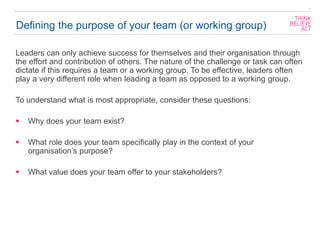
Leaders can only achieve success for themselves and their organisation through
the effort and contribution of others. The nature of the challenge or task can often
dictate if this requires a team or a working group. To be effective, leaders often
play a very different role when leading a team as opposed to a working group.
To understand what is most appropriate, consider these questions:
▪ Why does your team exist?
▪ What role does your team specifically play in the context of your
organisation’s purpose?
▪ What value does your team offer to your stakeholders?
2
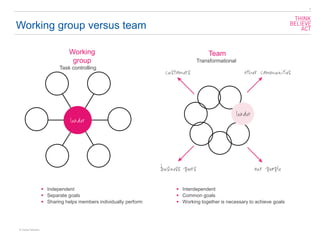
Working group versus team
3
© Telos Partners
Working
group
Task controlling
Team
Transformational
▪ Independent
▪ Separate goals
▪ Sharing helps members individually perform
▪ Interdependent
▪ Common goals
▪ Working together is necessary to achieve goals
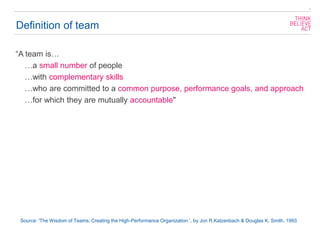
Definition of team
“A team is…
…a small number of people
…with complementary skills
…who are committed to a common purpose, performance goals, and approach
…for which they are mutually accountable"
4
Source: 'The Wisdom of Teams, Creating the High-Performance Organization‘, by Jon R.Katzenbach & Douglas K. Smith. 1993
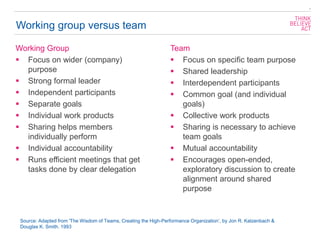
Working group versus team
Working Group
▪ Focus on wider (company)
purpose
▪ Strong formal leader
▪ Independent participants
▪ Separate goals
▪ Individual work products
▪ Sharing helps members
individually perform
▪ Individual accountability
▪ Runs efficient meetings that get
tasks done by clear delegation
5
Team
▪ Focus on specific team purpose
▪ Shared leadership
▪ Interdependent participants
▪ Common goal (and individual
goals)
▪ Collective work products
▪ Sharing is necessary to achieve
team goals
▪ Mutual accountability
▪ Encourages open-ended,
exploratory discussion to create
alignment around shared
purpose
Source: Adapted from 'The Wisdom of Teams, Creating the High-Performance Organization’, by Jon R. Katzenbach &
Douglas K. Smith. 1993
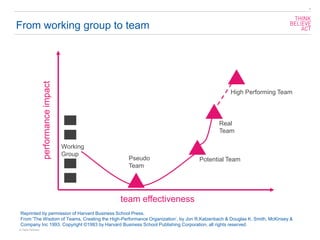
From working group to team
6
© Telos Partners
High Performing Team
performanceimpact
team effectiveness
Working
Group
Potential Team
Real
Team
Reprinted by permission of Harvard Business School Press.
From 'The Wisdom of Teams, Creating the High-Performance Organization’, by Jon R.Katzenbach & Douglas K. Smith, McKinsey &
Company Inc 1993. Copyright ©1993 by Harvard Business School Publishing Corporation, all rights reserved.
Pseudo
Team
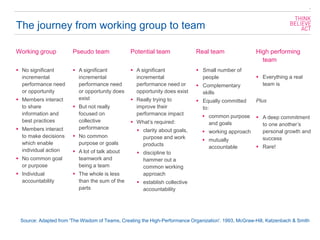
The journey from working group to team
7
Working group
▪ No significant
incremental
performance need
or opportunity
▪ Members interact
to share
information and
best practices
▪ Members interact
to make decisions
which enable
individual action
▪ No common goal
or purpose
▪ Individual
accountability
Pseudo team
▪ A significant
incremental
performance need
or opportunity does
exist
▪ But not really
focused on
collective
performance
▪ No common
purpose or goals
▪ A lot of talk about
teamwork and
being a team
▪ The whole is less
than the sum of the
parts
Potential team
▪ A significant
incremental
performance need or
opportunity does exist
▪ Really trying to
improve their
performance impact
▪ What’s required:
▪ clarity about goals,
purpose and work
products
▪ discipline to
hammer out a
common working
approach
▪ establish collective
accountability
Real team
▪ Small number of
people
▪ Complementary
skills
▪ Equally committed
to:
▪ common purpose
and goals
▪ working approach
▪ mutually
accountable
High performing
team
▪ Everything a real
team is
Plus
▪ A deep commitment
to one another’s
personal growth and
success
▪ Rare!
Source: Adapted from 'The Wisdom of Teams, Creating the High-Performance Organization'. 1993, McGraw-Hill, Katzenbach & Smith
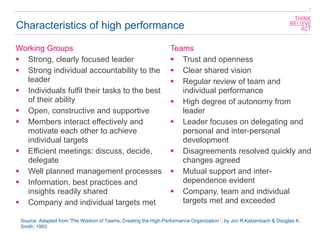
Characteristics of high performance
8
Working Groups
▪ Strong, clearly focused leader
▪ Strong individual accountability to the
leader
▪ Individuals fulfil their tasks to the best
of their ability
▪ Open, constructive and supportive
▪ Members interact effectively and
motivate each other to achieve
individual targets
▪ Efficient meetings: discuss, decide,
delegate
▪ Well planned management processes
▪ Information, best practices and
insights readily shared
▪ Company and individual targets met
Teams
▪ Trust and openness
▪ Clear shared vision
▪ Regular review of team and
individual performance
▪ High degree of autonomy from
leader
▪ Leader focuses on delegating and
personal and inter-personal
development
▪ Disagreements resolved quickly and
changes agreed
▪ Mutual support and inter-
dependence evident
▪ Company, team and individual
targets met and exceeded
Source: Adapted from 'The Wisdom of Teams, Creating the High-Performance Organization‘, by Jon R.Katzenbach & Douglas K.
Smith. 1993
THANK YOU
Admiral House
St. Leonard’s Road
Windsor
SL4 3BL
www.telospartners.com

Dynamics of a team vs. working group

  • 1.
    DYNAMICS OF ATEAM VS. WORKING GROUP 1
  • 2.
    Defining the purposeof your team (or working group) Leaders can only achieve success for themselves and their organisation through the effort and contribution of others. The nature of the challenge or task can often dictate if this requires a team or a working group. To be effective, leaders often play a very different role when leading a team as opposed to a working group. To understand what is most appropriate, consider these questions: ▪ Why does your team exist? ▪ What role does your team specifically play in the context of your organisation’s purpose? ▪ What value does your team offer to your stakeholders? 2
  • 3.
    Working group versusteam 3 © Telos Partners Working group Task controlling Team Transformational ▪ Independent ▪ Separate goals ▪ Sharing helps members individually perform ▪ Interdependent ▪ Common goals ▪ Working together is necessary to achieve goals
  • 4.
    Definition of team “Ateam is… …a small number of people …with complementary skills …who are committed to a common purpose, performance goals, and approach …for which they are mutually accountable" 4 Source: 'The Wisdom of Teams, Creating the High-Performance Organization‘, by Jon R.Katzenbach & Douglas K. Smith. 1993
  • 5.
    Working group versusteam Working Group ▪ Focus on wider (company) purpose ▪ Strong formal leader ▪ Independent participants ▪ Separate goals ▪ Individual work products ▪ Sharing helps members individually perform ▪ Individual accountability ▪ Runs efficient meetings that get tasks done by clear delegation 5 Team ▪ Focus on specific team purpose ▪ Shared leadership ▪ Interdependent participants ▪ Common goal (and individual goals) ▪ Collective work products ▪ Sharing is necessary to achieve team goals ▪ Mutual accountability ▪ Encourages open-ended, exploratory discussion to create alignment around shared purpose Source: Adapted from 'The Wisdom of Teams, Creating the High-Performance Organization’, by Jon R. Katzenbach & Douglas K. Smith. 1993
  • 6.
    From working groupto team 6 © Telos Partners High Performing Team performanceimpact team effectiveness Working Group Potential Team Real Team Reprinted by permission of Harvard Business School Press. From 'The Wisdom of Teams, Creating the High-Performance Organization’, by Jon R.Katzenbach & Douglas K. Smith, McKinsey & Company Inc 1993. Copyright ©1993 by Harvard Business School Publishing Corporation, all rights reserved. Pseudo Team
  • 7.
    The journey fromworking group to team 7 Working group ▪ No significant incremental performance need or opportunity ▪ Members interact to share information and best practices ▪ Members interact to make decisions which enable individual action ▪ No common goal or purpose ▪ Individual accountability Pseudo team ▪ A significant incremental performance need or opportunity does exist ▪ But not really focused on collective performance ▪ No common purpose or goals ▪ A lot of talk about teamwork and being a team ▪ The whole is less than the sum of the parts Potential team ▪ A significant incremental performance need or opportunity does exist ▪ Really trying to improve their performance impact ▪ What’s required: ▪ clarity about goals, purpose and work products ▪ discipline to hammer out a common working approach ▪ establish collective accountability Real team ▪ Small number of people ▪ Complementary skills ▪ Equally committed to: ▪ common purpose and goals ▪ working approach ▪ mutually accountable High performing team ▪ Everything a real team is Plus ▪ A deep commitment to one another’s personal growth and success ▪ Rare! Source: Adapted from 'The Wisdom of Teams, Creating the High-Performance Organization'. 1993, McGraw-Hill, Katzenbach & Smith
  • 8.
    Characteristics of highperformance 8 Working Groups ▪ Strong, clearly focused leader ▪ Strong individual accountability to the leader ▪ Individuals fulfil their tasks to the best of their ability ▪ Open, constructive and supportive ▪ Members interact effectively and motivate each other to achieve individual targets ▪ Efficient meetings: discuss, decide, delegate ▪ Well planned management processes ▪ Information, best practices and insights readily shared ▪ Company and individual targets met Teams ▪ Trust and openness ▪ Clear shared vision ▪ Regular review of team and individual performance ▪ High degree of autonomy from leader ▪ Leader focuses on delegating and personal and inter-personal development ▪ Disagreements resolved quickly and changes agreed ▪ Mutual support and inter- dependence evident ▪ Company, team and individual targets met and exceeded Source: Adapted from 'The Wisdom of Teams, Creating the High-Performance Organization‘, by Jon R.Katzenbach & Douglas K. Smith. 1993
  • 9.
    THANK YOU Admiral House St.Leonard’s Road Windsor SL4 3BL www.telospartners.com