Teaching Students with
Visual Impairments
For administrators, teachers, paras and related service
providers who will be working with a student with blindness
Elizabeth Wallace, M.Ed., CTSVI, TDB
What do you use your
vision for?
Driving
Writing
Playing sports
Eating
How much of your vision
do you use?
According to VisionAware, it is estimated
that the sense of sight provides approximately
80% of all the information we receive about
the world.
(visionaware.org, 2021)
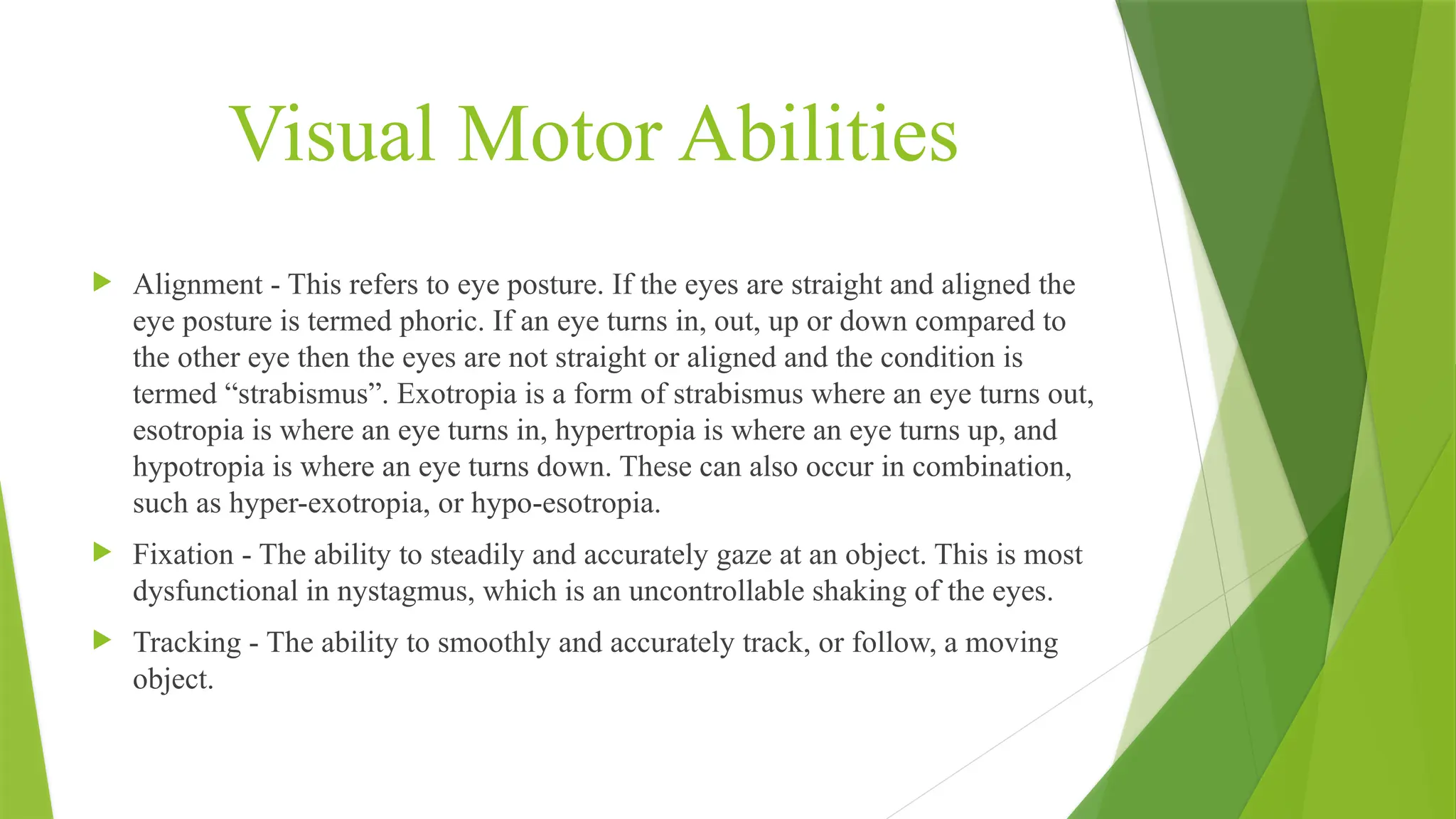
How does your vision work?
https://www.youtube.com/watch?v=RE1MvRmWg7I
Visual Acuity and Visual Field
 The process of Vision can be broken down into 3 parts. Visual acuity/visual field, visual
motor abilities, and visual perception.
 Visual Acuity - This refers to clarity of sight. It is commonly measured using the
Snellen chart and noted, for example, as 20/20, 20/50, 20/200 etc. Visual acuity
becomes blurred in various refractive conditions, for example, myopia (nearsighted),
hyperopia (far-sighted), astigmatism (mixed), and presbyopia (age related loss of
focusing).
 Visual Field - This is the complete central and peripheral range of vision. Various
neurologic conditions, such as a stroke, cause characteristic losses of the visual field,
for example hemianopsia. The person may, or may not, concurrently demonstrate a
visual neglect which is a perceptual loss of vision and visual motor integration to the
side of the visual field loss.
Visual Motor Abilities
 Alignment - This refers to eye posture. If the eyes are straight and aligned the
eye posture is termed phoric. If an eye turns in, out, up or down compared to
the other eye then the eyes are not straight or aligned and the condition is
termed “strabismus”. Exotropia is a form of strabismus where an eye turns out,
esotropia is where an eye turns in, hypertropia is where an eye turns up, and
hypotropia is where an eye turns down. These can also occur in combination,
such as hyper-exotropia, or hypo-esotropia.
 Fixation - The ability to steadily and accurately gaze at an object. This is most
dysfunctional in nystagmus, which is an uncontrollable shaking of the eyes.
 Tracking - The ability to smoothly and accurately track, or follow, a moving
object.
Visual Motor Abilities (cont.)
 Saccades - The ability to quickly and accurately look, or scan,
from one object to another.
 Accommodation - The ability to accurately focus on an object of
regard, sustain focusing of the eyes, and to change focus when
looking from different distances.
 Convergence - The ability to accurately aim the eyes at an object
of regard and to track an object as it moves towards and away
from the person.
 Binocularity - The integration of accommodation and
convergence.
 Stereopsis - Depth perception.
Visual Perception
 Visual-Motor Integration - Eye-hand, eye-foot, and eye-body
coordination.
 Visual-Auditory Integration - The ability to relate and associate
what is seen and heard.
 Visual Memory - The ability to remember and recall information
that is seen.
 Visual Closure - The ability "to fill in the gaps," or complete a
visual picture based on seeing only some of the parts.
 Spatial Relationships - The ability to know "where I am" in
relation to objects and space around me and to know where
objects are in relation to one another.
 Figure-Ground Discrimination - The ability to discern form and
object from background.
Vision Simulation
https://www.youtube.com/watch?v=KVQvqmze5SU
Our Youngest Consumers:
3 and under
 ECI – Early Childhood Intervention. Serves children 3
and under. ECI contracts with school districts for VI,
ToDHH and O&M services.
 When a child qualifies with ECI with a visual
impairment, the parent MUST FIRST register the child
at the child’s home campus before a teacher of the
visually impaired can begin services.
Strategies for Low Vision Students
 Preferential seating is often necessary for a student with
low vision.
 Let the student select a seat where he/she sees best
 Seat a student as close to the board as practical
 Reduce glare from windows and lights, as much as
possible
 Seat the student with his/her back to windows
 We ask that you do not laminate unless you use the non-
glare laminate
Strategies for Low Vision Students (cont.)
 Clear contrast between the print and the background will help the
student be more successful.
 Black print on white paper is usually best. If other modifications
are required they should be contained in the list of modifications
handed out at the beginning of the semester and in the Special
Education Folder
 Contrast, print style, and spacing of letters can be more important
than print size.
 Low vision students may require more time to complete
assignment.
 Low vision students are usually slow readers because of the
visual impairment.
Strategies for Low Vision
Students (cont.)
 Standardized tests requiring separate answer sheets may be especially difficult for a
visually impaired student to use. Check the modifications page to see what procedure to
use.
 Word games, puzzles and graphs may be inappropriate for a low vision student due to
clutter. Check with the VI teacher if you are unsure.
 Give the student the grade he/she earns. Donating a grade to a student hinders, not
helps, the student's learning.
 The rules of discipline should be the same for a low vision student, as for any other,
unless the IEP states otherwise.
 So much of our communication is non-verbal. Often a student with low vision is unable
to recognize the expression on someone's face or figure out what has happened in a
situation that is nonverbal. It is helpful if the teacher privately explains the situation to
the student with low vision.
Strategies for Students who
are Blind
 It's okay to say "look" and "see." Even people with sight use their other senses in the
context of looking at something. People with visual impairments might look at things in
a different way, but "seeing" is in the perception (rather than the eye) of the beholder.
 Audiovisual presentations and demonstrations are made accessible to students with a
severe visual impairment by providing verbal explanations. It is best to read what is
being written on the board and/or describe what is pictured in the presentation. Allow
the student time to handle tactually adapted materials.
 Saying "over there" and pointing to something the student cannot see are not useful
with a student with blindness. Instead, spatial directions must be given from the
STUDENT'S perspective. Remember that the student's left and right are opposite yours
when you are facing the student.
Strategies for Students who
are Blind (cont.)
 Seat or encourage the student with blindness to come to the front of the
classroom or presentation area in order to be certain that s/he hears all
instruction/explanation correctly.
 Braille materials take an exceptionally long time to order and/or prepare.
Textbook committee members should be aware of this and be certain that
braille textbooks can be ordered in January for the following fall so that they
can be transcribed in time. Extra time may be required for math and technical
books, as braille mathematical notation requires a unique certification that
many literary braille transcribers do not possess. Electronic textbooks have
been very beneficial in this area.
Strategies for Students who are
Blind (cont.)
 Classroom handouts, especially those with pictures or diagrams, also require a great
deal of time to transcribe into braille, tactile formats and/or verbal descriptions.
Classroom teachers are asked to provide materials to be transcribed at least two weeks
ahead of time, preferably by email, as some text can be transcribed using computer
translation software. The link to provide our braillist with assignments is attached
below: THIS IS WHERE THE BRAILLIST WOULD ADD HER INFO!
 Expect the student with visual impairments to complete the same assignments as the
rest of the class. Due to alternative media, assignments may take a student with visual
impairments longer to complete. Due to time constraints it may occasionally be
necessary to reduce the number of examples to be completed for classwork or
homework (such as in math problems), as long as the student is able to demonstrate that
s/he understands the concepts and/or skills exhibited within each example.
Strategies for Students
who are Blind (cont.)
 Independence is of primary importance! Be patient. Observe the student, silently
encouraging independent problem-solving skills. Wait until the student asks for help
and provide minimal assistance only as needed to build self-confidence and
independence.
 Avoid leaving doors and drawers ajar or chairs out from under tables and desks. Either
keep furniture consistent or inform and/or involve the student in rearranging. For peers,
please keep all backpacks under the desk keeping the aisles clear.
 Address all students by name so that the student with visual impairments can learn to
associate names with voices of classmates. Address the student with visual impairments
by name as well, so he or she knows when he or she is being spoken to.
Strategies for Students
who are Blind (cont.)
 Encourage the student's use of proper posture, eye contact as
much as possible and proper social etiquette. Discourage any
inappropriate mannerisms to maximize the student's physical and
emotional health, as well as the student's social, educational and
career potential.
 Always treat the student with visual impairments equally as other
students. This includes discipline and special privileges as well as
involvement in extracurricular and leadership opportunities.
Strategies for Students who
are Blind (cont.)
 Please do not presume that just because the student cannot see
and is using other learning mediums, that the student is incapable.
Try to allow the student to use their strengths in the areas they
need to learn.
 All students, including those with visual impairments, learn at
individual rates.
 As much as possible, treat the student the same as any other
student and your example will encourage classmates to do the
same.
Orientation & Mobility
Movement is important to everyone. Orientation asks the questions:
“Where am I?”
“Where am I going?” and
“How do I get there?”
Mobility involves getting there safely and efficiently. Orientation and mobility (O&M) begins with understanding where
your body ends and the environment begins. It also includes knowing about relationships between different objects in the
environment. O&M is a related service and may be provided for all students with visual impairments from birth through age
21 years, regardless of additional disabilities.
Orientation and mobility is a lifelong learning process. It is important because:
! Movement teaches the brain. O&M teaches movement with a purpose. Purposeful movement may not occur naturally
for children with a visual impairment. An early O&M evaluation is critical.
! Safety creates confidence and a sense of well-being. O&M skills enable children to safely explore and interact with
the world, including the home, school, and community. When infants and children, including those with low vision or
multiple disabilities, understand their environments, they feel safe. Early O&M evaluation is critical.
Orientation & Mobility
Experience brings context to life.
O&M instruction provides real experiences essential to all children. The skills learned reduce isolation by giving students
a “common ground” for interacting with family, friends, and future employers. O&M instruction brings the general
curriculum to life. Early and periodic O&M evaluations are critical.
O&M evaluations include activities such as assessing a student while:
 He/she moves around a different campus to evaluate his/her abilities in unfamiliar environments.
 He/she uses his/her limited night vision in the neighborhood or community.
 He/she uses his/her wheelchair to travel to the cafeteria, restroom, or other spot on the campus or community.
O&M instruction includes activities such as teaching:
 parents of an infant how to deal with their fear that their baby will hurt himself as he moves around the room.
 a young child how to move towards her mother’s voice.
 a young child with limited movement that those movements creates changes in his life.
 a student how to find her way in the community by using a telescope or monocular to read street signs.
 an adolescent how to use a cane and the bus system to independently meet his friends.
 a girl in a wheelchair how to find the bathroom independently.
 a student to travel independently to a future job in the community.
Low Vision Accommodation Video
https://www.youtube.com/watch?v
=1Q1er25gqzE
Blind Children’s Center Video
https://www.youtube.com/wat
ch?v=9RJMKEJf63g

Wallace_teaching_students_with_Visual_Impairment.pptx

  • 1.
    Teaching Students with VisualImpairments For administrators, teachers, paras and related service providers who will be working with a student with blindness Elizabeth Wallace, M.Ed., CTSVI, TDB
  • 2.
    What do youuse your vision for? Driving Writing Playing sports Eating
  • 3.
    How much ofyour vision do you use? According to VisionAware, it is estimated that the sense of sight provides approximately 80% of all the information we receive about the world. (visionaware.org, 2021)
  • 4.
    How does yourvision work? https://www.youtube.com/watch?v=RE1MvRmWg7I
  • 5.
    Visual Acuity andVisual Field  The process of Vision can be broken down into 3 parts. Visual acuity/visual field, visual motor abilities, and visual perception.  Visual Acuity - This refers to clarity of sight. It is commonly measured using the Snellen chart and noted, for example, as 20/20, 20/50, 20/200 etc. Visual acuity becomes blurred in various refractive conditions, for example, myopia (nearsighted), hyperopia (far-sighted), astigmatism (mixed), and presbyopia (age related loss of focusing).  Visual Field - This is the complete central and peripheral range of vision. Various neurologic conditions, such as a stroke, cause characteristic losses of the visual field, for example hemianopsia. The person may, or may not, concurrently demonstrate a visual neglect which is a perceptual loss of vision and visual motor integration to the side of the visual field loss.
  • 6.
    Visual Motor Abilities Alignment - This refers to eye posture. If the eyes are straight and aligned the eye posture is termed phoric. If an eye turns in, out, up or down compared to the other eye then the eyes are not straight or aligned and the condition is termed “strabismus”. Exotropia is a form of strabismus where an eye turns out, esotropia is where an eye turns in, hypertropia is where an eye turns up, and hypotropia is where an eye turns down. These can also occur in combination, such as hyper-exotropia, or hypo-esotropia.  Fixation - The ability to steadily and accurately gaze at an object. This is most dysfunctional in nystagmus, which is an uncontrollable shaking of the eyes.  Tracking - The ability to smoothly and accurately track, or follow, a moving object.
  • 7.
    Visual Motor Abilities(cont.)  Saccades - The ability to quickly and accurately look, or scan, from one object to another.  Accommodation - The ability to accurately focus on an object of regard, sustain focusing of the eyes, and to change focus when looking from different distances.  Convergence - The ability to accurately aim the eyes at an object of regard and to track an object as it moves towards and away from the person.  Binocularity - The integration of accommodation and convergence.  Stereopsis - Depth perception.
  • 8.
    Visual Perception  Visual-MotorIntegration - Eye-hand, eye-foot, and eye-body coordination.  Visual-Auditory Integration - The ability to relate and associate what is seen and heard.  Visual Memory - The ability to remember and recall information that is seen.  Visual Closure - The ability "to fill in the gaps," or complete a visual picture based on seeing only some of the parts.  Spatial Relationships - The ability to know "where I am" in relation to objects and space around me and to know where objects are in relation to one another.  Figure-Ground Discrimination - The ability to discern form and object from background.
  • 9.
  • 10.
    Our Youngest Consumers: 3and under  ECI – Early Childhood Intervention. Serves children 3 and under. ECI contracts with school districts for VI, ToDHH and O&M services.  When a child qualifies with ECI with a visual impairment, the parent MUST FIRST register the child at the child’s home campus before a teacher of the visually impaired can begin services.
  • 11.
    Strategies for LowVision Students  Preferential seating is often necessary for a student with low vision.  Let the student select a seat where he/she sees best  Seat a student as close to the board as practical  Reduce glare from windows and lights, as much as possible  Seat the student with his/her back to windows  We ask that you do not laminate unless you use the non- glare laminate
  • 12.
    Strategies for LowVision Students (cont.)  Clear contrast between the print and the background will help the student be more successful.  Black print on white paper is usually best. If other modifications are required they should be contained in the list of modifications handed out at the beginning of the semester and in the Special Education Folder  Contrast, print style, and spacing of letters can be more important than print size.  Low vision students may require more time to complete assignment.  Low vision students are usually slow readers because of the visual impairment.
  • 13.
    Strategies for LowVision Students (cont.)  Standardized tests requiring separate answer sheets may be especially difficult for a visually impaired student to use. Check the modifications page to see what procedure to use.  Word games, puzzles and graphs may be inappropriate for a low vision student due to clutter. Check with the VI teacher if you are unsure.  Give the student the grade he/she earns. Donating a grade to a student hinders, not helps, the student's learning.  The rules of discipline should be the same for a low vision student, as for any other, unless the IEP states otherwise.  So much of our communication is non-verbal. Often a student with low vision is unable to recognize the expression on someone's face or figure out what has happened in a situation that is nonverbal. It is helpful if the teacher privately explains the situation to the student with low vision.
  • 14.
    Strategies for Studentswho are Blind  It's okay to say "look" and "see." Even people with sight use their other senses in the context of looking at something. People with visual impairments might look at things in a different way, but "seeing" is in the perception (rather than the eye) of the beholder.  Audiovisual presentations and demonstrations are made accessible to students with a severe visual impairment by providing verbal explanations. It is best to read what is being written on the board and/or describe what is pictured in the presentation. Allow the student time to handle tactually adapted materials.  Saying "over there" and pointing to something the student cannot see are not useful with a student with blindness. Instead, spatial directions must be given from the STUDENT'S perspective. Remember that the student's left and right are opposite yours when you are facing the student.
  • 15.
    Strategies for Studentswho are Blind (cont.)  Seat or encourage the student with blindness to come to the front of the classroom or presentation area in order to be certain that s/he hears all instruction/explanation correctly.  Braille materials take an exceptionally long time to order and/or prepare. Textbook committee members should be aware of this and be certain that braille textbooks can be ordered in January for the following fall so that they can be transcribed in time. Extra time may be required for math and technical books, as braille mathematical notation requires a unique certification that many literary braille transcribers do not possess. Electronic textbooks have been very beneficial in this area.
  • 16.
    Strategies for Studentswho are Blind (cont.)  Classroom handouts, especially those with pictures or diagrams, also require a great deal of time to transcribe into braille, tactile formats and/or verbal descriptions. Classroom teachers are asked to provide materials to be transcribed at least two weeks ahead of time, preferably by email, as some text can be transcribed using computer translation software. The link to provide our braillist with assignments is attached below: THIS IS WHERE THE BRAILLIST WOULD ADD HER INFO!  Expect the student with visual impairments to complete the same assignments as the rest of the class. Due to alternative media, assignments may take a student with visual impairments longer to complete. Due to time constraints it may occasionally be necessary to reduce the number of examples to be completed for classwork or homework (such as in math problems), as long as the student is able to demonstrate that s/he understands the concepts and/or skills exhibited within each example.
  • 17.
    Strategies for Students whoare Blind (cont.)  Independence is of primary importance! Be patient. Observe the student, silently encouraging independent problem-solving skills. Wait until the student asks for help and provide minimal assistance only as needed to build self-confidence and independence.  Avoid leaving doors and drawers ajar or chairs out from under tables and desks. Either keep furniture consistent or inform and/or involve the student in rearranging. For peers, please keep all backpacks under the desk keeping the aisles clear.  Address all students by name so that the student with visual impairments can learn to associate names with voices of classmates. Address the student with visual impairments by name as well, so he or she knows when he or she is being spoken to.
  • 18.
    Strategies for Students whoare Blind (cont.)  Encourage the student's use of proper posture, eye contact as much as possible and proper social etiquette. Discourage any inappropriate mannerisms to maximize the student's physical and emotional health, as well as the student's social, educational and career potential.  Always treat the student with visual impairments equally as other students. This includes discipline and special privileges as well as involvement in extracurricular and leadership opportunities.
  • 19.
    Strategies for Studentswho are Blind (cont.)  Please do not presume that just because the student cannot see and is using other learning mediums, that the student is incapable. Try to allow the student to use their strengths in the areas they need to learn.  All students, including those with visual impairments, learn at individual rates.  As much as possible, treat the student the same as any other student and your example will encourage classmates to do the same.
  • 20.
    Orientation & Mobility Movementis important to everyone. Orientation asks the questions: “Where am I?” “Where am I going?” and “How do I get there?” Mobility involves getting there safely and efficiently. Orientation and mobility (O&M) begins with understanding where your body ends and the environment begins. It also includes knowing about relationships between different objects in the environment. O&M is a related service and may be provided for all students with visual impairments from birth through age 21 years, regardless of additional disabilities. Orientation and mobility is a lifelong learning process. It is important because: ! Movement teaches the brain. O&M teaches movement with a purpose. Purposeful movement may not occur naturally for children with a visual impairment. An early O&M evaluation is critical. ! Safety creates confidence and a sense of well-being. O&M skills enable children to safely explore and interact with the world, including the home, school, and community. When infants and children, including those with low vision or multiple disabilities, understand their environments, they feel safe. Early O&M evaluation is critical.
  • 21.
    Orientation & Mobility Experiencebrings context to life. O&M instruction provides real experiences essential to all children. The skills learned reduce isolation by giving students a “common ground” for interacting with family, friends, and future employers. O&M instruction brings the general curriculum to life. Early and periodic O&M evaluations are critical. O&M evaluations include activities such as assessing a student while:  He/she moves around a different campus to evaluate his/her abilities in unfamiliar environments.  He/she uses his/her limited night vision in the neighborhood or community.  He/she uses his/her wheelchair to travel to the cafeteria, restroom, or other spot on the campus or community. O&M instruction includes activities such as teaching:  parents of an infant how to deal with their fear that their baby will hurt himself as he moves around the room.  a young child how to move towards her mother’s voice.  a young child with limited movement that those movements creates changes in his life.  a student how to find her way in the community by using a telescope or monocular to read street signs.  an adolescent how to use a cane and the bus system to independently meet his friends.  a girl in a wheelchair how to find the bathroom independently.  a student to travel independently to a future job in the community.
  • 22.
    Low Vision AccommodationVideo https://www.youtube.com/watch?v =1Q1er25gqzE
  • 23.
    Blind Children’s CenterVideo https://www.youtube.com/wat ch?v=9RJMKEJf63g