OVERVIEW OF MONKEYPOX
Presenter: Dr INGABIRE Prosper
Supervisors: Dr Marcellin MUSABENDE
March 29, 2023
Outline
‱ Introduction
‱ Epidemiology
‱ Pathogenesis
‱ Clinical Presentation
‱ Diagnosis
‱ Management
Introduction
‱ Monkeypox is a zoonotic infection due to
monkeypox virus
‱ Presents with a rash similar to that of smallpox
but less severe
‱ Monkeypox highly seen in endemic areas of
Central &Western Africa
‱ Multiple new cases found Worldwide in the
last two decades
‱ Public health concerned about it as a pandemic
and its use as an agent of bioterrorism
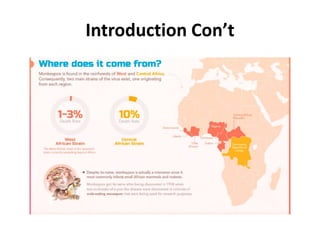
Introduction Con’t
History
‱ DNA Virus first isolated in Denmark in 1958
‱ Found in colony of laboratory monkeys from
Singapore: polio virus research
‱ US &Rotterdam: Lab animals outbreak a
decade later
‱ Caused disease in humans early 1970s in DRC
‱ Cases increased post eradication of smallpox
(1980s)
Hx –Cont’d
‱ Monkeypox virus infection detected in:
 Squirrels
Rodents
species of monkeys
‱ West and Central Africa: 2 clades
 Clade 1: Central Africa-Congo Basin Clade
Clade 2: West Africa (less virulent)-IIa&IIb
‱ Monkeys and Humans: Hosts, unknown reservoir
Epidemiology
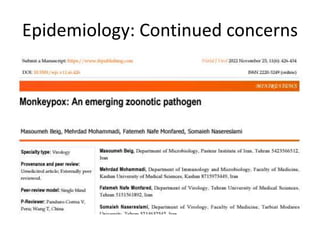
Epidemiology: Continued concerns
Epidemiology
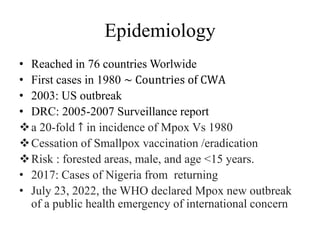
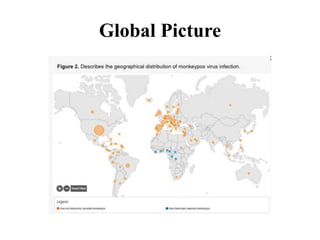
‱ Reached in 76 countries Worlwide
‱ First cases in 1980 ~ Countries of CWA
‱ 2003: US outbreak
‱ DRC: 2005-2007 Surveillance report
a 20-fold ↑ in incidence of Mpox Vs 1980
Cessation of Smallpox vaccination /eradication
Risk : forested areas, male, and age <15 years.
‱ 2017: Cases of Nigeria from returning
‱ July 23, 2022, the WHO declared Mpox new outbreak
of a public health emergency of international concern
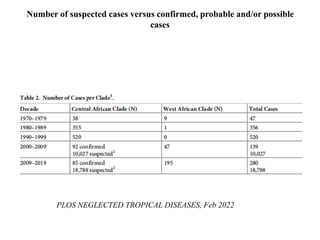
Number of suspected cases versus confirmed, probable and/or possible
cases
PLOS NEGLECTED TROPICAL DISEASES, Feb 2022
Epidem-Cont’d
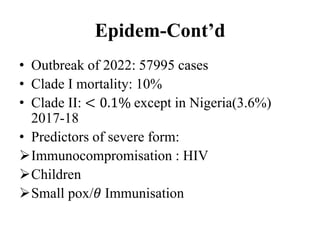
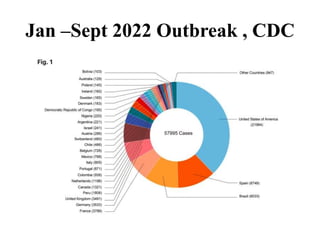
‱ Outbreak of 2022: 57995 cases
‱ Clade I mortality: 10%
‱ Clade II: < 0.1% except in Nigeria(3.6%)
2017-18
‱ Predictors of severe form:
Immunocompromisation : HIV
Children
Small pox/𝜃 Immunisation
Jan –Sept 2022 Outbreak , CDC
Global Picture
Virology
‱ Mpox virus , orthopoxvirus genus
‱ Poxviridae family, w/ other species like:
 Variola virus that causes smallpox
 Vaccinia virus, which was used in making smallpox vaccine
 Mollusci virus that causes Molluscum Contagiosum
‱ Enveloped virus
‱ Double stranded DNA genome
Who is at high risk?
‱ Household of someone with Monkeypox
‱ HCP of an infected person/ IPC.
‱ Travel to an area with confirmed cases: 21 days
‱ Contact w/ a person who has a similar rash or a
dx of confirmed or suspected Monkeypox
‱ Sexual partners of diagnosed or suspected
Monkeypox, predominantly MSM
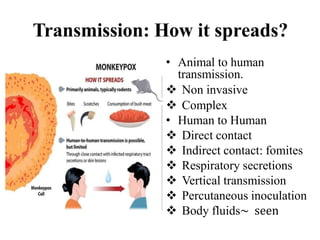
Transmission: How it spreads?
‱ Animal to human
transmission.
 Non invasive
 Complex
‱ Human to Human
 Direct contact
 Indirect contact: fomites
 Respiratory secretions
 Vertical transmission
 Percutaneous inoculation
 Body fluids~ seen
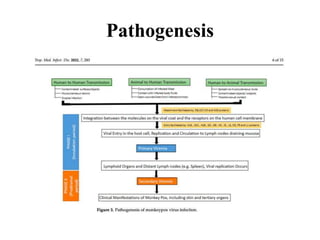
Pathogenesis
Symptoms
‱ Incubation period: 4-21 days
‱ Traditional : systemic illness with
fevers, chills, and myalgias
 characteristic rash ≠other vesicular (eg,
varicella, smallpox)
‱ 2022 Mpox outbreak special attention:
genital, anal
and/or oral lesions without the systemic illness
Symptomatology- Cont’d
‱ Prodrome: Viremic phase of illness
 From 1-5 days
 Fever, headache, sore throat, back pain,
myalgia & fatigue
‱ Rash: Persist 2-3 weeks
‱ Generalized lymphadenopathies
‱ Proctitis and tonsillitis
‱ Encephalitis
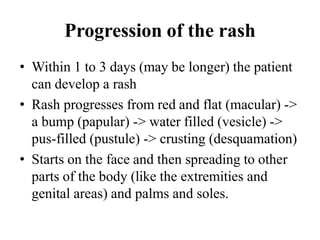
Progression of the rash
‱ Within 1 to 3 days (may be longer) the patient
can develop a rash
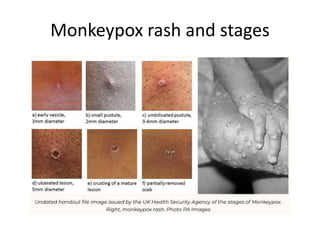
‱ Rash progresses from red and flat (macular) ->
a bump (papular) -> water filled (vesicle) ->
pus-filled (pustule) -> crusting (desquamation)
‱ Starts on the face and then spreading to other
parts of the body (like the extremities and
genital areas) and palms and soles.
Monkeypox rash and stages
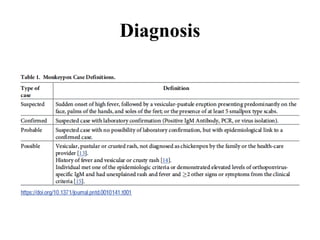
Diagnosis
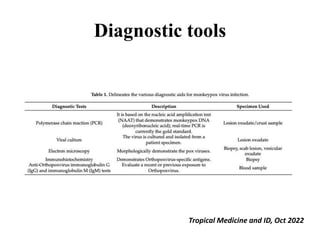
Diagnostic tools
Tropical Medicine and ID, Oct 2022
Investigations
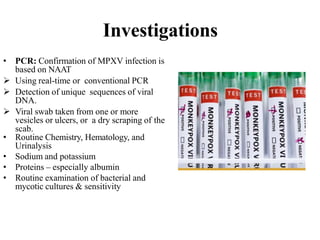
‱ PCR: Confirmation of MPXV infection is
based on NAAT
 Using real-time or conventional PCR
 Detection of unique sequences of viral
DNA.
 Viral swab taken from one or more
vesicles or ulcers, or a dry scraping of the
scab.
‱ Routine Chemistry, Hematology, and
Urinalysis
‱ Sodium and potassium
‱ Proteins – especially albumin
‱ Routine examination of bacterial and
mycotic cultures & sensitivity
Gilada/Unison/Mumbai
Differential Diagnosis
‱ Small pox
‱ Chicken pox & Herpes Zoster (bilateral)
‱ Measles
‱ Superficial Bacterial infections –
Impetigo
‱ Scabies
‱ Syphilis
‱ Drug reactions
‱ Pemphigus Vulgaris
‱ Bullous Pemphigoid
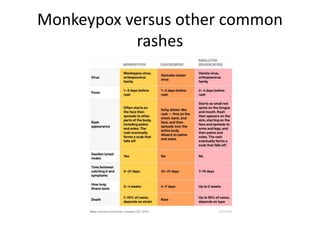
Monkeypox versus other common
rashes
Gilada/Unison/Mumbai
Complications and sequelae
‱ Features of illness that may be predictive of
illness severity and poor outcomes
‱ Consequences of compromised skin and mucosa
‱ Systemic Illness
‱ Hypoalbuminemia and low hematocrit, s/o
malnutrition
‱ Bronchopneumonia
‱ Secondary infection of the integument, sepsis,
‱ Encephalitis
‱ Infection of the cornea with ensuing loss of vision
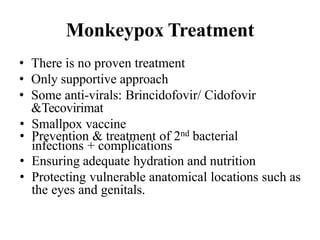
Monkeypox Treatment
‱ There is no proven treatment
‱ Only supportive approach
‱ Some anti-virals: Brincidofovir/ Cidofovir
&Tecovirimat
‱ Smallpox vaccine
‱ Prevention & treatment of 2nd bacterial
infections + complications
‱ Ensuring adequate hydration and nutrition
‱ Protecting vulnerable anatomical locations such as
the eyes and genitals.
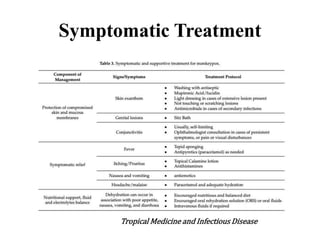
Symptomatic Treatment
Tropical Medicine and Infectious Disease
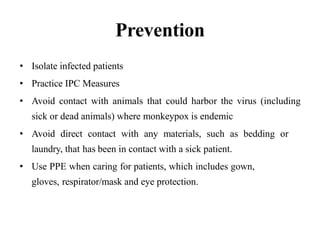
Prevention
‱ Isolate infected patients
‱ Practice IPC Measures
‱ Avoid contact with animals that could harbor the virus (including
sick or dead animals) where monkeypox is endemic
‱ Avoid direct contact with any materials, such as bedding or
laundry, that has been in contact with a sick patient.
‱ Use PPE when caring for patients, which includes gown,
gloves, respirator/mask and eye protection.
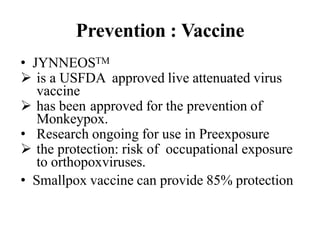
Prevention : Vaccine
‱ JYNNEOSTM
 is a USFDA approved live attenuated virus
vaccine
 has been approved for the prevention of
Monkeypox.
‱ Research ongoing for use in Preexposure
 the protection: risk of occupational exposure
to orthopoxviruses.
‱ Smallpox vaccine can provide 85% protection
Take Home Message
‱ Mpox virus is expected to spread more, we
have to tackle it
‱ No perfect anti-Monkeypox treatment
‱ Mainstay: treat of symptoms & secondary
infections, fluid balance.
‱ Smallpox vaccine can be used for therapeutic
and prevention purposes
‱ Disaster management plan & Global Health
Security should be in place
References
‱ monkeypox—A potential threat? A systematic
review. Gromowski G, editor. PLoS Negl Trop
Dis. 2022 Feb 11;16(2):e0010141.
‱ El Eid R, Allaw F, Haddad SF, Kanj SS. Human
monkeypox: A review of the literature. PLoS
Pathog. 2022 Sep 22;18(9):e1010768.
‱ Huang Y, Mu L, Wang W. Monkeypox:
epidemiology, pathogenesis, treatment and
prevention. Signal Transduct Target Ther. 2022
Nov 2;7:373.
References
‱ monkeypox—A potential threat? A systematic review. Gromowski G, editor. PLoS
Negl Trop Dis. 2022 Feb 11;16(2):e0010141.
‱ 2. El Eid R, Allaw F, Haddad SF, Kanj SS. Human monkeypox: A review of the
literature. PLoS Pathog. 2022 Sep 22;18(9):e1010768.
‱ 3. Huang Y, Mu L, Wang W. Monkeypox: epidemiology, pathogenesis,
treatment and prevention. Signal Transduct Target Ther. 2022 Nov 2;7:373.
Remerciements
Thanking
appreciation

CPD Monkeypox.pptx

  • 1.
    OVERVIEW OF MONKEYPOX Presenter:Dr INGABIRE Prosper Supervisors: Dr Marcellin MUSABENDE March 29, 2023
  • 2.
    Outline ‱ Introduction ‱ Epidemiology ‱Pathogenesis ‱ Clinical Presentation ‱ Diagnosis ‱ Management
  • 3.
    Introduction ‱ Monkeypox isa zoonotic infection due to monkeypox virus ‱ Presents with a rash similar to that of smallpox but less severe ‱ Monkeypox highly seen in endemic areas of Central &Western Africa ‱ Multiple new cases found Worldwide in the last two decades ‱ Public health concerned about it as a pandemic and its use as an agent of bioterrorism
  • 4.
  • 5.
    History ‱ DNA Virusfirst isolated in Denmark in 1958 ‱ Found in colony of laboratory monkeys from Singapore: polio virus research ‱ US &Rotterdam: Lab animals outbreak a decade later ‱ Caused disease in humans early 1970s in DRC ‱ Cases increased post eradication of smallpox (1980s)
  • 6.
    Hx –Cont’d ‱ Monkeypoxvirus infection detected in:  Squirrels Rodents species of monkeys ‱ West and Central Africa: 2 clades  Clade 1: Central Africa-Congo Basin Clade Clade 2: West Africa (less virulent)-IIa&IIb ‱ Monkeys and Humans: Hosts, unknown reservoir
  • 7.
  • 8.
  • 9.
    Epidemiology ‱ Reached in76 countries Worlwide ‱ First cases in 1980 ~ Countries of CWA ‱ 2003: US outbreak ‱ DRC: 2005-2007 Surveillance report a 20-fold ↑ in incidence of Mpox Vs 1980 Cessation of Smallpox vaccination /eradication Risk : forested areas, male, and age <15 years. ‱ 2017: Cases of Nigeria from returning ‱ July 23, 2022, the WHO declared Mpox new outbreak of a public health emergency of international concern
  • 10.
    Number of suspectedcases versus confirmed, probable and/or possible cases PLOS NEGLECTED TROPICAL DISEASES, Feb 2022
  • 11.
    Epidem-Cont’d ‱ Outbreak of2022: 57995 cases ‱ Clade I mortality: 10% ‱ Clade II: < 0.1% except in Nigeria(3.6%) 2017-18 ‱ Predictors of severe form: Immunocompromisation : HIV Children Small pox/𝜃 Immunisation
  • 12.
    Jan –Sept 2022Outbreak , CDC
  • 13.
  • 14.
    Virology ‱ Mpox virus, orthopoxvirus genus ‱ Poxviridae family, w/ other species like:  Variola virus that causes smallpox  Vaccinia virus, which was used in making smallpox vaccine  Mollusci virus that causes Molluscum Contagiosum ‱ Enveloped virus ‱ Double stranded DNA genome
  • 15.
    Who is athigh risk? ‱ Household of someone with Monkeypox ‱ HCP of an infected person/ IPC. ‱ Travel to an area with confirmed cases: 21 days ‱ Contact w/ a person who has a similar rash or a dx of confirmed or suspected Monkeypox ‱ Sexual partners of diagnosed or suspected Monkeypox, predominantly MSM
  • 16.
    Transmission: How itspreads? ‱ Animal to human transmission.  Non invasive  Complex ‱ Human to Human  Direct contact  Indirect contact: fomites  Respiratory secretions  Vertical transmission  Percutaneous inoculation  Body fluids~ seen
  • 17.
  • 18.
    Symptoms ‱ Incubation period:4-21 days ‱ Traditional : systemic illness with fevers, chills, and myalgias  characteristic rash ≠other vesicular (eg, varicella, smallpox) ‱ 2022 Mpox outbreak special attention: genital, anal and/or oral lesions without the systemic illness
  • 19.
    Symptomatology- Cont’d ‱ Prodrome:Viremic phase of illness  From 1-5 days  Fever, headache, sore throat, back pain, myalgia & fatigue ‱ Rash: Persist 2-3 weeks ‱ Generalized lymphadenopathies ‱ Proctitis and tonsillitis ‱ Encephalitis
  • 20.
    Progression of therash ‱ Within 1 to 3 days (may be longer) the patient can develop a rash ‱ Rash progresses from red and flat (macular) -> a bump (papular) -> water filled (vesicle) -> pus-filled (pustule) -> crusting (desquamation) ‱ Starts on the face and then spreading to other parts of the body (like the extremities and genital areas) and palms and soles.
  • 21.
  • 22.
  • 23.
  • 24.
    Investigations ‱ PCR: Confirmationof MPXV infection is based on NAAT  Using real-time or conventional PCR  Detection of unique sequences of viral DNA.  Viral swab taken from one or more vesicles or ulcers, or a dry scraping of the scab. ‱ Routine Chemistry, Hematology, and Urinalysis ‱ Sodium and potassium ‱ Proteins – especially albumin ‱ Routine examination of bacterial and mycotic cultures & sensitivity
  • 25.
    Gilada/Unison/Mumbai Differential Diagnosis ‱ Smallpox ‱ Chicken pox & Herpes Zoster (bilateral) ‱ Measles ‱ Superficial Bacterial infections – Impetigo ‱ Scabies ‱ Syphilis ‱ Drug reactions ‱ Pemphigus Vulgaris ‱ Bullous Pemphigoid
  • 26.
  • 27.
    Gilada/Unison/Mumbai Complications and sequelae ‱Features of illness that may be predictive of illness severity and poor outcomes ‱ Consequences of compromised skin and mucosa ‱ Systemic Illness ‱ Hypoalbuminemia and low hematocrit, s/o malnutrition ‱ Bronchopneumonia ‱ Secondary infection of the integument, sepsis, ‱ Encephalitis ‱ Infection of the cornea with ensuing loss of vision
  • 28.
    Monkeypox Treatment ‱ Thereis no proven treatment ‱ Only supportive approach ‱ Some anti-virals: Brincidofovir/ Cidofovir &Tecovirimat ‱ Smallpox vaccine ‱ Prevention & treatment of 2nd bacterial infections + complications ‱ Ensuring adequate hydration and nutrition ‱ Protecting vulnerable anatomical locations such as the eyes and genitals.
  • 29.
  • 30.
    Prevention ‱ Isolate infectedpatients ‱ Practice IPC Measures ‱ Avoid contact with animals that could harbor the virus (including sick or dead animals) where monkeypox is endemic ‱ Avoid direct contact with any materials, such as bedding or laundry, that has been in contact with a sick patient. ‱ Use PPE when caring for patients, which includes gown, gloves, respirator/mask and eye protection.
  • 31.
    Prevention : Vaccine ‱JYNNEOSTM  is a USFDA approved live attenuated virus vaccine  has been approved for the prevention of Monkeypox. ‱ Research ongoing for use in Preexposure  the protection: risk of occupational exposure to orthopoxviruses. ‱ Smallpox vaccine can provide 85% protection
  • 32.
    Take Home Message ‱Mpox virus is expected to spread more, we have to tackle it ‱ No perfect anti-Monkeypox treatment ‱ Mainstay: treat of symptoms & secondary infections, fluid balance. ‱ Smallpox vaccine can be used for therapeutic and prevention purposes ‱ Disaster management plan & Global Health Security should be in place
  • 33.
    References ‱ monkeypox—A potentialthreat? A systematic review. Gromowski G, editor. PLoS Negl Trop Dis. 2022 Feb 11;16(2):e0010141. ‱ El Eid R, Allaw F, Haddad SF, Kanj SS. Human monkeypox: A review of the literature. PLoS Pathog. 2022 Sep 22;18(9):e1010768. ‱ Huang Y, Mu L, Wang W. Monkeypox: epidemiology, pathogenesis, treatment and prevention. Signal Transduct Target Ther. 2022 Nov 2;7:373.
  • 34.
    References ‱ monkeypox—A potentialthreat? A systematic review. Gromowski G, editor. PLoS Negl Trop Dis. 2022 Feb 11;16(2):e0010141. ‱ 2. El Eid R, Allaw F, Haddad SF, Kanj SS. Human monkeypox: A review of the literature. PLoS Pathog. 2022 Sep 22;18(9):e1010768. ‱ 3. Huang Y, Mu L, Wang W. Monkeypox: epidemiology, pathogenesis, treatment and prevention. Signal Transduct Target Ther. 2022 Nov 2;7:373.
  • 35.