
Understanding Kubernetes
Next extended 2017 – Ha Noi
CTO @ DynoMarketing
Technologies: Java, Python, all kind of databases and
Cloud platform from Google, Aws, Azure.
Interests: Cloud computing / architecture, technology
evolution, distributed systems.
Husband, Father, GDE, Open source contributor.
Tu Pham
foto: Lars Kruse, Aarhus Universitet
Pervasive Systems group, Section of Electrical and Computer Engineering, Department of Engineering, Aarhus University
2
Let’s get started with a short introduction to Cloud Computing…
3
What is CloudComputing?
4
5
- “Cloud	computing	refers	to	applications	and	services	that	run	on	a	distributed	network	using		
virtualized	resources	and	accessed	by	common	Internet	protocols	and	networking		standards.”	
- B. Sosinsky, The Cloud Computing Bible
- Key enabling concepts
-
-
Abstraction: Cloud computing abstracts the details of system implementation from
users and developers
Virtualization: Cloud computing virtualizes systems by pooling and sharing
resources
- Cloud types
-
-
Deployment models: Public, Private, Hybrid,Community
Service models: IaaS, PaaS, SaaS, (CaaS)
What is CloudComputing?
Source: “The Cloud Computing Bible”, B.Sosinsky, page10
6
-
-
-
-
-
-
-
-
-
On-demand self-service
Broad network access
Resource pooling
Rapid elasticity
Measured service
Lower costs (Than one time buy all)
Ease of utilization
Quality of Service Reliability
Outsourced IT Management
Benefits of CloudComputing?
Source: “The Cloud Computing Bible”, B.Sosinsky, page17
7
-
-
-
-
More suitable for mid & largeorganizations (Poor understanding)
Less customizable (For specific reasons)
Network latency (Vietnam, ..)
Privacy and security (Poor understanding)
Disadvantages of CloudComputing?
Source: “The Cloud Computing Bible”, B.Sosinsky, page17
8
What about SoftwareArchitecture?
9
Source: https://thirdeyemom.com/2015/07/07/the-great-american-road-trip-mount-rushmore/
Monolithic architecture
“A	monolith	application,	in	layman	terms,	is	where	entire		
functionality	of	the	application	is	packaged	together	as	a	single		
unit	or	application”	-	Arun	Gupta,	2015
10
Microservice architecture
“Small	Autonomous	services	that	work	together,	modelled	around	a	business	domain”	- Sam Newman, 2015
Source: http://d195zpdxad0ld.cloudfront.net/media/W1siZiIsIjIwMTIvMDUvMjUvMTVfMDVfMjhfNjkwX1N0b25laGVuZ2VfYXRfZGF3bi5qcGciXSxbImUiLCJqcGciLCItcXVhbGl0eSA2MCJdLFsicCIsInN0cmlwIl1d/
Stonehenge%20at%20dawn.jpg
11
Monolithic vs Microservice architecture
Source: http://martinfowler.com/articles/microservices.html
12
Design forfailure - Resilience in a distributed system?
13
resilience
or resiliency
[ri-zil-yuh	ns, -zil-ee-uh	ns]
noun
2.
1. the power or ability to return to the original form, position, etc., after being bent,
compressed, or stretched: elasticity.
ability to recover readily from illness, depression, adversity, or the like; buoyancy
Source: http://www.dictionary.com/browse/resilience
14
15
THINGS WILL GO WRONG
EMBRACE FAILURES 16
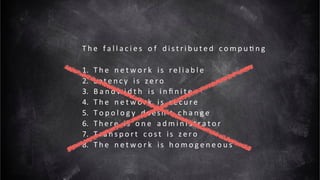
T h e 	 f a l l a c i e s 	 o f 	 d i s t r i b u t e d 	 c o m p u t i n g 	
1. T h e 	 n e t w o r k 	 is	 r e l i a b l e 	
2. L a t e n c y 	 is	 ze r o 	
3. B a n d w i d t h 	 is	 i n f i n i t e 	
4. T h e 	 n e t w o r k 	 is	 s e c u re 	
5. To p o l o g y 	 doesn’t	 c h a n g e 	
6. T h e re 	 is	 o n e 	 a d m i n i s t r a t o r 	
7. Tra n s p o r t 	 c o s t 	 is	 ze r o 	
8. T h e 	 n e t w o r k 	 is	 h o m o g e n e o u s
17
- Application level
-
-
-
-
-
Synchronous/Asynchronous architecture (request/response, message queues)
Apply circuit breakers at integrationpoints
Manage timeouts
Bulkheads
Health checks
- Infrastructure level
-
-
Fault tolerance
Infrastructure that detectsfailures
What can wedo?
18
What is aContainer?
19
20
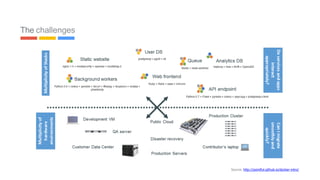
The challenges
Source: http://pointful.github.io/docker-intro/ 21
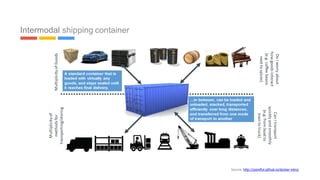
Intermodal shipping container
Source: http://pointful.github.io/docker-intro/ 22
Docker is a container system for code
Source: http://pointful.github.io/docker-intro/ 23
What is Continuous Delivery?
24
Source: https://www.robots.com/images/Robot%20Integration.jpg
25
What is ServiceDiscovery?
26
27
Alittle tour of the
28
cloud.google.com
29
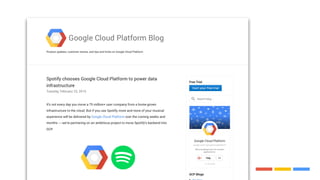
Who uses Google CloudPlatform?
30
31
32
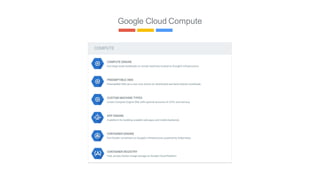
Google Cloud Compute
33
Google Container Engine
Fully Managed
Container Engine is fully managed by Google reliability
engineers, ensuring your cluster is available and up-to-
date.
Private ContainerRegistry
Google Container Registry makes it easy to store and
access your private Dockerimages.
Scalable
Easily adjust the cluster resources allocated to your
containers, or the size of your container cluster, as
your application's requirements change.
Docker Support
Container Engine supports the commonDocker
container format.
Logging
Enable Google Cloud Logging with a singlecheckbox,
making it easy to gain insight into how your
application is running
Hybrid Networking
Reserve an IP address range for your container cluster,
allowing your cluster IPs to coexist with private
network IPs via Google CloudVPN.
Source: https://cloud.google.com/container-engine/34
Google Container Registry
Container Engine
Use container images with Container Engine with no
authentication setup.
Advanced Authentication
Easily integrate with your favorite continuous
integration, continuous delivery, and container
orchestration systems withnative Docker Login
support.
Container Tags
Add and remove image tags with a simple click in the
web UI.
Docker V2 Registry API Support
Push and pull Docker images to your private Container
Registry using the V2API.
Docker CLIIntegration
Pull container images from Container Registry using
the standard Docker command lineinterface.
Regional Repositories
Get the fastest possible pull times by storing your
images close to your Compute Engine instances in
Europe,Asia, or USregional Cloud Storagebuckets.
Search Images
Quickly search for images by name and tag.
Nearline StorageIntegration
Archival storage of images in Cloud Storage Nearline
buckets.
Source: https://cloud.google.com/container-registry/35
Kubernetes - Infrastructure For EveryoneElse
Kubernetes is an open-source system for automating deployment, operations,
and scaling of containerizedapplications.
#GIFEE
36
37
How tomanage all these containers?
38
39
How to utilize the resources we have?
40
Machine utilization
-
-
-
Machine shapes
Workload shapes
Bin packing problem
Where should we deploy this workload?
2.5GB
1Core
Source: bit.ly/1PrkwoN 41
Let’s play some tetris
42
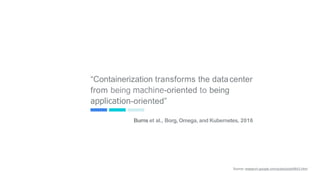
“Containerization transforms the datacenter
from being machine-oriented to being
application-oriented”
Burns et al., Borg, Omega, and Kubernetes, 2016
Source: research.google.com/pubs/pub44843.html43
-
-
-
-
-
-
Greek for “pilot” or “helmsman of a ship”
Runs and manages containers
Builds on Googles experiences running a hyper-scale webplatform for more than 15 years.
Inspired by Googles internal Cluster Management and scheduling platform, “Borg”
Supports multiple cloud and bare-metalenvironments
100% Open source, written inGo
What is Kubernetes?
Source: https://youtu.be/_xNFt7FsWaA 44
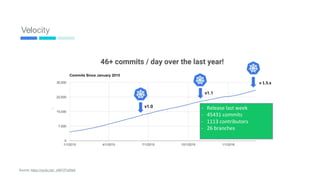
Velocity
Source: https://youtu.be/_xNFt7FsWaA
v	1.5.x	
- Release	last	week	
- 45431	commits	
- 1113	contributors	
- 26	branches		
45
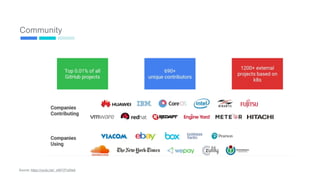
Community
Source: https://youtu.be/_xNFt7FsWaA 46
Everything at Google runs incontainers
-
-
-
-
Gmail, Web search, …
MapReduce, batch, …
GFS,Colossus, …
Even Google’s Cloud Platform:
VMs run in containers
In fact, launches over 2 billion containers perweek.
Google and Containers
47
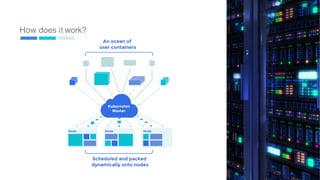
How does it work?
48
Let’s have a look a some of the concepts
49
Pods
50
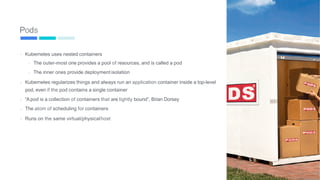
Pods
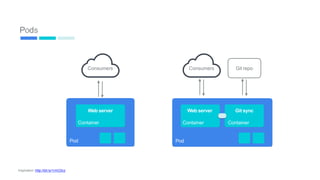
- Kubernetes uses nested containers
-
-
The outer-most one provides a pool of resources, and is called a pod
The inner ones provide deployment isolation
- Kubernetes regularizes things and always run an application container inside a top-level
pod, even if the pod contains a single container
-
-
-
“Apod is a collection of containers that are tightly bound”, Brian Dorsey
The atom of scheduling for containers
Runs on the same virtual/physicalhost
51
Pods
Pod
Web server
Container
Pod
Web server
Consumers
Container
Git sync
Container
Git repoConsumers
Inspiration: http://bit.ly/1rmC0cz 52
Pod networking
53
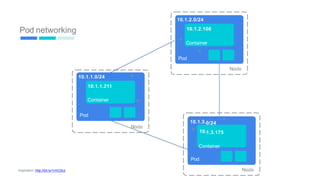
Pod networking
-
-
Pods have IPs which areroutable
Pods can communicate directly with each other
- Even across nodes
-
-
No brokering of PortNumbers
Many solutions
- Contiv
- Flannel
- Google Compute Engine
- L2 Networks and linux briding
- Nuage network VCS
- OpenVSwitch
- …
54
Pod networking
P
Pod
Container
10.1.1.0/24
10.1.1.211
Pod
10.1.3.
10.
10.1.2.0/24
10.1.2.106
Container
od
0/24
1.3.175
Container
Node
Node
Node
Inspiration: http://bit.ly/1rmC0cz 55
Services
56
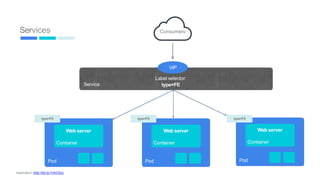
Services
-
-
-
Aservice has a static IP and aDNS entry
Acts as a load-balancer and knows how to route traffic to pods
Load balances incoming request across constituent pods
57
Services
Pod
Web server
Container
Pod
Web server
Container
Pod
Web server
Container
type=FE type=FE type=FE
Consumers
Service
VIP
Label selector:
type=FE
Inspiration: http://bit.ly/1rmC0cz
58
Labels
59
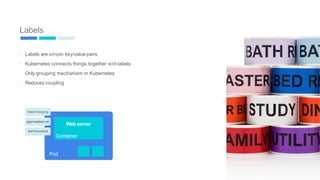
Labels
-
-
-
-
Labels are simple key/valuepairs
Kubernetes connects things together withlabels
Only grouping mechanism in Kubernetes
Reduces coupling
Web server
track=staging
app=webserver
tier=frontend
Container
Pod
60
Replica Sets
Hey!
You alwayswear
the same as Ido
61
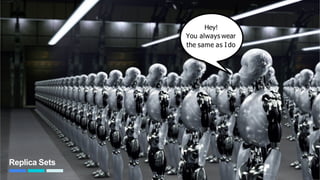
ReplicaSets
-
-
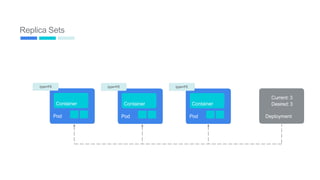
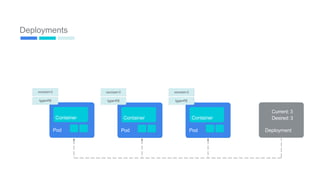
A Replica Set ensures that a specified number of pods “replicas” are running at any given
time.
Replica Set is the next-generation ReplicationController
- The only difference right now is the selector support (set-based support)
- Use deployments tocontrol your Replica Sets
62
Replica Sets
Pod
Container
type=FE
Pod
Container
type=FE
Pod
Container
type=FE
Current: 3
Desired: 3
Deployment
63
Source: http://imgur.com/tjD4L
Deployments
OH F*CK!
Not again!
Whyyyyyy…
64
Deployments
-
-
-
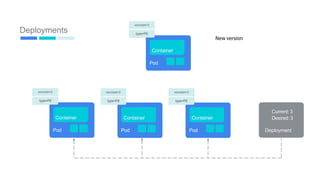
Deployment is a higher-level concept that manages replica sets, pods and provides
declarative updates to pods along with a lot of other useful features
You only need to describe the desired state in a Deployment object, and the Deployment
controller will change the actual state to the desired state at a controlled rate for you
Deploying a new version will result in a rolling-update, where Kubernetes will replace one
pod at a time until all are running the latest version.
65
Deployments
Pod
Container
type=FE
Pod
Container
type=FE
Pod
Container
type=FE
Current: 3
Desired: 3
version=2 version=2 version=2
Pod
Container
type=FE
version=3
New version
Deployment
66
Deployments
Pod
Container
type=FE
Pod
Container
type=FE
Pod
Container
type=FE
version=3 version=2 version=2
Deployment
Current: 3
Desired: 3
67
Deployments
Pod
Container
type=FE
Pod
Container
type=FE
Pod
Container
type=FE
version=3 version=3 version=2
Deployment
Current: 3
Desired: 3
68
Deployments
Pod
Container
type=FE
Pod
Container
type=FE
Pod
Container
type=FE
version=3 version=3 version=3
Deployment
Current: 3
Desired: 3
69
Canary
WHAZZZAH!
I’m the newkid
on thestick!
70
Canary
-
-
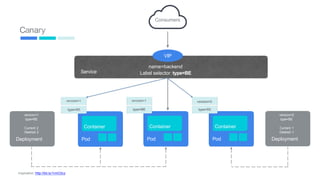
Running different versions at the same time
Testing new features with a subset of your users
71
Canary
Pod
Container
type=BE
Pod
Container
Pod
Container
type=BE
version=1
type=BE
Current: 2
Desired: 2
Deployment
version=2
version=1
type=BE
version=1
version=2
type=BE
Current: 1
Desired: 1
Deployment
Consumers
Service
VIP
name=backend
Label selector: type=BE
Inspiration: http://bit.ly/1rmC0cz
72
Scaling
I feel inflated today!
73
Scale (auto)
-
-
-
-
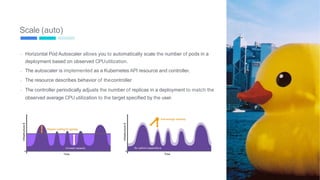
Horizontal Pod Autoscaler allows you to automatically scale the number of pods in a
deployment based on observed CPUutilization.
The autoscaler is implemented as a Kubernetes API resource and controller.
The resource describes behavior of thecontroller
The controller periodically adjusts the number of replicas in a deployment to match the
observed average CPU utilization to the target specified by the user.
74
Scale (auto)
Pod 1
Container
type=FE
Pod 2
Container
type=FE
Pod N
Container
type=FE
version=3 version=3 version=3
Deployment
Scale
…
Horizontal
Pod
Autoscaler
kubectl autoscale deployment foo --max=5 --cpu-percent=80
75
How can I get started with Kubernetes?
76
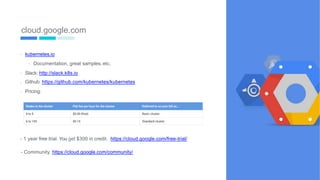
cloud.google.com
- kubernetes.io
- Documentation, great samples, etc.
-
-
-
Slack: http://slack.k8s.io
Github: https://github.com/kubernetes/kubernetes
Pricing:
- 1 year free trial. You get $300 in credit. https://cloud.google.com/free-trial/
- Community. https://cloud.google.com/community/
77
Demo on Google ContainerEngine
78
Kubernetes Basic Demo
config-service
79
Kubernetes One Million Requests Per Second Demo
config-service
https://github.com/kubernetes/contrib
80
References
-
-
Book: “The Cloud computing bible”, Sosinsky,B.
Link: “Microservices - a definition of this new architectural term”, Fowler, M., Lewis, J.
- martinfowler.com/articles/microservices.html
- Link: “Borg, Omega, and Kubernetes”, Burns, B. et al.
- http://research.google.com/pubs/pub44843.html
- Link: “Introduction to Docker”
- http://pointful.github.io/docker-intro/
81
JOIN THE FLIGHT
Next extended 2017
Twitter: @phamptu
Email: tu@dyno.vn

Understanding Kubernetes