
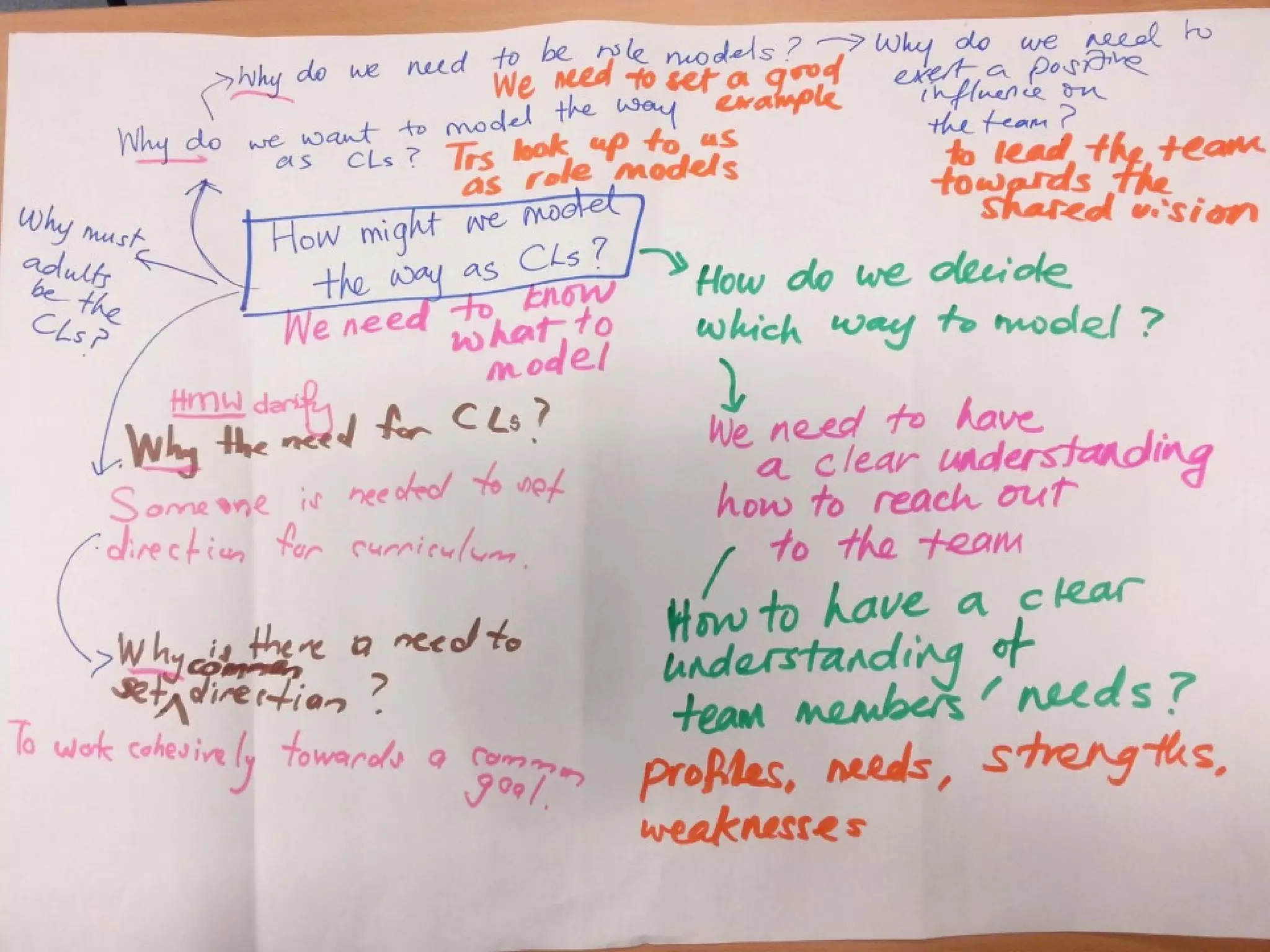

Understanding Challenges of Curriculum
Innovation and the Implementation:
John Yeo
National Institute of Education, Singapore
Invited Plenary Seminar in Gakushuin Univerisity, Tokyo
What Impact Teachers’ Practice and Students’ Learning?
•Innovation: Where is the
Evidence?
•Curriculum: What gets lost in
translation?
•Didatik as “ways of seeing” the
interplay of teaching and learning
•Bringing in the cultural artifacts
through Activity Theory
•From the “collapse” of learning
to the “renovation” of teaching
Understanding Challenges of Curriculum
Innovation and the Implementation:
What Impact Teachers’ Practice and Students’ Learning?
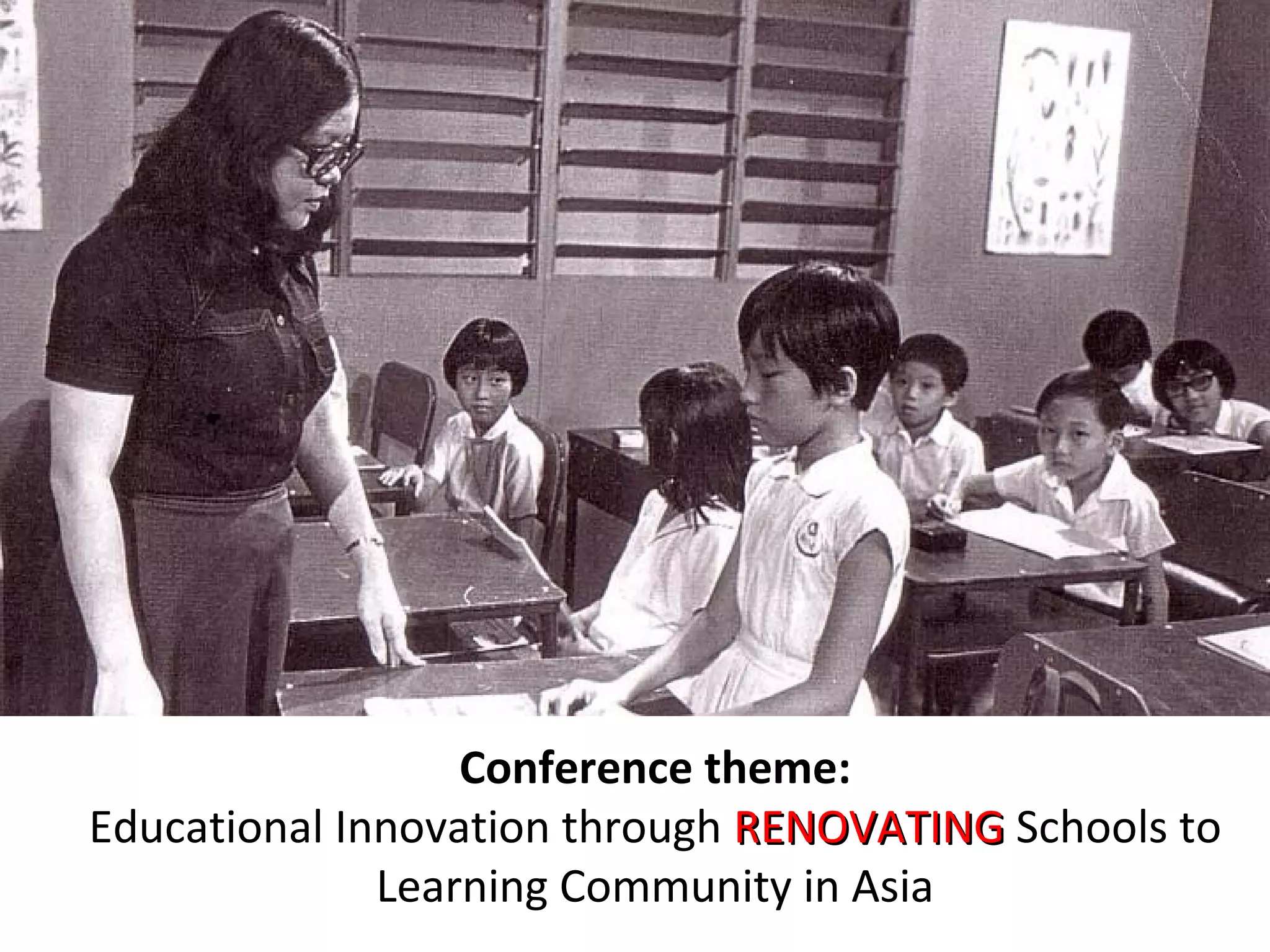
Conference theme:
Educational Innovation through RENOVATINGRENOVATING Schools to
Learning Community in Asia
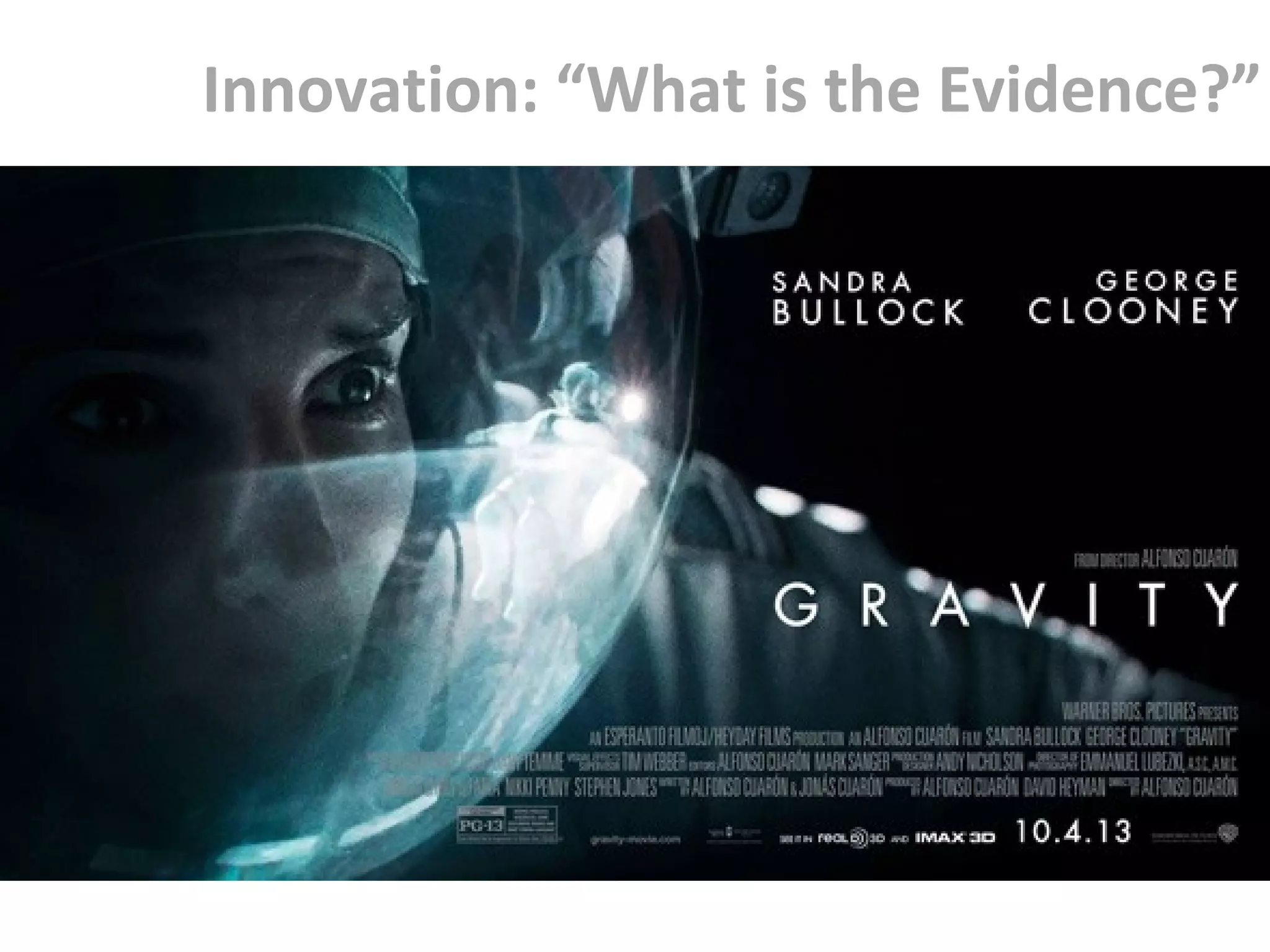
Innovation: “What is the Evidence?”
What do we want to measure?
– how well have teachers taught
– how well have students learnt
Innovation: “What is the Evidence?”
Difference between matter and meaning:
".... we lost the ability to catch children's
imagination and forgot what they are
worth.”
Innovation: “What is the Evidence?”
Curriculum Innovation: What gets lost
in the translation?
• Public accountability
• Good structures in
place
• School-based
curriculum innovation
with ‘Teach Less, Learn
More’ (MOE, 2007)
Curriculum Innovation: What gets lost
in the translation?
• Address diverse
learning needs of
students
• Intensification of
diagnostic data
– determine student
needs
– expand teachers’
instructional toolkits
Curriculum Innovation: What gets lost
in the translation?
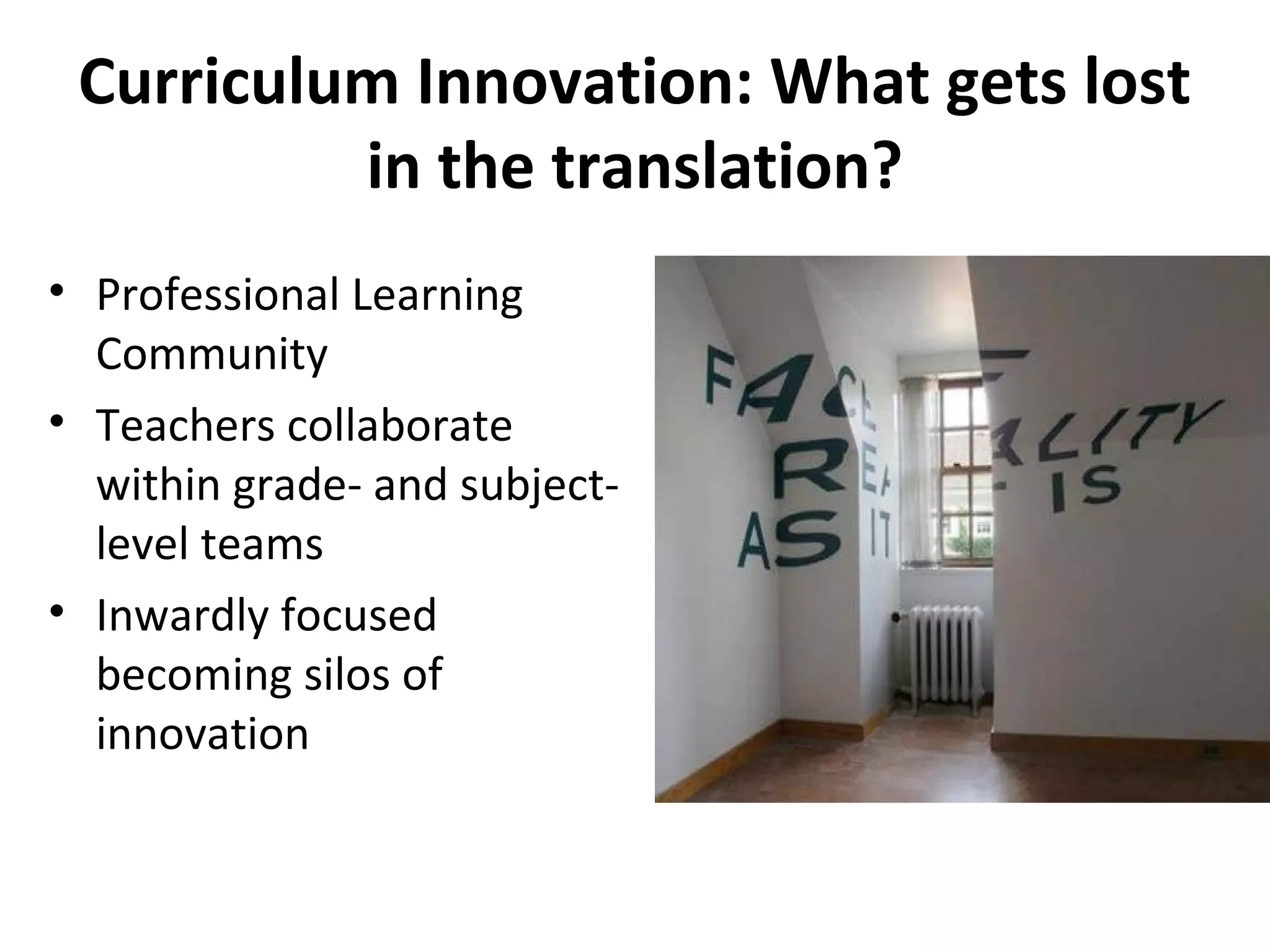
• Professional Learning
Community
• Teachers collaborate
within grade- and subject-
level teams
• Inwardly focused
becoming silos of
innovation
Curriculum Innovation: What gets lost
in the translation?
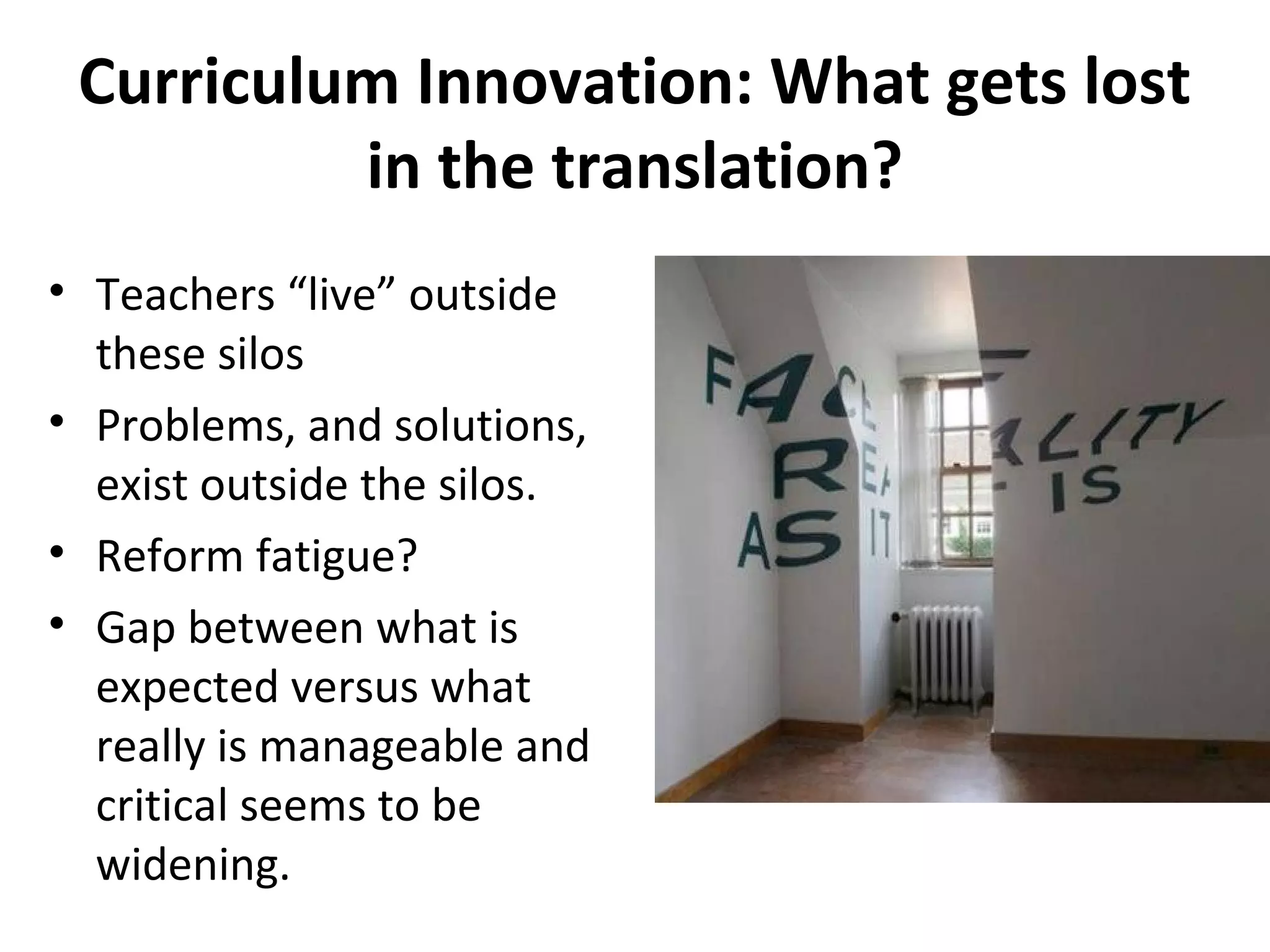
• Teachers “live” outside
these silos
• Problems, and solutions,
exist outside the silos.
• Reform fatigue?
• Gap between what is
expected versus what
really is manageable and
critical seems to be
widening.
Curriculum Innovation: What gets lost
in the translation?
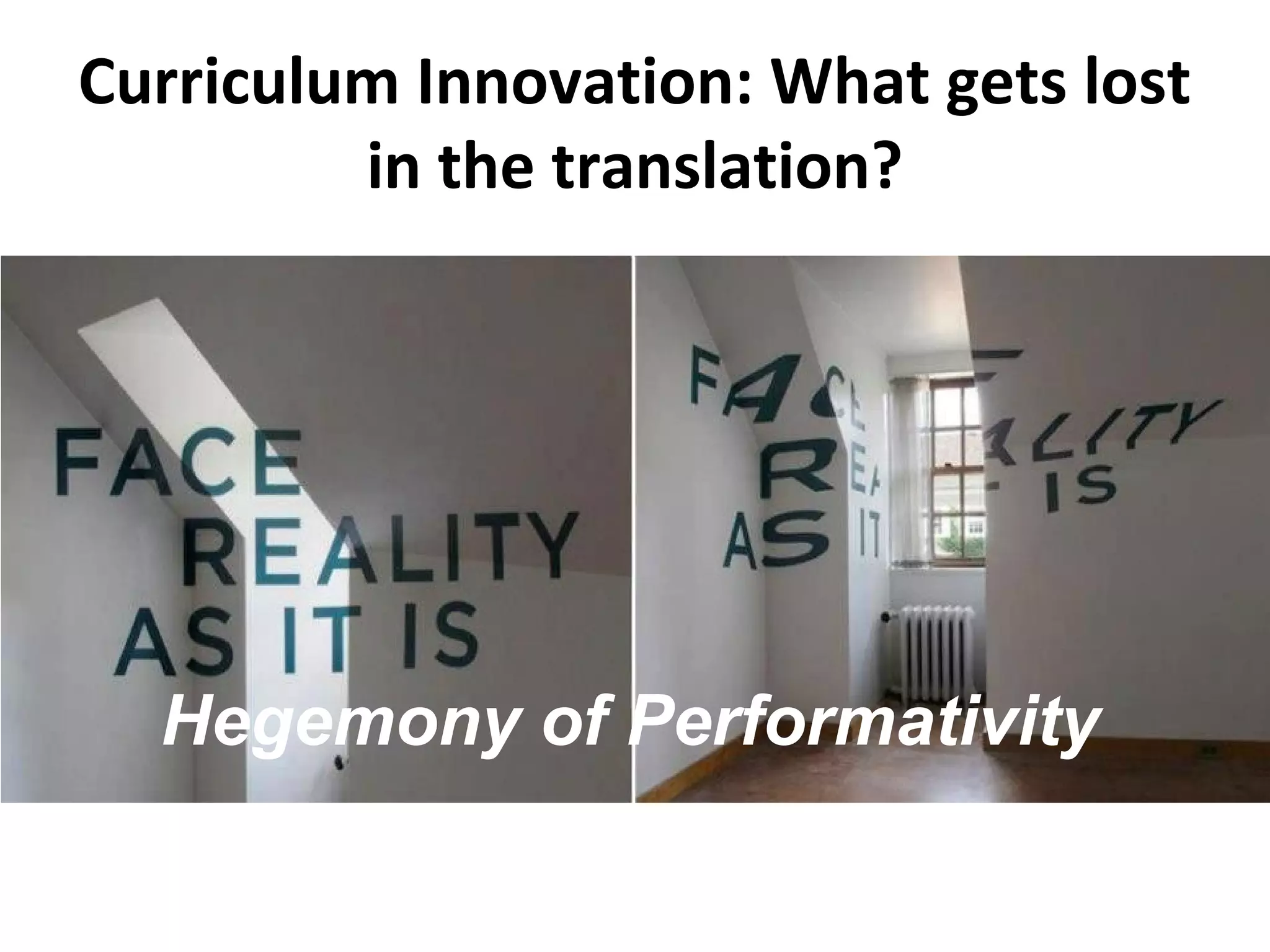
Hegemony of Performativity
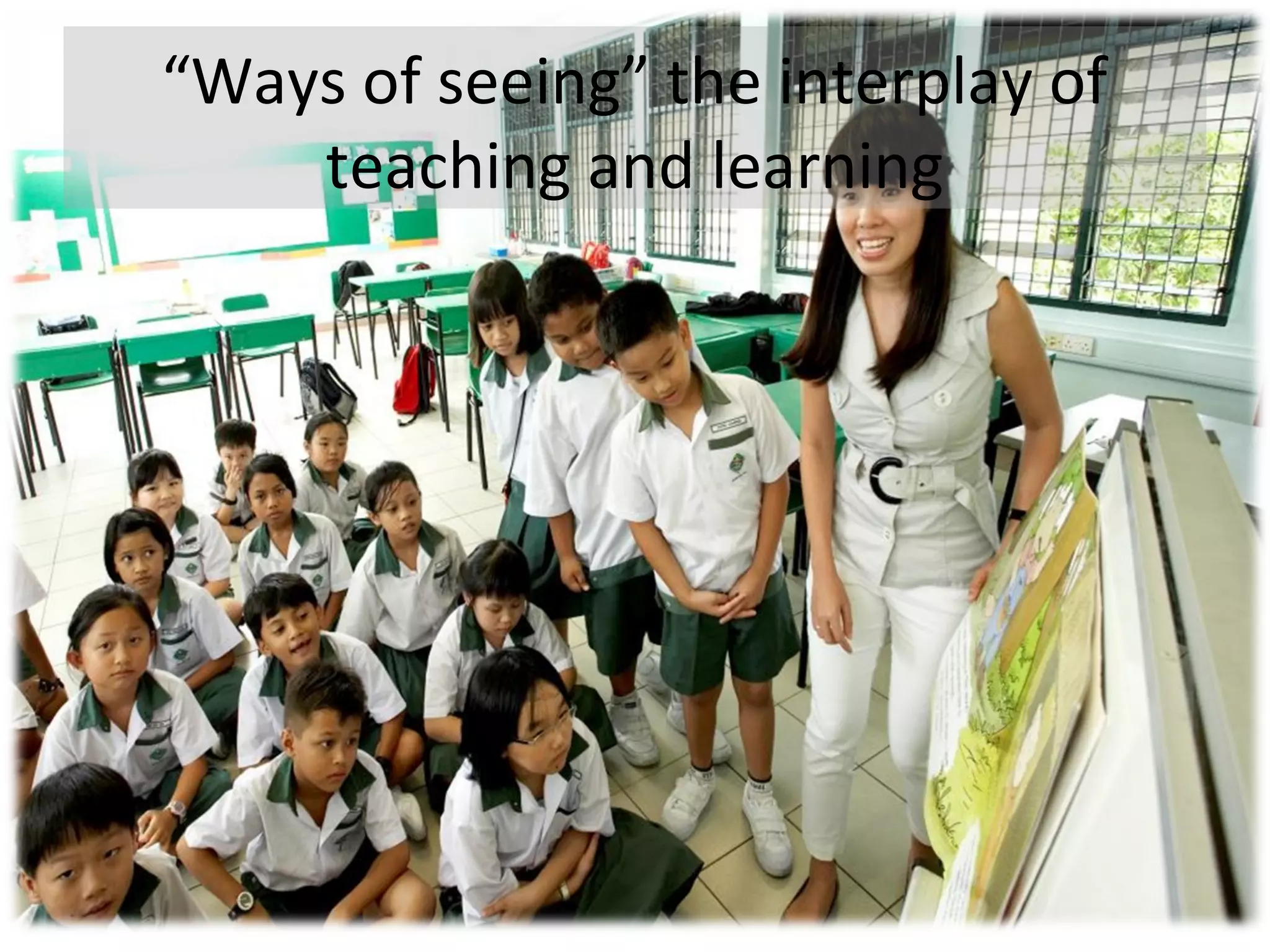
“Ways of seeing” the interplay of
teaching and learning
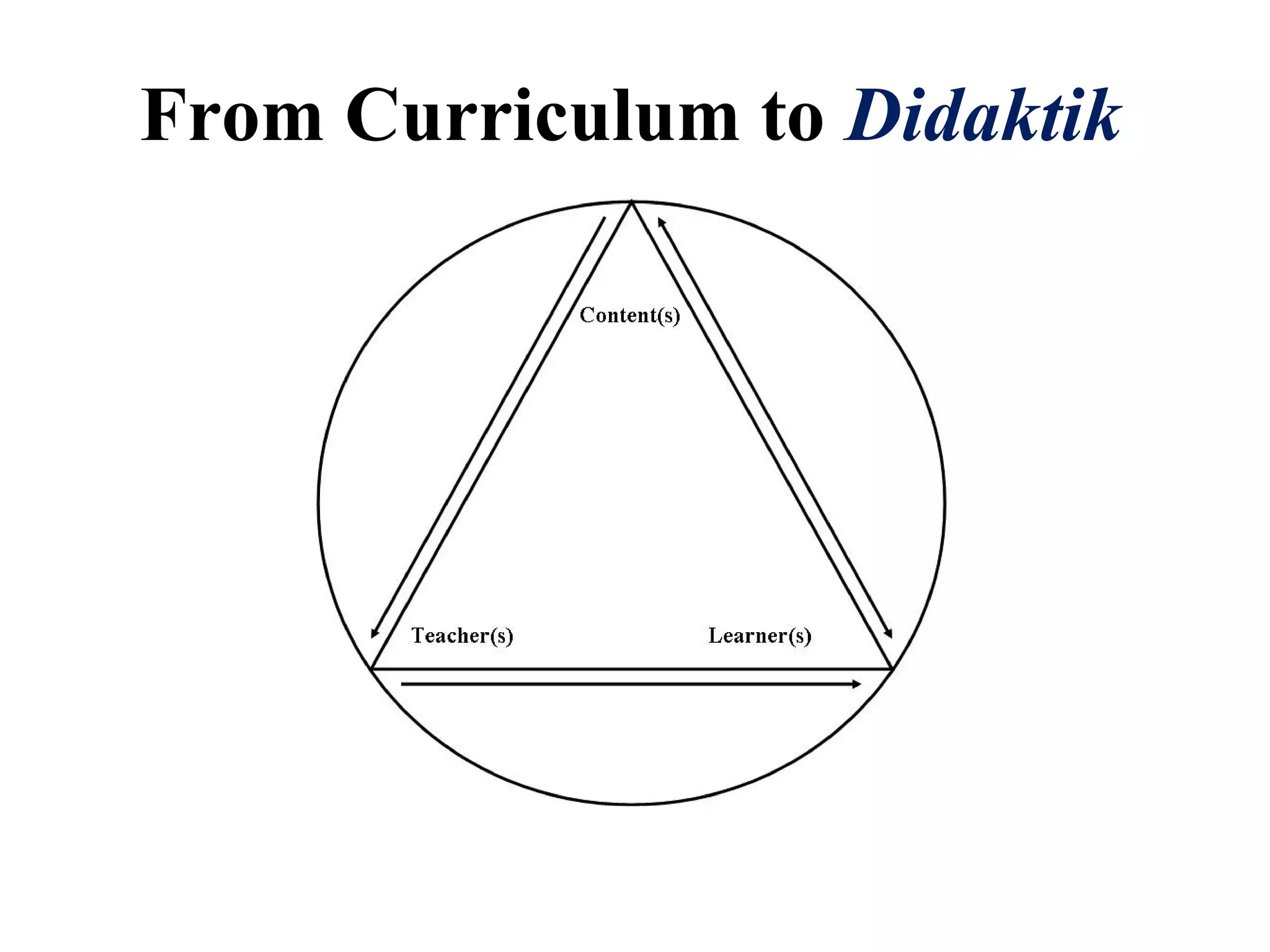
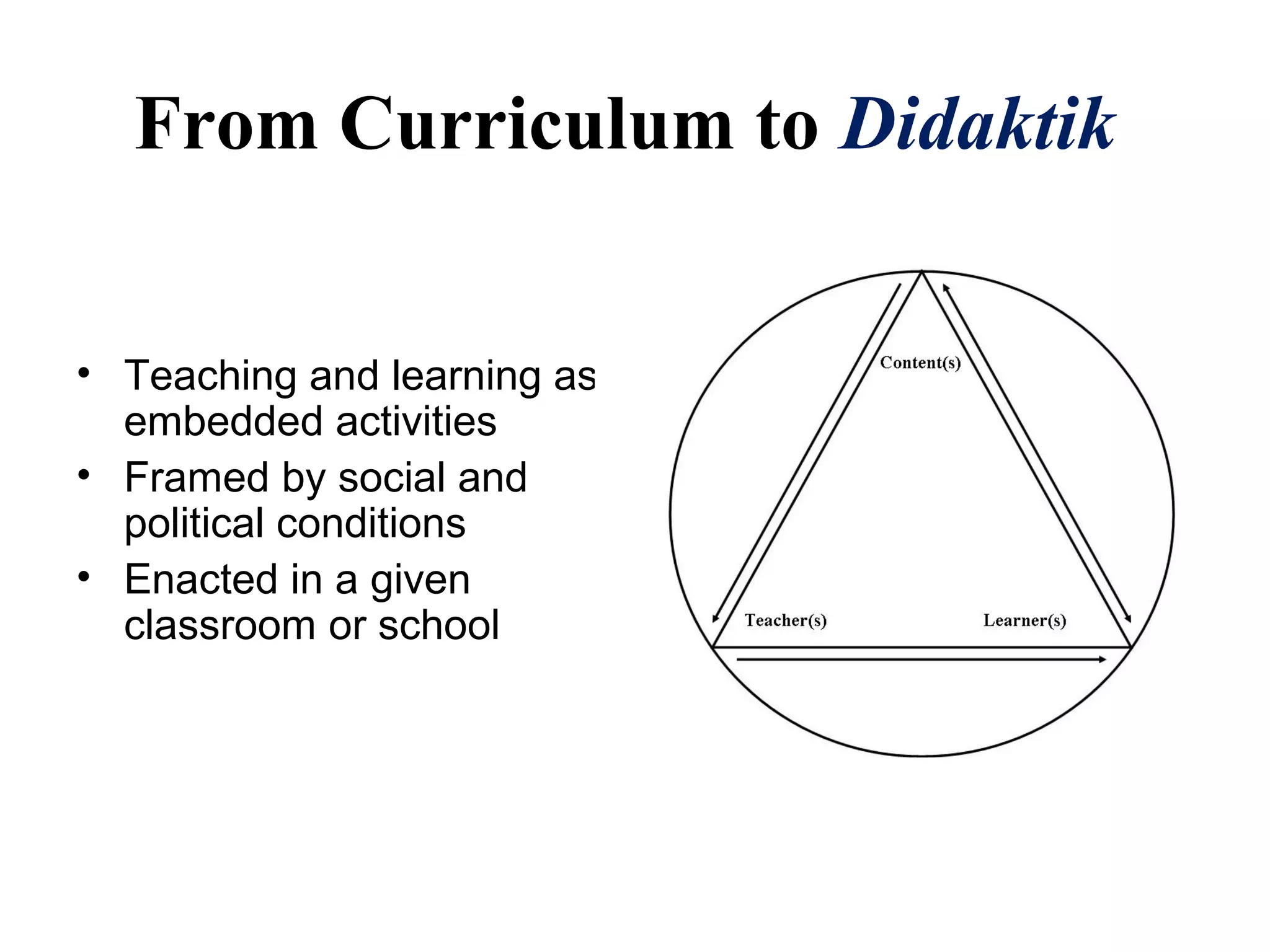
From Curriculum to Didaktik
• Teaching and learning as
embedded activities
• Framed by social and
political conditions
• Enacted in a given
classroom or school
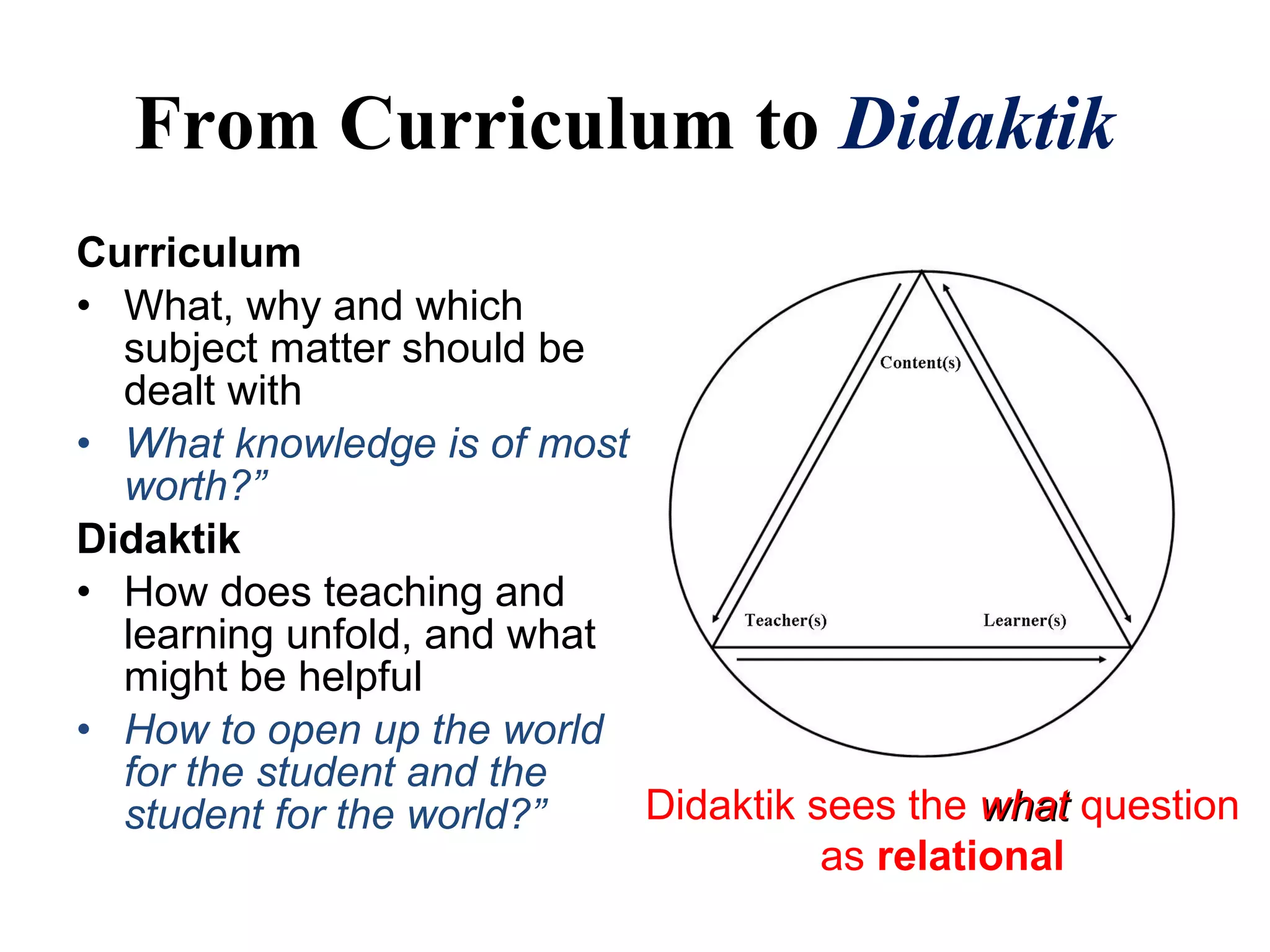
From Curriculum to Didaktik
Curriculum
• What, why and which
subject matter should be
dealt with
• What knowledge is of most
worth?”
Didaktik
• How does teaching and
learning unfold, and what
might be helpful
• How to open up the world
for the student and the
student for the world?”
From Curriculum to Didaktik
Didaktik sees the whatwhat question
as relational
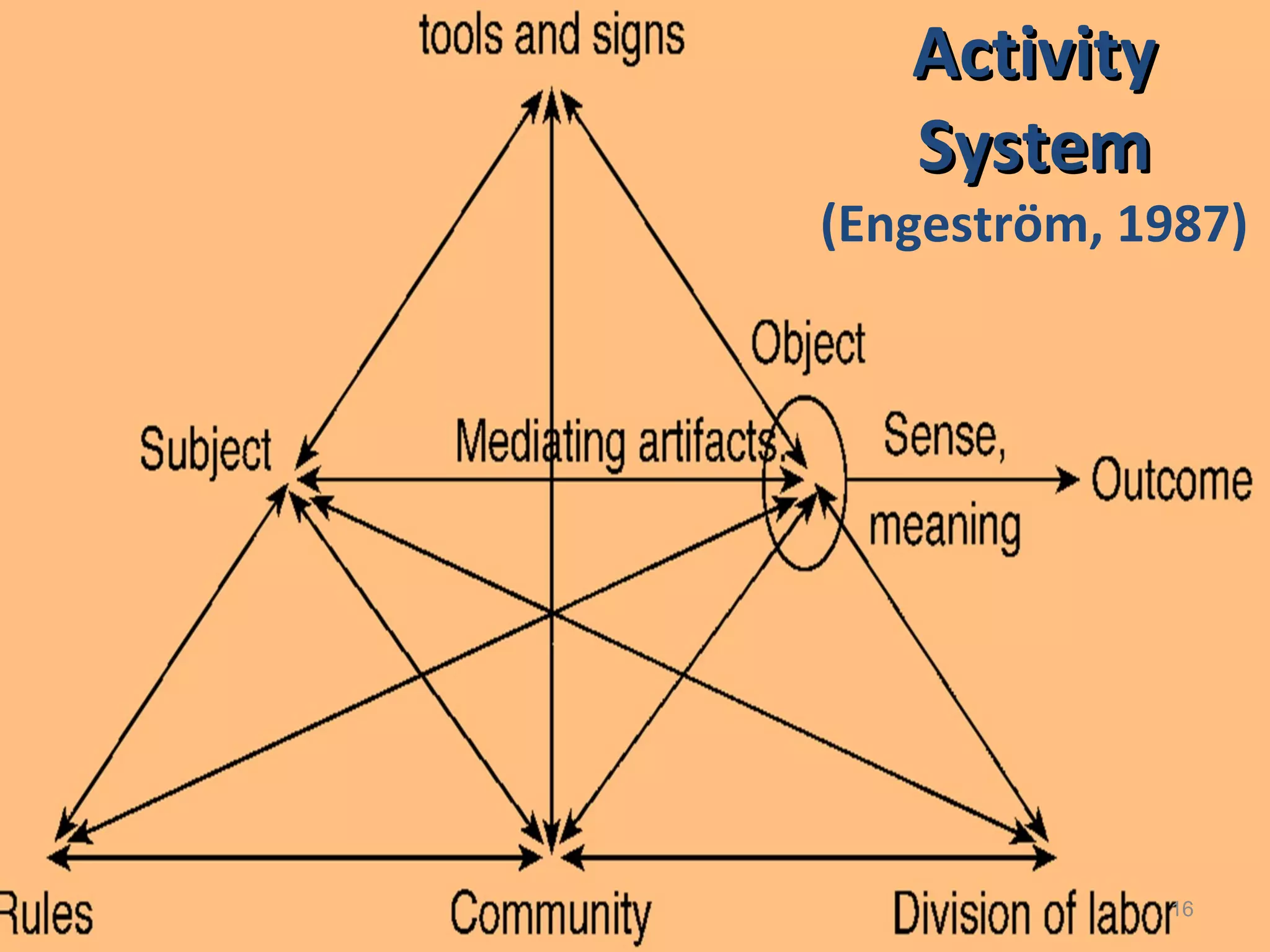
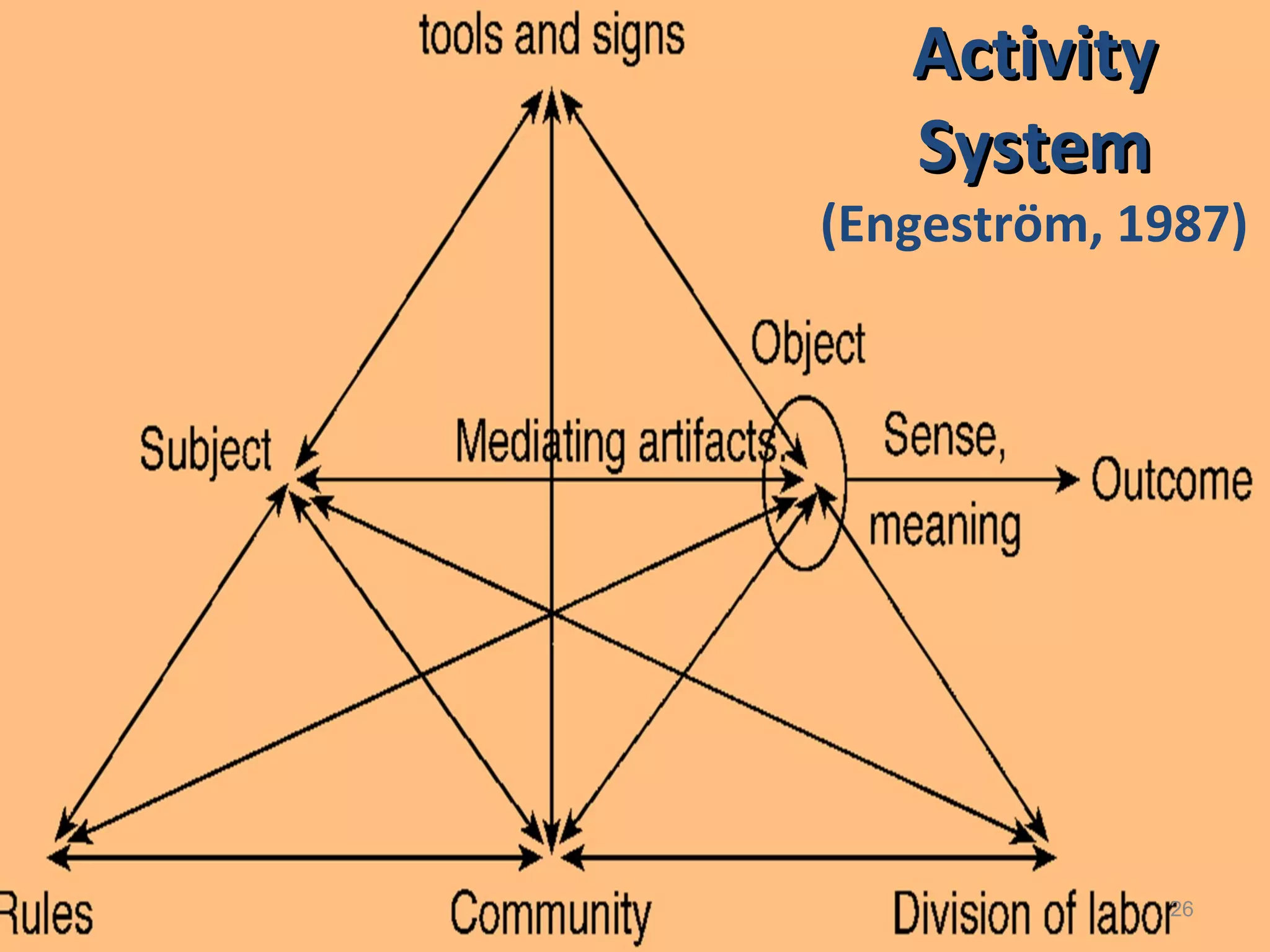
ActivityActivity
SystemSystem
(Engeström, 1987)
16
TOOLS
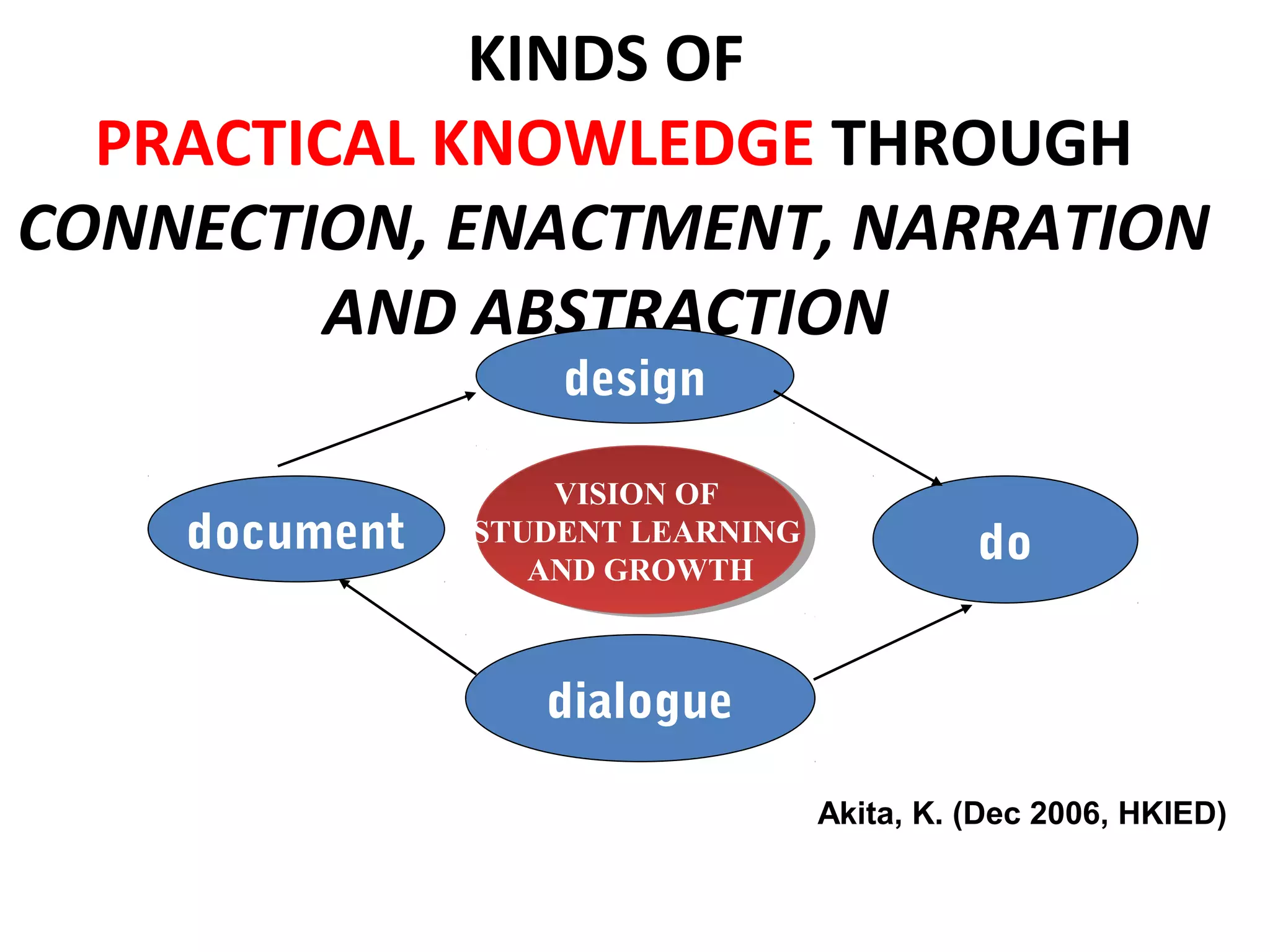
KINDS OF
PRACTICAL KNOWLEDGE THROUGH
CONNECTION, ENACTMENT, NARRATION
AND ABSTRACTION
design
do
dialogue
document
VISION OF
STUDENT LEARNING
AND GROWTH
VISION OF
STUDENT LEARNING
AND GROWTH
Akita, K. (Dec 2006, HKIED)
“Some leaders do give teachers more space
and time to reflect and make sense, but
being the good civil servants we are, we
tend to be too objective and the whole
process dissolves into 'reporting'; not
reflecting.
Discomfort arises when we see
inadequacies in ourselves that we do not
want to face up or do not want others to
know because it takes too much EMOTIONS
to do so. We'd rather finish our marking
than ask ourselves WHY we are marking
what we are marking.”
Activity Theory
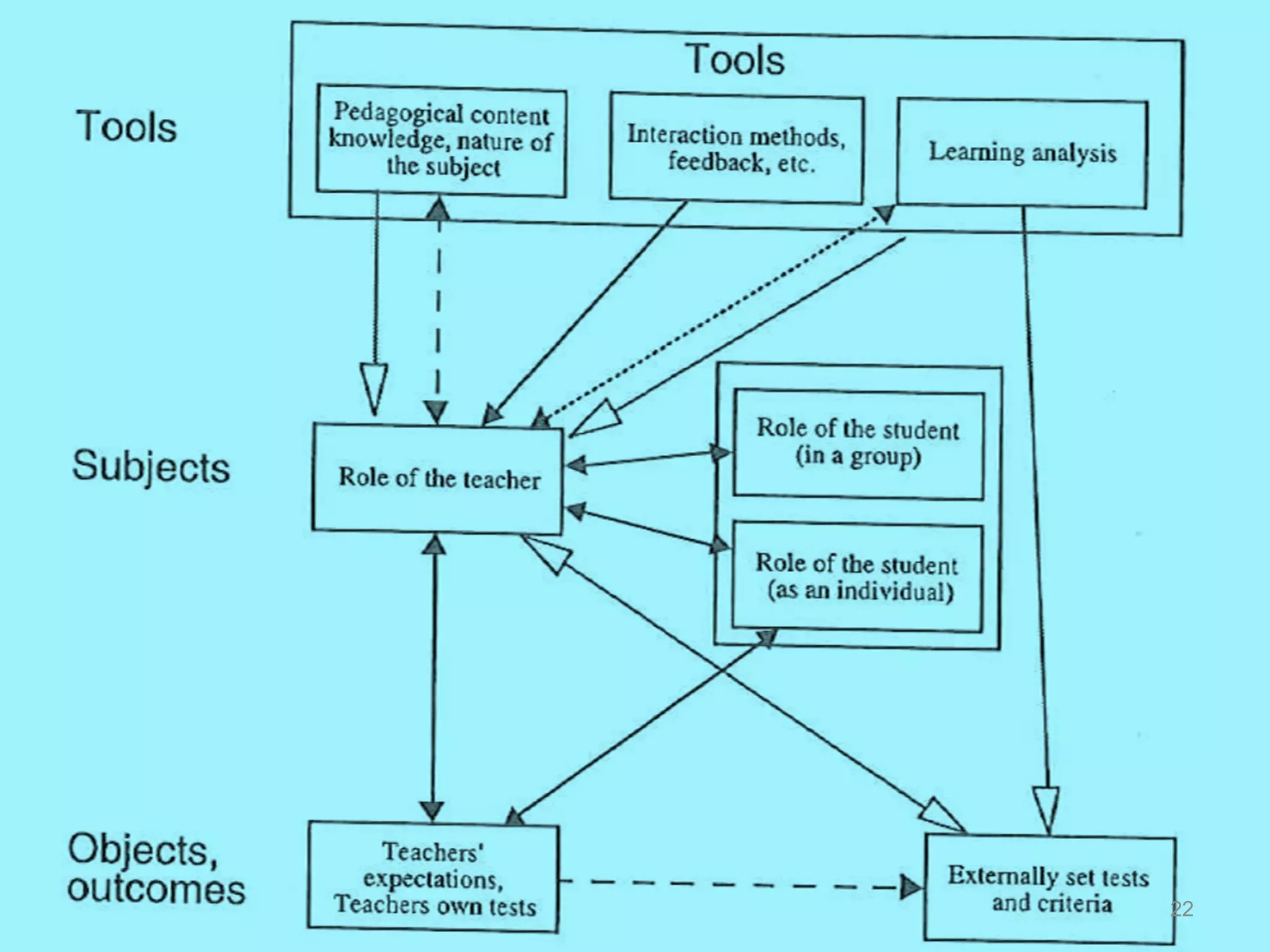
• Object – elements of human activity is
directed and transformed into results with the
aid of physical and symbolic and external and
internal thoughts
• Subject – the individual or group of individuals
whose actions are considered interesting from
an analytical point of view
20
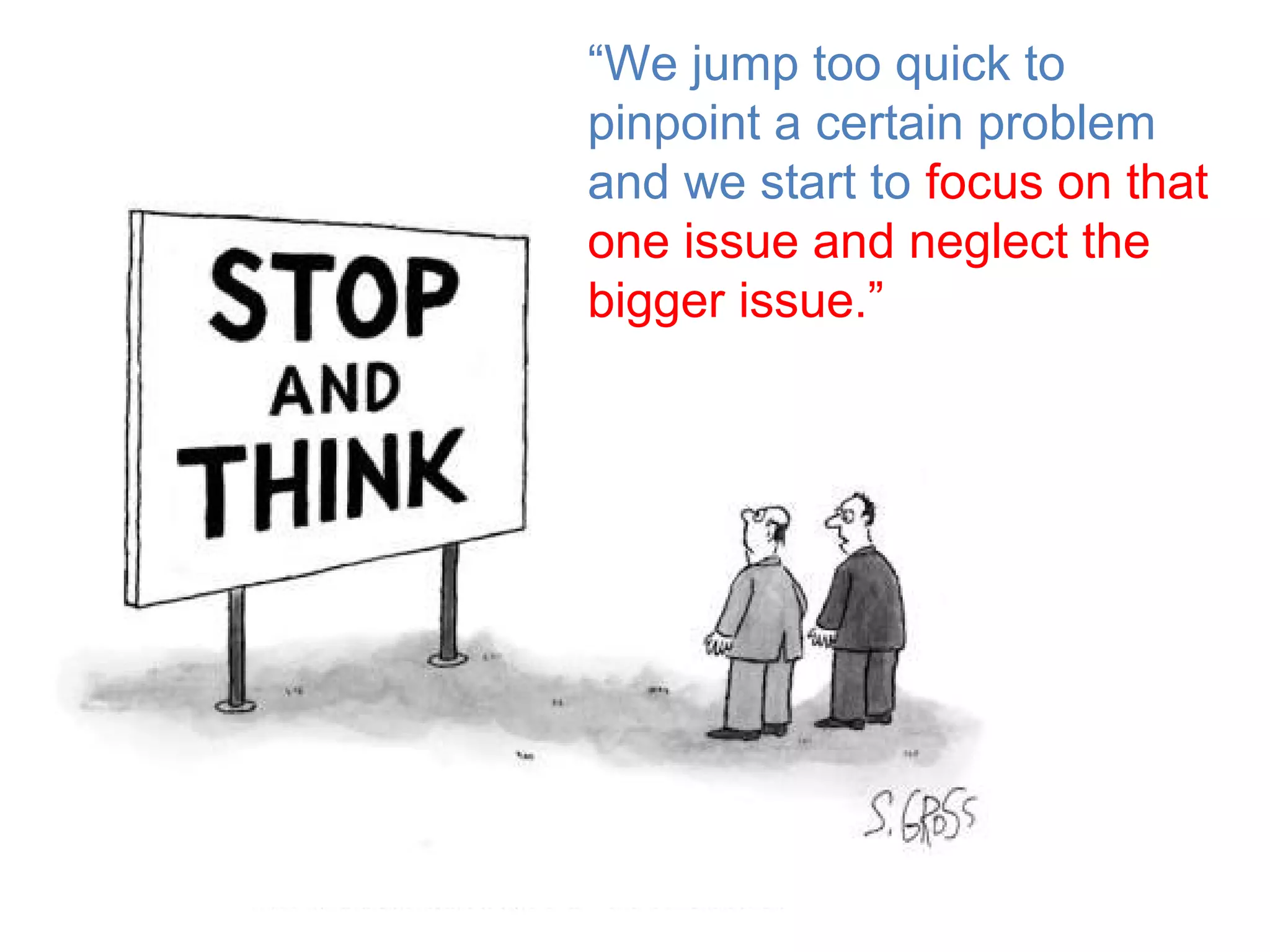
“We jump too quick to
pinpoint a certain problem
and we start to focus on that
one issue and neglect the
bigger issue.”
22
Tip of the
iceberg but …
what actually
lies beneath?
Activity Theory
• Insertion of cultural artifacts into human actions
• Unit of analysis overcame the split between the
Cartesian individual and the untouchable societal
structure.
• Individual could no longer be understood without
his or her cultural means
• Society could no longer be understood without
the agency of individuals who use and produce
artifacts.
24
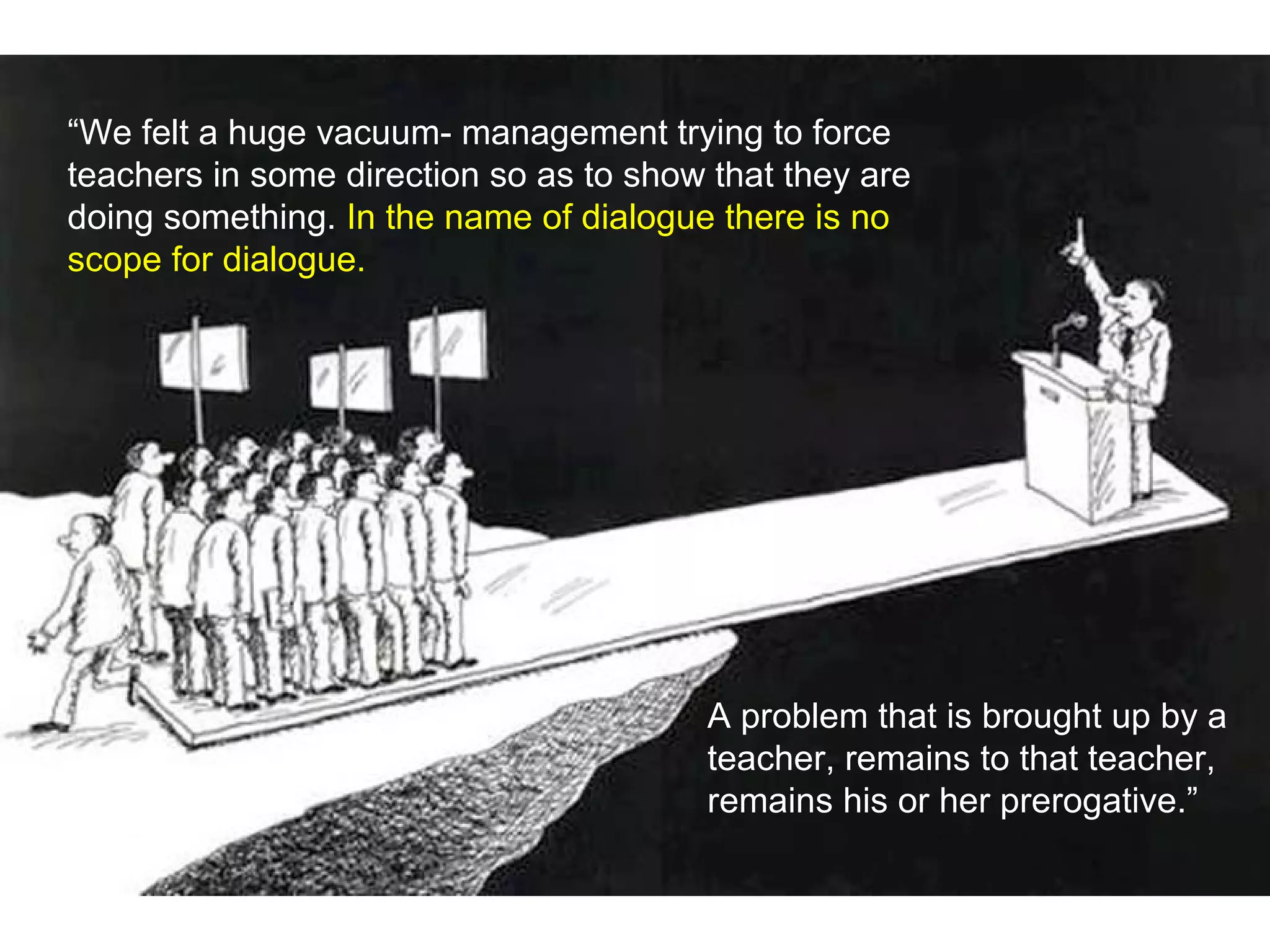
“We felt a huge vacuum- management trying to force
teachers in some direction so as to show that they are
doing something. In the name of dialogue there is no
scope for dialogue.
A problem that is brought up by a
teacher, remains to that teacher,
remains his or her prerogative.”
ActivityActivity
SystemSystem
(Engeström, 1987)
26
Activity Theory
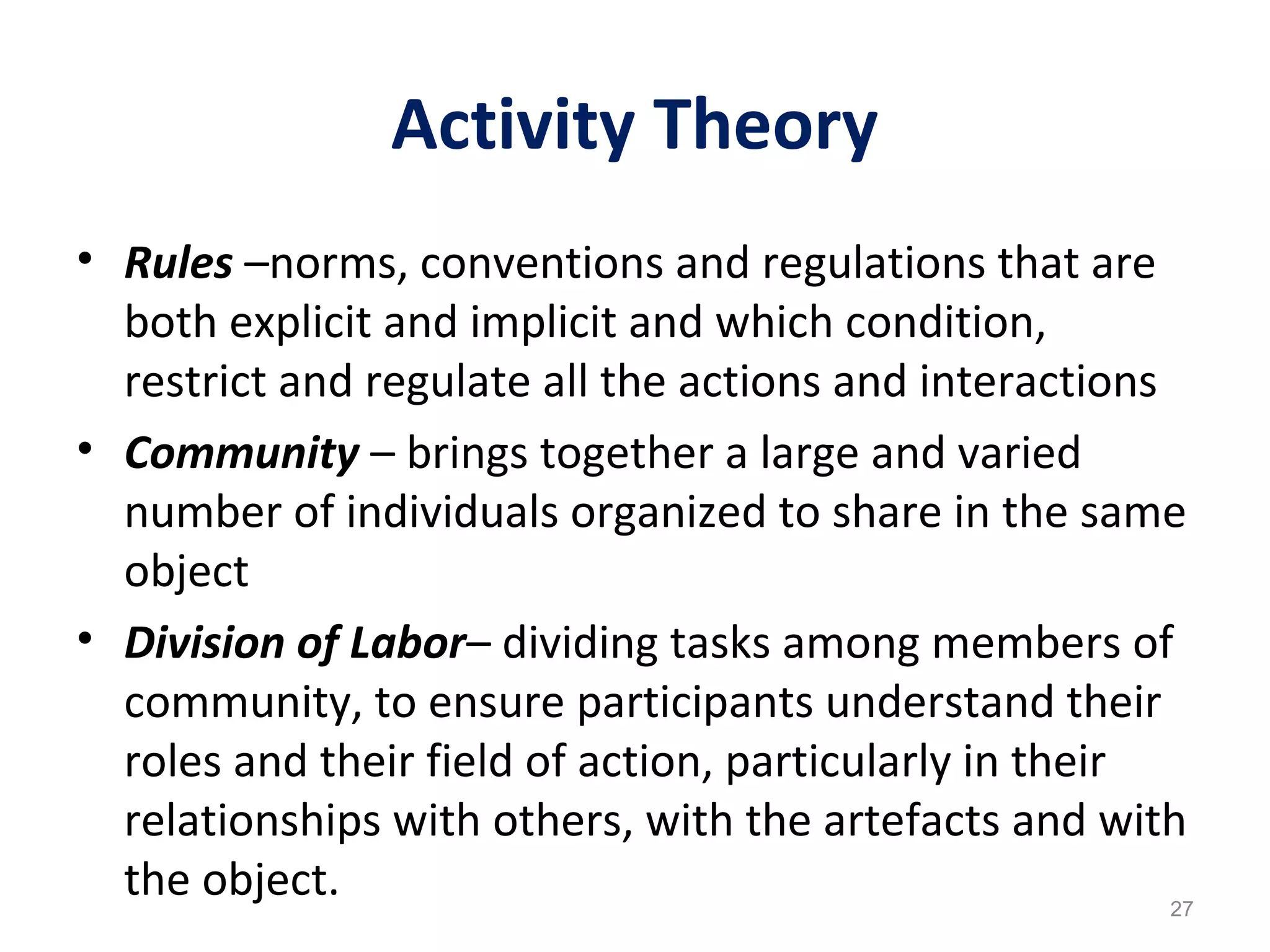
• Rules –norms, conventions and regulations that are
both explicit and implicit and which condition,
restrict and regulate all the actions and interactions
• Community – brings together a large and varied
number of individuals organized to share in the same
object
• Division of Labor– dividing tasks among members of
community, to ensure participants understand their
roles and their field of action, particularly in their
relationships with others, with the artefacts and with
the object. 27
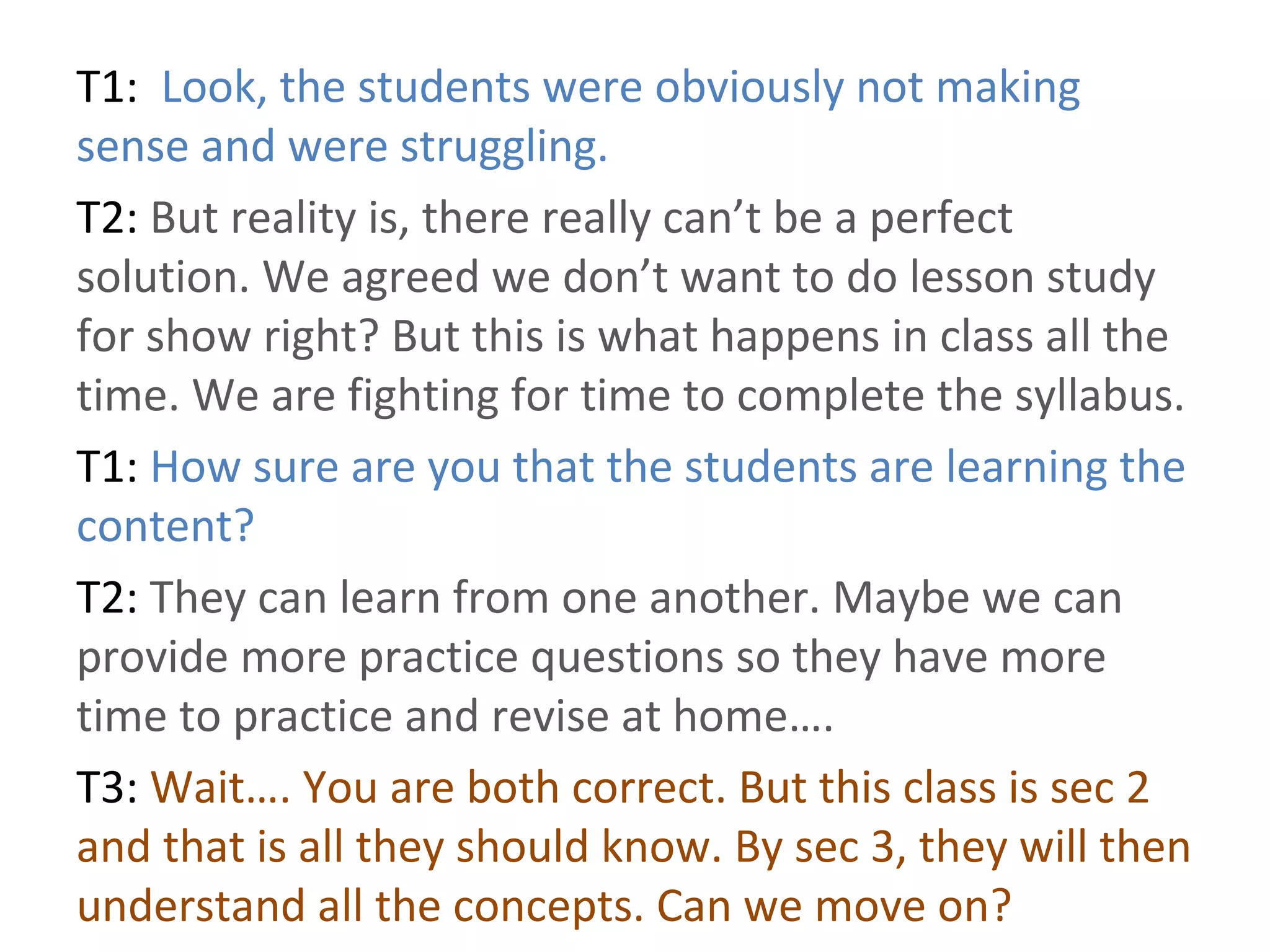
T1: Look, the students were obviously not making
sense and were struggling.
T2: But reality is, there really can’t be a perfect
solution. We agreed we don’t want to do lesson study
for show right? But this is what happens in class all the
time. We are fighting for time to complete the syllabus.
T1: How sure are you that the students are learning the
content?
T2: They can learn from one another. Maybe we can
provide more practice questions so they have more
time to practice and revise at home….
T3: Wait…. You are both correct. But this class is sec 2
and that is all they should know. By sec 3, they will then
understand all the concepts. Can we move on?
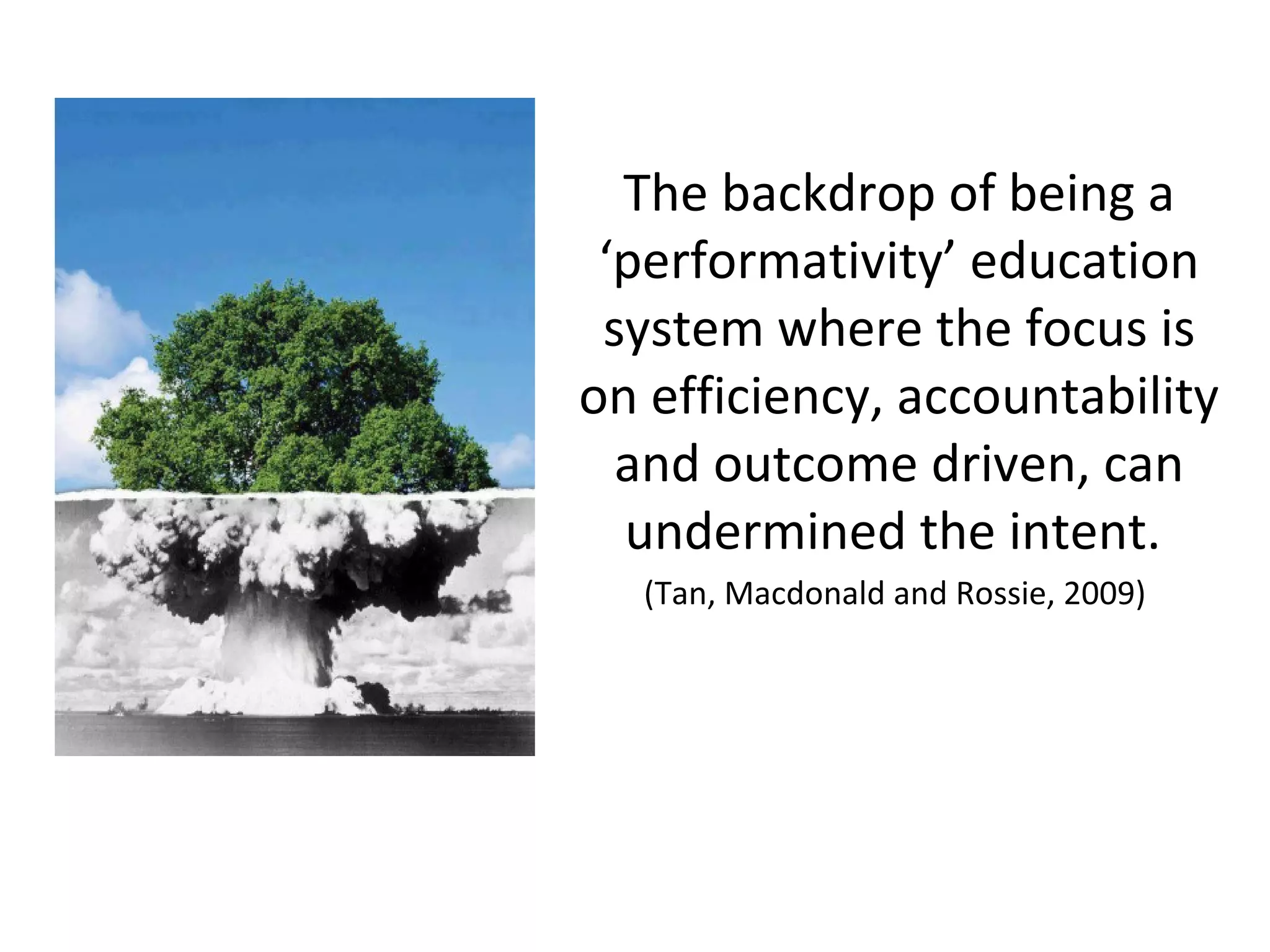
The backdrop of being a
‘performativity’ education
system where the focus is
on efficiency, accountability
and outcome driven, can
undermined the intent.
(Tan, Macdonald and Rossie, 2009)
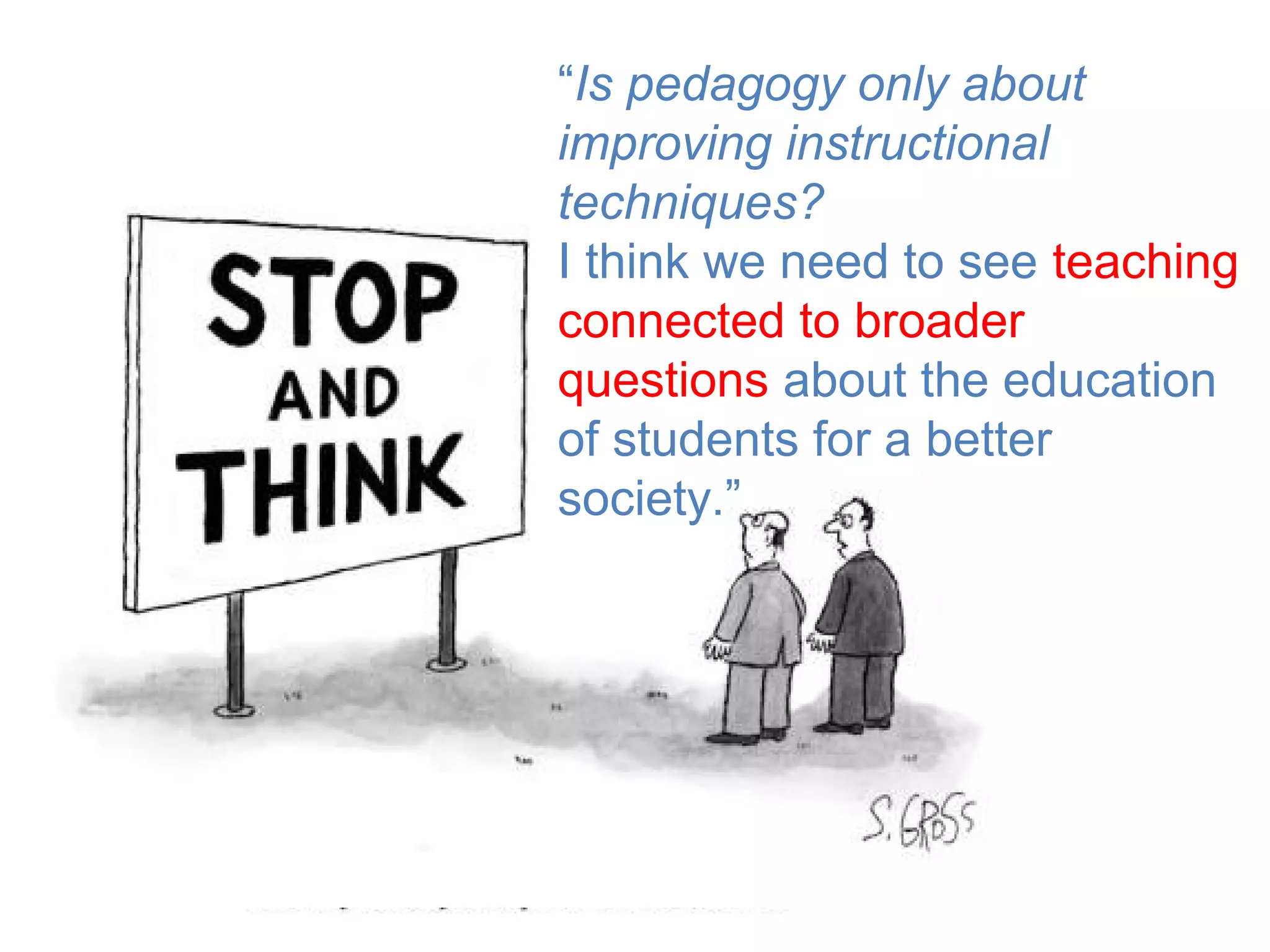
“Is pedagogy only about
improving instructional
techniques?
I think we need to see teaching
connected to broader
questions about the education
of students for a better
society.”
From the “Collapse” of Learning
to the “Renovation” of Teaching
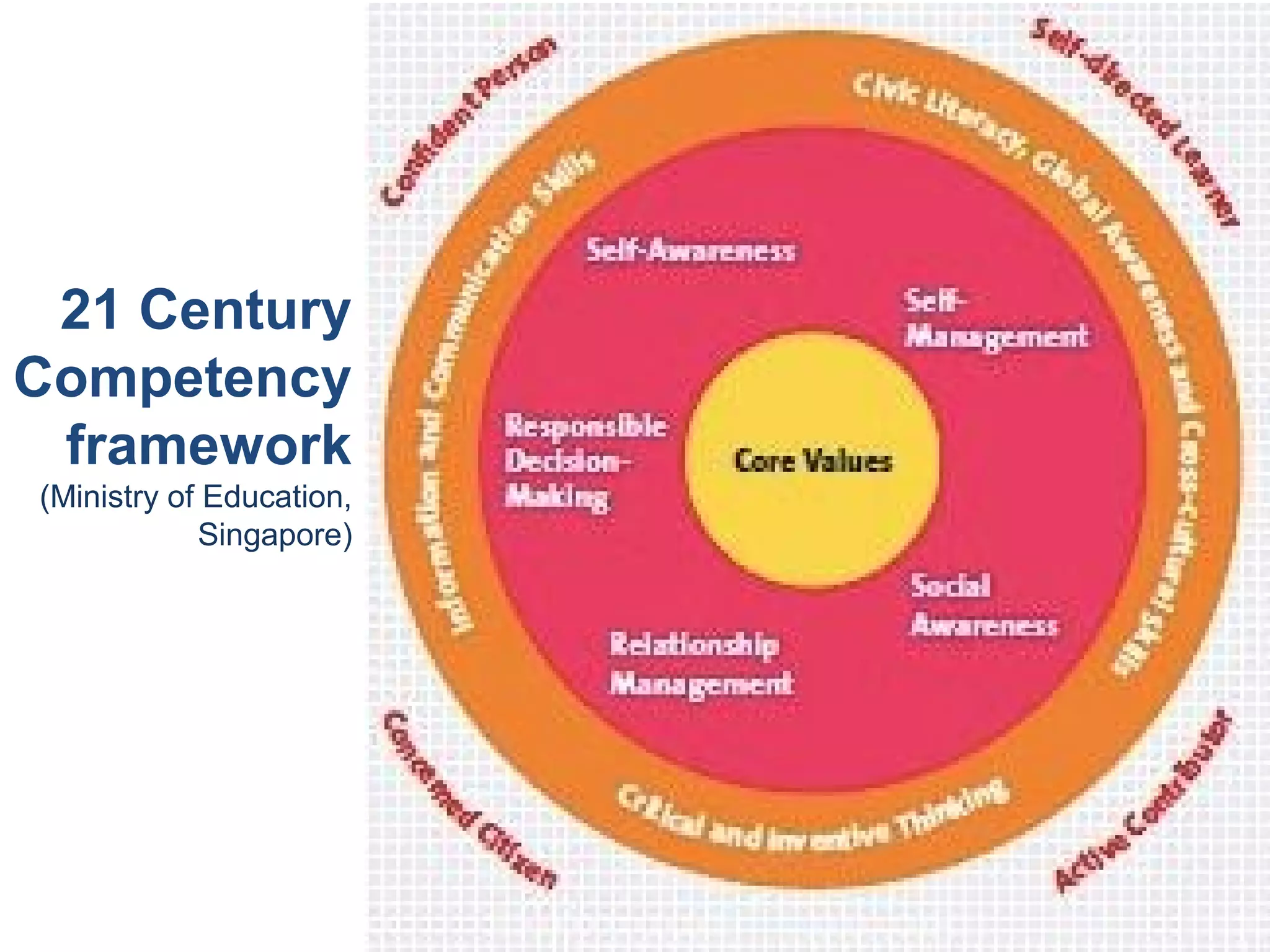
21 Century
Competency
framework
(Ministry of Education,
Singapore)
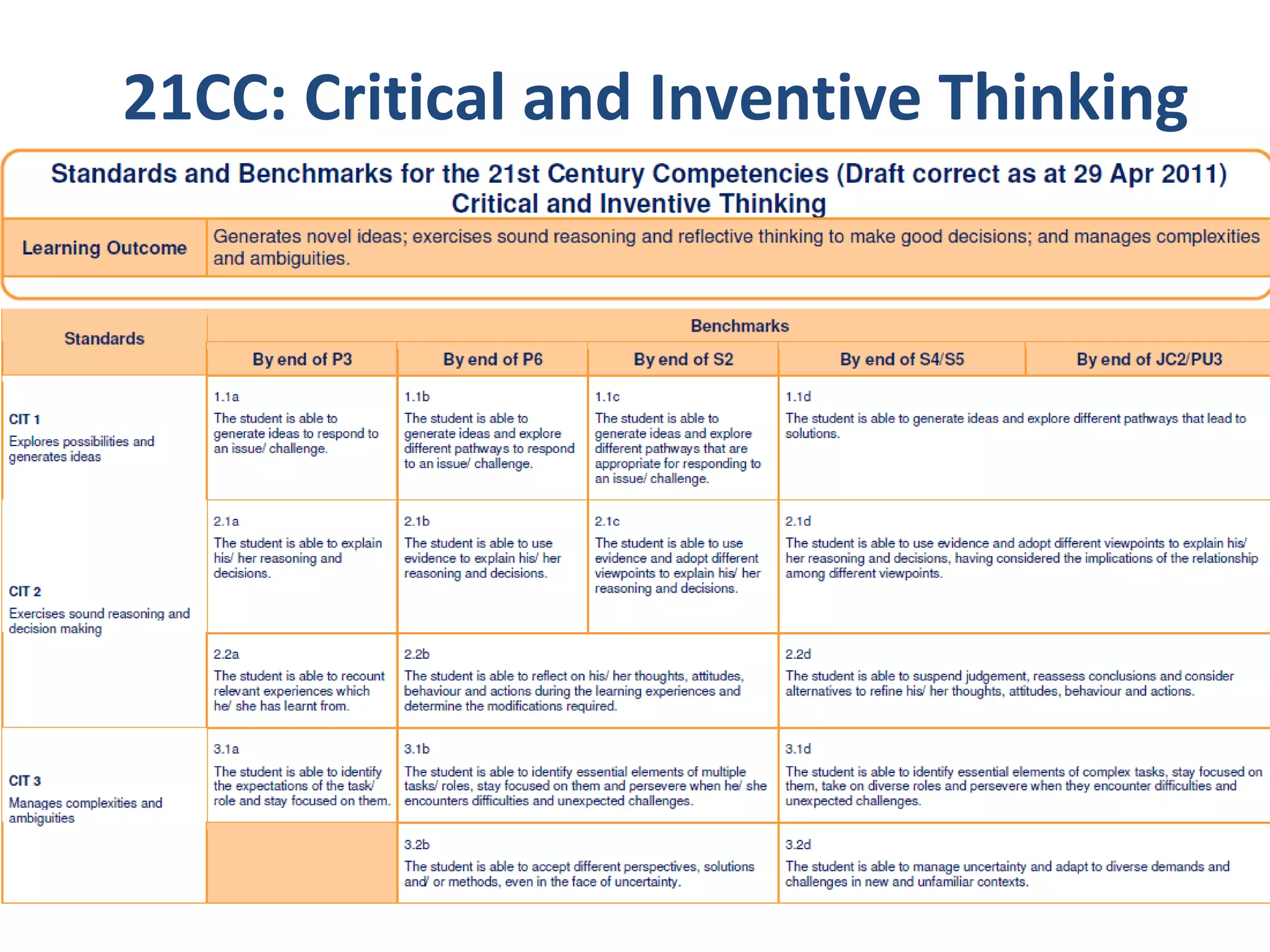
21CC: Critical and Inventive Thinking
33
The “Collapse” of Learning
• Research Theme: Assessment for Learning
(AfL) - To develop higher-order thinking skills
through cooperative learning strategies in
Science
• Research Hypothesis: Developing higher-
order thinking skills through the use of
cooperative learning strategies will raise
students’ performance in Science
The “Collapse” of Learning
• Research Theme: Assessment for Learning
(AfL) - To develop higher-order thinking skills
through cooperative learning strategies in
Science
• Research Hypothesis: Developing higher-
order thinking skills through the use of
cooperative learning strategies will raise
students’ performance in Science
SO WHAT??
The “Collapse” of Learning
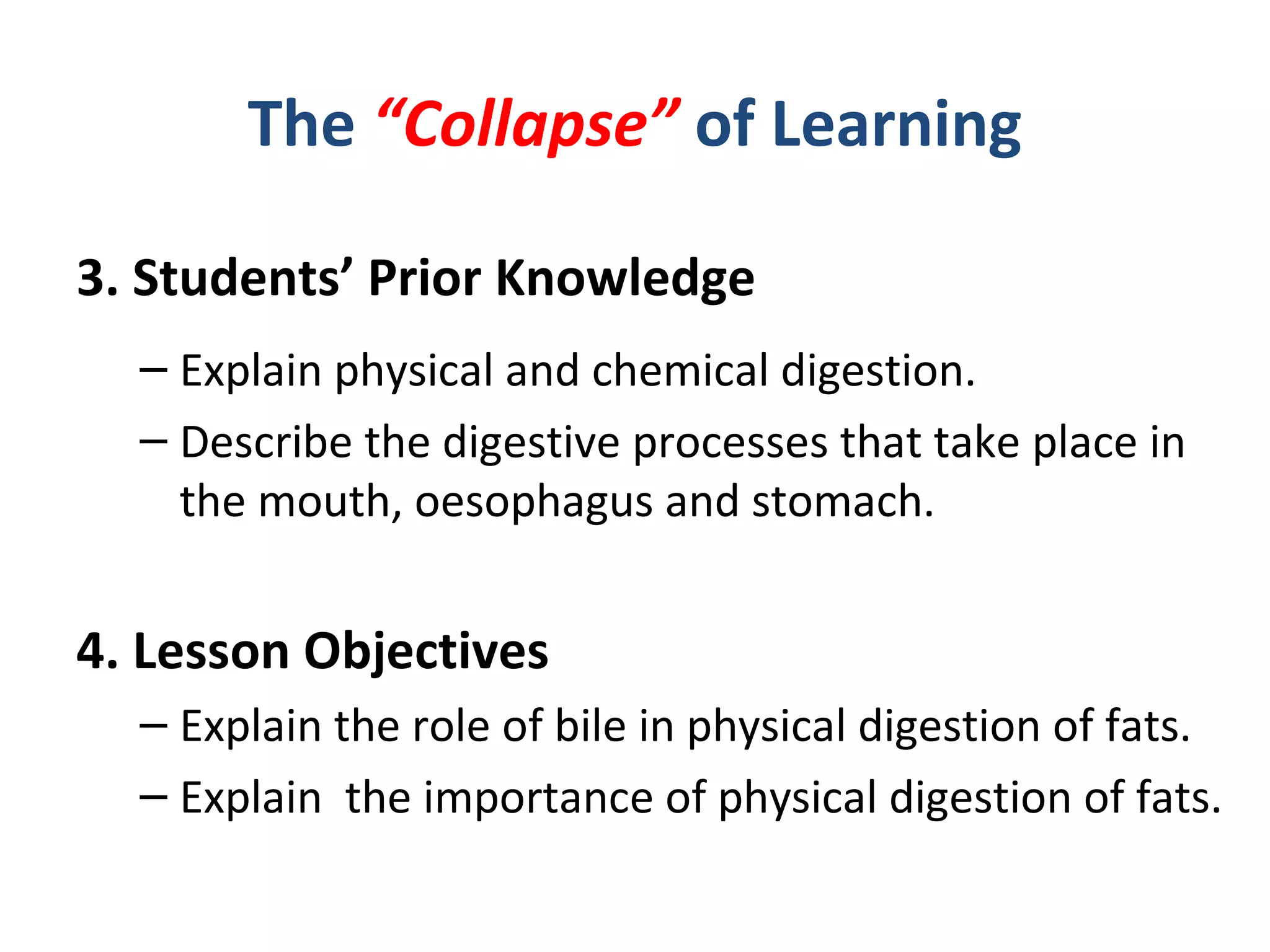
3. Students’ Prior Knowledge
– Explain physical and chemical digestion.
– Describe the digestive processes that take place in
the mouth, oesophagus and stomach.
4. Lesson Objectives
– Explain the role of bile in physical digestion of fats.
– Explain the importance of physical digestion of fats.
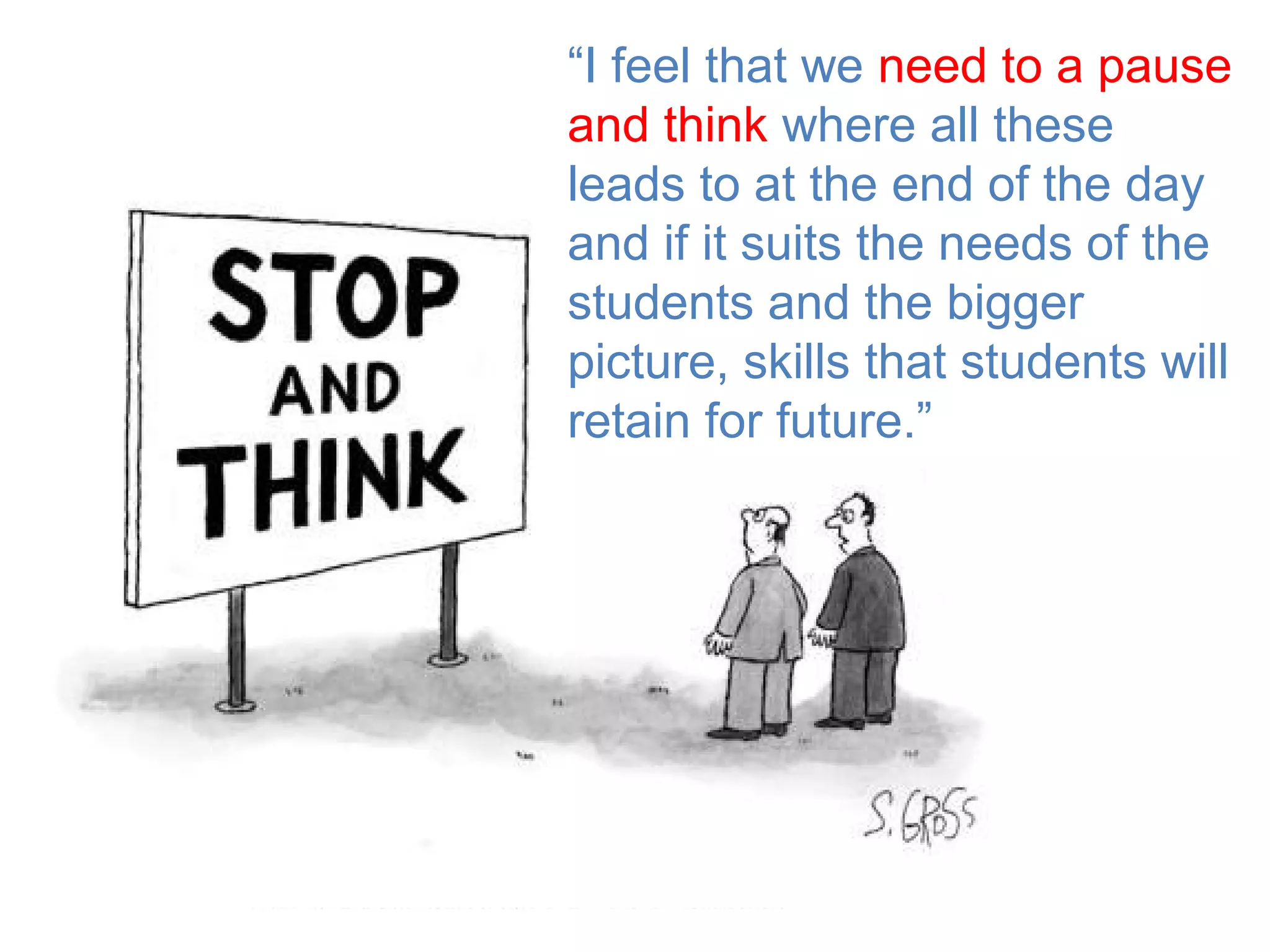
“I feel that we need to a pause
and think where all these
leads to at the end of the day
and if it suits the needs of the
students and the bigger
picture, skills that students will
retain for future.”
The “Renovation” of Teaching
• First begin with the tools with using the
classroom interactions to discover authentic
relations which prompt changes in the
relationship
• Between the subjects (the relationship
between the teacher and the students)
• Prompt changes in the subject themselves
(changes in teacher’s and students’ roles)
39
Stages in practical discourse shared by teachers:
① How to teach for inquiry in science?    
② How to teach children to inquire?
③ How to teach children to learn doing inquiry?
④ How to learn to teach children to learn by doing
inquiry?
The “Renovation” of Teaching
• Teachers’ classroom practices shifted from
associationistic views of learning to embracing
constructivism
• Teachers take collective responsibility for
learning linked to self-regulated learning,
metacognition and social learning
41
Illuminate the students’ voice
• Create open channels to design for teachers
themselves to become agents to change the
learning ecology in the classroom
• Agency of teachers and students, both as
individuals and as groups within the classroom
can have a substantial impact on what the ‘world
of that classroom’ looks like (the structure).
• Primary interest is also in the changes that
occurred in teachers’ practices, and in their
classrooms (the environments), than in
continuities and stabilities.
42
What did I learn yesteday?
• “Tipping point”- point at which a trend
catches fire – spreading exponentially through
the population
• For good or bad, change can be promoted
rather easily in a social system through a
domino effect.
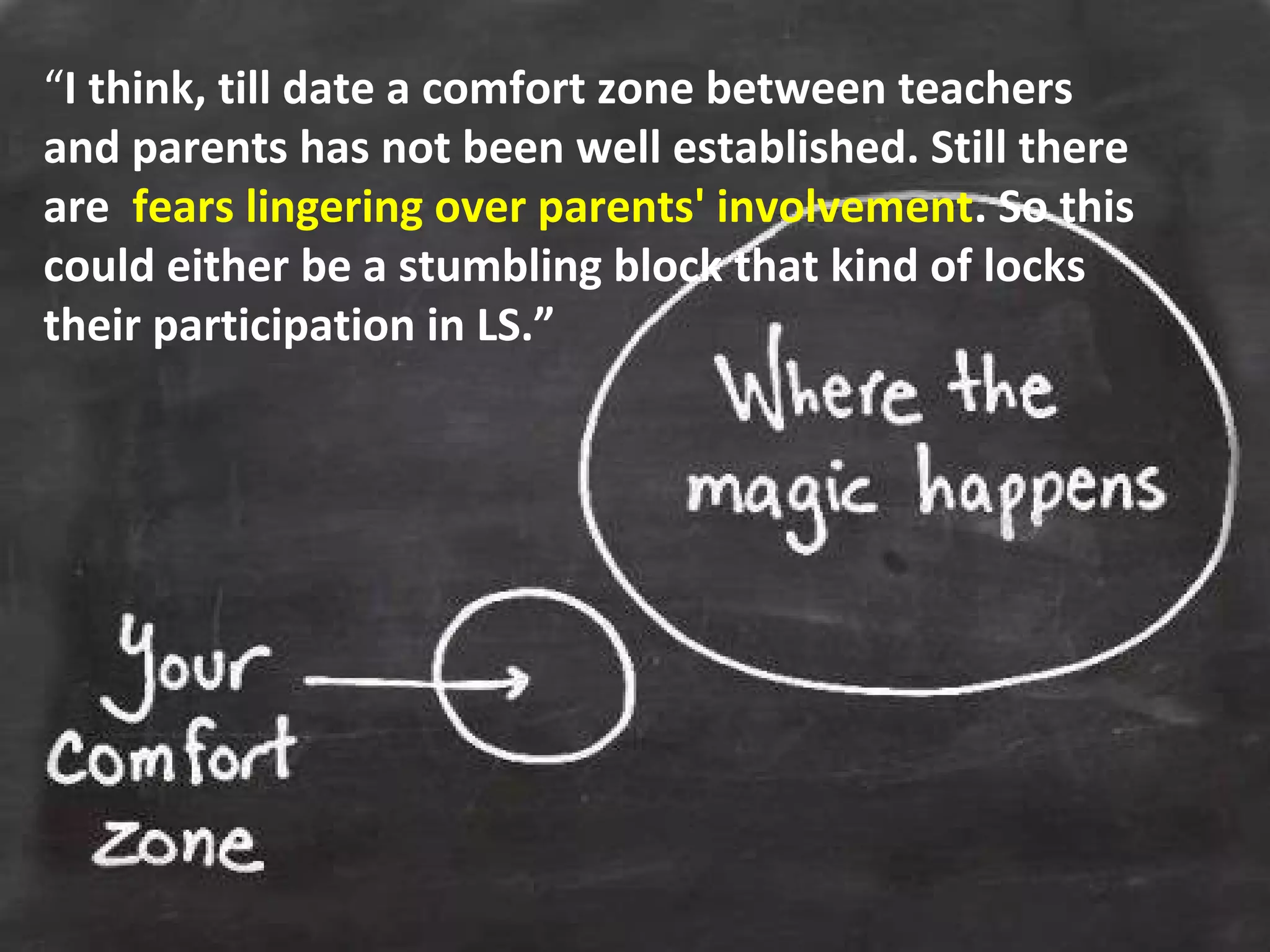
“I think, till date a comfort zone between teachers
and parents has not been well established. Still there
are fears lingering over parents' involvement. So this
could either be a stumbling block that kind of locks
their participation in LS.”
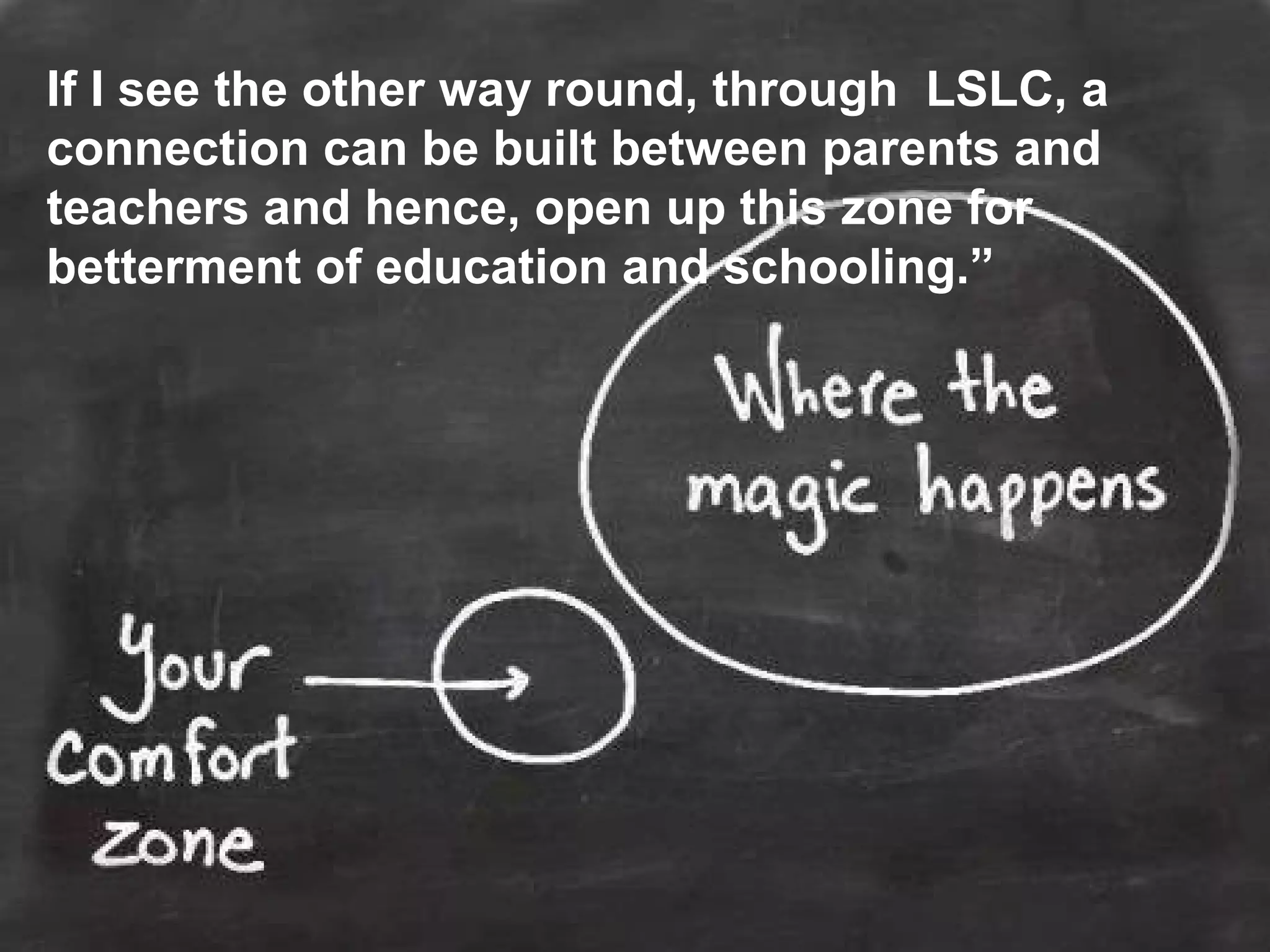
If I see the other way round, through LSLC, a
connection can be built between parents and
teachers and hence, open up this zone for
betterment of education and schooling.”
The key goal of my ministry is to bring out the
best in every child. In every domain of learning;
in every school; at every stage of the learning
journey; whatever the starting point; to create a
better future together.
Minister Heng Swee Kiat
@Parliament Debates 07 March 2014
John.yeo@nie.edu.sg
Thank you

Understanding Challenges of Curriculum Innovation and the Implementation_John Yeo (Singapore)

  • 1.
    Understanding Challenges ofCurriculum Innovation and the Implementation: John Yeo National Institute of Education, Singapore Invited Plenary Seminar in Gakushuin Univerisity, Tokyo What Impact Teachers’ Practice and Students’ Learning?
  • 2.
    •Innovation: Where isthe Evidence? •Curriculum: What gets lost in translation? •Didatik as “ways of seeing” the interplay of teaching and learning •Bringing in the cultural artifacts through Activity Theory •From the “collapse” of learning to the “renovation” of teaching Understanding Challenges of Curriculum Innovation and the Implementation: What Impact Teachers’ Practice and Students’ Learning?
  • 3.
    Conference theme: Educational Innovationthrough RENOVATINGRENOVATING Schools to Learning Community in Asia
  • 4.
    Innovation: “What isthe Evidence?”
  • 5.
    What do wewant to measure? – how well have teachers taught – how well have students learnt Innovation: “What is the Evidence?”
  • 6.
    Difference between matterand meaning: ".... we lost the ability to catch children's imagination and forgot what they are worth.” Innovation: “What is the Evidence?”
  • 7.
    Curriculum Innovation: Whatgets lost in the translation? • Public accountability • Good structures in place • School-based curriculum innovation with ‘Teach Less, Learn More’ (MOE, 2007)
  • 8.
    Curriculum Innovation: Whatgets lost in the translation? • Address diverse learning needs of students • Intensification of diagnostic data – determine student needs – expand teachers’ instructional toolkits
  • 9.
    Curriculum Innovation: Whatgets lost in the translation? • Professional Learning Community • Teachers collaborate within grade- and subject- level teams • Inwardly focused becoming silos of innovation
  • 10.
    Curriculum Innovation: Whatgets lost in the translation? • Teachers “live” outside these silos • Problems, and solutions, exist outside the silos. • Reform fatigue? • Gap between what is expected versus what really is manageable and critical seems to be widening.
  • 11.
    Curriculum Innovation: Whatgets lost in the translation? Hegemony of Performativity
  • 12.
    “Ways of seeing”the interplay of teaching and learning
  • 13.
  • 14.
    • Teaching andlearning as embedded activities • Framed by social and political conditions • Enacted in a given classroom or school From Curriculum to Didaktik
  • 15.
    Curriculum • What, whyand which subject matter should be dealt with • What knowledge is of most worth?” Didaktik • How does teaching and learning unfold, and what might be helpful • How to open up the world for the student and the student for the world?” From Curriculum to Didaktik Didaktik sees the whatwhat question as relational
  • 16.
  • 17.
  • 18.
    KINDS OF PRACTICAL KNOWLEDGETHROUGH CONNECTION, ENACTMENT, NARRATION AND ABSTRACTION design do dialogue document VISION OF STUDENT LEARNING AND GROWTH VISION OF STUDENT LEARNING AND GROWTH Akita, K. (Dec 2006, HKIED)
  • 19.
    “Some leaders dogive teachers more space and time to reflect and make sense, but being the good civil servants we are, we tend to be too objective and the whole process dissolves into 'reporting'; not reflecting. Discomfort arises when we see inadequacies in ourselves that we do not want to face up or do not want others to know because it takes too much EMOTIONS to do so. We'd rather finish our marking than ask ourselves WHY we are marking what we are marking.”
  • 20.
    Activity Theory • Object– elements of human activity is directed and transformed into results with the aid of physical and symbolic and external and internal thoughts • Subject – the individual or group of individuals whose actions are considered interesting from an analytical point of view 20
  • 21.
    “We jump tooquick to pinpoint a certain problem and we start to focus on that one issue and neglect the bigger issue.”
  • 22.
  • 23.
    Tip of the icebergbut … what actually lies beneath?
  • 24.
    Activity Theory • Insertionof cultural artifacts into human actions • Unit of analysis overcame the split between the Cartesian individual and the untouchable societal structure. • Individual could no longer be understood without his or her cultural means • Society could no longer be understood without the agency of individuals who use and produce artifacts. 24
  • 25.
    “We felt ahuge vacuum- management trying to force teachers in some direction so as to show that they are doing something. In the name of dialogue there is no scope for dialogue. A problem that is brought up by a teacher, remains to that teacher, remains his or her prerogative.”
  • 26.
  • 27.
    Activity Theory • Rules–norms, conventions and regulations that are both explicit and implicit and which condition, restrict and regulate all the actions and interactions • Community – brings together a large and varied number of individuals organized to share in the same object • Division of Labor– dividing tasks among members of community, to ensure participants understand their roles and their field of action, particularly in their relationships with others, with the artefacts and with the object. 27
  • 28.
    T1: Look, thestudents were obviously not making sense and were struggling. T2: But reality is, there really can’t be a perfect solution. We agreed we don’t want to do lesson study for show right? But this is what happens in class all the time. We are fighting for time to complete the syllabus. T1: How sure are you that the students are learning the content? T2: They can learn from one another. Maybe we can provide more practice questions so they have more time to practice and revise at home…. T3: Wait…. You are both correct. But this class is sec 2 and that is all they should know. By sec 3, they will then understand all the concepts. Can we move on?
  • 29.
    The backdrop ofbeing a ‘performativity’ education system where the focus is on efficiency, accountability and outcome driven, can undermined the intent. (Tan, Macdonald and Rossie, 2009)
  • 30.
    “Is pedagogy onlyabout improving instructional techniques? I think we need to see teaching connected to broader questions about the education of students for a better society.”
  • 31.
    From the “Collapse”of Learning to the “Renovation” of Teaching
  • 32.
  • 33.
    21CC: Critical andInventive Thinking 33
  • 34.
    The “Collapse” ofLearning • Research Theme: Assessment for Learning (AfL) - To develop higher-order thinking skills through cooperative learning strategies in Science • Research Hypothesis: Developing higher- order thinking skills through the use of cooperative learning strategies will raise students’ performance in Science
  • 35.
    The “Collapse” ofLearning • Research Theme: Assessment for Learning (AfL) - To develop higher-order thinking skills through cooperative learning strategies in Science • Research Hypothesis: Developing higher- order thinking skills through the use of cooperative learning strategies will raise students’ performance in Science SO WHAT??
  • 36.
    The “Collapse” ofLearning 3. Students’ Prior Knowledge – Explain physical and chemical digestion. – Describe the digestive processes that take place in the mouth, oesophagus and stomach. 4. Lesson Objectives – Explain the role of bile in physical digestion of fats. – Explain the importance of physical digestion of fats.
  • 37.
    “I feel thatwe need to a pause and think where all these leads to at the end of the day and if it suits the needs of the students and the bigger picture, skills that students will retain for future.”
  • 39.
    The “Renovation” ofTeaching • First begin with the tools with using the classroom interactions to discover authentic relations which prompt changes in the relationship • Between the subjects (the relationship between the teacher and the students) • Prompt changes in the subject themselves (changes in teacher’s and students’ roles) 39
  • 40.
    Stages in practicaldiscourse shared by teachers: ① How to teach for inquiry in science?     ② How to teach children to inquire? ③ How to teach children to learn doing inquiry? ④ How to learn to teach children to learn by doing inquiry? The “Renovation” of Teaching
  • 41.
    The “Renovation” ofTeaching • Teachers’ classroom practices shifted from associationistic views of learning to embracing constructivism • Teachers take collective responsibility for learning linked to self-regulated learning, metacognition and social learning 41
  • 42.
    Illuminate the students’voice • Create open channels to design for teachers themselves to become agents to change the learning ecology in the classroom • Agency of teachers and students, both as individuals and as groups within the classroom can have a substantial impact on what the ‘world of that classroom’ looks like (the structure). • Primary interest is also in the changes that occurred in teachers’ practices, and in their classrooms (the environments), than in continuities and stabilities. 42
  • 43.
    What did Ilearn yesteday? • “Tipping point”- point at which a trend catches fire – spreading exponentially through the population • For good or bad, change can be promoted rather easily in a social system through a domino effect.
  • 44.
    “I think, tilldate a comfort zone between teachers and parents has not been well established. Still there are fears lingering over parents' involvement. So this could either be a stumbling block that kind of locks their participation in LS.”
  • 45.
    If I seethe other way round, through LSLC, a connection can be built between parents and teachers and hence, open up this zone for betterment of education and schooling.”
  • 46.
    The key goalof my ministry is to bring out the best in every child. In every domain of learning; in every school; at every stage of the learning journey; whatever the starting point; to create a better future together. Minister Heng Swee Kiat @Parliament Debates 07 March 2014
  • 47.

Editor's Notes

  • #2 Thank you Prof Manabu Sato for inviting me to speak on this topic.
  • #3 Thank you Prof Manabu Sato for inviting me to speak on this topic. My topic is… In the spirit of LSLC, pls allow me to model the learning nature with a question: If there is a word that best describes LSLC, what would that be?
  • #4 The theme of the conference is "Educational Innovation through Renovating Schools to Learning Community in Asia", as we know school as learning community has drastically impacted on educational reform in all of the Asian countries and we, people who are concerned about human right of education for all , are keen to know what this means to democratization of schooling. It is also our firm belief that practical research which integrates theory and practice in the reflective practice has been elaborated among the colleagues of this movement.
  • #5 Ladies and gentlemen, I watched the movie Gravity on my way to the conference. Sandra Bullocks was sent as a commissioned specialist to space on a mission. A classic line she said was SHOW ME THE EVIDENCE…. An unexpected disruption happened and the whole mission was aborted. Worst, she lost her team mates and her world collapse. The evidence she was seeking proved to become empty shells when she was brought to her core. The only meaning to innovation in her desperate state was but one word- Survival.
  • #6 Today, we search for evidence to identify gaps to help us move forward and essentially to show progress. But the heart of it is, what are we measuring? What evidence are we looking for? In education, essentially, its mostly about how well teachers have taught and how well their students have learnt. If the outcome for Singapore is better results, I think the international measurements have proved a point that we have worked hard towards. We have done well as a system to produce top results. This is the outcome that many other education systems are hoping to learn from. But as we celebrate the success, it is necessary to rethink, have we gathered the right forms of data? I am an academic and I think we need to first be self-critical in order for us to use these ‘evidences’ to help us to continue to innovate.
  • #8 In my view, there is an “international movement”- an obsessive attachment to public accountability. Please don’t get me wrong. It’s all good and it’s important. We need to put in good structures and I think it’s evident that with the push for our national curriculum policy of ‘Teach Less, Learn More’ (MOE, 2007) the many school-based curriculum innovation have sowed wonderful seeds.
  • #9 Evidently, there is an intensification of diagnostic data to determine student needs and expand teachers’ instructional toolkits to address diverse learning needs of students.
  • #10 To support teachers’ professional learning, our MOE has given much support for schools to embark on Professional Learning Community. In most schools, teachers frequently collaborate within grade- and subject level teams blossom to create vibrant learning. Yet, little did we realize that we have mostly inwardly focused and creating silos of deepened professionalism. These efforts are great to heighten teachers’ awareness but there is another inherent problem.
  • #11 Teachers often “live” outside these silos. Many of the problems, as well as solutions, exist outside the silos. I suspect, some are struggling and may be undergoing reform fatigue. With new expectations to adopt more rigorous academic standards, teachers on ground feel it and the gap between what is expected versus what really is manageable and critical seems to be widening. Levels of Curriculum work: policy  planned  enacted  experienced
  • #12 These TENSIONS create new dilemmas in the culture of performativity; teachers feel constrained and do what is most possible. With the emphasis of performativity and the need to be accountable to results, we often look at the success of school-based research as how many percent improvement in students’ academic results rather than the true meaning of education. Extending along the same line of how these shape teachers’ beliefs and actions, we need to also consider, what else gets lost in the translation? From the broad national curriculum goals of TLLM, we look then at the levels of curriculum work. From policy to planned to enacted to the experience curriculum, what gets lost? Yet, the ‘matter’ of enacting the planned curriculum to the experienced curriculum takes more than one or two attempts to “plug” the gap. LSLC argues that we cannot just do PLC once or twice a year. While the frequency sounds daunting, the execution of the process, based on what Prof Sato advocates should be simplified to become more organic. Peter Senge introduced systems thinking to educators and we start peering more carefully into what is missing in the structures and processes schools need for systems thinking to make that difference. Donald Schon proposed that a “learning organization” is one that is “capable of bringing about its own transformation”. However, while transformation is our goal, we often hear teachers sigh “here we go again”. What are the conditions that we need to pay attention to teachers’ professional lives and in schools- how information flows, role of leadership, diversity of perspectives we use to solve problems and the degree to which our interdependence becomes an opportunity rather than a nightmare?
  • #13 What is curriculum translation? What are causes for failure in translation? (The TLLM Framework (Customization); the TLLM Ignite: SBCI; The PETALS: Engaged Learning) What are the roles of school and teachers in curriculum translation?
  • #14 Internationally, there exist two historically predominant “ways of seeing” the interplay of teaching and learning: Didaktik and Curriculum The concept of Didaktik goes back to ancient times (Plato: Menon), and found its modern shape around 1800 in Germany (e.g. Herbart 1806). It has been widely used ever since in most of Europe, in some parts of Asia as well as in Latin America. The concept of curriculum emerged in 16th century (Ramus 1543), and got is modern re-vitalization around 1900 (e.g. Dewey 1902). Throughout 20th century it has been predominant in most of the English speaking world, and – step by step – it has gained some influence in other cultures as well as a kind of “lingua franca” of schooling.
  • #19 The LS research cycle creates many kinds of teacher’s practical knowledge through connection, enactment, narration, and abstraction. At designning lesson. Teachers discuss about their pedagogical content knowledge. They conect subject matter knowledge with children’s learning and development. Next, doing lessons. Lesson Teacher show his emobodied knowlede and other teacher’s lean how to enact, how to insert their intention Into teaching behavior. After that they have a dialogue and knowledge of children’s leaning process. Narration is talk about cases. The last one, after some Interval, teacher write their report or portfolio. They find the narratives of learning trajectories.That is the abstraction process . Yeallos part shows the teacher’s knowledge. Orange part shows the teacher’s congnitive process And green part is behaviors.
  • #20 Reporting vs Reflection
  • #41 Change in practical reasoning
  • #44 http://www.stanford.edu/class/symbsys205/Diffusion%20of%20Innovations.htm