
5 JUNE 2013. GEB. CPDD.
IvP Workshop
2013
Copyright © Ministry of Education, Singapore.
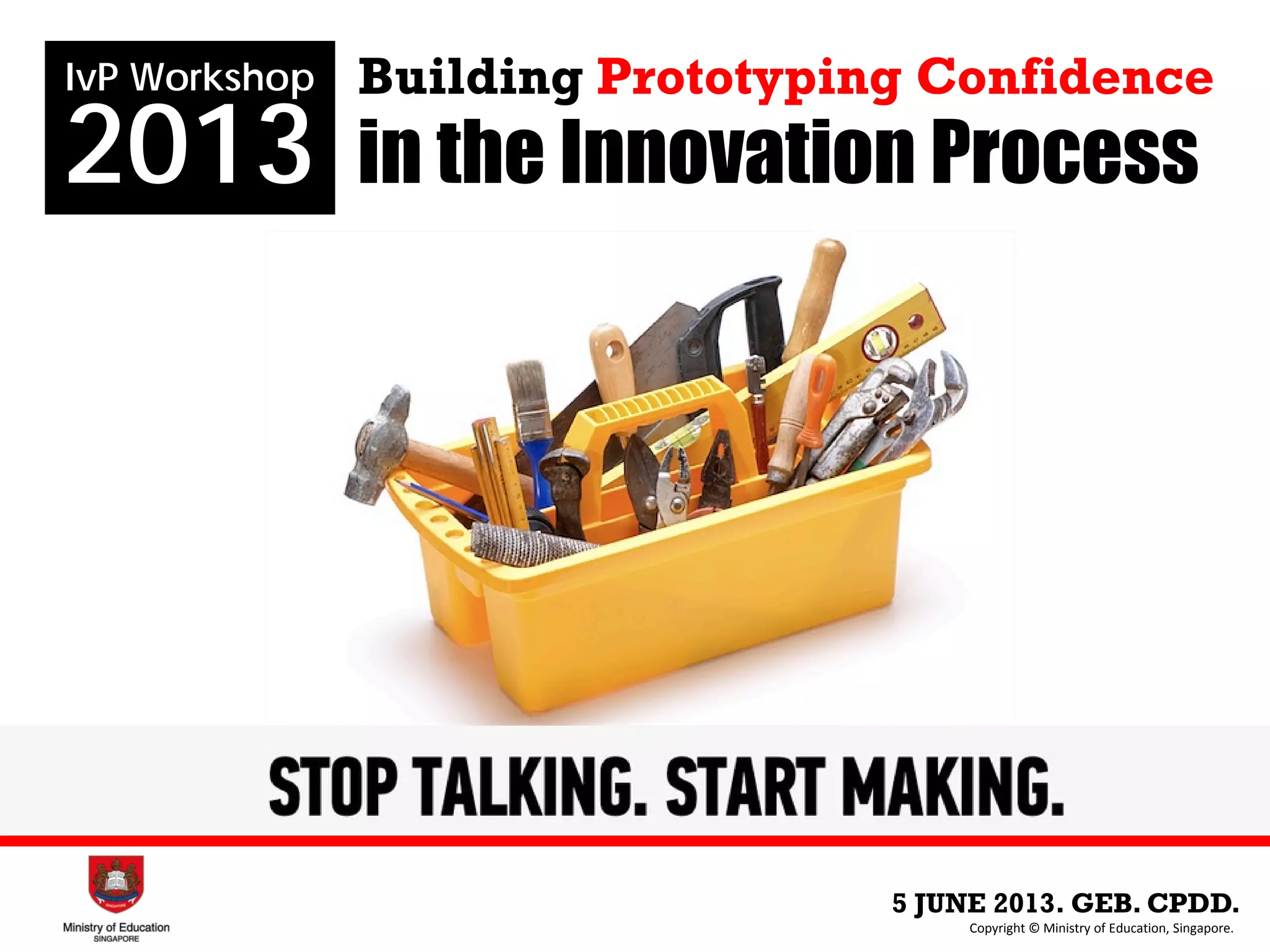
Building Prototyping Confidence
in the Innovation Process
5 JUNE 2013. GEB. CPDD.
IvP Workshop
2013
Copyright © Ministry of Education, Singapore.
Building Prototyping Confidence
in the Innovation Process
David Kwek.Tan ChorYean. Melvin Tan.
Benjamin Tan.Tan Huizhen.
JohnYeo.
in the Innovation Process
• Introduction: About IvP
• What is prototyping?
• Prototyping Lesson
• Conclusion + Feedback
5 JUNE 2013. GEB. CPDD.
IvP Workshop
2013
Copyright © Ministry of Education, Singapore.
Building Prototyping Confidence
9 0 m i n u t e s
in the Innovation Process
5 JUNE 2013. GEB. CPDD.
IvP Workshop
2013
Copyright © Ministry of Education, Singapore.
Building Prototyping Confidence
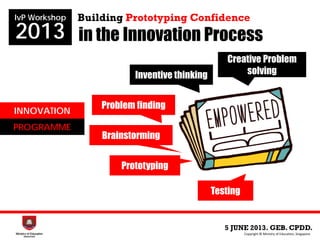
INNOVATION
PROGRAMME
Creative Problem
solvingInventive thinking
Problem finding
Brainstorming
Prototyping
Testing
in the Innovation Process
5 JUNE 2013. GEB. CPDD.
IvP Workshop
2013
Copyright © Ministry of Education, Singapore.
Building Prototyping Confidence
INNOVATION
PROGRAMME
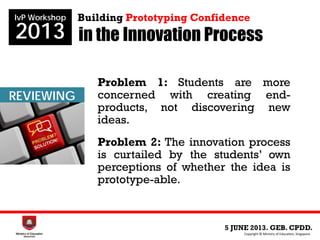
REVIEWING
Problem 1: Students are more
concerned with creating end-
products, not discovering new
ideas.
Problem 2: The innovation process
is curtailed by the students’ own
perceptions of whether the idea is
prototype-able.
in the Innovation Process
5 JUNE 2013. GEB. CPDD.
IvP Workshop
2013
Copyright © Ministry of Education, Singapore.
Building Prototyping Confidence
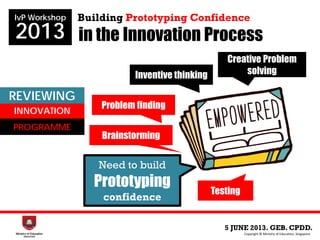
INNOVATION
PROGRAMME
Creative Problem
solvingInventive thinking
Problem finding
Brainstorming
Need to build
Prototyping
confidence
Testing
REVIEWING
in the Innovation Process
5 JUNE 2013. GEB. CPDD.
IvP Workshop
2013
Copyright © Ministry of Education, Singapore.
Building Prototyping Confidence
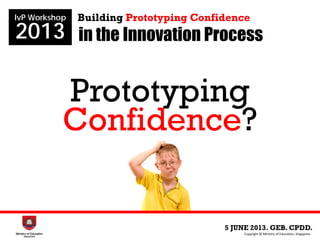
Prototyping
Confidence?
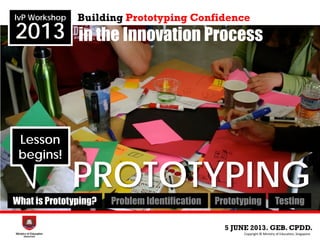
PROTOTYPING
in the Innovation Process
5 JUNE 2013. GEB. CPDD.
IvP Workshop
2013
Copyright © Ministry of Education, Singapore.
Building Prototyping Confidence
Lesson
begins!
What is Prototyping? Problem Identification Prototyping Testing
in the Innovation Process
5 JUNE 2013. GEB. CPDD.
IvP Workshop
2013
Copyright © Ministry of Education, Singapore.
Building Prototyping Confidence
What is Prototyping? Problem Identification Prototyping Testing
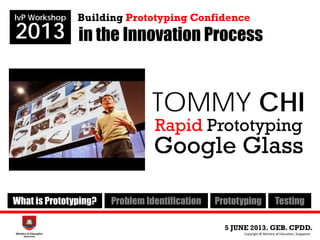
TOMMY CHI
Rapid Prototyping
Google Glass
in the Innovation Process
5 JUNE 2013. GEB. CPDD.
IvP Workshop
2013
Copyright © Ministry of Education, Singapore.
Building Prototyping Confidence
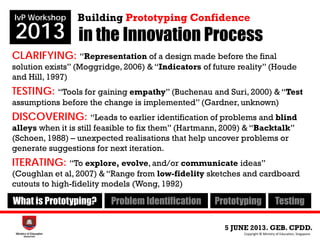
CLARIFYING: “Representation of a design made before the final
solution exists” (Moggridge, 2006) & “Indicators of future reality” (Houde
and Hill, 1997)
TESTING: “Tools for gaining empathy” (Buchenau and Suri, 2000) & “Test
assumptions before the change is implemented” (Gardner, unknown)
DISCOVERING: “Leads to earlier identification of problems and blind
alleys when it is still feasible to fix them” (Hartmann, 2009) & “Backtalk”
(Schoen, 1988) – unexpected realisations that help uncover problems or
generate suggestions for next iteration.
ITERATING: “To explore, evolve, and/or communicate ideas”
(Coughlan et al, 2007) & “Range from low-fidelity sketches and cardboard
cutouts to high-fidelity models (Wong, 1992)
What is Prototyping? Problem Identification Prototyping Testing
in the Innovation Process
5 JUNE 2013. GEB. CPDD.
IvP Workshop
2013
Copyright © Ministry of Education, Singapore.
Building Prototyping Confidence
What is Prototyping? Problem Identification Prototyping Testing
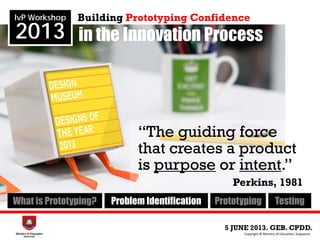
“The guiding force
that creates a product
is purpose or intent.”
Perkins, 1981
in the Innovation Process
For this workshop, we will be
working on “common
problems faced by teachers”.
Step 1: Brainstorming
Step 2: 4Is Analysis
Step 3: Ladder of Abstraction
5 JUNE 2013. GEB. CPDD.
IvP Workshop
2013
Copyright © Ministry of Education, Singapore.
Building Prototyping Confidence
What is Prototyping? Problem Identification Prototyping Testing
in the Innovation Process
5 JUNE 2013. GEB. CPDD.
IvP Workshop
2013
Copyright © Ministry of Education, Singapore.
Building Prototyping Confidence
What is Prototyping? Problem Identification Prototyping Testing
• Generate a list of 30-50 potential
problems that should be worked on.
• Need NOT be from a common
theme.
• For this workshop, we have
generated a list of ‘30 common
problems faced by teachers’.
in the Innovation Process
5 JUNE 2013. GEB. CPDD.
IvP Workshop
2013
Copyright © Ministry of Education, Singapore.
Building Prototyping Confidence
What is Prototyping? Problem Identification Prototyping Testing
4Is ANALYSIS
• Influence
• Importance
• Immediacy
• Imagination
Ladder of Abstracting
• After analysing the 30 problems, pick the
one that we feel is the most important to
work on.
* Need not be the problem with 4 ticks
• With the chosen problem, analyse it again to
see if it is really the problem that we want.
*For this workshop, we will work on the problem
‘students sleeping in class’.
in the Innovation Process
5 JUNE 2013. GEB. CPDD.
IvP Workshop
2013
Copyright © Ministry of Education, Singapore.
Building Prototyping Confidence
What is Prototyping? Problem Identification Prototyping Testing
in the Innovation Process
5 JUNE 2013. GEB. CPDD.
IvP Workshop
2013
Copyright © Ministry of Education, Singapore.
Building Prototyping Confidence
What is Prototyping? Problem Identification Prototyping Testing
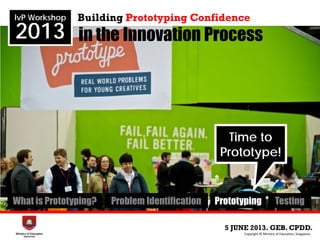
Time to
Prototype!
in the Innovation Process
5 JUNE 2013. GEB. CPDD.
IvP Workshop
2013
Copyright © Ministry of Education, Singapore.
Building Prototyping Confidence
What is Prototyping? Problem Identification Prototyping Testing
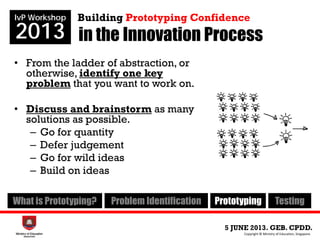
• From the ladder of abstraction, or
otherwise, identify one key
problem that you want to work on.
• Discuss and brainstorm as many
solutions as possible.
– Go for quantity
– Defer judgement
– Go for wild ideas
– Build on ideas
in the Innovation Process
5 JUNE 2013. GEB. CPDD.
IvP Workshop
2013
Copyright © Ministry of Education, Singapore.
Building Prototyping Confidence
What is Prototyping? Problem Identification Prototyping Testing
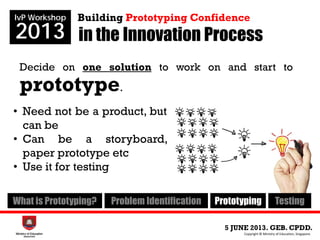
Decide on one solution to work on and start to
prototype.
• Need not be a product, but
can be
• Can be a storyboard,
paper prototype etc
• Use it for testing
click here to start timer
20 minutes
in the Innovation Process
5 JUNE 2013. GEB. CPDD.
IvP Workshop
2013
Copyright © Ministry of Education, Singapore.
Building Prototyping Confidence
What is Prototyping? Problem Identification Prototyping Testing
For the group presenting
For the rest of the groups
giving feedback
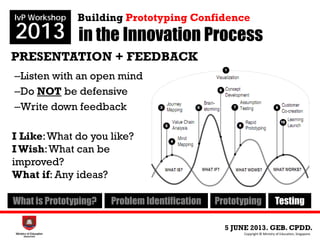
PRESENTATION + FEEDBACK
–Listen with an open mind
–Do NOT be defensive
–Write down feedback
I Like:What do you like?
IWish:What can be
improved?
What if: Any ideas?
Use the feedback to improve your idea!
click here to start timer
10 minutes
in the Innovation Process
5 JUNE 2013. GEB. CPDD.
IvP Workshop
2013
Copyright © Ministry of Education, Singapore.
Building Prototyping Confidence
Conclusion
in the Innovation Process
5 JUNE 2013. GEB. CPDD.
IvP Workshop
2013
Copyright © Ministry of Education, Singapore.
Building Prototyping Confidence
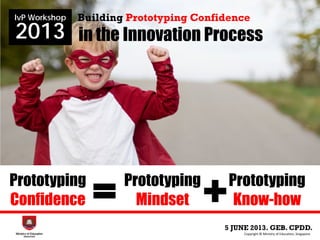
Prototyping
Confidence
Prototyping
Mindset
Prototyping
Know-how+=
in the Innovation Process
5 JUNE 2013. GEB. CPDD.
IvP Workshop
2013
Copyright © Ministry of Education, Singapore.
Building Prototyping Confidence
Prototyping
Confidence
Prototyping
Mindset
Prototyping
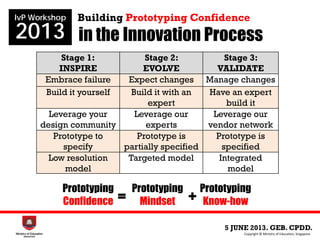
Know-how+=
Stage 1:
INSPIRE
Stage 2:
EVOLVE
Stage 3:
VALIDATE
Embrace failure Expect changes Manage changes
Build it yourself Build it with an
expert
Have an expert
build it
Leverage your
design community
Leverage our
experts
Leverage our
vendor network
Prototype to
specify
Prototype is
partially specified
Prototype is
specified
Low resolution
model
Targeted model Integrated
model
in the Innovation Process
5 JUNE 2013. GEB. CPDD.
IvP Workshop
2013
Copyright © Ministry of Education, Singapore.
Building Prototyping Confidence
Prototyping
Confidence
Prototyping
Mindset
Prototyping
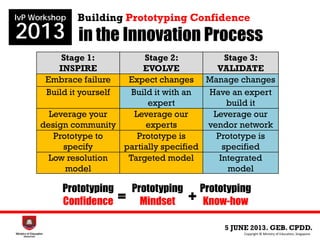
Know-how+=
Stage 1:
INSPIRE
Stage 2:
EVOLVE
Stage 3:
VALIDATE
Embrace failure Expect changes Manage changes
Build it yourself Build it with an
expert
Have an expert
build it
Leverage your
design community
Leverage our
experts
Leverage our
vendor network
Prototype to
specify
Prototype is
partially specified
Prototype is
specified
Low resolution
model
Targeted model Integrated
model
Developing Prototyping Mindsets
in the Innovation Process
5 JUNE 2013. GEB. CPDD.
IvP Workshop
2013
Copyright © Ministry of Education, Singapore.
Building Prototyping Confidence
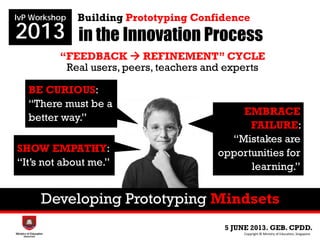
“FEEDBACK  REFINEMENT” CYCLE
Real users, peers, teachers and experts
BE CURIOUS:
“There must be a
better way.”
SHOW EMPATHY:
“It’s not about me.”
EMBRACE
FAILURE:
“Mistakes are
opportunities for
learning.”
Developing Prototyping Know-how
in the Innovation Process
5 JUNE 2013. GEB. CPDD.
IvP Workshop
2013
Copyright © Ministry of Education, Singapore.
Building Prototyping Confidence
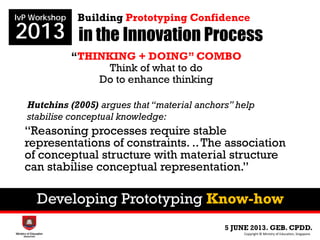
“THINKING + DOING” COMBO
Think of what to do
Do to enhance thinking
Hutchins (2005) argues that “material anchors” help
stabilise conceptual knowledge:
“Reasoning processes require stable
representations of constraints. ..The association
of conceptual structure with material structure
can stabilise conceptual representation.”
in the Innovation Process
5 JUNE 2013. GEB. CPDD.
IvP Workshop
2013
Copyright © Ministry of Education, Singapore.
Building Prototyping Confidence
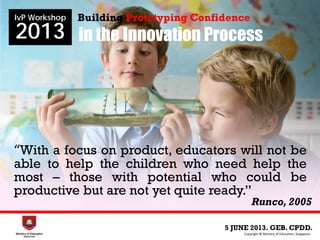
Runco, 2005
“With a focus on product, educators will not be
able to help the children who need help the
most – those with potential who could be
productive but are not yet quite ready.”
in the Innovation Process
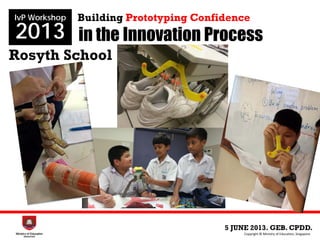
Rosyth School
5 JUNE 2013. GEB. CPDD.
IvP Workshop
2013
Copyright © Ministry of Education, Singapore.
Building Prototyping Confidence
in the Innovation Process
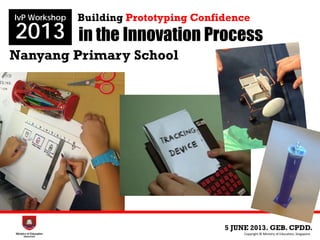
Nanyang Primary School
5 JUNE 2013. GEB. CPDD.
IvP Workshop
2013
Copyright © Ministry of Education, Singapore.
Building Prototyping Confidence
in the Innovation Process
5 JUNE 2013. GEB. CPDD.
IvP Workshop
2013
Copyright © Ministry of Education, Singapore.
Building Prototyping Confidence
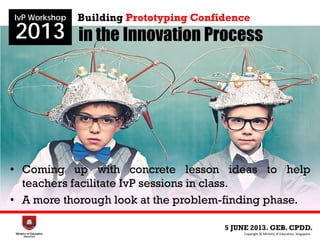
• Coming up with concrete lesson ideas to help
teachers facilitate IvP sessions in class.
• A more thorough look at the problem-finding phase.
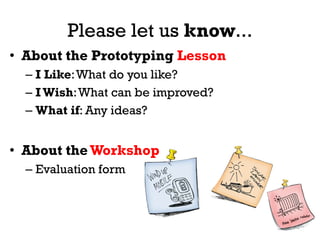
Please let us know...
• About the Prototyping Lesson
– I Like:What do you like?
– I Wish:What can be improved?
– What if: Any ideas?
• About the Workshop
– Evaluation form
SPECIAL
THANKS
5 JUNE 2013. GEB. CPDD.
Copyright © Ministry of Education, Singapore.
NIE:
John Yeo
GE Branch:
Dr Tan Bee Geok,
Dr Quek Chwee Geok,
Miss Joyce Soh,
Mrs Soo Kim Bee
REFERENCES
5 JUNE 2013. GEB. CPDD.
Copyright © Ministry of Education, Singapore.
Björn Hartmann, Gaining Design Insight Through Interaction Prototyping
Tools. Ph.D. Dissertation, Stanford University Computer Science
Department, September 2009.
Buchenau, M., & Fulton Suri, J. (2000). Experience prototyping. In
Proceedings of Design of Interactive Systems 2000 (pp. 424-433). New York:
ACM Press.
Houde, S., & Hill, C. (1997). What do prototypes prototype? In M. Helander,
T. Landauer, & P. Prabhu (Eds.), Handbook of human-computer interaction
(2nd ed., pp. 367-381). Amsterdam: Elsevier Science.
Coughlan, P., Suri, J., & Canales, K. (2008). Prototypes as (Design) Tools for
Behavioral and Organizational Change: A Design-Based Approach to Help
Organizations Change Work Behaviors. The Journal of Applied Behavioral
Science, 43(1), 1-13

Building prototyping confidence in innovation process

  • 1.
    5 JUNE 2013.GEB. CPDD. IvP Workshop 2013 Copyright © Ministry of Education, Singapore. Building Prototyping Confidence in the Innovation Process
  • 2.
    5 JUNE 2013.GEB. CPDD. IvP Workshop 2013 Copyright © Ministry of Education, Singapore. Building Prototyping Confidence in the Innovation Process David Kwek.Tan ChorYean. Melvin Tan. Benjamin Tan.Tan Huizhen. JohnYeo.
  • 3.
    in the InnovationProcess • Introduction: About IvP • What is prototyping? • Prototyping Lesson • Conclusion + Feedback 5 JUNE 2013. GEB. CPDD. IvP Workshop 2013 Copyright © Ministry of Education, Singapore. Building Prototyping Confidence 9 0 m i n u t e s
  • 4.
    in the InnovationProcess 5 JUNE 2013. GEB. CPDD. IvP Workshop 2013 Copyright © Ministry of Education, Singapore. Building Prototyping Confidence INNOVATION PROGRAMME Creative Problem solvingInventive thinking Problem finding Brainstorming Prototyping Testing
  • 5.
    in the InnovationProcess 5 JUNE 2013. GEB. CPDD. IvP Workshop 2013 Copyright © Ministry of Education, Singapore. Building Prototyping Confidence INNOVATION PROGRAMME REVIEWING Problem 1: Students are more concerned with creating end- products, not discovering new ideas. Problem 2: The innovation process is curtailed by the students’ own perceptions of whether the idea is prototype-able.
  • 6.
    in the InnovationProcess 5 JUNE 2013. GEB. CPDD. IvP Workshop 2013 Copyright © Ministry of Education, Singapore. Building Prototyping Confidence INNOVATION PROGRAMME Creative Problem solvingInventive thinking Problem finding Brainstorming Need to build Prototyping confidence Testing REVIEWING
  • 7.
    in the InnovationProcess 5 JUNE 2013. GEB. CPDD. IvP Workshop 2013 Copyright © Ministry of Education, Singapore. Building Prototyping Confidence Prototyping Confidence?
  • 8.
    PROTOTYPING in the InnovationProcess 5 JUNE 2013. GEB. CPDD. IvP Workshop 2013 Copyright © Ministry of Education, Singapore. Building Prototyping Confidence Lesson begins! What is Prototyping? Problem Identification Prototyping Testing
  • 9.
    in the InnovationProcess 5 JUNE 2013. GEB. CPDD. IvP Workshop 2013 Copyright © Ministry of Education, Singapore. Building Prototyping Confidence What is Prototyping? Problem Identification Prototyping Testing TOMMY CHI Rapid Prototyping Google Glass
  • 10.
    in the InnovationProcess 5 JUNE 2013. GEB. CPDD. IvP Workshop 2013 Copyright © Ministry of Education, Singapore. Building Prototyping Confidence CLARIFYING: “Representation of a design made before the final solution exists” (Moggridge, 2006) & “Indicators of future reality” (Houde and Hill, 1997) TESTING: “Tools for gaining empathy” (Buchenau and Suri, 2000) & “Test assumptions before the change is implemented” (Gardner, unknown) DISCOVERING: “Leads to earlier identification of problems and blind alleys when it is still feasible to fix them” (Hartmann, 2009) & “Backtalk” (Schoen, 1988) – unexpected realisations that help uncover problems or generate suggestions for next iteration. ITERATING: “To explore, evolve, and/or communicate ideas” (Coughlan et al, 2007) & “Range from low-fidelity sketches and cardboard cutouts to high-fidelity models (Wong, 1992) What is Prototyping? Problem Identification Prototyping Testing
  • 11.
    in the InnovationProcess 5 JUNE 2013. GEB. CPDD. IvP Workshop 2013 Copyright © Ministry of Education, Singapore. Building Prototyping Confidence What is Prototyping? Problem Identification Prototyping Testing “The guiding force that creates a product is purpose or intent.” Perkins, 1981
  • 12.
    in the InnovationProcess For this workshop, we will be working on “common problems faced by teachers”. Step 1: Brainstorming Step 2: 4Is Analysis Step 3: Ladder of Abstraction 5 JUNE 2013. GEB. CPDD. IvP Workshop 2013 Copyright © Ministry of Education, Singapore. Building Prototyping Confidence What is Prototyping? Problem Identification Prototyping Testing
  • 13.
    in the InnovationProcess 5 JUNE 2013. GEB. CPDD. IvP Workshop 2013 Copyright © Ministry of Education, Singapore. Building Prototyping Confidence What is Prototyping? Problem Identification Prototyping Testing • Generate a list of 30-50 potential problems that should be worked on. • Need NOT be from a common theme. • For this workshop, we have generated a list of ‘30 common problems faced by teachers’.
  • 14.
    in the InnovationProcess 5 JUNE 2013. GEB. CPDD. IvP Workshop 2013 Copyright © Ministry of Education, Singapore. Building Prototyping Confidence What is Prototyping? Problem Identification Prototyping Testing 4Is ANALYSIS • Influence • Importance • Immediacy • Imagination
  • 15.
    Ladder of Abstracting •After analysing the 30 problems, pick the one that we feel is the most important to work on. * Need not be the problem with 4 ticks • With the chosen problem, analyse it again to see if it is really the problem that we want. *For this workshop, we will work on the problem ‘students sleeping in class’. in the Innovation Process 5 JUNE 2013. GEB. CPDD. IvP Workshop 2013 Copyright © Ministry of Education, Singapore. Building Prototyping Confidence What is Prototyping? Problem Identification Prototyping Testing
  • 16.
    in the InnovationProcess 5 JUNE 2013. GEB. CPDD. IvP Workshop 2013 Copyright © Ministry of Education, Singapore. Building Prototyping Confidence What is Prototyping? Problem Identification Prototyping Testing Time to Prototype!
  • 17.
    in the InnovationProcess 5 JUNE 2013. GEB. CPDD. IvP Workshop 2013 Copyright © Ministry of Education, Singapore. Building Prototyping Confidence What is Prototyping? Problem Identification Prototyping Testing • From the ladder of abstraction, or otherwise, identify one key problem that you want to work on. • Discuss and brainstorm as many solutions as possible. – Go for quantity – Defer judgement – Go for wild ideas – Build on ideas
  • 18.
    in the InnovationProcess 5 JUNE 2013. GEB. CPDD. IvP Workshop 2013 Copyright © Ministry of Education, Singapore. Building Prototyping Confidence What is Prototyping? Problem Identification Prototyping Testing Decide on one solution to work on and start to prototype. • Need not be a product, but can be • Can be a storyboard, paper prototype etc • Use it for testing
  • 19.
    click here tostart timer 20 minutes
  • 20.
    in the InnovationProcess 5 JUNE 2013. GEB. CPDD. IvP Workshop 2013 Copyright © Ministry of Education, Singapore. Building Prototyping Confidence What is Prototyping? Problem Identification Prototyping Testing For the group presenting For the rest of the groups giving feedback PRESENTATION + FEEDBACK –Listen with an open mind –Do NOT be defensive –Write down feedback I Like:What do you like? IWish:What can be improved? What if: Any ideas?
  • 21.
    Use the feedbackto improve your idea! click here to start timer 10 minutes
  • 22.
    in the InnovationProcess 5 JUNE 2013. GEB. CPDD. IvP Workshop 2013 Copyright © Ministry of Education, Singapore. Building Prototyping Confidence Conclusion
  • 23.
    in the InnovationProcess 5 JUNE 2013. GEB. CPDD. IvP Workshop 2013 Copyright © Ministry of Education, Singapore. Building Prototyping Confidence Prototyping Confidence Prototyping Mindset Prototyping Know-how+=
  • 24.
    in the InnovationProcess 5 JUNE 2013. GEB. CPDD. IvP Workshop 2013 Copyright © Ministry of Education, Singapore. Building Prototyping Confidence Prototyping Confidence Prototyping Mindset Prototyping Know-how+= Stage 1: INSPIRE Stage 2: EVOLVE Stage 3: VALIDATE Embrace failure Expect changes Manage changes Build it yourself Build it with an expert Have an expert build it Leverage your design community Leverage our experts Leverage our vendor network Prototype to specify Prototype is partially specified Prototype is specified Low resolution model Targeted model Integrated model
  • 25.
    in the InnovationProcess 5 JUNE 2013. GEB. CPDD. IvP Workshop 2013 Copyright © Ministry of Education, Singapore. Building Prototyping Confidence Prototyping Confidence Prototyping Mindset Prototyping Know-how+= Stage 1: INSPIRE Stage 2: EVOLVE Stage 3: VALIDATE Embrace failure Expect changes Manage changes Build it yourself Build it with an expert Have an expert build it Leverage your design community Leverage our experts Leverage our vendor network Prototype to specify Prototype is partially specified Prototype is specified Low resolution model Targeted model Integrated model
  • 26.
    Developing Prototyping Mindsets inthe Innovation Process 5 JUNE 2013. GEB. CPDD. IvP Workshop 2013 Copyright © Ministry of Education, Singapore. Building Prototyping Confidence “FEEDBACK  REFINEMENT” CYCLE Real users, peers, teachers and experts BE CURIOUS: “There must be a better way.” SHOW EMPATHY: “It’s not about me.” EMBRACE FAILURE: “Mistakes are opportunities for learning.”
  • 27.
    Developing Prototyping Know-how inthe Innovation Process 5 JUNE 2013. GEB. CPDD. IvP Workshop 2013 Copyright © Ministry of Education, Singapore. Building Prototyping Confidence “THINKING + DOING” COMBO Think of what to do Do to enhance thinking Hutchins (2005) argues that “material anchors” help stabilise conceptual knowledge: “Reasoning processes require stable representations of constraints. ..The association of conceptual structure with material structure can stabilise conceptual representation.”
  • 28.
    in the InnovationProcess 5 JUNE 2013. GEB. CPDD. IvP Workshop 2013 Copyright © Ministry of Education, Singapore. Building Prototyping Confidence Runco, 2005 “With a focus on product, educators will not be able to help the children who need help the most – those with potential who could be productive but are not yet quite ready.”
  • 29.
    in the InnovationProcess Rosyth School 5 JUNE 2013. GEB. CPDD. IvP Workshop 2013 Copyright © Ministry of Education, Singapore. Building Prototyping Confidence
  • 30.
    in the InnovationProcess Nanyang Primary School 5 JUNE 2013. GEB. CPDD. IvP Workshop 2013 Copyright © Ministry of Education, Singapore. Building Prototyping Confidence
  • 31.
    in the InnovationProcess 5 JUNE 2013. GEB. CPDD. IvP Workshop 2013 Copyright © Ministry of Education, Singapore. Building Prototyping Confidence • Coming up with concrete lesson ideas to help teachers facilitate IvP sessions in class. • A more thorough look at the problem-finding phase.
  • 33.
    Please let usknow... • About the Prototyping Lesson – I Like:What do you like? – I Wish:What can be improved? – What if: Any ideas? • About the Workshop – Evaluation form
  • 34.
    SPECIAL THANKS 5 JUNE 2013.GEB. CPDD. Copyright © Ministry of Education, Singapore. NIE: John Yeo GE Branch: Dr Tan Bee Geok, Dr Quek Chwee Geok, Miss Joyce Soh, Mrs Soo Kim Bee
  • 35.
    REFERENCES 5 JUNE 2013.GEB. CPDD. Copyright © Ministry of Education, Singapore. Björn Hartmann, Gaining Design Insight Through Interaction Prototyping Tools. Ph.D. Dissertation, Stanford University Computer Science Department, September 2009. Buchenau, M., & Fulton Suri, J. (2000). Experience prototyping. In Proceedings of Design of Interactive Systems 2000 (pp. 424-433). New York: ACM Press. Houde, S., & Hill, C. (1997). What do prototypes prototype? In M. Helander, T. Landauer, & P. Prabhu (Eds.), Handbook of human-computer interaction (2nd ed., pp. 367-381). Amsterdam: Elsevier Science. Coughlan, P., Suri, J., & Canales, K. (2008). Prototypes as (Design) Tools for Behavioral and Organizational Change: A Design-Based Approach to Help Organizations Change Work Behaviors. The Journal of Applied Behavioral Science, 43(1), 1-13