21st Century Pedagogy
Narad Rijal
Head, English
Kathmandu University High School
2nd August , 2014
Pedagogy: Definition
* the method and practice of teaching,
especially as an academic subject or
theoretical concept
* Science
* The theory of Teaching
21st Century
Learning
Education 2.0
Education 3.0 - a Paradigm Shift
Education 1.0
Supported Through an Adapted
Reform Agenda
Enabled by
Technology
21st
Century
Skills
Interdisciplinary
Pedagogy
Achieved in
Holistic
Transformation
Education 3.0
Traditional
Education
Systems
Curriculum
Teachers
Accountability
Leadership
Education Is the Great Equalizer in Our Society
and the Foundation of Innovation and Prosperity
Traditional Education System
 Home based education system
 Transfer of education generation wise-
father to son, mother to daughter
 Gurukul system
 Gurus used to decide everything
 Students live in Gurus home for
education
 Life skills, valuable life experiences
Education in Rana Regime
 Very few schools
 Common people had no access to
education
 No right to establish school even
libraries
 State's first school: Durbar School
First College: Tri Chandra College
Democratic Period
 Milestone period in education: 2007
 State accepted the responsibility to
educate citizens
 Unorganized education in the
beginning and institutionalized in the
later time of this period
 Curriculum : not need based
 Completely Teacher centered
Now: Development period
 Period after 2027 BS as the
development period in education
system
 Launched Nepal Education System
Plan( NSEP)
 Janak Shikshya Samagri is assigned
to publish textbooks
 Inclusion of vocational education in
school level curriculum
Contd.
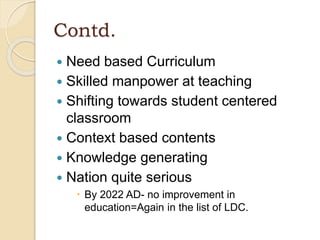
 Need based Curriculum
 Skilled manpower at teaching
 Shifting towards student centered
classroom
 Context based contents
 Knowledge generating
 Nation quite serious
 By 2022 AD- no improvement in
education=Again in the list of LDC.
Beyond constructivism?
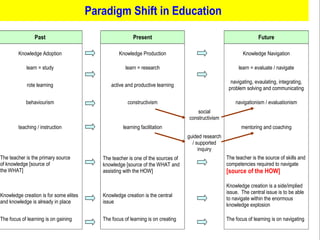
Paradigm Shift in Education
Past Present Future
Knowledge Adoption Knowledge Production Knowledge Navigation
learn = study learn = research learn = evaluate / navigate
rote learning active and productive learning
navigating, evaulating, integrating,
problem solving and communicating
behaviourism constructivism navigationism / evaluationism
social
constructivism
teaching / instruction learning facilitation mentoring and coaching
guided research
/ supported
inquiry
The teacher is the primary source
of knowledge [source of
the WHAT]
The teacher is one of the sources of
knowledge [source of the WHAT and
assisting with the HOW]
The teacher is the source of skills and
competencies required to navigate
[source of the HOW]
Knowledge creation is for some elites
and knowledge is already in place
Knowledge creation is the central
issue
Knowledge creation is a side/implied
issue. The central issue is to be able
to navigate within the enormous
knowledge explosion
The focus of learning is on gaining The focus of learning is on creating The focus of learning is on navigating
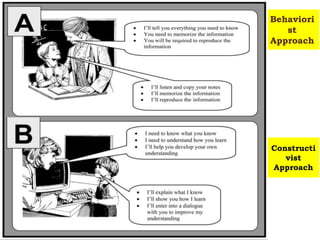
Behaviori
st
Approach
Constructi
vist
Approach
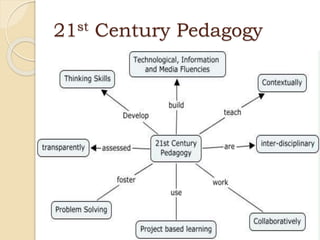
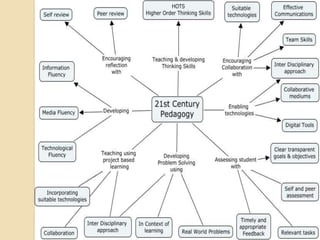
21st Century Pedagogy
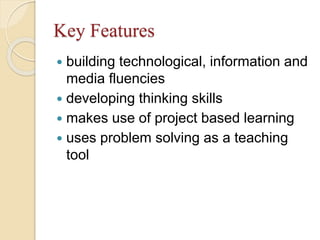
Key Features
 building technological, information and
media fluencies
 developing thinking skills
 makes use of project based learning
 uses problem solving as a teaching
tool
Contd.
 uses 21st Century with timely,
appropriate and detailed feedback and
reflection
 collaborative in nature and uses
enabling and empowering
technologies
 Contextual learning bridging the
disciplines and curriculum areas
21st Century Classroom
 Exciting one that can deliver powerful
learning outcomes through the use of
emerging technologies
 Adaptable
 Flexible
Contd.
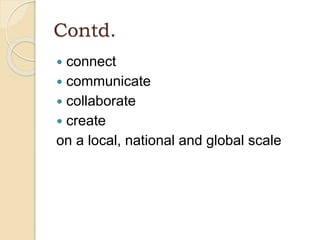
 connect
 communicate
 collaborate
 create
on a local, national and global scale
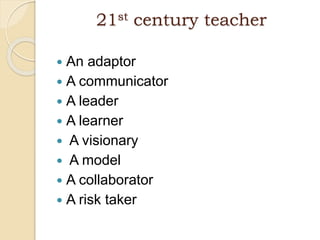
21st century teacher
 An adaptor
 A communicator
 A leader
 A learner
 A visionary
 A model
 A collaborator
 A risk taker
Contd.
 Even though our curriculum reflects
the new paradigm and we have the
facilities and resources that could
enable 21st century learning: we will
only be the 21st century teacher if how
we teach changes as well
Our pedagogy must also
change
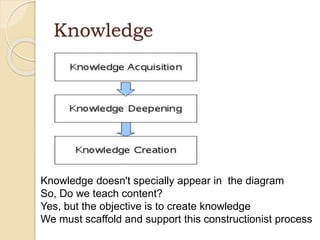
Knowledge
Knowledge doesn't specially appear in the diagram
So, Do we teach content?
Yes, but the objective is to create knowledge
We must scaffold and support this constructionist process
Contd.
 Knowledge or Content contexts
with the tasks and activities the
students are undertaking
 Students respond well to real world
problems
 Our delivery of knowledge should
scaffold the learning process and
provide a foundation for activities
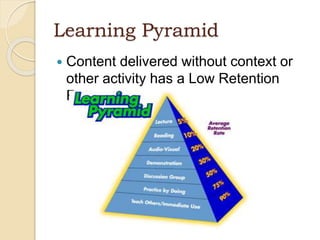
Learning Pyramid
 Content delivered without context or
other activity has a Low Retention
Rate
Thinking skills
 Knowledge we teach may be obsolete
within years
 Thinking Skills Entire Life
 Industrial Age education: Lower Order
thinking skills
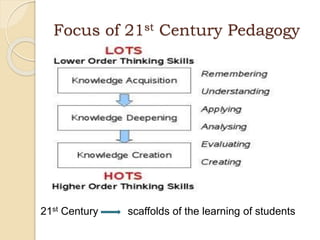
 LOTS are just remembering and
understanding aspects in Bloom’s
Taxonomy
Focus of 21st Century Pedagogy
21st Century scaffolds of the learning of students
Collaboration
 21st Century is the age of collaboration
as well as the Information age
 21st C students and digital natives:
Collaborative
 Social Networking sites: Collaborative
Projects
 Examples: International School Award
Contd.
 Teaching should model as
Collaboration
 Collaborative tools
 Wikis
 Classroom blogs
 Social networks
Collaboration is not a 21st century
skill it is 21st century essential
Contd.
 Collaboration has been a key element
of each of the four pillars:
 Learning to do
 Learning to do
 Learning to live together
 Learning to be
The four pillars of Education, Learning:
The Treasure within; UNESCO
publication
Real World, Inter disciplinary and PBL
 21st century students do not want
abstract examples
 Focus on real world problems
 Projects should be encompassing,
bringing together and reinforcing the
learning in the disciplines
 The sum of the students’ learning will
be greater than the individual aspects
taught in isolation
21st Century Skills
 Critical Thinking and Problem Solving
 Collaboration across Networks and
Leading by Influence
 Agility( liveliness) and Adaptability
 Initiative and Entrepreneurialism
 Effective Oral and Written
Communication
 Accessing and Analyzing Information
 Curiosity and Imagination
Assessment
 an integral part of instruction
 determines whether or not the goals of
education are being met
 Assessment affects decisions about
grades, placement, advancement,
instructional needs, curriculum, and, in
some cases, funding
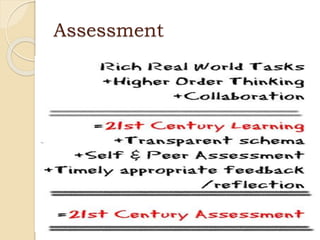
Assessment
Standardized Assessment
 Almost every school is exercising
standardized tests
 same test
 Paper and pencil test
 3 hours exams
Alternative Assessment
 Observation
 Essays
 Interviews
 Performance tasks
 Exhibitions and demonstrations
 Portfolios
 Journals
 Student-created tests
 Rubrics
 Self- and peer-evaluation
Feedback
 Value of timely, appropriate, detailed
and specific feedback
 Feedback as a learning tool after
thinking skills
 We must provide and facilitate safe
and appropriate feedback
Fluency
 Use of technology= Technological
fluency
 Collecting, processing, manipulating
and validating information=information
fluency
 Using, selecting, viewing and
manipulating media= media fluency
Five Major Promoters of
Learning
◦ NATURAL LEARNING
PROGRAMS (Gallistel, 2003)
◦ REPETITION of
INFORMATION (Squire and
Kandel, 2000)
◦ EXCITEMENT at the time of
learning (Cahill & Gorski, 2003;
LeDoux, 2002)
◦ EATING CARBOHYDRATES at
time of learning (Korol, 2002)
◦ 8-9 HOURS OF SLEEP after
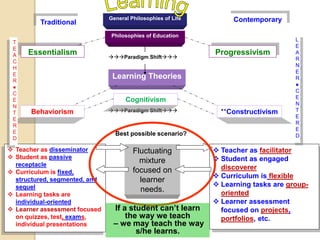
General Philosophies of Life
Philosophies of Education
Learning Theories
Fluctuating
mixture
focused on
learner
needs.
 Teacher as disseminator
 Student as passive
receptacle
 Curriculum is fixed,
structured, segmented, and
sequel
 Learning tasks are
individual-oriented
 Learner assessment focused
on quizzes, test, exams,
individual presentations
 Teacher as facilitator
 Student as engaged
discoverer
 Curriculum is flexible
 Learning tasks are group-
oriented
 Learner assessment
focused on projects,
portfolios, etc.
Traditional
Behaviorism
Contemporary
**Constructivism
Paradigm Shift
Essentialism Progressivism
Paradigm Shift
T
E
A
C
H
E
R
●
C
E
N
T
E
R
E
D
L
E
A
R
N
E
R
●
C
E
N
T
E
R
E
D
Best possible scenario?
If a student can’t learn
the way we teach
– we may teach the way
s/he learns.
Cognitivism
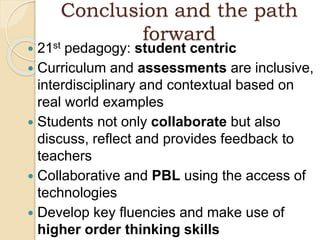
Conclusion and the path
forward
 21st pedagogy: student centric
 Curriculum and assessments are inclusive,
interdisciplinary and contextual based on
real world examples
 Students not only collaborate but also
discuss, reflect and provides feedback to
teachers
 Collaborative and PBL using the access of
technologies
 Develop key fluencies and make use of
higher order thinking skills
21st century pedagogy