ASSESSING
STUDENT
LEARNING
OUTCOMES
LEARNING OUTCOMES
Clarify the principles in assessing learning outcomes.
Explain the phases of outcomes assessment
Determine alignment of learning outcomes and
assessment tasks
Discuss various assessment methods, tools and tasks
including portfolios
Construct a scoring rubric > Give sample assessment
task for each MI
Explain at least 3 key features of assessment in the K to
12
2
INTRODUCTION
Outcome assessment is the process of
gathering information on whether the
instruction, services and activities that the
program provides are producing the desired
student learning outcomes.
3
“
Principles of Good
Practice in Assessing
Learning Outcomes
4
1
5
The assessment of student
learning starts with the institution's
vision, mission and core values.
There should be a clear statement
on the kinds of learning that the
institution values most for its
students.
2
6
Assessment works best when the
program has clear statement of
objectives aligned with the institutional
vision, mission and core values. Such
alignment ensures clear, shared and
implementable objectives.
3
7
Outcome-based assessment focuses on
the student activities that will still be relevant
after formal schooling concludes.
The approach is to design assessment
activities which are observable and less abstract
such as to determine the student's ability to write
a paragraph" which is more observable than to
determine the student's verbal ability."
4
8
Assessment requires attention not
only to outcomes but also and equally to
the activities and experiences that lead to
the attainment of learning outcomes.
These are supporting student activities.
5
9
Assessment works best when it is
continuous, on going and not episodic.
Assessment should be cumulative
because improvement is best achieved
through a linked series of activities done
over time in an instructional cycle.
6
10
Begin assessment by specifying
clearly and exactly what you want to
assess. What you want to assess is/are
stated in your learning outcomes/lesson
objectives..
7
11
The intended learning outcome/lesson
objective NOT CONTENT is the basis of the
assessment task. You use content in the
development of the assessment tool and task but
it is the attainment of your learning outcome
NOT content that you want to assess. This is
Outcome-based Teaching and Learning,
8
12
Set your criterion of success or
acceptable standard of success. It is
against this established standard that
you will interpret your assessment
results.
Example: Is a score of 7 out of 10 (the
highest possible score) acceptable or
considered success?
9
Make use of varied tools for assessment
data-gathering and multiple sources of
assessment data. It is not pedagogically sound
to rely on just one source of data gathered by
only one assessment tool. Consider multiple
intelligences and learning styles. DepED
Order No. 73, s. 2012 cites the use of multiple
measures as one assessment guideline.
10
14
Learners must be given feedback about
their performance. Feedback must be
specific. "Good work!" is positive feedback
and is welcome but actually is not a very
good feedback since it is not specific. A
more specific better feedback is "You
observed rules on subject-verb agreement
and variety of sentences. Three of your
commas were misplaced."
11
15
Assessment should be on
real-world application and not
on out of-context drills.
12
16
Emphasize on the
assessment of higher-order
thinking.
13
17
Provide opportunities for
self-assessment.
“
Samples of Supporting
Student Activities
18
Student Learning Outcome #1:
Students can organize information
from secondary sources as basis of a
research topic.
Supporting Student Activities
◎ 1.1. practise differentiating source
material and one's opinion
◎ 1.2. reading articles and formulating an
original paragraph from quotes,
paraphrases and summaries
◎ 1.3. writing of essays to develop the topic
◎ 1.4. integrating bibliographic entries in
appropriate format
19
Student Learning Outcome #2:
Students apply principles of logical
thinking and persuasive argument in
writing.
Supporting Student Activities
◎ 2.1. forming opinion about the topic
◎ 2.2. researching and writing about a
variety of perspectives
◎ 2.3. adapting style to the identified
audience
◎ 2.4. employing clear argument in
writing
20
Student Learning Outcome #3:
Students write multiple-page essays
complying with standard format and
style Supporting Student Activities
Supporting Student Activities
◎ 3.1. analyzing and evaluating texts
◎ 3.2. writing about a variety of perspectives on
single topic
◎ 3.3. adapting tone and style to address one's
audience
◎ 3.4. reviewing grammar and essay format in
readings
◎ 3.5. holding group discussion about various
topics 21
“
Phases of Outcome
Assessment in the
Instructional Cycle
22
Big concept
Bring the attention of your audience over a
key concept using icons or illustrations
23
1. On which is assessment on the institutional cycle
based after the vision mission of an institution,
program goals and subject objectives?
2. What is the purpose of diagnostic assessment?
3. Based on the institutional cycle, how can you ensure
mastery learning?
4. How does formative assessment of outcomes differ
from the summative assessment of outcomes?
5. Why does summative assessment of outcomes point
to program goals and subject objectives?
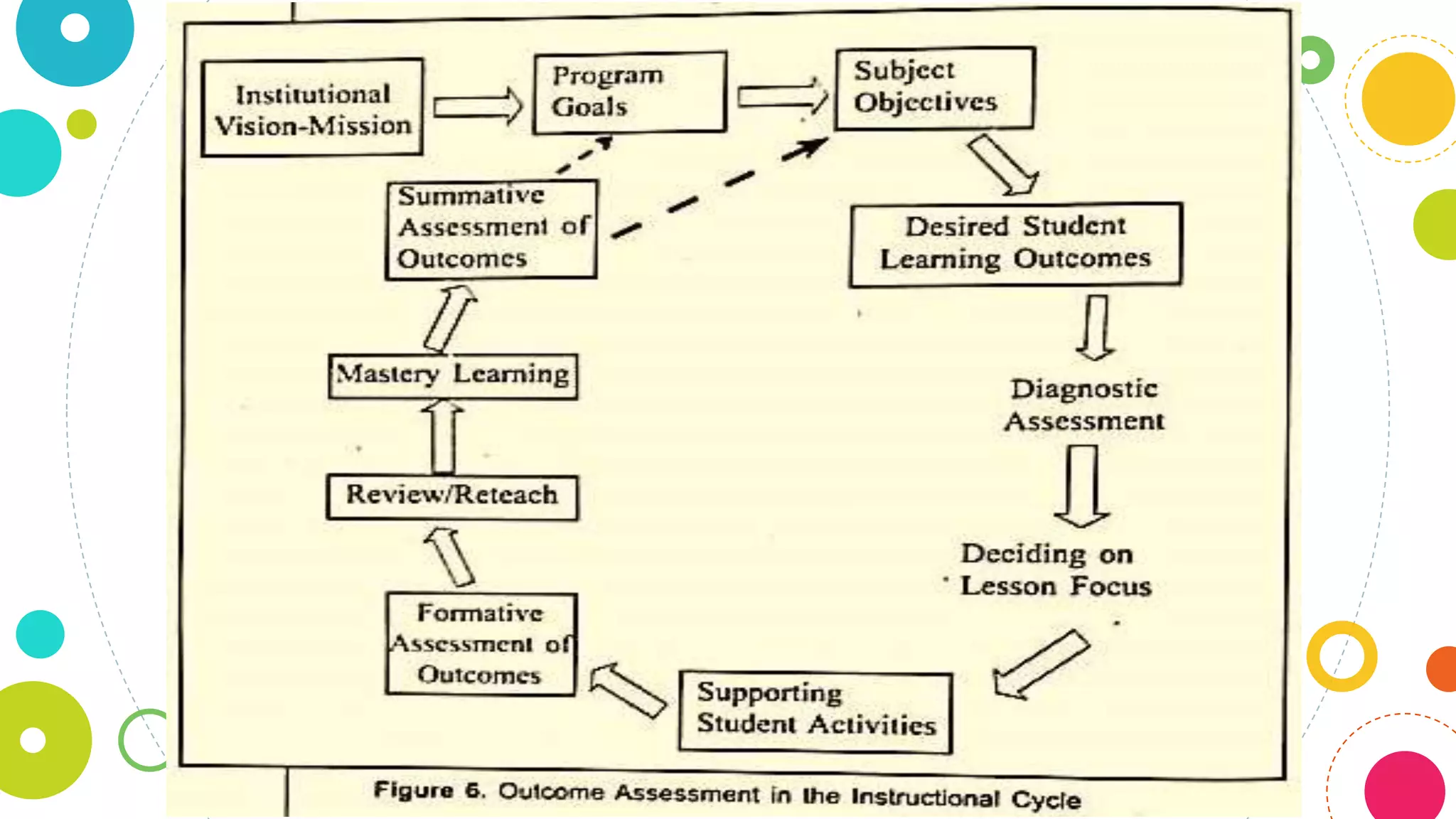
Study the phases of outcome assessment in the
instructional cycle as shown in the Figure above
then as a group answer the following questions:
24
“
Constructive Alignment
25
Big concept
Bring the attention of your audience over a
key concept using icons or illustrations
26
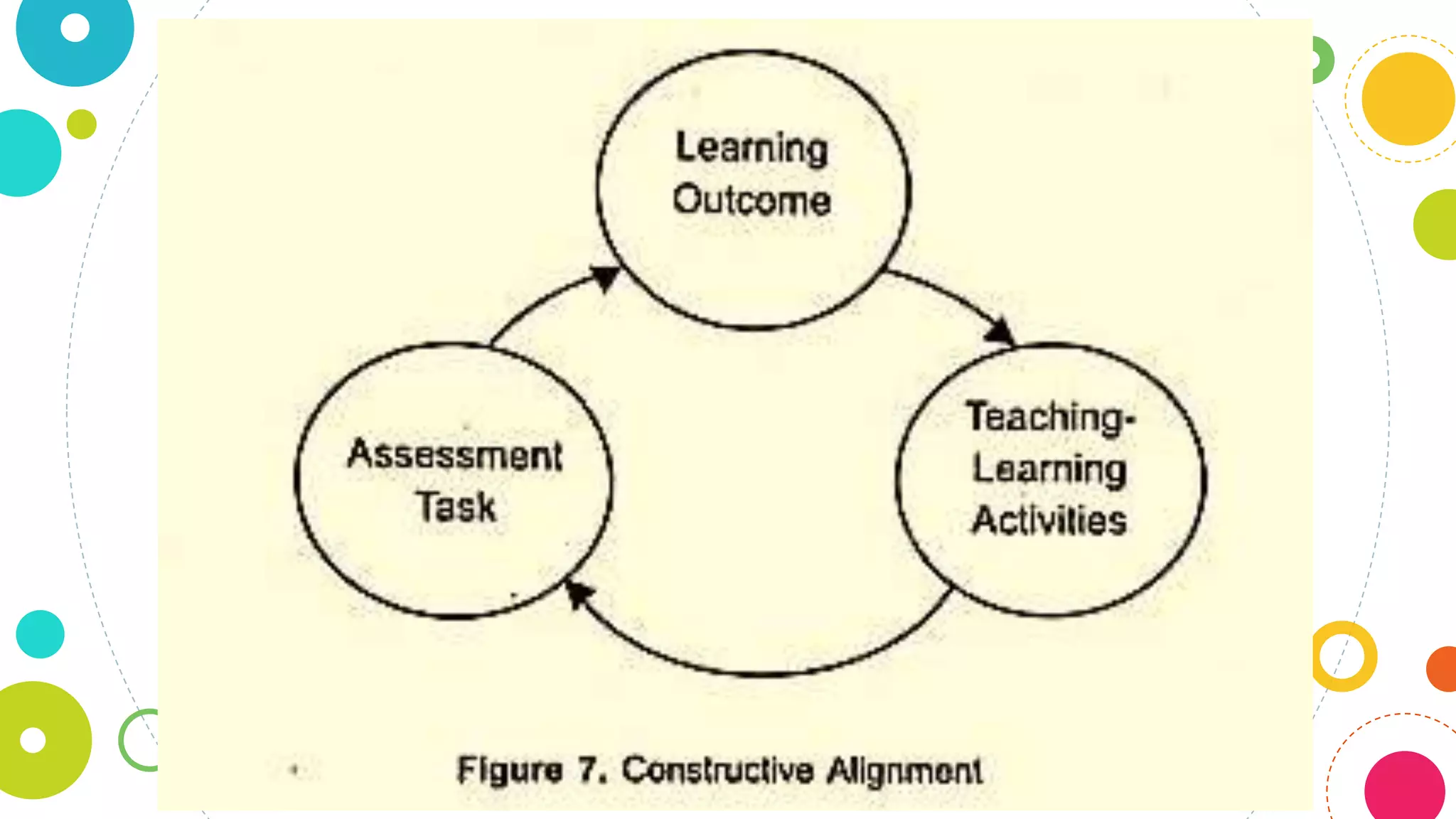
Figure 7 illustrates the principle of constructive
alignment. The principle of constructive alignment simply
means that the teaching learning activity or activities and
assessment tasks are aligned with the intended learning
outcome. The intended learning outcome is "to drive a car."
The teaching-learning activity is driving a car not giving
lectures on car driving. The assessment task is to let the
student drive a car not to describe how to drive a car.
You have been victims of teachers who taught you
one thing but assessed you on another. The result? Much
confusion and disappointment? If you have been victims of
lack of constructive alignment, then break the cycle by not
victimizing your students, too. Observe the principle of
constructive alignment. Make sure your assessment tasks
are aligned with your learning outcomes.
Why the term "constructive?" Constructive
alignment is based on the constructivist theory (Biggs, 2007)
that learners use their own activity to construct their
knowledge or other outcome/s.
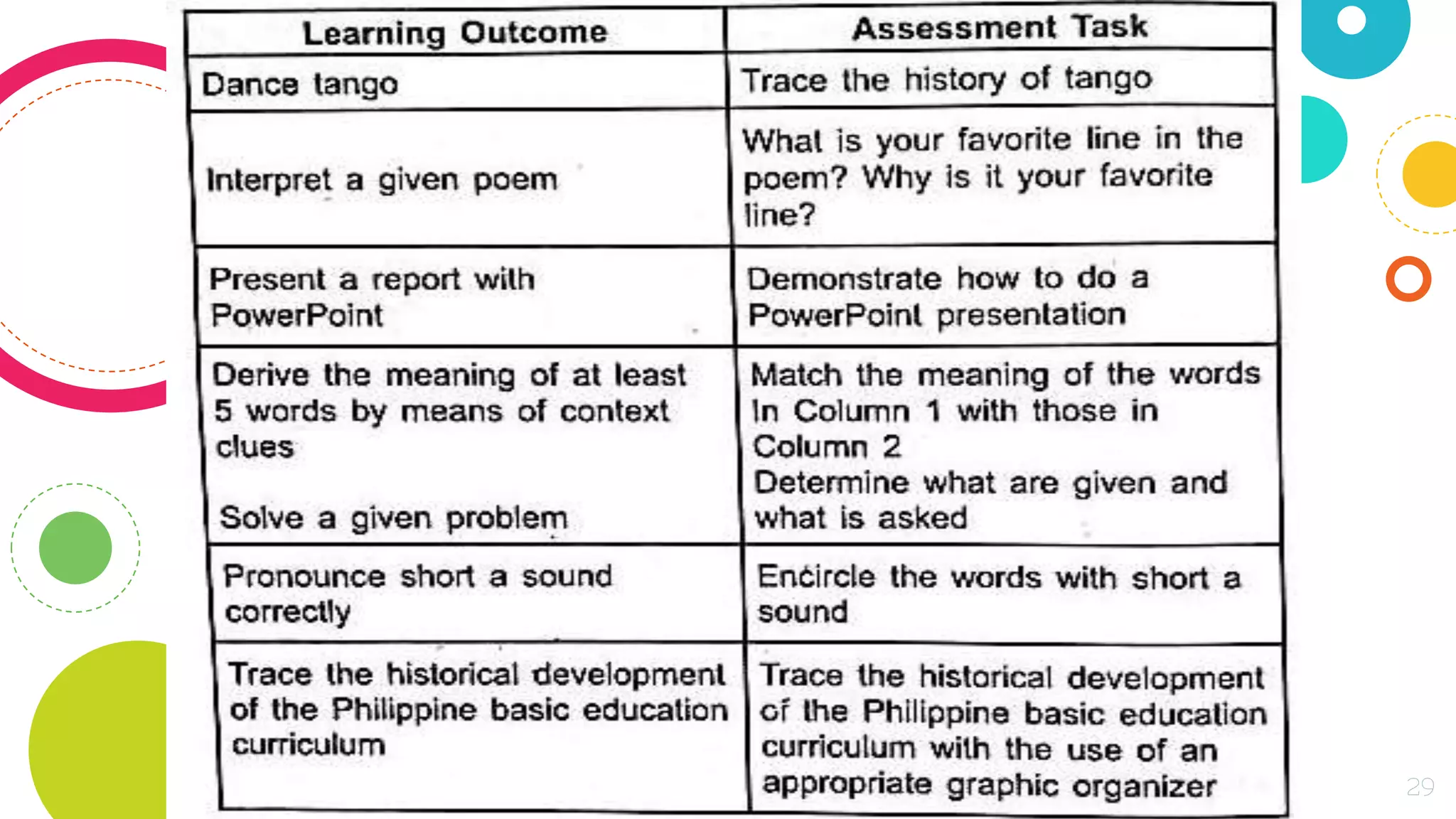
MENTAL
EXERCISE!!!
28
29
“
Variety of Assessment
Methods, Tools and Tasks
30
Assessment methods can be classified as
traditional and authentic.
Traditional assessment method refers to
the usual paper-and-pencil test.
Authentic assessment refers to non-
paper-and-pencil test. It is also
called alternative assessment, it
being an alternative to the
traditional.
The paper-and-pencil test (traditional assessment)
assesses learning in the cognitive domain (Bloom) or
declarative knowledge (Kendall and Marzano, 2012).
The paper-and-pencil test, however, is inadequate to
measure all forms of learning. Psychomotor learning (Kendall
and Marzano, 2012) or procedural knowledge (Kendall and
Marzano, 2012) and learning proven by a product and by a
performance cannot be measured by a -paper-and-pencil test.
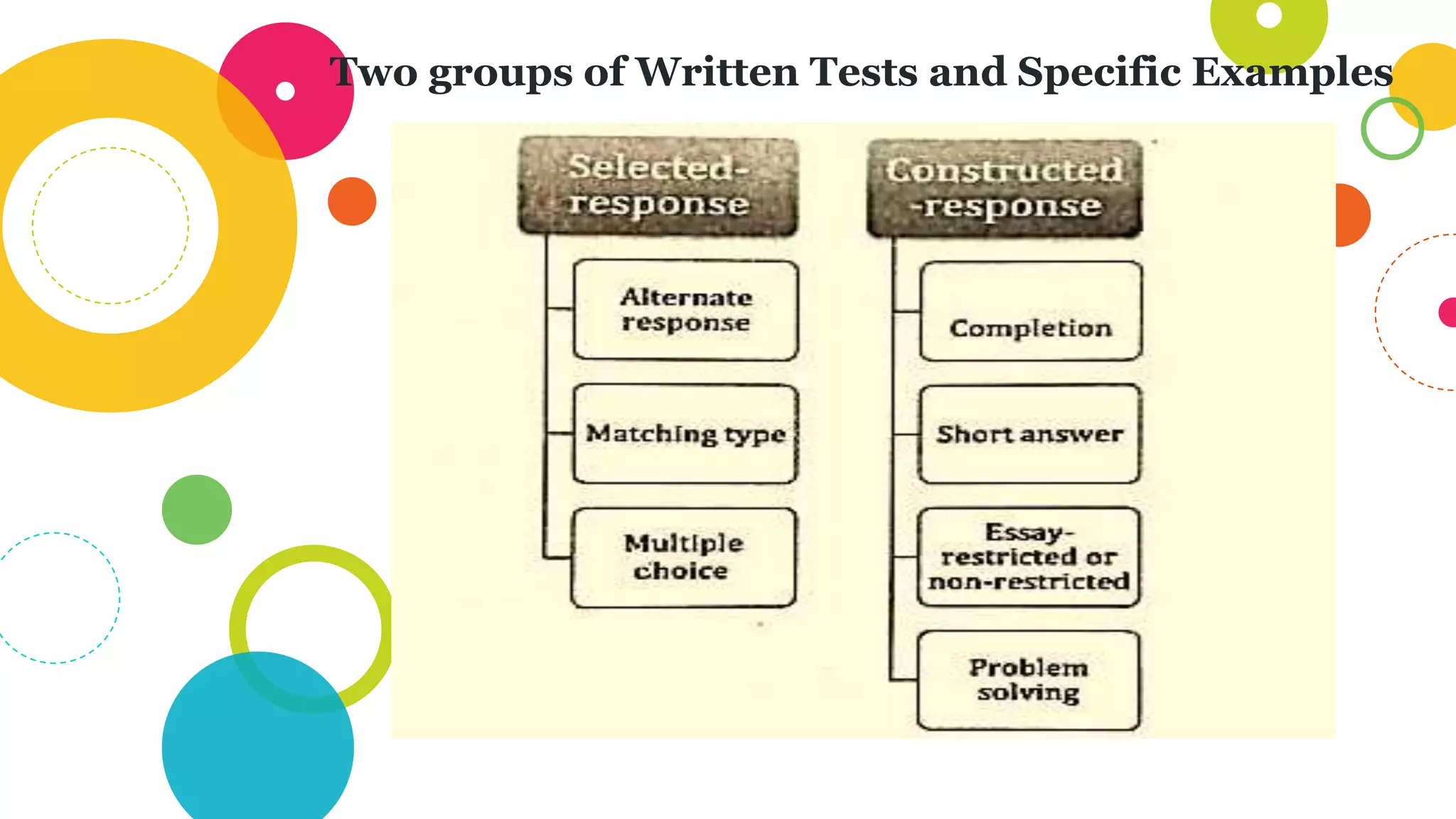
Assessment tools for the cognitive domain
(declarative knowledge) are the different paper-and-pencil
tests.
Traditional Assessment
Two groups of Written Tests and Specific Examples
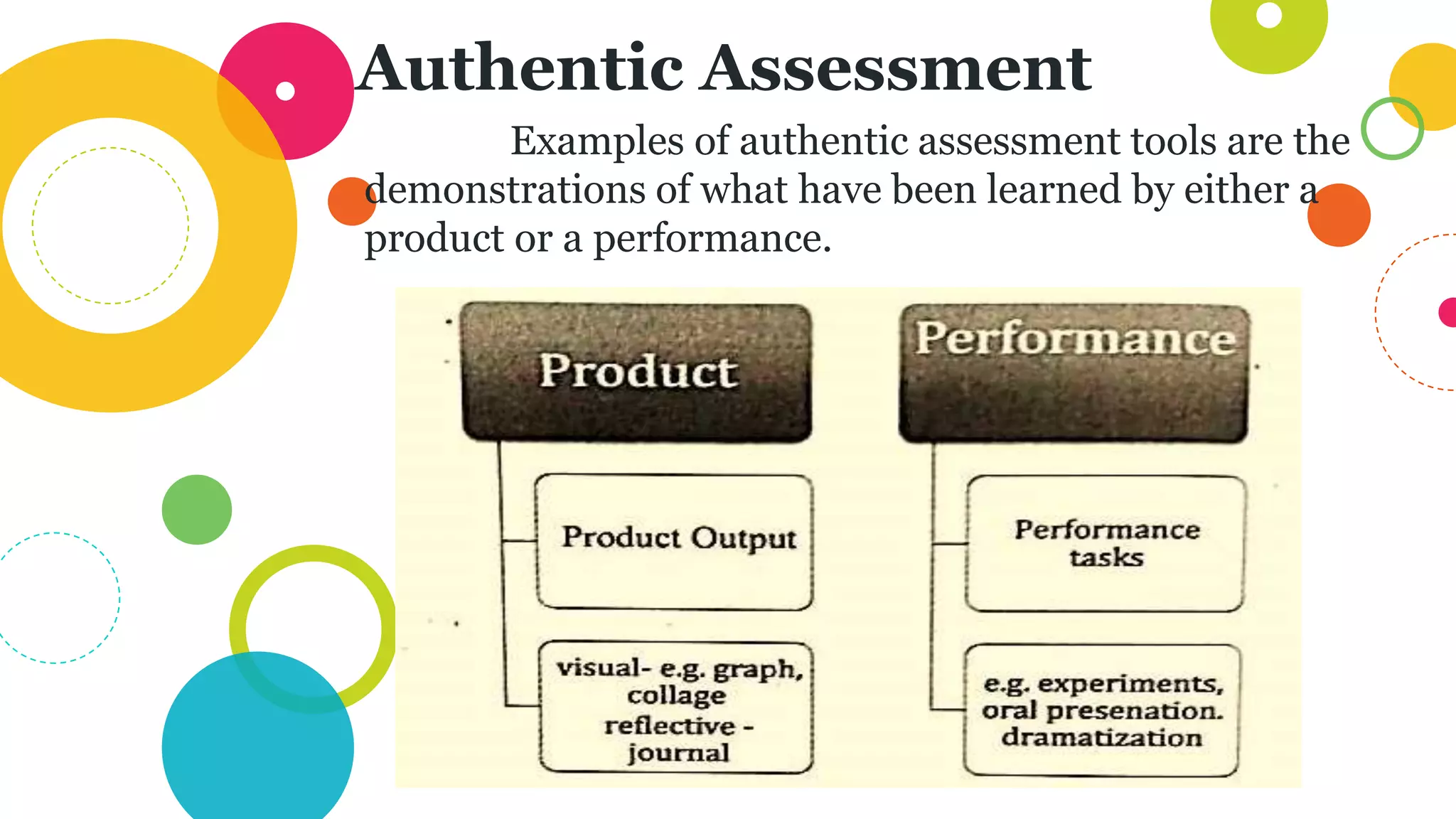
Examples of authentic assessment tools are the
demonstrations of what have been learned by either a
product or a performance.
Authentic Assessment
THANK YOU FOR
LISTENING!!!!
Blow your audience
away with attractive
visuals

CHAPTER 4 Assessing Student Learning Outcomes.pptx

  • 1.
  • 2.
    LEARNING OUTCOMES Clarify theprinciples in assessing learning outcomes. Explain the phases of outcomes assessment Determine alignment of learning outcomes and assessment tasks Discuss various assessment methods, tools and tasks including portfolios Construct a scoring rubric > Give sample assessment task for each MI Explain at least 3 key features of assessment in the K to 12 2
  • 3.
    INTRODUCTION Outcome assessment isthe process of gathering information on whether the instruction, services and activities that the program provides are producing the desired student learning outcomes. 3
  • 4.
    “ Principles of Good Practicein Assessing Learning Outcomes 4
  • 5.
    1 5 The assessment ofstudent learning starts with the institution's vision, mission and core values. There should be a clear statement on the kinds of learning that the institution values most for its students.
  • 6.
    2 6 Assessment works bestwhen the program has clear statement of objectives aligned with the institutional vision, mission and core values. Such alignment ensures clear, shared and implementable objectives.
  • 7.
    3 7 Outcome-based assessment focuseson the student activities that will still be relevant after formal schooling concludes. The approach is to design assessment activities which are observable and less abstract such as to determine the student's ability to write a paragraph" which is more observable than to determine the student's verbal ability."
  • 8.
    4 8 Assessment requires attentionnot only to outcomes but also and equally to the activities and experiences that lead to the attainment of learning outcomes. These are supporting student activities.
  • 9.
    5 9 Assessment works bestwhen it is continuous, on going and not episodic. Assessment should be cumulative because improvement is best achieved through a linked series of activities done over time in an instructional cycle.
  • 10.
    6 10 Begin assessment byspecifying clearly and exactly what you want to assess. What you want to assess is/are stated in your learning outcomes/lesson objectives..
  • 11.
    7 11 The intended learningoutcome/lesson objective NOT CONTENT is the basis of the assessment task. You use content in the development of the assessment tool and task but it is the attainment of your learning outcome NOT content that you want to assess. This is Outcome-based Teaching and Learning,
  • 12.
    8 12 Set your criterionof success or acceptable standard of success. It is against this established standard that you will interpret your assessment results. Example: Is a score of 7 out of 10 (the highest possible score) acceptable or considered success?
  • 13.
    9 Make use ofvaried tools for assessment data-gathering and multiple sources of assessment data. It is not pedagogically sound to rely on just one source of data gathered by only one assessment tool. Consider multiple intelligences and learning styles. DepED Order No. 73, s. 2012 cites the use of multiple measures as one assessment guideline.
  • 14.
    10 14 Learners must begiven feedback about their performance. Feedback must be specific. "Good work!" is positive feedback and is welcome but actually is not a very good feedback since it is not specific. A more specific better feedback is "You observed rules on subject-verb agreement and variety of sentences. Three of your commas were misplaced."
  • 15.
    11 15 Assessment should beon real-world application and not on out of-context drills.
  • 16.
    12 16 Emphasize on the assessmentof higher-order thinking.
  • 17.
  • 18.
  • 19.
    Student Learning Outcome#1: Students can organize information from secondary sources as basis of a research topic. Supporting Student Activities ◎ 1.1. practise differentiating source material and one's opinion ◎ 1.2. reading articles and formulating an original paragraph from quotes, paraphrases and summaries ◎ 1.3. writing of essays to develop the topic ◎ 1.4. integrating bibliographic entries in appropriate format 19
  • 20.
    Student Learning Outcome#2: Students apply principles of logical thinking and persuasive argument in writing. Supporting Student Activities ◎ 2.1. forming opinion about the topic ◎ 2.2. researching and writing about a variety of perspectives ◎ 2.3. adapting style to the identified audience ◎ 2.4. employing clear argument in writing 20
  • 21.
    Student Learning Outcome#3: Students write multiple-page essays complying with standard format and style Supporting Student Activities Supporting Student Activities ◎ 3.1. analyzing and evaluating texts ◎ 3.2. writing about a variety of perspectives on single topic ◎ 3.3. adapting tone and style to address one's audience ◎ 3.4. reviewing grammar and essay format in readings ◎ 3.5. holding group discussion about various topics 21
  • 22.
    “ Phases of Outcome Assessmentin the Instructional Cycle 22
  • 23.
    Big concept Bring theattention of your audience over a key concept using icons or illustrations 23
  • 24.
    1. On whichis assessment on the institutional cycle based after the vision mission of an institution, program goals and subject objectives? 2. What is the purpose of diagnostic assessment? 3. Based on the institutional cycle, how can you ensure mastery learning? 4. How does formative assessment of outcomes differ from the summative assessment of outcomes? 5. Why does summative assessment of outcomes point to program goals and subject objectives? Study the phases of outcome assessment in the instructional cycle as shown in the Figure above then as a group answer the following questions: 24
  • 25.
  • 26.
    Big concept Bring theattention of your audience over a key concept using icons or illustrations 26
  • 27.
    Figure 7 illustratesthe principle of constructive alignment. The principle of constructive alignment simply means that the teaching learning activity or activities and assessment tasks are aligned with the intended learning outcome. The intended learning outcome is "to drive a car." The teaching-learning activity is driving a car not giving lectures on car driving. The assessment task is to let the student drive a car not to describe how to drive a car. You have been victims of teachers who taught you one thing but assessed you on another. The result? Much confusion and disappointment? If you have been victims of lack of constructive alignment, then break the cycle by not victimizing your students, too. Observe the principle of constructive alignment. Make sure your assessment tasks are aligned with your learning outcomes. Why the term "constructive?" Constructive alignment is based on the constructivist theory (Biggs, 2007) that learners use their own activity to construct their knowledge or other outcome/s.
  • 28.
  • 29.
  • 30.
  • 31.
    Assessment methods canbe classified as traditional and authentic. Traditional assessment method refers to the usual paper-and-pencil test. Authentic assessment refers to non- paper-and-pencil test. It is also called alternative assessment, it being an alternative to the traditional.
  • 32.
    The paper-and-pencil test(traditional assessment) assesses learning in the cognitive domain (Bloom) or declarative knowledge (Kendall and Marzano, 2012). The paper-and-pencil test, however, is inadequate to measure all forms of learning. Psychomotor learning (Kendall and Marzano, 2012) or procedural knowledge (Kendall and Marzano, 2012) and learning proven by a product and by a performance cannot be measured by a -paper-and-pencil test. Assessment tools for the cognitive domain (declarative knowledge) are the different paper-and-pencil tests. Traditional Assessment
  • 33.
    Two groups ofWritten Tests and Specific Examples
  • 34.
    Examples of authenticassessment tools are the demonstrations of what have been learned by either a product or a performance. Authentic Assessment
  • 35.
    THANK YOU FOR LISTENING!!!! Blowyour audience away with attractive visuals