A presentation on
Computer Languages
An artificial language designed to communicate
via giving instructions to a machine. For ex- a
computer.
It consists of a set of symbols that instructs the
h/w to perform a specific task.
These symbols are formed as instructions which
follow some rules known as syntax.
Commands are written as sets of instructions,
called programs.
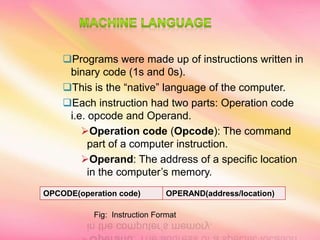
Programs were made up of instructions written in
binary code (1s and 0s).
This is the “native” language of the computer.
Each instruction had two parts: Operation code
i.e. opcode and Operand.
Operation code (Opcode): The command
part of a computer instruction.
Operand: The address of a specific location
in the computer’s memory.
OPCODE(operation code) OPERAND(address/location)
Fig: Instruction Format
Advantages/Limitations
Machine dependent.
Difficult to program.
Error prone.
Difficult to program.
Assembly language
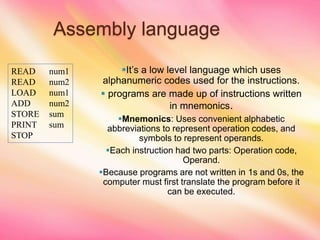
It’s a low level language which uses
alphanumeric codes used for the instructions.
 programs are made up of instructions written
in mnemonics.
Mnemonics: Uses convenient alphabetic
abbreviations to represent operation codes, and
symbols to represent operands.
Each instruction had two parts: Operation code,
Operand.
Because programs are not written in 1s and 0s, the
computer must first translate the program before it
can be executed.
READ num1
READ num2
LOAD num1
ADD num2
STORE sum
PRINT sum
STOP
Advantages/limitations
Easier to understand and use
Easier to modify.
Easier to locate and correct errors.
No worry about addresses.
Easily relocatable.
Efficiency of machine language.
Machine dependent.
Knowledge of h/w required.
Machine level coding.
High Level language
A programming language that enables a
programmer to write programs that are more or less
independent of a particular type of computer.
These are considered high-level because they are
closer to human languages and further from machine
languages.
hey are easier to read, write, and maintain.
Ultimately, programs written in a high-level language
must be translated into machine language by a
compiler or interpreter.
Advantages /limitation
Better documentation.
Easier to learn and use.
Machine independence.
Fewer errors.
Lower program preparations cost.
Easier to maintain.
Lower flexibility.

Programming Languages

  • 1.
  • 2.
    An artificial languagedesigned to communicate via giving instructions to a machine. For ex- a computer. It consists of a set of symbols that instructs the h/w to perform a specific task. These symbols are formed as instructions which follow some rules known as syntax. Commands are written as sets of instructions, called programs.
  • 4.
    Programs were madeup of instructions written in binary code (1s and 0s). This is the “native” language of the computer. Each instruction had two parts: Operation code i.e. opcode and Operand. Operation code (Opcode): The command part of a computer instruction. Operand: The address of a specific location in the computer’s memory. OPCODE(operation code) OPERAND(address/location) Fig: Instruction Format
  • 5.
    Advantages/Limitations Machine dependent. Difficult toprogram. Error prone. Difficult to program.
  • 6.
    Assembly language It’s alow level language which uses alphanumeric codes used for the instructions.  programs are made up of instructions written in mnemonics. Mnemonics: Uses convenient alphabetic abbreviations to represent operation codes, and symbols to represent operands. Each instruction had two parts: Operation code, Operand. Because programs are not written in 1s and 0s, the computer must first translate the program before it can be executed. READ num1 READ num2 LOAD num1 ADD num2 STORE sum PRINT sum STOP
  • 7.
    Advantages/limitations Easier to understandand use Easier to modify. Easier to locate and correct errors. No worry about addresses. Easily relocatable. Efficiency of machine language. Machine dependent. Knowledge of h/w required. Machine level coding.
  • 8.
    High Level language Aprogramming language that enables a programmer to write programs that are more or less independent of a particular type of computer. These are considered high-level because they are closer to human languages and further from machine languages. hey are easier to read, write, and maintain. Ultimately, programs written in a high-level language must be translated into machine language by a compiler or interpreter.
  • 9.
    Advantages /limitation Better documentation. Easierto learn and use. Machine independence. Fewer errors. Lower program preparations cost. Easier to maintain. Lower flexibility.