Understanding Data
Communication and
Network Topologies
for Effective
Networking
Data Communication
Data communications are the
exchange of data between two
devices via some form of
transmission medium such as a
wire cable.
Telecommunicati
on
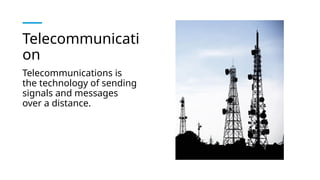
Telecommunications is
the technology of sending
signals and messages
over a distance.
Protocol
A protocol is a
standard set of
rules for
transmitting data
that defines what,
how and when the
data is transmitted.
Key elements of a
protocol
The key elements of a protocol are
syntax, semantics, and timing.
Syntax
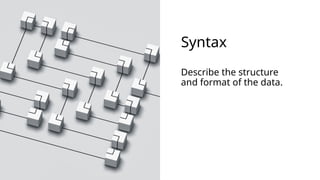
Describe the structure
and format of the data.
Semantics
Describes the meaning of
each section of data bit.
Timing
Timing refers to two
characteristics: when data
should be sent and how
fast it should be sent.
Types of Data Flow
Simplex
In simplex mode, communication between sender and
receiver occurs in only one direction. The sender can only
send the data, and the receiver can only receive the data.
The receiver cannot reply to the sender.
Half Duplex
In Half-Duplex mode, communication occurs in both
directions. The sender and receiver can both send and
receive the data, but only one is permitted to send them
at a unit time.
Full Duplex
In full-duplex mode, communication between sender and
receiver occurs concurrently. The sender and receiver can
both transmit and receive at the same time.
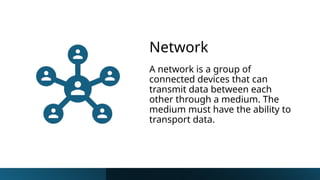
Network
A network is a group of
connected devices that can
transmit data between each
other through a medium. The
medium must have the ability to
transport data.
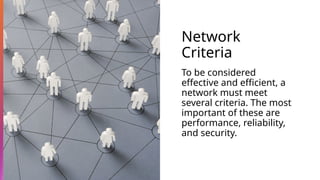
Network
Criteria
To be considered
effective and efficient, a
network must meet
several criteria. The most
important of these are
performance, reliability,
and security.
Performance
Network performance
describes the network
elements and the
duration between
transit time and
response time.
Reliabilit
y
Network reliability states the
frequency of failure and the
network’s robustness.
Security
Network security is
used to protect
data from
unauthorized
access and data
error.
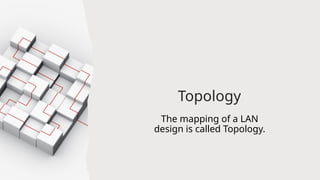
Topology
The mapping of a LAN
design is called Topology.
Types of
tropology
• There are four categories:
• Star topology
• Bus topology
• Ring topology and
• Mesh topology.
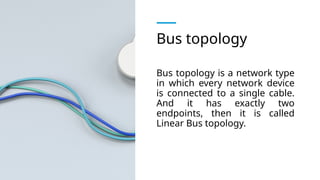
Bus topology
Bus topology is a network type
in which every network device
is connected to a single cable.
And it has exactly two
endpoints, then it is called
Linear Bus topology.
Merits and
Demerits
• It is low cost.
• It is easy to understand.
Advantages of Bus
Topology
• Cables fail then the whole network
fails.
• In each unit time, only two devices
can exchange data through the
cable.
Disadvantages of Bus
Topology
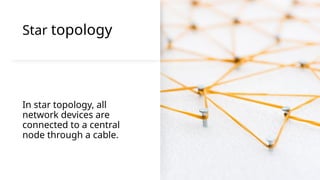
Star topology
In star topology, all
network devices are
connected to a central
node through a cable.
Merits and
demerits
• Easy to set up and modify.
• Follows the ethernet standard.
Advantages of star topology
• Cost of installation is high.
• If the central node fails, then the
whole network is stopped.
Disadvantages of star
topology
Ring topology
Network devices are
connected to a closed-loop
cable and form a circle. In
this system, there are
exactly two neighbors for
each device.
Merits and
demerits
• Easy to set up and modify.
Advantages of Ring Topology
• Transmission process is complex.
• Failure of one computer disturbs the
whole network.
Disadvantages of Ring
Topology

Understanding Data Communication and Network Topologies for Effective Networking.pptx