ULNAR NERVE
Brachial Plexus
FORMATION
 It composed of fibers from C8 and T1
coming from medial cord of brachial
plexus.
 C7 fibers of lateral cord add to it in axilla.
 So root value is C7,8, T1.
COURSE
 A) Axilla
 The Ulnar nerve runs between the third
part of Axillary artery and vein in the axilla.
 B) Arm :
 It lies medial to brachial artery upto the
level of insertion of coracobrachialis.
 Then it pierces the medial inter-muscular
septum to enter the posterior
compartment.
 In posterior compartment the nerve runs on
medial head of triceps along with superior ulnar
collateral artery.
 It runs in a groove behind the medial epicondyle
of humerus.
CUBITAL TUNNEL
 It is a channel which allow ulnar nerve to
travel over elbow.
 It is bordered by medial epicondyle of
humerus, olecranon process of ulna and
the tendinous arch joining the humeral and
ulnar head of flexor carpi ulnaris.
CUBITAL TUNNEL
C) Forearm
In the upper forearm it lies in between
flexor carpi ulnaris & flexor digitorum
profundus.
In lower part it becomes superficial & lies
lateral to tendon of flexor carpi ulnaris.
D) Wrist ( Guyon’s canal)
At the wrist, the ulnar nerve and artery lie in
a guyon’s canal
Formed by the pisiform bone medially and
the hook of hamate laterally.
Roof by superficial palmar carpal ligament
and floor by flexor retinaculum.
 In this region the nerve divides into two
superficial and deep branches.
 The Superficial Branch
 The Deep Branch
Branches in Forearm
 MUSCULAR:
a) Flexor digitorum profundus
b) Flexor carpi ulnaris
 ARTICULAR: elbow jt
 Palmar cutaneous br: supply skin over
hypothenar eminence.
Branches in Forearm
 Dorsal cutaneous br: winds round the
lower end of ulna and supply dorsal skin.
Distribution in hand
 Superficial terminal br:
 A) Palmaris brevis
 B) Proper digital br- little finger
 C) Common digital br-
Deep Terminal br
 Supplies hypothenar muscles
 Passes in between abductor digiti minimi
& flexor digiti minimi.
 Runs in mediolateral direction in concavity
of deep palmar arch.
Deep Terminal br
 Supplies :
 Third & fourth lumbrical
 Palmar & Dorsal interossei
 Ends by supplying the adductor pollicis
muscle.
 MUSICIAN’S NERVE
Tardy ulnar palsy
 Displaced fracture of medial humeral
epicondyle.
 Cubital tunnel syndrome
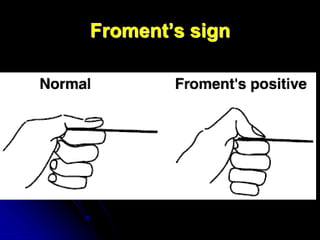
Froment’s sign
GUYON’S CANAL SYNDROME
 Injury at wrist
 Claw hand deformity
 Sensory loss only to medial digits( palmar
& dorsal cutaneous br spared)
ULNAR NERVE PARADOX
 The claw hand due to injury at wrist is
more obvious compared to injury at elbow.
 The lesion at wrist spares the flexor
digitorum profundus, which brings
powerful flexion at the interphalangeal joint
causing more clawing.
ULNAR NERVE.pptx

ULNAR NERVE.pptx

  • 1.
  • 2.
  • 3.
    FORMATION  It composedof fibers from C8 and T1 coming from medial cord of brachial plexus.  C7 fibers of lateral cord add to it in axilla.  So root value is C7,8, T1.
  • 4.
    COURSE  A) Axilla The Ulnar nerve runs between the third part of Axillary artery and vein in the axilla.
  • 6.
     B) Arm:  It lies medial to brachial artery upto the level of insertion of coracobrachialis.  Then it pierces the medial inter-muscular septum to enter the posterior compartment.
  • 8.
     In posteriorcompartment the nerve runs on medial head of triceps along with superior ulnar collateral artery.  It runs in a groove behind the medial epicondyle of humerus.
  • 10.
    CUBITAL TUNNEL  Itis a channel which allow ulnar nerve to travel over elbow.  It is bordered by medial epicondyle of humerus, olecranon process of ulna and the tendinous arch joining the humeral and ulnar head of flexor carpi ulnaris.
  • 11.
  • 13.
    C) Forearm In theupper forearm it lies in between flexor carpi ulnaris & flexor digitorum profundus. In lower part it becomes superficial & lies lateral to tendon of flexor carpi ulnaris.
  • 14.
    D) Wrist (Guyon’s canal) At the wrist, the ulnar nerve and artery lie in a guyon’s canal Formed by the pisiform bone medially and the hook of hamate laterally. Roof by superficial palmar carpal ligament and floor by flexor retinaculum.
  • 16.
     In thisregion the nerve divides into two superficial and deep branches.  The Superficial Branch  The Deep Branch
  • 17.
    Branches in Forearm MUSCULAR: a) Flexor digitorum profundus b) Flexor carpi ulnaris  ARTICULAR: elbow jt  Palmar cutaneous br: supply skin over hypothenar eminence.
  • 18.
    Branches in Forearm Dorsal cutaneous br: winds round the lower end of ulna and supply dorsal skin.
  • 19.
    Distribution in hand Superficial terminal br:  A) Palmaris brevis  B) Proper digital br- little finger  C) Common digital br-
  • 21.
    Deep Terminal br Supplies hypothenar muscles  Passes in between abductor digiti minimi & flexor digiti minimi.  Runs in mediolateral direction in concavity of deep palmar arch.
  • 22.
    Deep Terminal br Supplies :  Third & fourth lumbrical  Palmar & Dorsal interossei  Ends by supplying the adductor pollicis muscle.  MUSICIAN’S NERVE
  • 25.
    Tardy ulnar palsy Displaced fracture of medial humeral epicondyle.  Cubital tunnel syndrome
  • 26.
  • 27.
    GUYON’S CANAL SYNDROME Injury at wrist  Claw hand deformity  Sensory loss only to medial digits( palmar & dorsal cutaneous br spared)
  • 28.
    ULNAR NERVE PARADOX The claw hand due to injury at wrist is more obvious compared to injury at elbow.  The lesion at wrist spares the flexor digitorum profundus, which brings powerful flexion at the interphalangeal joint causing more clawing.