
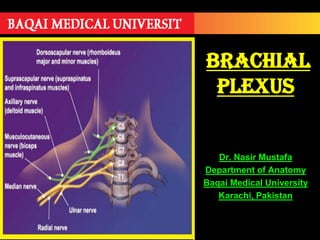




Brachial
Plexus
Dr. Nasir Mustafa
Department of Anatomy
Baqai Medical University
Karachi, Pakistan
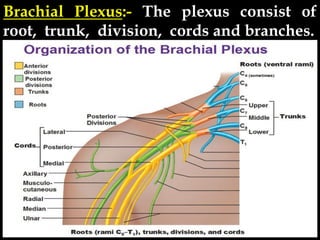
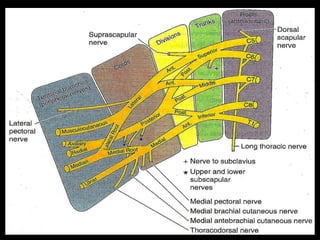
Brachial Plexus:- The plexus consist of
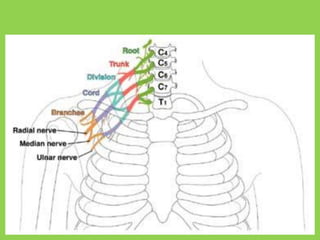
root, trunk, division, cords and branches.
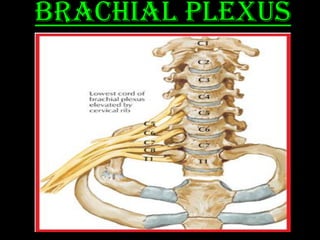
Brachial Plexus
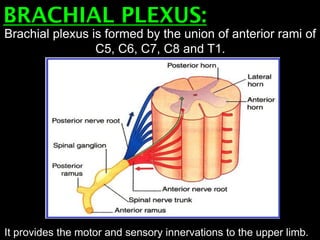
BRACHIAL PLEXUS:
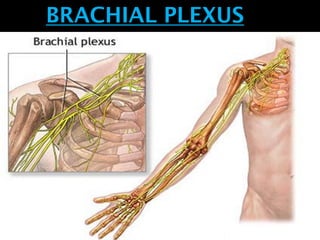
Brachial plexus is formed by the union of anterior rami of
C5, C6, C7, C8 and T1.
It provides the motor and sensory innervations to the upper limb.
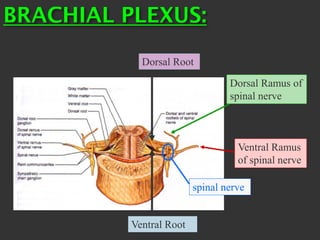
Dorsal Root
Ventral Root
spinal nerve
Dorsal Ramus of
spinal nerve
Ventral Ramus
of spinal nerve
BRACHIAL PLEXUS:
BRACHIAL PLEXUS
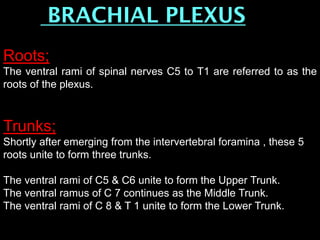
Roots;
The ventral rami of spinal nerves C5 to T1 are referred to as the
roots of the plexus.
Trunks;
Shortly after emerging from the intervertebral foramina , these 5
roots unite to form three trunks.
The ventral rami of C5 & C6 unite to form the Upper Trunk.
The ventral ramus of C 7 continues as the Middle Trunk.
The ventral rami of C 8 & T 1 unite to form the Lower Trunk.
BRACHIAL PLEXUS:
Divisions;
Each trunk splits into an anterior division and a posterior division.
The anterior divisions usually supply flexor muscles.
The posterior divisions usually supply extensor muscles.
Cords;
The anterior divisions of the upper and middle trunks unite to form
the lateral cord.
The anterior division of the lower trunk forms the medial cord.
All 3 posterior divisions from each of the 3 cords all unite to form
the posterior cord.
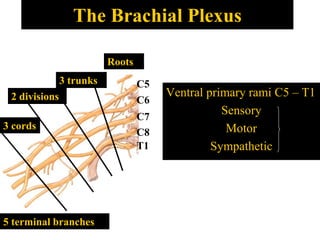
The Brachial Plexus
Ventral primary rami C5 – T1
Sensory
Motor
Sympathetic
C5
C6
C7
C8
T1
Roots
3 trunks
2 divisions
3 cords
5 terminal branches
BRACHIAL PLEXUS:
Terminal Branches;
They are mixed nerves containing both sensory and
motor axons.
Musculocutaneous
Median
Ulnar
Axillary
Radial
BRACHIAL PLEXUS
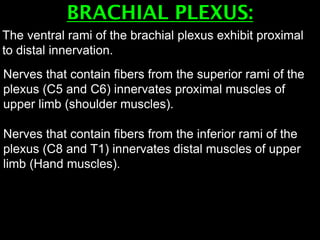
BRACHIAL PLEXUS:
Nerves that contain fibers from the superior rami of the
plexus (C5 and C6) innervates proximal muscles of
upper limb (shoulder muscles).
Nerves that contain fibers from the inferior rami of the
plexus (C8 and T1) innervates distal muscles of upper
limb (Hand muscles).
The ventral rami of the brachial plexus exhibit proximal
to distal innervation.
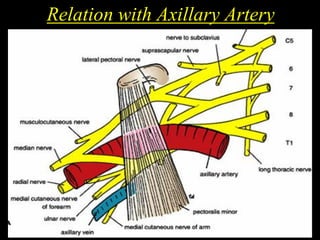
Relations of Brachial plexus
BRACHIAL PLEXUS:
Musculocutaneous nerve (C5 - C6)
Supplies all muscles of the anterior compartment
of the arm.
• Flex albow
• Supination (bicep brachi)
BRACHIAL PLEXUS
BRACHIAL PLEXUS:
Median nerve (C5 – T1)
a.Forearm;
Supplies the anterior compartment except 1.5 muscle by
ulnar nerve (Flexor carpi ulnaris and ulnar half of the
flexor digitorum profundus)
b.Hand;
Also supplies Thenar compartment, Opponens pollicis,
Central compartment and Lumbricals of Digit 2 & 3
• Flex wrist and all digits Pronation
• Opposition of thumb
• Flex MP joint and extend interphalangeal.
Brachial Plexus
BRACHIAL PLEXUS:
Ulnar nerve (C8 – T1)
a.Forearm;
Supplies anterior compartment 1 ½ muscle not
innervated by the median nerve.
b.Hand;
Hypothenar compartment
Central compartment
Introssei muscle (Palmar and Dorsal)
Lumbricals (Digit 4 and 5)
Adductor pollicis
• Flex wrist (weak) and digits 4 and 5
• Dorsal – Abduct digits 2-5
• Palmar – Adduct digits 2-5
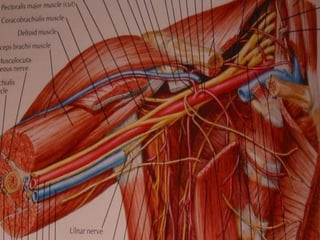
Relations of Brachial plexus
BRACHIAL PLEXUS:
Axillary nerve (C5 - C6)
Supplies Deltoid and
Teres minor muscle.
• Abduct shoulder 15 – 110
degree
• Lateral rotation of shoulder
BRACHIAL PLEXUS:
Radial nerve (C5 – T1)
Posterior compartment muscle of arm and forearm
• Extend MP, wrist and elbow
• Supination (Supinator muscle)
Relation with Axillary Artery
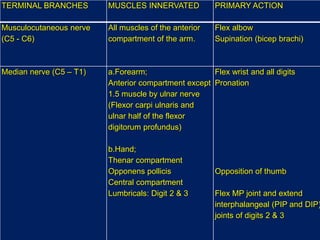
TERMINAL BRANCHES MUSCLES INNERVATED PRIMARY ACTION
Musculocutaneous nerve
(C5 - C6)
All muscles of the anterior
compartment of the arm.
Flex albow
Supination (bicep brachi)
Median nerve (C5 – T1) a.Forearm;
Anterior compartment except
1.5 muscle by ulnar nerve
(Flexor carpi ulnaris and
ulnar half of the flexor
digitorum profundus)
b.Hand;
Thenar compartment
Opponens pollicis
Central compartment
Lumbricals: Digit 2 & 3
Flex wrist and all digits
Pronation
Opposition of thumb
Flex MP joint and extend
interphalangeal (PIP and DIP)
joints of digits 2 & 3
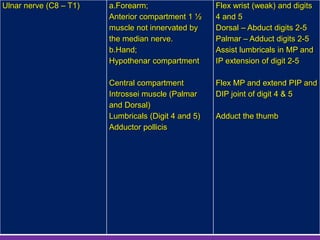
Ulnar nerve (C8 – T1) a.Forearm;
Anterior compartment 1 ½
muscle not innervated by
the median nerve.
b.Hand;
Hypothenar compartment
Central compartment
Introssei muscle (Palmar
and Dorsal)
Lumbricals (Digit 4 and 5)
Adductor pollicis
Flex wrist (weak) and digits
4 and 5
Dorsal – Abduct digits 2-5
Palmar – Adduct digits 2-5
Assist lumbricals in MP and
IP extension of digit 2-5
Flex MP and extend PIP and
DIP joint of digit 4 & 5
Adduct the thumb
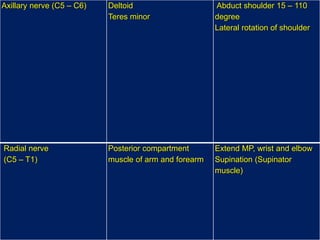
Axillary nerve (C5 – C6) Deltoid
Teres minor
Abduct shoulder 15 – 110
degree
Lateral rotation of shoulder
Radial nerve
(C5 – T1)
Posterior compartment
muscle of arm and forearm
Extend MP, wrist and elbow
Supination (Supinator
muscle)
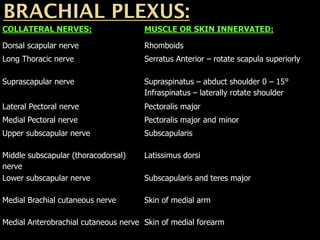
COLLATERAL NERVES: MUSCLE OR SKIN INNERVATED:
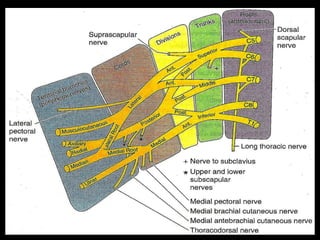
Dorsal scapular nerve Rhomboids
Long Thoracic nerve Serratus Anterior – rotate scapula superiorly
Suprascapular nerve Supraspinatus – abduct shoulder 0 – 15°
Infraspinatus – laterally rotate shoulder
Lateral Pectoral nerve Pectoralis major
Medial Pectoral nerve Pectoralis major and minor
Upper subscapular nerve Subscapularis
Middle subscapular (thoracodorsal)
nerve
Latissimus dorsi
Lower subscapular nerve Subscapularis and teres major
Medial Brachial cutaneous nerve Skin of medial arm
Medial Anterobrachial cutaneous nerve Skin of medial forearm
BRACHIAL PLEXUS:
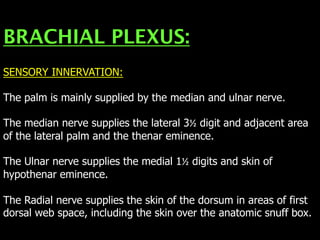
SENSORY INNERVATION:
The palm is mainly supplied by the median and ulnar nerve.
The median nerve supplies the lateral 3½ digit and adjacent area
of the lateral palm and the thenar eminence.
The Ulnar nerve supplies the medial 1½ digits and skin of
hypothenar eminence.
The Radial nerve supplies the skin of the dorsum in areas of first
dorsal web space, including the skin over the anatomic snuff box.
BRACHIAL PLEXUS:
CLINICAL CORRELATION OF BRACHIAL PLEXUS:
NERVE INJURIES:
Upper C5-C6 Brachial Plexus Lesion:
Erb-Duchenne Palsy (Waiter’s tip syndrome)
(Suprascapular, Musculocutaneous, Axillary)
Lower C8-T1 Brachial plexus lesion:
Klumpke’s paralysis
(Ulnar, Median)
BRACHIAL PLEXUS:
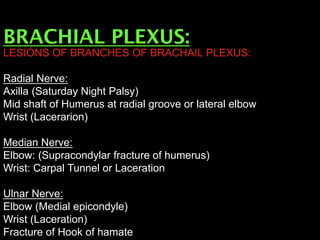
LESIONS OF BRANCHES OF BRACHAIL PLEXUS:
Radial Nerve:
Axilla (Saturday Night Palsy)
Mid shaft of Humerus at radial groove or lateral elbow
Wrist (Lacerarion)
Median Nerve:
Elbow: (Supracondylar fracture of humerus)
Wrist: Carpal Tunnel or Laceration
Ulnar Nerve:
Elbow (Medial epicondyle)
Wrist (Laceration)
Fracture of Hook of hamate
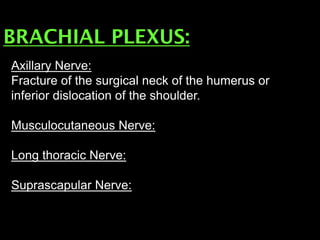
BRACHIAL PLEXUS:
Axillary Nerve:
Fracture of the surgical neck of the humerus or
inferior dislocation of the shoulder.
Musculocutaneous Nerve:
Long thoracic Nerve:
Suprascapular Nerve:
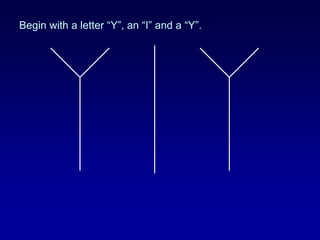
Begin with a letter “Y”, an “I” and a “Y”.
Add a “strike” and a “spare” (bowling scorekeeping symbols)
Draw “arches”.
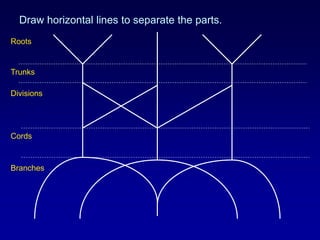
Draw horizontal lines to separate the parts.
Roots
Trunks
Divisions
Cords
Branches
Roots
Trunks
Divisions
Cords
Branches
Begin labeling.
C5 C6 C7 C8 T1
Upper Middle Lower
Musculocutaneous Axillary Median Radial Ulnar
Lateral
Posterior
Medial
SLOW
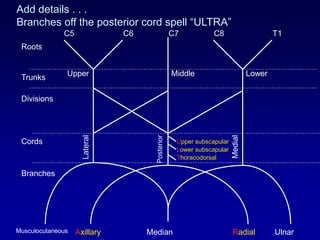
Add details . . .
Branches off the posterior cord spell “ULTRA”
Axillary Radial
C5 C6 C7 C8 T1
Roots
Trunks
Divisions
Cords
Branches
Upper Middle Lower
Musculocutaneous Median Ulnar
Lateral
Posterior
Medial
Upper subscapular
Lower subscapular
Thoracodorsal
SLOWSLOW
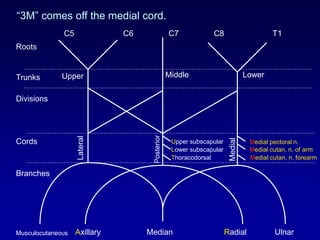
“3M” comes off the medial cord.
Axillary Radial
Roots
Trunks
Divisions
Cords
Branches
C5 C6 C7 C8 T1
Upper Middle Lower
Musculocutaneous Median Ulnar
Lateral
Posterior
Medial
Upper subscapular
Lower subscapular
Thoracodorsal
Medial pectoral n.
Medial cutan. n. of arm
Medial cutan. n. forearm
SLOWSLOW
The lateral pectoral n. comes off the lateral cord.
Axillary Radial
Roots
Trunks
Divisions
Cords
Branches
C5 C6 C7 C8 T1
Upper Middle Lower
Musculocutaneous Median Ulnar
Lateral
Posterior
Medial
Upper subscapular
Lower subscapular
Thoracodorsal
Medial pectoral n.
Medial cutan. n. of arm
Medial cutan. n. forearm
Lateral pectoral n.
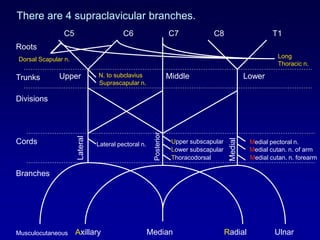
There are 4 supraclavicular branches.
Axillary Radial
Roots
Trunks
Divisions
Cords
Branches
C5 C6 C7 C8 T1
Upper Middle Lower
Musculocutaneous Median Ulnar
Lateral
Posterior
Medial
Upper subscapular
Lower subscapular
Thoracodorsal
Medial pectoral n.
Medial cutan. n. of arm
Medial cutan. n. forearm
Lateral pectoral n.
Dorsal Scapular n.
N. to subclavius
Suprascapular n.
Long
Thoracic n.
SLOW
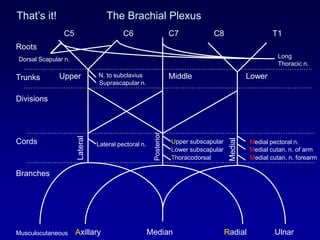
That’s it! The Brachial Plexus
Axillary Radial
Roots
Trunks
Divisions
Cords
Branches
C5 C6 C7 C8 T1
Upper Middle Lower
Musculocutaneous Median Ulnar
Lateral
Posterior
Medial
Upper subscapular
Lower subscapular
Thoracodorsal
Medial pectoral n.
Medial cutan. n. of arm
Medial cutan. n. forearm
Lateral pectoral n.
Dorsal Scapular n.
N. to subclavius
Suprascapular n.
Long
Thoracic n.
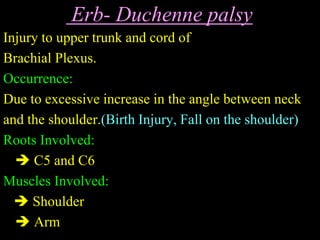
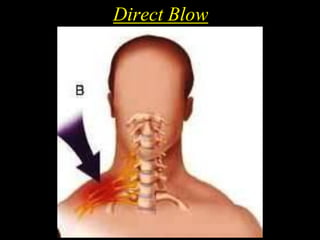
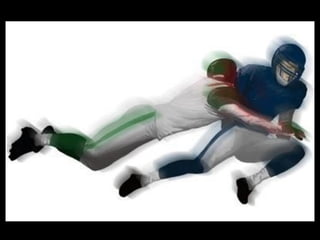
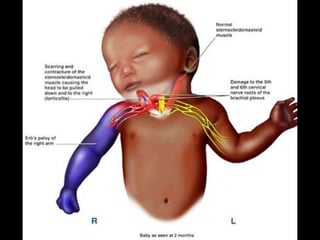
Erb- Duchenne palsy
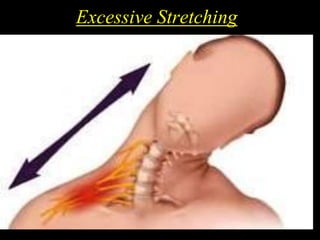
Injury to upper trunk and cord of
Brachial Plexus.
Occurrence:
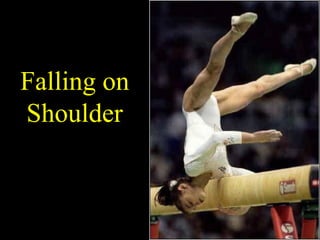
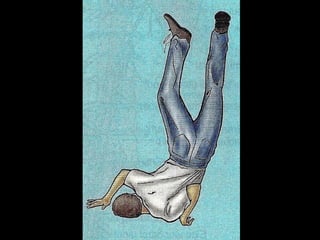
Due to excessive increase in the angle between neck
and the shoulder.(Birth Injury, Fall on the shoulder)
Roots Involved:
 C5 and C6
Muscles Involved:
 Shoulder
 Arm
Falling on
Shoulder
Excessive Stretching
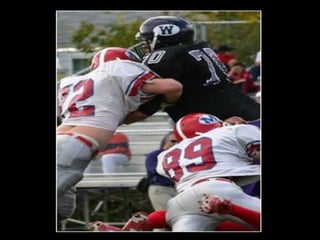
Direct Blow
Erb- Duchenne palsy
Clinical Appearance:
Motor Loss:
 Adducted Shoulder
 Medially Rotated Arm
 Extended Elbow
Sensory Loss:
 Lateral aspect of Upper Limb
klumpke paralysis or Palsy
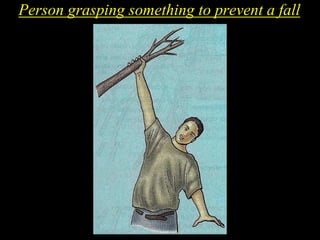
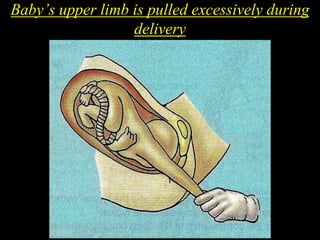
Injury to Inferior part of Plexus.
Occurrence:
Excessive abduction of arm.
Less common then Injury to Superior part of Plexus.
Roots Involved:
 C8 and T1
klumpke paralysis or Palsy
Clinical Appearance:
Motor Loss:
 Small muscles of Hand
Sensory Loss:
 Medial aspect of Upper Limb
Person grasping something to prevent a fall
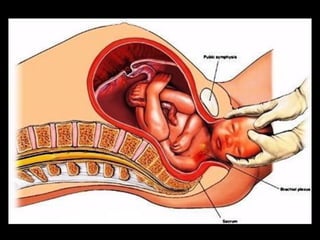
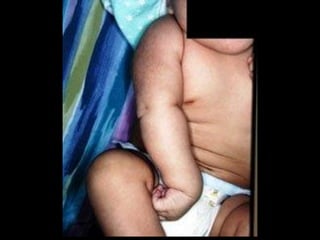
Baby’s upper limb is pulled excessively during
delivery
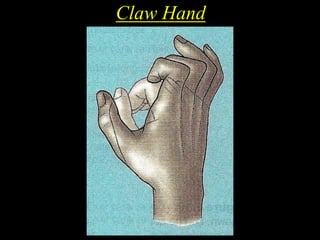
Claw Hand
Claw
Hand
Anatomical Anomalies of the Brachial Plexus
• Prefixed plexus: Formed by the ventral
primary rami of C4 - 8
• Postfixed plexus: formed by the ventral
primary rami of C6-T2
*
*Rib 1 can impinge on the lower trunk of the
brachial plexus and create problems
THANK YOU

Brachial plexus by Dr. Nasir Mustafa

  • 2.
    Brachial Plexus Dr. Nasir Mustafa Departmentof Anatomy Baqai Medical University Karachi, Pakistan
  • 4.
    Brachial Plexus:- Theplexus consist of root, trunk, division, cords and branches.
  • 5.
  • 6.
    BRACHIAL PLEXUS: Brachial plexusis formed by the union of anterior rami of C5, C6, C7, C8 and T1. It provides the motor and sensory innervations to the upper limb.
  • 7.
    Dorsal Root Ventral Root spinalnerve Dorsal Ramus of spinal nerve Ventral Ramus of spinal nerve BRACHIAL PLEXUS:
  • 10.
    BRACHIAL PLEXUS Roots; The ventralrami of spinal nerves C5 to T1 are referred to as the roots of the plexus. Trunks; Shortly after emerging from the intervertebral foramina , these 5 roots unite to form three trunks. The ventral rami of C5 & C6 unite to form the Upper Trunk. The ventral ramus of C 7 continues as the Middle Trunk. The ventral rami of C 8 & T 1 unite to form the Lower Trunk.
  • 12.
    BRACHIAL PLEXUS: Divisions; Each trunksplits into an anterior division and a posterior division. The anterior divisions usually supply flexor muscles. The posterior divisions usually supply extensor muscles.
  • 13.
    Cords; The anterior divisionsof the upper and middle trunks unite to form the lateral cord. The anterior division of the lower trunk forms the medial cord. All 3 posterior divisions from each of the 3 cords all unite to form the posterior cord.
  • 14.
    The Brachial Plexus Ventralprimary rami C5 – T1 Sensory Motor Sympathetic C5 C6 C7 C8 T1 Roots 3 trunks 2 divisions 3 cords 5 terminal branches
  • 15.
    BRACHIAL PLEXUS: Terminal Branches; Theyare mixed nerves containing both sensory and motor axons. Musculocutaneous Median Ulnar Axillary Radial
  • 16.
  • 17.
    BRACHIAL PLEXUS: Nerves thatcontain fibers from the superior rami of the plexus (C5 and C6) innervates proximal muscles of upper limb (shoulder muscles). Nerves that contain fibers from the inferior rami of the plexus (C8 and T1) innervates distal muscles of upper limb (Hand muscles). The ventral rami of the brachial plexus exhibit proximal to distal innervation.
  • 18.
  • 19.
    BRACHIAL PLEXUS: Musculocutaneous nerve(C5 - C6) Supplies all muscles of the anterior compartment of the arm. • Flex albow • Supination (bicep brachi)
  • 20.
  • 21.
    BRACHIAL PLEXUS: Median nerve(C5 – T1) a.Forearm; Supplies the anterior compartment except 1.5 muscle by ulnar nerve (Flexor carpi ulnaris and ulnar half of the flexor digitorum profundus) b.Hand; Also supplies Thenar compartment, Opponens pollicis, Central compartment and Lumbricals of Digit 2 & 3 • Flex wrist and all digits Pronation • Opposition of thumb • Flex MP joint and extend interphalangeal.
  • 22.
  • 23.
    BRACHIAL PLEXUS: Ulnar nerve(C8 – T1) a.Forearm; Supplies anterior compartment 1 ½ muscle not innervated by the median nerve. b.Hand; Hypothenar compartment Central compartment Introssei muscle (Palmar and Dorsal) Lumbricals (Digit 4 and 5) Adductor pollicis • Flex wrist (weak) and digits 4 and 5 • Dorsal – Abduct digits 2-5 • Palmar – Adduct digits 2-5
  • 24.
  • 25.
    BRACHIAL PLEXUS: Axillary nerve(C5 - C6) Supplies Deltoid and Teres minor muscle. • Abduct shoulder 15 – 110 degree • Lateral rotation of shoulder
  • 27.
    BRACHIAL PLEXUS: Radial nerve(C5 – T1) Posterior compartment muscle of arm and forearm • Extend MP, wrist and elbow • Supination (Supinator muscle)
  • 28.
  • 29.
    TERMINAL BRANCHES MUSCLESINNERVATED PRIMARY ACTION Musculocutaneous nerve (C5 - C6) All muscles of the anterior compartment of the arm. Flex albow Supination (bicep brachi) Median nerve (C5 – T1) a.Forearm; Anterior compartment except 1.5 muscle by ulnar nerve (Flexor carpi ulnaris and ulnar half of the flexor digitorum profundus) b.Hand; Thenar compartment Opponens pollicis Central compartment Lumbricals: Digit 2 & 3 Flex wrist and all digits Pronation Opposition of thumb Flex MP joint and extend interphalangeal (PIP and DIP) joints of digits 2 & 3
  • 30.
    Ulnar nerve (C8– T1) a.Forearm; Anterior compartment 1 ½ muscle not innervated by the median nerve. b.Hand; Hypothenar compartment Central compartment Introssei muscle (Palmar and Dorsal) Lumbricals (Digit 4 and 5) Adductor pollicis Flex wrist (weak) and digits 4 and 5 Dorsal – Abduct digits 2-5 Palmar – Adduct digits 2-5 Assist lumbricals in MP and IP extension of digit 2-5 Flex MP and extend PIP and DIP joint of digit 4 & 5 Adduct the thumb
  • 31.
    Axillary nerve (C5– C6) Deltoid Teres minor Abduct shoulder 15 – 110 degree Lateral rotation of shoulder Radial nerve (C5 – T1) Posterior compartment muscle of arm and forearm Extend MP, wrist and elbow Supination (Supinator muscle)
  • 32.
    COLLATERAL NERVES: MUSCLEOR SKIN INNERVATED: Dorsal scapular nerve Rhomboids Long Thoracic nerve Serratus Anterior – rotate scapula superiorly Suprascapular nerve Supraspinatus – abduct shoulder 0 – 15° Infraspinatus – laterally rotate shoulder Lateral Pectoral nerve Pectoralis major Medial Pectoral nerve Pectoralis major and minor Upper subscapular nerve Subscapularis Middle subscapular (thoracodorsal) nerve Latissimus dorsi Lower subscapular nerve Subscapularis and teres major Medial Brachial cutaneous nerve Skin of medial arm Medial Anterobrachial cutaneous nerve Skin of medial forearm
  • 33.
    BRACHIAL PLEXUS: SENSORY INNERVATION: Thepalm is mainly supplied by the median and ulnar nerve. The median nerve supplies the lateral 3½ digit and adjacent area of the lateral palm and the thenar eminence. The Ulnar nerve supplies the medial 1½ digits and skin of hypothenar eminence. The Radial nerve supplies the skin of the dorsum in areas of first dorsal web space, including the skin over the anatomic snuff box.
  • 34.
    BRACHIAL PLEXUS: CLINICAL CORRELATIONOF BRACHIAL PLEXUS: NERVE INJURIES: Upper C5-C6 Brachial Plexus Lesion: Erb-Duchenne Palsy (Waiter’s tip syndrome) (Suprascapular, Musculocutaneous, Axillary) Lower C8-T1 Brachial plexus lesion: Klumpke’s paralysis (Ulnar, Median)
  • 35.
    BRACHIAL PLEXUS: LESIONS OFBRANCHES OF BRACHAIL PLEXUS: Radial Nerve: Axilla (Saturday Night Palsy) Mid shaft of Humerus at radial groove or lateral elbow Wrist (Lacerarion) Median Nerve: Elbow: (Supracondylar fracture of humerus) Wrist: Carpal Tunnel or Laceration Ulnar Nerve: Elbow (Medial epicondyle) Wrist (Laceration) Fracture of Hook of hamate
  • 36.
    BRACHIAL PLEXUS: Axillary Nerve: Fractureof the surgical neck of the humerus or inferior dislocation of the shoulder. Musculocutaneous Nerve: Long thoracic Nerve: Suprascapular Nerve:
  • 37.
    Begin with aletter “Y”, an “I” and a “Y”.
  • 38.
    Add a “strike”and a “spare” (bowling scorekeeping symbols)
  • 39.
  • 40.
    Draw horizontal linesto separate the parts. Roots Trunks Divisions Cords Branches
  • 41.
    Roots Trunks Divisions Cords Branches Begin labeling. C5 C6C7 C8 T1 Upper Middle Lower Musculocutaneous Axillary Median Radial Ulnar Lateral Posterior Medial SLOW
  • 42.
    Add details .. . Branches off the posterior cord spell “ULTRA” Axillary Radial C5 C6 C7 C8 T1 Roots Trunks Divisions Cords Branches Upper Middle Lower Musculocutaneous Median Ulnar Lateral Posterior Medial Upper subscapular Lower subscapular Thoracodorsal SLOWSLOW
  • 43.
    “3M” comes offthe medial cord. Axillary Radial Roots Trunks Divisions Cords Branches C5 C6 C7 C8 T1 Upper Middle Lower Musculocutaneous Median Ulnar Lateral Posterior Medial Upper subscapular Lower subscapular Thoracodorsal Medial pectoral n. Medial cutan. n. of arm Medial cutan. n. forearm SLOWSLOW
  • 44.
    The lateral pectoraln. comes off the lateral cord. Axillary Radial Roots Trunks Divisions Cords Branches C5 C6 C7 C8 T1 Upper Middle Lower Musculocutaneous Median Ulnar Lateral Posterior Medial Upper subscapular Lower subscapular Thoracodorsal Medial pectoral n. Medial cutan. n. of arm Medial cutan. n. forearm Lateral pectoral n.
  • 45.
    There are 4supraclavicular branches. Axillary Radial Roots Trunks Divisions Cords Branches C5 C6 C7 C8 T1 Upper Middle Lower Musculocutaneous Median Ulnar Lateral Posterior Medial Upper subscapular Lower subscapular Thoracodorsal Medial pectoral n. Medial cutan. n. of arm Medial cutan. n. forearm Lateral pectoral n. Dorsal Scapular n. N. to subclavius Suprascapular n. Long Thoracic n. SLOW
  • 46.
    That’s it! TheBrachial Plexus Axillary Radial Roots Trunks Divisions Cords Branches C5 C6 C7 C8 T1 Upper Middle Lower Musculocutaneous Median Ulnar Lateral Posterior Medial Upper subscapular Lower subscapular Thoracodorsal Medial pectoral n. Medial cutan. n. of arm Medial cutan. n. forearm Lateral pectoral n. Dorsal Scapular n. N. to subclavius Suprascapular n. Long Thoracic n.
  • 47.
    Erb- Duchenne palsy Injuryto upper trunk and cord of Brachial Plexus. Occurrence: Due to excessive increase in the angle between neck and the shoulder.(Birth Injury, Fall on the shoulder) Roots Involved:  C5 and C6 Muscles Involved:  Shoulder  Arm
  • 50.
  • 52.
  • 54.
  • 57.
    Erb- Duchenne palsy ClinicalAppearance: Motor Loss:  Adducted Shoulder  Medially Rotated Arm  Extended Elbow Sensory Loss:  Lateral aspect of Upper Limb
  • 61.
    klumpke paralysis orPalsy Injury to Inferior part of Plexus. Occurrence: Excessive abduction of arm. Less common then Injury to Superior part of Plexus. Roots Involved:  C8 and T1
  • 62.
    klumpke paralysis orPalsy Clinical Appearance: Motor Loss:  Small muscles of Hand Sensory Loss:  Medial aspect of Upper Limb
  • 63.
    Person grasping somethingto prevent a fall
  • 64.
    Baby’s upper limbis pulled excessively during delivery
  • 65.
  • 66.
  • 67.
    Anatomical Anomalies ofthe Brachial Plexus • Prefixed plexus: Formed by the ventral primary rami of C4 - 8 • Postfixed plexus: formed by the ventral primary rami of C6-T2 * *Rib 1 can impinge on the lower trunk of the brachial plexus and create problems
  • 68.