Nerves of the Upper Limb
Mgr. Veronika Mrkvicová
(physiotherapist)
Examination Methods in Rehabilitation (26.10.2020)
Nerves of the Upper Limb
1. Axillary nerve
2. Musculocutaneuous nerve
3. Radial nerve
4. Median nerve
5. Ulnar nerve
Brachial plexus
• Networking of spinal nerves, formed by
ventral (anterior rami) of cervical spinal
nerves C5-C8 and thoracic spinal nerves T1
• It is responsible for cutaneous (sensory) and
muscular (motor) innervation of the entire
upper limb
Brachial plexus
• 5 main nerves arise from brachial plexus:
1. Axillary nerve
2. Musculocutaneuous nerve
3. Radial nerve
4. Median nerve
5. Ulnar nerve
Nerves of the Upper Limb - sensitivity
The cutaneous inervation of the right hand
Axillary nerve
• From root C5-C6
• Arise from posterior cord of brachial plexus
at the level of axilla
Innervations of the Axillary nerve
Muscular innervations:
• Anterior branch – anterior and lateral fiber of
deltoid muscles
• Posterior branch – teres minor and posterior
fiber of deltoid
Cutaneuos innervation:
• Superior lateral brachial cutaneous nerve
• Carry information from the shoulder joint
• Skin covering inferior region of deltoid muscles
Axillary nerve paralysis
• Frequently injured due to shoulder dislocation because
of the proximity of this joint
• Paralysis of the deltoid and teres minor – it results in
weakness of the arm abduction
Musculocutaneous nerve
Innervation of the Musculocutaneous nerve
Median nerve
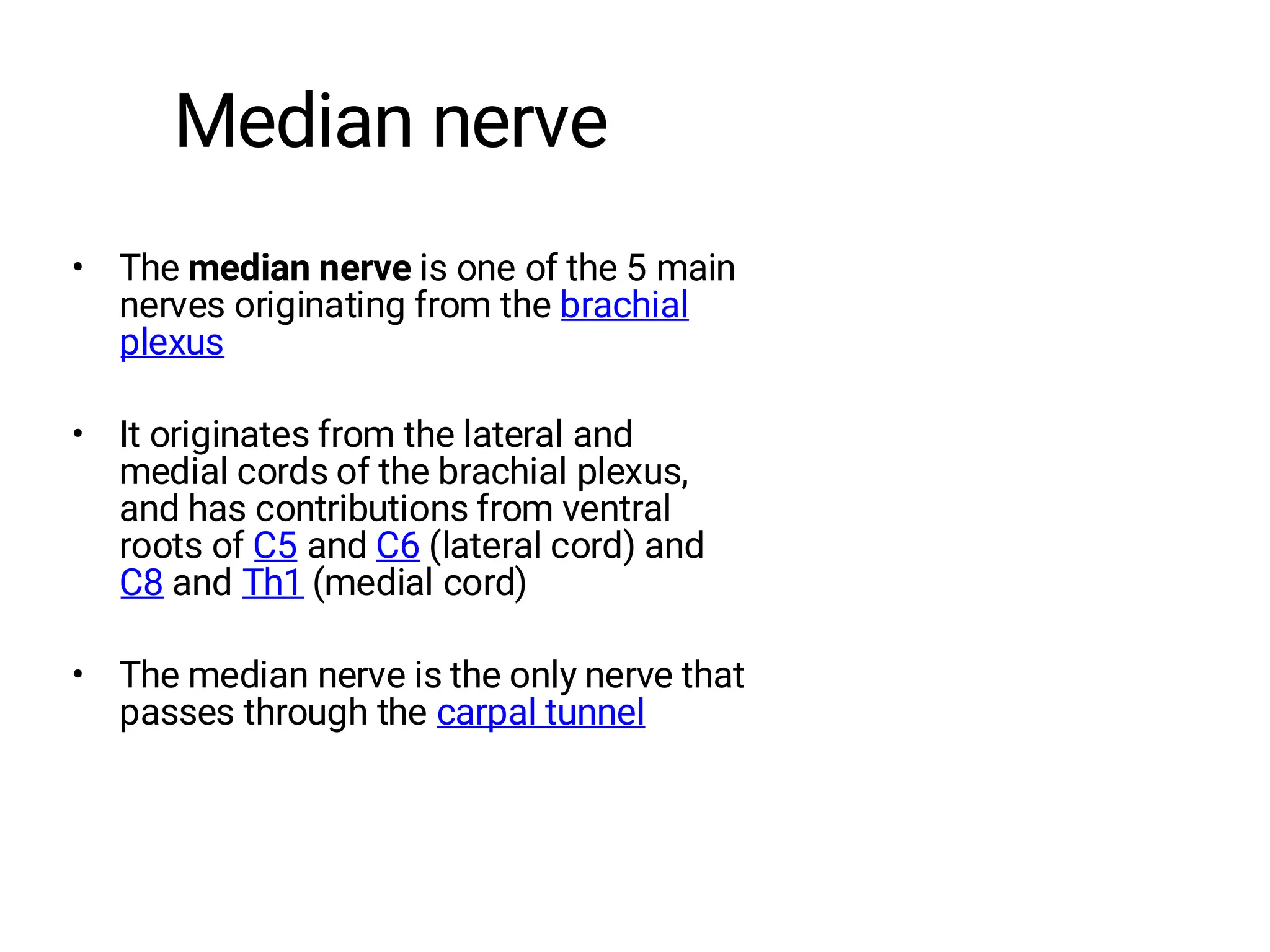
• The median nerve is one of the 5 main
nerves originating from the brachial
plexus
• It originates from the lateral and
medial cords of the brachial plexus,
and has contributions from ventral
roots of C5 and C6 (lateral cord) and
C8 and Th1 (medial cord)
• The median nerve is the only nerve that
passes through the carpal tunnel
Median nerve
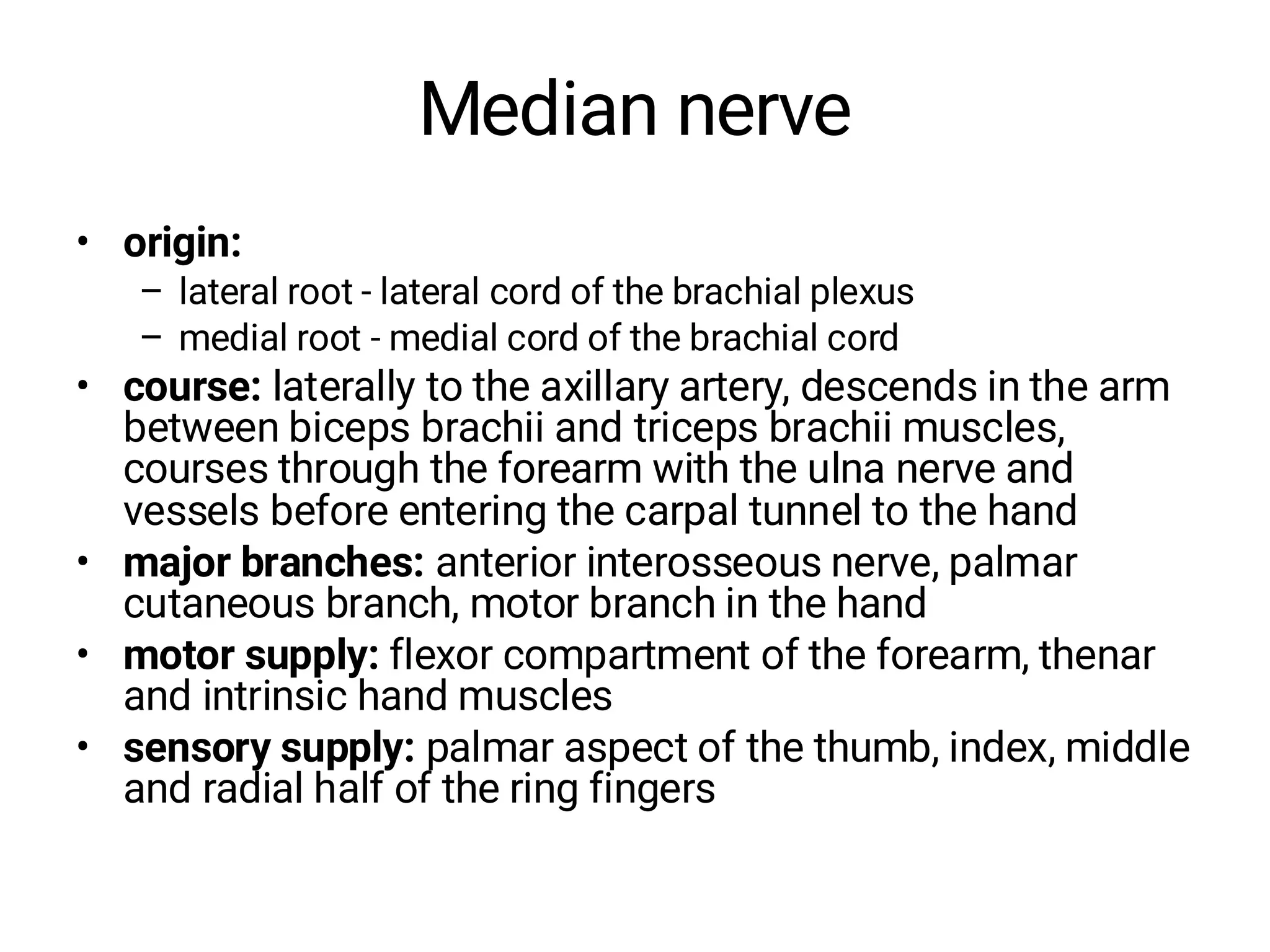
• origin:
– lateral root - lateral cord of the brachial plexus
– medial root - medial cord of the brachial cord
• course: laterally to the axillary artery, descends in the arm
between biceps brachii and triceps brachii muscles,
courses through the forearm with the ulna nerve and
vessels before entering the carpal tunnel to the hand
• major branches: anterior interosseous nerve, palmar
cutaneous branch, motor branch in the hand
• motor supply: flexor compartment of the forearm, thenar
and intrinsic hand muscles
• sensory supply: palmar aspect of the thumb, index, middle
and radial half of the ring fingers
Median nerve – branches:
• anterior interosseous nerve supplies
all the flexor muscles of the forearm
apart from flexor carpi ulnaris and
the ulnar half of flexor digitorum profundus
• motor branch in the hand - supplies thenar muscles and the radial
two lumbricals
• palmar cutaneous branch - cutaneous innervation to the palmar
aspect of the thumb, index and middle fingers and the radial half of
the ring finger
• articular branches to the elbow, wrist, carpal and phalangeal joints
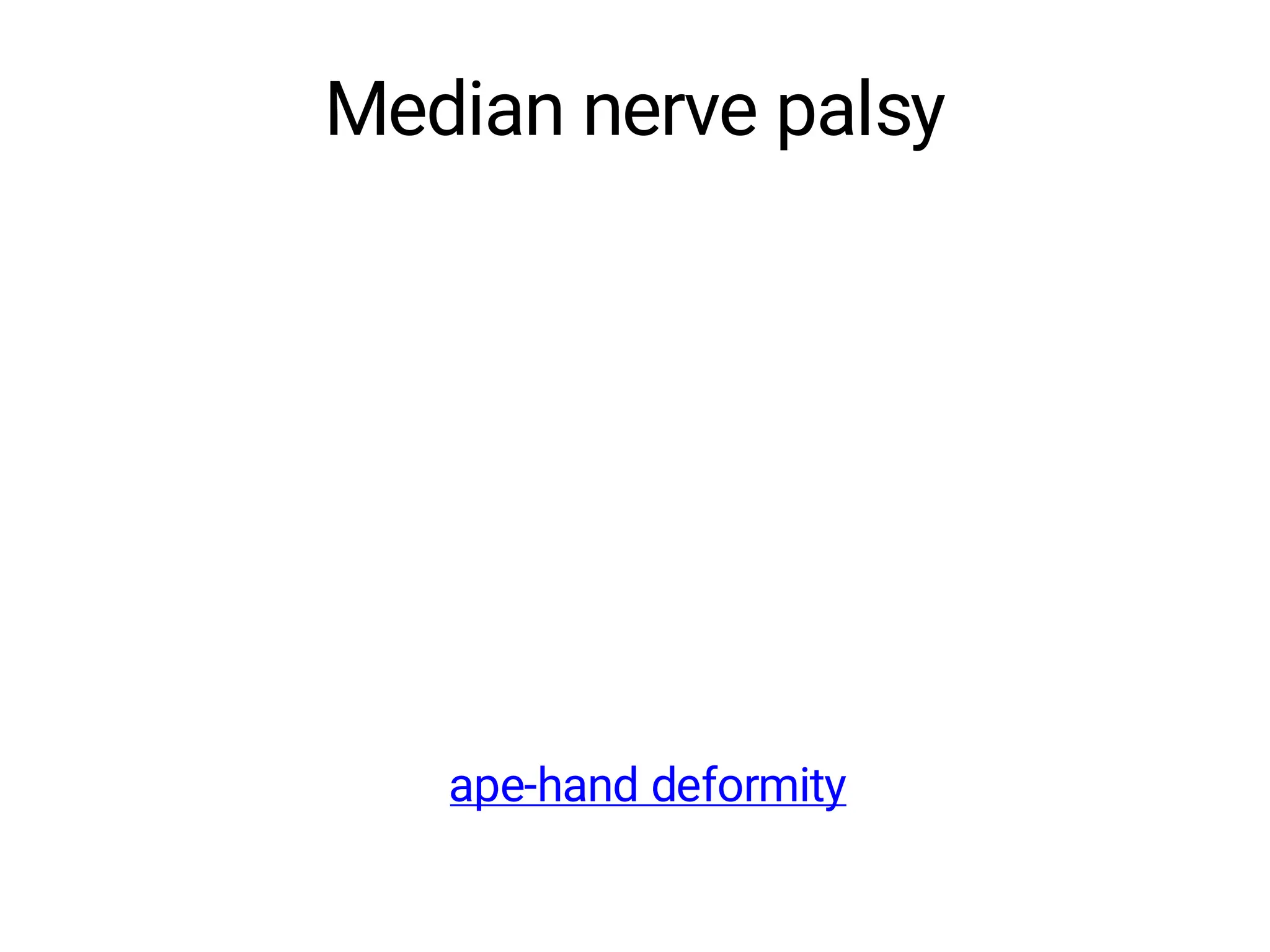
Median nerve palsy
ape-hand deformity
Median nerve palsy – signs and
symptoms:
• Lack of ability to abduct and oppose the thumb due to
paralysis of the thenar muscles. This is called "ape-hand
deformity„
• Sensory loss in the thumb, index finger, long finger, and
the radial aspect of the ring finger
• Weakness in forearm pronation and wrist and finger
flexion
• Difficulties in Activities of daily living (ADL) such as
brushing teeth, tying shoes, making phone calls, turning
door knobs and writing
Median nerve palsy – causes:
• deep, penetrating injuries to the arm, forearm, or wrist
• or blunt force trauma or neuropathy
Can be separated into 2 subsections - high and low MNP:
• High MNP involves lesions at the elbow and forearm areas
• Low MNP results from lesions at the wrist
• compression at the different levels of the median nerve produce variable
symptoms and/or syndromes, the areas are:
• Underneath Struthers' ligament
• Passing by the bicipital aponeurosis (also known as lacertus fibrosus)
• Between the two heads of the pronator teres
• Compression in the carpal tunnel causes carpal tunnel syndrome
Tests of median nerve function
• Thumb „ circles“ • Thumb opposition
• Thumb flexion • Fingers flexion
Carpal tunnel syndrome
Ulnar nerve
• It originates from the
C8-T1 nerve roots (and
occasionally carries C7
fibres) which form part
of the medial cord of
the brachial plexus,
and descends on the
posteromedial aspect
of the humerus
Ulnar nerve – motor inervation
• In the forearm, via the muscular branches of ulnar nerve:
– Flexor carpi ulnaris
– Flexor digitorum profundus (medial half)
• In the hand, via the deep branch of ulnar nerve:
– hypothenar muscles
• Opponens digiti minimi
• Abductor digiti minimi
• Flexor digiti minimi brevis
– The third and fourth lumbrical muscles
– Dorsal interossei
– Palmar interossei
– Adductor Pollicis
– Flexor pollicis brevis (deep head)
• In the hand, via the superficial branch of ulnar nerve:
– Palmaris brevis
Ulnar nerve – sensory inervation
Sensory inervation to the V.digit and the medial half of
the IV.digit, and the corresponding part of the palm:
Palmar branch of ulnar nerve:
cutaneous innervation to the
anterior skin and nails
Dorsal cutaneous branch of
ulnar nerve:
cutaneous innervation to the
dorsal medial hand and the
dorsum of the medial 1.5
fingers
Ulnar nerve palsy
• The ulnar nerve can suffer injury anywhere between its
proximal origin of the brachial plexus all the way to its
distal branches in the hand
• It is the most commonly injured nerve around the elbow
• Although it can be damaged under various circumstances,
it is commonly injured by local trauma or physical
impigement ("pinched nerve")
• Injury of the ulnar nerve at different levels causes specific
motor and sensory deficits
Ulnar nerve palsy – position of the hand
An ulnar claw (or claw hand, or ´Spinster's Claw´)
The metacarpophalangeal joints of the 4th and 5th fingers are extended
and the Interphalangeal joints are flexed, thumb IP flexion
Ulnar nerve palsy
• The hand will show hyper-extension of the MCP and
flexion of the distal and proximal IP joints of the 4th and
5th digits
• The clawing will become most obvious when the person is
asked to flex the digits from an extended position as the
4th and 5th digits can not flex
• 1st, 2nd and 3rd digits will partially flex giving them a
"claw-like" appearance, this happens because the Thenar
muscles (Abductor pollicis brevis, Flexor Pollicis brevis
and Opponens pollicis) are innervated by the median nerve
as the first two lumbricals of digit 2 and 3 are
Froments´ test (Froments´ sign)
• Tests for the action of adductor pollicis
• A patient is asked to hold a flat object (a piece of paper), between their
thumb and index finger (pinch grip)
• The examiner then attempts to pull the object out of the subject's hands
• A normal individual will be able to maintain a hold on the object without
difficulty
• With ulnar nerve palsy, the patient will experience difficulty maintaining a
hold and will compensate by flexing the FPL (flexor pollicis longus) of
the thumb to maintain grip pressure causing a pinching effect
Ulnar nerve palsy – fingers abduction
• Unability to spread
(abduct) or pull together
(adduct) the fingers
against resistance
(because the ulnar nerve
innervates the palmar
and dorsal interossei of
the hand)
Ulnar nerve palsy – muscles atrophy
• Patients with this deficit will become
increasingly easy to identify over time as the
paralyzed first dorsal interosseous muscle
atrophies, leaving a prominent hollowing
between the thumb and forefinger
Ulnar entrapment
• It is a condition where the ulnar nerve becomes trapped or
pinched due to some physiological abnormalities
• It is classified by location of entrapment
• The ulnar nerve passes through several small tunnels and
outlets through the medial upper extremity, and at these
points the nerve is vulnerable to compression or
entrapment - a so-called "pinched nerve„
• The nerve is particularly vulnerable to injury when there
has been a disruption in the normal anatomy
Ulnar entrapment
It can be classified by specific local causes, including:
• Problems originating at the neck: thoracic outlet sy, cervical spine
pathology, tight anterior scalene muscles
• Problems originating in the chest: tight pectoralis minor muscles
• Brachial plexus abnormalities
• Elbow pathology: fractures, growth plate injuries, cubital tunnel sy,
flexorpronator aponeurosis, arcade of Struthers
• Forearm pathology: tight flexor carpi ulnaris muscles
• Wrist pathology: fractures, ulnar tunnel sy, hypothenar hammer sy
Radial nerve
• The radial nerve supplies the
posterior portion of the upper limb
• It innervates the medial and lateral
heads of the triceps brachii muscle
of the arm, as well as all 12
muscles in the posterior
osteofascial compartment of the
forearm and the associated joints
and overlying skin
• It originates from the brachial
plexus, carrying fibers from the
ventral roots of spinal nerves C5,
C6, C7, C8 & Th1
Radial nerve
• origin: one of the two posterior cords of the brachial plexus
• course: posteromedially with the axillary vessels, behind the
humerus, then anteriorly towards the elbow where it divides
into superficial and deep branches
• terminal branches: posterior interosseous (deep) and
superficial radial nerve
• motor: wrist and finger extension
• sensory: dorsal aspect of the thumb, index and middle fingers
Radial nerve –
branches
• muscular twigs in the arm –
triceps brachii and anconeus muscles
• superficial branch - supplies cutaneous sensation to
the dorsal aspect of the hand and dorsal aspect of the
first to third digits and the dorsal lateral aspect of the
fourth finger
• deep branch - posterior interosseous nerve - extensor
muscles in the forearm as well as brachioradialis
• articular twigs to the elbow and wrist joints
Radial nerve injury
• The radial nerve is often injured in its course
close to the humerus, either from fracture or
pressure from direct blow to the humerus
(incorrect use of a crutch)
• Triceps usually escapes because derivation
of the nerve giving off high in arm, but total
paralysis of the extensor of the wrist and
digits leads to the dropped wrist deformities
Radial nerve palsy
• Drop hand
Tests for extensors
• Thumb extensors • Wrist extensors
Brachial plexus injury
Erb´s Duchenne Palsy
Klumpke´s Palsy
Literature, e-sources
• http://criticalcaremcqs.com/tag/aipgmee-mcqs/page/15/
• www.graysanatomyonline.com
• https://en.wikipedia.org/wiki/Median_nerve_palsy
• http://www.slideshare.net/hermizan84/peripheral-nerves-of-upper-limb?r
elated=1
• https://meded.ucsd.edu/clinicalmed/neuro2.htm
• http://accessphysiotherapy.mhmedical.com/data/Multimedia/grandRou
nds/brachial/media/brachial_print.html
• http://www.slideshare.net/hermizan84/peripheral-nerves-of-upper-limb?r
elated=1
Thank you for your attention 

4c5ff848-18ff-493d-be9e-b2c0e33c3e12.pdf

  • 1.
    Nerves of theUpper Limb Mgr. Veronika Mrkvicová (physiotherapist) Examination Methods in Rehabilitation (26.10.2020)
  • 2.
    Nerves of theUpper Limb 1. Axillary nerve 2. Musculocutaneuous nerve 3. Radial nerve 4. Median nerve 5. Ulnar nerve
  • 3.
    Brachial plexus • Networkingof spinal nerves, formed by ventral (anterior rami) of cervical spinal nerves C5-C8 and thoracic spinal nerves T1 • It is responsible for cutaneous (sensory) and muscular (motor) innervation of the entire upper limb
  • 4.
    Brachial plexus • 5main nerves arise from brachial plexus: 1. Axillary nerve 2. Musculocutaneuous nerve 3. Radial nerve 4. Median nerve 5. Ulnar nerve
  • 5.
    Nerves of theUpper Limb - sensitivity
  • 7.
    The cutaneous inervationof the right hand
  • 8.
    Axillary nerve • Fromroot C5-C6 • Arise from posterior cord of brachial plexus at the level of axilla
  • 10.
    Innervations of theAxillary nerve Muscular innervations: • Anterior branch – anterior and lateral fiber of deltoid muscles • Posterior branch – teres minor and posterior fiber of deltoid Cutaneuos innervation: • Superior lateral brachial cutaneous nerve • Carry information from the shoulder joint • Skin covering inferior region of deltoid muscles
  • 11.
    Axillary nerve paralysis •Frequently injured due to shoulder dislocation because of the proximity of this joint • Paralysis of the deltoid and teres minor – it results in weakness of the arm abduction
  • 12.
  • 13.
    Innervation of theMusculocutaneous nerve
  • 15.
    Median nerve • Themedian nerve is one of the 5 main nerves originating from the brachial plexus • It originates from the lateral and medial cords of the brachial plexus, and has contributions from ventral roots of C5 and C6 (lateral cord) and C8 and Th1 (medial cord) • The median nerve is the only nerve that passes through the carpal tunnel
  • 16.
    Median nerve • origin: –lateral root - lateral cord of the brachial plexus – medial root - medial cord of the brachial cord • course: laterally to the axillary artery, descends in the arm between biceps brachii and triceps brachii muscles, courses through the forearm with the ulna nerve and vessels before entering the carpal tunnel to the hand • major branches: anterior interosseous nerve, palmar cutaneous branch, motor branch in the hand • motor supply: flexor compartment of the forearm, thenar and intrinsic hand muscles • sensory supply: palmar aspect of the thumb, index, middle and radial half of the ring fingers
  • 17.
    Median nerve –branches: • anterior interosseous nerve supplies all the flexor muscles of the forearm apart from flexor carpi ulnaris and the ulnar half of flexor digitorum profundus • motor branch in the hand - supplies thenar muscles and the radial two lumbricals • palmar cutaneous branch - cutaneous innervation to the palmar aspect of the thumb, index and middle fingers and the radial half of the ring finger • articular branches to the elbow, wrist, carpal and phalangeal joints
  • 19.
  • 20.
    Median nerve palsy– signs and symptoms: • Lack of ability to abduct and oppose the thumb due to paralysis of the thenar muscles. This is called "ape-hand deformity„ • Sensory loss in the thumb, index finger, long finger, and the radial aspect of the ring finger • Weakness in forearm pronation and wrist and finger flexion • Difficulties in Activities of daily living (ADL) such as brushing teeth, tying shoes, making phone calls, turning door knobs and writing
  • 21.
    Median nerve palsy– causes: • deep, penetrating injuries to the arm, forearm, or wrist • or blunt force trauma or neuropathy Can be separated into 2 subsections - high and low MNP: • High MNP involves lesions at the elbow and forearm areas • Low MNP results from lesions at the wrist • compression at the different levels of the median nerve produce variable symptoms and/or syndromes, the areas are: • Underneath Struthers' ligament • Passing by the bicipital aponeurosis (also known as lacertus fibrosus) • Between the two heads of the pronator teres • Compression in the carpal tunnel causes carpal tunnel syndrome
  • 22.
    Tests of mediannerve function • Thumb „ circles“ • Thumb opposition • Thumb flexion • Fingers flexion
  • 24.
  • 25.
    Ulnar nerve • Itoriginates from the C8-T1 nerve roots (and occasionally carries C7 fibres) which form part of the medial cord of the brachial plexus, and descends on the posteromedial aspect of the humerus
  • 26.
    Ulnar nerve –motor inervation • In the forearm, via the muscular branches of ulnar nerve: – Flexor carpi ulnaris – Flexor digitorum profundus (medial half) • In the hand, via the deep branch of ulnar nerve: – hypothenar muscles • Opponens digiti minimi • Abductor digiti minimi • Flexor digiti minimi brevis – The third and fourth lumbrical muscles – Dorsal interossei – Palmar interossei – Adductor Pollicis – Flexor pollicis brevis (deep head) • In the hand, via the superficial branch of ulnar nerve: – Palmaris brevis
  • 27.
    Ulnar nerve –sensory inervation Sensory inervation to the V.digit and the medial half of the IV.digit, and the corresponding part of the palm: Palmar branch of ulnar nerve: cutaneous innervation to the anterior skin and nails Dorsal cutaneous branch of ulnar nerve: cutaneous innervation to the dorsal medial hand and the dorsum of the medial 1.5 fingers
  • 29.
    Ulnar nerve palsy •The ulnar nerve can suffer injury anywhere between its proximal origin of the brachial plexus all the way to its distal branches in the hand • It is the most commonly injured nerve around the elbow • Although it can be damaged under various circumstances, it is commonly injured by local trauma or physical impigement ("pinched nerve") • Injury of the ulnar nerve at different levels causes specific motor and sensory deficits
  • 30.
    Ulnar nerve palsy– position of the hand An ulnar claw (or claw hand, or ´Spinster's Claw´) The metacarpophalangeal joints of the 4th and 5th fingers are extended and the Interphalangeal joints are flexed, thumb IP flexion
  • 31.
    Ulnar nerve palsy •The hand will show hyper-extension of the MCP and flexion of the distal and proximal IP joints of the 4th and 5th digits • The clawing will become most obvious when the person is asked to flex the digits from an extended position as the 4th and 5th digits can not flex • 1st, 2nd and 3rd digits will partially flex giving them a "claw-like" appearance, this happens because the Thenar muscles (Abductor pollicis brevis, Flexor Pollicis brevis and Opponens pollicis) are innervated by the median nerve as the first two lumbricals of digit 2 and 3 are
  • 32.
    Froments´ test (Froments´sign) • Tests for the action of adductor pollicis • A patient is asked to hold a flat object (a piece of paper), between their thumb and index finger (pinch grip) • The examiner then attempts to pull the object out of the subject's hands • A normal individual will be able to maintain a hold on the object without difficulty • With ulnar nerve palsy, the patient will experience difficulty maintaining a hold and will compensate by flexing the FPL (flexor pollicis longus) of the thumb to maintain grip pressure causing a pinching effect
  • 33.
    Ulnar nerve palsy– fingers abduction • Unability to spread (abduct) or pull together (adduct) the fingers against resistance (because the ulnar nerve innervates the palmar and dorsal interossei of the hand)
  • 34.
    Ulnar nerve palsy– muscles atrophy • Patients with this deficit will become increasingly easy to identify over time as the paralyzed first dorsal interosseous muscle atrophies, leaving a prominent hollowing between the thumb and forefinger
  • 35.
    Ulnar entrapment • Itis a condition where the ulnar nerve becomes trapped or pinched due to some physiological abnormalities • It is classified by location of entrapment • The ulnar nerve passes through several small tunnels and outlets through the medial upper extremity, and at these points the nerve is vulnerable to compression or entrapment - a so-called "pinched nerve„ • The nerve is particularly vulnerable to injury when there has been a disruption in the normal anatomy
  • 36.
    Ulnar entrapment It canbe classified by specific local causes, including: • Problems originating at the neck: thoracic outlet sy, cervical spine pathology, tight anterior scalene muscles • Problems originating in the chest: tight pectoralis minor muscles • Brachial plexus abnormalities • Elbow pathology: fractures, growth plate injuries, cubital tunnel sy, flexorpronator aponeurosis, arcade of Struthers • Forearm pathology: tight flexor carpi ulnaris muscles • Wrist pathology: fractures, ulnar tunnel sy, hypothenar hammer sy
  • 37.
    Radial nerve • Theradial nerve supplies the posterior portion of the upper limb • It innervates the medial and lateral heads of the triceps brachii muscle of the arm, as well as all 12 muscles in the posterior osteofascial compartment of the forearm and the associated joints and overlying skin • It originates from the brachial plexus, carrying fibers from the ventral roots of spinal nerves C5, C6, C7, C8 & Th1
  • 38.
    Radial nerve • origin:one of the two posterior cords of the brachial plexus • course: posteromedially with the axillary vessels, behind the humerus, then anteriorly towards the elbow where it divides into superficial and deep branches • terminal branches: posterior interosseous (deep) and superficial radial nerve • motor: wrist and finger extension • sensory: dorsal aspect of the thumb, index and middle fingers
  • 39.
    Radial nerve – branches •muscular twigs in the arm – triceps brachii and anconeus muscles • superficial branch - supplies cutaneous sensation to the dorsal aspect of the hand and dorsal aspect of the first to third digits and the dorsal lateral aspect of the fourth finger • deep branch - posterior interosseous nerve - extensor muscles in the forearm as well as brachioradialis • articular twigs to the elbow and wrist joints
  • 42.
    Radial nerve injury •The radial nerve is often injured in its course close to the humerus, either from fracture or pressure from direct blow to the humerus (incorrect use of a crutch) • Triceps usually escapes because derivation of the nerve giving off high in arm, but total paralysis of the extensor of the wrist and digits leads to the dropped wrist deformities
  • 43.
  • 44.
    Tests for extensors •Thumb extensors • Wrist extensors
  • 45.
  • 46.
  • 47.
  • 48.
    Literature, e-sources • http://criticalcaremcqs.com/tag/aipgmee-mcqs/page/15/ •www.graysanatomyonline.com • https://en.wikipedia.org/wiki/Median_nerve_palsy • http://www.slideshare.net/hermizan84/peripheral-nerves-of-upper-limb?r elated=1 • https://meded.ucsd.edu/clinicalmed/neuro2.htm • http://accessphysiotherapy.mhmedical.com/data/Multimedia/grandRou nds/brachial/media/brachial_print.html • http://www.slideshare.net/hermizan84/peripheral-nerves-of-upper-limb?r elated=1
  • 49.
    Thank you foryour attention 