ULNAR NERVE INJURY
Moderator –Dr.Nitish Bikram Deo
Presenter-Kushal Khanal
Contents
• Anatomy
• Etiology of Ulnar Nerve Injury
• Clinical Features
• Nerve Repair
• Cubital Tunnel Syndrome
• Ulnar Tunnel Syndrome
• Tendon Transfer in Ulnar Nerve Injury
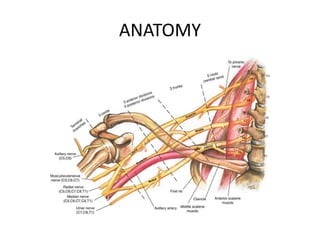
ANATOMY
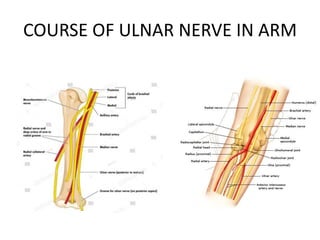
COURSE OF ULNAR NERVE IN ARM
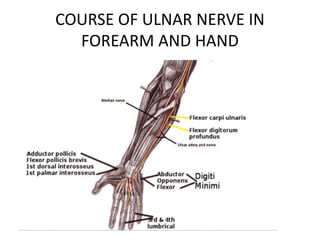
COURSE OF ULNAR NERVE IN
FOREARM AND HAND
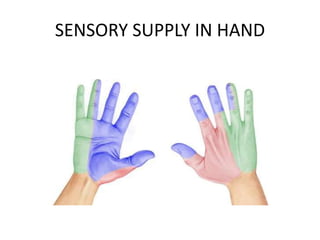
SENSORY SUPPLY IN HAND
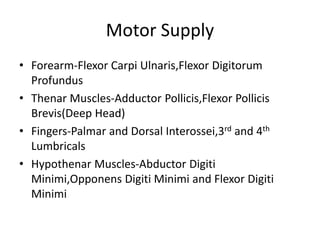
Motor Supply
• Forearm-Flexor Carpi Ulnaris,Flexor Digitorum
Profundus
• Thenar Muscles-Adductor Pollicis,Flexor Pollicis
Brevis(Deep Head)
• Fingers-Palmar and Dorsal Interossei,3rd and 4th
Lumbricals
• Hypothenar Muscles-Abductor Digiti
Minimi,Opponens Digiti Minimi and Flexor Digiti
Minimi
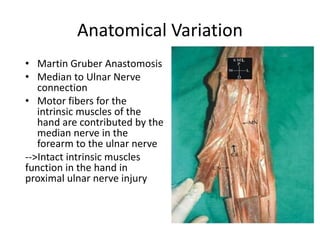
Anatomical Variation
• Martin Gruber Anastomosis
• Median to Ulnar Nerve
connection
• Motor fibers for the
intrinsic muscles of the
hand are contributed by the
median nerve in the
forearm to the ulnar nerve
-->Intact intrinsic muscles
function in the hand in
proximal ulnar nerve injury
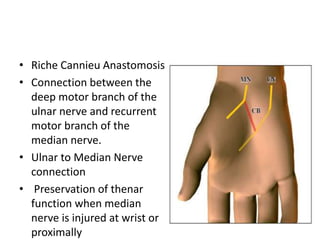
• Riche Cannieu Anastomosis
• Connection between the
deep motor branch of the
ulnar nerve and recurrent
motor branch of the
median nerve.
• Ulnar to Median Nerve
connection
• Preservation of thenar
function when median
nerve is injured at wrist or
proximally
Etiology of Ulnar Nerve Injury
1)Acute Injury:
-Traumatic Events
2)Compression Neuropathy:
a)Cubital Tunnel Syndrome
->Intrinsic-arcade of Struther, Osborne ligament
->Extrinsic-cubitus varus deformity, medial
epicondylitis, heterotopic ossificans
b)Ulnar Tunnel Syndrome
-Ganglion cyst, Hook of hamate fracture, pisiform
dislocation, repetitive trauma, idiopathic
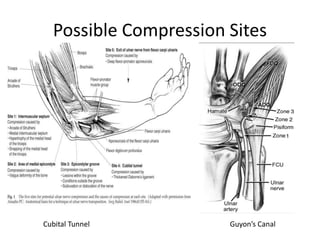
Possible Compression Sites
Guyon’s Canal
Cubital Tunnel
High vs Low Ulnar Nerve Injury
• High Lesion- above the level of elbow
• Low Lesion- below the level of elbow
• Prominent clawing of the ring and little finger
• Atrophy of first web space and the interosseous muscles
• Atrophy of hypothenar muscles
• Weak grasp and pinch
• Low Lesion-1)Able to ulnar deviation and flexion of wrist
-2) Intact sensation over proximal and middle
phalanx of little and ring finger due to sparing of dorsal
cutaneous branch
Clinical Features
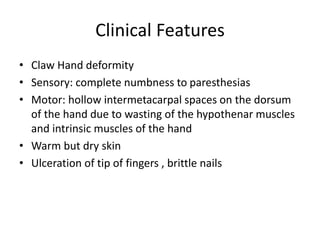
• Claw Hand deformity
• Sensory: complete numbness to paresthesias
• Motor: hollow intermetacarpal spaces on the dorsum
of the hand due to wasting of the hypothenar muscles
and intrinsic muscles of the hand
• Warm but dry skin
• Ulceration of tip of fingers , brittle nails
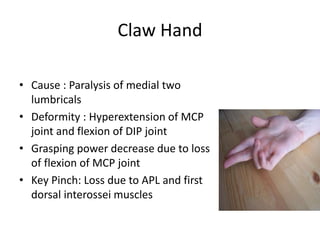
Claw Hand
• Cause : Paralysis of medial two
lumbricals
• Deformity : Hyperextension of MCP
joint and flexion of DIP joint
• Grasping power decrease due to loss
of flexion of MCP joint
• Key Pinch: Loss due to APL and first
dorsal interossei muscles
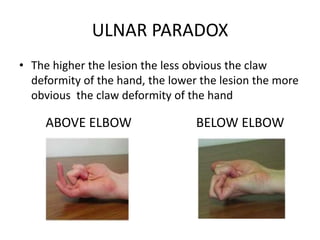
ULNAR PARADOX
• The higher the lesion the less obvious the claw
deformity of the hand, the lower the lesion the more
obvious the claw deformity of the hand
ABOVE ELBOW BELOW ELBOW
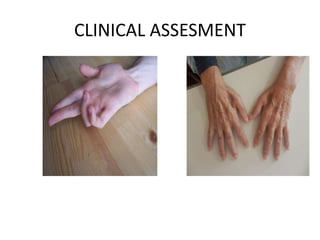
CLINICAL ASSESMENT
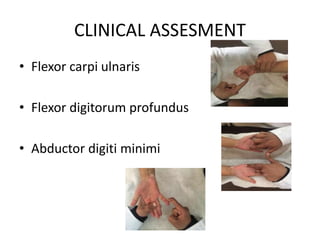
CLINICAL ASSESMENT
• Flexor carpi ulnaris
• Flexor digitorum profundus
• Abductor digiti minimi
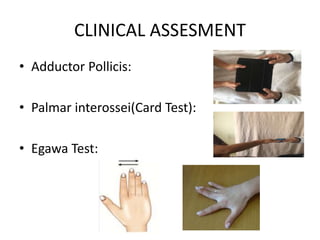
CLINICAL ASSESMENT
• Adductor Pollicis:
• Palmar interossei(Card Test):
• Egawa Test:
Management
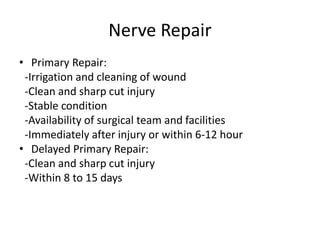
Nerve Repair
• Primary Repair:
-Irrigation and cleaning of wound
-Clean and sharp cut injury
-Stable condition
-Availability of surgical team and facilities
-Immediately after injury or within 6-12 hour
• Delayed Primary Repair:
-Clean and sharp cut injury
-Within 8 to 15 days
Secondary Nerve Repair:
• Extensive soft-tissue injury and loss with extensive
trauma to the nerve
• Extensive wound contamination
• Presence of multiple limb injuries
• Extensive crush injury or traction injury
• When extent and nature of nerve repair are unknown
• Done after 2 weeks and nerve end can be tagged with
wire suture
Nerve Grafting and Reconstruction
• Nerve Grafting:
• Graft: Sural nerve; lateral/medial antebrachial
cutaneous nerve
• Grafting gaps > 2.5cm –keep extremity in functional
position
• Flexion of Elbow>90 degree or the wrist beyond 40
degree—Contraindicated
• Nerve Reconstruction :Mackinnon and Novak-
transferring distal portion of AIN into motor branch of
ulnar nerve to improve intrinsic return
Closing Gap
• Gap of 12 to 15 cm: mobilization and transposition of
nerve, flexion of wrist and elbow
• Greatest Gap reduction achieved by intramuscular
transposition, followed by submuscular and
subcutaneous transposition
• Outcome better for those who had early repair(<4
weeks)
Critical limit
• Should not be delayed 9 months after injury in high
lesions
• After 15 months in low lesions
Ulnar Nerve Compression Neuropathy
• Compression mainly occur
 Elbow – cubital tunnel syndrome
 Wrist - ulnar tunnel syndrome
Cubital tunnel syndrome
• 2nd most common nerve entrapement in upper
extremities
• Floor-ulnar collateral ligament and elbow joint capsule
• Wall – medial epicondyle and olecranon
• Roof – Osborne’s Fascia
Management
• Nonoperative:
-NSAIDS, activity modification and night-time elbow
extension
• Operative:
-Insitu Nerve Decompression(Simple Decompression)
-Anterior transposition (subcutaneous, intramuscular or
submuscular)
-Medial epicondylectomy
Indications of Simple Decompression
-Mild symptoms and short history
-Nonsubluxating nerve and symptoms not associated with
varus or valgus deformity
-No prior evidence of injury or degenerative changes that
distort anatomy
-Compression localized to be due to Osborne’s Fascia
Indications of Anterior Transposition
-Failed insitu release
-Intractable, long-standing ulnar neuritis localized to
elbow
-Throwing Athlete
-Metabolic /granulomatous neuropathy
-Open reduction of intra-articular fracture
-Elbow reconstruction and arthroplasty
-Mobilisation associated with nerve repair at the elbow
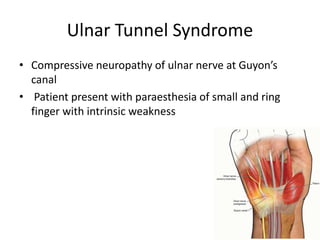
Ulnar Tunnel Syndrome
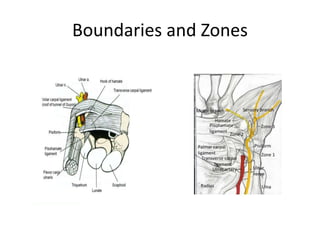
• Compressive neuropathy of ulnar nerve at Guyon’s
canal
• Patient present with paraesthesia of small and ring
finger with intrinsic weakness
Boundaries and Zones
Causes
• Ganglion cyst (80% of non-traumatic causes)
• Lipoma
• Repetitive trauma
• Ulnar artery thrombosis or aneurysm
• Hook of hamate fracture or nonunion
• Pisiform dislocation
• Inflammatory arthritis
• Fibrous band, muscle or bony anomaly
• Congenital bands
• Palmaris brevis hypertrophy
Management
• Non-operative: NSAIDS, activity modification and wrist
splinting
• Operative:
-Obvious disability due to clawed fingers
-Loss of power in pinch and grasp
-Failed conservative management
Cont….
1)Local decompression
2)Tendon transfer
• Small and ring finger DIP flexion (in cases of high ulnar
nerve palsy),
• Restoration of key pinch
• Correction of clawing
• Integration of MCP and IP joint flexion
• Improvement in grip strength
Tendon Transfer
Goals to achieve:
• Flexion and ulnar deviation of the wrist
• Flexion of the ring and little finger
• Independent flexion at MCP joint of ring and little
finger
• Abduction-adduction of all fingers
• Thumb adduction
• Index abduction
High Ulnar Palsy
• Flexion and ulnar deviation of the wrist
-FCR to the insertion of the FCU
• Flexion of ring and little finger
-ECRL to the flexor profundus tendons to the ring
and little finger
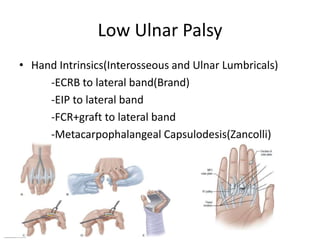
Low Ulnar Palsy
• Hand Intrinsics(Interosseous and Ulnar Lumbricals)
-ECRB to lateral band(Brand)
-EIP to lateral band
-FCR+graft to lateral band
-Metacarpophalangeal Capsulodesis(Zancolli)
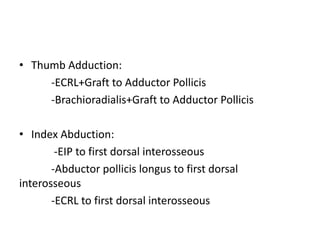
• Thumb Adduction:
-ECRL+Graft to Adductor Pollicis
-Brachioradialis+Graft to Adductor Pollicis
• Index Abduction:
-EIP to first dorsal interosseous
-Abductor pollicis longus to first dorsal
interosseous
-ECRL to first dorsal interosseous
THANK YOU
NEXT PRESENTATION BY
Dr. AKASH PRABHAKAR
MEDIAN NERVE INJURY

Ulnar Nerve Injury.pptx

  • 1.
    ULNAR NERVE INJURY Moderator–Dr.Nitish Bikram Deo Presenter-Kushal Khanal
  • 2.
    Contents • Anatomy • Etiologyof Ulnar Nerve Injury • Clinical Features • Nerve Repair • Cubital Tunnel Syndrome • Ulnar Tunnel Syndrome • Tendon Transfer in Ulnar Nerve Injury
  • 3.
  • 4.
    COURSE OF ULNARNERVE IN ARM
  • 5.
    COURSE OF ULNARNERVE IN FOREARM AND HAND
  • 6.
  • 7.
    Motor Supply • Forearm-FlexorCarpi Ulnaris,Flexor Digitorum Profundus • Thenar Muscles-Adductor Pollicis,Flexor Pollicis Brevis(Deep Head) • Fingers-Palmar and Dorsal Interossei,3rd and 4th Lumbricals • Hypothenar Muscles-Abductor Digiti Minimi,Opponens Digiti Minimi and Flexor Digiti Minimi
  • 8.
    Anatomical Variation • MartinGruber Anastomosis • Median to Ulnar Nerve connection • Motor fibers for the intrinsic muscles of the hand are contributed by the median nerve in the forearm to the ulnar nerve -->Intact intrinsic muscles function in the hand in proximal ulnar nerve injury
  • 9.
    • Riche CannieuAnastomosis • Connection between the deep motor branch of the ulnar nerve and recurrent motor branch of the median nerve. • Ulnar to Median Nerve connection • Preservation of thenar function when median nerve is injured at wrist or proximally
  • 10.
    Etiology of UlnarNerve Injury 1)Acute Injury: -Traumatic Events 2)Compression Neuropathy: a)Cubital Tunnel Syndrome ->Intrinsic-arcade of Struther, Osborne ligament ->Extrinsic-cubitus varus deformity, medial epicondylitis, heterotopic ossificans b)Ulnar Tunnel Syndrome -Ganglion cyst, Hook of hamate fracture, pisiform dislocation, repetitive trauma, idiopathic
  • 11.
  • 12.
    High vs LowUlnar Nerve Injury • High Lesion- above the level of elbow • Low Lesion- below the level of elbow • Prominent clawing of the ring and little finger • Atrophy of first web space and the interosseous muscles • Atrophy of hypothenar muscles • Weak grasp and pinch • Low Lesion-1)Able to ulnar deviation and flexion of wrist -2) Intact sensation over proximal and middle phalanx of little and ring finger due to sparing of dorsal cutaneous branch
  • 13.
    Clinical Features • ClawHand deformity • Sensory: complete numbness to paresthesias • Motor: hollow intermetacarpal spaces on the dorsum of the hand due to wasting of the hypothenar muscles and intrinsic muscles of the hand • Warm but dry skin • Ulceration of tip of fingers , brittle nails
  • 14.
    Claw Hand • Cause: Paralysis of medial two lumbricals • Deformity : Hyperextension of MCP joint and flexion of DIP joint • Grasping power decrease due to loss of flexion of MCP joint • Key Pinch: Loss due to APL and first dorsal interossei muscles
  • 15.
    ULNAR PARADOX • Thehigher the lesion the less obvious the claw deformity of the hand, the lower the lesion the more obvious the claw deformity of the hand ABOVE ELBOW BELOW ELBOW
  • 16.
  • 17.
    CLINICAL ASSESMENT • Flexorcarpi ulnaris • Flexor digitorum profundus • Abductor digiti minimi
  • 18.
    CLINICAL ASSESMENT • AdductorPollicis: • Palmar interossei(Card Test): • Egawa Test:
  • 19.
  • 20.
    Nerve Repair • PrimaryRepair: -Irrigation and cleaning of wound -Clean and sharp cut injury -Stable condition -Availability of surgical team and facilities -Immediately after injury or within 6-12 hour • Delayed Primary Repair: -Clean and sharp cut injury -Within 8 to 15 days
  • 21.
    Secondary Nerve Repair: •Extensive soft-tissue injury and loss with extensive trauma to the nerve • Extensive wound contamination • Presence of multiple limb injuries • Extensive crush injury or traction injury • When extent and nature of nerve repair are unknown • Done after 2 weeks and nerve end can be tagged with wire suture
  • 22.
    Nerve Grafting andReconstruction • Nerve Grafting: • Graft: Sural nerve; lateral/medial antebrachial cutaneous nerve • Grafting gaps > 2.5cm –keep extremity in functional position • Flexion of Elbow>90 degree or the wrist beyond 40 degree—Contraindicated • Nerve Reconstruction :Mackinnon and Novak- transferring distal portion of AIN into motor branch of ulnar nerve to improve intrinsic return
  • 23.
    Closing Gap • Gapof 12 to 15 cm: mobilization and transposition of nerve, flexion of wrist and elbow • Greatest Gap reduction achieved by intramuscular transposition, followed by submuscular and subcutaneous transposition • Outcome better for those who had early repair(<4 weeks)
  • 24.
    Critical limit • Shouldnot be delayed 9 months after injury in high lesions • After 15 months in low lesions
  • 25.
    Ulnar Nerve CompressionNeuropathy • Compression mainly occur  Elbow – cubital tunnel syndrome  Wrist - ulnar tunnel syndrome
  • 26.
    Cubital tunnel syndrome •2nd most common nerve entrapement in upper extremities • Floor-ulnar collateral ligament and elbow joint capsule • Wall – medial epicondyle and olecranon • Roof – Osborne’s Fascia
  • 27.
    Management • Nonoperative: -NSAIDS, activitymodification and night-time elbow extension • Operative: -Insitu Nerve Decompression(Simple Decompression) -Anterior transposition (subcutaneous, intramuscular or submuscular) -Medial epicondylectomy
  • 28.
    Indications of SimpleDecompression -Mild symptoms and short history -Nonsubluxating nerve and symptoms not associated with varus or valgus deformity -No prior evidence of injury or degenerative changes that distort anatomy -Compression localized to be due to Osborne’s Fascia
  • 29.
    Indications of AnteriorTransposition -Failed insitu release -Intractable, long-standing ulnar neuritis localized to elbow -Throwing Athlete -Metabolic /granulomatous neuropathy -Open reduction of intra-articular fracture -Elbow reconstruction and arthroplasty -Mobilisation associated with nerve repair at the elbow
  • 30.
    Ulnar Tunnel Syndrome •Compressive neuropathy of ulnar nerve at Guyon’s canal • Patient present with paraesthesia of small and ring finger with intrinsic weakness
  • 31.
  • 32.
    Causes • Ganglion cyst(80% of non-traumatic causes) • Lipoma • Repetitive trauma • Ulnar artery thrombosis or aneurysm • Hook of hamate fracture or nonunion • Pisiform dislocation • Inflammatory arthritis • Fibrous band, muscle or bony anomaly • Congenital bands • Palmaris brevis hypertrophy
  • 33.
    Management • Non-operative: NSAIDS,activity modification and wrist splinting • Operative: -Obvious disability due to clawed fingers -Loss of power in pinch and grasp -Failed conservative management
  • 34.
    Cont…. 1)Local decompression 2)Tendon transfer •Small and ring finger DIP flexion (in cases of high ulnar nerve palsy), • Restoration of key pinch • Correction of clawing • Integration of MCP and IP joint flexion • Improvement in grip strength
  • 35.
    Tendon Transfer Goals toachieve: • Flexion and ulnar deviation of the wrist • Flexion of the ring and little finger • Independent flexion at MCP joint of ring and little finger • Abduction-adduction of all fingers • Thumb adduction • Index abduction
  • 36.
    High Ulnar Palsy •Flexion and ulnar deviation of the wrist -FCR to the insertion of the FCU • Flexion of ring and little finger -ECRL to the flexor profundus tendons to the ring and little finger
  • 37.
    Low Ulnar Palsy •Hand Intrinsics(Interosseous and Ulnar Lumbricals) -ECRB to lateral band(Brand) -EIP to lateral band -FCR+graft to lateral band -Metacarpophalangeal Capsulodesis(Zancolli)
  • 38.
    • Thumb Adduction: -ECRL+Graftto Adductor Pollicis -Brachioradialis+Graft to Adductor Pollicis • Index Abduction: -EIP to first dorsal interosseous -Abductor pollicis longus to first dorsal interosseous -ECRL to first dorsal interosseous
  • 39.
    THANK YOU NEXT PRESENTATIONBY Dr. AKASH PRABHAKAR MEDIAN NERVE INJURY