Baseline activities and data management for the
African Chicken Genetic Gains program
Jane Poole and Absolomon Kihara (ILRI)
First ACGG Program Management Team meeting,
Addis Ababa, Ethiopia
18-20 May 2015
ACGG Baseline – Objectives / Purpose
• The main Objective / Purpose of our ACGG
baseline activities is to establish our ‘starting
point’ before implementing project activities
– establishing the current levels of key project
indicators that relate to: monitoring project
progress and help to guide project activities and
interventions (e.g. on-station testing and on-farm
monitoring).
– Deciding at what level / in what format to collect
the data (e.g. household, community)
ACGG Baseline – Indicators
Indicator
Potential
productivity
Improved
Genetics and
reproduction
Genetic gain (for milk, eggs and meat) Outcome TBD
Milk yield as a function of best available breed Outcome TBD
Egg yield as a function of best available breed Outcome TBD
Poultry meat yield as a function of best available breed Outcome TBD
RealizedProductivity
Animal health
systems
% of smallholder farmers using animal health products Outcome HH surveys
% of smallholder farmers using vaccination for [ECF, Newcastle Disease] Outcome HH surveys
Mortalityrate due to disease Outcome HH surveys
OIE PVS scores Outcome OIE
Animal genetic
systems
% of farmers owning improved breeds (of poultry, dairy cattle) Outcome
HH surveys
% of dairy farmers using artificial insemination Outcome HH surveys
Livestock
production
mgmt
% of improved/crossbred dairy and poultry animals in smallholder farmer-owned
herds
Outcome
HH surveys
% of smallholder farmers using housing for poultry Outcome HH surveys
% of smallholder farmers using supplemental feed/fodder practices Outcome HH surveys
Productivity(eggs per animal, by breed) Impact HH surveys
Productivity(milk per animal, by breed) Impact HH surveys
Household production (eggs per household) Impact HH surveys
Household production (poultry, small ruminant meat per household) Impact HH surveys
Household production (milkper household) Impact HH surveys
Knowledge
exchange
% of smallholder farmers with access to extension services(ICT, radio, extension
agent)
Outcome HH surveys
Postproduction losses (milk, eggs, meat) Outcome HH surveys
RealizedValue
Total livestock holding (by species), disaggregated by sex of owner Impact HH surveys
Per capita annual HHincome – livestock ($US), disaggregated by sex of earner Impact HH surveys
Mean household asset score, (livestock, productive, etc.) disaggregated by sex of
owner
Impact
HH surveys
Annual net cash income frompoultry Impact HH surveys
Annual net cash income fromdairy Impact HH surveys
Annual net cash income fromsmallruminants Impact HH surveys
Consumption of livestockproducts (frompoultry, dairy, small ruminants) Impact HH surveys
ACGG Baseline - Activities
• Community level surveys (Focus Group
Discussions, FGDs)
• Household level producer surveys
• Other value-chain actor surveys (e.g. traders,
feed suppliers etc.)
• Key Informant Interviews
ACGG Baseline – Activities cont’d
• What do we need for each activity?
– Sampling plan (linked across activities)
– Data management plan (linked across activities)
– Tools: questionnaires, interview questions, group
work materials, facilitation methods
– Hardware to complete the activity (i.e. tablets)
– Resources & logistics (e.g. enumerators and field
supervisors, transport etc.)
• A lot of this has already been thought through
by the country teams and documented
• Where? – Which area and communities to include
in the survey (target population), stratification
&/or clustering of households, logistics &
resources
• Who? – Chicken producers with at least 2 – 3
years experience keeping poultry, how many?
how selected?
• How & What? – Survey tool covering a range of
issues relating to chicken keeping and capturing
data needed to establish baseline levels for key
project indicators….
ACGG Baseline – Household level survey
• Key aspect – Single tool for ALL countries
• Topics to cover in household level survey:
– Poultry production
– Poultry productivity
– Income from poultry & poultry products
– Household Dynamics & Gender
– Food Security & Nutrition: Social aspects of poultry
keeping (mostly covered in FGDs)
– Training & extension, access to credit, group membership
– General household information
ACGG Baseline – Household level survey:
How? & What?
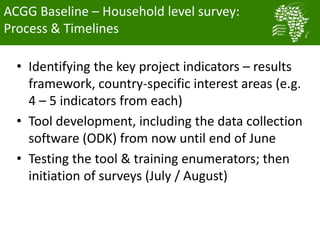
• Identifying the key project indicators – results
framework, country-specific interest areas (e.g.
4 – 5 indicators from each)
• Tool development, including the data collection
software (ODK) from now until end of June
• Testing the tool & training enumerators; then
initiation of surveys (July / August)
ACGG Baseline – Household level survey:
Process & Timelines
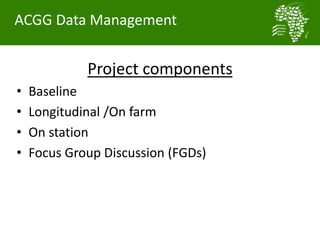
Project components
• Baseline
• Longitudinal /On farm
• On station
• Focus Group Discussion (FGDs)
ACGG Data Management
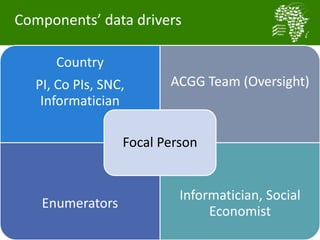
Components’ data drivers
Country
PI, Co PIs, SNC,
Informatician
ACGG Team (Oversight)
Enumerators
Informatician, Social
Economist
Focal Person
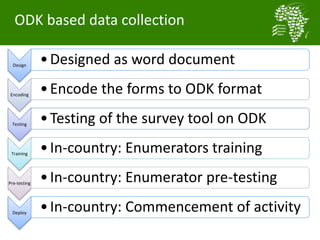
ODK based data collection
Design
•Designed as word document
Encoding
•Encode the forms to ODK format
Testing
•Testing of the survey tool on ODK
Training
•In-country: Enumerators training
Pre-testing
•In-country: Enumerator pre-testing
Deploy
•In-country: Commencement of activity
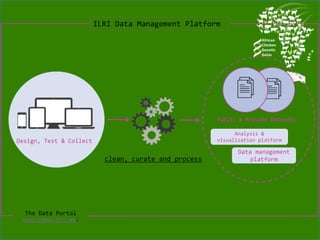
Design, Test & Collect
Public & Private Datasets
Data management
platform
Analysis &
visualization platform
clean, curate and process
ILRI Data Management Platform
The Data Portal
http://data.ilri.org/
• Data standards
• Data access
– Country level
– Project level
• Data security
• Sharing
• Open access
Housekeeping
more productive chickens for
Africa’s smallholders
http://africacgg.net
The presentation has a Creative Commons licence. You are free to re-use or distribute this work, provided credit is given to ILRI.

Baseline activities and data management for the African Chicken Genetic Gains program

  • 1.
    Baseline activities anddata management for the African Chicken Genetic Gains program Jane Poole and Absolomon Kihara (ILRI) First ACGG Program Management Team meeting, Addis Ababa, Ethiopia 18-20 May 2015
  • 2.
    ACGG Baseline –Objectives / Purpose • The main Objective / Purpose of our ACGG baseline activities is to establish our ‘starting point’ before implementing project activities – establishing the current levels of key project indicators that relate to: monitoring project progress and help to guide project activities and interventions (e.g. on-station testing and on-farm monitoring). – Deciding at what level / in what format to collect the data (e.g. household, community)
  • 3.
    ACGG Baseline –Indicators Indicator Potential productivity Improved Genetics and reproduction Genetic gain (for milk, eggs and meat) Outcome TBD Milk yield as a function of best available breed Outcome TBD Egg yield as a function of best available breed Outcome TBD Poultry meat yield as a function of best available breed Outcome TBD RealizedProductivity Animal health systems % of smallholder farmers using animal health products Outcome HH surveys % of smallholder farmers using vaccination for [ECF, Newcastle Disease] Outcome HH surveys Mortalityrate due to disease Outcome HH surveys OIE PVS scores Outcome OIE Animal genetic systems % of farmers owning improved breeds (of poultry, dairy cattle) Outcome HH surveys % of dairy farmers using artificial insemination Outcome HH surveys Livestock production mgmt % of improved/crossbred dairy and poultry animals in smallholder farmer-owned herds Outcome HH surveys % of smallholder farmers using housing for poultry Outcome HH surveys % of smallholder farmers using supplemental feed/fodder practices Outcome HH surveys Productivity(eggs per animal, by breed) Impact HH surveys Productivity(milk per animal, by breed) Impact HH surveys Household production (eggs per household) Impact HH surveys Household production (poultry, small ruminant meat per household) Impact HH surveys Household production (milkper household) Impact HH surveys Knowledge exchange % of smallholder farmers with access to extension services(ICT, radio, extension agent) Outcome HH surveys Postproduction losses (milk, eggs, meat) Outcome HH surveys RealizedValue Total livestock holding (by species), disaggregated by sex of owner Impact HH surveys Per capita annual HHincome – livestock ($US), disaggregated by sex of earner Impact HH surveys Mean household asset score, (livestock, productive, etc.) disaggregated by sex of owner Impact HH surveys Annual net cash income frompoultry Impact HH surveys Annual net cash income fromdairy Impact HH surveys Annual net cash income fromsmallruminants Impact HH surveys Consumption of livestockproducts (frompoultry, dairy, small ruminants) Impact HH surveys
  • 4.
    ACGG Baseline -Activities • Community level surveys (Focus Group Discussions, FGDs) • Household level producer surveys • Other value-chain actor surveys (e.g. traders, feed suppliers etc.) • Key Informant Interviews
  • 5.
    ACGG Baseline –Activities cont’d • What do we need for each activity? – Sampling plan (linked across activities) – Data management plan (linked across activities) – Tools: questionnaires, interview questions, group work materials, facilitation methods – Hardware to complete the activity (i.e. tablets) – Resources & logistics (e.g. enumerators and field supervisors, transport etc.) • A lot of this has already been thought through by the country teams and documented
  • 6.
    • Where? –Which area and communities to include in the survey (target population), stratification &/or clustering of households, logistics & resources • Who? – Chicken producers with at least 2 – 3 years experience keeping poultry, how many? how selected? • How & What? – Survey tool covering a range of issues relating to chicken keeping and capturing data needed to establish baseline levels for key project indicators…. ACGG Baseline – Household level survey
  • 7.
    • Key aspect– Single tool for ALL countries • Topics to cover in household level survey: – Poultry production – Poultry productivity – Income from poultry & poultry products – Household Dynamics & Gender – Food Security & Nutrition: Social aspects of poultry keeping (mostly covered in FGDs) – Training & extension, access to credit, group membership – General household information ACGG Baseline – Household level survey: How? & What?
  • 8.
    • Identifying thekey project indicators – results framework, country-specific interest areas (e.g. 4 – 5 indicators from each) • Tool development, including the data collection software (ODK) from now until end of June • Testing the tool & training enumerators; then initiation of surveys (July / August) ACGG Baseline – Household level survey: Process & Timelines
  • 9.
    Project components • Baseline •Longitudinal /On farm • On station • Focus Group Discussion (FGDs) ACGG Data Management
  • 10.
    Components’ data drivers Country PI,Co PIs, SNC, Informatician ACGG Team (Oversight) Enumerators Informatician, Social Economist Focal Person
  • 11.
    ODK based datacollection Design •Designed as word document Encoding •Encode the forms to ODK format Testing •Testing of the survey tool on ODK Training •In-country: Enumerators training Pre-testing •In-country: Enumerator pre-testing Deploy •In-country: Commencement of activity
  • 12.
    Design, Test &Collect Public & Private Datasets Data management platform Analysis & visualization platform clean, curate and process ILRI Data Management Platform The Data Portal http://data.ilri.org/
  • 13.
    • Data standards •Data access – Country level – Project level • Data security • Sharing • Open access Housekeeping
  • 15.
    more productive chickensfor Africa’s smallholders http://africacgg.net The presentation has a Creative Commons licence. You are free to re-use or distribute this work, provided credit is given to ILRI.

Editor's Notes

  • #4 Key project indicators – we want to add additional ones which are of interest to each country!
  • #5 FGDs will focus on aspects which show less variation at household level and where it makes more sense to collect at community level. Aspects such as: breed preferences and characteristics, identification of constraints to poultry production, market orientation, social aspects – taboos & regulations, KAP related to poultry management (and improved management), common health issues (e.g. diseases) and poultry production & consumption ‘calendar’ (e.g. specific periods of the year where the demand is high like at festival time)
  • #7 Where – link to current country documents? How – Next slide….
  • #8 N.B. For all elements some aspects will be covered in FGDs where appropriate! Refer to earlier slide Systems, management – housing, feeding systems etc., Breed on-farm performance – clutch length, chick mortality etc. Offtake rates, market access, etc. Gender aspects cut across the whole survey – disaggregated data throughout and specific focus in key areas like labour allocation, food consumption etc. Food consumption & dietary diversity, food sufficiency / security – with a specific focus on the contributions of poultry & poultry products Xxx Asset ownership including livestock, household composition – these elements are helped to characterise the households and to identify realtionships between household typology and poultry production options
  • #9 Countries to discuss and submit 4 – 5 indicators of interest to them (Tadelle / Jasmine - perhaps easier if we send them an outline of the survey with the sections rather than the current messy draft? I’ll share an idea of this a.s.a.p) FGDs likely to come after this – they will provide both qualitative and semi-quantitative data, be part of the sensitization but with resource limitations likely in a subset of communities
  • #11 The main aim of this organisation is to provide a means of accountability and ensure proper planning. Component leader – Is the overall in-charge of the component. Coordinate between the countries and provide a focal point of liason with the ACGG PMT. In consultation with the country teams: Plan the activities – Gantt chart with the activity timelines Coordinate all the activities in the component Ensure similar deployment plans for consistency Country leader