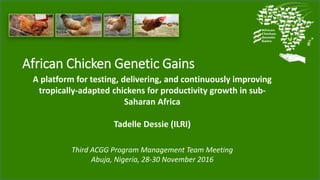
African Chicken Genetic Gains
A platform for testing, delivering, and continuously improving
tropically-adapted chickens for productivity growth in sub-
Saharan Africa
Tadelle Dessie (ILRI)
Third ACGG Program Management Team Meeting
Abuja, Nigeria, 28-30 November 2016
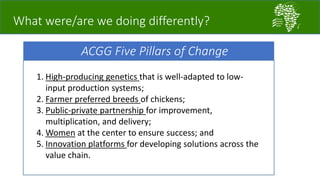
What were/are we doing differently?
ACGG Five Pillars of Change
1. High-producing genetics that is well-adapted to low-
input production systems;
2. Farmer preferred breeds of chickens;
3. Public-private partnership for improvement,
multiplication, and delivery;
4. Women at the center to ensure success; and
5. Innovation platforms for developing solutions across the
value chain.
.
• What has been achieved thus far???
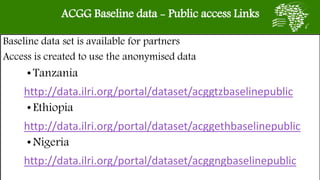
ACGG Baseline data - Public access Links
Baseline data set is available for partners
Access is created to use the anonymised data
• Tanzania
http://data.ilri.org/portal/dataset/acggtzbaselinepublic
• Ethiopia
http://data.ilri.org/portal/dataset/acggethbaselinepublic
• Nigeria
http://data.ilri.org/portal/dataset/acggngbaselinepublic
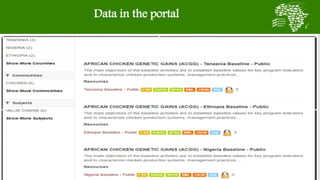
Data in the portal
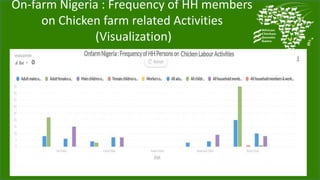
On-farm Nigeria : Frequency of HH members
on Chicken farm related Activities
(Visualization)
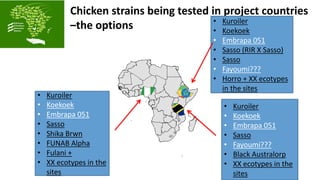
Chicken strains being tested in project countries
–the options
• Kuroiler
• Koekoek
• Embrapa 051
• Sasso
• Shika Brwn
• FUNAB Alpha
• Fulani +
• XX ecotypes in the
sites
• Kuroiler
• Koekoek
• Embrapa 051
• Sasso (RIR X Sasso)
• Sasso
• Fayoumi???
• Horro + XX ecotypes
in the sites
• Kuroiler
• Koekoek
• Embrapa 051
• Sasso
• Fayoumi???
• Black Australorp
• XX ecotypes in the
sites
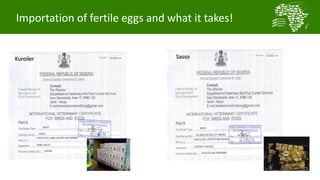
Importation of fertile eggs and what it takes!
Kuroiler Sasso
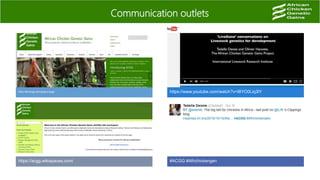
Communication outlets
https://africacgg.net/category/acgg/ https://www.youtube.com/watch?v=I8YO0Liq3lY
https://acgg.wikispaces.com/ #ACGG #Africhickengen
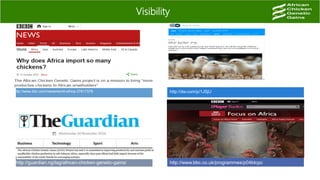
Visibility
ACGG on the media
ttp://www.bbc.com/news/world-africa-37617379 http://dw.com/p/1JSjU
http://guardian.ng/tag/african-chicken-genetic-gains/ http://www.bbc.co.uk/programmes/p04btcpc
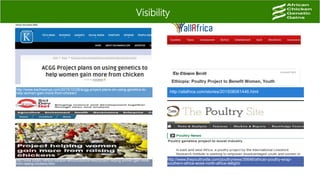
Visibility
http://www.kachwanya.com/2015/10/28/acgg-project-plans-on-using-genetics-to-
help-women-gain-more-from-chicken/ http://allafrica.com/stories/201508061446.html
http://www.scidev.net/sub-saharan-africa/livestock/news/project-helping-women-gain-more-
from-raising-chickens.html
http://www.thepoultrysite.com/poultrynews/35646/african-poultry-wrap-
southern-africa-woes-north-africa-delight/
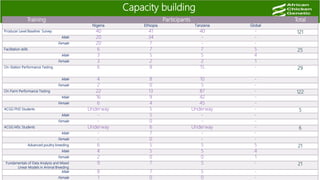
Training Participants Total
Nigeria Ethiopia Tanzania Global
Producer Level Baseline Survey 40 41 40 - 121
Male 20 34 - -
Female 20 7 - -
Facilitation skills 6 7 7 5 25
Male 3 5 5 4
Female 3 2 2 1
On-Station Performance Testing 6 8 15 - 29
Male 4 8 10 -
Female 2 0 5 -
On-Farm Performance Testing 22 13 87 - 122
Male 16 9 42 -
Female 6 4 45 -
ACGG PhD Students Underway 5 Underway - 5
Male - 5 - -
Female - 0 - -
ACGG MSc Students Underway 6 Underway - 6
Male - 7 - -
Female - 0 - -
Advanced poultry breeding 6 5 5 5 21
Male 4 5 5 4
Female 2 0 0 1
Fundamentals of Data Analysis and Mixed
Linear Models in Animal Breeding
9 7 5 - 21
Male 8 7 5 -
Female 1 0 0 -
Capacity building
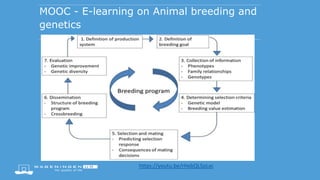
MOOC - E-learning on Animal breeding and
genetics
https://youtu.be/rHxbQLSoLxc
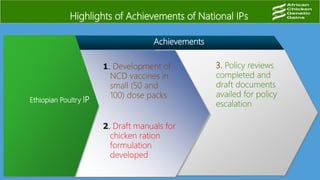
Achievements
Ethiopian Poultry IP
3. Policy reviews
completed and
draft documents
availed for policy
escalation
1. Development of
NCD vaccines in
small (50 and
100) dose packs
Highlights of Achievements of National IPs
2. Draft manuals for
chicken ration
formulation
developed
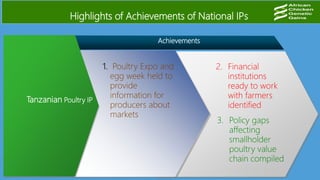
Achievements
Tanzanian Poultry IP
2. Financial
institutions
ready to work
with farmers
identified
1. Poultry Expo and
egg week held to
provide
information for
producers about
markets
Highlights of Achievements of National IPs
3. Policy gaps
affecting
smallholder
poultry value
chain compiled
Achievements
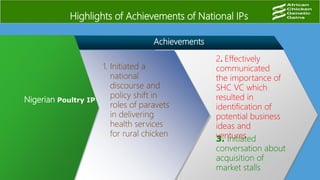
Nigerian Poultry IP
2. Effectively
communicated
the importance of
SHC VC which
resulted in
identification of
potential business
ideas and
ventures
1. Initiated a
national
discourse and
policy shift in
roles of paravets
in delivering
health services
for rural chicken
Highlights of Achievements of National IPs
3. Initiated
conversation about
acquisition of
market stalls
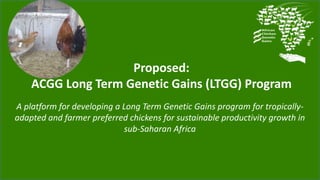
A platform for developing a Long Term Genetic Gains program for tropically-
adapted and farmer preferred chickens for sustainable productivity growth in
sub-Saharan Africa
Proposed:
ACGG Long Term Genetic Gains (LTGG) Program
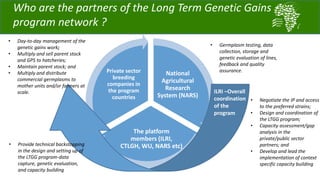
• Negotiate the IP and access
to the preferred strains;
• Design and coordination of
the LTGG program;
• Capacity assessment/gap
analysis in the
private/public sector
partners; and
• Develop and lead the
implementation of context
specific capacity building
Who are the partners of the Long Term Genetic Gains
program network ?
National
Agricultural
Research
System (NARS)
The platform
members (ILRI,
CTLGH, WU, NARS etc)
Private sector
breeding
companies in
the program
countries
ILRI –Overall
coordination
of the
program
• Day-to-day management of the
genetic gains work;
• Multiply and sell parent stock
and GPS to hatcheries;
• Maintain parent stock; and
• Multiply and distribute
commercial germplasms to
mother units and/or farmers at
scale.
• Germplasm testing, data
collection, storage and
genetic evaluation of lines,
feedback and quality
assurance.
• Provide technical backstopping
in the design and setting up of
the LTGG program-data
capture, genetic evaluation,
and capacity building
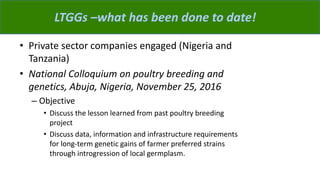
LTGGs –what has been done to date!
.
• Private sector companies engaged (Nigeria and
Tanzania)
• National Colloquium on poultry breeding and
genetics, Abuja, Nigeria, November 25, 2016
– Objective
• Discuss the lesson learned from past poultry breeding
project
• Discuss data, information and infrastructure requirements
for long-term genetic gains of farmer preferred strains
through introgression of local germplasm.
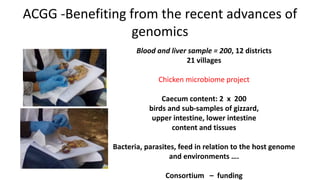
ACGG -Benefiting from the recent advances of
genomics
Blood and liver sample = 200, 12 districts
21 villages
Chicken microbiome project
Caecum content: 2 x 200
birds and sub-samples of gizzard,
upper intestine, lower intestine
content and tissues
Bacteria, parasites, feed in relation to the host genome
and environments ….
Consortium – funding
ACGG Partners
Kind Palms
Ventures
Olorun
Osun Farms
Partners now
more productive chickens for Africa’s
smallholders
http://africacgg.net
The presentation has a Creative Commons licence. You are free to re-use or distribute this work, provided credit is given to ILRI.

ACGG: A platform for testing, delivering, and continuously improving tropically-adapted chickens for productivity growth in sub-Saharan Africa

  • 1.
    African Chicken GeneticGains A platform for testing, delivering, and continuously improving tropically-adapted chickens for productivity growth in sub- Saharan Africa Tadelle Dessie (ILRI) Third ACGG Program Management Team Meeting Abuja, Nigeria, 28-30 November 2016
  • 3.
    What were/are wedoing differently? ACGG Five Pillars of Change 1. High-producing genetics that is well-adapted to low- input production systems; 2. Farmer preferred breeds of chickens; 3. Public-private partnership for improvement, multiplication, and delivery; 4. Women at the center to ensure success; and 5. Innovation platforms for developing solutions across the value chain.
  • 4.
    . • What hasbeen achieved thus far???
  • 5.
    ACGG Baseline data- Public access Links Baseline data set is available for partners Access is created to use the anonymised data • Tanzania http://data.ilri.org/portal/dataset/acggtzbaselinepublic • Ethiopia http://data.ilri.org/portal/dataset/acggethbaselinepublic • Nigeria http://data.ilri.org/portal/dataset/acggngbaselinepublic
  • 6.
  • 7.
    On-farm Nigeria :Frequency of HH members on Chicken farm related Activities (Visualization)
  • 8.
    Chicken strains beingtested in project countries –the options • Kuroiler • Koekoek • Embrapa 051 • Sasso • Shika Brwn • FUNAB Alpha • Fulani + • XX ecotypes in the sites • Kuroiler • Koekoek • Embrapa 051 • Sasso (RIR X Sasso) • Sasso • Fayoumi??? • Horro + XX ecotypes in the sites • Kuroiler • Koekoek • Embrapa 051 • Sasso • Fayoumi??? • Black Australorp • XX ecotypes in the sites
  • 9.
    Importation of fertileeggs and what it takes! Kuroiler Sasso
  • 10.
  • 11.
    Visibility ACGG on themedia ttp://www.bbc.com/news/world-africa-37617379 http://dw.com/p/1JSjU http://guardian.ng/tag/african-chicken-genetic-gains/ http://www.bbc.co.uk/programmes/p04btcpc
  • 12.
  • 13.
    Training Participants Total NigeriaEthiopia Tanzania Global Producer Level Baseline Survey 40 41 40 - 121 Male 20 34 - - Female 20 7 - - Facilitation skills 6 7 7 5 25 Male 3 5 5 4 Female 3 2 2 1 On-Station Performance Testing 6 8 15 - 29 Male 4 8 10 - Female 2 0 5 - On-Farm Performance Testing 22 13 87 - 122 Male 16 9 42 - Female 6 4 45 - ACGG PhD Students Underway 5 Underway - 5 Male - 5 - - Female - 0 - - ACGG MSc Students Underway 6 Underway - 6 Male - 7 - - Female - 0 - - Advanced poultry breeding 6 5 5 5 21 Male 4 5 5 4 Female 2 0 0 1 Fundamentals of Data Analysis and Mixed Linear Models in Animal Breeding 9 7 5 - 21 Male 8 7 5 - Female 1 0 0 - Capacity building
  • 14.
    MOOC - E-learningon Animal breeding and genetics https://youtu.be/rHxbQLSoLxc
  • 15.
    Achievements Ethiopian Poultry IP 3.Policy reviews completed and draft documents availed for policy escalation 1. Development of NCD vaccines in small (50 and 100) dose packs Highlights of Achievements of National IPs 2. Draft manuals for chicken ration formulation developed
  • 16.
    Achievements Tanzanian Poultry IP 2.Financial institutions ready to work with farmers identified 1. Poultry Expo and egg week held to provide information for producers about markets Highlights of Achievements of National IPs 3. Policy gaps affecting smallholder poultry value chain compiled
  • 17.
    Achievements Nigerian Poultry IP 2.Effectively communicated the importance of SHC VC which resulted in identification of potential business ideas and ventures 1. Initiated a national discourse and policy shift in roles of paravets in delivering health services for rural chicken Highlights of Achievements of National IPs 3. Initiated conversation about acquisition of market stalls
  • 18.
    A platform fordeveloping a Long Term Genetic Gains program for tropically- adapted and farmer preferred chickens for sustainable productivity growth in sub-Saharan Africa Proposed: ACGG Long Term Genetic Gains (LTGG) Program
  • 19.
    • Negotiate theIP and access to the preferred strains; • Design and coordination of the LTGG program; • Capacity assessment/gap analysis in the private/public sector partners; and • Develop and lead the implementation of context specific capacity building Who are the partners of the Long Term Genetic Gains program network ? National Agricultural Research System (NARS) The platform members (ILRI, CTLGH, WU, NARS etc) Private sector breeding companies in the program countries ILRI –Overall coordination of the program • Day-to-day management of the genetic gains work; • Multiply and sell parent stock and GPS to hatcheries; • Maintain parent stock; and • Multiply and distribute commercial germplasms to mother units and/or farmers at scale. • Germplasm testing, data collection, storage and genetic evaluation of lines, feedback and quality assurance. • Provide technical backstopping in the design and setting up of the LTGG program-data capture, genetic evaluation, and capacity building
  • 20.
    LTGGs –what hasbeen done to date! . • Private sector companies engaged (Nigeria and Tanzania) • National Colloquium on poultry breeding and genetics, Abuja, Nigeria, November 25, 2016 – Objective • Discuss the lesson learned from past poultry breeding project • Discuss data, information and infrastructure requirements for long-term genetic gains of farmer preferred strains through introgression of local germplasm.
  • 21.
    ACGG -Benefiting fromthe recent advances of genomics Blood and liver sample = 200, 12 districts 21 villages Chicken microbiome project Caecum content: 2 x 200 birds and sub-samples of gizzard, upper intestine, lower intestine content and tissues Bacteria, parasites, feed in relation to the host genome and environments …. Consortium – funding
  • 22.
  • 23.
  • 24.
    more productive chickensfor Africa’s smallholders http://africacgg.net The presentation has a Creative Commons licence. You are free to re-use or distribute this work, provided credit is given to ILRI.