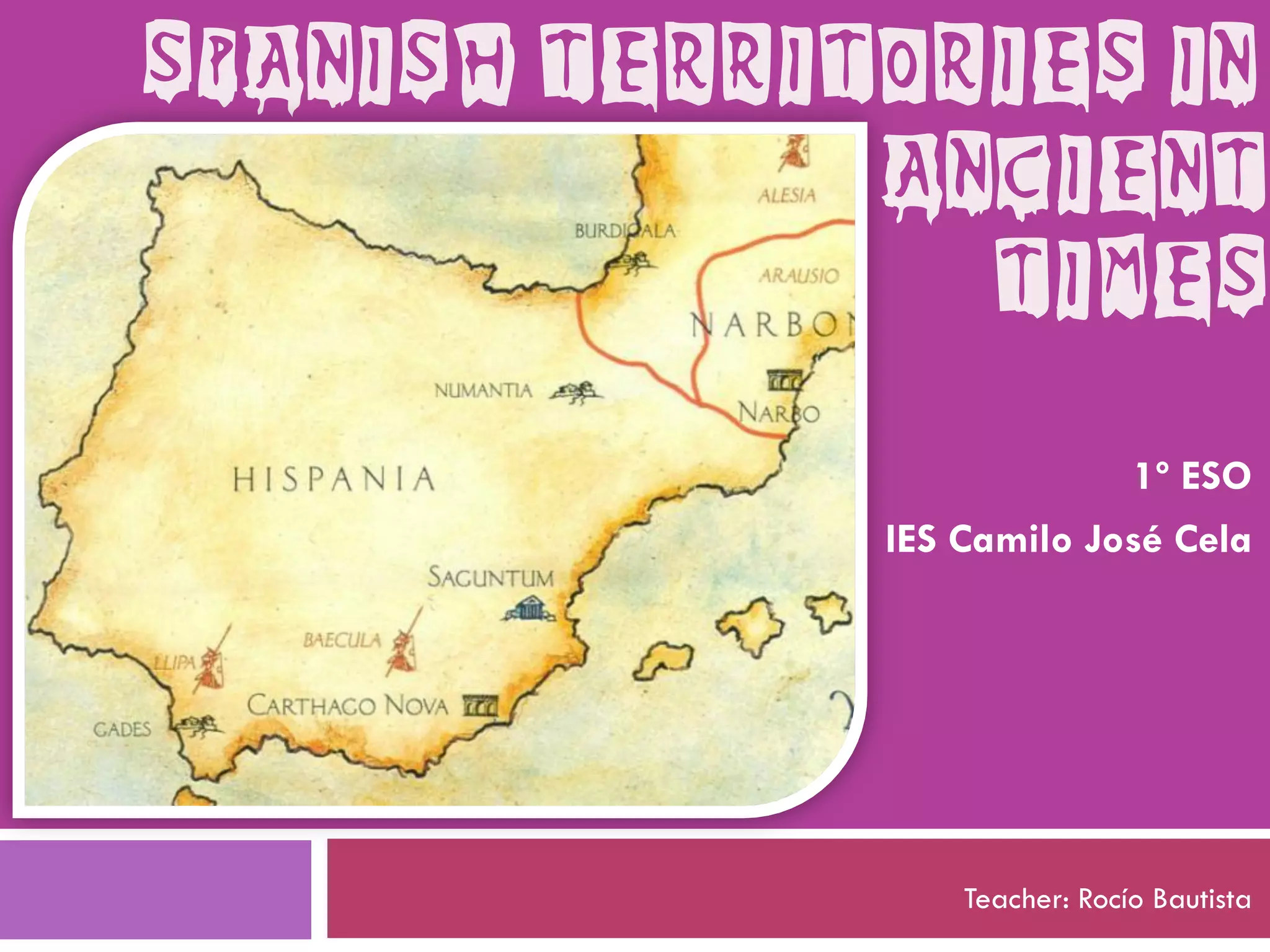
SPANISH TERRITORIES IN
1º ESO
IES Camilo José Cela
Teacher: Rocío Bautista
ANCIENT
TIMES
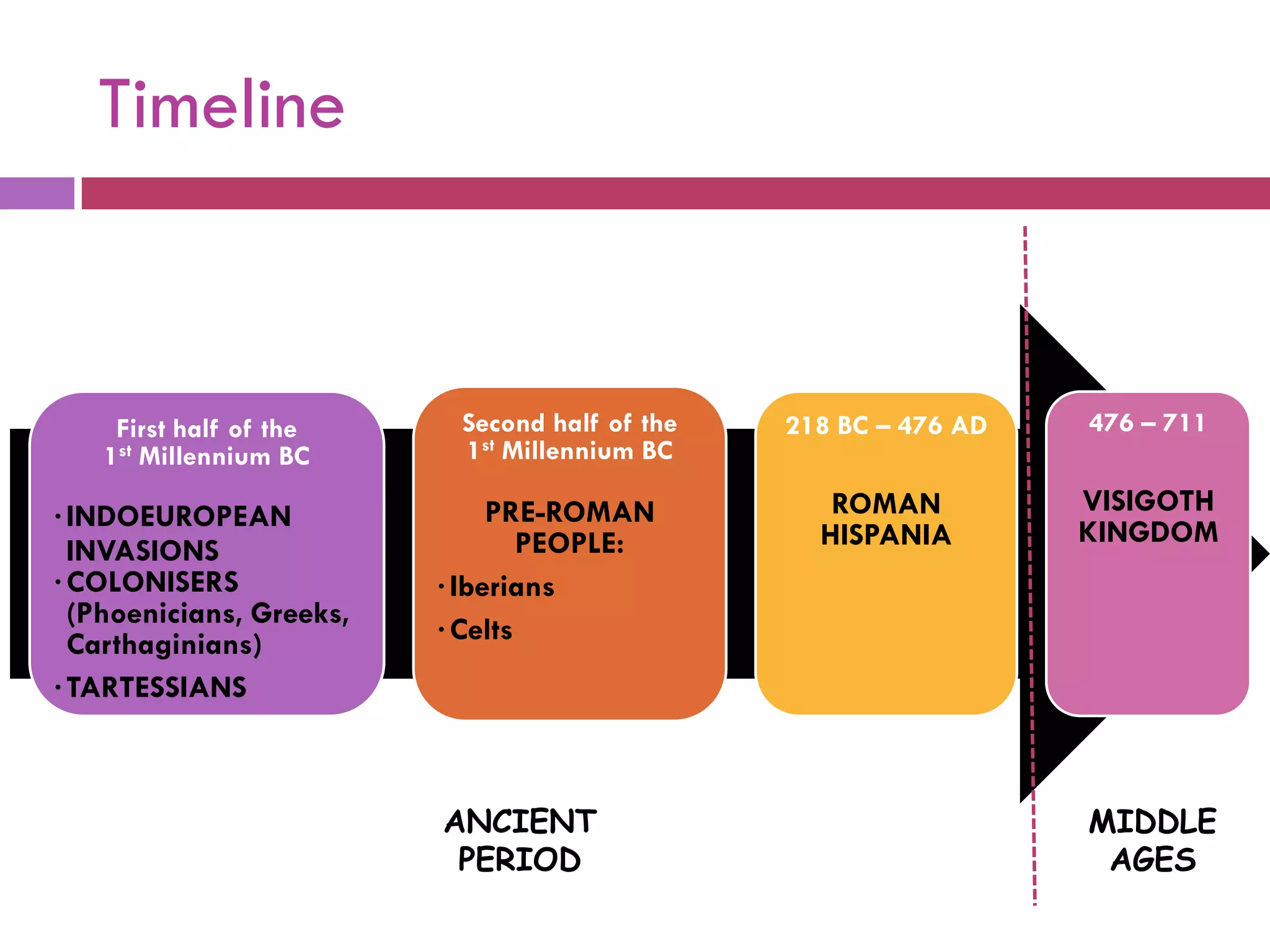
Timeline
First half of the
1st Millennium BC
·INDOEUROPEAN
INVASIONS
·COLONISERS
(Phoenicians, Greeks,
Carthaginians)
·TARTESSIANS
Second half of the
1st Millennium BC
PRE-ROMAN
PEOPLE:
·Iberians
·Celts
218 BC – 476 AD
ROMAN
HISPANIA
476 – 711
VISIGOTH
KINGDOM
ANCIENT
PERIOD
MIDDLE
AGES
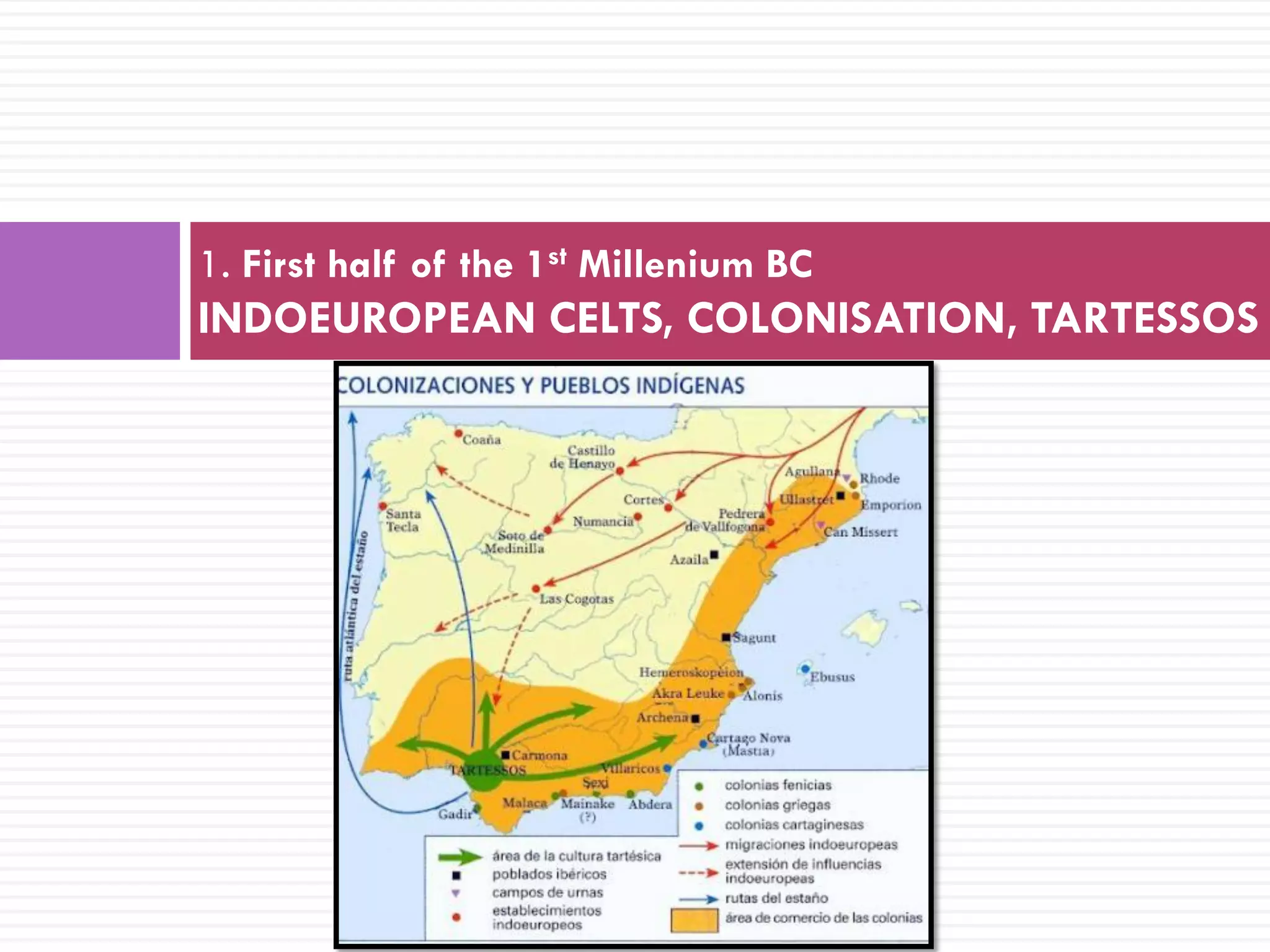
1. First half of the 1st Millenium BC
INDOEUROPEAN CELTS, COLONISATION, TARTESSOS
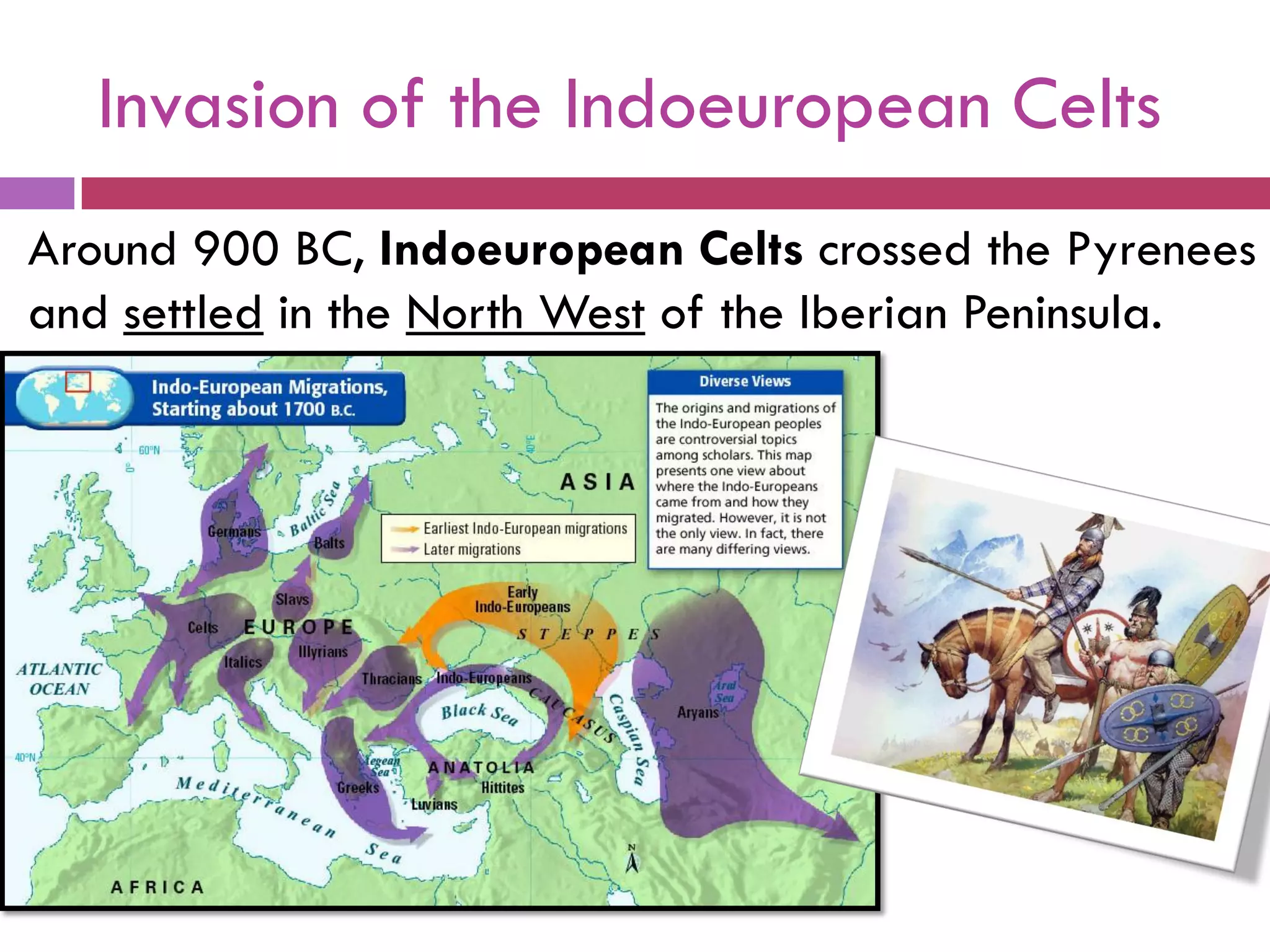
Invasion of the Indoeuropean Celts
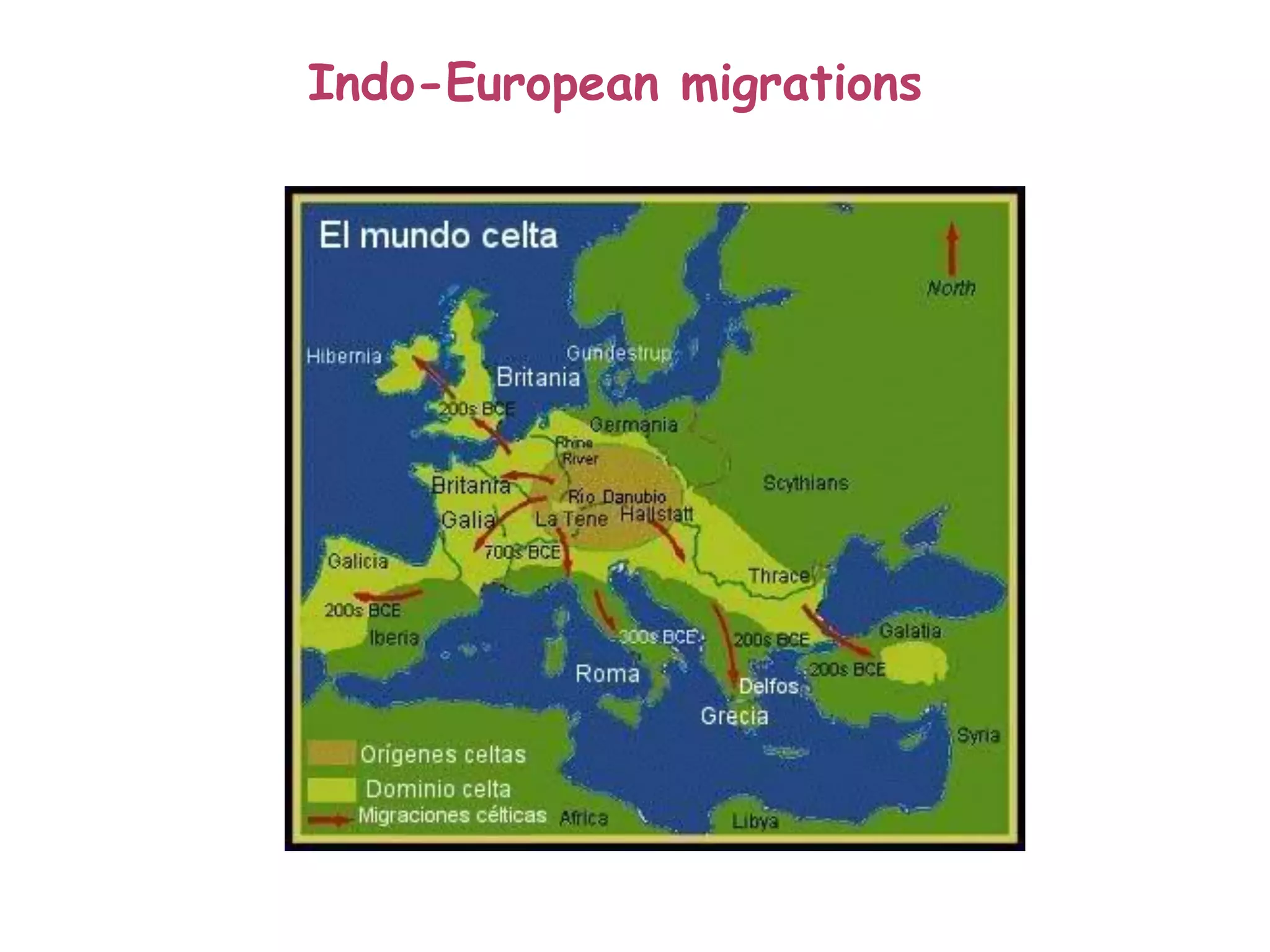
Around 900 BC, Indoeuropean Celts crossed the Pyrenees
and settled in the North West of the Iberian Peninsula.
Indo-European migrations
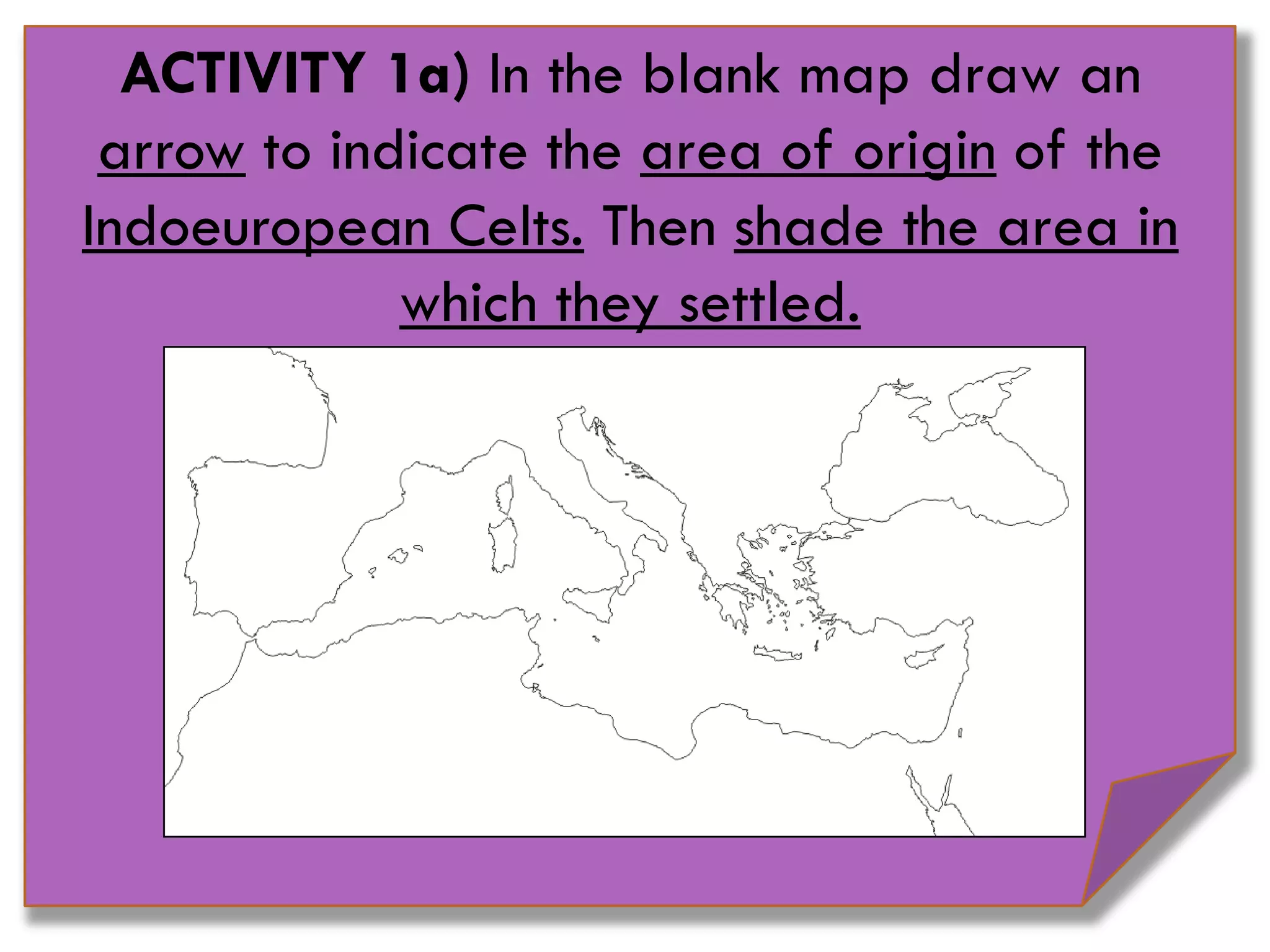
ACTIVITY 1a) In the blank map draw an
arrow to indicate the area of origin of the
Indoeuropean Celts. Then shade the area in
which they settled.
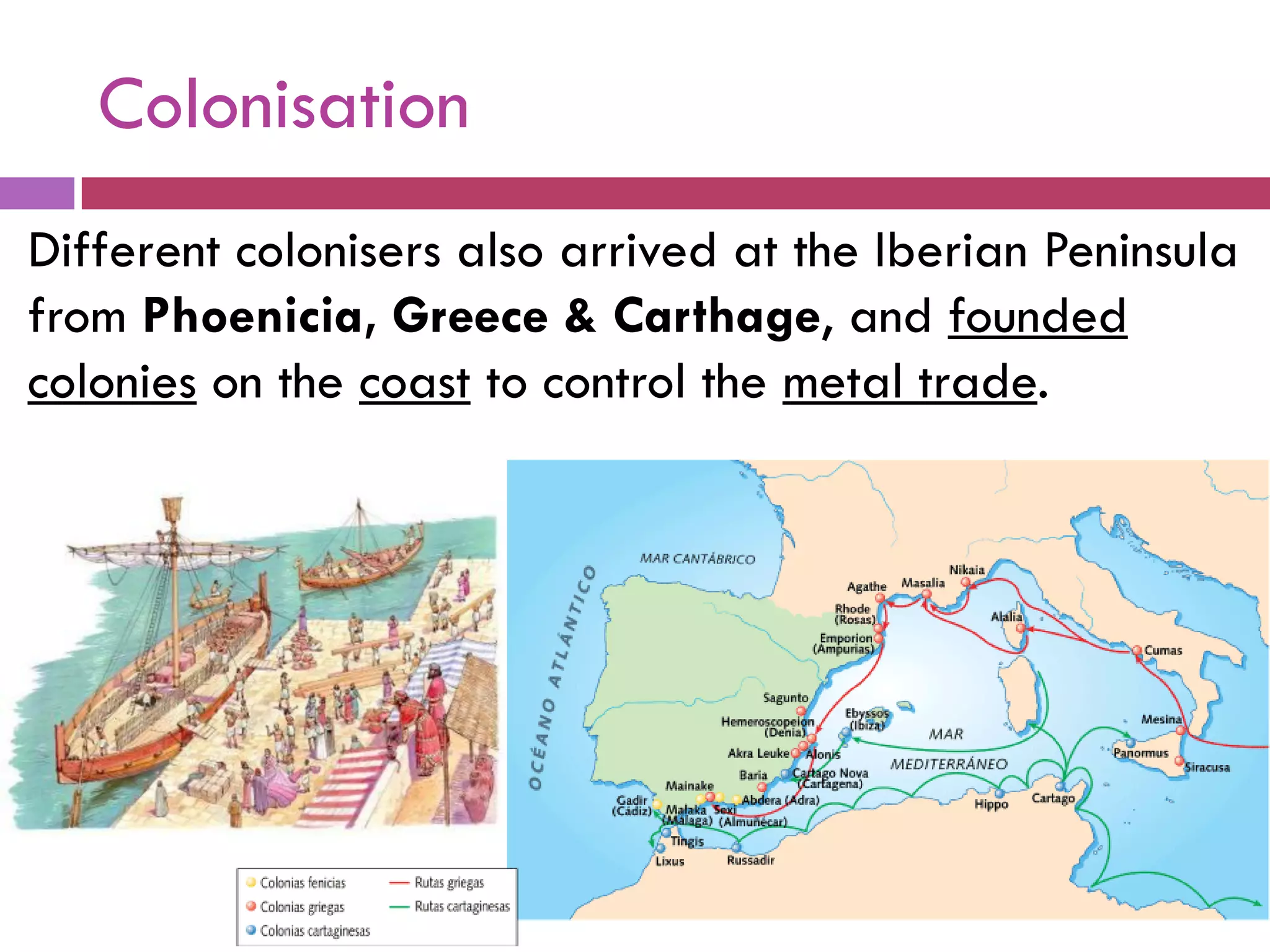
Colonisation
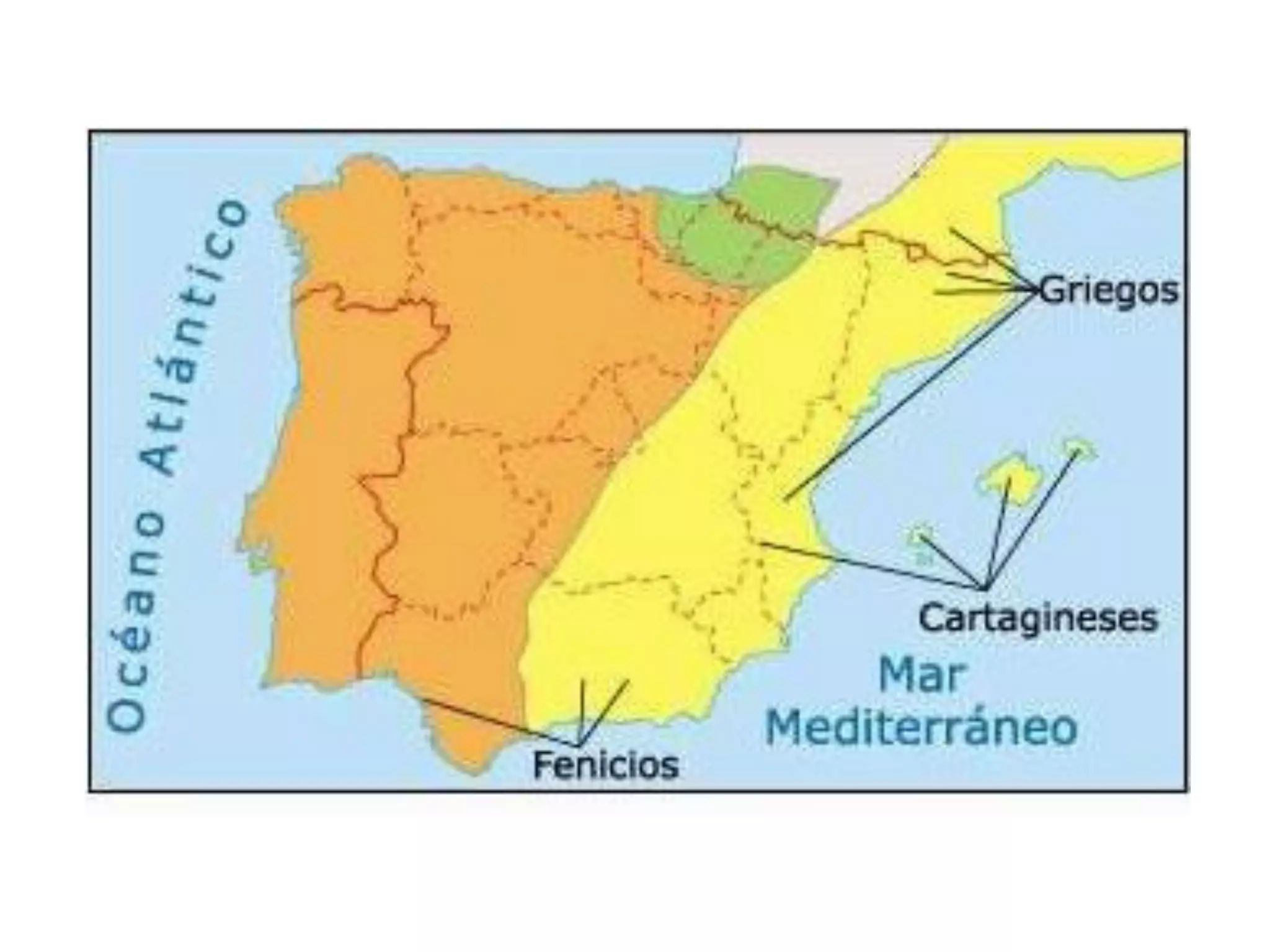
Different colonisers also arrived at the Iberian Peninsula
from Phoenicia, Greece & Carthage, and founded
colonies on the coast to control the metal trade.
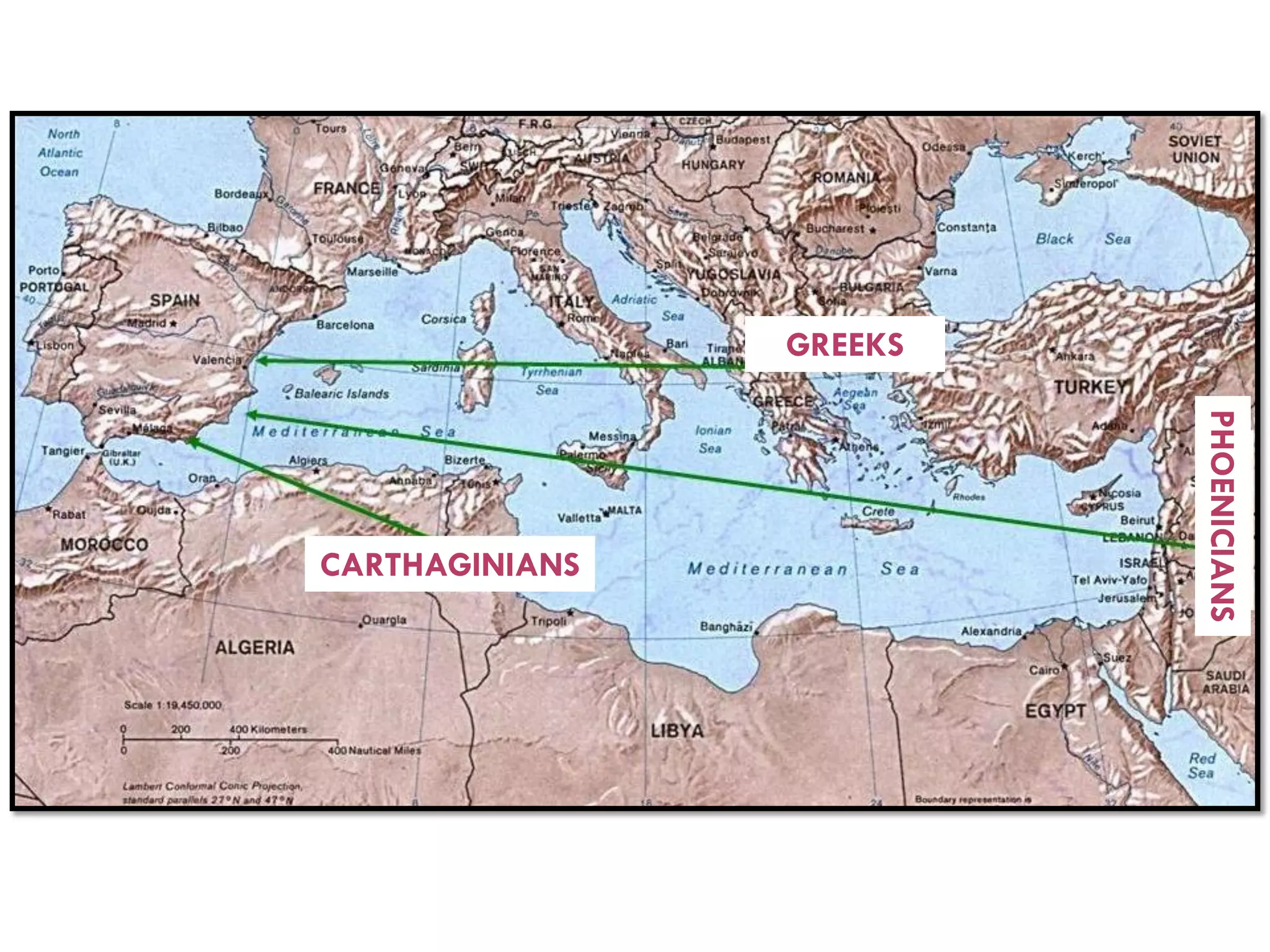
CARTHAGINIANS
GREEKS
PHOENICIANS
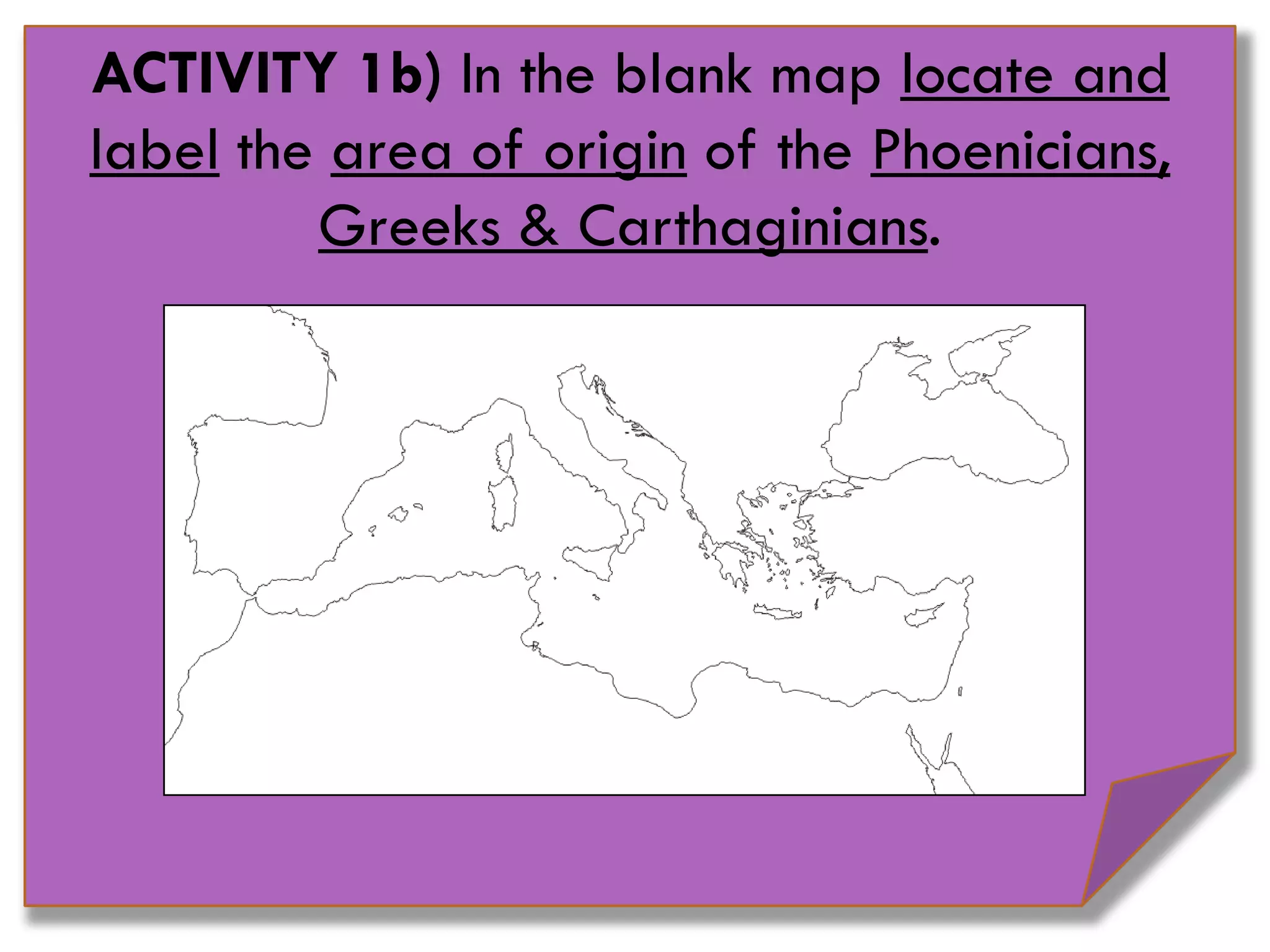
ACTIVITY 1b) In the blank map locate and
label the area of origin of the Phoenicians,
Greeks & Carthaginians.
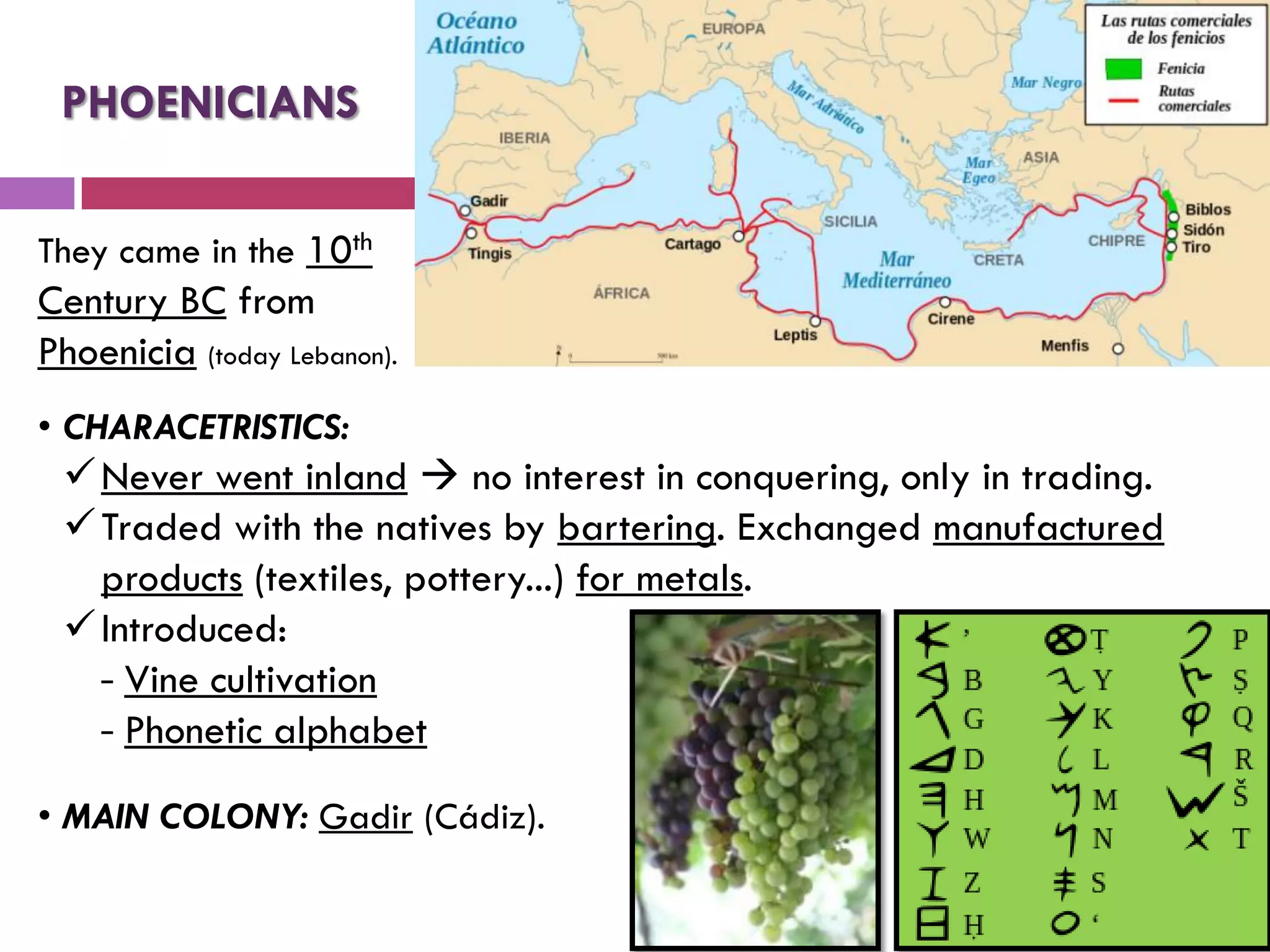
They came in the 10th
Century BC from
Phoenicia (today Lebanon).
PHOENICIANS
• CHARACETRISTICS:
Never went inland  no interest in conquering, only in trading.
Traded with the natives by bartering. Exchanged manufactured
products (textiles, pottery...) for metals.
Introduced:
‐ Vine cultivation
‐ Phonetic alphabet
• MAIN COLONY: Gadir (Cádiz).
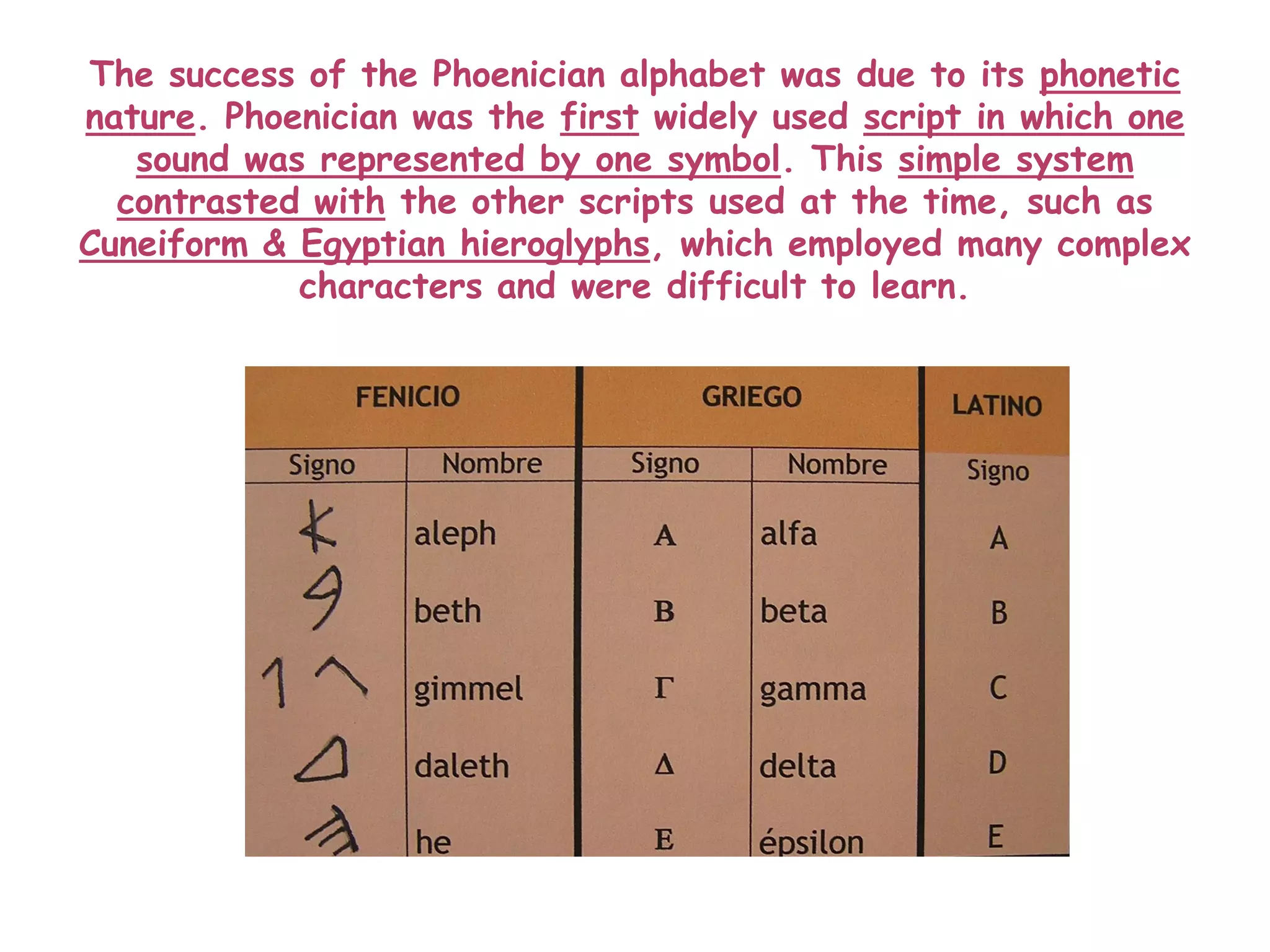
The success of the Phoenician alphabet was due to its phonetic
nature. Phoenician was the first widely used script in which one
sound was represented by one symbol. This simple system
contrasted with the other scripts used at the time, such as
Cuneiform & Egyptian hieroglyphs, which employed many complex
characters and were difficult to learn.
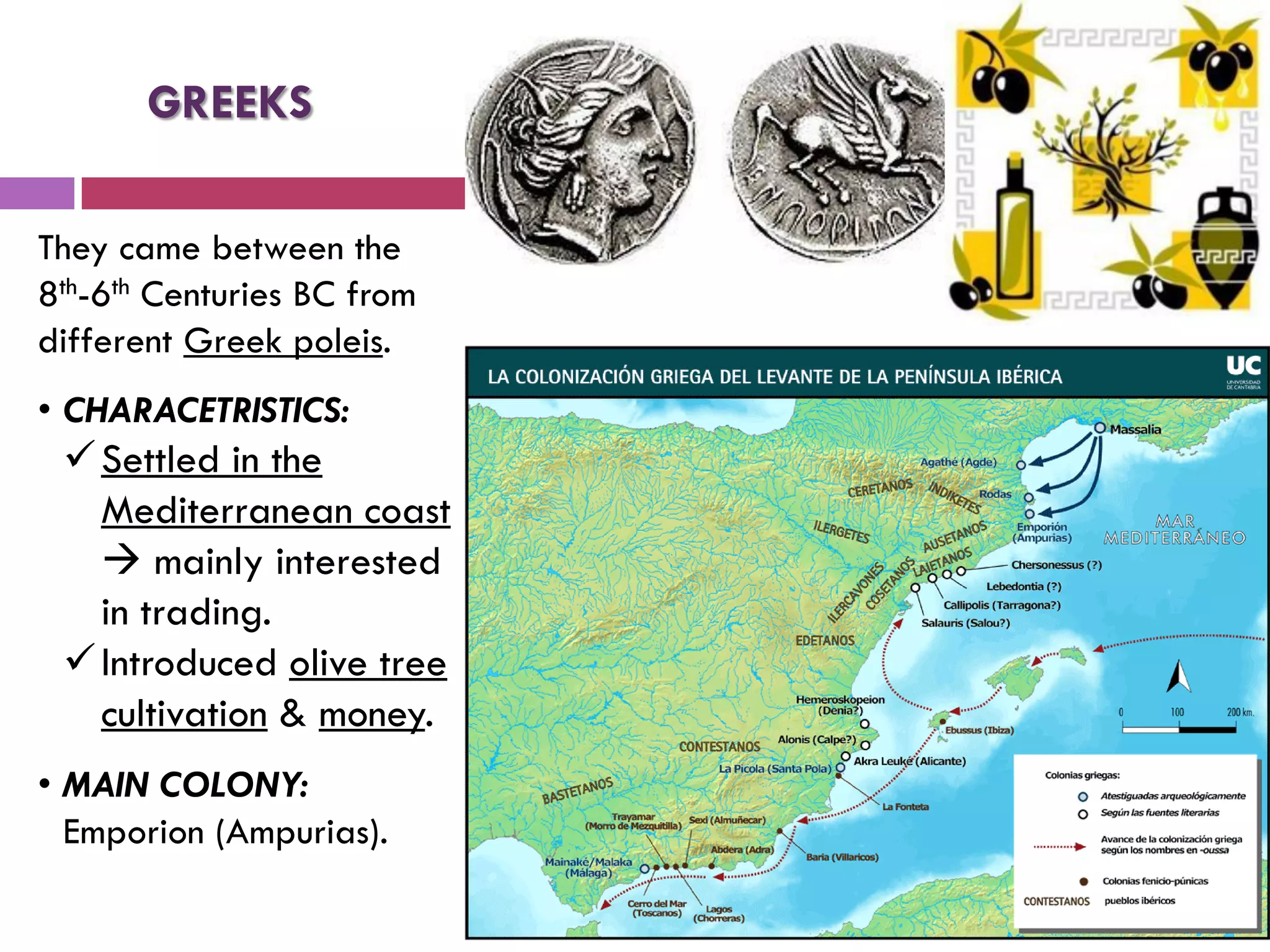
They came between the
8th-6th Centuries BC from
different Greek poleis.
• CHARACETRISTICS:
Settled in the
Mediterranean coast
 mainly interested
in trading.
Introduced olive tree
cultivation & money.
• MAIN COLONY:
Emporion (Ampurias).
GREEKS
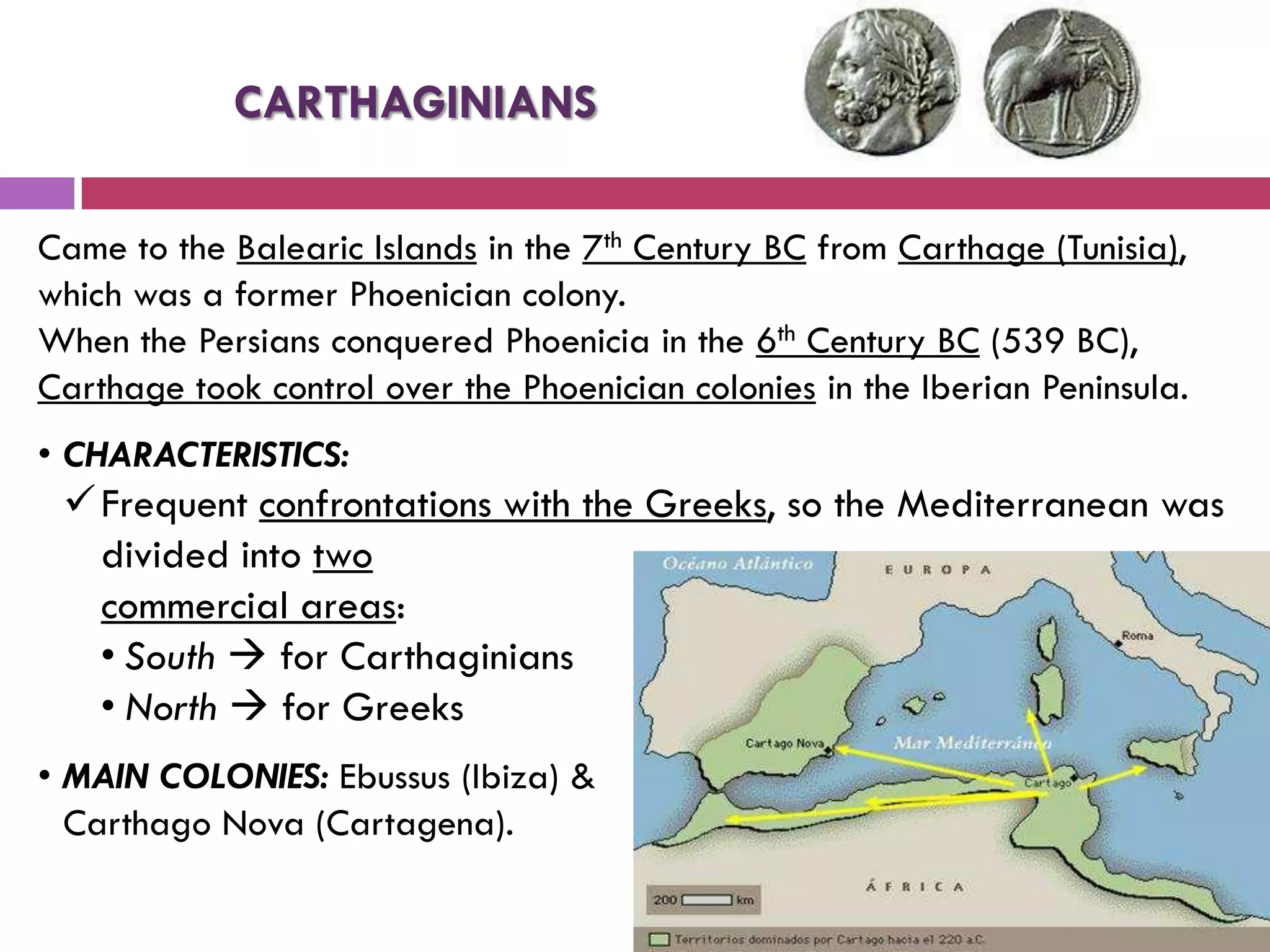
Came to the Balearic Islands in the 7th Century BC from Carthage (Tunisia),
which was a former Phoenician colony.
When the Persians conquered Phoenicia in the 6th Century BC (539 BC),
Carthage took control over the Phoenician colonies in the Iberian Peninsula.
• CHARACTERISTICS:
Frequent confrontations with the Greeks, so the Mediterranean was
divided into two
commercial areas:
• South  for Carthaginians
• North  for Greeks
• MAIN COLONIES: Ebussus (Ibiza) &
Carthago Nova (Cartagena).
CARTHAGINIANS
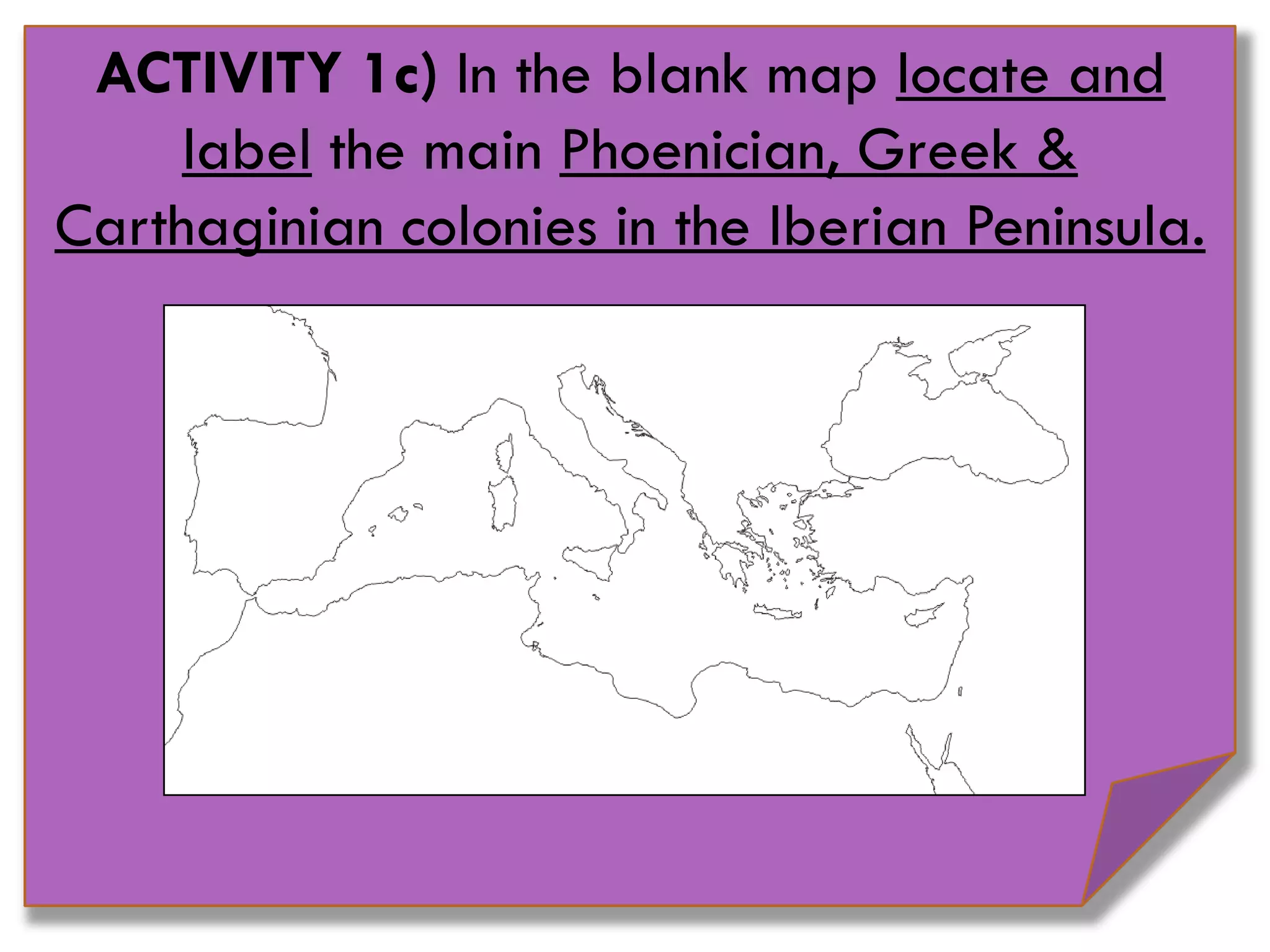
ACTIVITY 1c) In the blank map locate and
label the main Phoenician, Greek &
Carthaginian colonies in the Iberian Peninsula.
The Tartessians
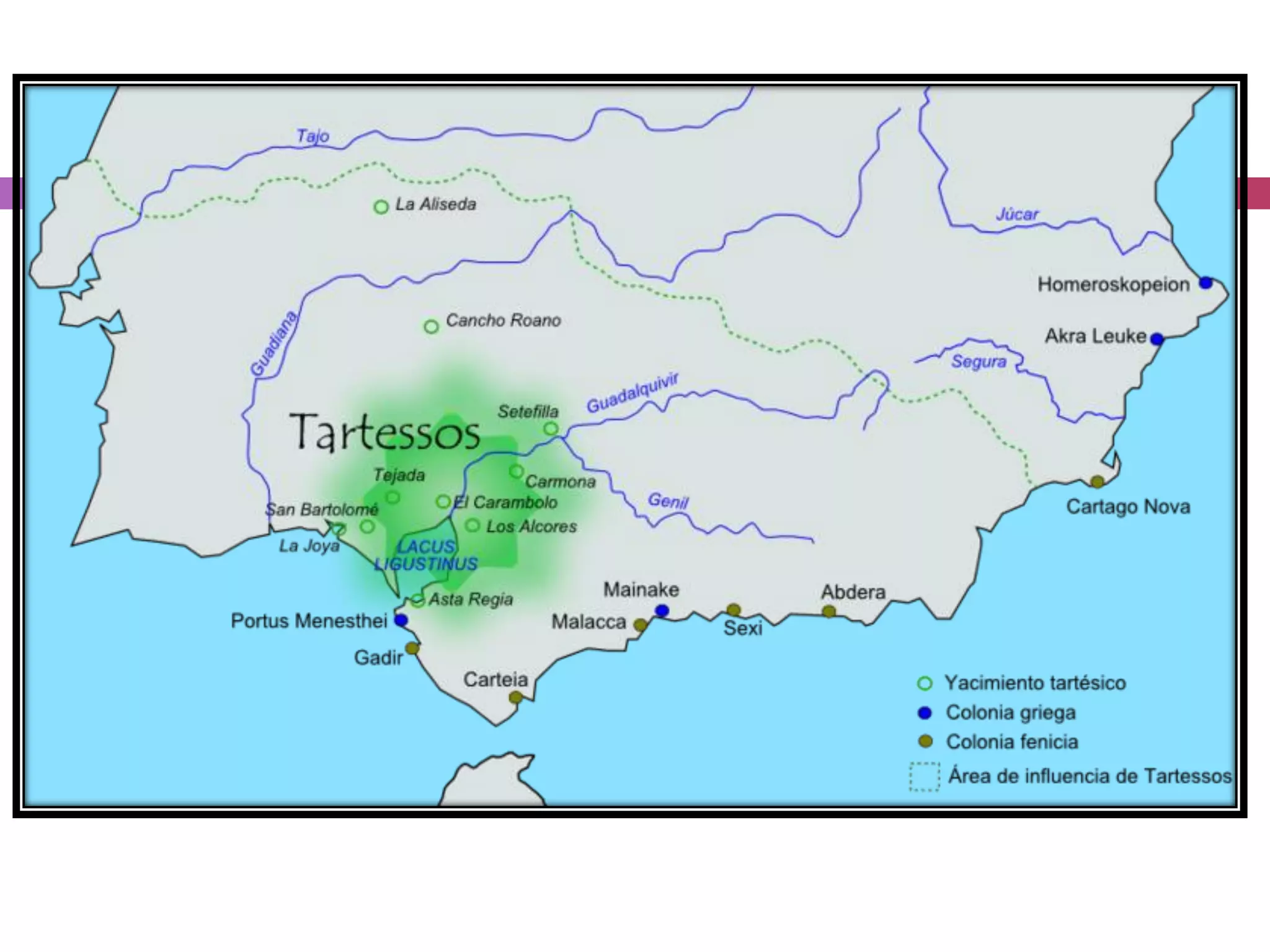
TARTESSIAN KINGDOM  1st organized state in Iberian Pen.
 CHRONOLOGY:
 Splendour: 7th - 6th Centuries BC  due to trade with Phoenicians
& Greeks.
 End: around 500 BC  defeat against Carthaginians.
 LOCATION: uncertain  area between Huelva-Cádiz-Sevilla.
 CHARACTERISTICS:
 Political organisation: monarchy. Most important king: Argantonio
 Economy: mainly based on metallurgy  they extracted metals
(silver, tin, copper...) and trade them with the colonizers.
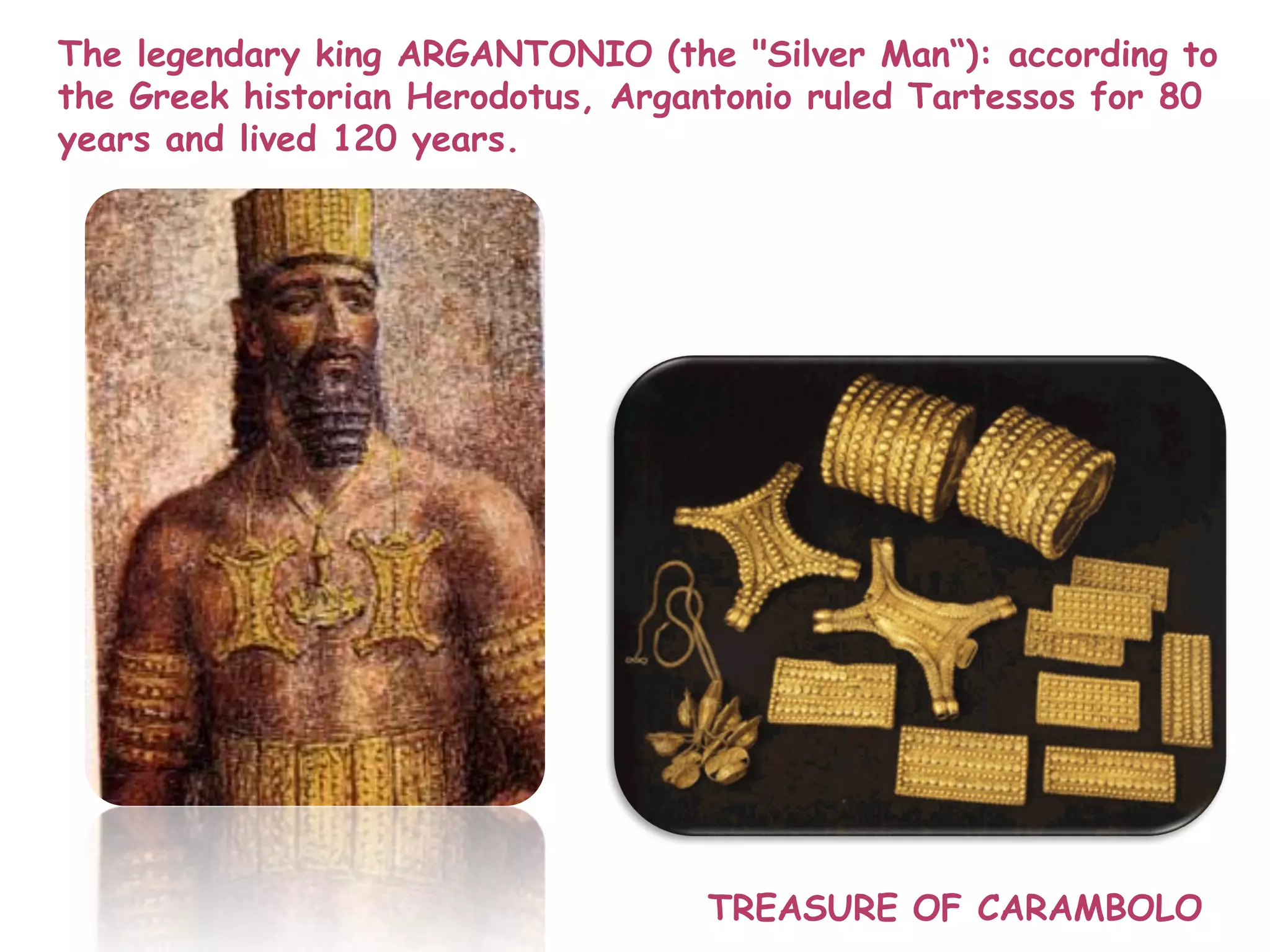
The legendary king ARGANTONIO (the "Silver Man“): according to
the Greek historian Herodotus, Argantonio ruled Tartessos for 80
years and lived 120 years.
TREASURE OF CARAMBOLO
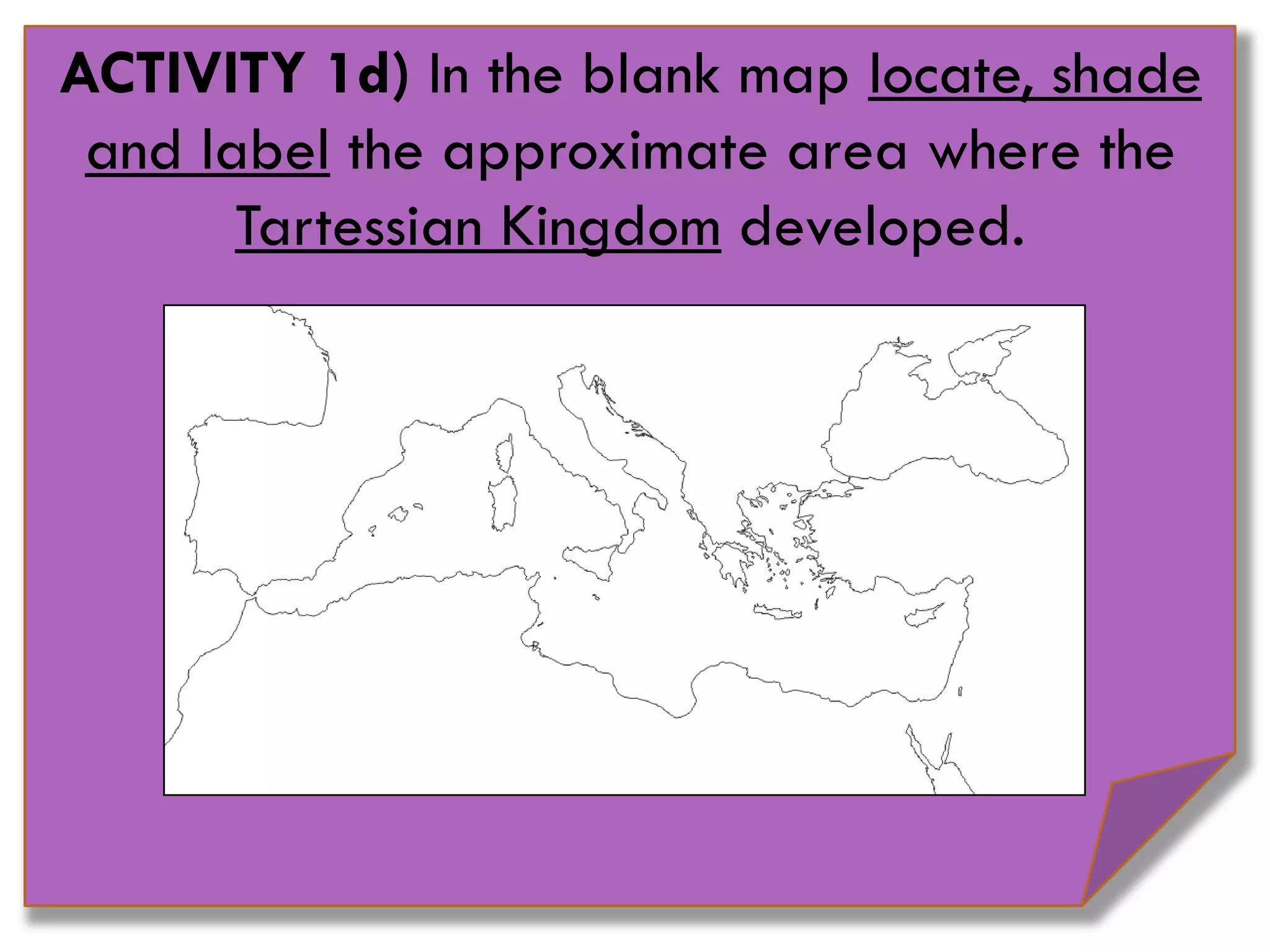
ACTIVITY 1d) In the blank map locate, shade
and label the approximate area where the
Tartessian Kingdom developed.
2. Second half of the 1st Millenium BC
Pre-Roman people
2. Pre-Roman people
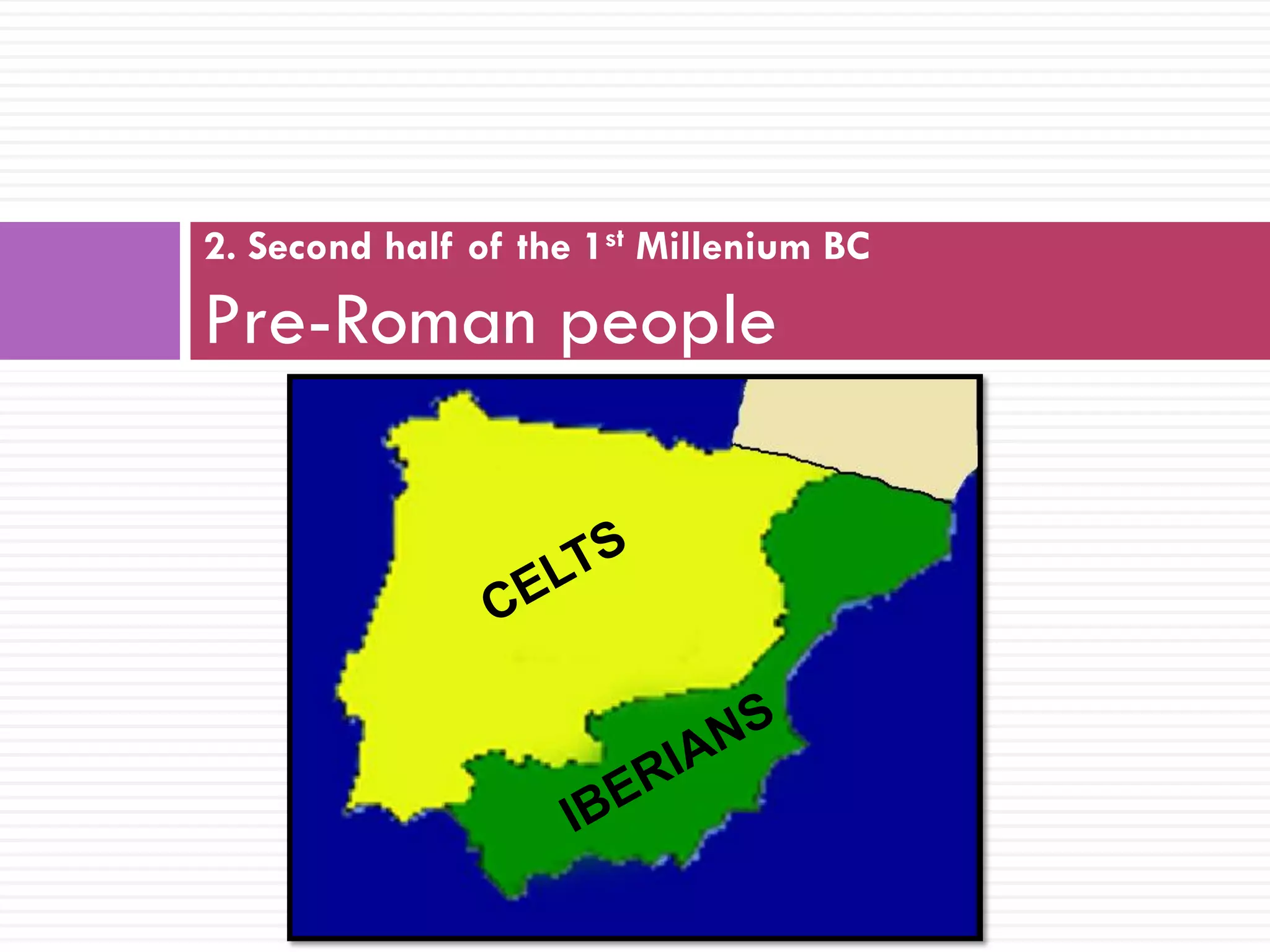
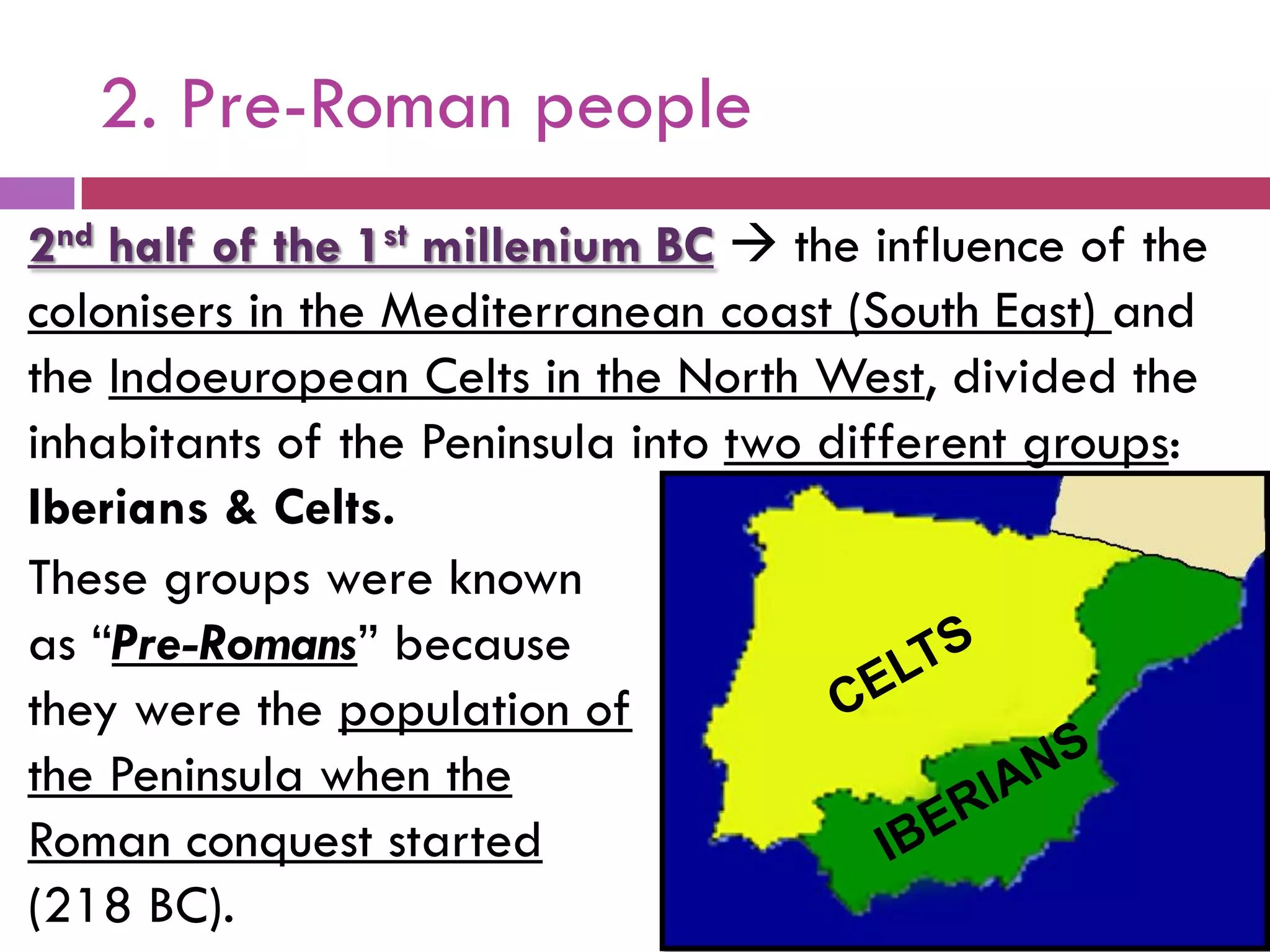
2nd half of the 1st millenium BC  the influence of the
colonisers in the Mediterranean coast (South East) and
the Indoeuropean Celts in the North West, divided the
inhabitants of the Peninsula into two different groups:
Iberians & Celts.
These groups were known
as “Pre-Romans” because
they were the population of
the Peninsula when the
Roman conquest started
(218 BC).
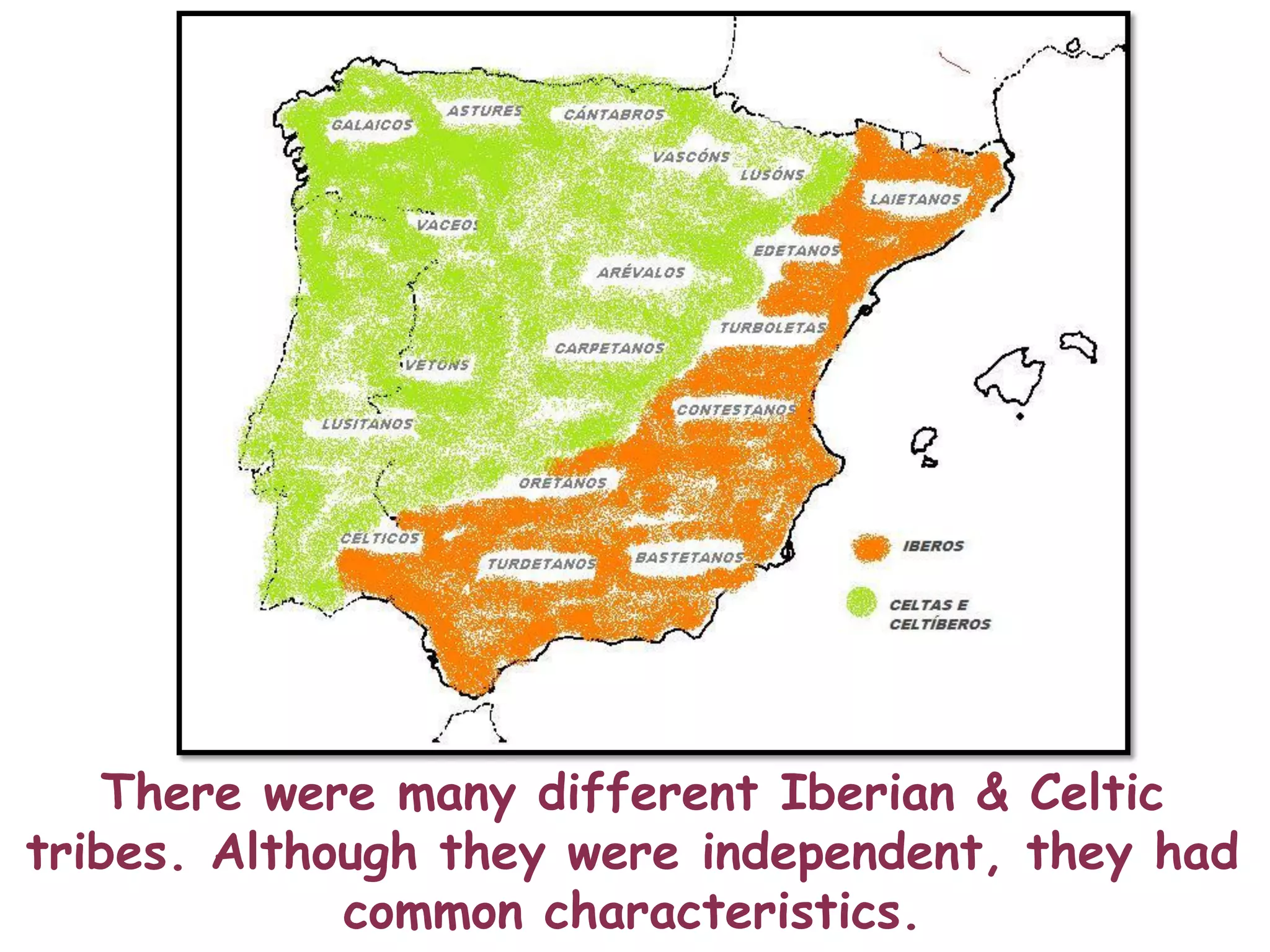
There were many different Iberian & Celtic
tribes. Although they were independent, they had
common characteristics.
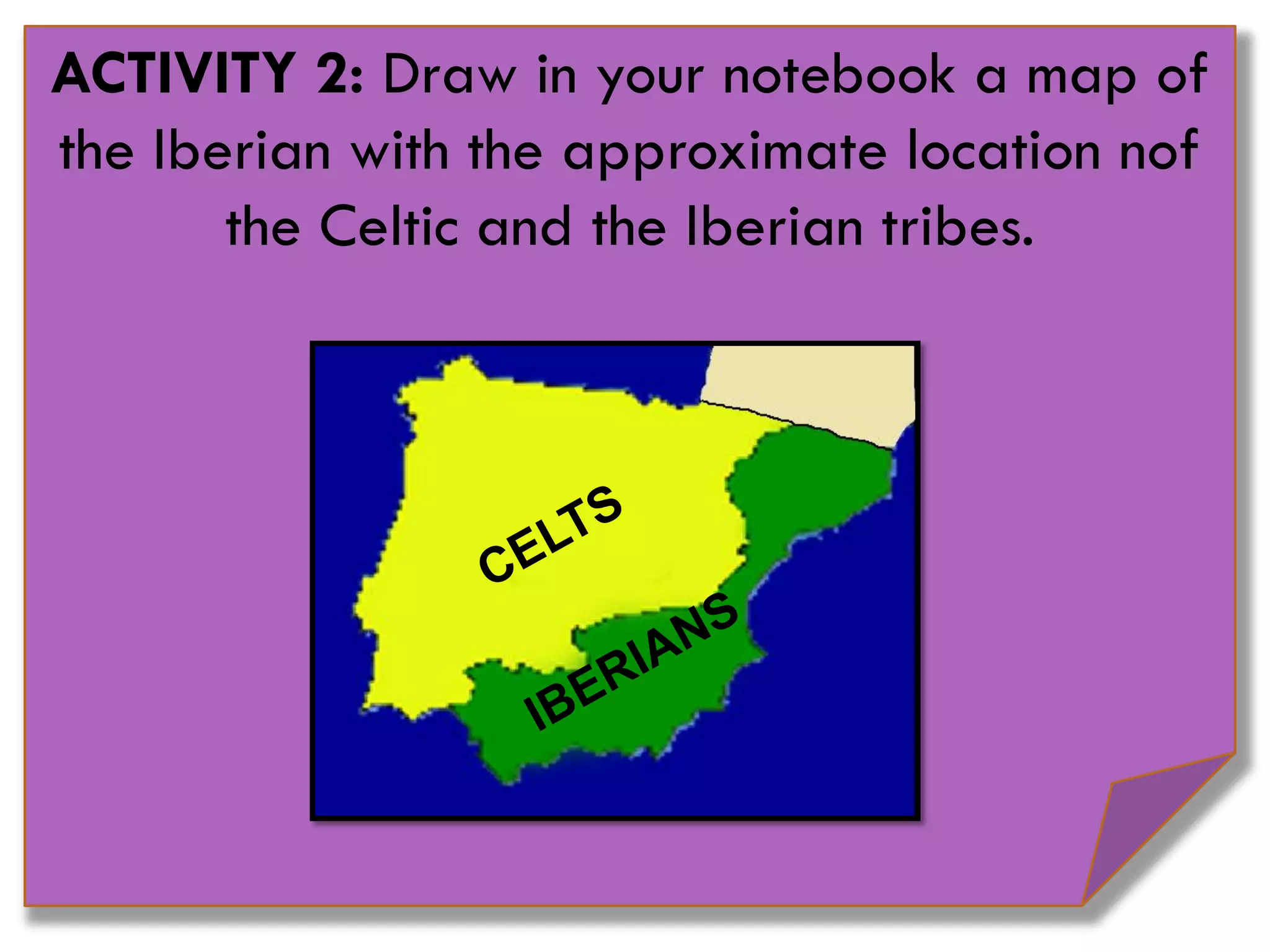
ACTIVITY 2: Draw in your notebook a map of
the Iberian with the approximate location nof
the Celtic and the Iberian tribes.
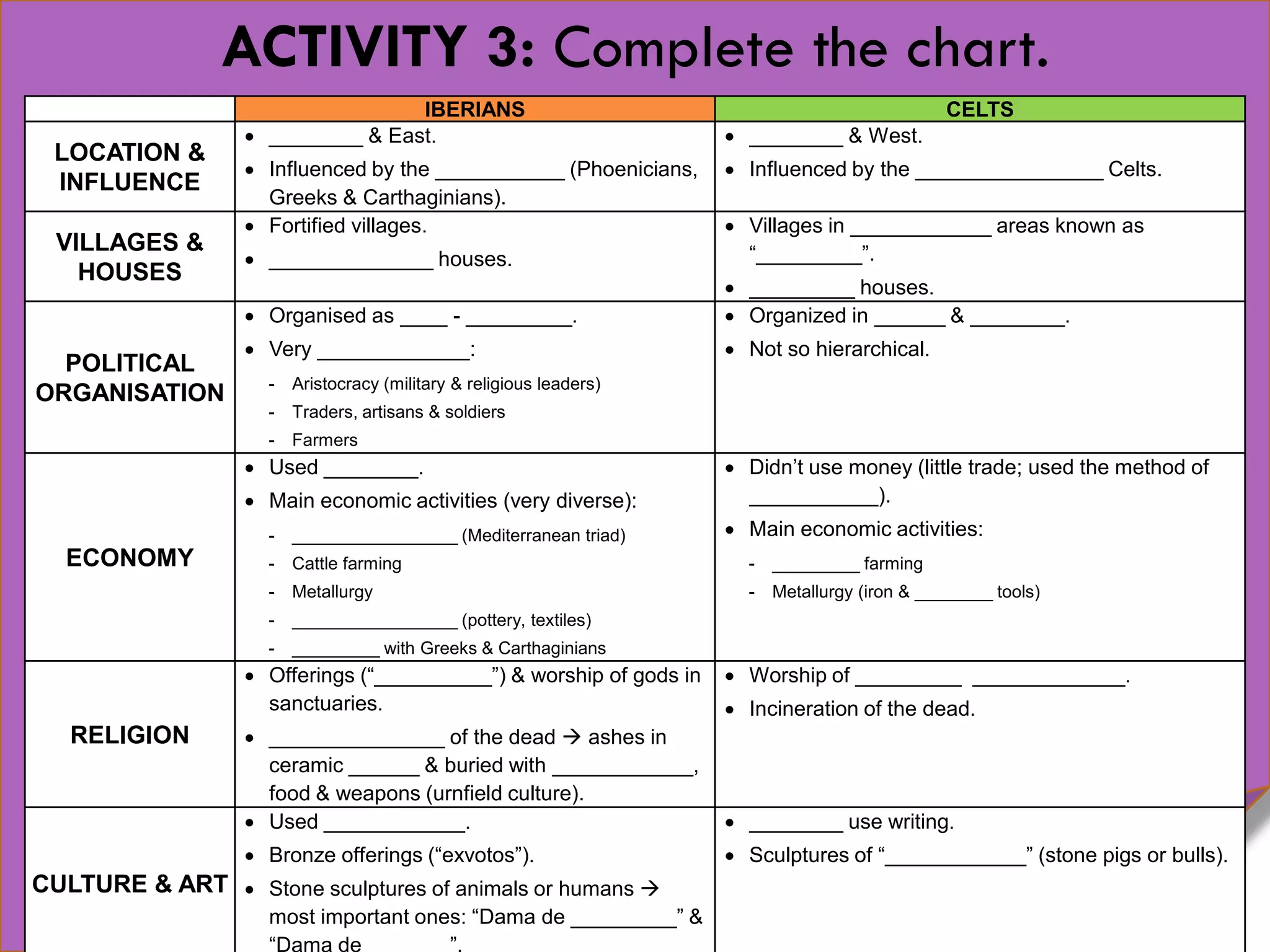
ACTIVITY 3: Complete the chart.
IBERIANS CELTS
LOCATION &
INFLUENCE
 ________ & East.
 Influenced by the ___________ (Phoenicians,
Greeks & Carthaginians).
 ________ & West.
 Influenced by the ________________ Celts.
VILLAGES &
HOUSES
 Fortified villages.
 ______________ houses.
 Villages in ____________ areas known as
“_________”.
 _________ houses.
POLITICAL
ORGANISATION
 Organised as ____ - _________.
 Very _____________:
- Aristocracy (military & religious leaders)
- Traders, artisans & soldiers
- Farmers
 Organized in ______ & ________.
 Not so hierarchical.
ECONOMY
 Used ________.
 Main economic activities (very diverse):
- _________________ (Mediterranean triad)
- Cattle farming
- Metallurgy
- _________________ (pottery, textiles)
- _________ with Greeks & Carthaginians
 Didn’t use money (little trade; used the method of
___________).
 Main economic activities:
- _________ farming
- Metallurgy (iron & ________ tools)
RELIGION
 Offerings (“__________”) & worship of gods in
sanctuaries.
 _______________ of the dead  ashes in
ceramic ______ & buried with ____________,
food & weapons (urnfield culture).
 Worship of _________ _____________.
 Incineration of the dead.
CULTURE & ART
 Used ____________.
 Bronze offerings (“exvotos”).
 Stone sculptures of animals or humans 
most important ones: “Dama de _________” &
“Dama de _______”.
 ________ use writing.
 Sculptures of “____________” (stone pigs or bulls).
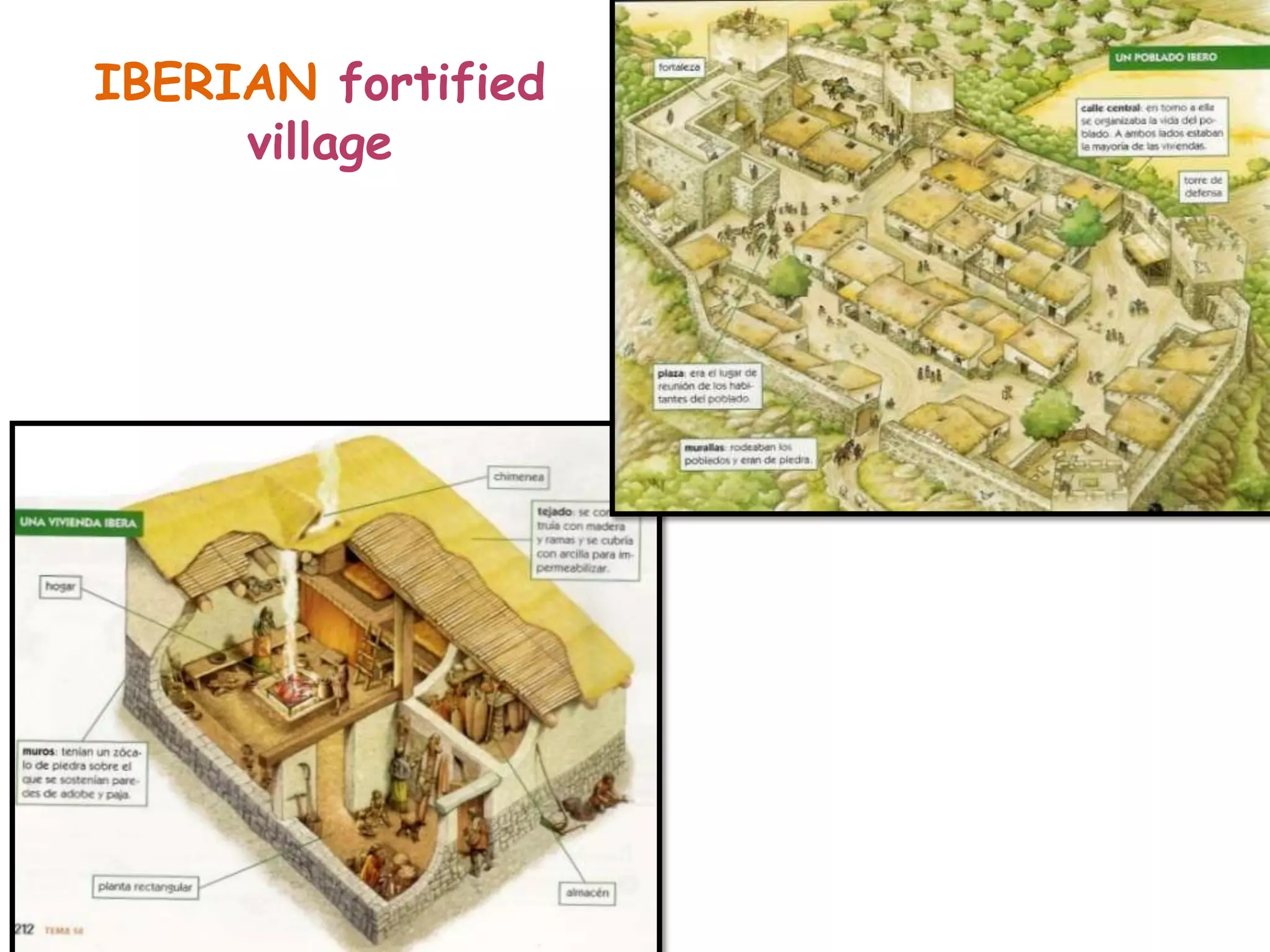
IBERIAN fortified
village
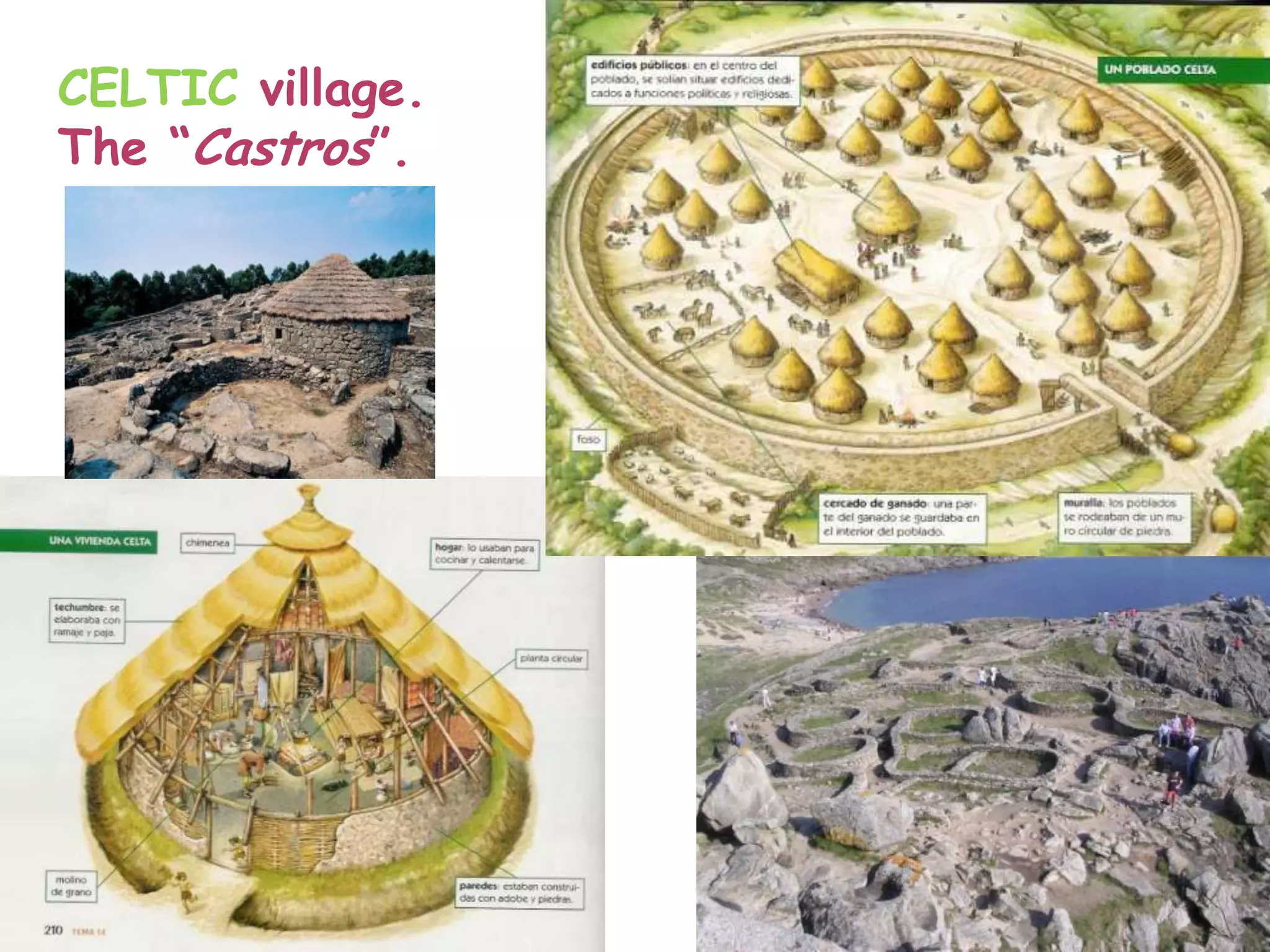
CELTIC village.
The “Castros”.
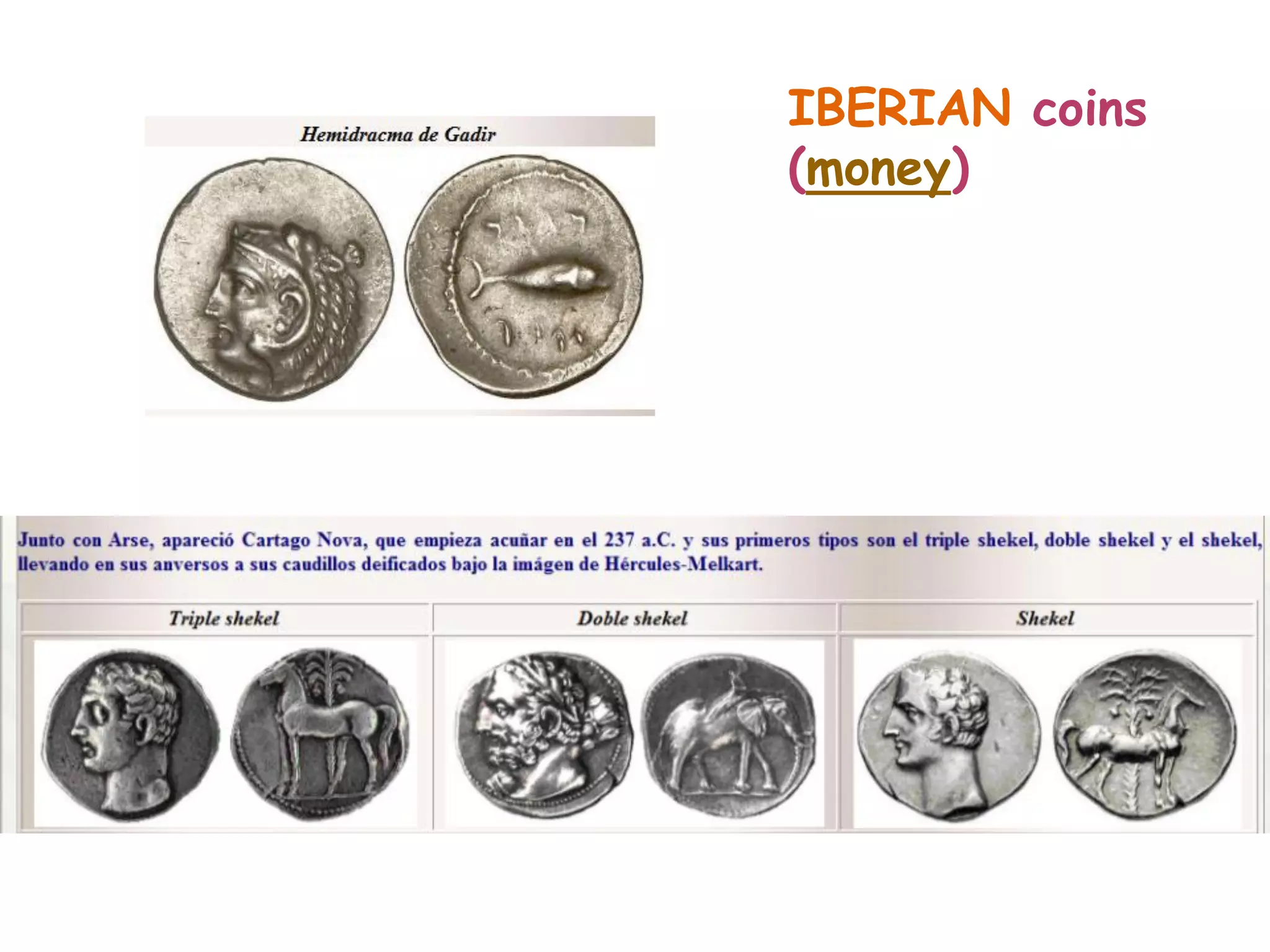
IBERIAN coins
(money)
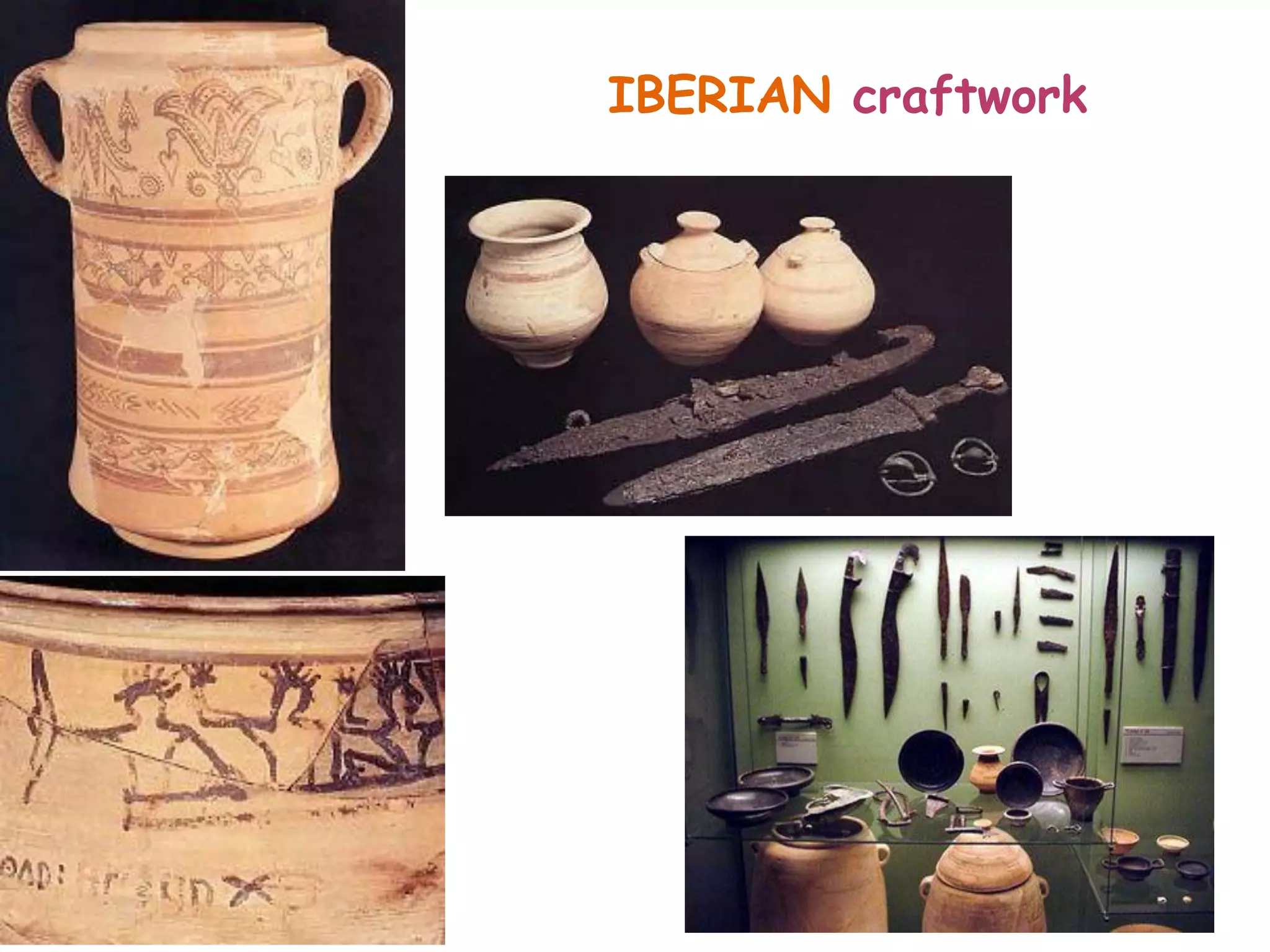
IBERIAN craftwork
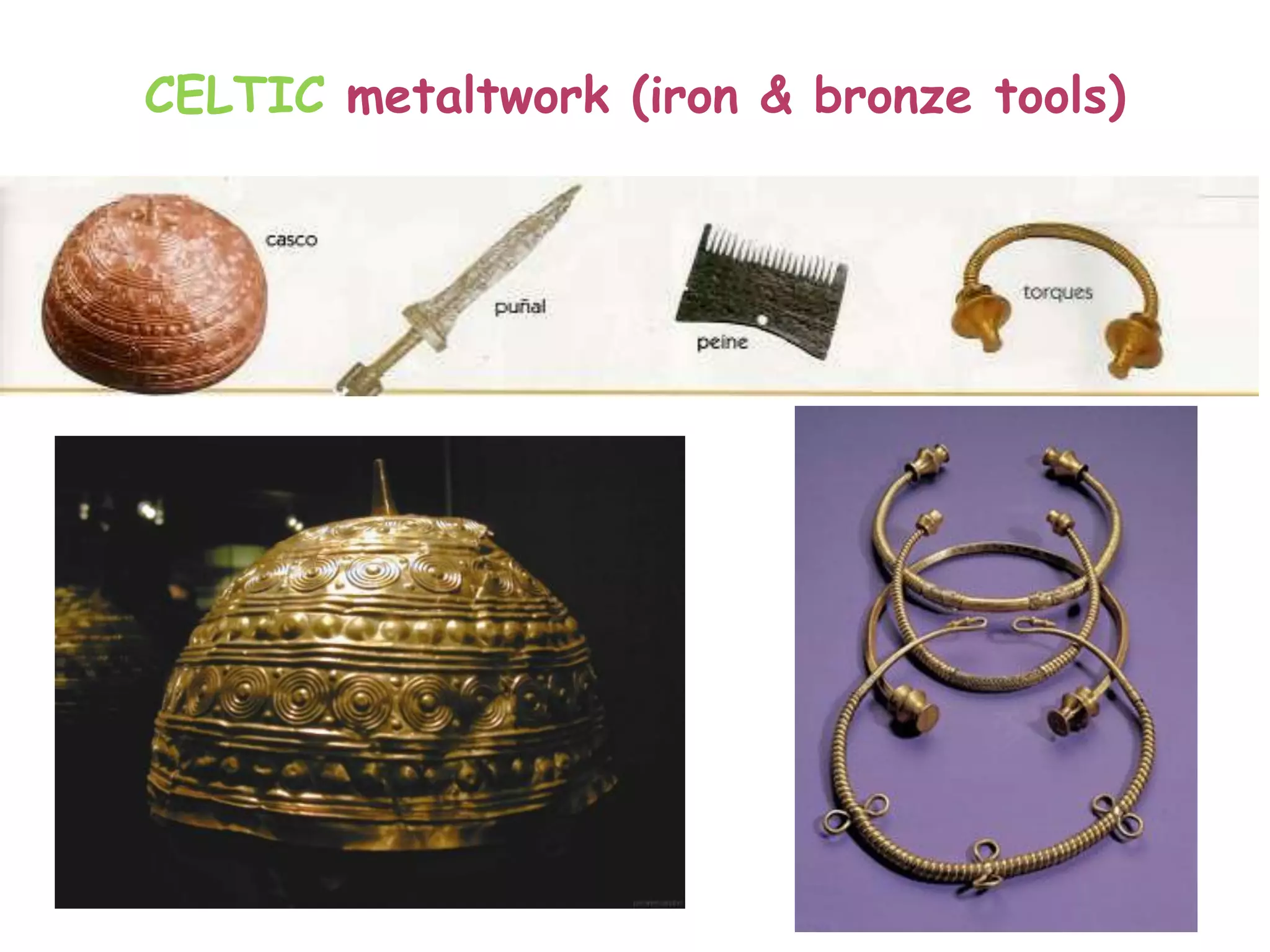
CELTIC metaltwork (iron & bronze tools)
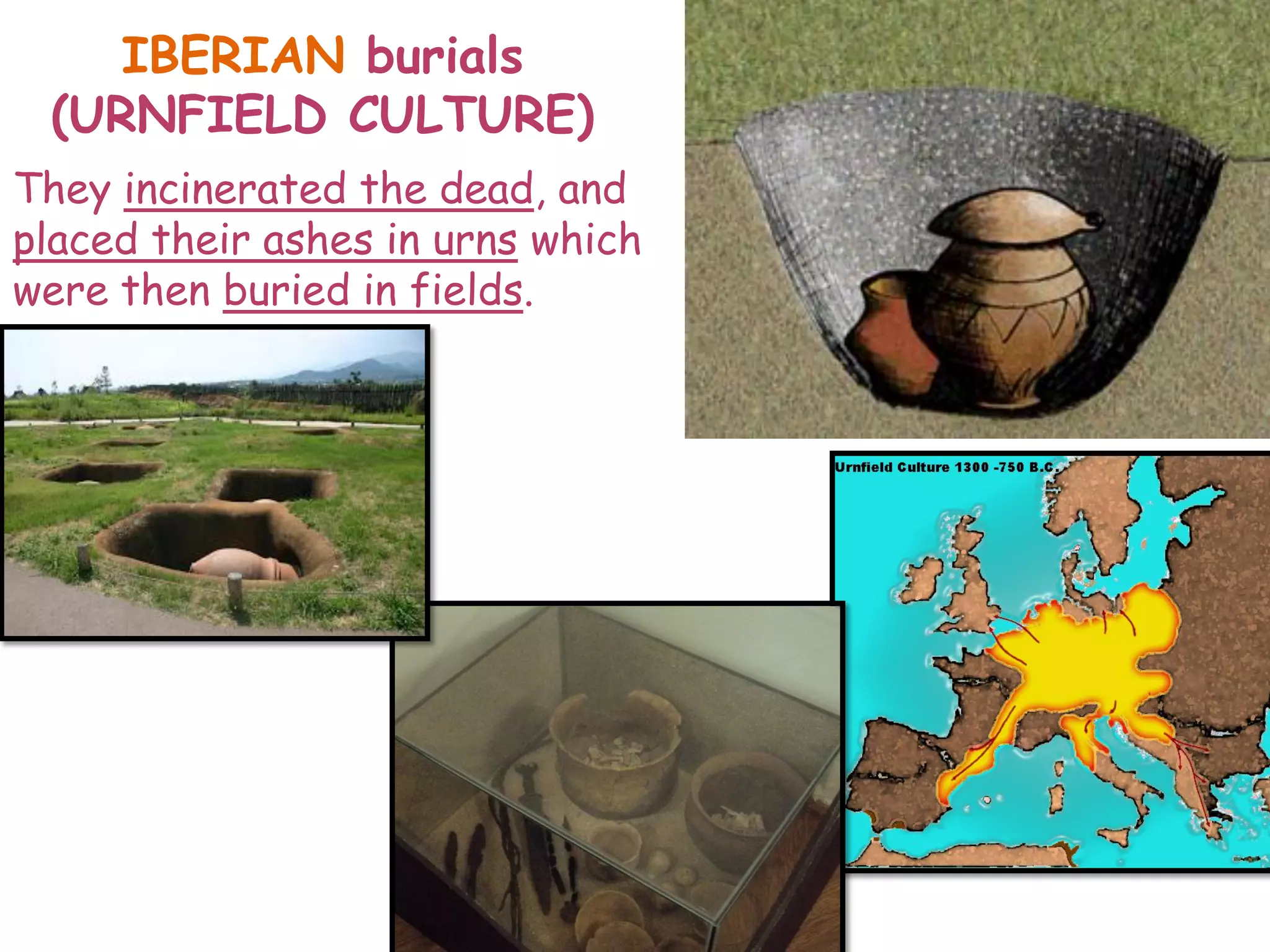
IBERIAN burials
(URNFIELD CULTURE)
They incinerated the dead, and
placed their ashes in urns which
were then buried in fields.
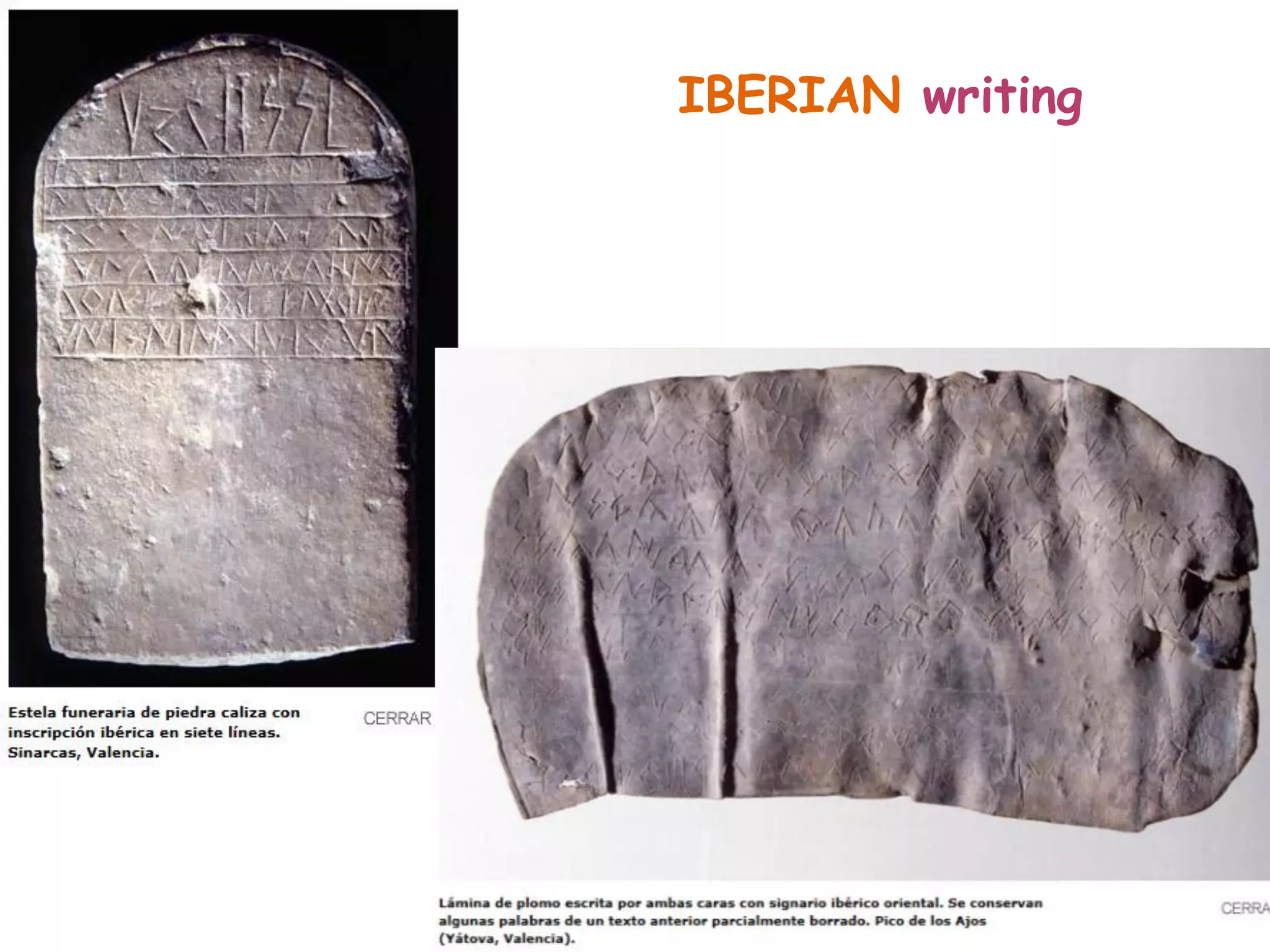
IBERIAN writing
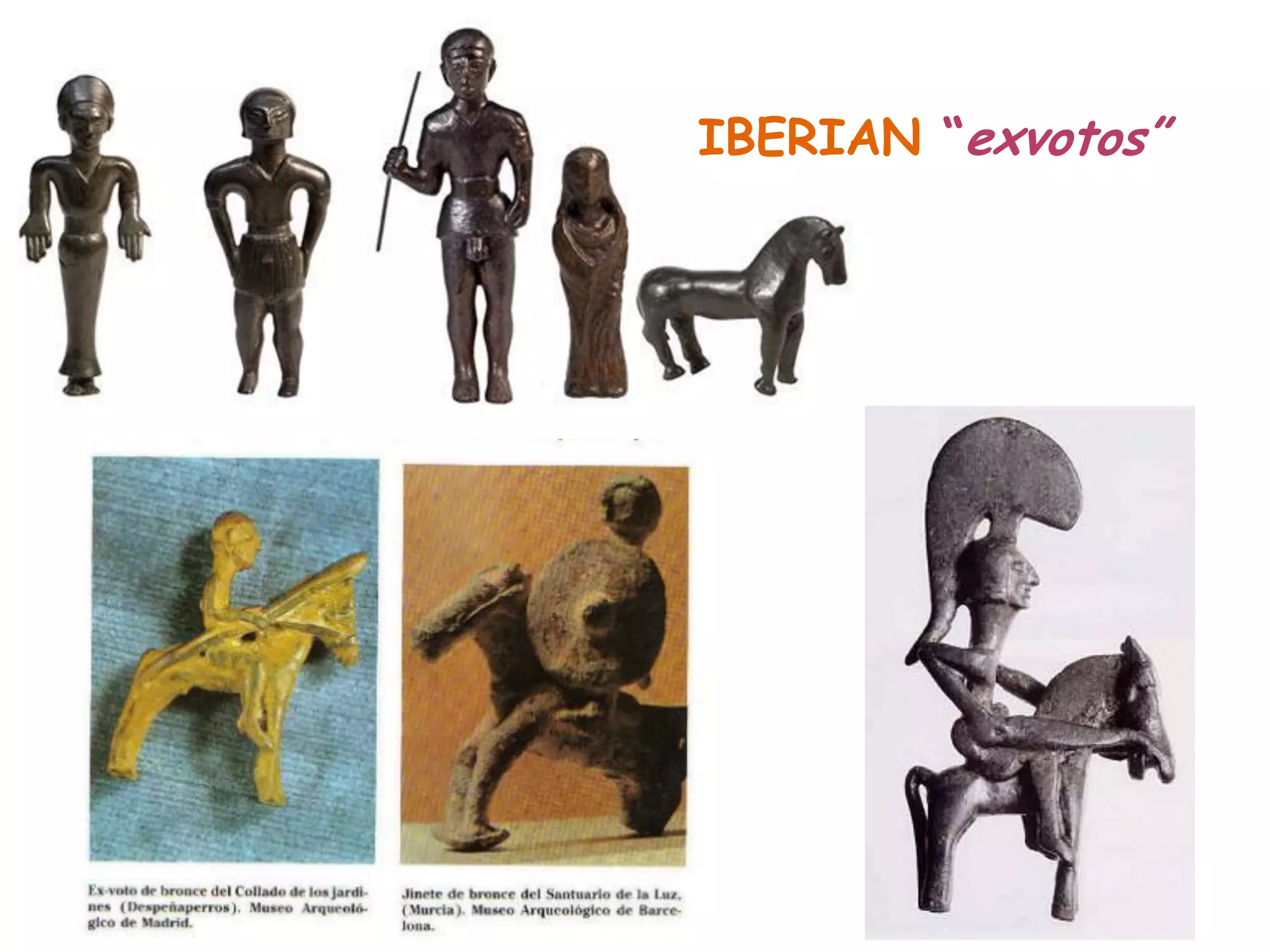
IBERIAN “exvotos”
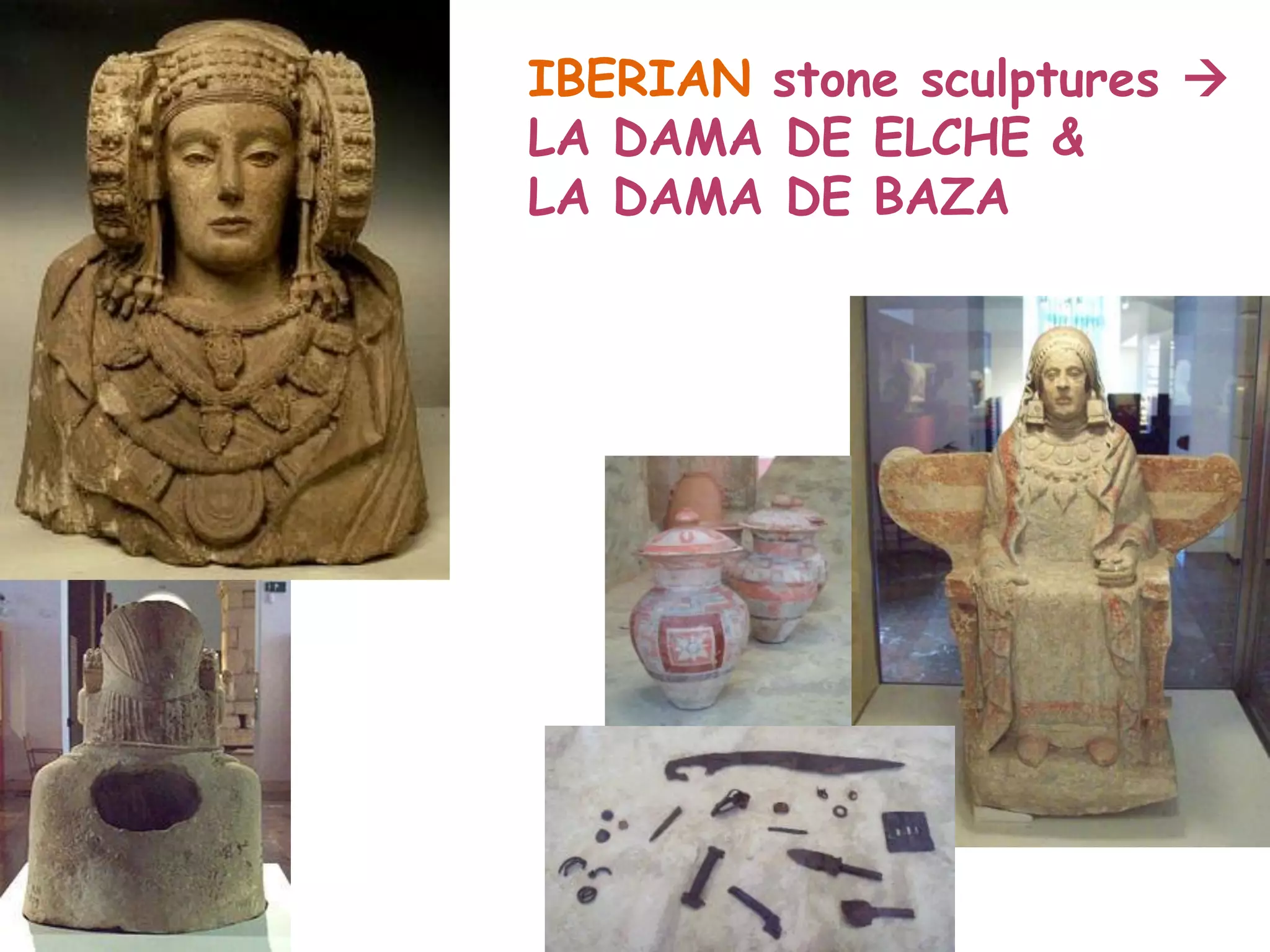
IBERIAN stone sculptures 
LA DAMA DE ELCHE &
LA DAMA DE BAZA
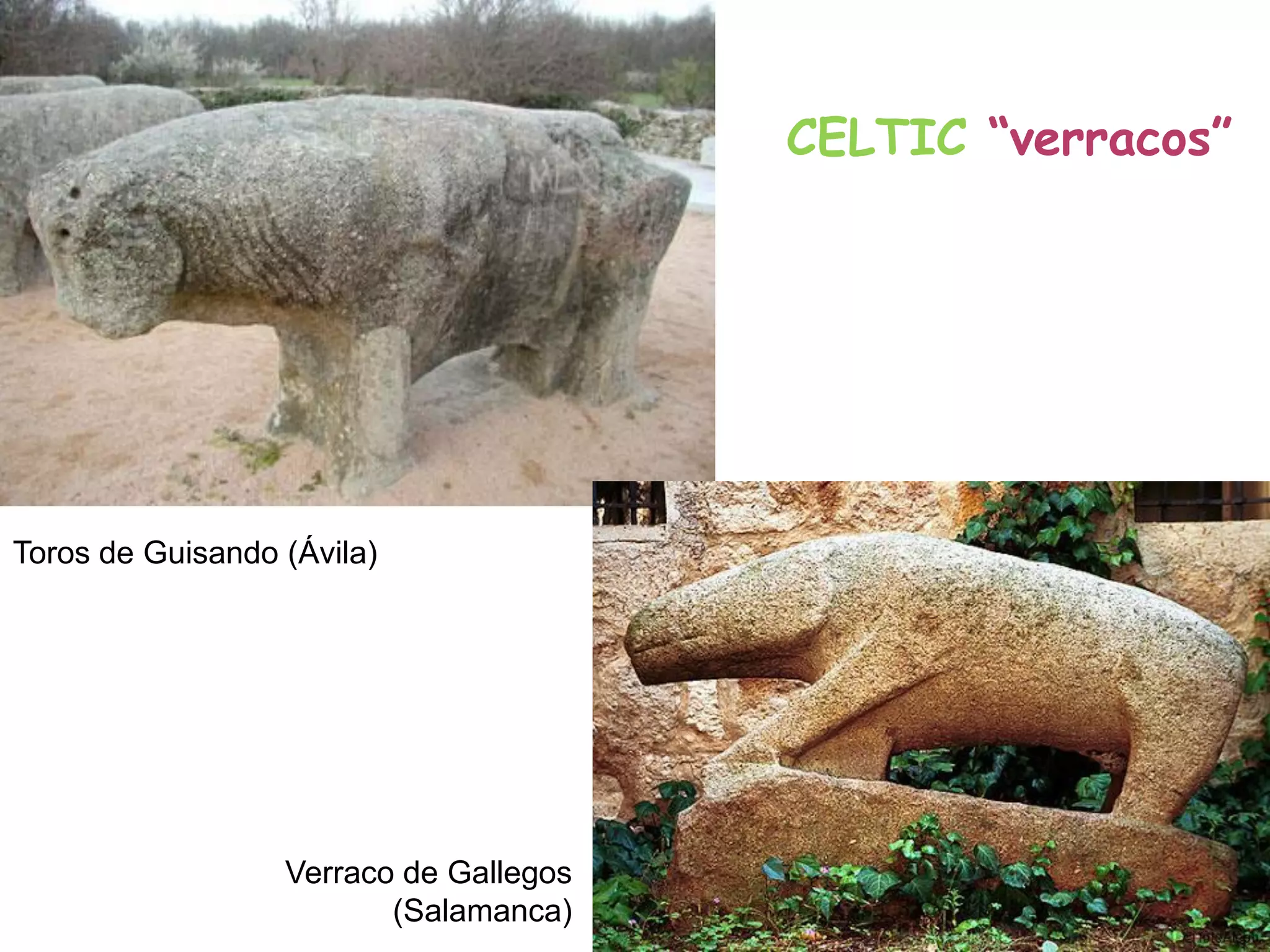
CELTIC “verracos”
Toros de Guisando (Ávila)
Verraco de Gallegos
(Salamanca)
3. Roman Hispania
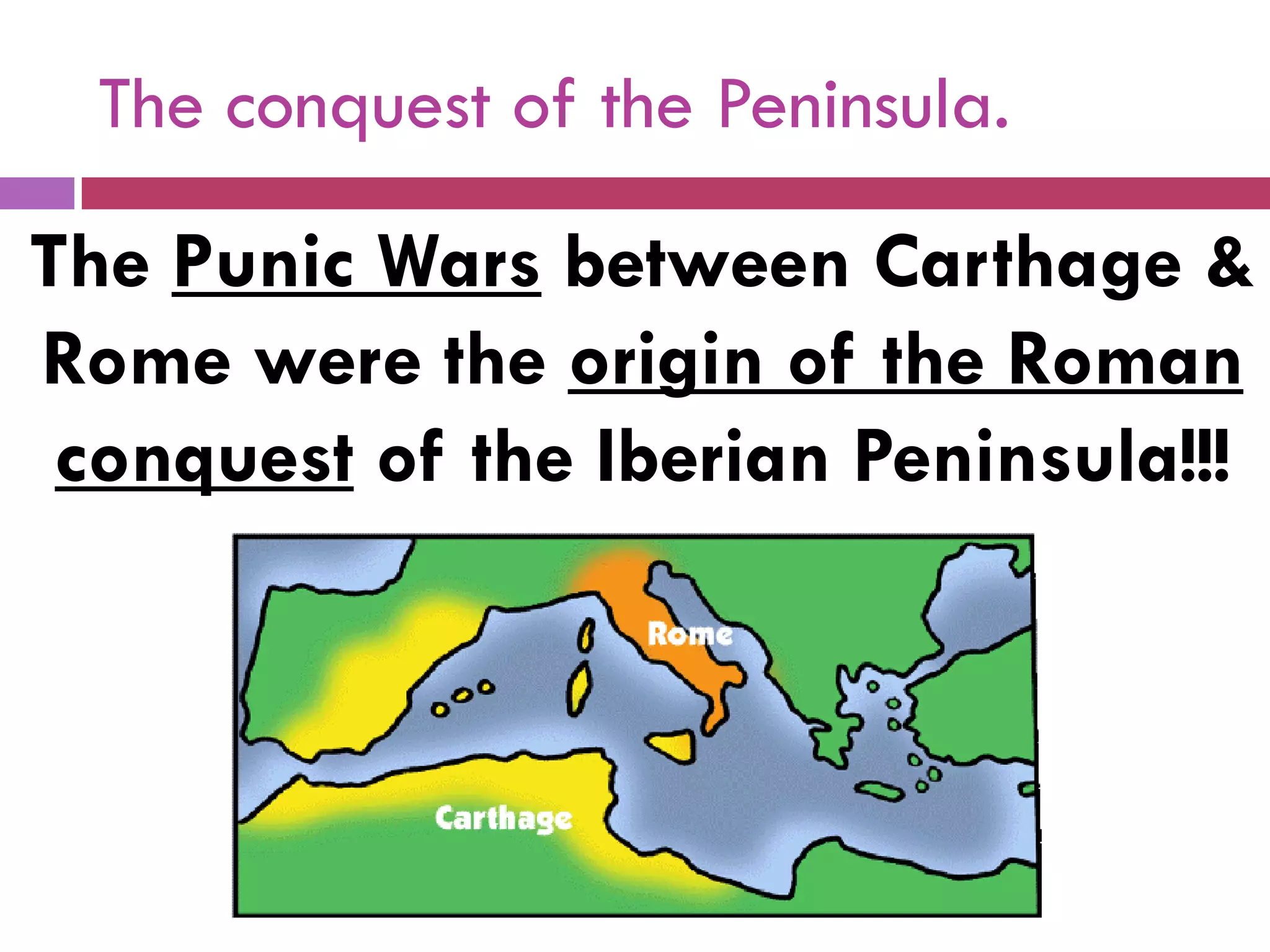
The conquest of the Peninsula.
The Punic Wars between Carthage &
Rome were the origin of the Roman
conquest of the Iberian Peninsula!!!
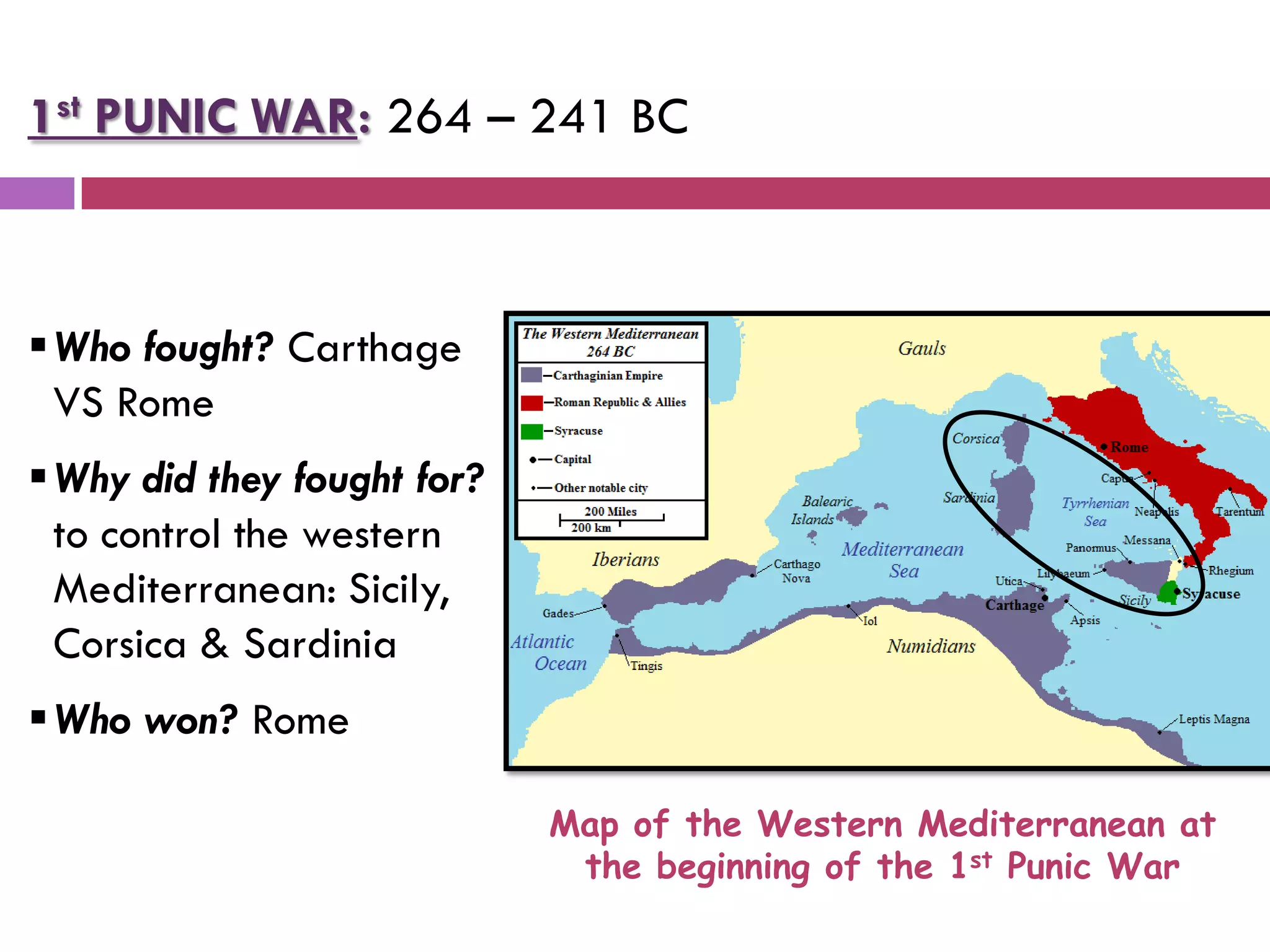
Who fought? Carthage
VS Rome
Why did they fought for?
to control the western
Mediterranean: Sicily,
Corsica & Sardinia
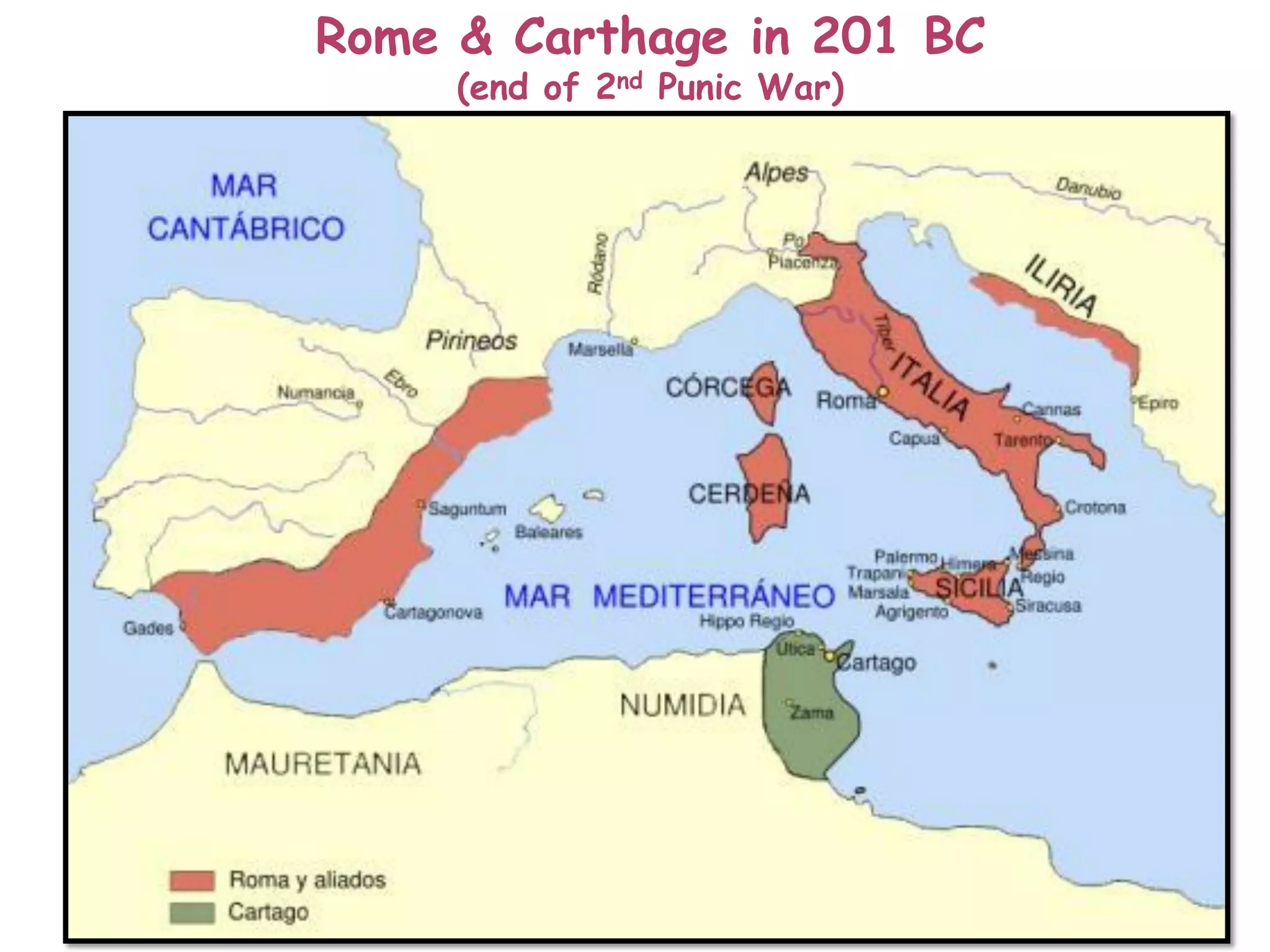
Who won? Rome
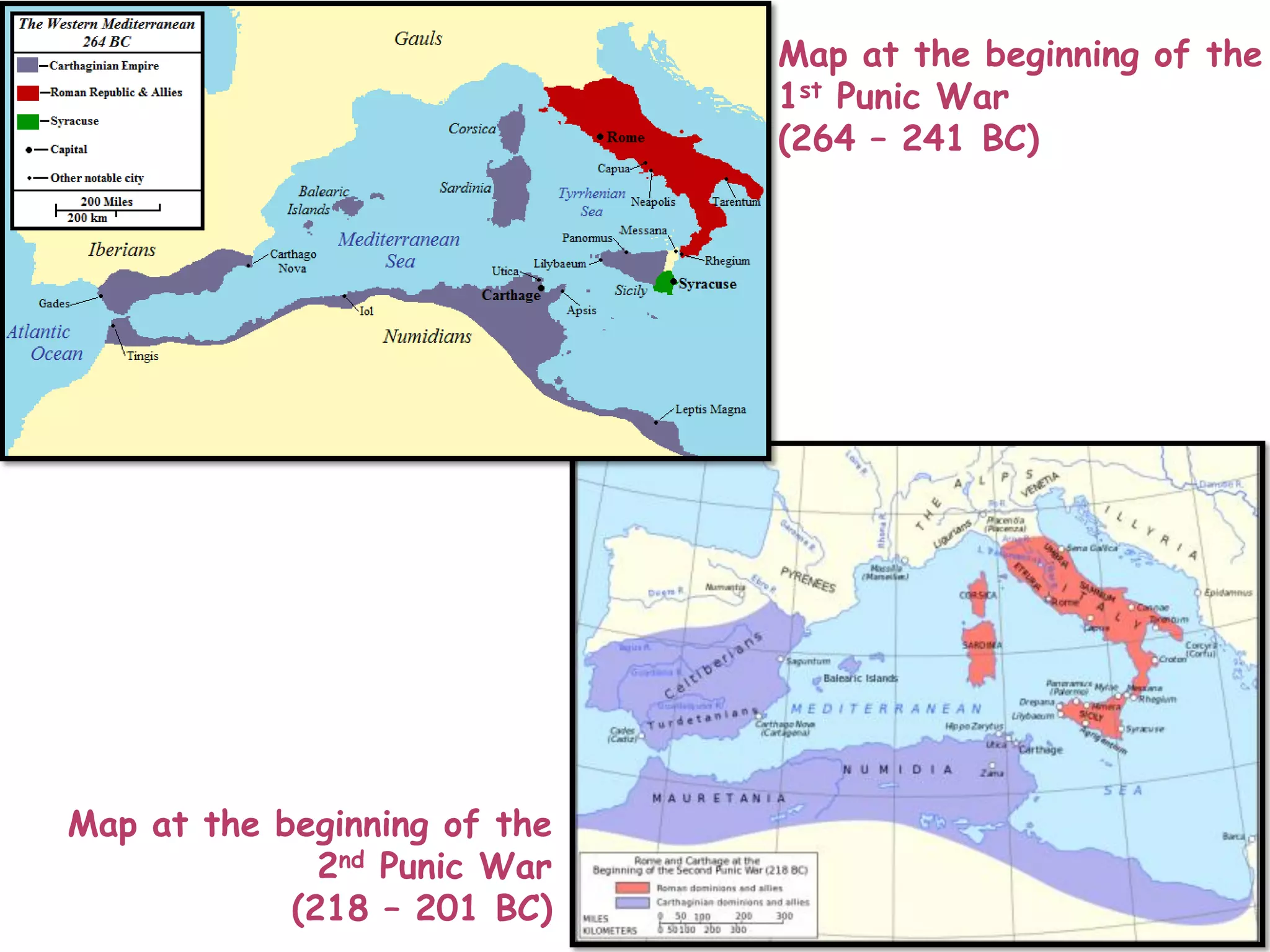
Map of the Western Mediterranean at
the beginning of the 1st Punic War
1st PUNIC WAR: 264 – 241 BC
Map at the beginning of the
1st Punic War
(264 – 241 BC)
Map at the beginning of the
2nd Punic War
(218 – 201 BC)
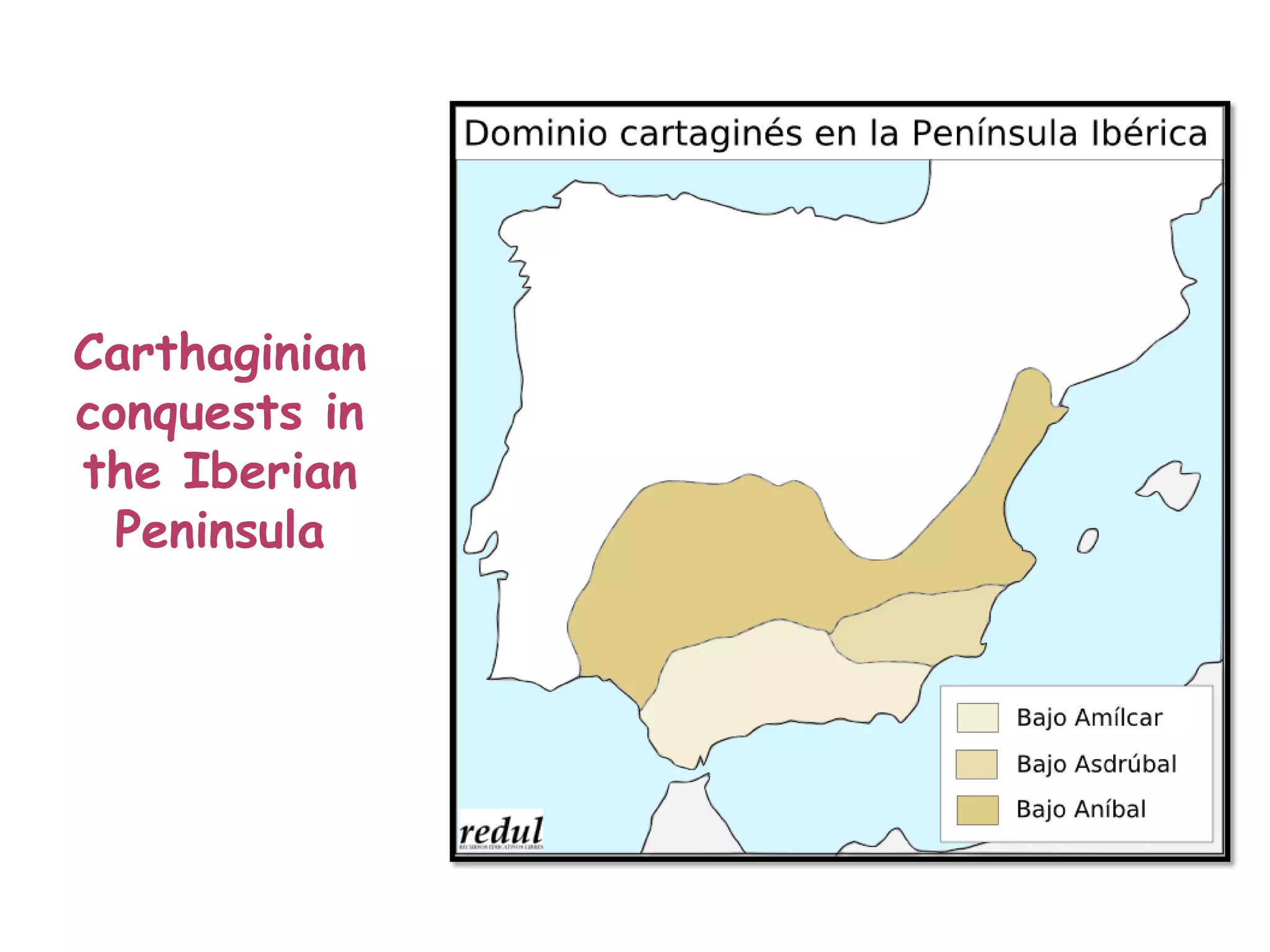
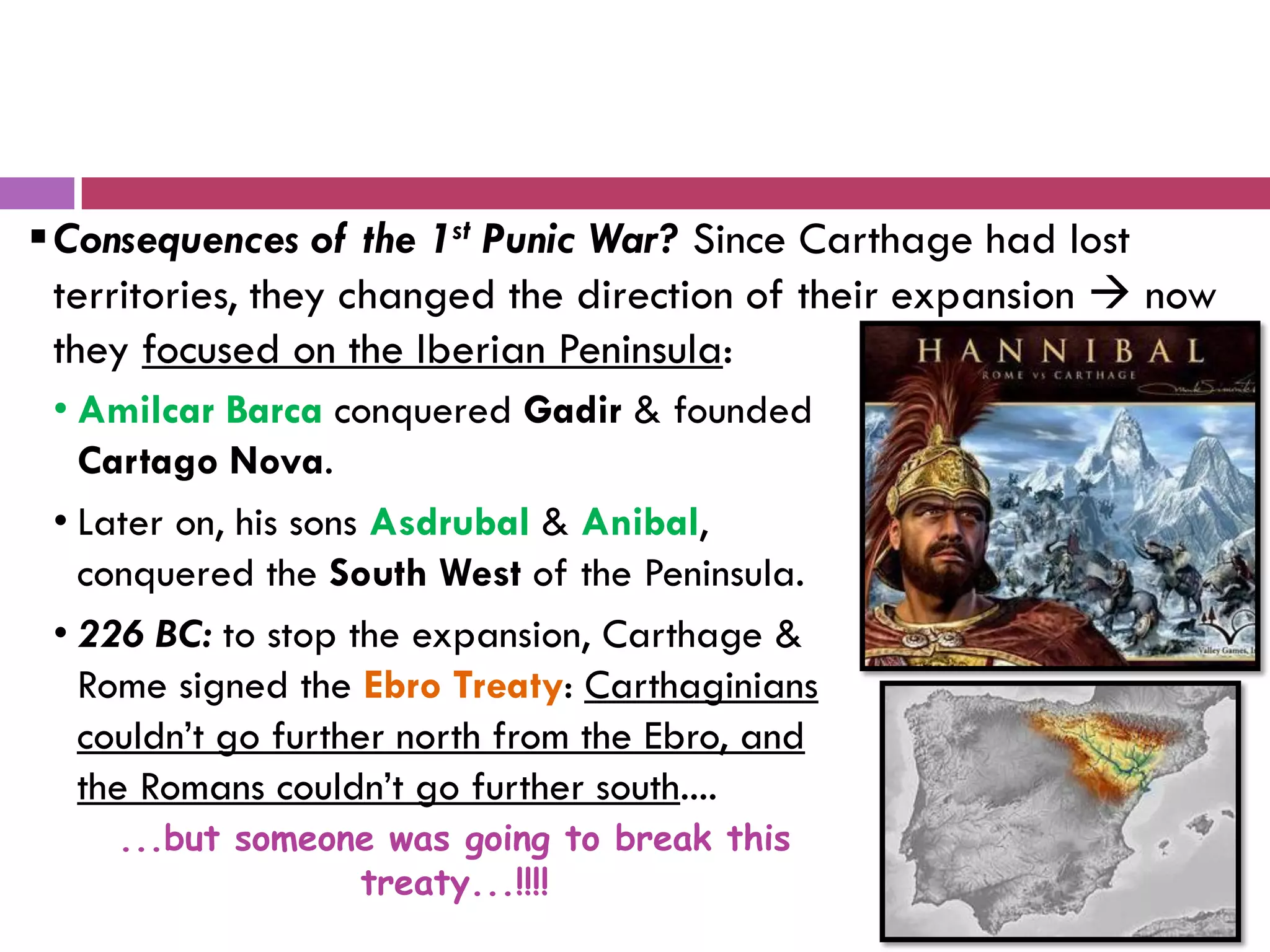
Consequences of the 1st Punic War? Since Carthage had lost
territories, they changed the direction of their expansion  now
they focused on the Iberian Peninsula:
• Amilcar Barca conquered Gadir & founded
Cartago Nova.
• Later on, his sons Asdrubal & Anibal,
conquered the South West of the Peninsula.
• 226 BC: to stop the expansion, Carthage &
Rome signed the Ebro Treaty: Carthaginians
couldn’t go further north from the Ebro, and
the Romans couldn’t go further south....
...but someone was going to break this
treaty...!!!!
Carthaginian
conquests in
the Iberian
Peninsula
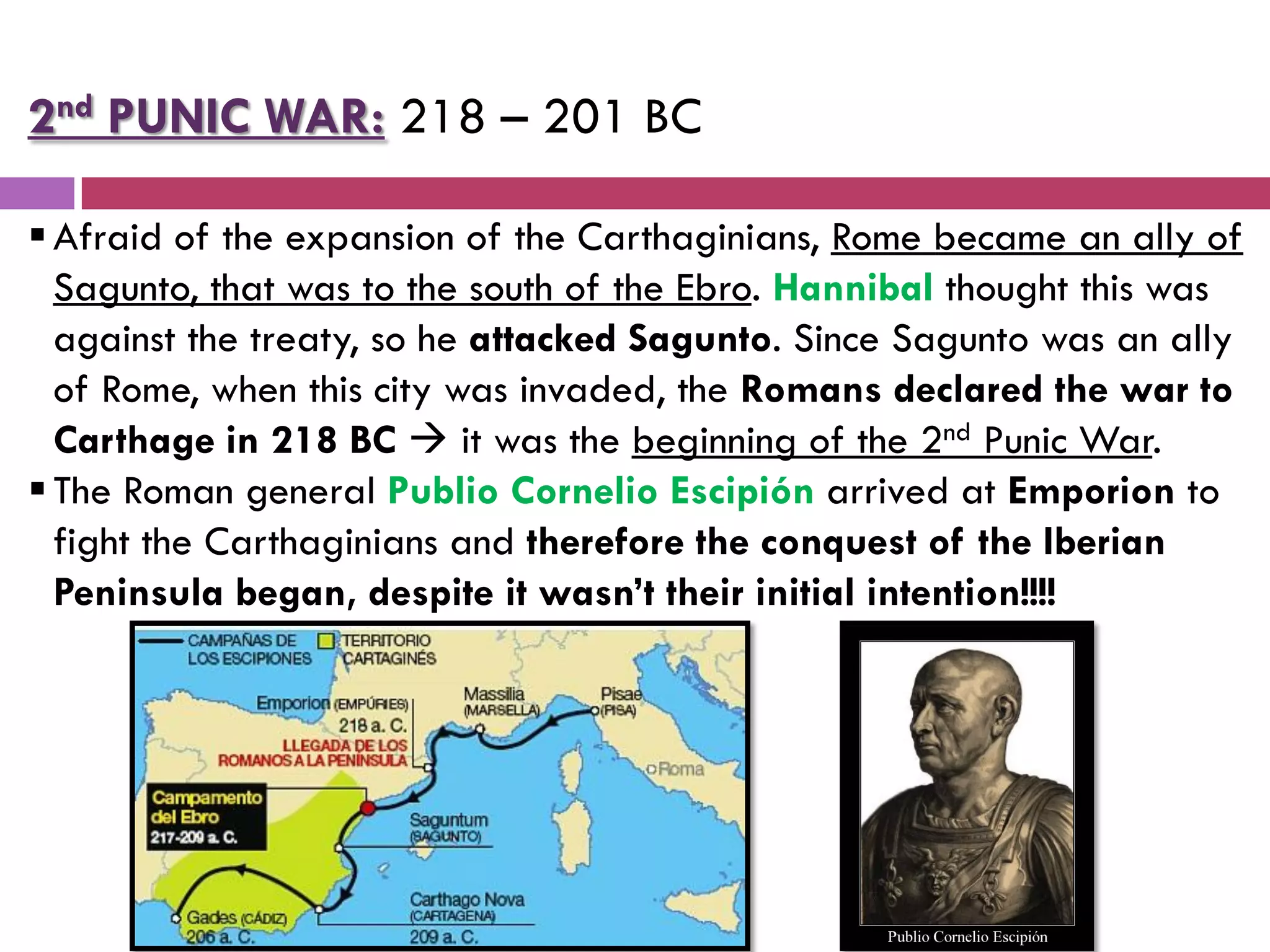
2nd PUNIC WAR: 218 – 201 BC
Afraid of the expansion of the Carthaginians, Rome became an ally of
Sagunto, that was to the south of the Ebro. Hannibal thought this was
against the treaty, so he attacked Sagunto. Since Sagunto was an ally
of Rome, when this city was invaded, the Romans declared the war to
Carthage in 218 BC  it was the beginning of the 2nd Punic War.
The Roman general Publio Cornelio Escipión arrived at Emporion to
fight the Carthaginians and therefore the conquest of the Iberian
Peninsula began, despite it wasn’t their initial intention!!!!
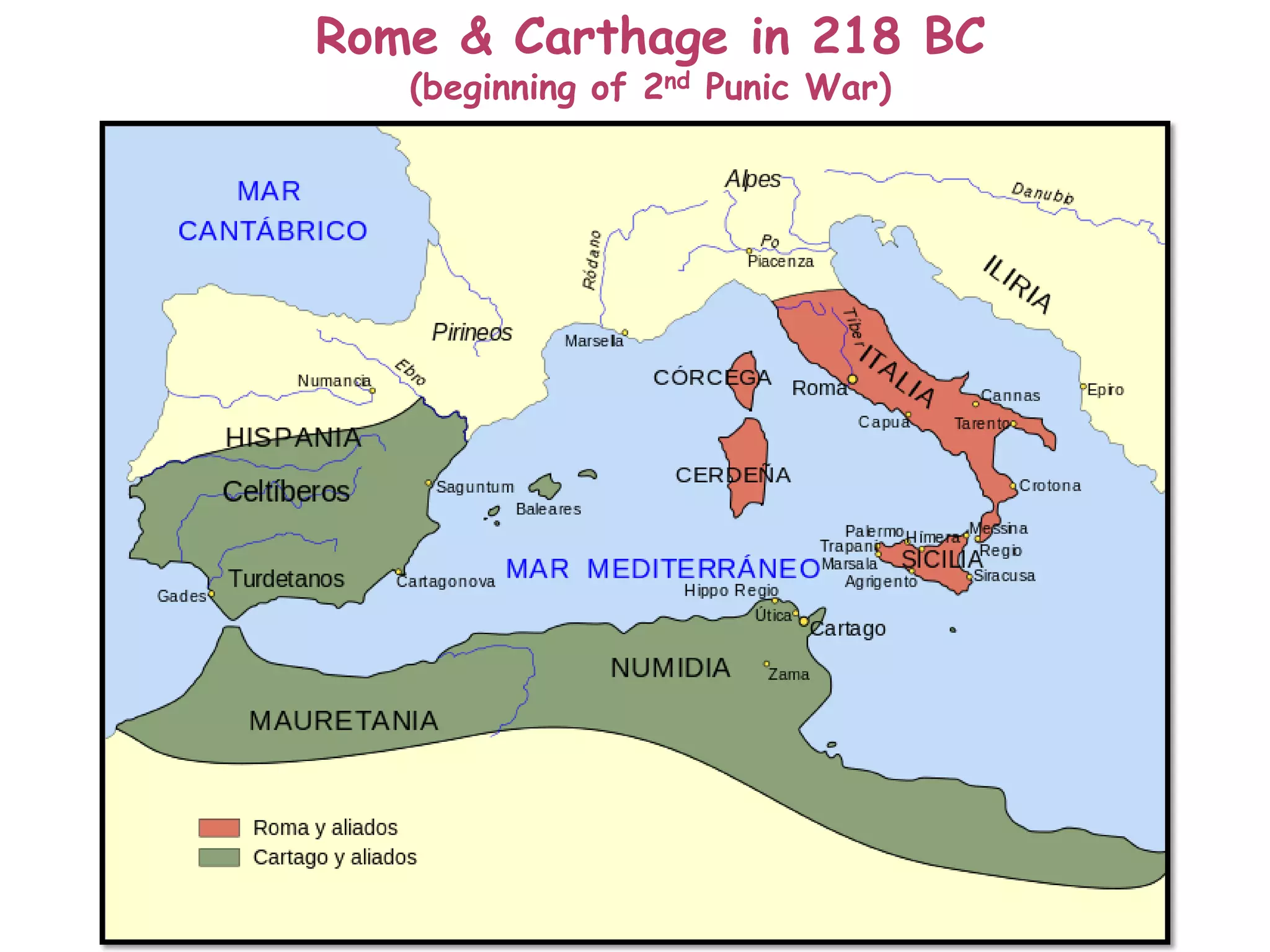
Rome & Carthage in 218 BC
(beginning of 2nd Punic War)
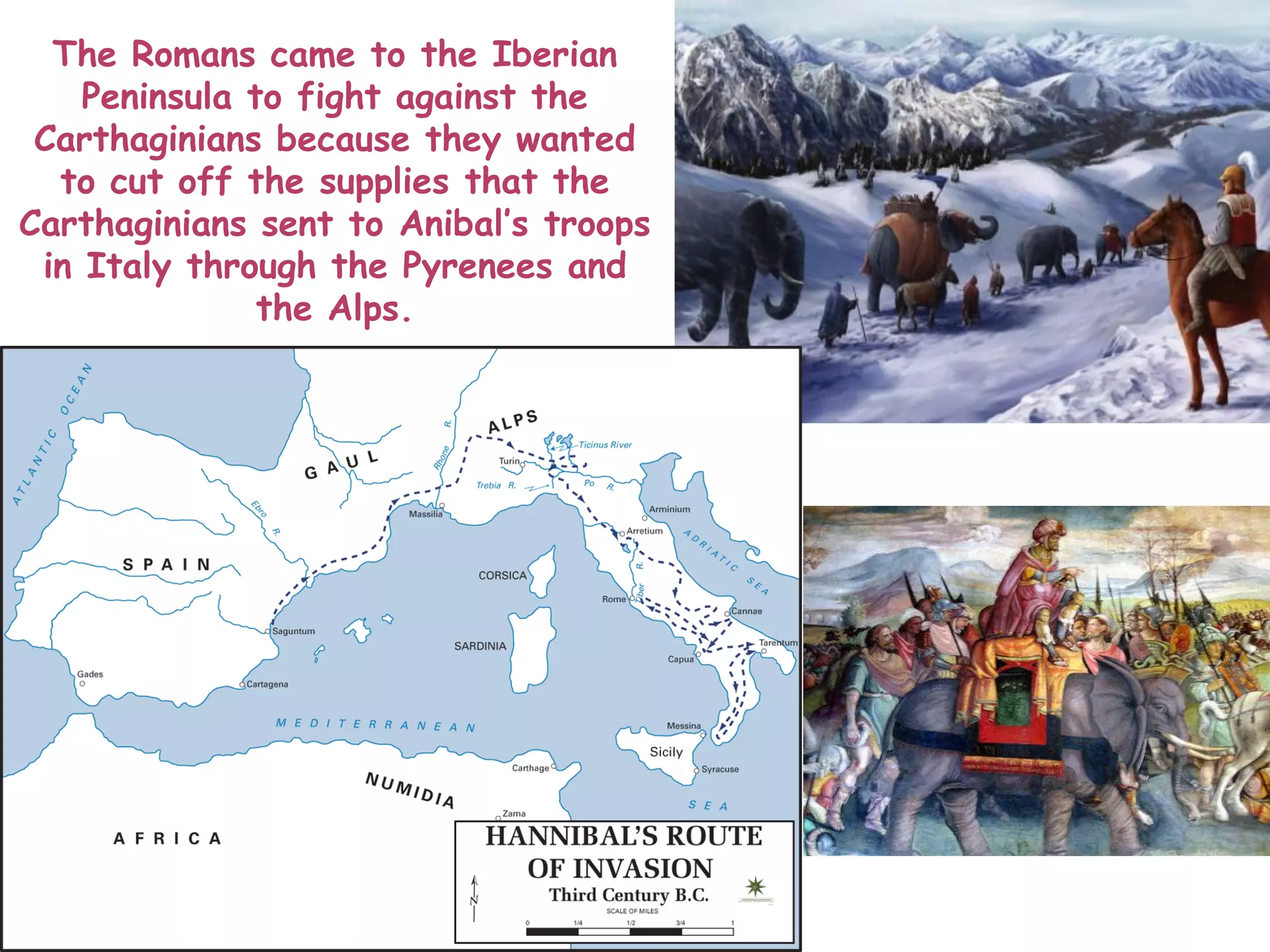
The Romans came to the Iberian
Peninsula to fight against the
Carthaginians because they wanted
to cut off the supplies that the
Carthaginians sent to Anibal’s troops
in Italy through the Pyrenees and
the Alps.
Rome & Carthage in 201 BC
(end of 2nd Punic War)
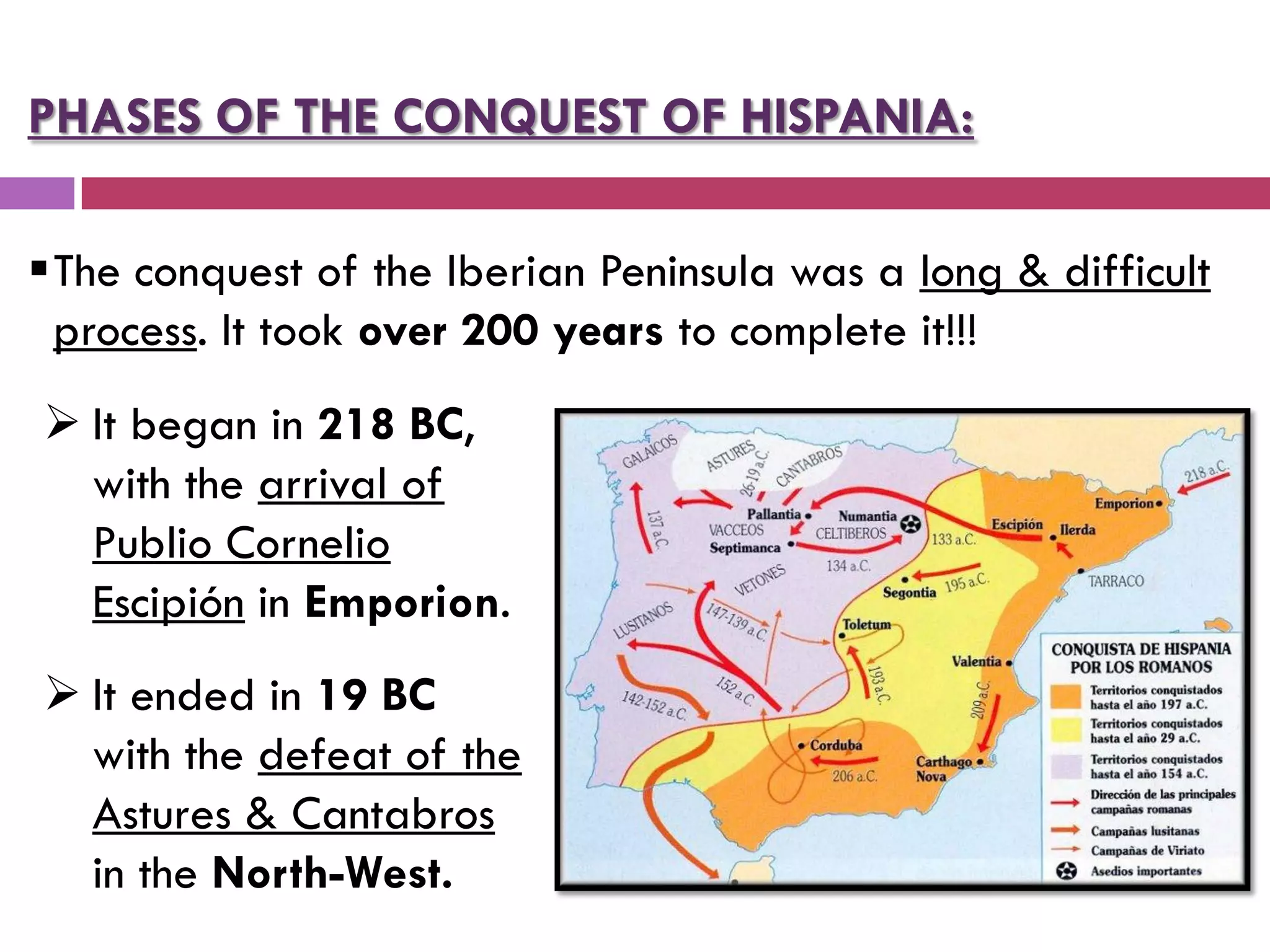
PHASES OF THE CONQUEST OF HISPANIA:
The conquest of the Iberian Peninsula was a long & difficult
process. It took over 200 years to complete it!!!
 It began in 218 BC,
with the arrival of
Publio Cornelio
Escipión in Emporion.
 It ended in 19 BC
with the defeat of the
Astures & Cantabros
in the North-West.
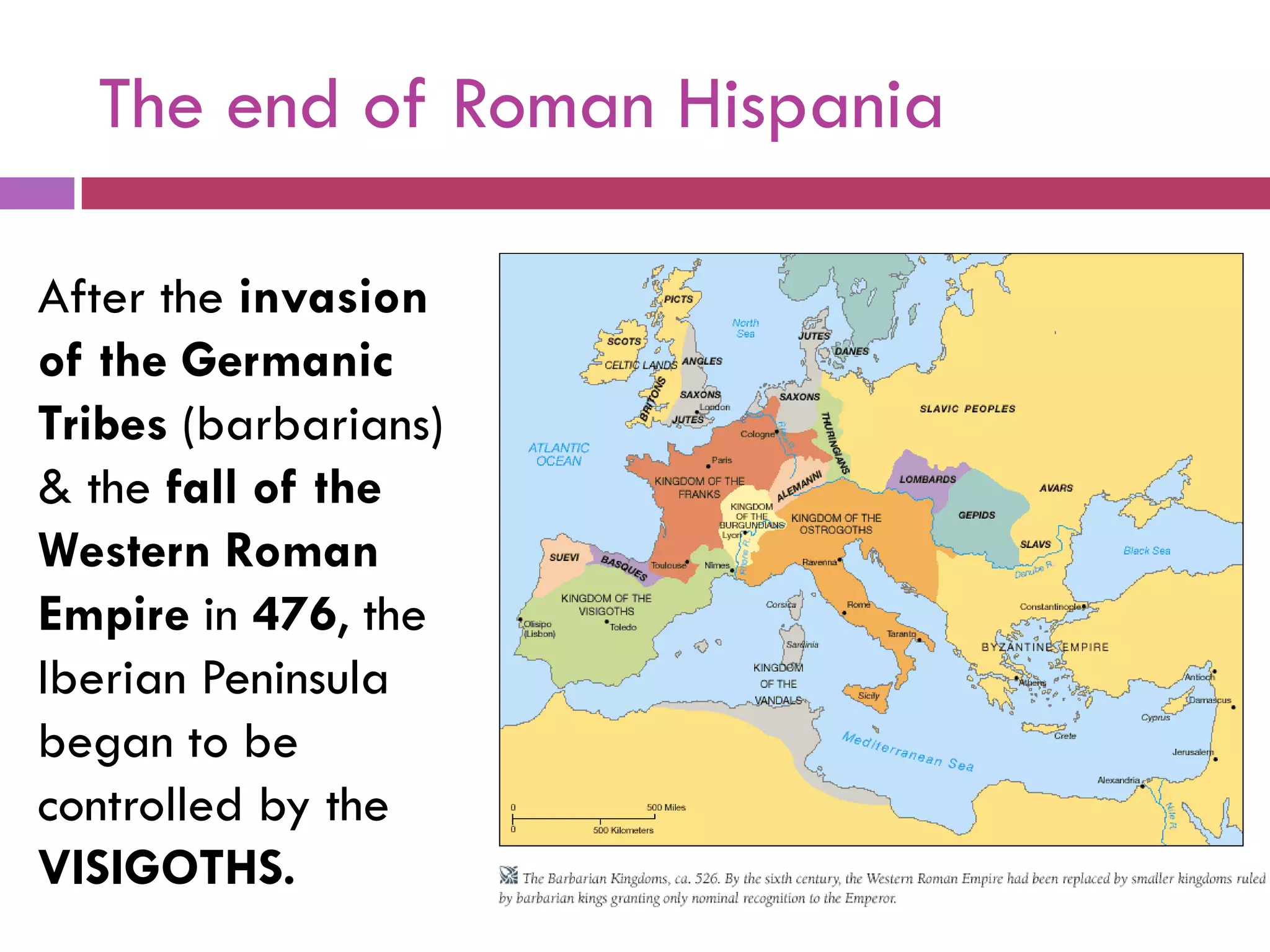
The end of Roman Hispania
After the invasion
of the Germanic
Tribes (barbarians)
& the fall of the
Western Roman
Empire in 476, the
Iberian Peninsula
began to be
controlled by the
VISIGOTHS.
ACTIVITY 4: Copy and answer the following
questions in your notebook.
a) Explain the 1st Punic War.
b) Define:
 Ebro treaty
 Amilcar Barca
 Hannibal Barca
 Publio Cornelio Escipión
c) Explain in detail and with your own words the Roman
conquest of the Iberian Peninsula.
d) What happened to Hispania after the fall of
the Western Roman Empire?
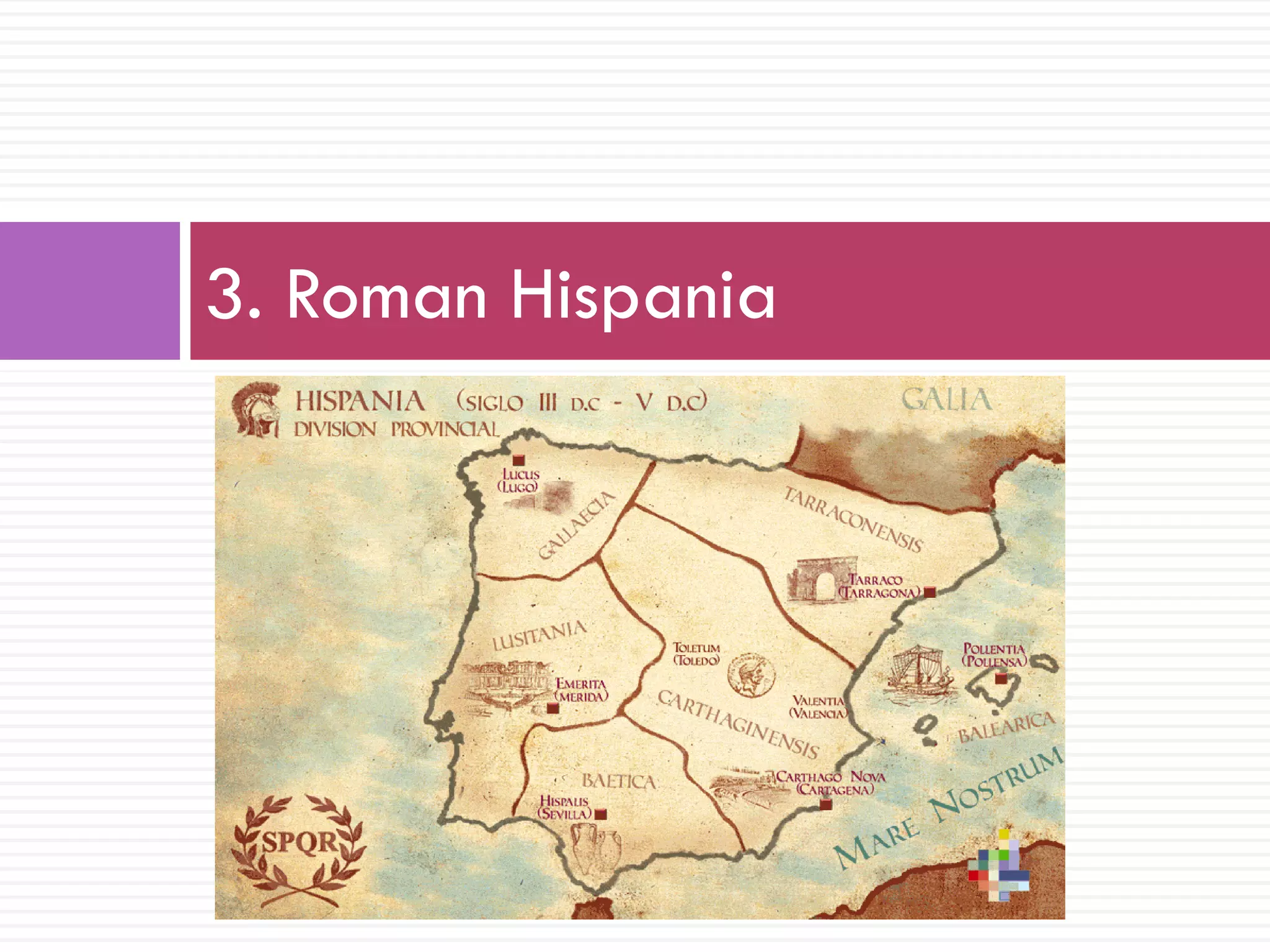
Administration & urban development
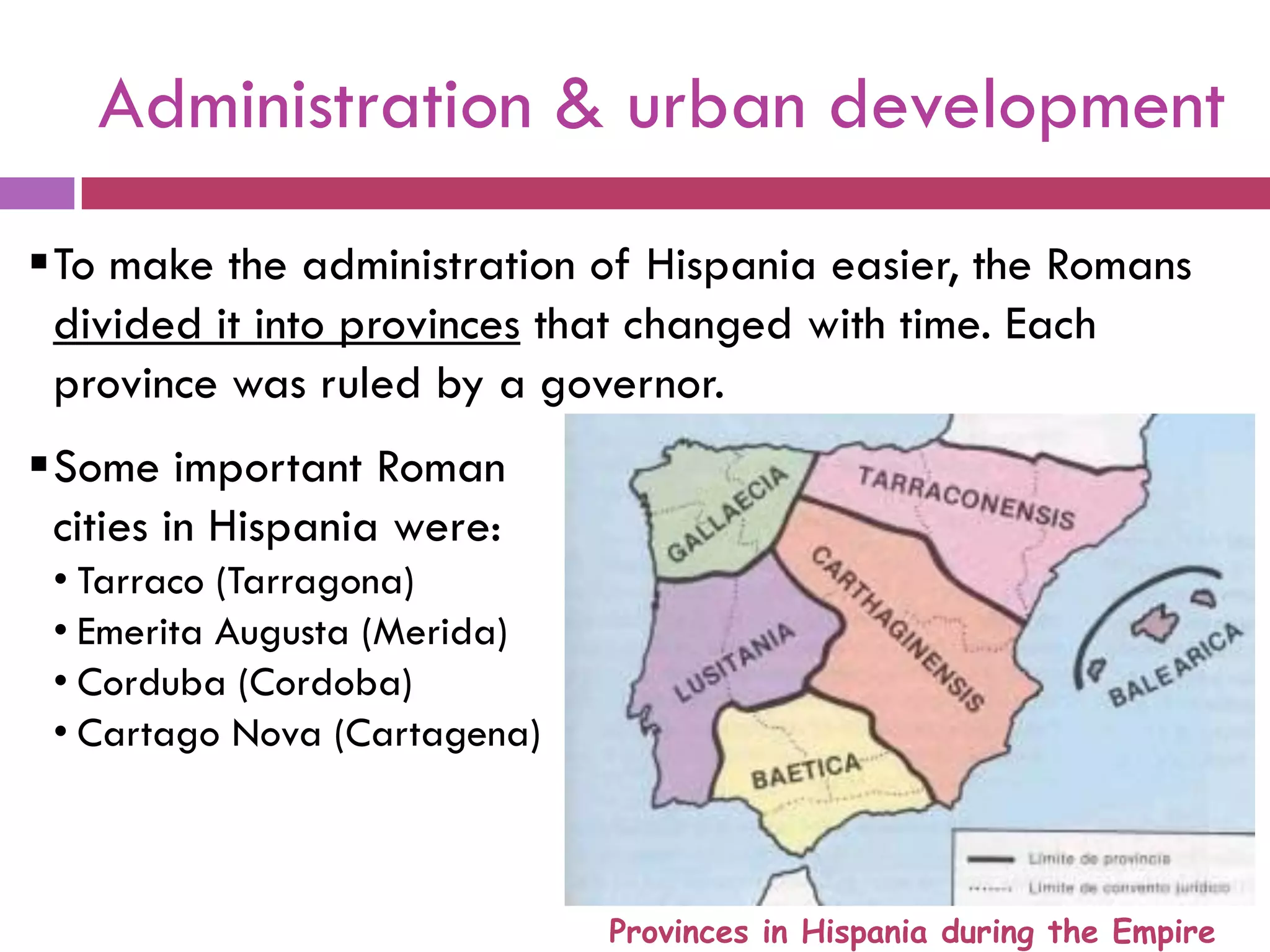
To make the administration of Hispania easier, the Romans
divided it into provinces that changed with time. Each
province was ruled by a governor.
Some important Roman
cities in Hispania were:
• Tarraco (Tarragona)
• Emerita Augusta (Merida)
• Corduba (Cordoba)
• Cartago Nova (Cartagena)
Provinces in Hispania during the Empire
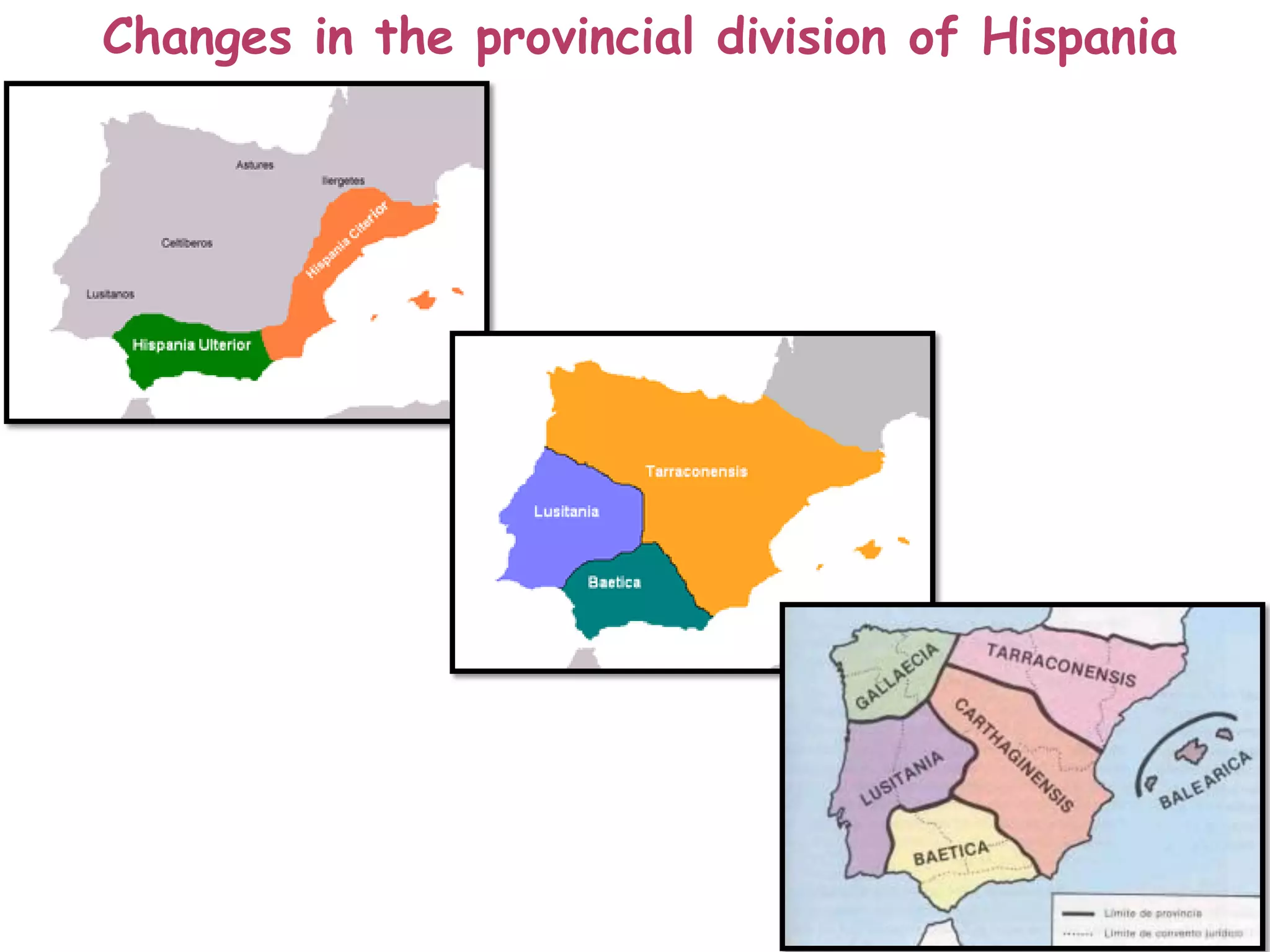
Changes in the provincial division of Hispania
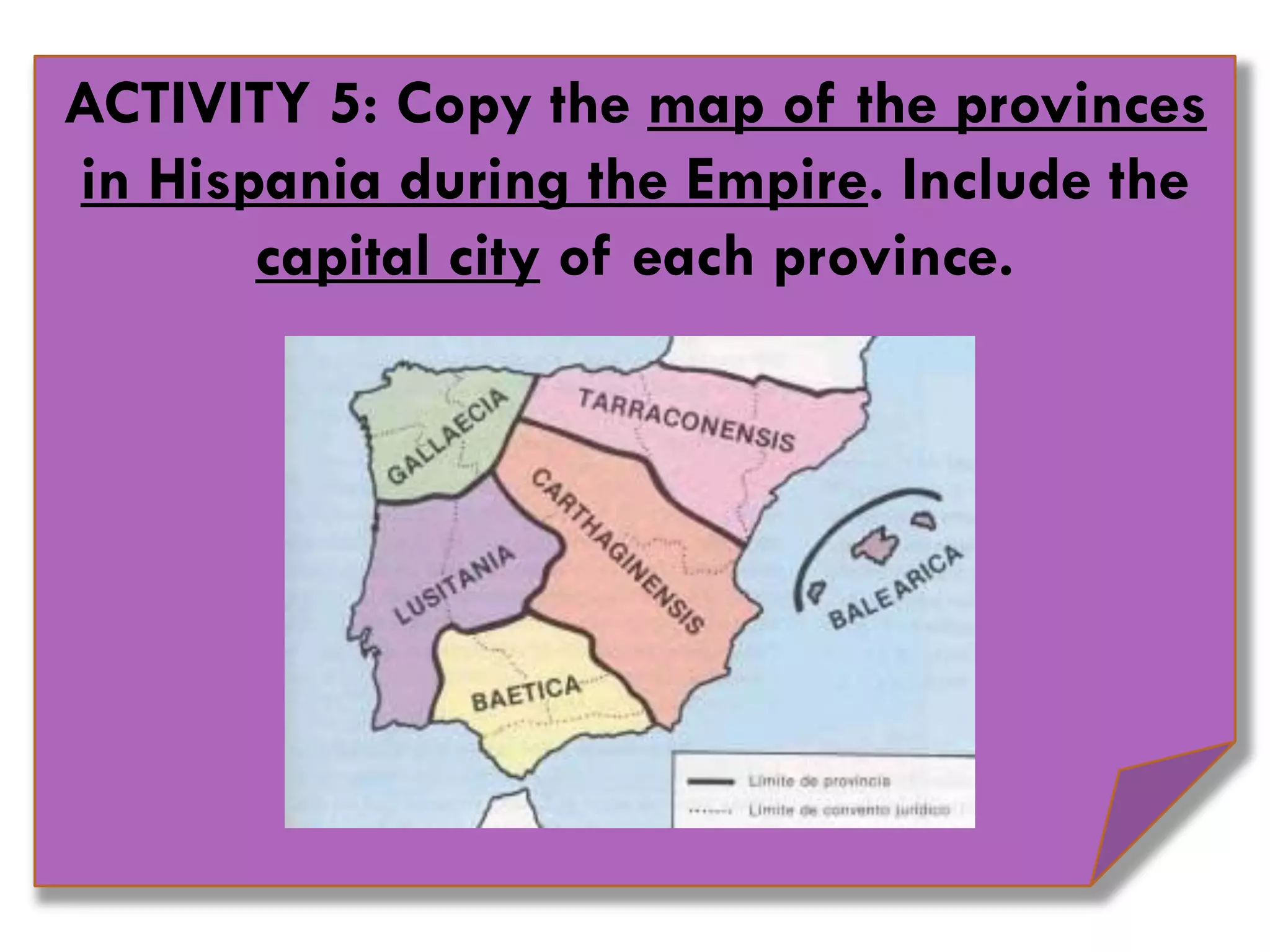
ACTIVITY 5: Copy the map of the provinces
in Hispania during the Empire. Include the
capital city of each province.
Roman culture was spread throughout Hispania.
 Latin replaced pre-roman languages
 Roman religion & later Christianity was adopted
 Roman urbanism & architecture was adopted
What is this process called???
Culture & art
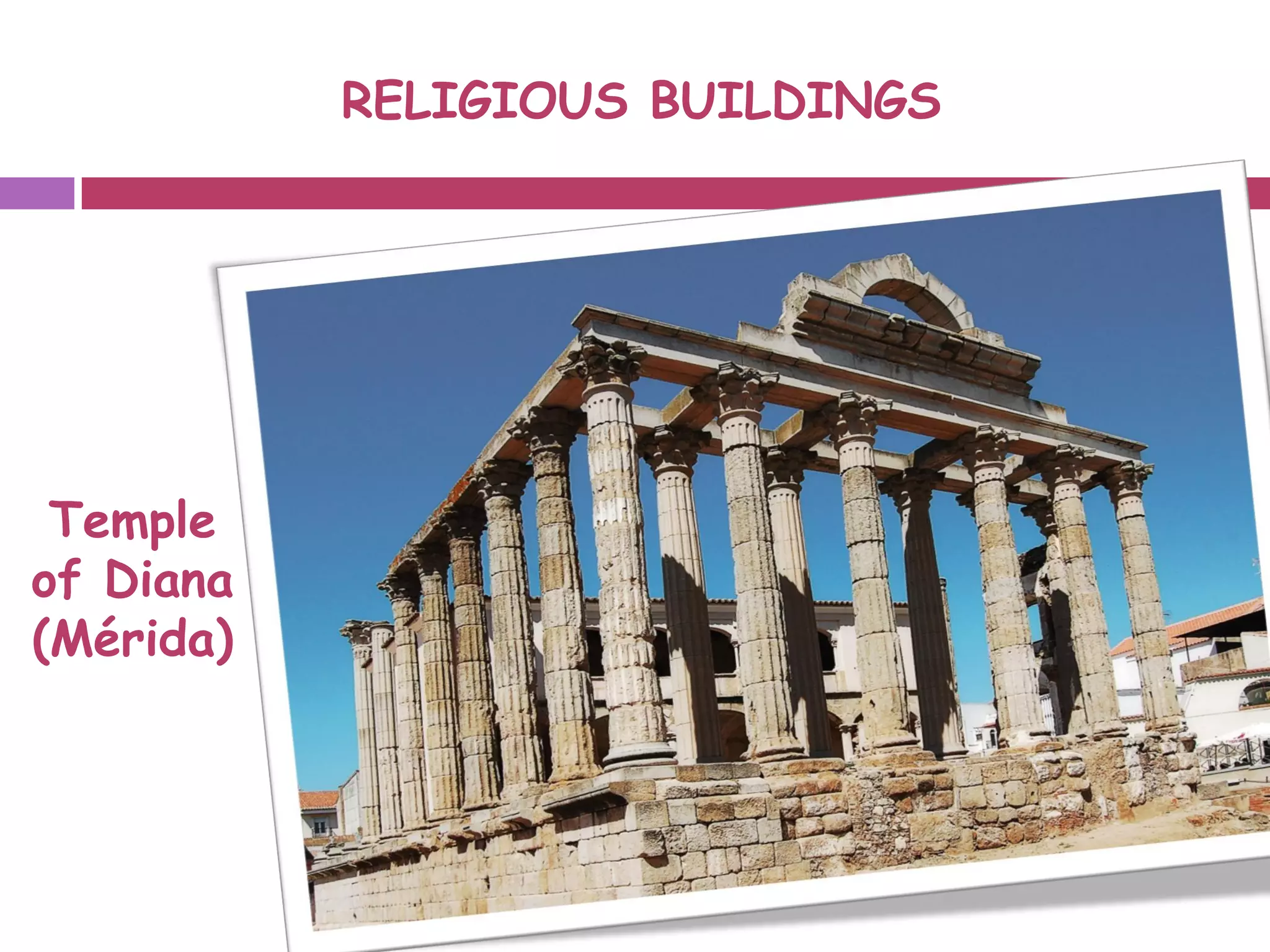
RELIGIOUS BUILDINGS
Temple
of Diana
(Mérida)
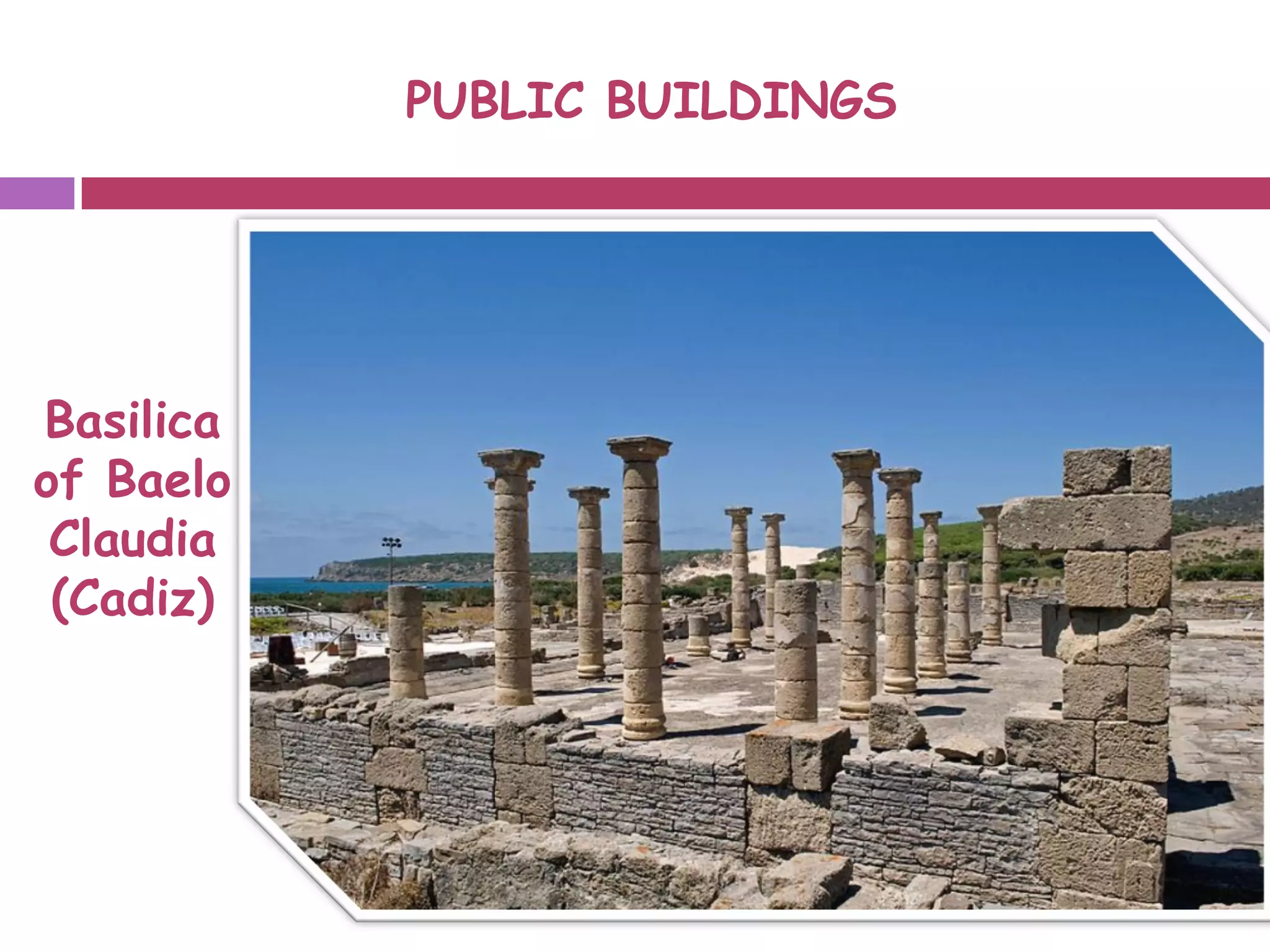
PUBLIC BUILDINGS
Basilica
of Baelo
Claudia
(Cadiz)
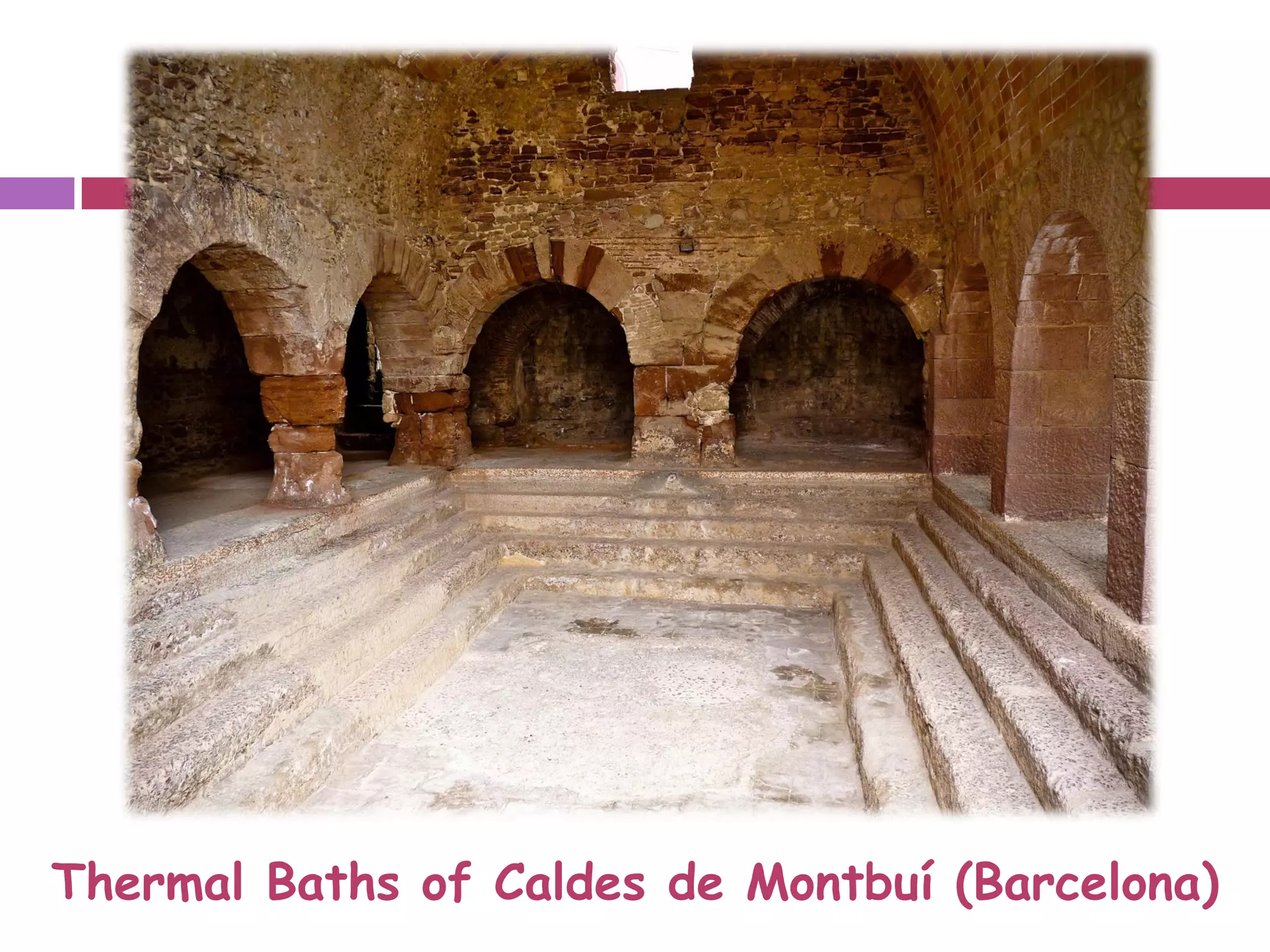
Thermal Baths of Caldes de Montbuí (Barcelona)
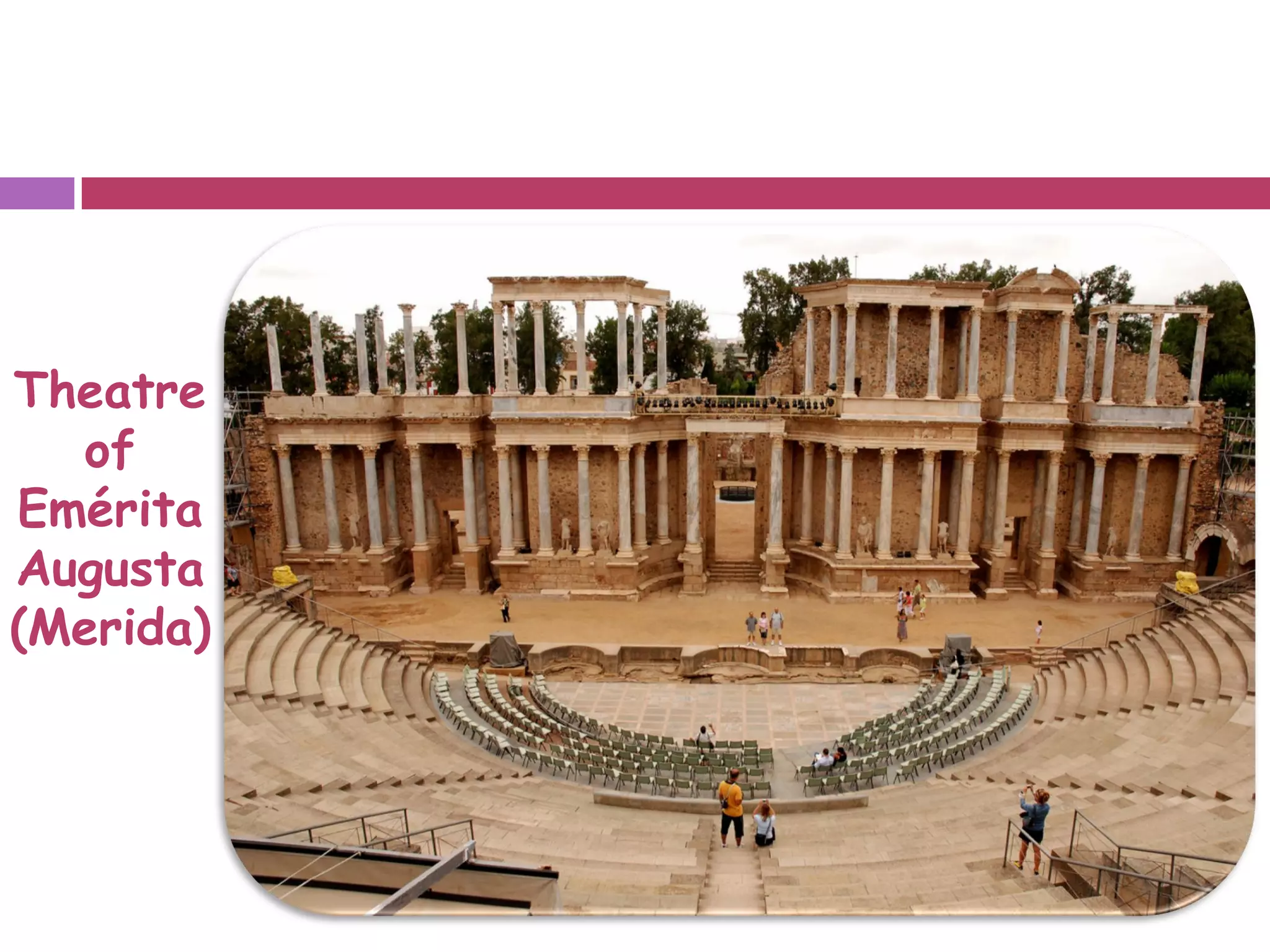
Theatre
of
Emérita
Augusta
(Merida)
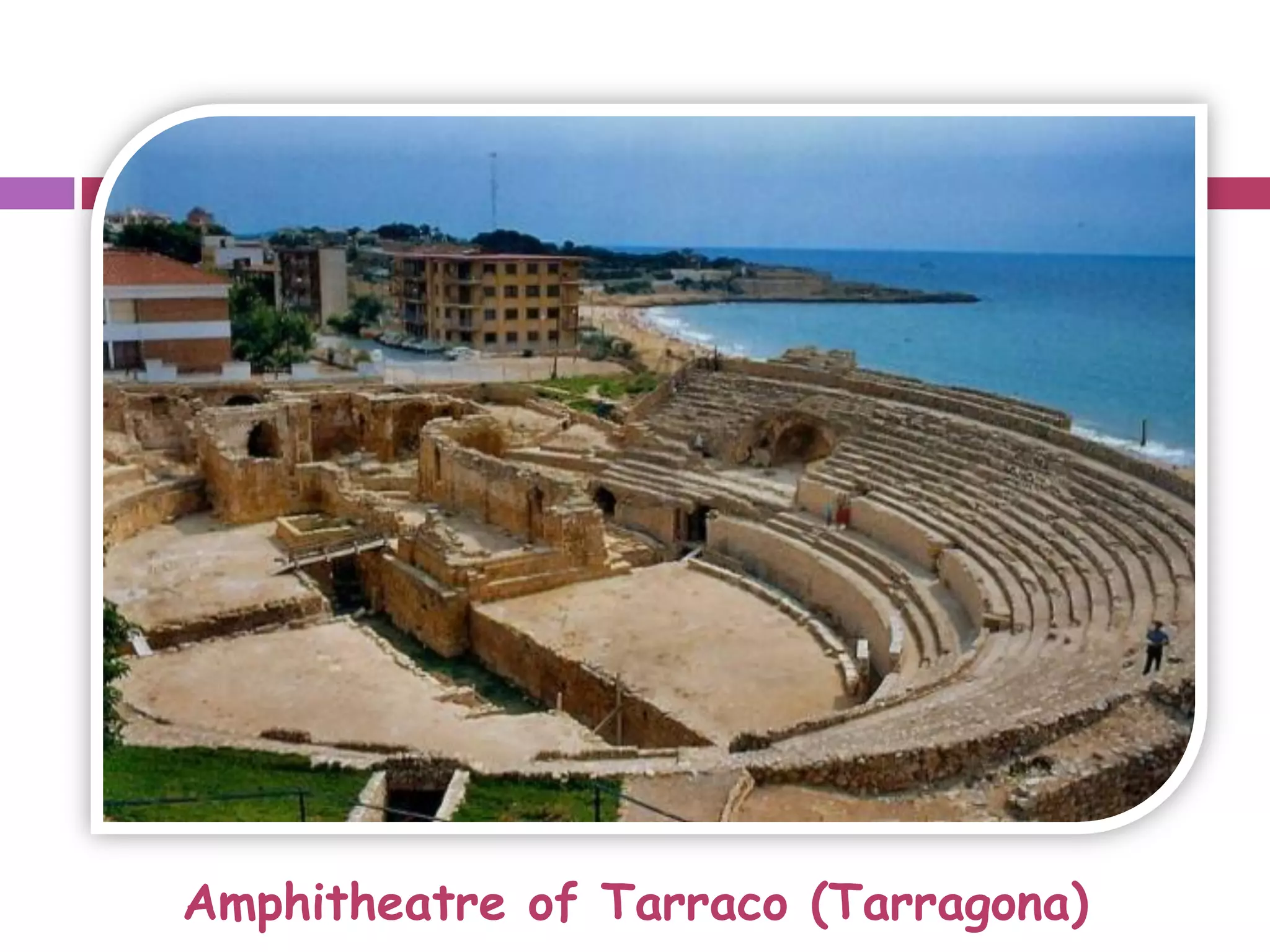
Amphitheatre of Tarraco (Tarragona)
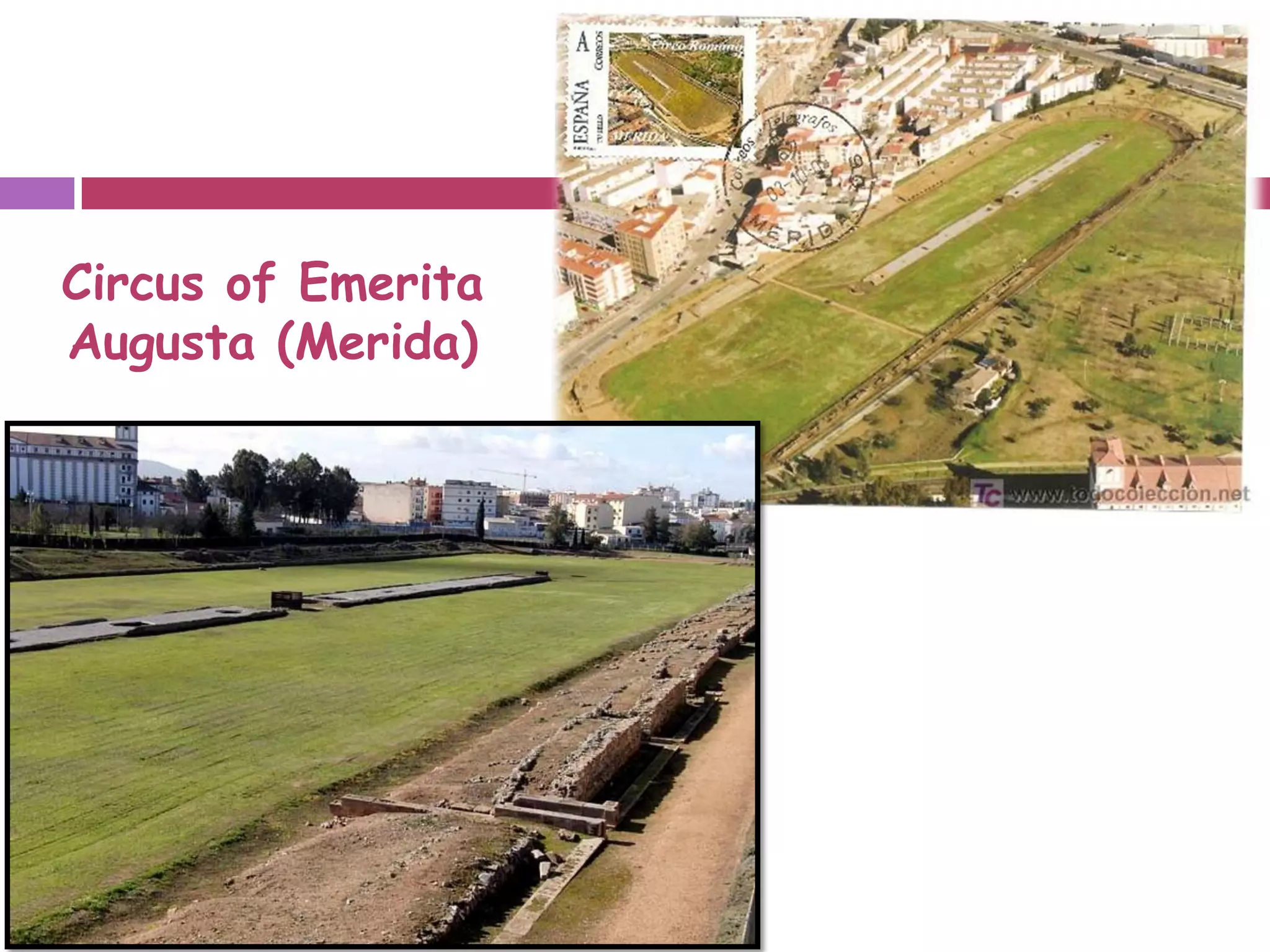
Circus of Emerita
Augusta (Merida)
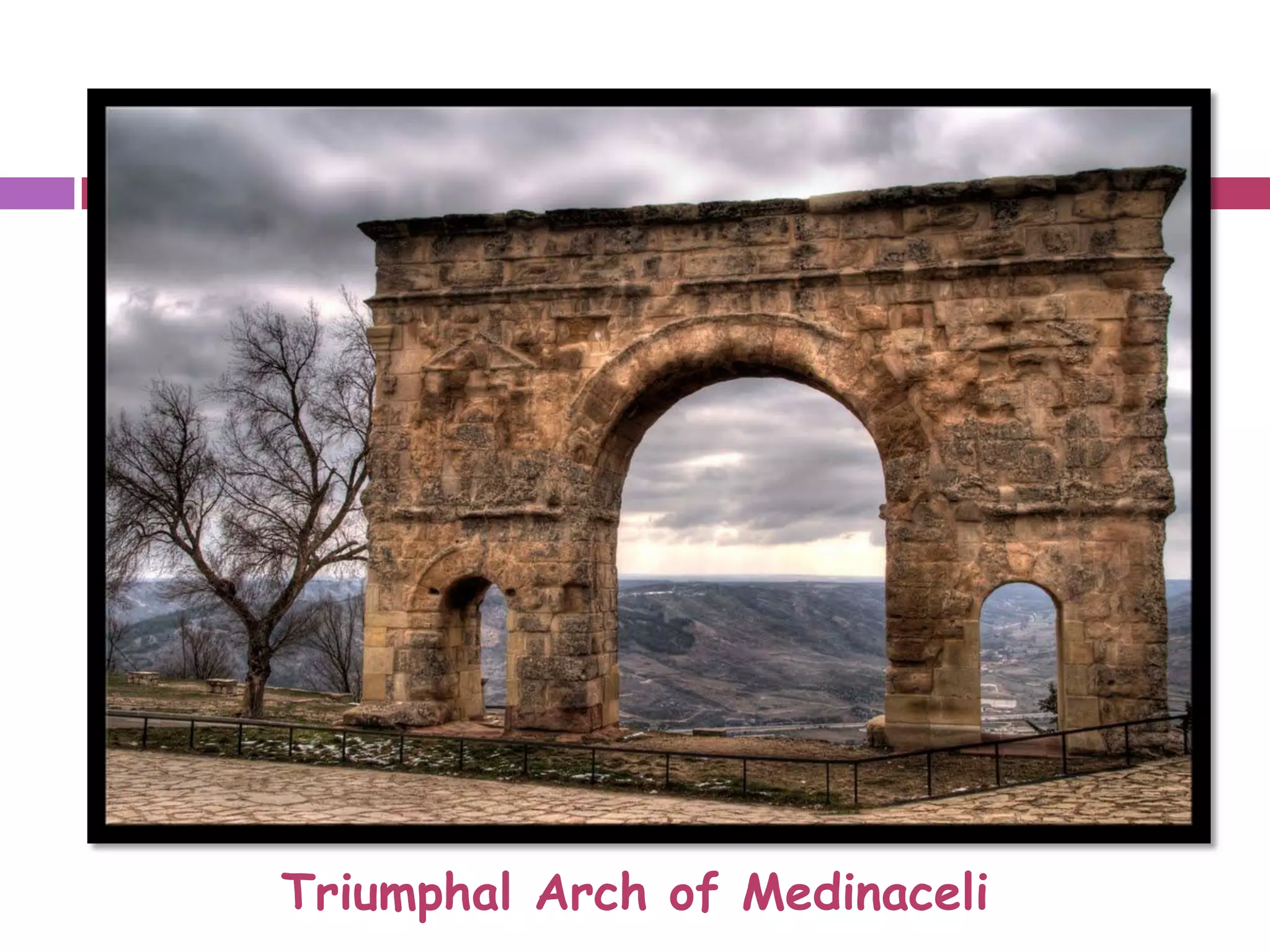
Triumphal Arch of Medinaceli
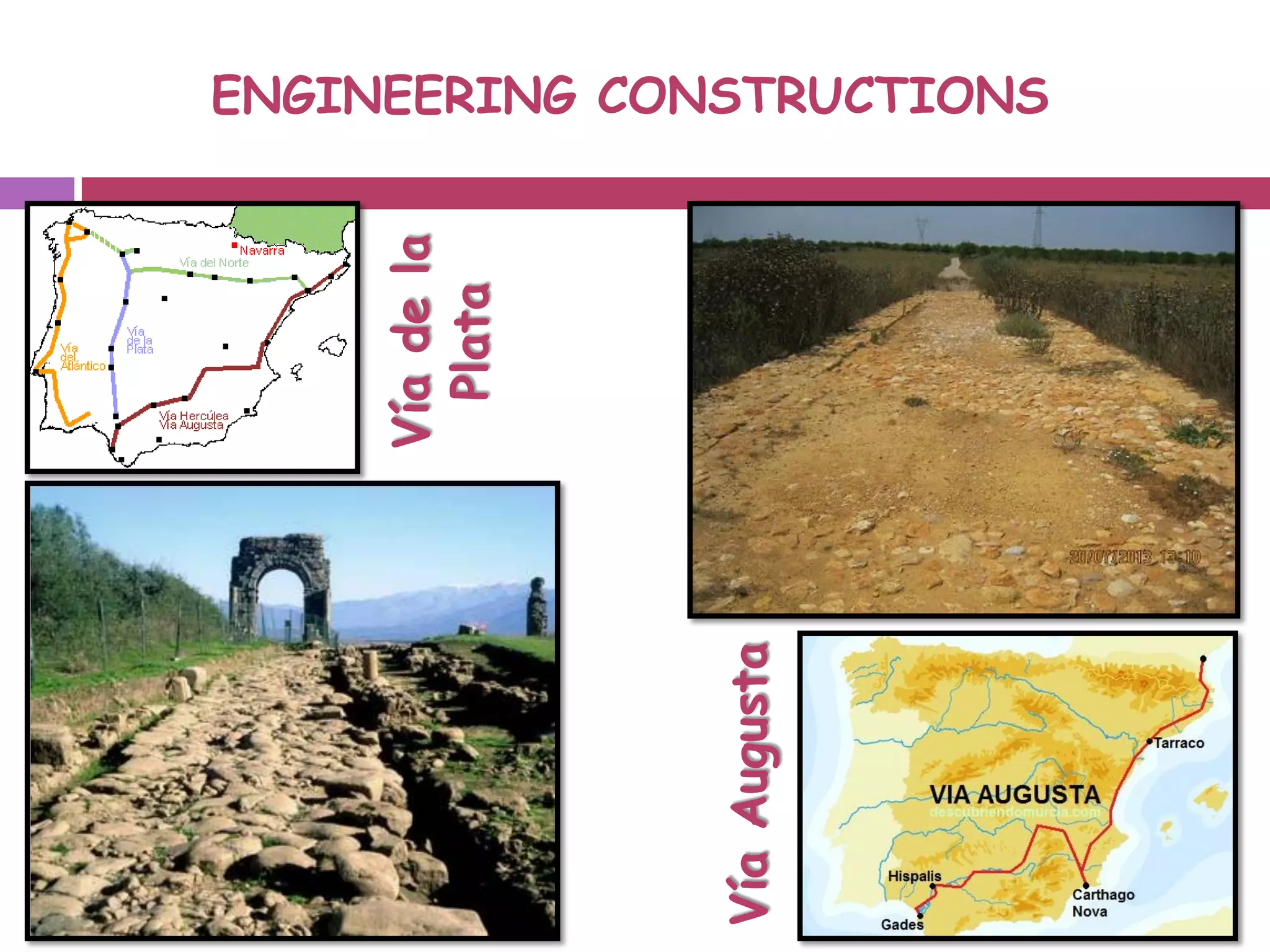
ENGINEERING CONSTRUCTIONS
Víadela
Plata
VíaAugusta
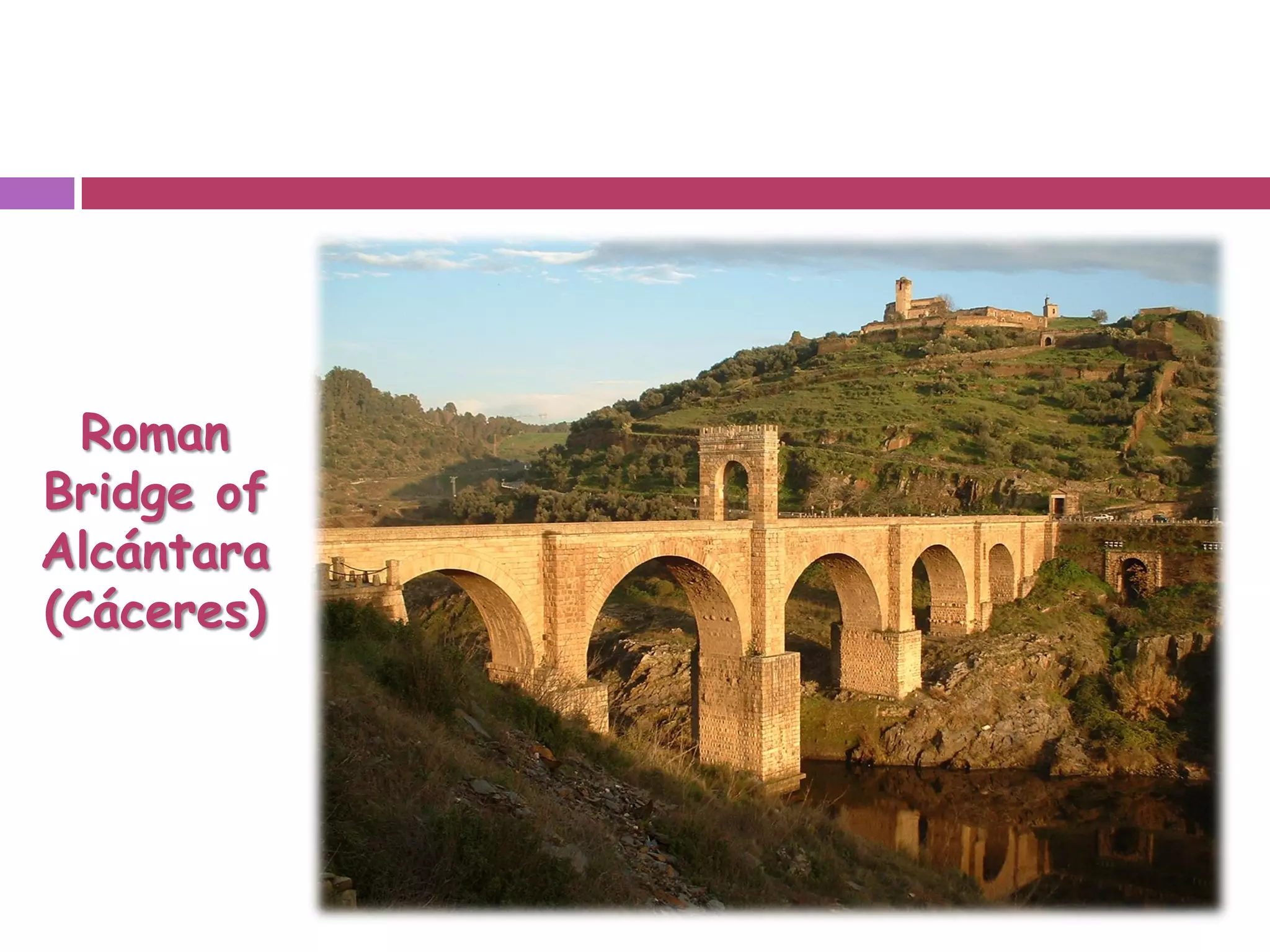
Roman
Bridge of
Alcántara
(Cáceres)
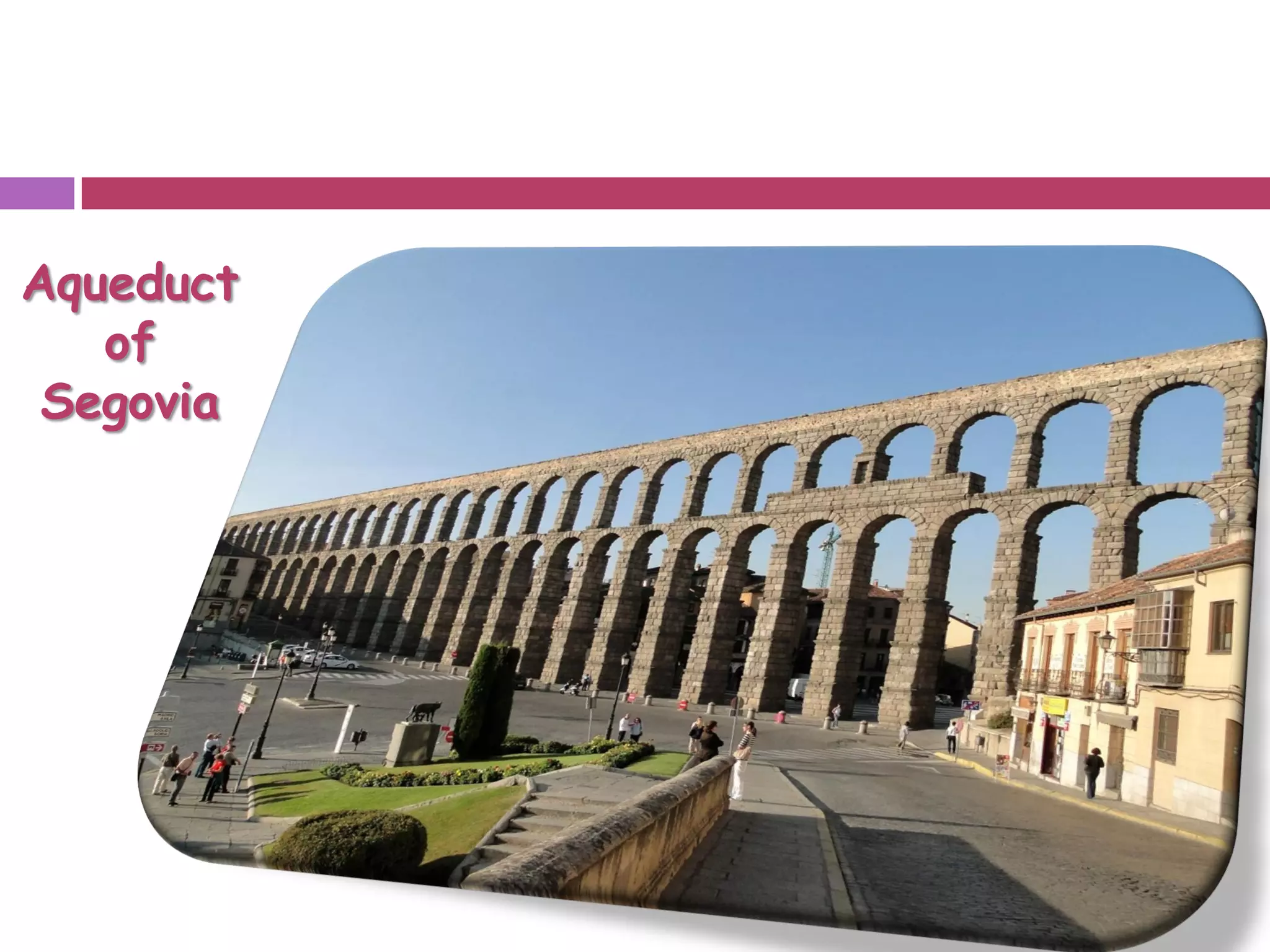
Aqueduct
of
Segovia
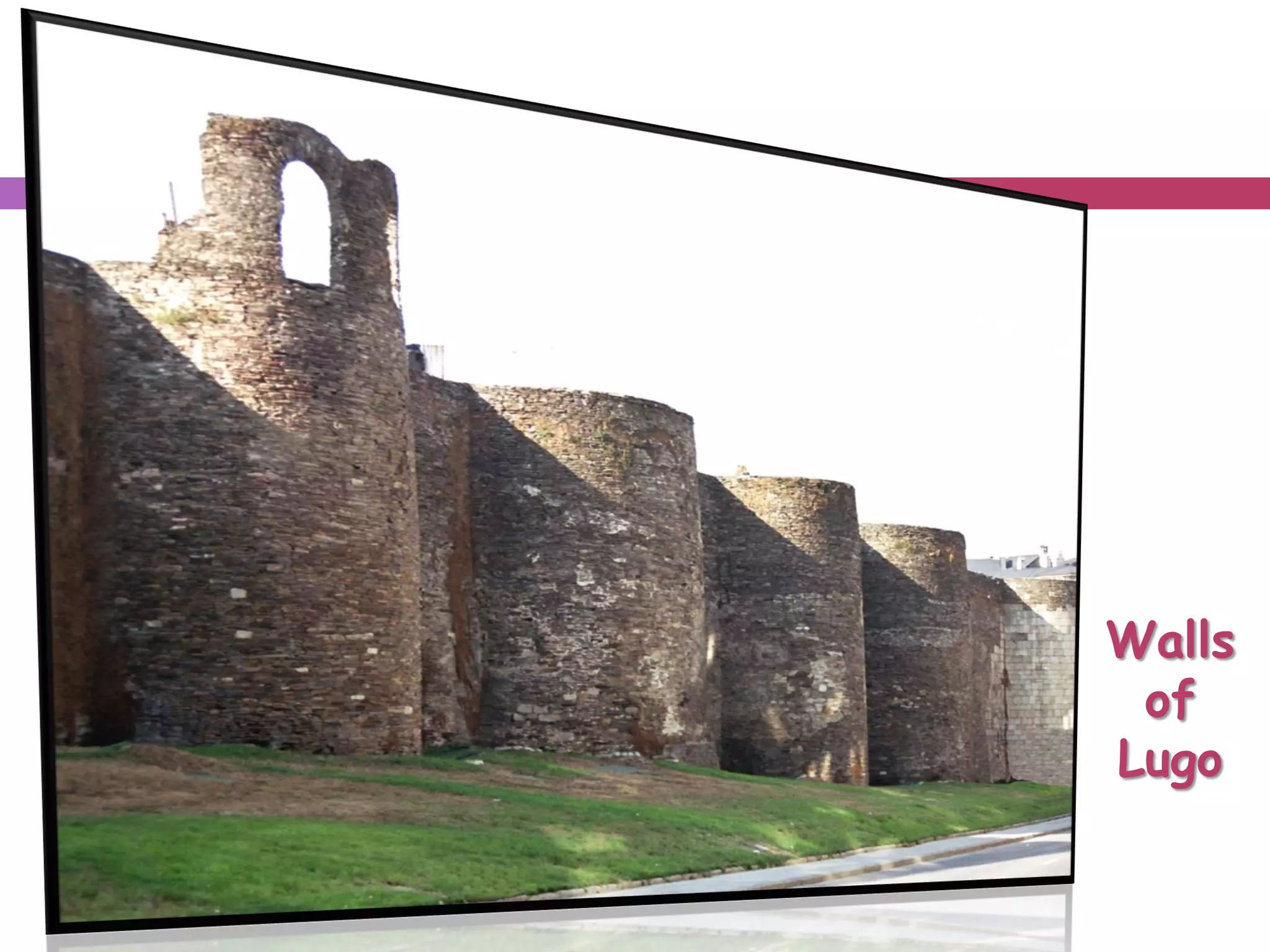
Walls
of
Lugo
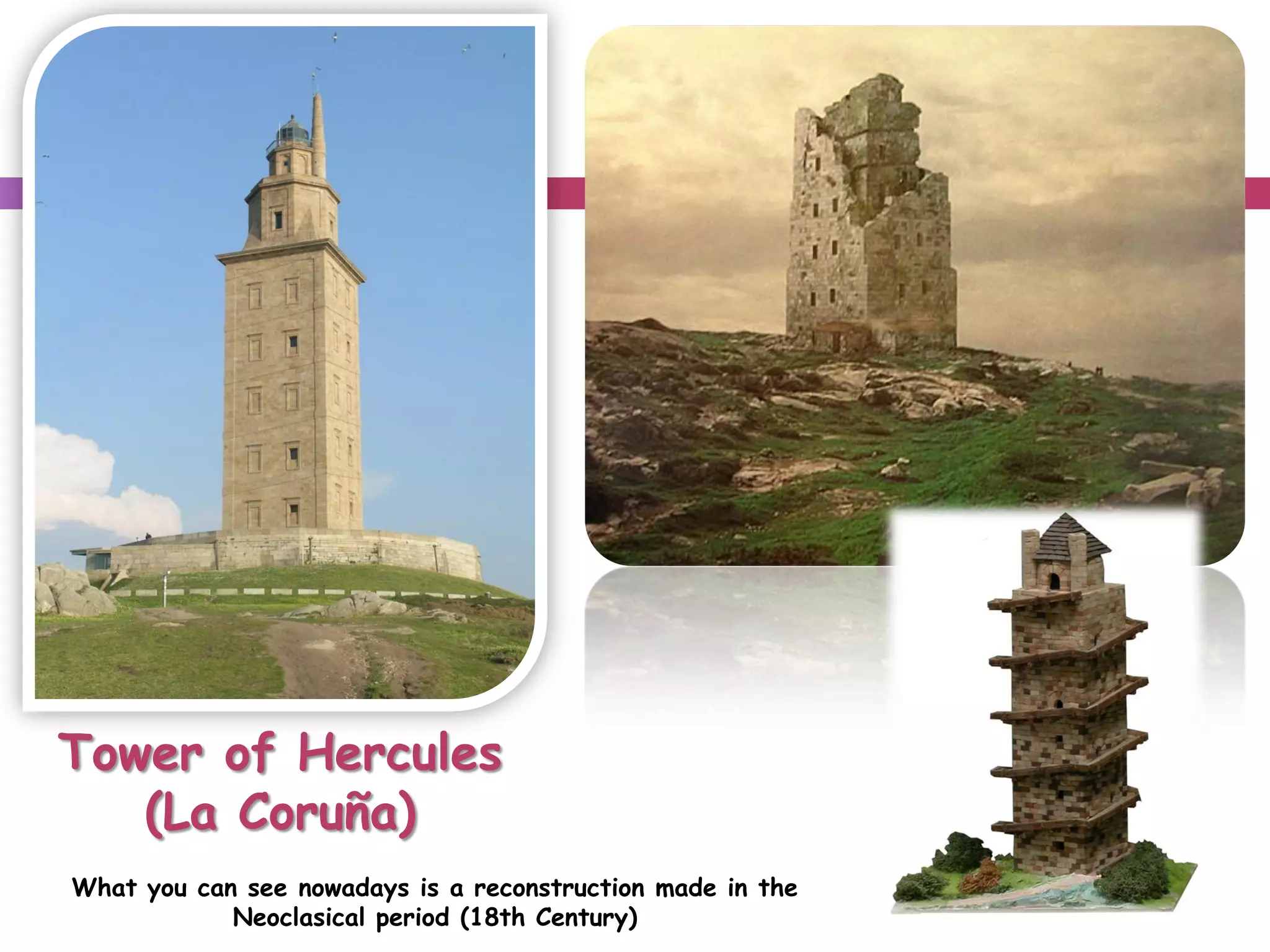
Tower of Hercules
(La Coruña)
What you can see nowadays is a reconstruction made in the
Neoclasical period (18th Century)

Ud13 spain in ancient times

  • 1.
    SPANISH TERRITORIES IN 1ºESO IES Camilo José Cela Teacher: Rocío Bautista ANCIENT TIMES
  • 2.
    Timeline First half ofthe 1st Millennium BC ·INDOEUROPEAN INVASIONS ·COLONISERS (Phoenicians, Greeks, Carthaginians) ·TARTESSIANS Second half of the 1st Millennium BC PRE-ROMAN PEOPLE: ·Iberians ·Celts 218 BC – 476 AD ROMAN HISPANIA 476 – 711 VISIGOTH KINGDOM ANCIENT PERIOD MIDDLE AGES
  • 3.
    1. First halfof the 1st Millenium BC INDOEUROPEAN CELTS, COLONISATION, TARTESSOS
  • 4.
    Invasion of theIndoeuropean Celts Around 900 BC, Indoeuropean Celts crossed the Pyrenees and settled in the North West of the Iberian Peninsula.
  • 5.
  • 6.
    ACTIVITY 1a) Inthe blank map draw an arrow to indicate the area of origin of the Indoeuropean Celts. Then shade the area in which they settled.
  • 7.
    Colonisation Different colonisers alsoarrived at the Iberian Peninsula from Phoenicia, Greece & Carthage, and founded colonies on the coast to control the metal trade.
  • 8.
  • 9.
    ACTIVITY 1b) Inthe blank map locate and label the area of origin of the Phoenicians, Greeks & Carthaginians.
  • 11.
    They came inthe 10th Century BC from Phoenicia (today Lebanon). PHOENICIANS • CHARACETRISTICS: Never went inland  no interest in conquering, only in trading. Traded with the natives by bartering. Exchanged manufactured products (textiles, pottery...) for metals. Introduced: ‐ Vine cultivation ‐ Phonetic alphabet • MAIN COLONY: Gadir (Cádiz).
  • 12.
    The success ofthe Phoenician alphabet was due to its phonetic nature. Phoenician was the first widely used script in which one sound was represented by one symbol. This simple system contrasted with the other scripts used at the time, such as Cuneiform & Egyptian hieroglyphs, which employed many complex characters and were difficult to learn.
  • 13.
    They came betweenthe 8th-6th Centuries BC from different Greek poleis. • CHARACETRISTICS: Settled in the Mediterranean coast  mainly interested in trading. Introduced olive tree cultivation & money. • MAIN COLONY: Emporion (Ampurias). GREEKS
  • 14.
    Came to theBalearic Islands in the 7th Century BC from Carthage (Tunisia), which was a former Phoenician colony. When the Persians conquered Phoenicia in the 6th Century BC (539 BC), Carthage took control over the Phoenician colonies in the Iberian Peninsula. • CHARACTERISTICS: Frequent confrontations with the Greeks, so the Mediterranean was divided into two commercial areas: • South  for Carthaginians • North  for Greeks • MAIN COLONIES: Ebussus (Ibiza) & Carthago Nova (Cartagena). CARTHAGINIANS
  • 15.
    ACTIVITY 1c) Inthe blank map locate and label the main Phoenician, Greek & Carthaginian colonies in the Iberian Peninsula.
  • 16.
    The Tartessians TARTESSIAN KINGDOM 1st organized state in Iberian Pen.  CHRONOLOGY:  Splendour: 7th - 6th Centuries BC  due to trade with Phoenicians & Greeks.  End: around 500 BC  defeat against Carthaginians.  LOCATION: uncertain  area between Huelva-Cádiz-Sevilla.  CHARACTERISTICS:  Political organisation: monarchy. Most important king: Argantonio  Economy: mainly based on metallurgy  they extracted metals (silver, tin, copper...) and trade them with the colonizers.
  • 18.
    The legendary kingARGANTONIO (the "Silver Man“): according to the Greek historian Herodotus, Argantonio ruled Tartessos for 80 years and lived 120 years. TREASURE OF CARAMBOLO
  • 19.
    ACTIVITY 1d) Inthe blank map locate, shade and label the approximate area where the Tartessian Kingdom developed.
  • 20.
    2. Second halfof the 1st Millenium BC Pre-Roman people
  • 21.
    2. Pre-Roman people 2ndhalf of the 1st millenium BC  the influence of the colonisers in the Mediterranean coast (South East) and the Indoeuropean Celts in the North West, divided the inhabitants of the Peninsula into two different groups: Iberians & Celts. These groups were known as “Pre-Romans” because they were the population of the Peninsula when the Roman conquest started (218 BC).
  • 22.
    There were manydifferent Iberian & Celtic tribes. Although they were independent, they had common characteristics.
  • 23.
    ACTIVITY 2: Drawin your notebook a map of the Iberian with the approximate location nof the Celtic and the Iberian tribes.
  • 24.
    ACTIVITY 3: Completethe chart. IBERIANS CELTS LOCATION & INFLUENCE  ________ & East.  Influenced by the ___________ (Phoenicians, Greeks & Carthaginians).  ________ & West.  Influenced by the ________________ Celts. VILLAGES & HOUSES  Fortified villages.  ______________ houses.  Villages in ____________ areas known as “_________”.  _________ houses. POLITICAL ORGANISATION  Organised as ____ - _________.  Very _____________: - Aristocracy (military & religious leaders) - Traders, artisans & soldiers - Farmers  Organized in ______ & ________.  Not so hierarchical. ECONOMY  Used ________.  Main economic activities (very diverse): - _________________ (Mediterranean triad) - Cattle farming - Metallurgy - _________________ (pottery, textiles) - _________ with Greeks & Carthaginians  Didn’t use money (little trade; used the method of ___________).  Main economic activities: - _________ farming - Metallurgy (iron & ________ tools) RELIGION  Offerings (“__________”) & worship of gods in sanctuaries.  _______________ of the dead  ashes in ceramic ______ & buried with ____________, food & weapons (urnfield culture).  Worship of _________ _____________.  Incineration of the dead. CULTURE & ART  Used ____________.  Bronze offerings (“exvotos”).  Stone sculptures of animals or humans  most important ones: “Dama de _________” & “Dama de _______”.  ________ use writing.  Sculptures of “____________” (stone pigs or bulls).
  • 25.
  • 26.
  • 27.
  • 28.
  • 29.
    CELTIC metaltwork (iron& bronze tools)
  • 30.
    IBERIAN burials (URNFIELD CULTURE) Theyincinerated the dead, and placed their ashes in urns which were then buried in fields.
  • 31.
  • 32.
  • 33.
    IBERIAN stone sculptures LA DAMA DE ELCHE & LA DAMA DE BAZA
  • 34.
    CELTIC “verracos” Toros deGuisando (Ávila) Verraco de Gallegos (Salamanca)
  • 35.
  • 36.
    The conquest ofthe Peninsula. The Punic Wars between Carthage & Rome were the origin of the Roman conquest of the Iberian Peninsula!!!
  • 37.
    Who fought? Carthage VSRome Why did they fought for? to control the western Mediterranean: Sicily, Corsica & Sardinia Who won? Rome Map of the Western Mediterranean at the beginning of the 1st Punic War 1st PUNIC WAR: 264 – 241 BC
  • 38.
    Map at thebeginning of the 1st Punic War (264 – 241 BC) Map at the beginning of the 2nd Punic War (218 – 201 BC)
  • 39.
    Consequences of the1st Punic War? Since Carthage had lost territories, they changed the direction of their expansion  now they focused on the Iberian Peninsula: • Amilcar Barca conquered Gadir & founded Cartago Nova. • Later on, his sons Asdrubal & Anibal, conquered the South West of the Peninsula. • 226 BC: to stop the expansion, Carthage & Rome signed the Ebro Treaty: Carthaginians couldn’t go further north from the Ebro, and the Romans couldn’t go further south.... ...but someone was going to break this treaty...!!!!
  • 40.
  • 41.
    2nd PUNIC WAR:218 – 201 BC Afraid of the expansion of the Carthaginians, Rome became an ally of Sagunto, that was to the south of the Ebro. Hannibal thought this was against the treaty, so he attacked Sagunto. Since Sagunto was an ally of Rome, when this city was invaded, the Romans declared the war to Carthage in 218 BC  it was the beginning of the 2nd Punic War. The Roman general Publio Cornelio Escipión arrived at Emporion to fight the Carthaginians and therefore the conquest of the Iberian Peninsula began, despite it wasn’t their initial intention!!!!
  • 42.
    Rome & Carthagein 218 BC (beginning of 2nd Punic War)
  • 43.
    The Romans cameto the Iberian Peninsula to fight against the Carthaginians because they wanted to cut off the supplies that the Carthaginians sent to Anibal’s troops in Italy through the Pyrenees and the Alps.
  • 44.
    Rome & Carthagein 201 BC (end of 2nd Punic War)
  • 45.
    PHASES OF THECONQUEST OF HISPANIA: The conquest of the Iberian Peninsula was a long & difficult process. It took over 200 years to complete it!!!  It began in 218 BC, with the arrival of Publio Cornelio Escipión in Emporion.  It ended in 19 BC with the defeat of the Astures & Cantabros in the North-West.
  • 46.
    The end ofRoman Hispania After the invasion of the Germanic Tribes (barbarians) & the fall of the Western Roman Empire in 476, the Iberian Peninsula began to be controlled by the VISIGOTHS.
  • 47.
    ACTIVITY 4: Copyand answer the following questions in your notebook. a) Explain the 1st Punic War. b) Define:  Ebro treaty  Amilcar Barca  Hannibal Barca  Publio Cornelio Escipión c) Explain in detail and with your own words the Roman conquest of the Iberian Peninsula. d) What happened to Hispania after the fall of the Western Roman Empire?
  • 48.
    Administration & urbandevelopment To make the administration of Hispania easier, the Romans divided it into provinces that changed with time. Each province was ruled by a governor. Some important Roman cities in Hispania were: • Tarraco (Tarragona) • Emerita Augusta (Merida) • Corduba (Cordoba) • Cartago Nova (Cartagena) Provinces in Hispania during the Empire
  • 49.
    Changes in theprovincial division of Hispania
  • 50.
    ACTIVITY 5: Copythe map of the provinces in Hispania during the Empire. Include the capital city of each province.
  • 51.
    Roman culture wasspread throughout Hispania.  Latin replaced pre-roman languages  Roman religion & later Christianity was adopted  Roman urbanism & architecture was adopted What is this process called??? Culture & art
  • 52.
  • 53.
  • 54.
    Thermal Baths ofCaldes de Montbuí (Barcelona)
  • 55.
  • 56.
  • 57.
  • 58.
  • 59.
  • 60.
  • 61.
  • 62.
  • 63.
    Tower of Hercules (LaCoruña) What you can see nowadays is a reconstruction made in the Neoclasical period (18th Century)