Hispania
By: Itziar, Noel, Mercedes, Pablo and Hernán
Index
● Pre-Roman peoples
● Hispania’s landscape
● Pre-Roman and Roman politics
● Pre-Roman and Roman culture
● Economy in Hispania
Pre-Roman peoples
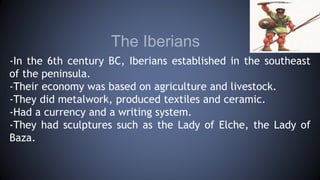
The Iberians
-In the 6th century BC, Iberians established in the southeast
of the peninsula.
-Their economy was based on agriculture and livestock.
-They did metalwork, produced textiles and ceramic.
-Had a currency and a writing system.
-They had sculptures such as the Lady of Elche, the Lady of
Baza.
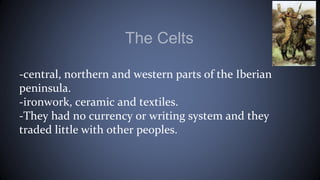
The Celts
-central, northern and western parts of the Iberian
peninsula.
-ironwork, ceramic and textiles.
-They had no currency or writing system and they
traded little with other peoples.
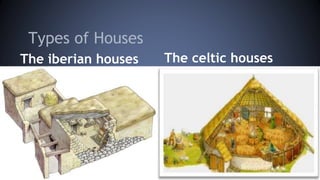
Types of Houses
The iberian houses The celtic houses
Invasions and Colonisations
-During the 1st millennium, different peoples arrived on the
Iberian Peninsula.
-Indo-European.
-Mediterranean colonists.
-The Phoenicians established on the south (10th-8th
centuries BC).
-The Greeks established along the Mediterranean coast (8th
- 7th centuries BC).
- The Carthaginians colonized Ebusus (3rd century BC).
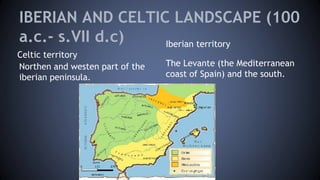
IBERIAN AND CELTIC LANDSCAPE (100
a.c.- s.VII d.c)
Celtic territory
Iberian territory
Northen and westen part of the
iberian peninsula.
The Levante (the Mediterranean
coast of Spain) and the south.
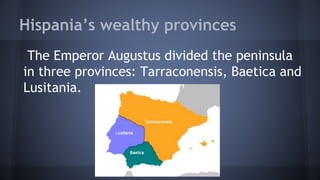
Hispania’s wealthy provinces
The Emperor Augustus divided the peninsula
in three provinces: Tarraconensis, Baetica and
Lusitania.
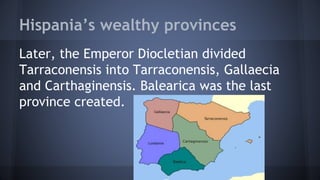
Hispania’s wealthy provinces
Later, the Emperor Diocletian divided
Tarraconensis into Tarraconensis, Gallaecia
and Carthaginensis. Balearica was the last
province created.
Pre-Roman Politics
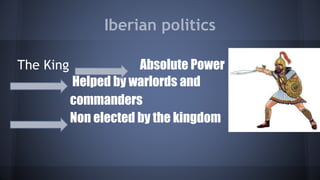
Iberian politics
The King Absolute Power
Helped by warlords and
commanders
Non elected by the kingdom
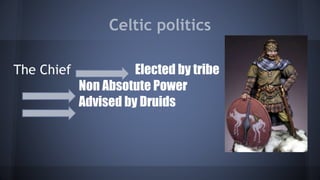
Celtic politics
The Chief Elected by tribe
Non Absotute Power
Advised by Druids
Roman politics
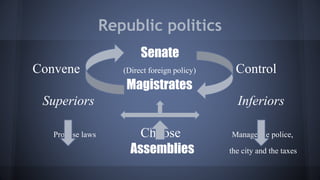
Republic politics
Senate
Convene (Direct foreign policy) Control
Magistrates
Superiors Inferiors
Propose laws Choose Manage the police,
Assemblies the city and the taxes
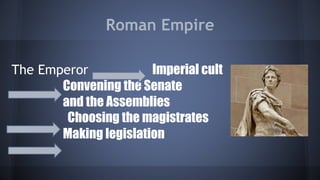
Roman Empire
The Emperor Imperial cult
Convening the Senate
and the Assemblies
Choosing the magistrates
Making legislation
Pre-Roman culture in
Hispania
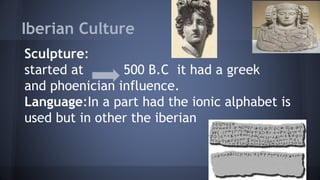
Sculpture:
started at 500 B.C it had a greek
and phoenician influence.
Language:In a part had the ionic alphabet is
used but in other the iberian
Iberian Culture =
Celtic Culture
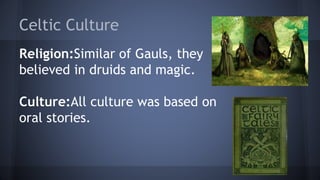
Religion:Similar of Gauls, they
believed in druids and magic.
Culture:All culture was based on
oral stories.
Culture in Hispania
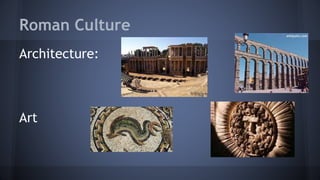
Architecture:
Art
Roman Culture
Hispania’s Economy
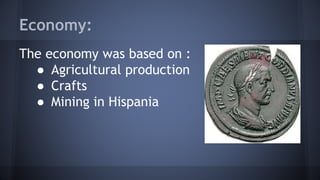
Economy:
The economy was based on :
● Agricultural production
● Crafts
● Mining in Hispania
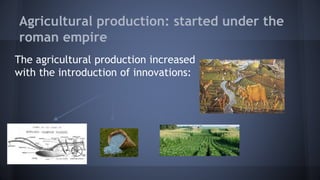
Agricultural production: started under the
roman empire
The agricultural production increased
with the introduction of innovations:
Ploughs Fertiliser Crop rotation
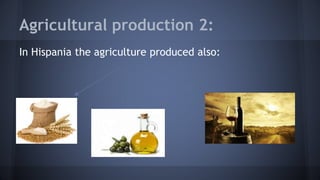
Agricultural production 2:
In Hispania the agriculture produced also:
Wheat Wine
Oil
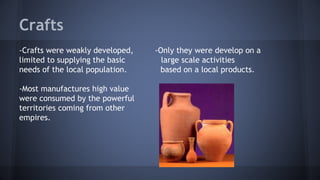
Crafts
-Crafts were weakly developed, -Only they were develop on a
limited to supplying the basic large scale activities
needs of the local population. based on a local products.
-Most manufactures high value
were consumed by the powerful
territories coming from other
empires.
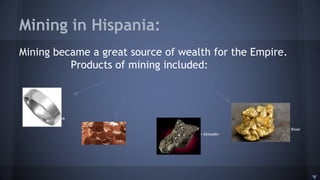
Mining in Hispania:
Mining became a great source of wealth for the Empire.
Products of mining included:
Silver from Cartagena
and Sierra Morena
Copper from Huelva Gold from the Sil River
Mercury from Almadén
Hipania 1a

Hipania 1a