1. PRE-ROMAN PEOPLES
2.COLONISERS
3. THE ROMAN CONQUEST OF THE IBERIAN
PENINSULA
4. ROMAN HISPANIA
5. CULTURE AND ART IN ROMAN HISPANIA
6. VISIGOTH HISPANIA
ROMAN HISPANIA
2.
1. Pre-Roman peoples
Pre-Romanpeoples inhabited the Iberian Peninsula before the Roman conquest in the 3rd century B.C.
They lived in independent settlements in high areas, with walls for defence against attacks.
• A military leader or king ruled.
• The dominant social group was the military aristocracy, and the least privileged group was the slaves.
• They had a subsistence economy, based mainly on agriculture.
• They worshipped the forces of nature and goddesses of fertility; they cremated their dead and buried the ashes in urns.
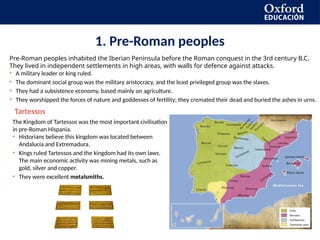
The Kingdom of Tartessos was the most important civilisation
in pre-Roman Hispania.
• Historians believe this kingdom was located between
Andalucía and Extremadura.
• Kings ruled Tartessos and the kingdom had its own laws.
The main economic activity was mining metals, such as
gold, silver and copper.
• They were excellent metalsmiths.
Tartessos
3.
1. Pre-Roman peoples
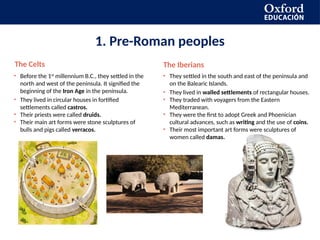
TheCelts
• Before the 1st
millennium B.C., they settled in the
north and west of the peninsula. It signified the
beginning of the Iron Age in the península.
• They lived in circular houses in fortified
settlements called castros.
• Their priests were called druids.
• Their main art forms were stone sculptures of
bulls and pigs called verracos.
The Iberians
• They settled in the south and east of the peninsula and
on the Balearic Islands.
• They lived in walled settlements of rectangular houses.
• They traded with voyagers from the Eastern
Mediterranean.
• They were the first to adopt Greek and Phoenician
cultural advances, such as writing and the use of coins.
• Their most important art forms were sculptures of
women called damas.
4.
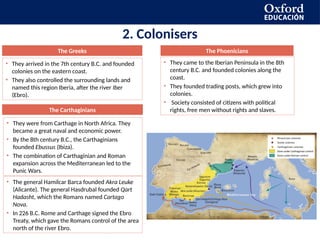
2. Colonisers
The Phoenicians
•They came to the Iberian Peninsula in the 8th
century B.C. and founded colonies along the
coast.
• They founded trading posts, which grew into
colonies.
• Society consisted of citizens with political
rights, free men without rights and slaves.
• They arrived in the 7th century B.C. and founded
colonies on the eastern coast.
• They also controlled the surrounding lands and
named this region Iberia, after the river Iber
(Ebro).
The Greeks
The Carthaginians
• They were from Carthage in North Africa. They
became a great naval and economic power.
• By the 8th century B.C., the Carthaginians
founded Ebussus (Ibiza).
• The combination of Carthaginian and Roman
expansion across the Mediterranean led to the
Punic Wars.
• The general Hamilcar Barca founded Akra Leuke
(Alicante). The general Hasdrubal founded Qart
Hadasht, which the Romans named Cartago
Nova.
• In 226 B.C. Rome and Carthage signed the Ebro
Treaty, which gave the Romans control of the area
north of the river Ebro.
5.
3. The Romanconquest of the Iberian Peninsula
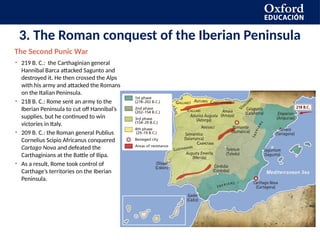
• 219 B. C.: the Carthaginian general
Hannibal Barca attacked Sagunto and
destroyed it. He then crossed the Alps
with his army and attacked the Romans
on the Italian Peninsula.
• 218 B. C.: Rome sent an army to the
Iberian Peninsula to cut off Hannibal’s
supplies, but he continued to win
victories in Italy.
• 209 B. C.: the Roman general Publius
Cornelius Scipio Africanus conquered
Cartago Nova and defeated the
Carthaginians at the Battle of Ilipa.
• As a result, Rome took control of
Carthage’s territories on the Iberian
Peninsula.
The Second Punic War
6.
3. The Romanconquest of the Iberian Peninsula
Other wars on the Iberian Peninsula
• The Lusitanian Wars (2nd century B. C.): Rome fought the Lusitanians. Their leader, Viriatus, who defeated
the romans ins various occaions, was murdered by the Romans in 139 B. C.
• The Celtiberian Wars (2nd century B. C.): Rome sent Scipio Aemilianus to conquer the city of Numantia. After
resisting a long siege, the Numantians ran out of food and burned the city down as a way to avoid becoming
slaves for the romans.
• The Cantabrian Wars (29-19 B. C.): Emperor Augustus conquered the Gallaeci, Astures and Cantabrians in the
north of the peninsula.
The political organisation of Hispania
During the Republic, Hispania
was divided into two
provinces:
• Hispania Ulterior: with its
capital in Corduba
(Córdoba).
• Hispania Citerior: with its
capital in Tarraco
(Tarragona).
In the 1st
century BC, Augustus
divided Hispania into three
provinces:
• Tarraconensis: mediterranean
coast (Caesaraugusta).
• Lusitania: the west of the
península (Lisbon).
• Baetica: the south of the
península (Hispalis, Gades)
During the final stages of the
empire, Romans added three
new provinces:
• Gallaecia:the north-west of the
península (Asturica Augusta,
Braga).
• Carthaginensis: Mediterranean
and centre (Valentia, Toletum).
• Balearica: the Balearic Islands
(Palma).
7.
4. Roman Hispania
Romanisationoccurred more rapidly in the centre, south and east of the Iberian Peninsula, and took longer in the north.
• The army: retired soldiers established colonies and military camps developed into cities.
• Latin became the official language. Christianity eventually replaced paganism.
• Roman law replaced local customs.
• The Celtiberians who submitted to Roman control received similar rights to Roman citizens on the Italian Peninsula.
Society
• Romans patricians held the most important
positions, along with the local-born elites who
adopted Roman customs.
• Plebeians and liberti lived modestly and
worked for the rich.
• Slaves were at the bottom of the pyramid.
The economy
• Agriculture was the most important economic activity (cereals, oil and wine).
• People also mined gold, silver and other metals.
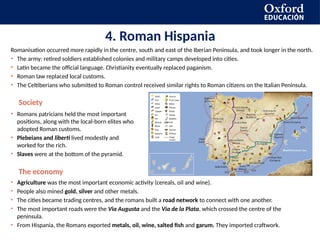
• The cities became trading centres, and the romans built a road network to connect with one another.
• The most important roads were the Via Augusta and the Via de la Plata, which crossed the centre of the
peninsula.
• From Hispania, the Romans exported metals, oil, wine, salted fish and garum. They imported craftwork.
8.
5. Culture andart in Roman Hispania
• The people of Hispania combined their existing religious beliefs with
Greco-Roman polytheism. Christianity spread across Hispania.
• Important Roman cultural figures born in Hispania include the
philosopher Seneca, the poets Lucan and Martial and the orator
Quintilian.
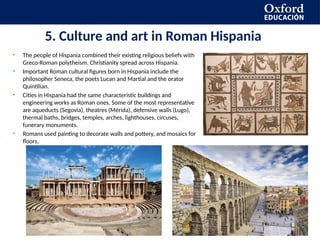
• Cities in Hispania had the same characteristic buildings and
engineering works as Roman ones. Some of the most representative
are aqueducts (Segovia), theatres (Mérida), defensive walls (Lugo),
thermal baths, bridges, temples, arches, lighthouses, circuses,
funerary monuments.
• Romans used painting to decorate walls and pottery, and mosaics for
floors.
9.
6. Visigoth Hispania
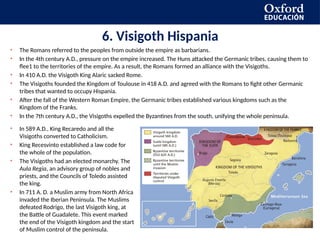
•The Romans referred to the peoples from outside the empire as barbarians.
• In the 4th century A.D., pressure on the empire increased. The Huns attacked the Germanic tribes, causing them to
flee1 to the territories of the empire. As a result, the Romans formed an alliance with the Visigoths.
• In 410 A.D. the Visigoth King Alaric sacked Rome.
• The Visigoths founded the Kingdom of Toulouse in 418 A.D. and agreed with the Romans to fight other Germanic
tribes that wanted to occupy Hispania.
• After the fall of the Western Roman Empire, the Germanic tribes established various kingdoms such as the
Kingdom of the Franks.
• In the 7th century A.D., the Visigoths expelled the Byzantines from the south, unifying the whole peninsula.
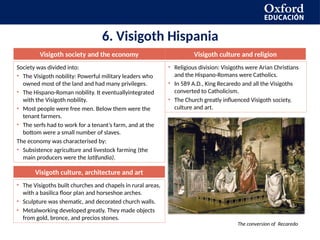
• In 589 A.D., King Recaredo and all the
Visigoths converted to Catholicism.
• King Recesvinto established a law code for
the whole of the population.
• The Visigoths had an elected monarchy. The
Aula Regia, an advisory group of nobles and
priests, and the Councils of Toledo assisted
the king.
• In 711 A. D. a Muslim army from North Africa
invaded the Iberian Peninsula. The Muslims
defeated Rodrigo, the last Visigoth king, at
the Battle of Guadalete. This event marked
the end of the Visigoth kingdom and the start
of Muslim control of the peninsula.
10.
6. Visigoth Hispania
Visigothsociety and the economy Visigoth culture and religion
Society was divided into:
• The Visigoth nobility: Powerful military leaders who
owned most of the land and had many privileges.
• The Hispano-Roman nobility. It eventuallyintegrated
with the Visigoth nobility.
• Most people were free men. Below them were the
tenant farmers.
• The serfs had to work for a tenant’s farm, and at the
bottom were a small number of slaves.
The economy was characterised by:
• Subsistence agriculture and livestock farming (the
main producers were the latifundia).
• Religious division: Visigoths were Arian Christians
and the Hispano-Romans were Catholics.
• In 589 A.D., King Recaredo and all the Visigoths
converted to Catholicism.
• The Church greatly influenced Visigoth society,
culture and art.
The conversion of Recaredo
Visigoth culture, architecture and art
• The Visigoths built churches and chapels in rural areas,
with a basilica floor plan and horseshoe arches.
• Sculpture was shematic, and decorated church walls.
• Metalworking developed greatly. They made objects
from gold, bronce, and precios stones.



![Spain (september update) [build 2009]](https://cdn.slidesharecdn.com/ss_thumbnails/spainseptemberupdatebuild2009-211217161855-thumbnail.jpg?width=640&height=640&fit=bounds)


