The Romans
A look into the Roman times
The Arrival of the RomansThe Arrival of the Romans
 Before the Romans the Iberian
Peninsula was inhabited by the Celts
and the Iberians.
 They lived on the Mediterranean coast.
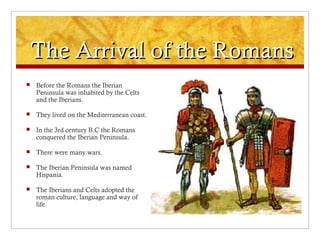
 In the 3rd century B.C the Romans
conquered the Iberian Peninsula.
 There were many wars.
 The Iberian Peninsula was named
Hispania.
 The Iberians and Celts adopted the
roman culture, language and way of
life.
The Pre-Roman Towns: The CeltsThe Pre-Roman Towns: The Celts
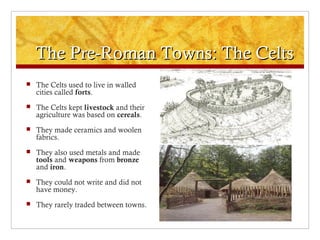
 The Celts used to live in walled
cities called forts.
 The Celts kept livestock and their
agriculture was based on cereals.
 They made ceramics and woolen
fabrics.
 They also used metals and made
tools and weapons from bronze
and iron.
 They could not write and did not
have money.
 They rarely traded between towns.
The Pre-Roman Towns: The IberiansThe Pre-Roman Towns: The Iberians
 The Iberians lived on the Mediterranean
coast.
 They lived from agriculture and livestock.
 The Iberians used iron and made ceramic
objects.
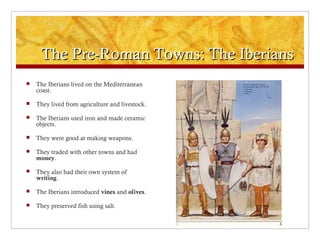
 They were good at making weapons.
 They traded with other towns and had
money.
 They also had their own system of
writing.
 The Iberians introduced vines and olives.
 They preserved fish using salt.
The Roman ConquestThe Roman Conquest
 The Roman conquest of the Iberian
Peninsula lasted for more than 200
years.
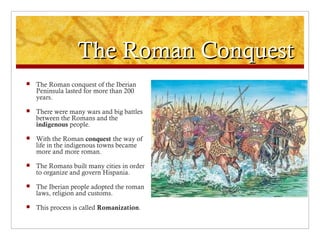
 There were many wars and big battles
between the Romans and the
indigenous people.
 With the Roman conquest the way of
life in the indigenous towns became
more and more roman.
 The Romans built many cities in order
to organize and govern Hispania.
 The Iberian people adopted the roman
laws, religion and customs.
 This process is called Romanization.
Life in the CitiesLife in the Cities
 Cities were the center of social,
economic, political and cultural
life in the roman world.
 People came to the cities to buy
and sell products, do business or
go to public events.
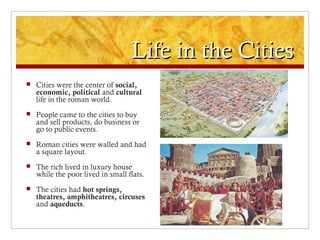
 Roman cities were walled and had
a square layout.
 The rich lived in luxury house
while the poor lived in small flats.
 The cities had hot springs,
theatres, amphitheatres, circuses
and aqueducts.
Life in the CountrysideLife in the Countryside
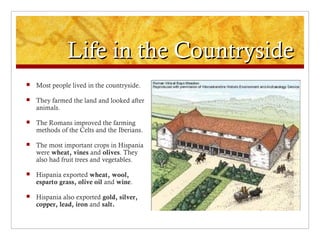
 Most people lived in the countryside.
 They farmed the land and looked after
animals.
 The Romans improved the farming
methods of the Celts and the Iberians.
 The most important crops in Hispania
were wheat, vines and olives. They
also had fruit trees and vegetables.
 Hispania exported wheat, wool,
esparto grass, olive oil and wine.
 Hispania also exported gold, silver,
copper, lead, iron and salt.
The Roman ReligionThe Roman Religion
 The Romans believed in multiple
gods.
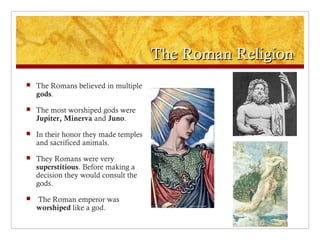
 The most worshiped gods were
Jupiter, Minerva and Juno.
 In their honor they made temples
and sacrificed animals.
 They Romans were very
superstitious. Before making a
decision they would consult the
gods.
 The Roman emperor was
worshiped like a god.

The romans

  • 1.
    The Romans A lookinto the Roman times
  • 2.
    The Arrival ofthe RomansThe Arrival of the Romans  Before the Romans the Iberian Peninsula was inhabited by the Celts and the Iberians.  They lived on the Mediterranean coast.  In the 3rd century B.C the Romans conquered the Iberian Peninsula.  There were many wars.  The Iberian Peninsula was named Hispania.  The Iberians and Celts adopted the roman culture, language and way of life.
  • 3.
    The Pre-Roman Towns:The CeltsThe Pre-Roman Towns: The Celts  The Celts used to live in walled cities called forts.  The Celts kept livestock and their agriculture was based on cereals.  They made ceramics and woolen fabrics.  They also used metals and made tools and weapons from bronze and iron.  They could not write and did not have money.  They rarely traded between towns.
  • 4.
    The Pre-Roman Towns:The IberiansThe Pre-Roman Towns: The Iberians  The Iberians lived on the Mediterranean coast.  They lived from agriculture and livestock.  The Iberians used iron and made ceramic objects.  They were good at making weapons.  They traded with other towns and had money.  They also had their own system of writing.  The Iberians introduced vines and olives.  They preserved fish using salt.
  • 5.
    The Roman ConquestTheRoman Conquest  The Roman conquest of the Iberian Peninsula lasted for more than 200 years.  There were many wars and big battles between the Romans and the indigenous people.  With the Roman conquest the way of life in the indigenous towns became more and more roman.  The Romans built many cities in order to organize and govern Hispania.  The Iberian people adopted the roman laws, religion and customs.  This process is called Romanization.
  • 6.
    Life in theCitiesLife in the Cities  Cities were the center of social, economic, political and cultural life in the roman world.  People came to the cities to buy and sell products, do business or go to public events.  Roman cities were walled and had a square layout.  The rich lived in luxury house while the poor lived in small flats.  The cities had hot springs, theatres, amphitheatres, circuses and aqueducts.
  • 7.
    Life in theCountrysideLife in the Countryside  Most people lived in the countryside.  They farmed the land and looked after animals.  The Romans improved the farming methods of the Celts and the Iberians.  The most important crops in Hispania were wheat, vines and olives. They also had fruit trees and vegetables.  Hispania exported wheat, wool, esparto grass, olive oil and wine.  Hispania also exported gold, silver, copper, lead, iron and salt.
  • 8.
    The Roman ReligionTheRoman Religion  The Romans believed in multiple gods.  The most worshiped gods were Jupiter, Minerva and Juno.  In their honor they made temples and sacrificed animals.  They Romans were very superstitious. Before making a decision they would consult the gods.  The Roman emperor was worshiped like a god.