Sustained Release Oral
Dosage Forms
PRESENTED BY: KAJAL A. PRADHAN
M.PHARM. (PHARMACEUTICS)
Introduction
 The oral route of drug delivery is typically considered the preferred and most
patient-convenient means of drug administration .
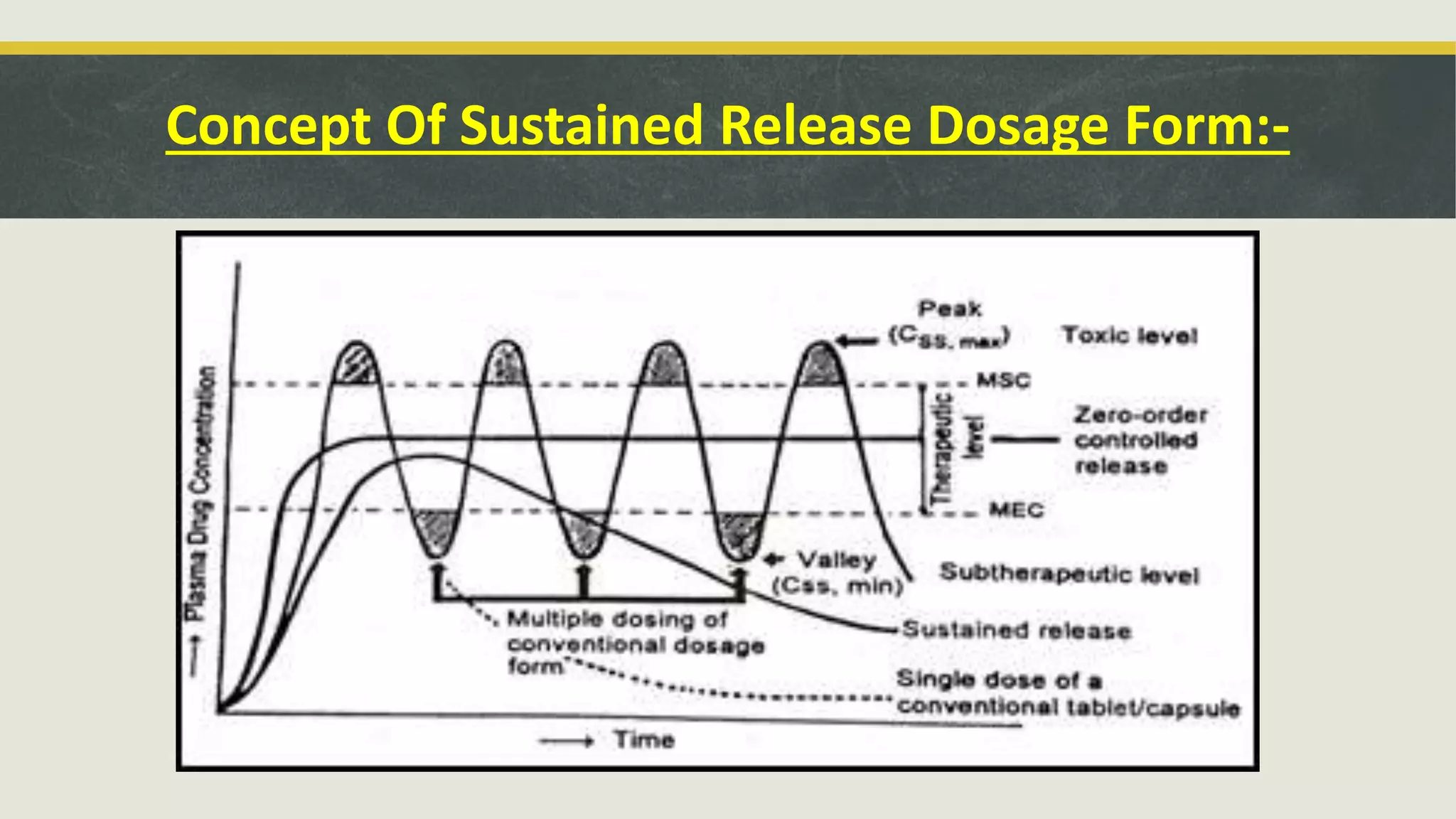
 With many drugs the basic Goal of therapy is to achieve a steady-state blood or
tissue level that is therapeutically effective and nontoxic for an extended
period of time.
 Sustain release system are considered a wiser approach for the drugs with
short half-lives and which require repeated dosing, they are easy to formulate
and are irrespective of absorption process from gastrointestinal tract after oral
administration.
Concept Of Sustained Release Dosage Form:-
a) Desirable half life
b) High therapeutic index.
c) Small dose.
d) Desirable absorption & solubility characteristic
e) Desirable absorption window.
f) First pass clearance.
Criteria Of Drug To Formulate As Sustained
Release Dosage Forms
Advantage
1.Improved patient compliance
>Less frequent dosing.
>Reduced night time dosing.
2. Better drug utilization
>reduction in total amount of drug used
3. Decreased local &systemic effects
>Due to dose reduction.
4. Increased bioavailability.
5. Increased reliability of therapy.
6. Extend duration of action.
Disadvantage
 Termination of therapy can be done i.e.
immediate change in therapy cannot be
done if any adverse effects seen.
 No dose adjustment can be done.
 Costly process &equipment are involved
in manufacturing of sustained drug
release.
 Drug with narrow absorption are poor
candidate for sustained release.
Sustained Release Formulation:-
1. Encapsulated slow release granules
2. Tabletted slow release granulations
3. Matrix tablet
4. Drug complexes
5. Ion activated systems
Cont…
6. pH based system:-
a. pH dependent system
b. pH independent system
7. Altered density system:-
a. Low density micro-pellets
b. High density micro-pellets
8. Colonic release system
Matrix Tablet
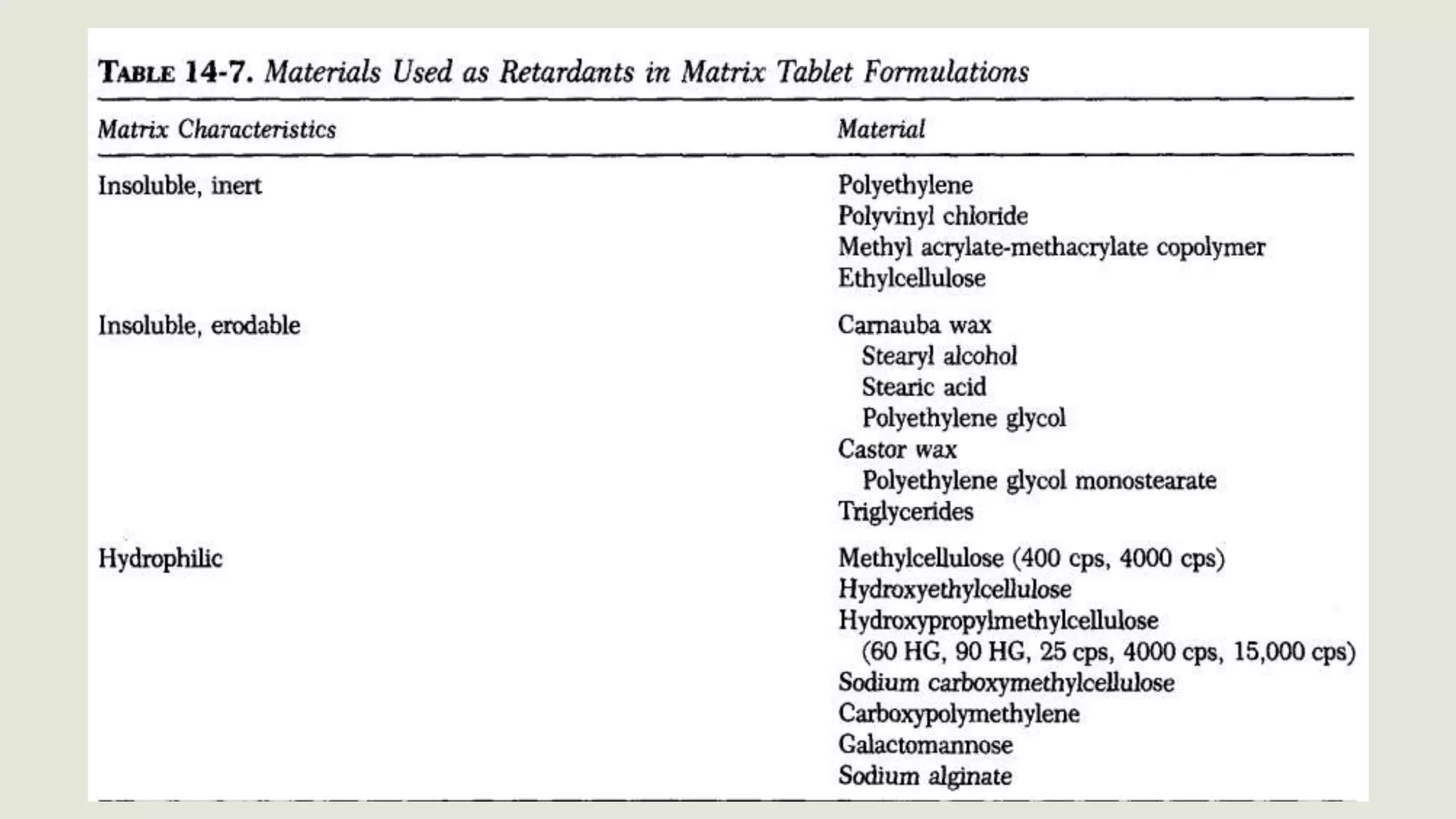
Matrix tablet is defined as “Oral solid dosage form in which active
pharmaceutical ingredient is uniformly dispersed throughout polymeric
matrices (hydrophilic or hydrophobic) which retards the drug release
rate.
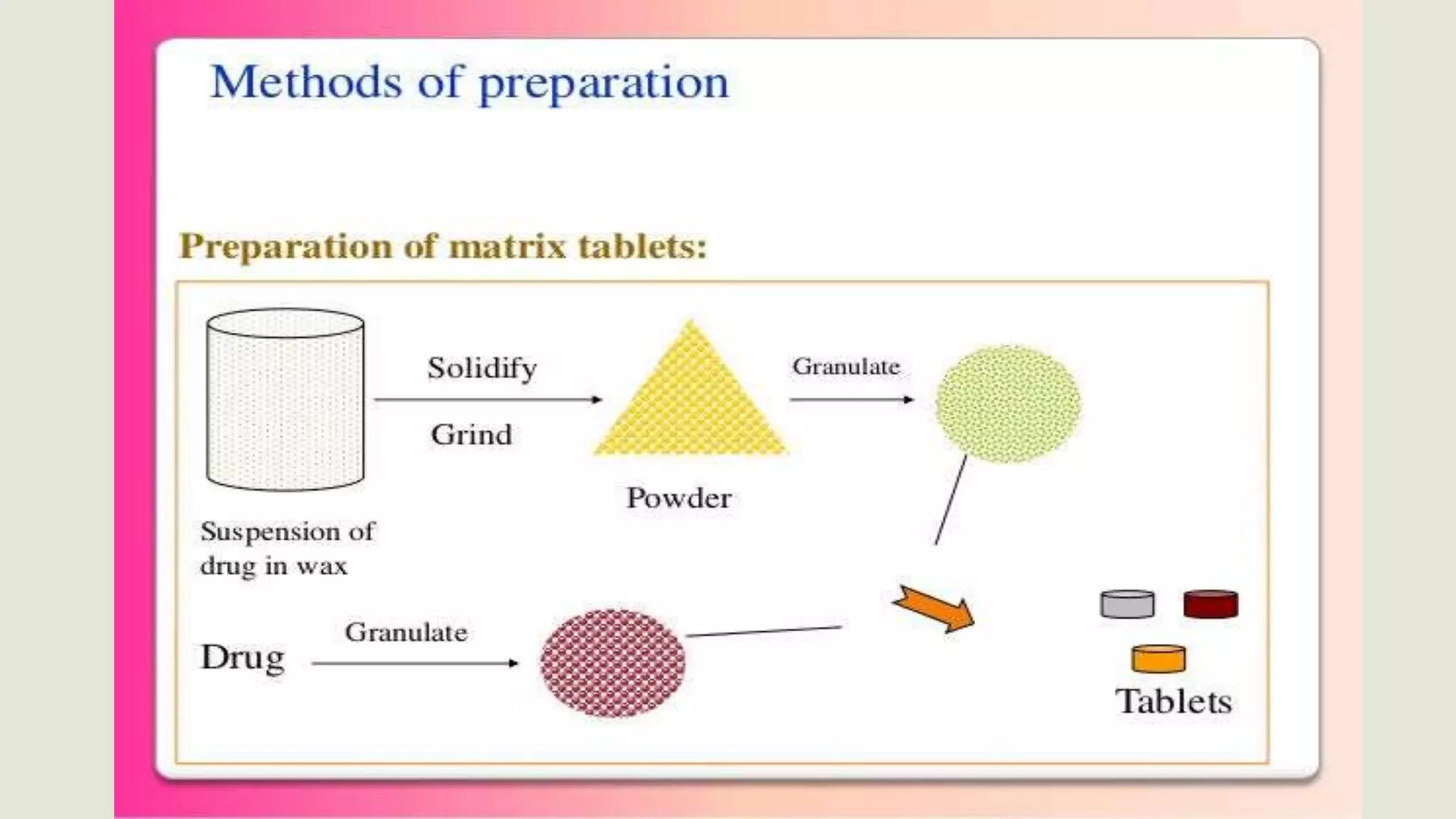
Matrix tablets can be formulated by either direct compression or wet
granulation method by using a variety of hydrophilic or hydrophobic
polymers.
Cont...
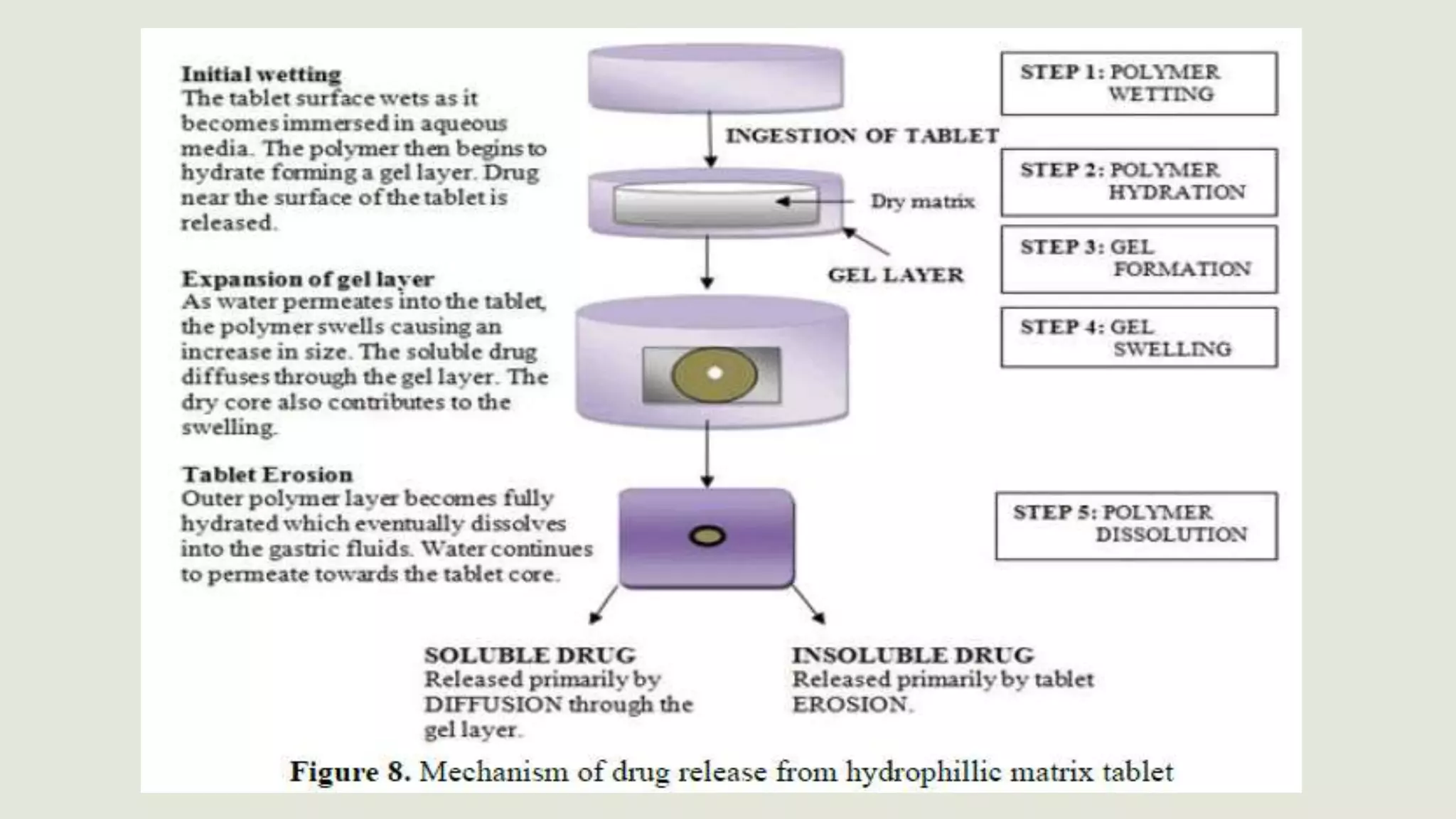
 The rate of drug release from the matrix is primarily governed by rate and
extent of water penetration, swelling of polymer, dissolution and diffusion of
drug. Thus, sustained release matrix tablet can offer better patient
compliance and could be quite helpful in treatment of chronic diseases.
 In a matrix system, the drug substance is homogenously mixed into the rate
controlling material as crystalline, amorphous or in rare cases molecular
dispersion
 Drug bioavailability which is critically dependent on the drug polymer ratio
may be modified by inclusion of diluents such as lactose in place of polymer
in low-milligram-potency formulations
References
 Lachman/Lieberman’s-The Theory and Practice of Industrial
Pharmacy, Fourth Edition, page no.597-616
 Aulton’s Pharmaceutics-The Design and Manufacture of Medicines, Third
edition, page no.490-495
Sustained release oral dosage forms

Sustained release oral dosage forms

  • 1.
    Sustained Release Oral DosageForms PRESENTED BY: KAJAL A. PRADHAN M.PHARM. (PHARMACEUTICS)
  • 2.
    Introduction  The oralroute of drug delivery is typically considered the preferred and most patient-convenient means of drug administration .  With many drugs the basic Goal of therapy is to achieve a steady-state blood or tissue level that is therapeutically effective and nontoxic for an extended period of time.  Sustain release system are considered a wiser approach for the drugs with short half-lives and which require repeated dosing, they are easy to formulate and are irrespective of absorption process from gastrointestinal tract after oral administration.
  • 3.
    Concept Of SustainedRelease Dosage Form:-
  • 4.
    a) Desirable halflife b) High therapeutic index. c) Small dose. d) Desirable absorption & solubility characteristic e) Desirable absorption window. f) First pass clearance. Criteria Of Drug To Formulate As Sustained Release Dosage Forms
  • 5.
    Advantage 1.Improved patient compliance >Lessfrequent dosing. >Reduced night time dosing. 2. Better drug utilization >reduction in total amount of drug used 3. Decreased local &systemic effects >Due to dose reduction. 4. Increased bioavailability. 5. Increased reliability of therapy. 6. Extend duration of action. Disadvantage  Termination of therapy can be done i.e. immediate change in therapy cannot be done if any adverse effects seen.  No dose adjustment can be done.  Costly process &equipment are involved in manufacturing of sustained drug release.  Drug with narrow absorption are poor candidate for sustained release.
  • 6.
    Sustained Release Formulation:- 1.Encapsulated slow release granules 2. Tabletted slow release granulations 3. Matrix tablet 4. Drug complexes 5. Ion activated systems
  • 7.
    Cont… 6. pH basedsystem:- a. pH dependent system b. pH independent system 7. Altered density system:- a. Low density micro-pellets b. High density micro-pellets 8. Colonic release system
  • 8.
    Matrix Tablet Matrix tabletis defined as “Oral solid dosage form in which active pharmaceutical ingredient is uniformly dispersed throughout polymeric matrices (hydrophilic or hydrophobic) which retards the drug release rate. Matrix tablets can be formulated by either direct compression or wet granulation method by using a variety of hydrophilic or hydrophobic polymers.
  • 9.
    Cont...  The rateof drug release from the matrix is primarily governed by rate and extent of water penetration, swelling of polymer, dissolution and diffusion of drug. Thus, sustained release matrix tablet can offer better patient compliance and could be quite helpful in treatment of chronic diseases.  In a matrix system, the drug substance is homogenously mixed into the rate controlling material as crystalline, amorphous or in rare cases molecular dispersion  Drug bioavailability which is critically dependent on the drug polymer ratio may be modified by inclusion of diluents such as lactose in place of polymer in low-milligram-potency formulations
  • 13.
    References  Lachman/Lieberman’s-The Theoryand Practice of Industrial Pharmacy, Fourth Edition, page no.597-616  Aulton’s Pharmaceutics-The Design and Manufacture of Medicines, Third edition, page no.490-495