Formulation and evaluation of sustained
release matrix tablets: basics and mechanism
of drug delivery
BVDU’S
Poona College of Pharmacy, Pune
Name- Prathamesh Patil
Roll no. - 09
M.Pharm 1st year ( Pharmaceutics )
INTRODUCTION
WHAT IS SUSTAINED RELEASE ?
It is any drug delivery system that achieves slow release of drugs
over an extended period of time.
• The Goals of SRDF’s is to obtain Zero order release from the dosage form.
• Zero order release is a release which is independent of the amount of drug
present in the dosage form.
• Usually SRDF’s do not follow zero order release but they try to mimic zero
order release by releasing the drug in a slow first order fashion.
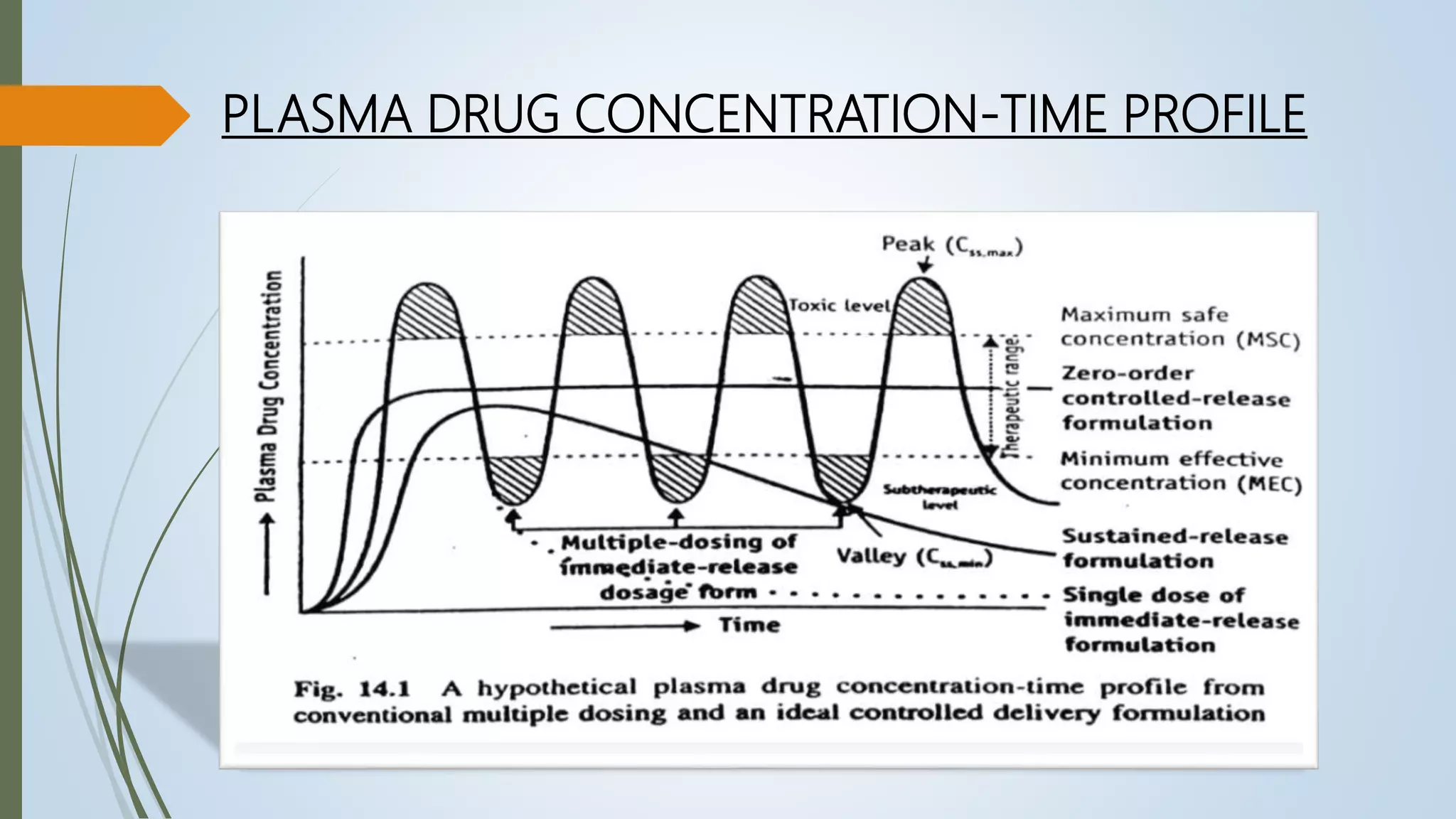
PLASMA DRUG CONCENTRATION-TIME PROFILE
The main Aim of preparing sustained release
formulations was intended to modify and improve the drug
performance by
• Increasing the duration of drug action.
• Decreasing the frequency of dosing.
• Decreasing the required dose employed.
• Less adverse effects.
• To minimize the fluctuation in plasma level.
Why we need to formulate sustained
release tablets???
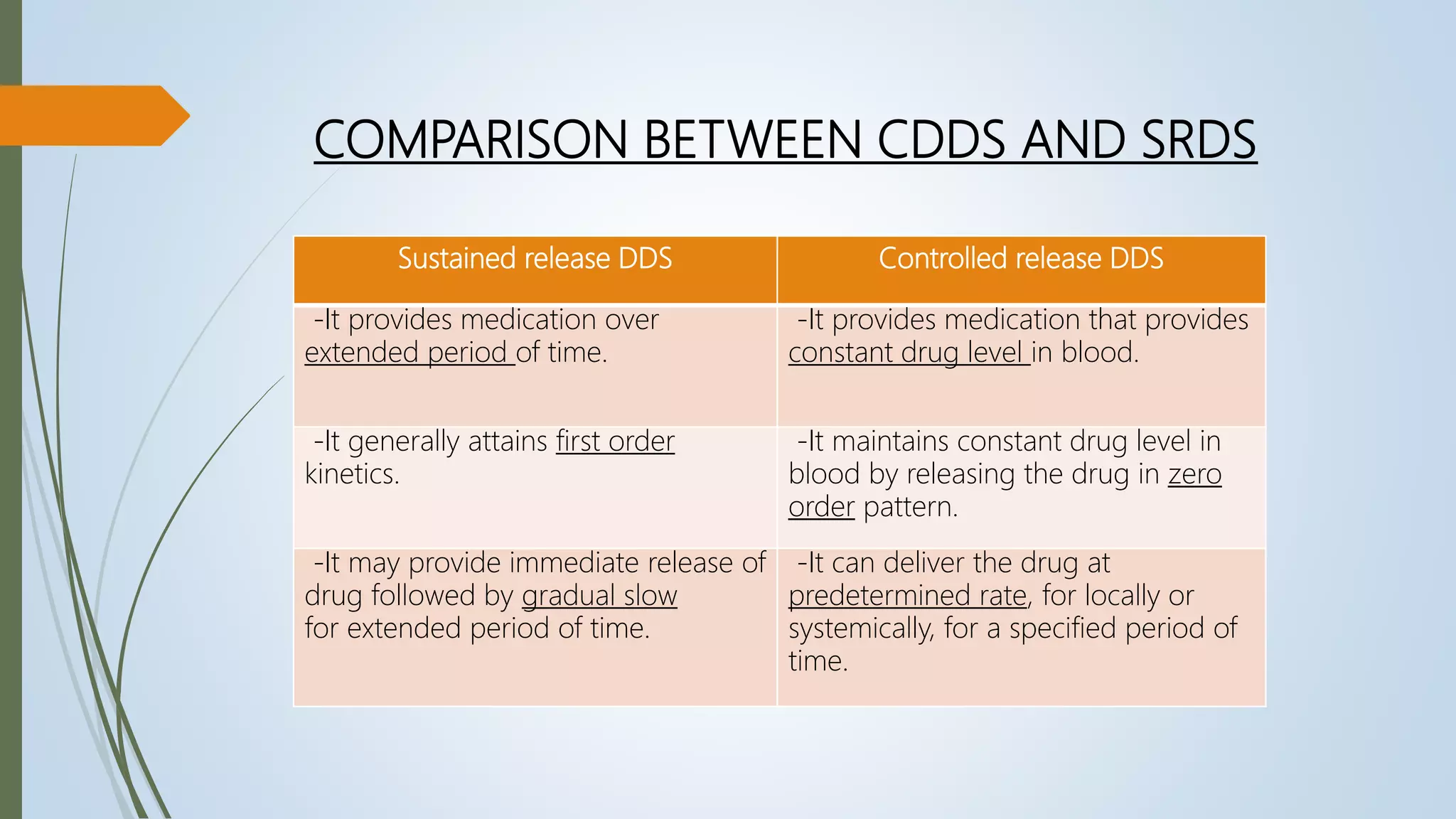
Sustained release DDS Controlled release DDS
-It provides medication over
extended period of time.
-It provides medication that provides
constant drug level in blood.
-It generally attains first order
kinetics.
-It maintains constant drug level in
blood by releasing the drug in zero
order pattern.
-It may provide immediate release of
drug followed by gradual slow
for extended period of time.
-It can deliver the drug at
predetermined rate, for locally or
systemically, for a specified period of
time.
COMPARISON BETWEEN CDDS AND SRDS
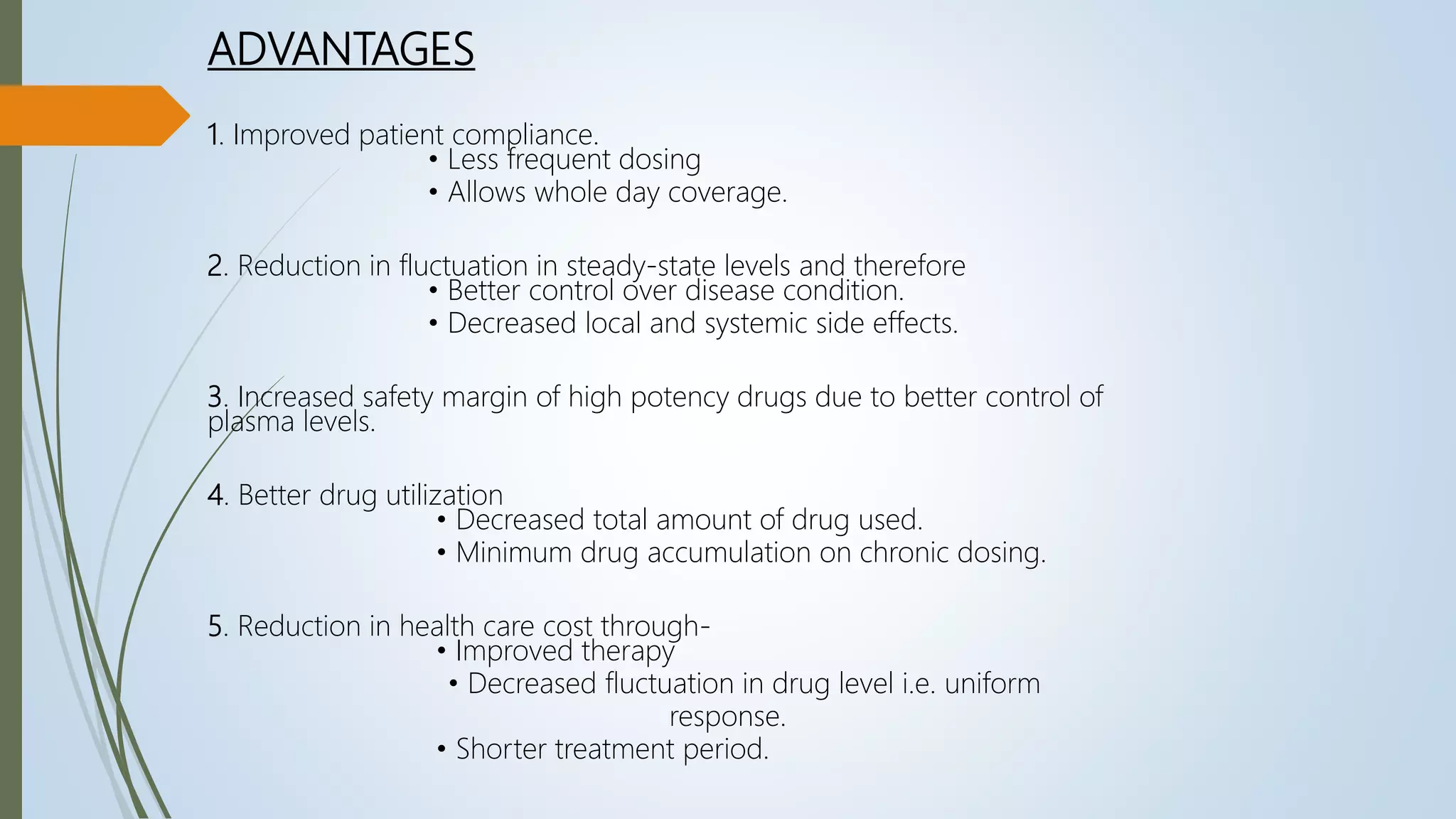
ADVANTAGES
1. Improved patient compliance.
• Less frequent dosing
• Allows whole day coverage.
2. Reduction in fluctuation in steady-state levels and therefore
• Better control over disease condition.
• Decreased local and systemic side effects.
3. Increased safety margin of high potency drugs due to better control of
plasma levels.
4. Better drug utilization
• Decreased total amount of drug used.
• Minimum drug accumulation on chronic dosing.
5. Reduction in health care cost through-
• Improved therapy
• Decreased fluctuation in drug level i.e. uniform
response.
• Shorter treatment period.
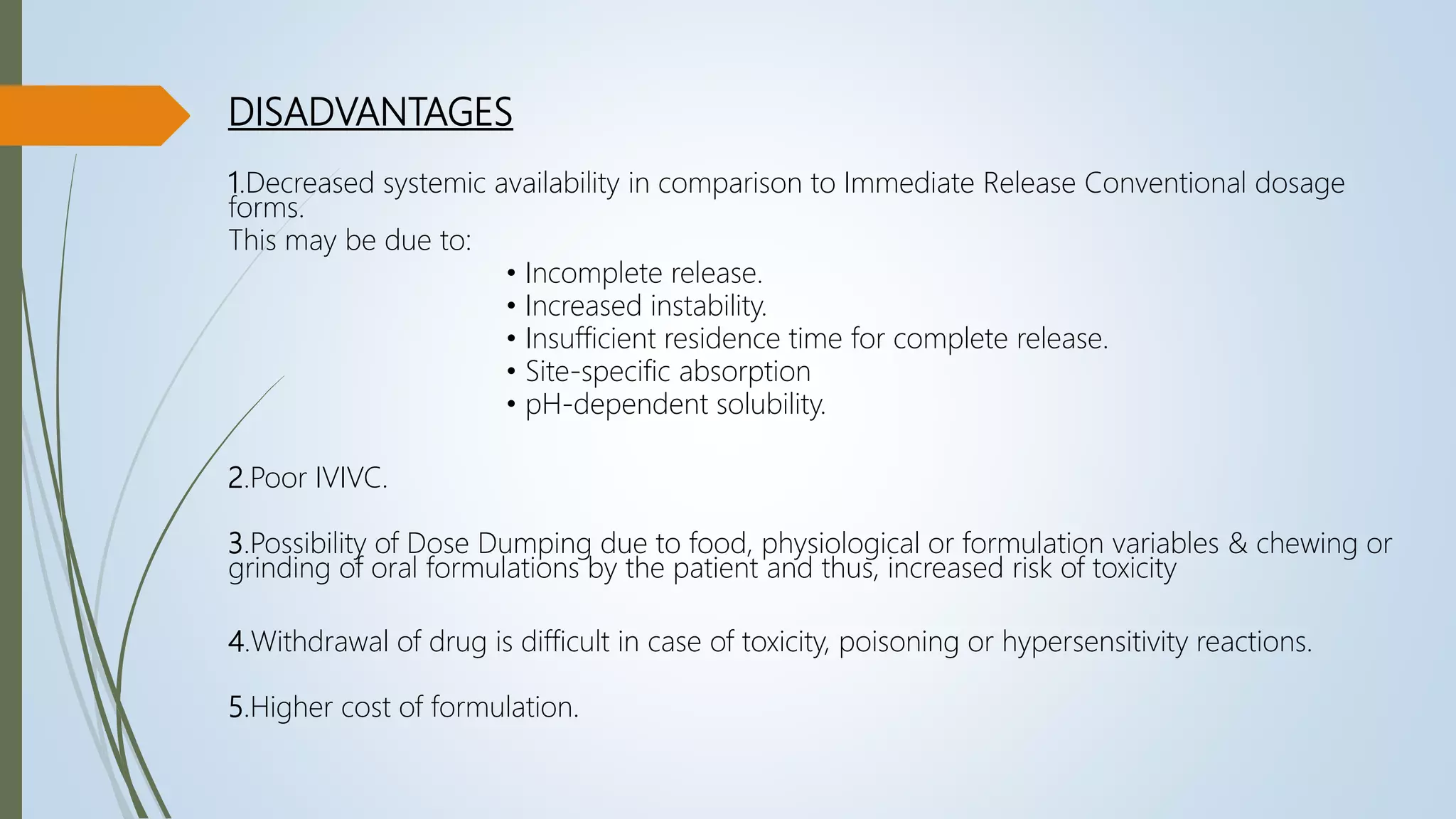
DISADVANTAGES
1.Decreased systemic availability in comparison to Immediate Release Conventional dosage
forms.
This may be due to:
• Incomplete release.
• Increased instability.
• Insufficient residence time for complete release.
• Site-specific absorption
• pH-dependent solubility.
2.Poor IVIVC.
3.Possibility of Dose Dumping due to food, physiological or formulation variables & chewing or
grinding of oral formulations by the patient and thus, increased risk of toxicity
4.Withdrawal of drug is difficult in case of toxicity, poisoning or hypersensitivity reactions.
5.Higher cost of formulation.
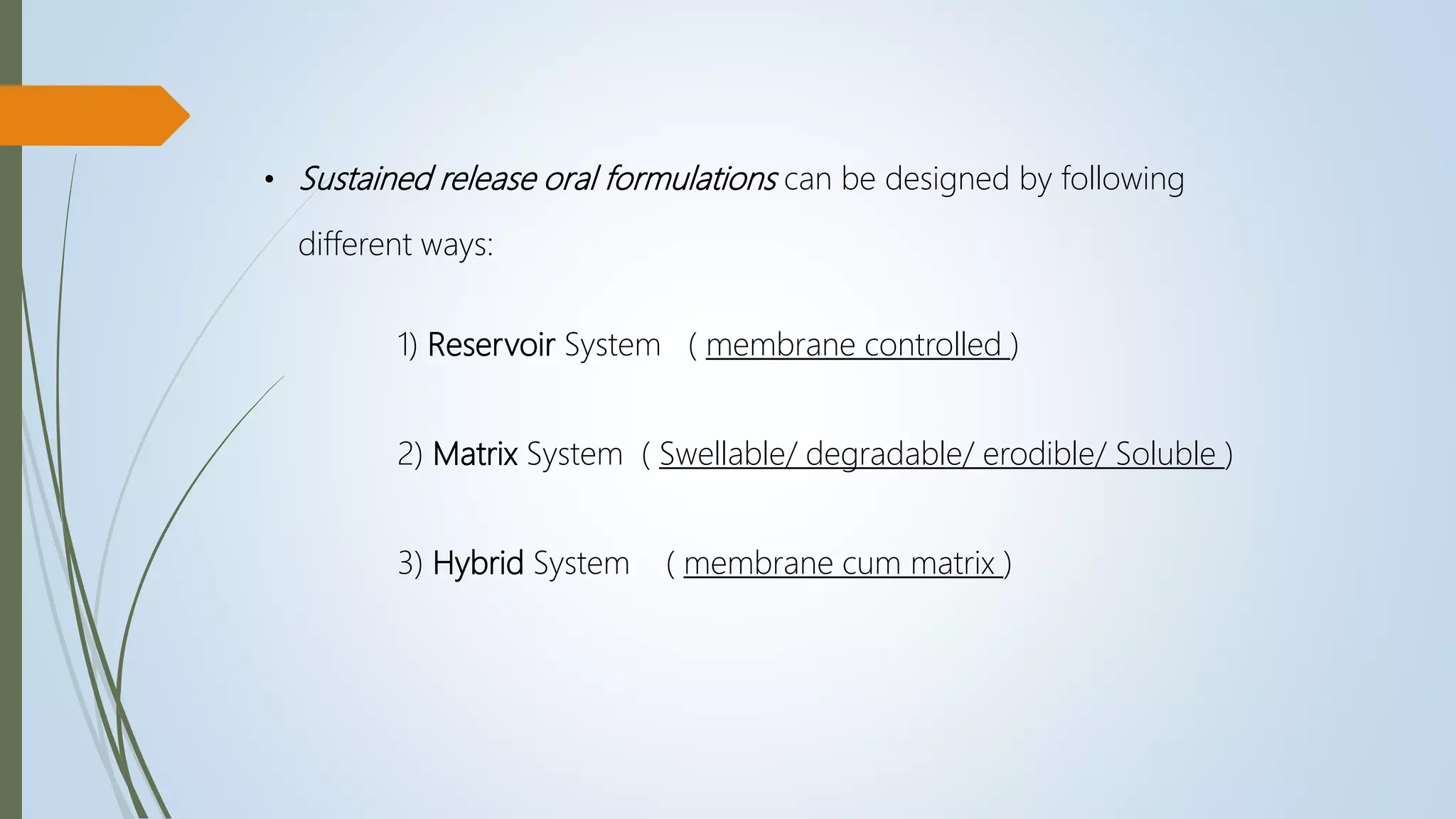
• Sustained release oral formulations can be designed by following
different ways:
1) Reservoir System ( membrane controlled )
2) Matrix System ( Swellable/ degradable/ erodible/ Soluble )
3) Hybrid System ( membrane cum matrix )
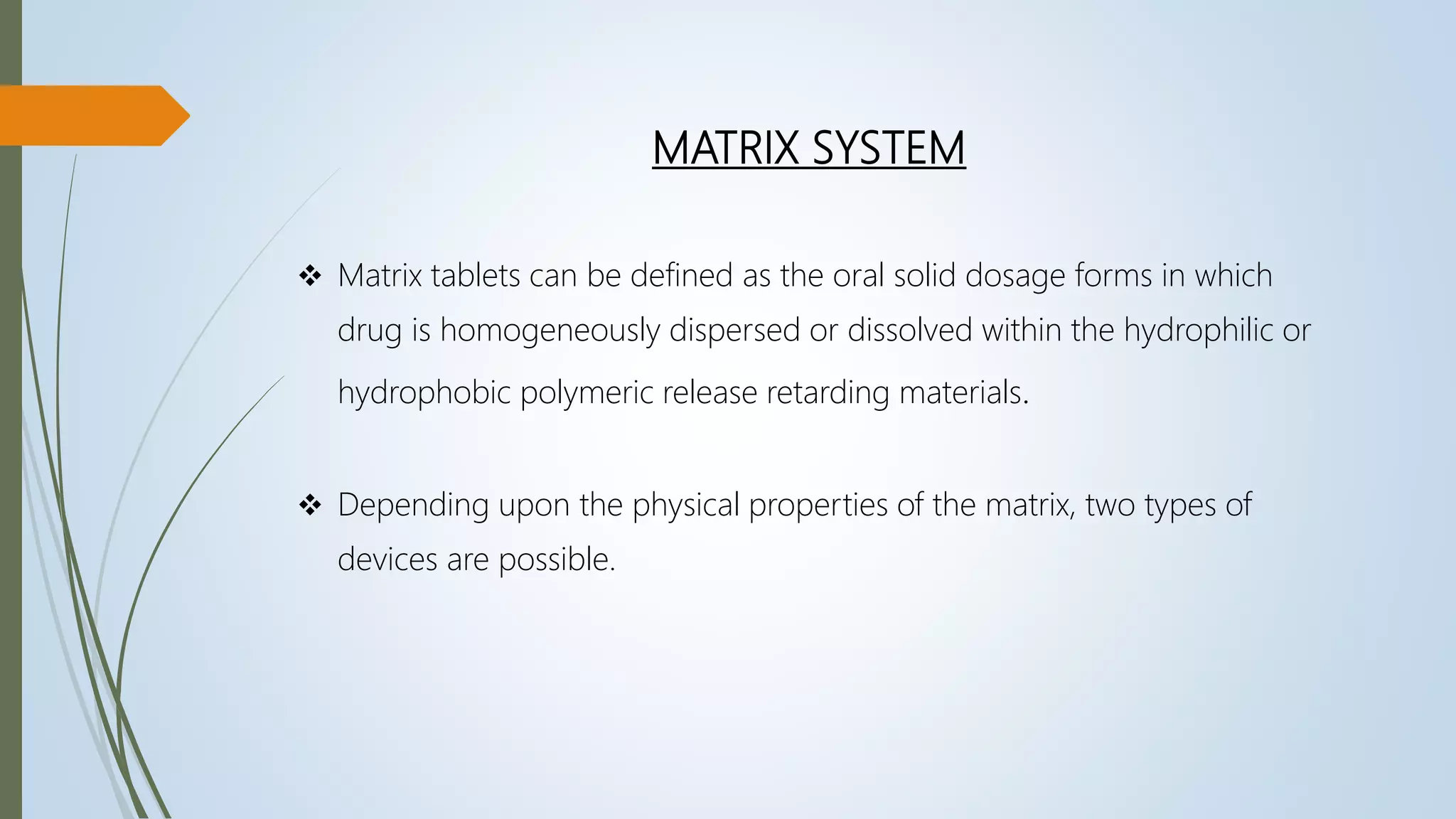
MATRIX SYSTEM
 Matrix tablets can be defined as the oral solid dosage forms in which
drug is homogeneously dispersed or dissolved within the hydrophilic or
hydrophobic polymeric release retarding materials.
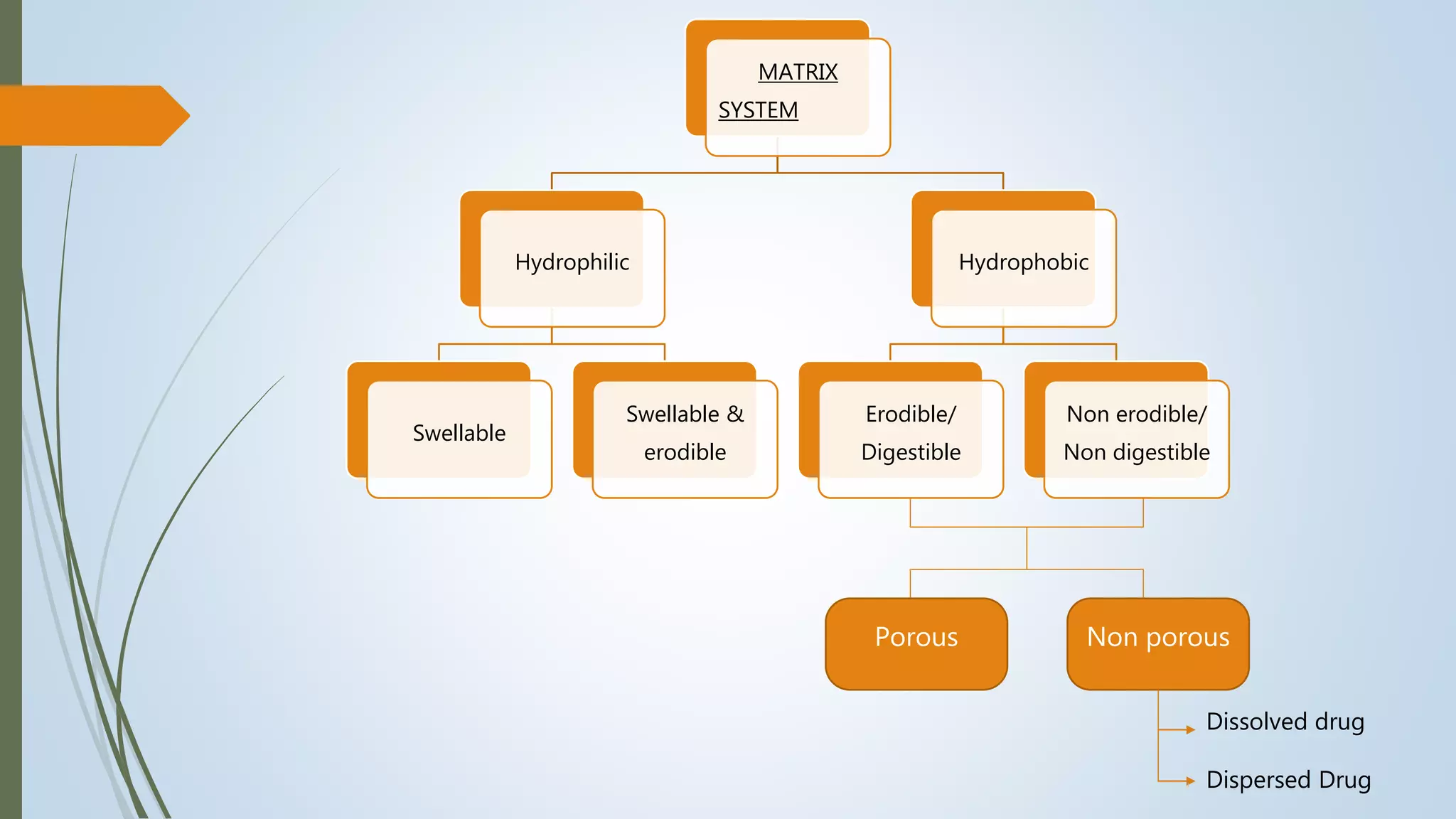
 Depending upon the physical properties of the matrix, two types of
devices are possible.
MATRIX
SYSTEM
Hydrophilic
Swellable
Swellable &
erodible
Hydrophobic
Erodible/
Digestible
Non erodible/
Non digestible
Porous Non porous
Dissolved drug
Dispersed Drug
A] Hydrophilic matrix
In this type of system the release-retarding material is water-swellable or
cum erodible hydrocolloid such as high molecular weight HPMC, HPC, HEC, xanthan gum,
alginate, etc.
Hydrophilic matrices are porous systems.
• Depending upon the swelling behaviour of hydrophilic polymer, two types of matrices are
possible-
1) Freely swellable matrix
In this type, the polymer swelling is unrestricted.
2) Restricted swelling matrix
One in which the surface of the device is partially coated with an
impermeable polymer film that restricts the hydration of swellable matrix material
B] Hydrophobic matrix ( plastic)
In this type of system the release-retarding material is slowly soluble, erodible or
digestible like waxes, hydrogenated vegetable oils, cetyl alcohol, etc. and insoluble or non
digestible materials like ethyl cellulose, polymethacrylates, etc.
- Depending upon the manner of incorporation of drug in the matrix, hydrophobic matrices can
be further classified as:
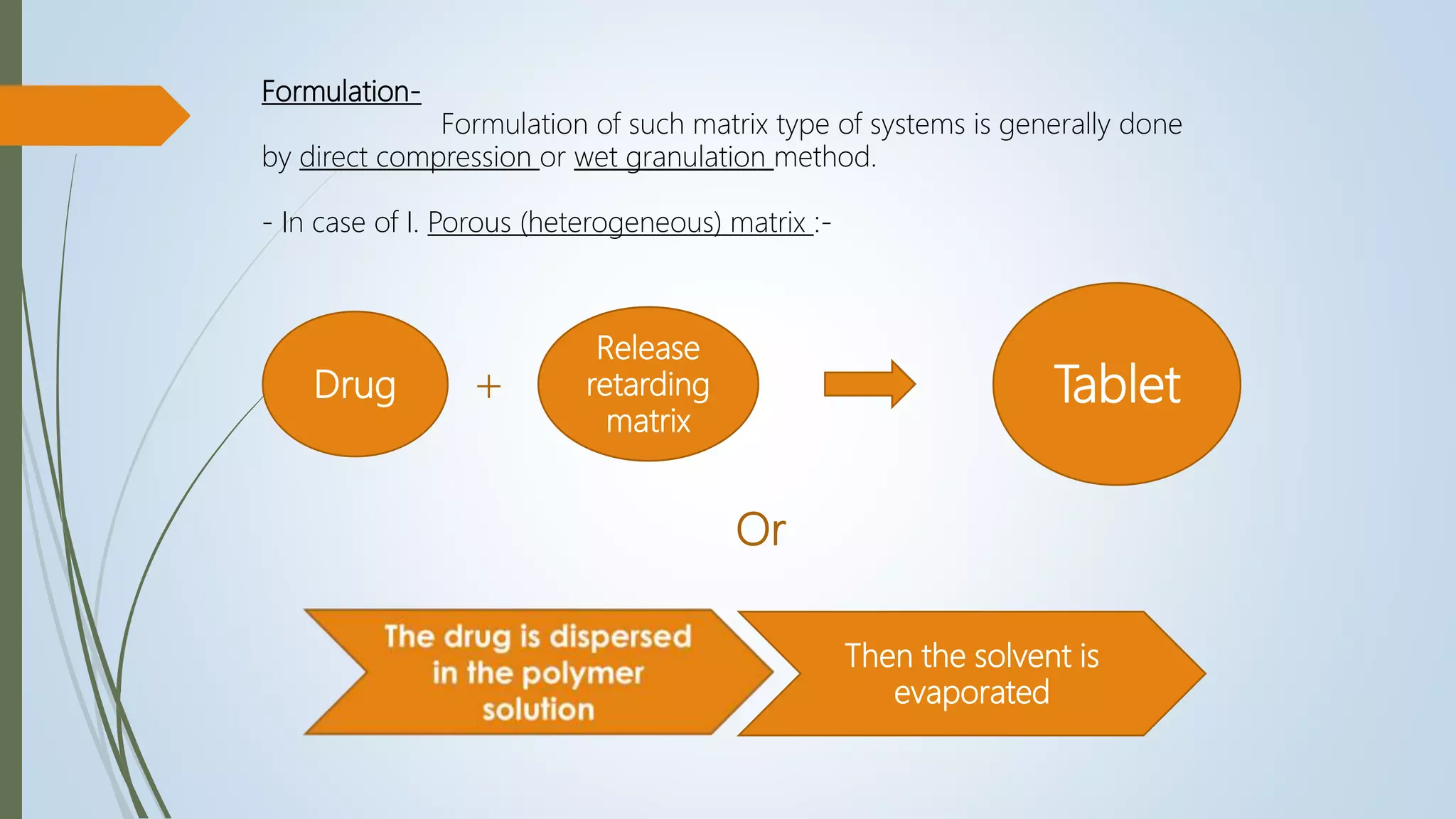
I. Porous (heterogeneous) matrix :
In these systems, the drug diffusion occurs through pores of the matrix.
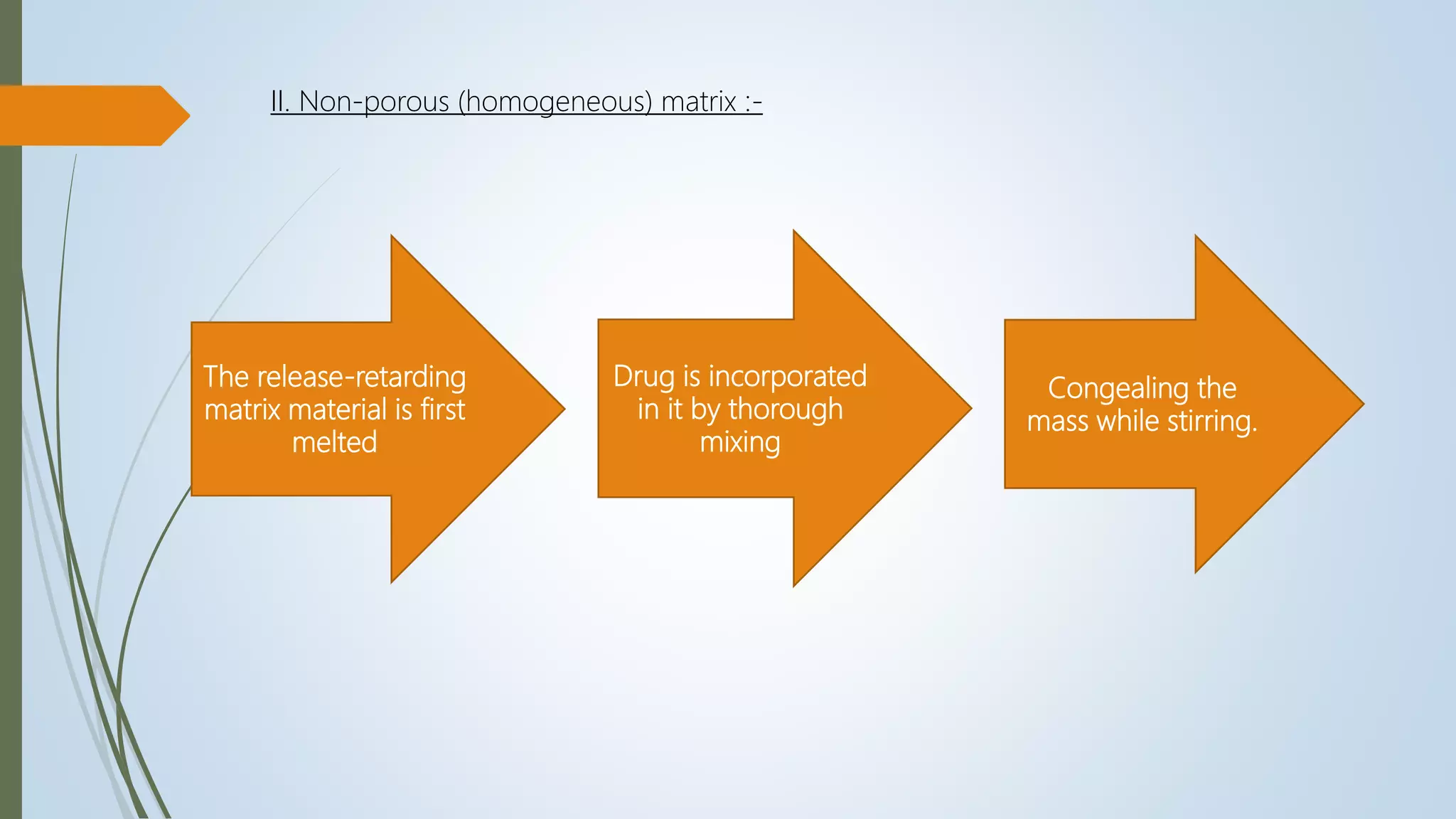
II. Non porous (homogenous) matrix :
These systems have no pores and the molecules diffuse through the network meshes.
Drug +
Release
retarding
matrix
Tablet
Formulation-
Formulation of such matrix type of systems is generally done
by direct compression or wet granulation method.
- In case of I. Porous (heterogeneous) matrix :-
Or
Then the solvent is
evaporated
The release-retarding
matrix material is first
melted
Drug is incorporated
in it by thorough
mixing
Congealing the
mass while stirring.
II. Non-porous (homogeneous) matrix :-
Mechanism of Drug Release from SR DDS
1. Dissolution controlled DDS
2. Diffusion controlled DDS
3. Erosion controlled DDS
4. Combination of dissolution, diffusion &/or erosion
controlled DDS
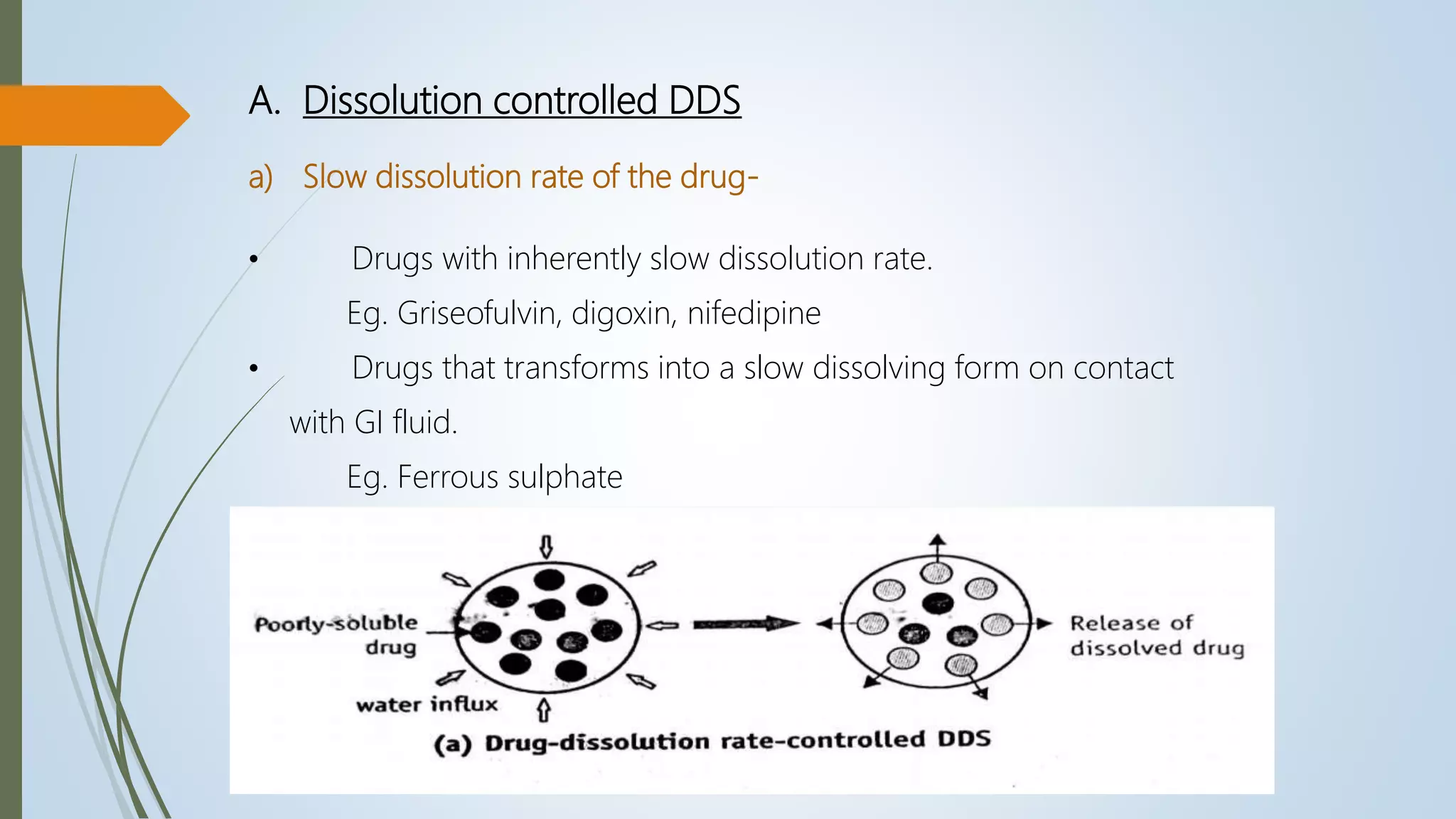
A. Dissolution controlled DDS
a) Slow dissolution rate of the drug-
• Drugs with inherently slow dissolution rate.
Eg. Griseofulvin, digoxin, nifedipine
• Drugs that transforms into a slow dissolving form on contact
with GI fluid.
Eg. Ferrous sulphate
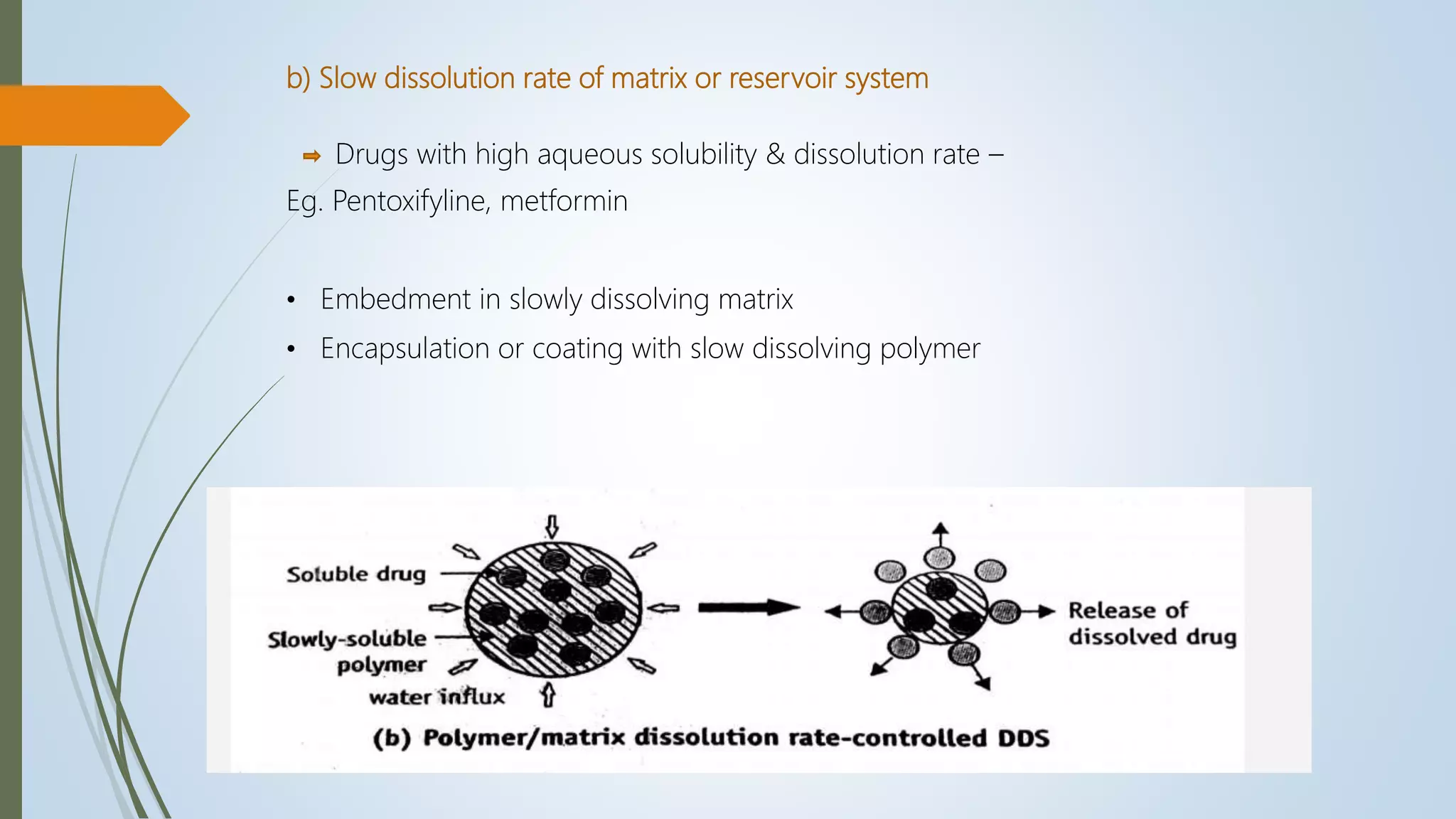
b) Slow dissolution rate of matrix or reservoir system
Drugs with high aqueous solubility & dissolution rate –
Eg. Pentoxifyline, metformin
• Embedment in slowly dissolving matrix
• Encapsulation or coating with slow dissolving polymer
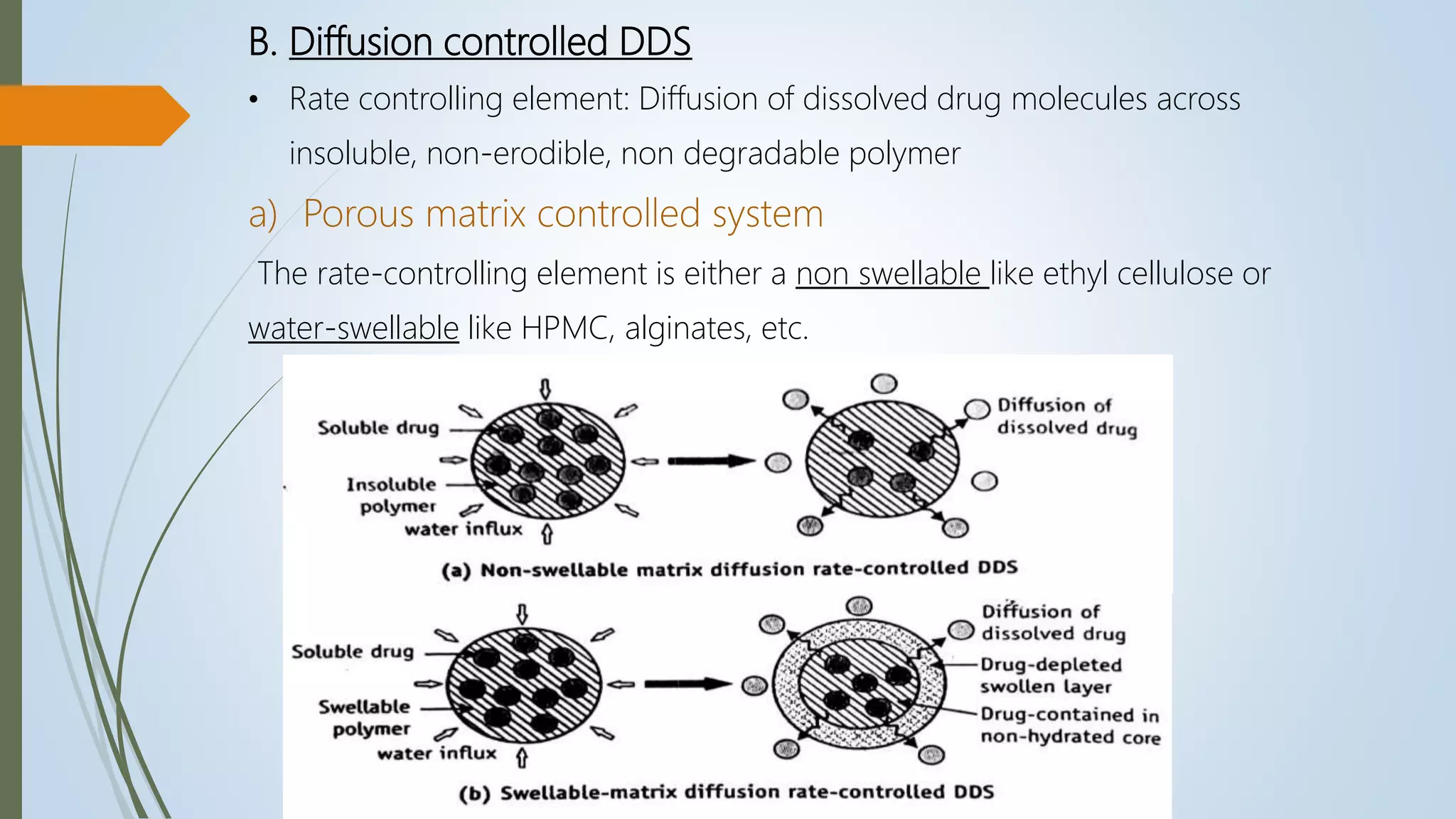
B. Diffusion controlled DDS
• Rate controlling element: Diffusion of dissolved drug molecules across
insoluble, non-erodible, non degradable polymer
a) Porous matrix controlled system
The rate-controlling element is either a non swellable like ethyl cellulose or
water-swellable like HPMC, alginates, etc.
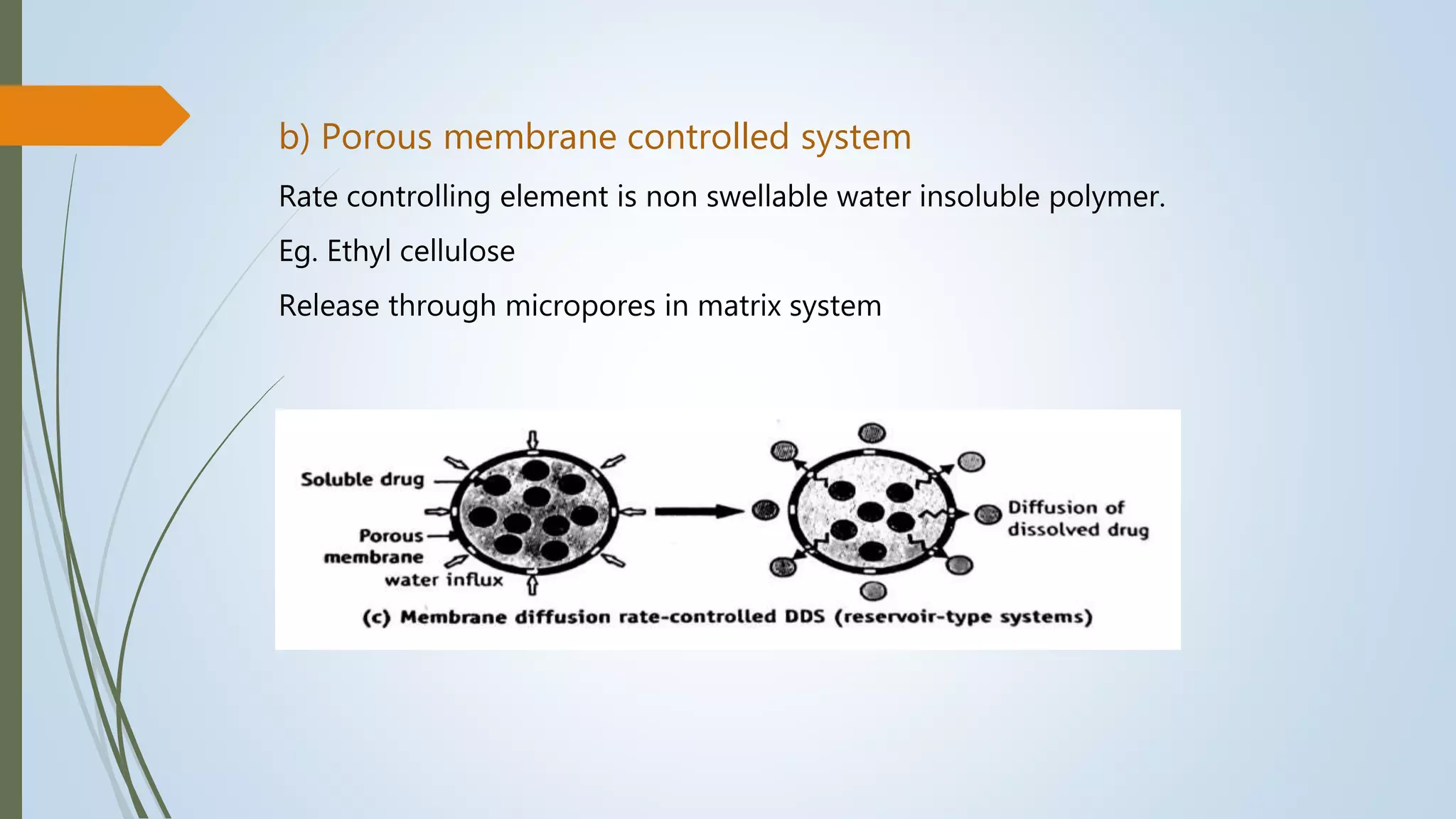
b) Porous membrane controlled system
Rate controlling element is non swellable water insoluble polymer.
Eg. Ethyl cellulose
Release through micropores in matrix system
C. Erosion controlled DDS
• Physical disintegration of a polymer/wax matrix as a result of degradation
and is characterized by material loss from the polymer.
• Polymer or wax degradation or hydrolysis is brought about by enzyme, pH
change or due to osmotic pressure or hydrodynamic pressure that causes
fragmentation.
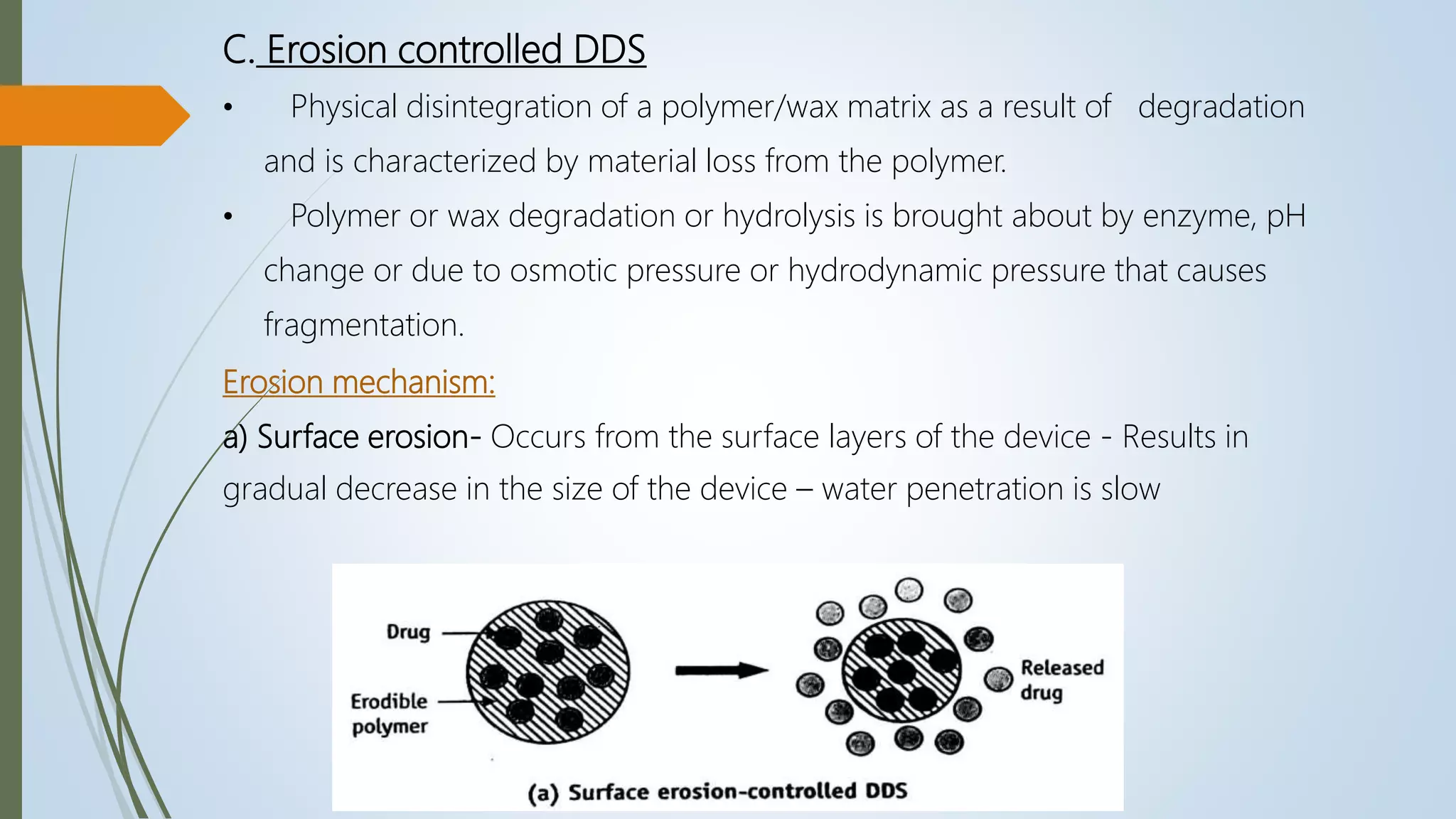
Erosion mechanism:
a) Surface erosion- Occurs from the surface layers of the device - Results in
gradual decrease in the size of the device – water penetration is slow
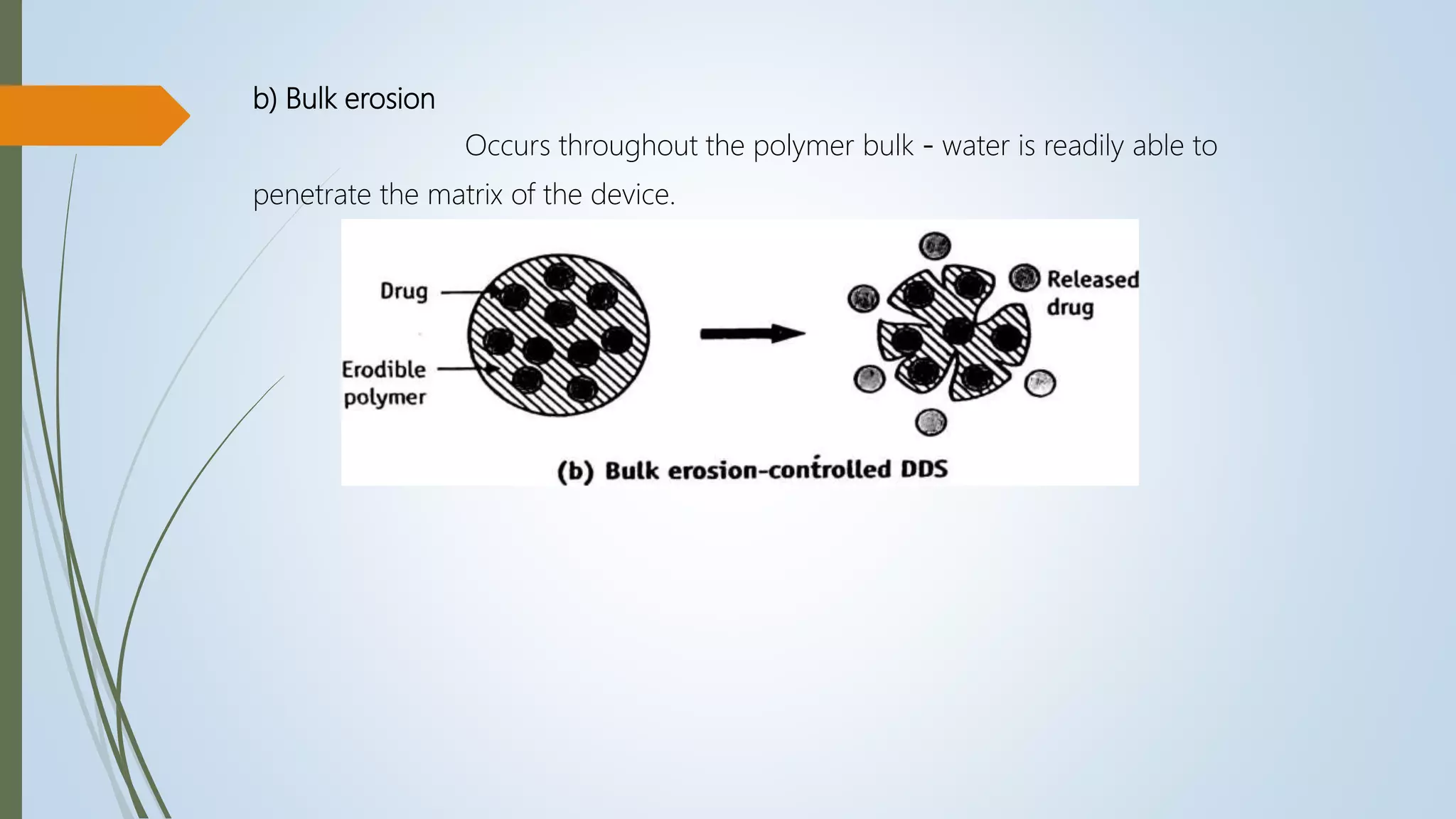
b) Bulk erosion
Occurs throughout the polymer bulk - water is readily able to
penetrate the matrix of the device.
D. Combination of dissolution, diffusion &/or erosion
controlled DDS
This system is a combination of two or more of the
three types of the system discussed above.
AIM &OBJECTIVE
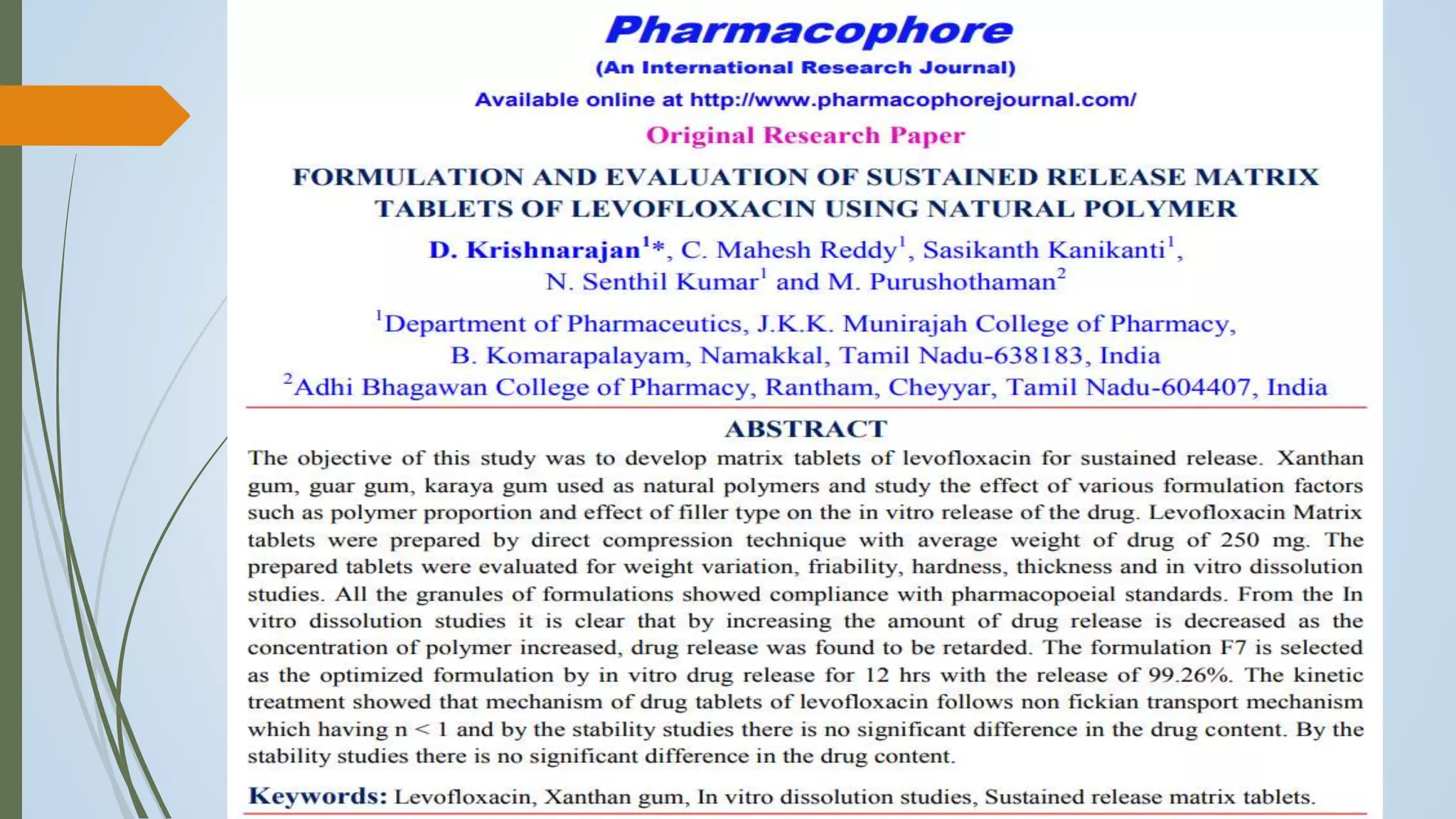
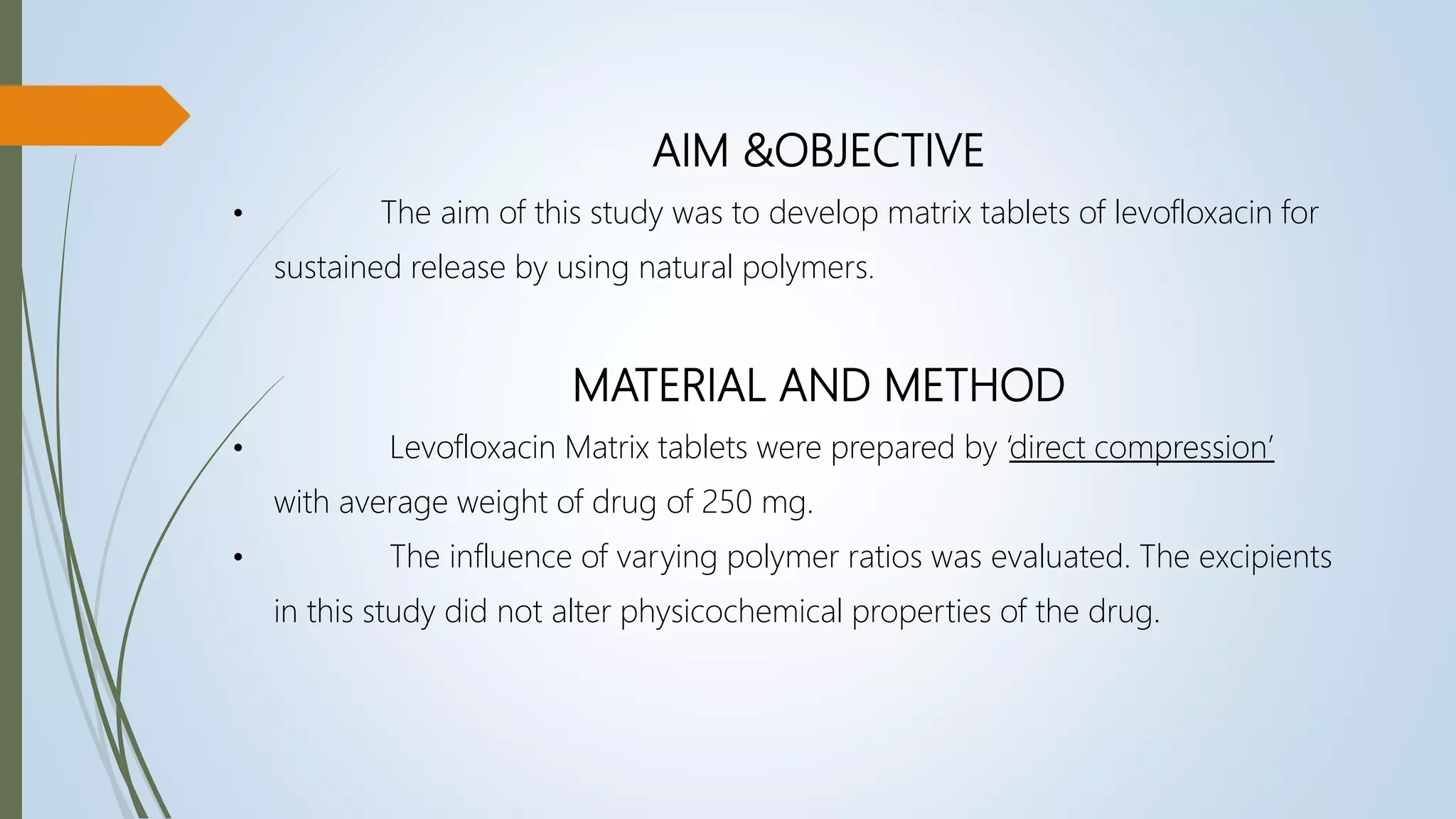
• The aim of this study was to develop matrix tablets of levofloxacin for
sustained release by using natural polymers.
MATERIAL AND METHOD
• Levofloxacin Matrix tablets were prepared by ‘direct compression’
with average weight of drug of 250 mg.
• The influence of varying polymer ratios was evaluated. The excipients
in this study did not alter physicochemical properties of the drug.
Formulation Table:-
Procedure:-
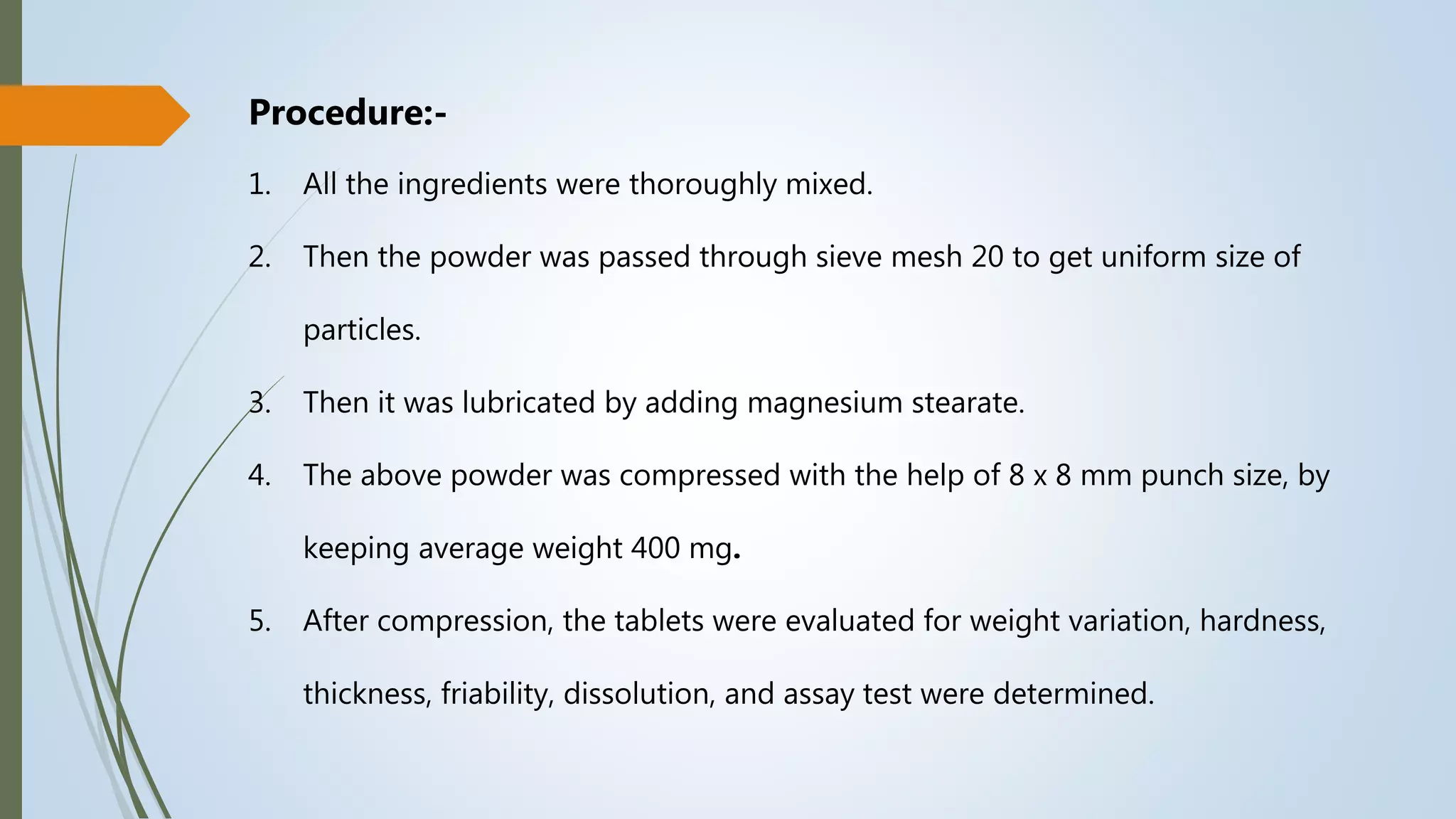
1. All the ingredients were thoroughly mixed.
2. Then the powder was passed through sieve mesh 20 to get uniform size of
particles.
3. Then it was lubricated by adding magnesium stearate.
4. The above powder was compressed with the help of 8 x 8 mm punch size, by
keeping average weight 400 mg.
5. After compression, the tablets were evaluated for weight variation, hardness,
thickness, friability, dissolution, and assay test were determined.
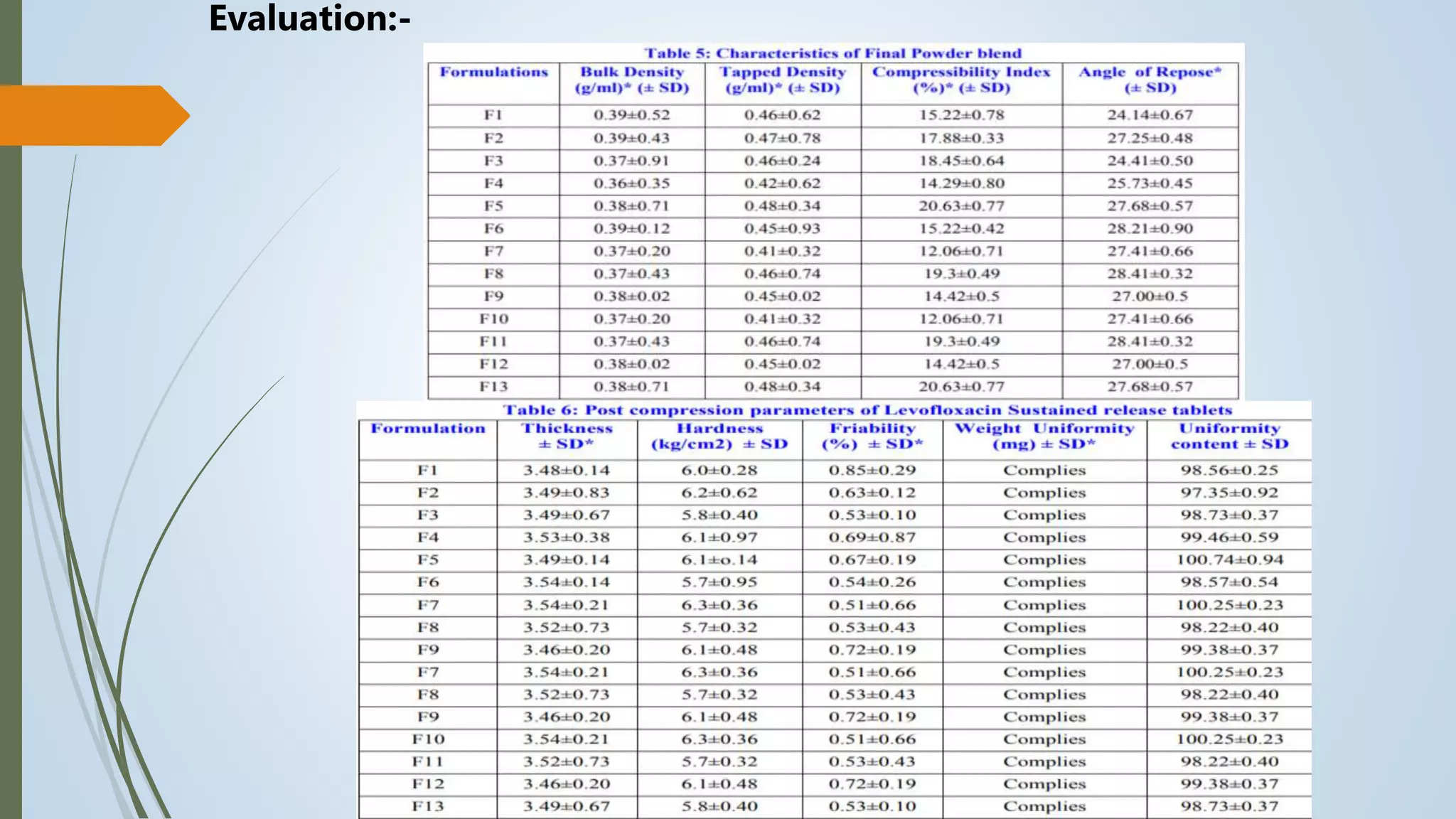
Evaluation:-
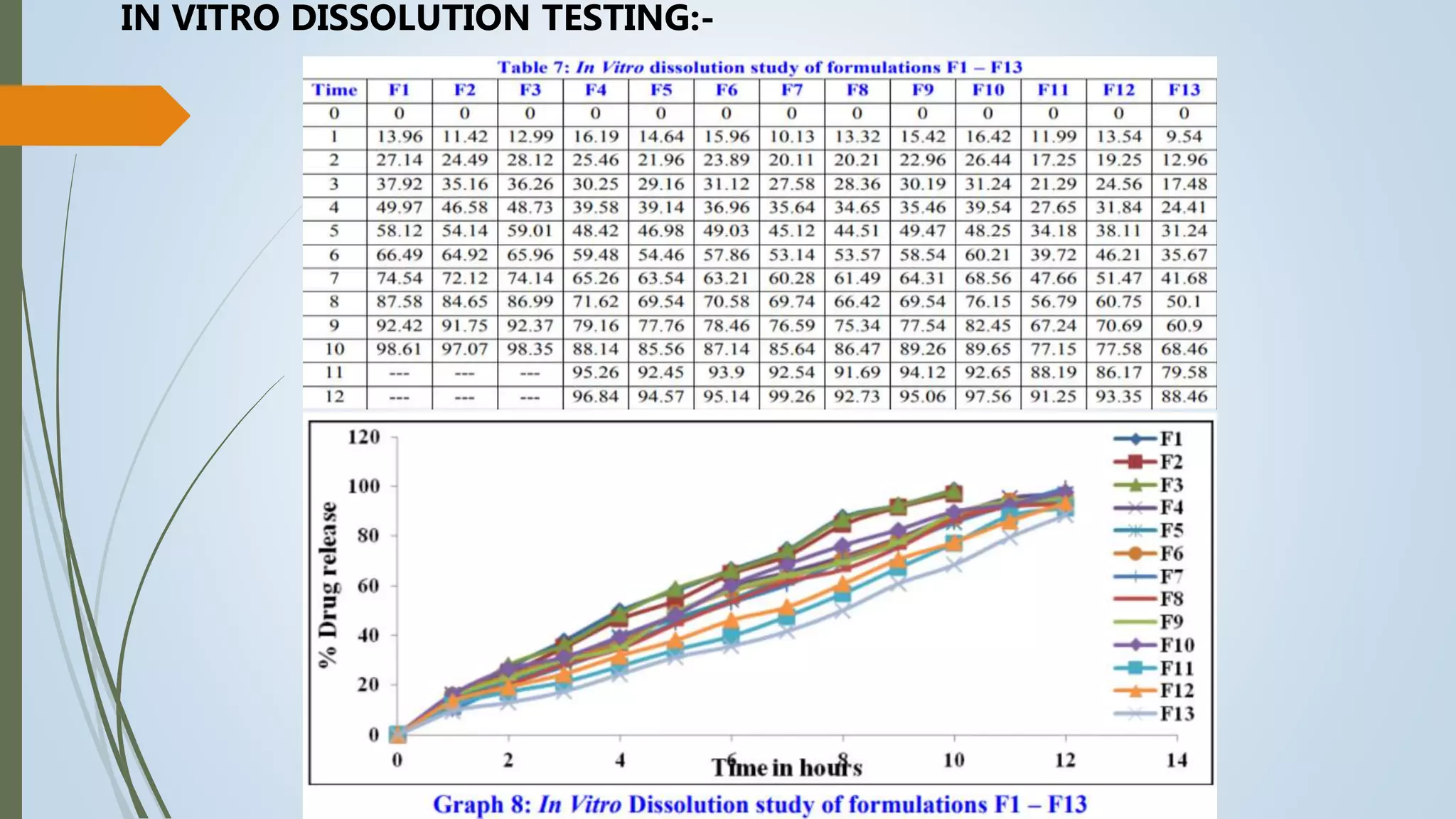
IN VITRO DISSOLUTION TESTING:-
CONCLUSION-
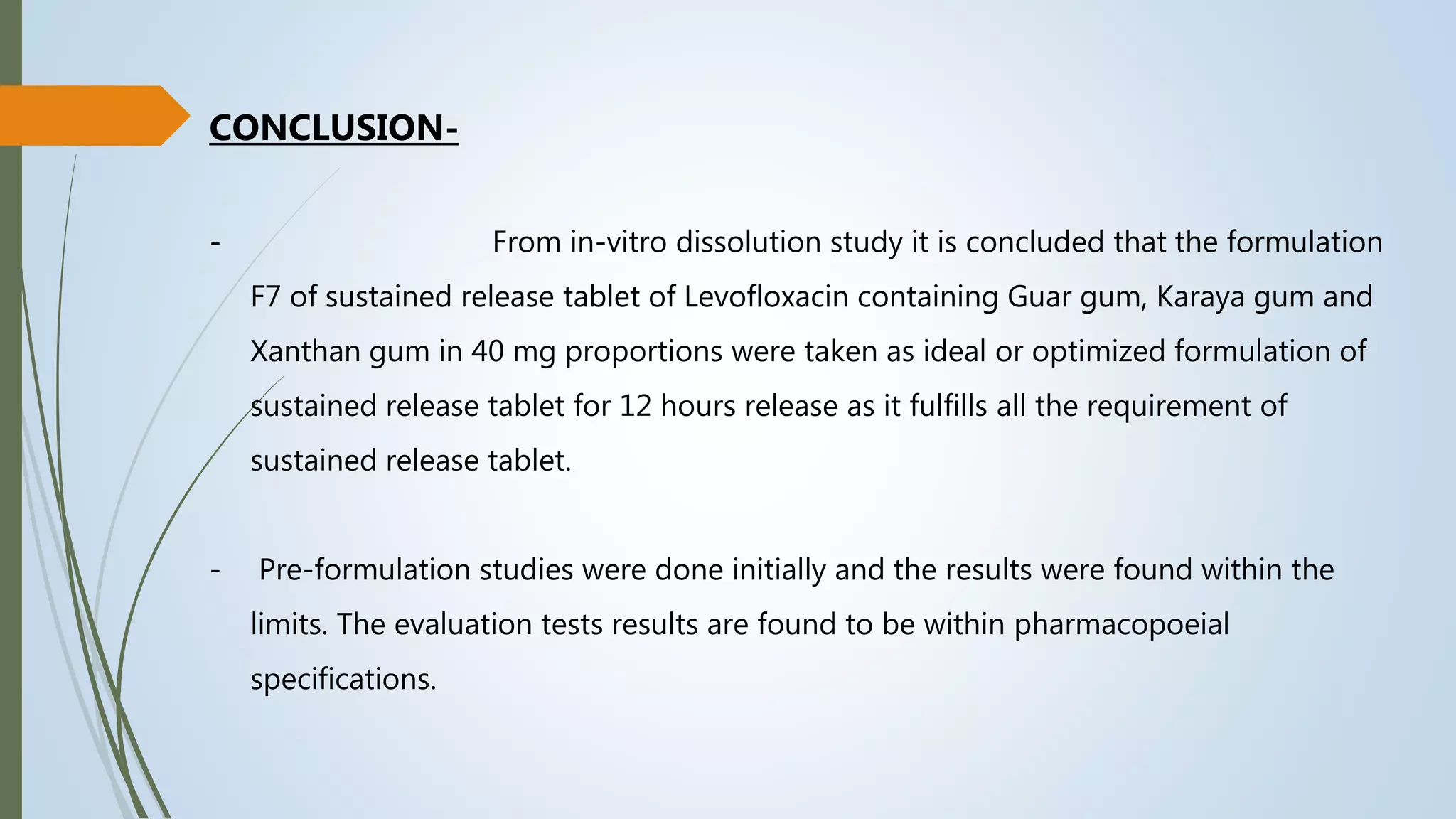
- From in-vitro dissolution study it is concluded that the formulation
F7 of sustained release tablet of Levofloxacin containing Guar gum, Karaya gum and
Xanthan gum in 40 mg proportions were taken as ideal or optimized formulation of
sustained release tablet for 12 hours release as it fulfills all the requirement of
sustained release tablet.
- Pre-formulation studies were done initially and the results were found within the
limits. The evaluation tests results are found to be within pharmacopoeial
specifications.
References:
1.Lachman/Lieberman’s the theory and practice of industrial pharmacy.
2. Biopharmaceutics and pharmacokinetics by D.M. Brahmankar and Sunil B. Jaiswal
3. Krishnarajan D, Mahesh Reddy C, Sasikanth Kanikanti SK, Purushothaman M.
Formulation and evaluation of sustained release matrix tablets of Levofloxacin
using natural polymer. Pharmacophore. 2013 Sep 1;4(5):146-57.
Formulation & evaluation of Sustained release matrix tablet

Formulation & evaluation of Sustained release matrix tablet

  • 1.
    Formulation and evaluationof sustained release matrix tablets: basics and mechanism of drug delivery BVDU’S Poona College of Pharmacy, Pune Name- Prathamesh Patil Roll no. - 09 M.Pharm 1st year ( Pharmaceutics )
  • 2.
    INTRODUCTION WHAT IS SUSTAINEDRELEASE ? It is any drug delivery system that achieves slow release of drugs over an extended period of time. • The Goals of SRDF’s is to obtain Zero order release from the dosage form. • Zero order release is a release which is independent of the amount of drug present in the dosage form. • Usually SRDF’s do not follow zero order release but they try to mimic zero order release by releasing the drug in a slow first order fashion.
  • 3.
  • 4.
    The main Aimof preparing sustained release formulations was intended to modify and improve the drug performance by • Increasing the duration of drug action. • Decreasing the frequency of dosing. • Decreasing the required dose employed. • Less adverse effects. • To minimize the fluctuation in plasma level. Why we need to formulate sustained release tablets???
  • 5.
    Sustained release DDSControlled release DDS -It provides medication over extended period of time. -It provides medication that provides constant drug level in blood. -It generally attains first order kinetics. -It maintains constant drug level in blood by releasing the drug in zero order pattern. -It may provide immediate release of drug followed by gradual slow for extended period of time. -It can deliver the drug at predetermined rate, for locally or systemically, for a specified period of time. COMPARISON BETWEEN CDDS AND SRDS
  • 6.
    ADVANTAGES 1. Improved patientcompliance. • Less frequent dosing • Allows whole day coverage. 2. Reduction in fluctuation in steady-state levels and therefore • Better control over disease condition. • Decreased local and systemic side effects. 3. Increased safety margin of high potency drugs due to better control of plasma levels. 4. Better drug utilization • Decreased total amount of drug used. • Minimum drug accumulation on chronic dosing. 5. Reduction in health care cost through- • Improved therapy • Decreased fluctuation in drug level i.e. uniform response. • Shorter treatment period.
  • 7.
    DISADVANTAGES 1.Decreased systemic availabilityin comparison to Immediate Release Conventional dosage forms. This may be due to: • Incomplete release. • Increased instability. • Insufficient residence time for complete release. • Site-specific absorption • pH-dependent solubility. 2.Poor IVIVC. 3.Possibility of Dose Dumping due to food, physiological or formulation variables & chewing or grinding of oral formulations by the patient and thus, increased risk of toxicity 4.Withdrawal of drug is difficult in case of toxicity, poisoning or hypersensitivity reactions. 5.Higher cost of formulation.
  • 8.
    • Sustained releaseoral formulations can be designed by following different ways: 1) Reservoir System ( membrane controlled ) 2) Matrix System ( Swellable/ degradable/ erodible/ Soluble ) 3) Hybrid System ( membrane cum matrix )
  • 9.
    MATRIX SYSTEM  Matrixtablets can be defined as the oral solid dosage forms in which drug is homogeneously dispersed or dissolved within the hydrophilic or hydrophobic polymeric release retarding materials.  Depending upon the physical properties of the matrix, two types of devices are possible.
  • 10.
  • 11.
    A] Hydrophilic matrix Inthis type of system the release-retarding material is water-swellable or cum erodible hydrocolloid such as high molecular weight HPMC, HPC, HEC, xanthan gum, alginate, etc. Hydrophilic matrices are porous systems. • Depending upon the swelling behaviour of hydrophilic polymer, two types of matrices are possible- 1) Freely swellable matrix In this type, the polymer swelling is unrestricted. 2) Restricted swelling matrix One in which the surface of the device is partially coated with an impermeable polymer film that restricts the hydration of swellable matrix material
  • 12.
    B] Hydrophobic matrix( plastic) In this type of system the release-retarding material is slowly soluble, erodible or digestible like waxes, hydrogenated vegetable oils, cetyl alcohol, etc. and insoluble or non digestible materials like ethyl cellulose, polymethacrylates, etc. - Depending upon the manner of incorporation of drug in the matrix, hydrophobic matrices can be further classified as: I. Porous (heterogeneous) matrix : In these systems, the drug diffusion occurs through pores of the matrix. II. Non porous (homogenous) matrix : These systems have no pores and the molecules diffuse through the network meshes.
  • 13.
    Drug + Release retarding matrix Tablet Formulation- Formulation ofsuch matrix type of systems is generally done by direct compression or wet granulation method. - In case of I. Porous (heterogeneous) matrix :- Or Then the solvent is evaporated
  • 14.
    The release-retarding matrix materialis first melted Drug is incorporated in it by thorough mixing Congealing the mass while stirring. II. Non-porous (homogeneous) matrix :-
  • 15.
    Mechanism of DrugRelease from SR DDS 1. Dissolution controlled DDS 2. Diffusion controlled DDS 3. Erosion controlled DDS 4. Combination of dissolution, diffusion &/or erosion controlled DDS
  • 16.
    A. Dissolution controlledDDS a) Slow dissolution rate of the drug- • Drugs with inherently slow dissolution rate. Eg. Griseofulvin, digoxin, nifedipine • Drugs that transforms into a slow dissolving form on contact with GI fluid. Eg. Ferrous sulphate
  • 17.
    b) Slow dissolutionrate of matrix or reservoir system Drugs with high aqueous solubility & dissolution rate – Eg. Pentoxifyline, metformin • Embedment in slowly dissolving matrix • Encapsulation or coating with slow dissolving polymer
  • 18.
    B. Diffusion controlledDDS • Rate controlling element: Diffusion of dissolved drug molecules across insoluble, non-erodible, non degradable polymer a) Porous matrix controlled system The rate-controlling element is either a non swellable like ethyl cellulose or water-swellable like HPMC, alginates, etc.
  • 19.
    b) Porous membranecontrolled system Rate controlling element is non swellable water insoluble polymer. Eg. Ethyl cellulose Release through micropores in matrix system
  • 20.
    C. Erosion controlledDDS • Physical disintegration of a polymer/wax matrix as a result of degradation and is characterized by material loss from the polymer. • Polymer or wax degradation or hydrolysis is brought about by enzyme, pH change or due to osmotic pressure or hydrodynamic pressure that causes fragmentation. Erosion mechanism: a) Surface erosion- Occurs from the surface layers of the device - Results in gradual decrease in the size of the device – water penetration is slow
  • 21.
    b) Bulk erosion Occursthroughout the polymer bulk - water is readily able to penetrate the matrix of the device.
  • 22.
    D. Combination ofdissolution, diffusion &/or erosion controlled DDS This system is a combination of two or more of the three types of the system discussed above.
  • 25.
    AIM &OBJECTIVE • Theaim of this study was to develop matrix tablets of levofloxacin for sustained release by using natural polymers. MATERIAL AND METHOD • Levofloxacin Matrix tablets were prepared by ‘direct compression’ with average weight of drug of 250 mg. • The influence of varying polymer ratios was evaluated. The excipients in this study did not alter physicochemical properties of the drug.
  • 26.
  • 27.
    Procedure:- 1. All theingredients were thoroughly mixed. 2. Then the powder was passed through sieve mesh 20 to get uniform size of particles. 3. Then it was lubricated by adding magnesium stearate. 4. The above powder was compressed with the help of 8 x 8 mm punch size, by keeping average weight 400 mg. 5. After compression, the tablets were evaluated for weight variation, hardness, thickness, friability, dissolution, and assay test were determined.
  • 28.
  • 29.
  • 30.
    CONCLUSION- - From in-vitrodissolution study it is concluded that the formulation F7 of sustained release tablet of Levofloxacin containing Guar gum, Karaya gum and Xanthan gum in 40 mg proportions were taken as ideal or optimized formulation of sustained release tablet for 12 hours release as it fulfills all the requirement of sustained release tablet. - Pre-formulation studies were done initially and the results were found within the limits. The evaluation tests results are found to be within pharmacopoeial specifications.
  • 31.
    References: 1.Lachman/Lieberman’s the theoryand practice of industrial pharmacy. 2. Biopharmaceutics and pharmacokinetics by D.M. Brahmankar and Sunil B. Jaiswal 3. Krishnarajan D, Mahesh Reddy C, Sasikanth Kanikanti SK, Purushothaman M. Formulation and evaluation of sustained release matrix tablets of Levofloxacin using natural polymer. Pharmacophore. 2013 Sep 1;4(5):146-57.