FORMULATION AND
DEVELOPMENT OF MATRIX TABLET
IN DRUG DELIVERY SYSTEM
BENGAL SCHOOL OF TECHNOLOGY
SUBJECT:- PHARMACEUTICS
-SAYAN PRAMANIK
BACHELOR OF PHARMACY
4th YEAR 7th SEM
INTRODUCTION
• Matrix tablet is an important tool for controlled and sustained release
dosage forms.
• The oral route remains the most common route for the administration of
drugs.
• Tablets offer the lowest cost approach to sustained and controlled
release dosage forms.
• Type of controlled drug delivery systems, which release the drug in
continuous manner.
• The hydrophilic polymer matrix is widely used in this dosage form.
2
ADVANTAGES
• Easy to manufacture
• Versatile, effective and low cost
• Can be made to release high molecular
weight compounds
• Improvement in treatment efficacy.
• Usage of less total drug.
• Improvement the bioavailability of some
drugs.
• Reduce the toxicity.
• Minimize the local and systemic side effects.
• Increase the stability.
• The remaining matrix must be removed
after the drug has been released.
• High cost of preparation.
• Poor in vitro-in vivo correlation.
• Higher cost of formulation
DISADVANTAGES
ADVANTAGES AND DISADVANTAGES OF
MATRIX TABLET
3
CLASSIFICATION OF MATRIX TABLET
• On the Basis of Retardant Material Used
I) Hydrophobic Matrices
II) Lipid Matrices
III) Hydrophilic Matrices
IV) Biodegradable Matrices
V) Mineral Matrices
• On the Basis of Porosity of Matrix
I) Macro porous Systems
II) Microporous System
III) Non-porous System
4
POLYMERS USED IN SR DRUG DELIVERY
SYSTEMS
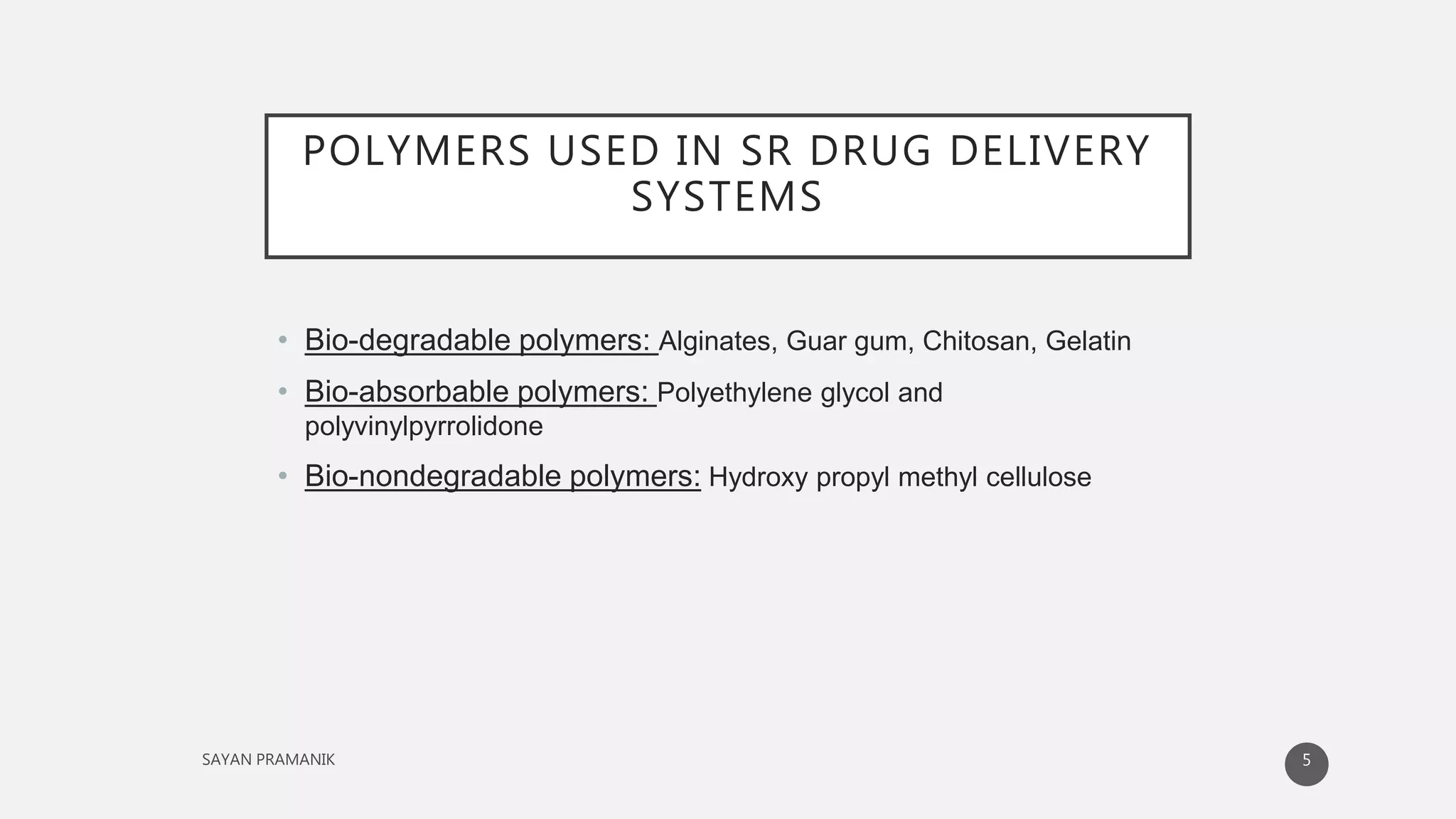
• Bio-degradable polymers: Alginates, Guar gum, Chitosan, Gelatin
• Bio-absorbable polymers: Polyethylene glycol and
polyvinylpyrrolidone
• Bio-nondegradable polymers: Hydroxy propyl methyl cellulose
5
EXPERIMENTAL WORK
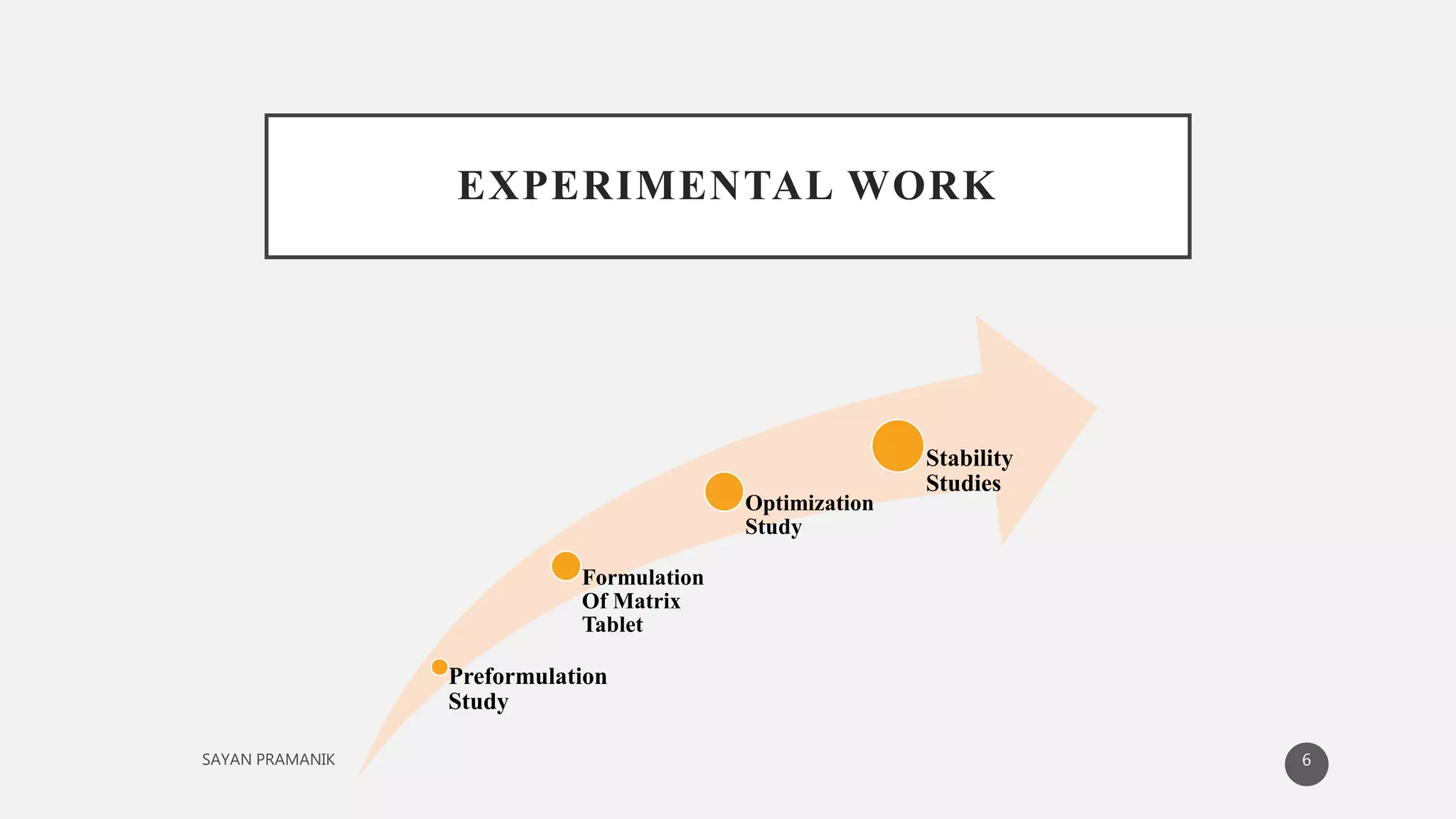
Preformulation
Study
Formulation
Of Matrix
Tablet
Optimization
Study
Stability
Studies
6
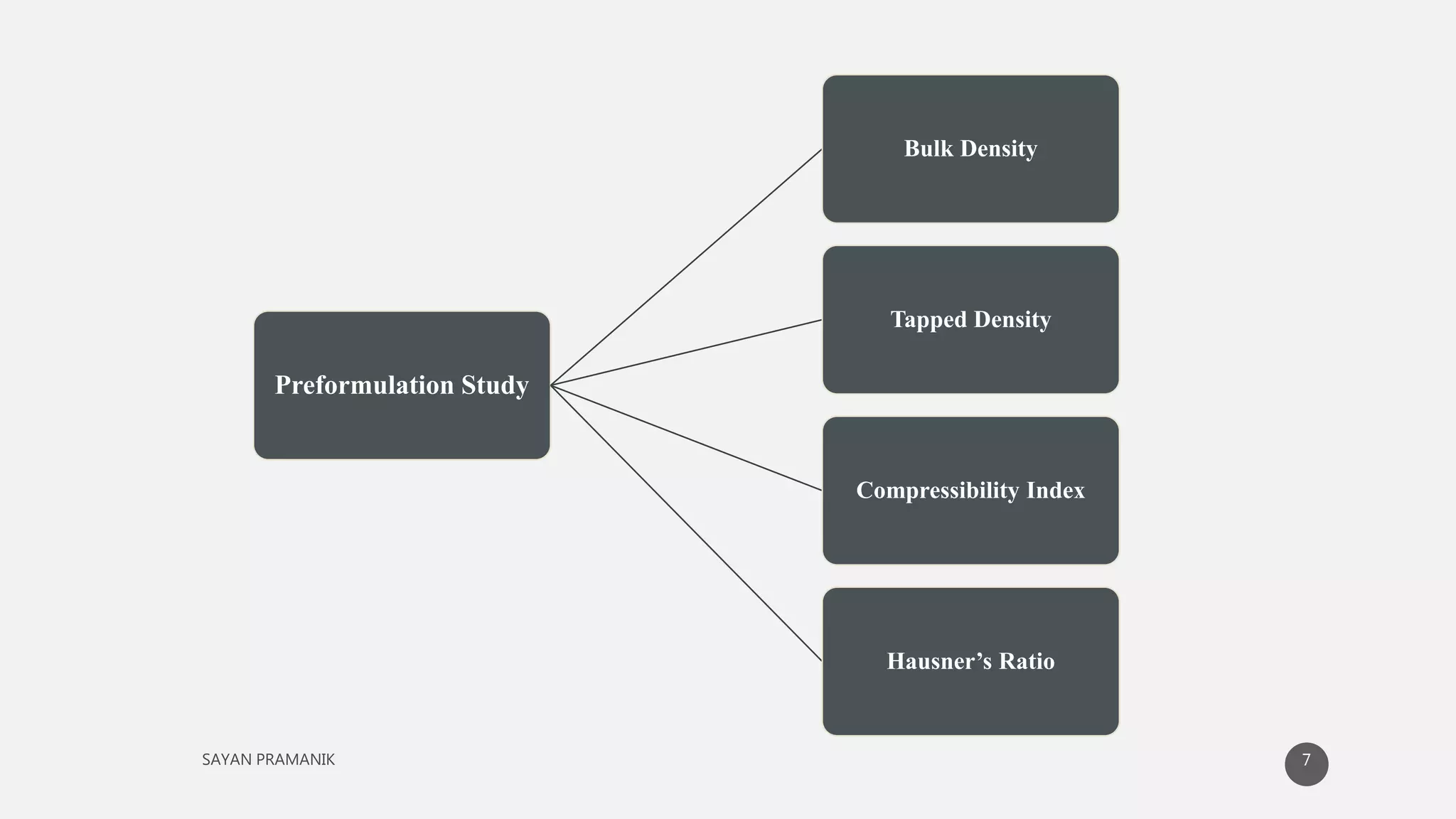
Preformulation Study
Bulk Density
Tapped Density
Compressibility Index
Hausner’s Ratio
7
FORMULATION OF MATRIX TABLET
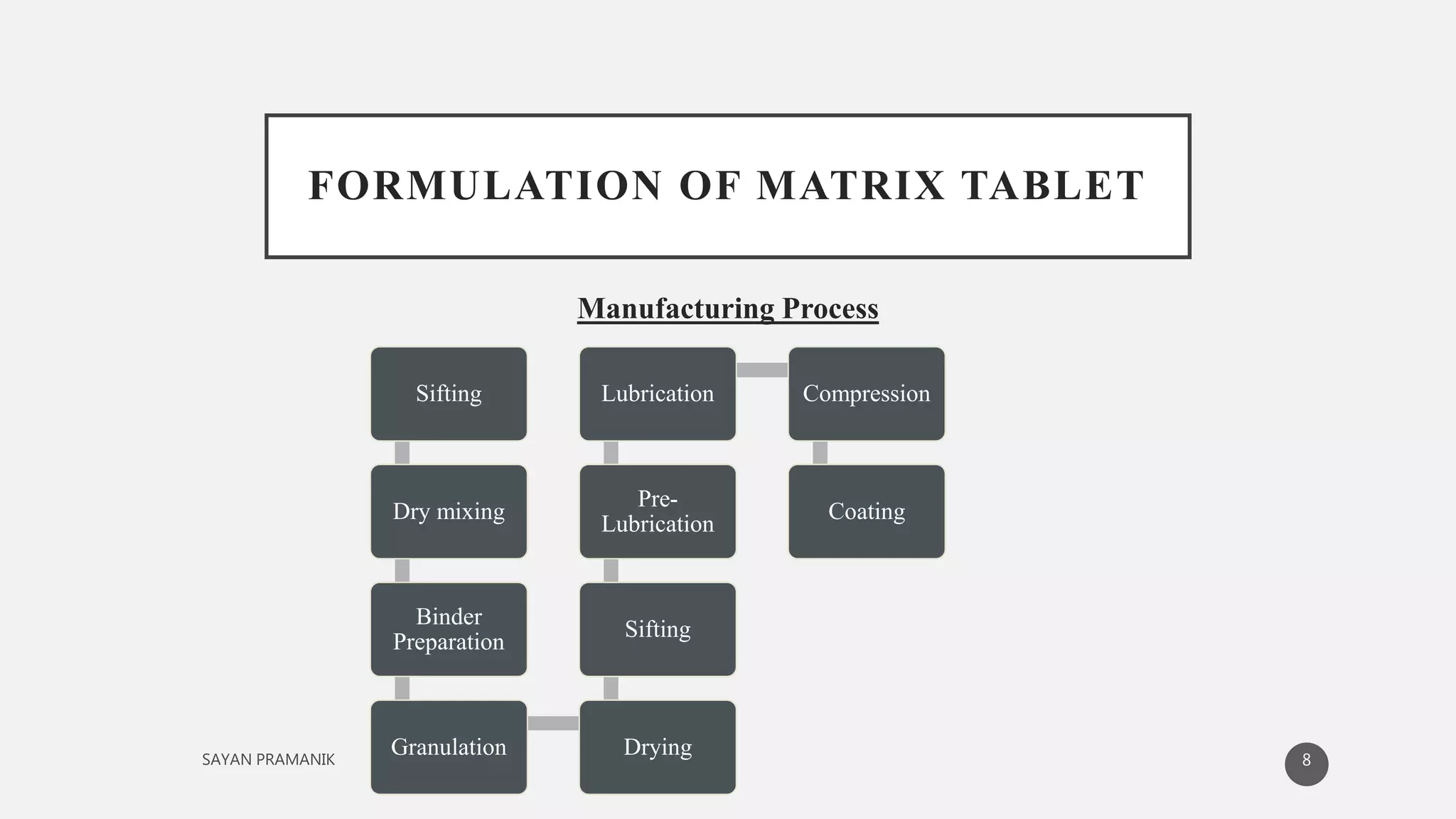
Manufacturing Process
Sifting
Dry mixing
Binder
Preparation
Granulation Drying
Sifting
Pre-
Lubrication
Lubrication Compression
Coating
8
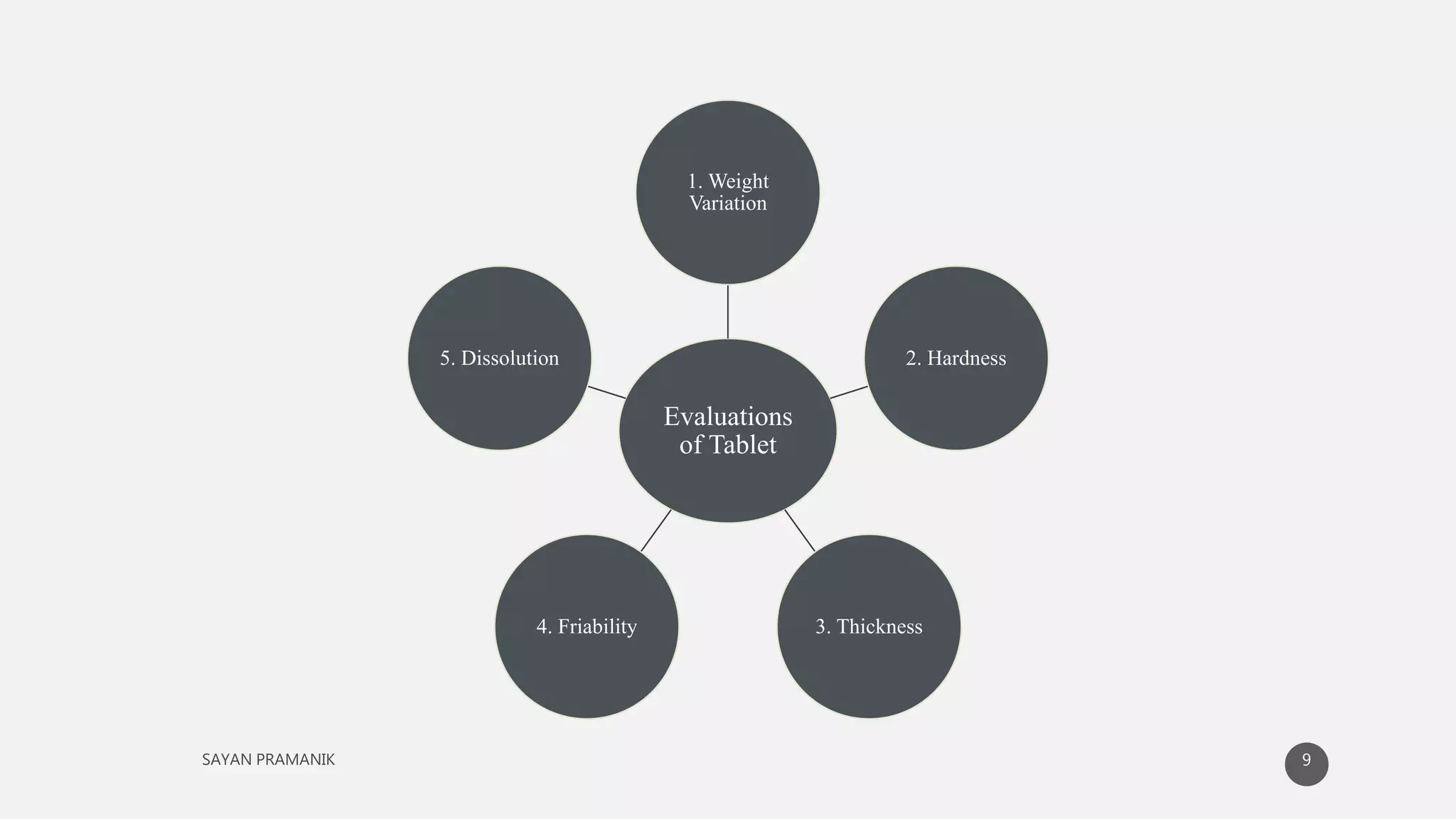
Evaluations
of Tablet
1. Weight
Variation
2. Hardness
3. Thickness
4. Friability
5. Dissolution
9
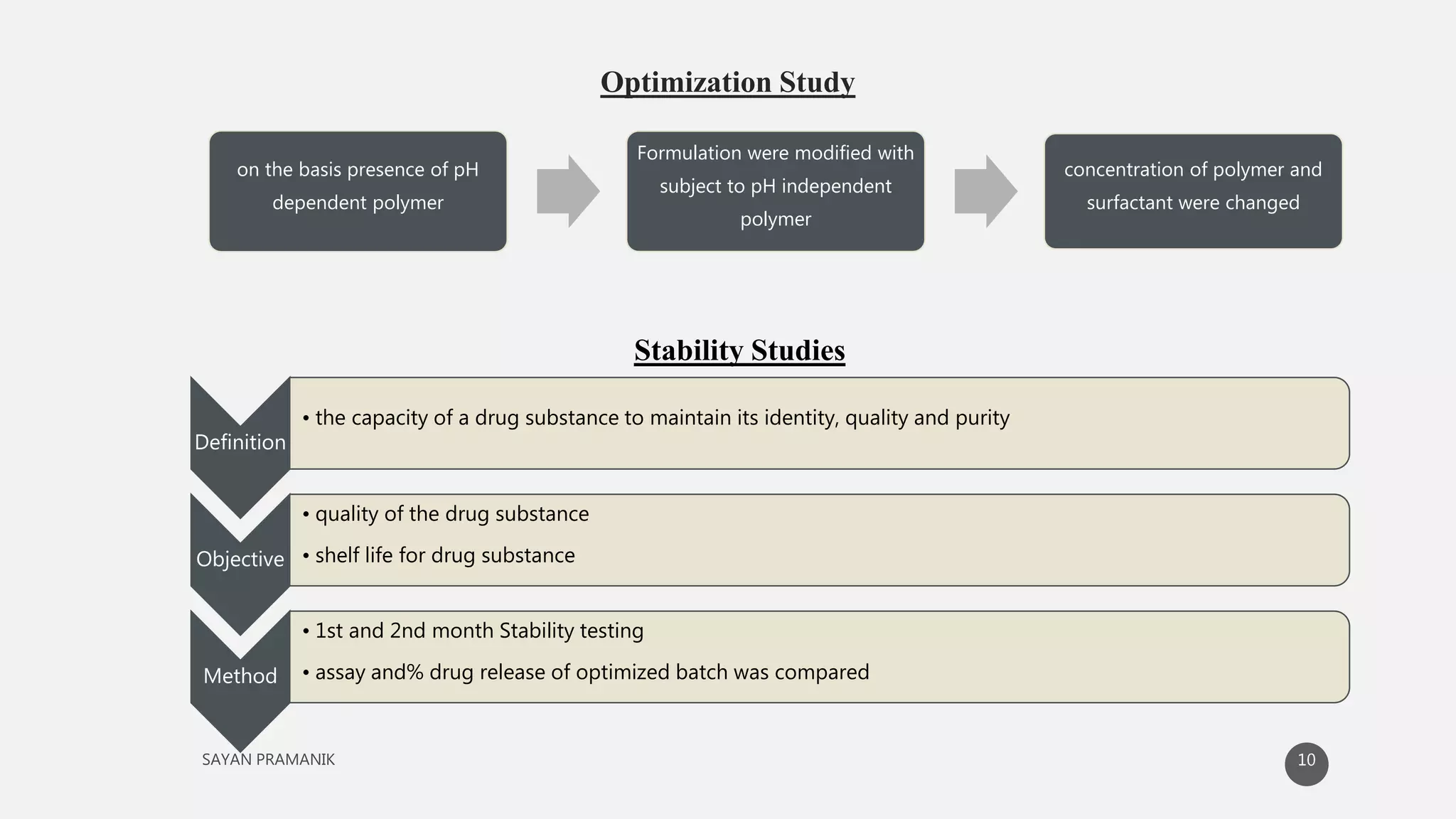
Optimization Study
on the basis presence of pH
dependent polymer
Formulation were modified with
subject to pH independent
polymer
concentration of polymer and
surfactant were changed
Stability Studies
Definition
• the capacity of a drug substance to maintain its identity, quality and purity
Objective
• quality of the drug substance
• shelf life for drug substance
Method
• 1st and 2nd month Stability testing
• assay and% drug release of optimized batch was compared
10
CONCLUSION
• By the above discussion, it can be easily concluded that sustained-
release formulation is helpful in increasing the efficiency of the dose as
well as they are also improving the patient’s compatibility. More over all
these comes with reasonable cost. The dosage form is easy to optimize
and very helpful in case of the antibiotics in which irrational use of the
same may result in resistance.
11

Formulation and Development of Matrix tablet In Drug Delivery System

  • 1.
    FORMULATION AND DEVELOPMENT OFMATRIX TABLET IN DRUG DELIVERY SYSTEM BENGAL SCHOOL OF TECHNOLOGY SUBJECT:- PHARMACEUTICS -SAYAN PRAMANIK BACHELOR OF PHARMACY 4th YEAR 7th SEM
  • 2.
    INTRODUCTION • Matrix tabletis an important tool for controlled and sustained release dosage forms. • The oral route remains the most common route for the administration of drugs. • Tablets offer the lowest cost approach to sustained and controlled release dosage forms. • Type of controlled drug delivery systems, which release the drug in continuous manner. • The hydrophilic polymer matrix is widely used in this dosage form. 2
  • 3.
    ADVANTAGES • Easy tomanufacture • Versatile, effective and low cost • Can be made to release high molecular weight compounds • Improvement in treatment efficacy. • Usage of less total drug. • Improvement the bioavailability of some drugs. • Reduce the toxicity. • Minimize the local and systemic side effects. • Increase the stability. • The remaining matrix must be removed after the drug has been released. • High cost of preparation. • Poor in vitro-in vivo correlation. • Higher cost of formulation DISADVANTAGES ADVANTAGES AND DISADVANTAGES OF MATRIX TABLET 3
  • 4.
    CLASSIFICATION OF MATRIXTABLET • On the Basis of Retardant Material Used I) Hydrophobic Matrices II) Lipid Matrices III) Hydrophilic Matrices IV) Biodegradable Matrices V) Mineral Matrices • On the Basis of Porosity of Matrix I) Macro porous Systems II) Microporous System III) Non-porous System 4
  • 5.
    POLYMERS USED INSR DRUG DELIVERY SYSTEMS • Bio-degradable polymers: Alginates, Guar gum, Chitosan, Gelatin • Bio-absorbable polymers: Polyethylene glycol and polyvinylpyrrolidone • Bio-nondegradable polymers: Hydroxy propyl methyl cellulose 5
  • 6.
  • 7.
    Preformulation Study Bulk Density TappedDensity Compressibility Index Hausner’s Ratio 7
  • 8.
    FORMULATION OF MATRIXTABLET Manufacturing Process Sifting Dry mixing Binder Preparation Granulation Drying Sifting Pre- Lubrication Lubrication Compression Coating 8
  • 9.
    Evaluations of Tablet 1. Weight Variation 2.Hardness 3. Thickness 4. Friability 5. Dissolution 9
  • 10.
    Optimization Study on thebasis presence of pH dependent polymer Formulation were modified with subject to pH independent polymer concentration of polymer and surfactant were changed Stability Studies Definition • the capacity of a drug substance to maintain its identity, quality and purity Objective • quality of the drug substance • shelf life for drug substance Method • 1st and 2nd month Stability testing • assay and% drug release of optimized batch was compared 10
  • 11.
    CONCLUSION • By theabove discussion, it can be easily concluded that sustained- release formulation is helpful in increasing the efficiency of the dose as well as they are also improving the patient’s compatibility. More over all these comes with reasonable cost. The dosage form is easy to optimize and very helpful in case of the antibiotics in which irrational use of the same may result in resistance. 11