DOMESTIC AVIATION INDUSTRY Group - IV
PRESENTED BY Rupali  M04 Milind Sarode  M Amarpreet Singh  Ghura  M02  Gurpreet Kour Lote  M07 Vijeta Wagle  M24 Santosh Singh    M Sharif  M10
Aviation Industry in India “ Once you get hooked on the airline business, it's worse than dope.” “ This is a nasty, rotten business.” “ Air transport is just a glorified bus operation.”
Aviation Industry in India History :  Before Independence Public Sector Privatization  Open Sky Policy Bilateral Treaties
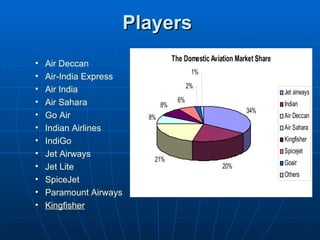
Players   Air  Deccan Air-India Express Air India Air Sahara Go Air Indian Airlines IndiGo Jet Airways Jet  Lite SpiceJet Paramount Airways Kingfisher
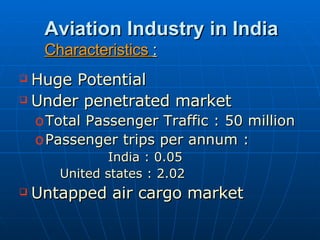
Aviation Industry in India Characteristics  : Huge Potential Under penetrated market Total Passenger Traffic : 50 million Passenger trips per annum :  India : 0.05  United states : 2.02 Untapped air cargo market
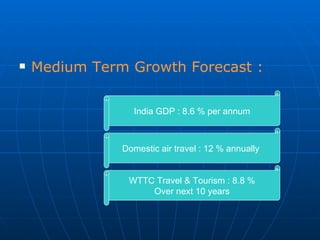
Medium Term Growth Forecast : India GDP : 8.6 % per annum WTTC Travel & Tourism : 8.8 % Over next 10 years Domestic air travel : 12 % annually
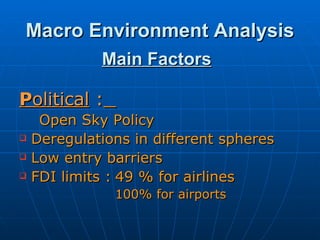
Macro Environment Analysis  Main Factors   P olitical  :   Open Sky Policy Deregulations in different spheres Low entry barriers FDI limits : 49 % for airlines  100% for airports
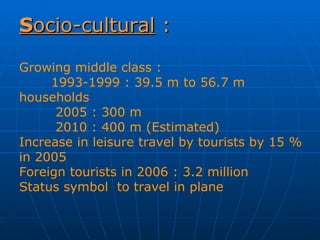
S ocio-cultural  : Growing middle class : 1993-1999 : 39.5 m to 56.7 m households   2005 : 300 m   2010 : 400 m (Estimated) Increase in leisure travel by tourists by 15 % in 2005 Foreign tourists in 2006 : 3.2 million  Status symbol  to travel in plane
E conomical  : Growing middle class income Consistent GDP growth of more than 8% and projected rate in two digits  Hike in average salary 14%(highest) in the world Tourism industry growth :8.8 %in 2005
T echnological  : Modernization & Privatization of Airports Modern Technology for efficient handling of aircraft, passenger and cargo. Example : ILS, CAT-3 Developing Greenfield Airports with Private Sector Example : Bangalore Airport Corporation Ltd.
Other Factors  : Demographic and Natural Environment  Changing pattern of consumers Highest percentage people of age group 20-25 Educational environment Shift towards family concept High energy cost
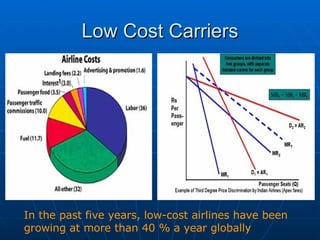
Low Cost Carriers In the past five years, low-cost airlines have been growing at more than 40 % a year globally
Business Model of Low Cost Carriers A single Passenger class A  single type of airplane reducing training  and service cost  No frills  such as free food/drinks, lounges etc. Emphasis on direct sale of ticket through Internet avoiding fee and commission paid to travel agents. Employees working in multiple roles Unbundling of ancillary charges to make the Headline fare lower
Low Cost Carriers in India Air Deccan SpiceJet IndiGo Airlines Go Air Jetlite (Formerly known as Air Sahara)
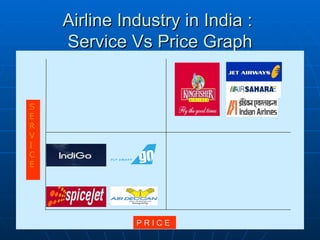
Airline Industry in India :  Service Vs Price Graph P R I C E SERVICE
Current Trends : Consolidations All Around Kingfisher-Air Deccan Deal Kingfisher buys out 26 % stake for Rs.550 crore. They have combined Market share of 33% They are second biggest player after Jet Sahara deal Jet airways and Air Sahara merger Air Sahara name changed to JetLite
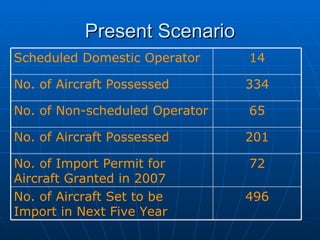
Present Scenario 496 No. of Aircraft Set to be Import in Next Five Year 72 No. of Import Permit for Aircraft Granted in 2007 201 No. of Aircraft Possessed  65 No. of Non-scheduled Operator 334 No. of Aircraft Possessed  14 Scheduled Domestic Operator
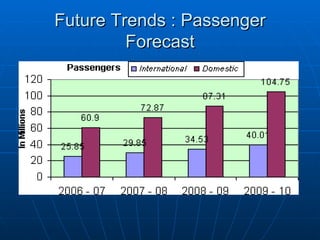
Future Trends : Passenger Forecast
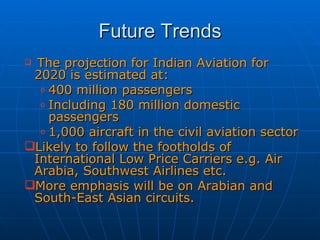
Future Trends The projection for Indian Aviation for 2020 is estimated at: 400 million passengers  Including 180 million domestic passengers  1,000 aircraft in the civil aviation sector Likely to follow the footholds of International Low Price Carriers e.g. Air Arabia, Southwest Airlines etc.  More emphasis will be on Arabian and South-East Asian circuits.
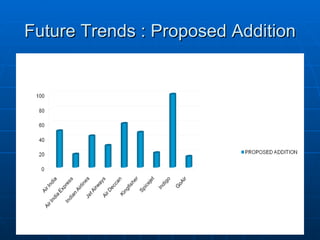
Future Trends : Proposed Addition
Challenges  Constraints : Infrastructure constraints Shortage of airport facilities Parking bays Air traffic control facilities Takeoff and landing slots. Less than 100 airports having more than one daily service.
References/Acknowledgements Article of Mr. S Sharma, Oct 2007 The Civil Aviation Act, 2000 (Draft) Business News from Hindustan Times Daily Report on ‘Study of the Indian Aviation Industry’ on   www.foolonahill.com www.findarticles.com     Wikipedia, the free content encyclopedia Economic servey, 2008 All site of domestic aviation Player  Remote Access Aviation System – RAAS
Thank You

Presentation On Aviation

  • 1.
  • 2.
    PRESENTED BY Rupali M04 Milind Sarode M Amarpreet Singh Ghura M02 Gurpreet Kour Lote M07 Vijeta Wagle M24 Santosh Singh M Sharif M10
  • 3.
    Aviation Industry inIndia “ Once you get hooked on the airline business, it's worse than dope.” “ This is a nasty, rotten business.” “ Air transport is just a glorified bus operation.”
  • 4.
    Aviation Industry inIndia History : Before Independence Public Sector Privatization Open Sky Policy Bilateral Treaties
  • 5.
    Players Air Deccan Air-India Express Air India Air Sahara Go Air Indian Airlines IndiGo Jet Airways Jet Lite SpiceJet Paramount Airways Kingfisher
  • 6.
    Aviation Industry inIndia Characteristics : Huge Potential Under penetrated market Total Passenger Traffic : 50 million Passenger trips per annum : India : 0.05 United states : 2.02 Untapped air cargo market
  • 7.
    Medium Term GrowthForecast : India GDP : 8.6 % per annum WTTC Travel & Tourism : 8.8 % Over next 10 years Domestic air travel : 12 % annually
  • 8.
    Macro Environment Analysis Main Factors P olitical : Open Sky Policy Deregulations in different spheres Low entry barriers FDI limits : 49 % for airlines 100% for airports
  • 9.
    S ocio-cultural : Growing middle class : 1993-1999 : 39.5 m to 56.7 m households 2005 : 300 m 2010 : 400 m (Estimated) Increase in leisure travel by tourists by 15 % in 2005 Foreign tourists in 2006 : 3.2 million Status symbol to travel in plane
  • 10.
    E conomical : Growing middle class income Consistent GDP growth of more than 8% and projected rate in two digits Hike in average salary 14%(highest) in the world Tourism industry growth :8.8 %in 2005
  • 11.
    T echnological : Modernization & Privatization of Airports Modern Technology for efficient handling of aircraft, passenger and cargo. Example : ILS, CAT-3 Developing Greenfield Airports with Private Sector Example : Bangalore Airport Corporation Ltd.
  • 12.
    Other Factors : Demographic and Natural Environment Changing pattern of consumers Highest percentage people of age group 20-25 Educational environment Shift towards family concept High energy cost
  • 13.
    Low Cost CarriersIn the past five years, low-cost airlines have been growing at more than 40 % a year globally
  • 14.
    Business Model ofLow Cost Carriers A single Passenger class A single type of airplane reducing training and service cost No frills such as free food/drinks, lounges etc. Emphasis on direct sale of ticket through Internet avoiding fee and commission paid to travel agents. Employees working in multiple roles Unbundling of ancillary charges to make the Headline fare lower
  • 15.
    Low Cost Carriersin India Air Deccan SpiceJet IndiGo Airlines Go Air Jetlite (Formerly known as Air Sahara)
  • 16.
    Airline Industry inIndia : Service Vs Price Graph P R I C E SERVICE
  • 17.
    Current Trends :Consolidations All Around Kingfisher-Air Deccan Deal Kingfisher buys out 26 % stake for Rs.550 crore. They have combined Market share of 33% They are second biggest player after Jet Sahara deal Jet airways and Air Sahara merger Air Sahara name changed to JetLite
  • 18.
    Present Scenario 496No. of Aircraft Set to be Import in Next Five Year 72 No. of Import Permit for Aircraft Granted in 2007 201 No. of Aircraft Possessed 65 No. of Non-scheduled Operator 334 No. of Aircraft Possessed 14 Scheduled Domestic Operator
  • 19.
    Future Trends :Passenger Forecast
  • 20.
    Future Trends Theprojection for Indian Aviation for 2020 is estimated at: 400 million passengers Including 180 million domestic passengers 1,000 aircraft in the civil aviation sector Likely to follow the footholds of International Low Price Carriers e.g. Air Arabia, Southwest Airlines etc. More emphasis will be on Arabian and South-East Asian circuits.
  • 21.
    Future Trends :Proposed Addition
  • 22.
    Challenges Constraints: Infrastructure constraints Shortage of airport facilities Parking bays Air traffic control facilities Takeoff and landing slots. Less than 100 airports having more than one daily service.
  • 23.
    References/Acknowledgements Article ofMr. S Sharma, Oct 2007 The Civil Aviation Act, 2000 (Draft) Business News from Hindustan Times Daily Report on ‘Study of the Indian Aviation Industry’ on www.foolonahill.com www.findarticles.com     Wikipedia, the free content encyclopedia Economic servey, 2008 All site of domestic aviation Player Remote Access Aviation System – RAAS
  • 24.