“Unmanned Aerospace Systems—An
Overview of Applications and Operations”
The Webinar begins at
2:00 p.m. Eastern Time (USA)
(11 a.m. Pacific/1 p.m. Central)
worldwide.erau.edu/webinars
Today’s Agenda
• Introductions
• Presentation by Prof. David Thirtyacre
• Questions and Answers
• ERAU UAS-related degree program
• Upcoming Webinar
• Attendance Certificate
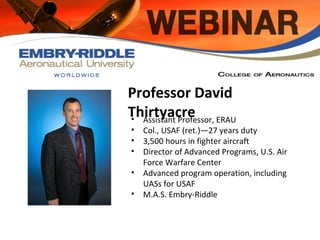
Professor David
Thirtyacre• Assistant Professor, ERAU
• Col., USAF (ret.)—27 years duty
• 3,500 hours in fighter aircraft
• Director of Advanced Programs, U.S. Air
Force Warfare Center
• Advanced program operation, including
UASs for USAF
• M.A.S. Embry-Riddle
4
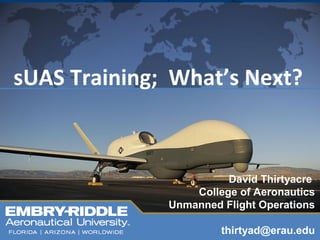
sUAS Training; What’s Next?
David Thirtyacre
College of Aeronautics
Unmanned Flight Operations
thirtyad@erau.edu
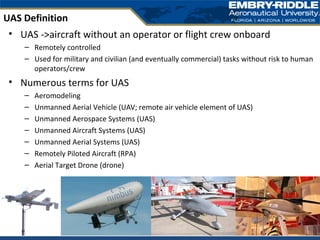
• UAS ->aircraft without an operator or flight crew onboard
– Remotely controlled
– Used for military and civilian (and eventually commercial) tasks without risk to human
operators/crew
• Numerous terms for UAS
– Aeromodeling
– Unmanned Aerial Vehicle (UAV; remote air vehicle element of UAS)
– Unmanned Aerospace Systems (UAS)
– Unmanned Aircraft Systems (UAS)
– Unmanned Aerial Systems (UAS)
– Remotely Piloted Aircraft (RPA)
– Aerial Target Drone (drone)
UAS Definition
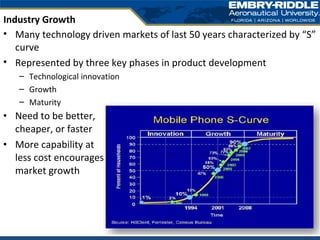
• Many technology driven markets of last 50 years characterized by “S”
curve
• Represented by three key phases in product development
– Technological innovation
– Growth
– Maturity
Industry Growth
• Need to be better,
cheaper, or faster
• More capability at
less cost encourages
market growth
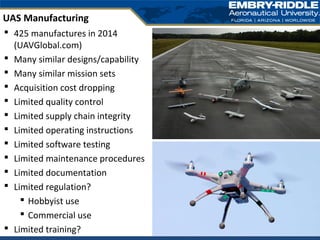
 425 manufactures in 2014
(UAVGlobal.com)
 Many similar designs/capability
 Many similar mission sets
 Acquisition cost dropping
 Limited quality control
 Limited supply chain integrity
 Limited operating instructions
 Limited software testing
 Limited maintenance procedures
 Limited documentation
 Limited regulation?
 Hobbyist use
 Commercial use
 Limited training?
UAS Manufacturing
 Recent NTSB ruling that sUAS are aircraft
 FAA can regulate
 No careless or reckless operations
 Commercial use requires:
 Special Airworthiness Certificate (Civil operators)
 Certificate of Authorization or Waiver (Public operators)
 Part 333 exemptions (Civil operators)
 Hobbyist
 Community of practice guidelines
Regulations
 Limitations
 Less than: 55lbs (25kg), 100mph (87kts), 500ft AGL
 Visual line-of-sight only (close enough for operator to see)
 First Person View (FPV) doesn’t count
 No operations over persons
 Day only
 Operations in B, C, D and E airspace with permission from ATC
 Operations in Class G airspace without permission
 No careless or reckless operations
FAA Proposed Part 107
Notice of Proposed Rulemaking (NPRM)
Commercial sUAS
 Operator Certification
 Pilots of sUAS considered “Operators”
 Pass an initial aeronautical knowledge test
 Be vetted by the Transportation Security Administration
 Obtain operator certificate (small UAS training)
 Must be 17years old
 Report accidents
 Ensure sUAS is safe to fly
 Recurrent aeronautical test every 24 mos
FAA Proposed Part 107
Notice of Proposed Rulemaking (NPRM)
Commercial sUAS
 If NPRM as written:
 General Aeronautical knowledge (FAA testing center)
 Airspace, weather, aerodynamics, communications, etc
 Operators Certificate
 Qualifications to instruct?
 On what type (RW, FW, Hybrid, manufacturer?)
 Written exam?
 Practical exam?
 To what standard?
 All trained on platforms with limited procedures
Training
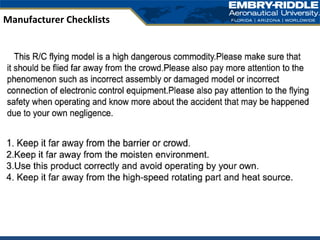
Manufacturer Checklists
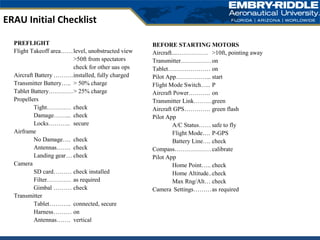
ERAU Initial Checklist
PREFLIGHT
Flight Takeoff area……level, unobstructed view
>50ft from spectators
check for other uas ops
Aircraft Battery ……….installed, fully charged
Transmitter Battery….. > 50% charge
Tablet Battery…………> 25% charge
Propellers
Tight………… check
Damage……... check
Locks……….. secure
Airframe
No Damage…. check
Antennas……. check
Landing gear… check
Camera
SD card……… check installed
Filter………… as required
Gimbal ……… check
Transmitter
Tablet……….. connected, secure
Harness……… on
Antennas……. vertical
BEFORE STARTING MOTORS
Aircraft....…………… >10ft, pointing away
Transmitter……………on
Tablet………………… on
Pilot App……………... start
Flight Mode Switch….. P
Aircraft Power……….. on
Transmitter Link………green
Aircraft GPS…………. green flash
Pilot App
A/C Status…… safe to fly
Flight Mode…. P-GPS
Battery Line…. check
Compass………………calibrate
Pilot App
Home Point….. check
Home Altitude..check
Max Rng/Alt… check
Camera Settings………as required
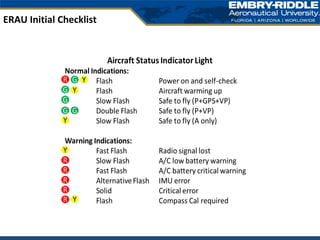
ERAU Initial Checklist
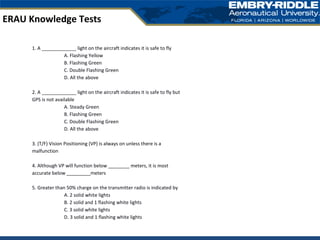
ERAU Knowledge Tests
1. A _____________ light on the aircraft indicates it is safe to fly
A. Flashing Yellow
B. Flashing Green
C. Double Flashing Green
D. All the above
2. A _____________ light on the aircraft indicates it is safe to fly but
GPS is not available
A. Steady Green
B. Flashing Green
C. Double Flashing Green
D. All the above
3. (T/F) Vision Positioning (VP) is always on unless there is a
malfunction
4. Although VP will function below ________ meters, it is most
accurate below _________meters
5. Greater than 50% charge on the transmitter radio is indicated by
A. 2 solid white lights
B. 2 solid and 1 flashing white lights
C. 3 solid white lights
D. 3 solid and 1 flashing white lights
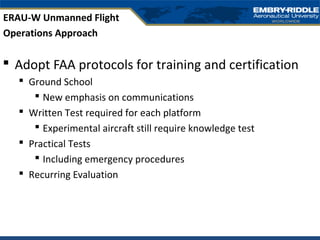
 Adopt FAA protocols for training and certification
 Ground School
 New emphasis on communications
 Written Test required for each platform
 Experimental aircraft still require knowledge test
 Practical Tests
 Including emergency procedures
 Recurring Evaluation
ERAU-W Unmanned Flight
Operations Approach
 sUAS manufacturing, training and commercial use
are all growth areas
 FAA NPRM indicates direction of regulations
 FAA certified training and testing will be required to
operate sUAS for commercial use
 The sUAS training market is in the infancy stage
 Common operating procedures only exist inside
organizations
Summary
QUESTIONS?
David Thirtyacre
Assistant Professor, Aeronautics
thirtyad@erau.edu
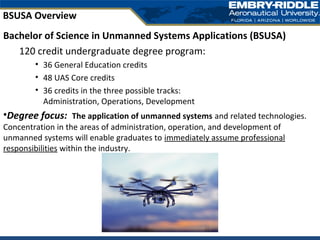
Bachelor of Science in Unmanned Systems Applications (BSUSA)
120 credit undergraduate degree program:
• 36 General Education credits
• 48 UAS Core credits
• 36 credits in the three possible tracks:
Administration, Operations, Development
•Degree focus: The application of unmanned systems and related technologies.
Concentration in the areas of administration, operation, and development of
unmanned systems will enable graduates to immediately assume professional
responsibilities within the industry.
BSUSA Overview
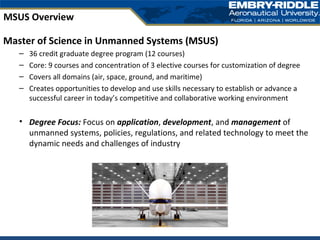
Master of Science in Unmanned Systems (MSUS)
– 36 credit graduate degree program (12 courses)
– Core: 9 courses and concentration of 3 elective courses for customization of degree
– Covers all domains (air, space, ground, and maritime)
– Creates opportunities to develop and use skills necessary to establish or advance a
successful career in today’s competitive and collaborative working environment
• Degree Focus: Focus on application, development, and management of
unmanned systems, policies, regulations, and related technology to meet the
dynamic needs and challenges of industry
MSUS Overview
Upcoming Webinar:
• June 9 Interviewing to Get the Job
worldwide.erau.edu/webinars
Todays Presentation:
Prof. David Thirtyacre
thirtyad@erau.edu
~~~
For questions about the webinar series:
Bill Gibbs, Webinar Series Coordinator
bill.gibbs@erau.edu

UAS--Unmanned Aerospace Systems

  • 1.
    “Unmanned Aerospace Systems—An Overviewof Applications and Operations” The Webinar begins at 2:00 p.m. Eastern Time (USA) (11 a.m. Pacific/1 p.m. Central) worldwide.erau.edu/webinars
  • 2.
    Today’s Agenda • Introductions •Presentation by Prof. David Thirtyacre • Questions and Answers • ERAU UAS-related degree program • Upcoming Webinar • Attendance Certificate
  • 3.
    Professor David Thirtyacre• AssistantProfessor, ERAU • Col., USAF (ret.)—27 years duty • 3,500 hours in fighter aircraft • Director of Advanced Programs, U.S. Air Force Warfare Center • Advanced program operation, including UASs for USAF • M.A.S. Embry-Riddle
  • 4.
    4 sUAS Training; What’sNext? David Thirtyacre College of Aeronautics Unmanned Flight Operations thirtyad@erau.edu
  • 5.
    • UAS ->aircraftwithout an operator or flight crew onboard – Remotely controlled – Used for military and civilian (and eventually commercial) tasks without risk to human operators/crew • Numerous terms for UAS – Aeromodeling – Unmanned Aerial Vehicle (UAV; remote air vehicle element of UAS) – Unmanned Aerospace Systems (UAS) – Unmanned Aircraft Systems (UAS) – Unmanned Aerial Systems (UAS) – Remotely Piloted Aircraft (RPA) – Aerial Target Drone (drone) UAS Definition
  • 6.
    • Many technologydriven markets of last 50 years characterized by “S” curve • Represented by three key phases in product development – Technological innovation – Growth – Maturity Industry Growth • Need to be better, cheaper, or faster • More capability at less cost encourages market growth
  • 7.
     425 manufacturesin 2014 (UAVGlobal.com)  Many similar designs/capability  Many similar mission sets  Acquisition cost dropping  Limited quality control  Limited supply chain integrity  Limited operating instructions  Limited software testing  Limited maintenance procedures  Limited documentation  Limited regulation?  Hobbyist use  Commercial use  Limited training? UAS Manufacturing
  • 8.
     Recent NTSBruling that sUAS are aircraft  FAA can regulate  No careless or reckless operations  Commercial use requires:  Special Airworthiness Certificate (Civil operators)  Certificate of Authorization or Waiver (Public operators)  Part 333 exemptions (Civil operators)  Hobbyist  Community of practice guidelines Regulations
  • 9.
     Limitations  Lessthan: 55lbs (25kg), 100mph (87kts), 500ft AGL  Visual line-of-sight only (close enough for operator to see)  First Person View (FPV) doesn’t count  No operations over persons  Day only  Operations in B, C, D and E airspace with permission from ATC  Operations in Class G airspace without permission  No careless or reckless operations FAA Proposed Part 107 Notice of Proposed Rulemaking (NPRM) Commercial sUAS
  • 10.
     Operator Certification Pilots of sUAS considered “Operators”  Pass an initial aeronautical knowledge test  Be vetted by the Transportation Security Administration  Obtain operator certificate (small UAS training)  Must be 17years old  Report accidents  Ensure sUAS is safe to fly  Recurrent aeronautical test every 24 mos FAA Proposed Part 107 Notice of Proposed Rulemaking (NPRM) Commercial sUAS
  • 11.
     If NPRMas written:  General Aeronautical knowledge (FAA testing center)  Airspace, weather, aerodynamics, communications, etc  Operators Certificate  Qualifications to instruct?  On what type (RW, FW, Hybrid, manufacturer?)  Written exam?  Practical exam?  To what standard?  All trained on platforms with limited procedures Training
  • 12.
  • 13.
    ERAU Initial Checklist PREFLIGHT FlightTakeoff area……level, unobstructed view >50ft from spectators check for other uas ops Aircraft Battery ……….installed, fully charged Transmitter Battery….. > 50% charge Tablet Battery…………> 25% charge Propellers Tight………… check Damage……... check Locks……….. secure Airframe No Damage…. check Antennas……. check Landing gear… check Camera SD card……… check installed Filter………… as required Gimbal ……… check Transmitter Tablet……….. connected, secure Harness……… on Antennas……. vertical BEFORE STARTING MOTORS Aircraft....…………… >10ft, pointing away Transmitter……………on Tablet………………… on Pilot App……………... start Flight Mode Switch….. P Aircraft Power……….. on Transmitter Link………green Aircraft GPS…………. green flash Pilot App A/C Status…… safe to fly Flight Mode…. P-GPS Battery Line…. check Compass………………calibrate Pilot App Home Point….. check Home Altitude..check Max Rng/Alt… check Camera Settings………as required
  • 14.
  • 15.
    ERAU Knowledge Tests 1.A _____________ light on the aircraft indicates it is safe to fly A. Flashing Yellow B. Flashing Green C. Double Flashing Green D. All the above 2. A _____________ light on the aircraft indicates it is safe to fly but GPS is not available A. Steady Green B. Flashing Green C. Double Flashing Green D. All the above 3. (T/F) Vision Positioning (VP) is always on unless there is a malfunction 4. Although VP will function below ________ meters, it is most accurate below _________meters 5. Greater than 50% charge on the transmitter radio is indicated by A. 2 solid white lights B. 2 solid and 1 flashing white lights C. 3 solid white lights D. 3 solid and 1 flashing white lights
  • 16.
     Adopt FAAprotocols for training and certification  Ground School  New emphasis on communications  Written Test required for each platform  Experimental aircraft still require knowledge test  Practical Tests  Including emergency procedures  Recurring Evaluation ERAU-W Unmanned Flight Operations Approach
  • 17.
     sUAS manufacturing,training and commercial use are all growth areas  FAA NPRM indicates direction of regulations  FAA certified training and testing will be required to operate sUAS for commercial use  The sUAS training market is in the infancy stage  Common operating procedures only exist inside organizations Summary
  • 18.
  • 19.
    Bachelor of Sciencein Unmanned Systems Applications (BSUSA) 120 credit undergraduate degree program: • 36 General Education credits • 48 UAS Core credits • 36 credits in the three possible tracks: Administration, Operations, Development •Degree focus: The application of unmanned systems and related technologies. Concentration in the areas of administration, operation, and development of unmanned systems will enable graduates to immediately assume professional responsibilities within the industry. BSUSA Overview
  • 20.
    Master of Sciencein Unmanned Systems (MSUS) – 36 credit graduate degree program (12 courses) – Core: 9 courses and concentration of 3 elective courses for customization of degree – Covers all domains (air, space, ground, and maritime) – Creates opportunities to develop and use skills necessary to establish or advance a successful career in today’s competitive and collaborative working environment • Degree Focus: Focus on application, development, and management of unmanned systems, policies, regulations, and related technology to meet the dynamic needs and challenges of industry MSUS Overview
  • 21.
    Upcoming Webinar: • June9 Interviewing to Get the Job worldwide.erau.edu/webinars
  • 22.
    Todays Presentation: Prof. DavidThirtyacre thirtyad@erau.edu ~~~ For questions about the webinar series: Bill Gibbs, Webinar Series Coordinator bill.gibbs@erau.edu

Editor's Notes

  • #5 IMAGE from: http://en.wikipedia.org/wiki/File:Flickr_-_Official_U.S._Navy_Imagery_-_In_this_undated_file_photo,_an_RQ-4_Global_Hawk_unmanned_aerial_vehicle_sits_on_a_flight_line..jpg
  • #6 Img1 from: http://en.wikipedia.org/wiki/File:LUNA_UAV.jpg Img2 from: http://en.wikipedia.org/wiki/File:MetaplaneInFlight1.PNG Img3 from: http://en.wikipedia.org/wiki/File:Salon_du_Bourget_20090619_227.jpg Img4 from: http://en.wikipedia.org/wiki/File:Ka-135_Engineering_technologies_international_forum_-_2010_01.jpg
  • #7 UAS in growth, according to UAVGlobal.com 425 manufactures in 201
  • #8 Group of UAS from: http://en.wikipedia.org/wiki/File:Group_photo_of_aerial_demonstrators_at_the_2005_Naval_Unmanned_Aerial_Vehicle_Air_Demo.jpg Quadrotor from: http://en.wikipedia.org/wiki/File:Walkera_QR_X350_Quadcopter_Hovering.jpg
  • #21 The MSUS is a 36 credit graduate degree program, composed of a core of nine required courses and three electives courses. The electives will be categorized by areas of concentration. These concentrations are anticipated to provide the flexibility to tailor the education to the requirements and goals of each student, while retaining continuity with the degree focus. This degree program was designed to meet the changing demands of the unmanned systems industry, across the air, ground, maritime, and space domains. This industry is anticipated to reach at least $13.6 billion with job creation exceeding 70,000 domestically within the next three years. Further more is it is expected that the economic impact will grow to $82 billion, with more than 100K jobs, by 2025. The focus of this degree , which has been validated by an outside marketing study, has been placed on the application, development, and management of unmanned systems, policies, regulations, and related technology to support the dynamic needs and challenges of this growing industry. Our intent is to provide a well-rounded education, enhance existing skills, provide new skills, and create opportunities to address the needs and challenges of the industry. The Goal of this program is to produce graduates qualified to enter the workforce or advance their existing position, which is expected to include roles associated with application, development, management, policy-making, and support. The expansive growth of the industry is envisioned to provide multitude of career options and those with the education, skills, knowledge, and experience are expected to thrive. Our student-base for this degree includes those students with a bachelor’s degree in aeronautics, aeronautical science, business administration, computer science, engineering, human factors, management, physical sciences, public policy, robotics, mathematics, and other related degrees. In addition those experienced professionals currently serving as researchers, developers, operators, regulators, applications experts, business developers, managers, and support roles, are expected to be ideal candidates for the program.