By Aniruddh Kommajosyula 
III C 
Delhi Public School, Nerul
Soil is the top layer of the earth where plants 
grow. 
Plants stay fixed to the with the help of their 
roots. 
Soil also provides water and nutrients to the 
plant.
 Once upon a time there were huge rocks on 
the earth. 
 Over time, these rocks started breaking 
because of the heat of the sun, rain, and wind. 
 Dead plants and animals got mixed with the 
rock pieces. 
 The breaking of rocks continued for many 
years, till rocks could not break further. 
 Finally, a layer of soil was formed.
 Thus, soil is formed by the breaking down 
of the rocks. 
 It takes thousands of years to form a small 
amount of soil. 
 The colour of the soil differs from place to 
place. 
 Soil may be light brown in one place and 
dark brown in another. 
 in India, red soil and black soil are also 
found.
 When garden soil is mixed with water in a jar and 
left undisturbed for some time, the soil settles down 
into different layers. 
 The layer at the bottom consists of tiny stones. 
 Above it, there is a layer of fine sand. 
 Above the layer of sand, there is clay. 
 Then there is a layer of muddy water. 
 The remains of dead plants and animals floating on 
water are called humus. Humus helps to hold water 
and provide nutrients in the soil. Thus, humus 
makes the soil fertile.
 When some garden soil is heated in a 
container covered with a lid, drops of water 
are noticed on the inside of the lid. This 
shows that soil contains water. 
 The water in the soil forms vapour when 
heated. The vapour touches the lid and cools 
down to form droplets of water. The water 
trapped in the soil is called moisture.
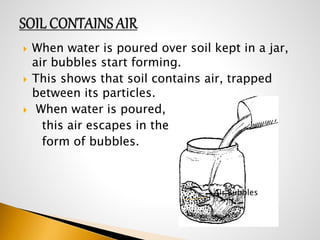
 When water is poured over soil kept in a jar, 
air bubbles start forming. 
 This shows that soil contains air, trapped 
between its particles. 
 When water is poured, 
this air escapes in the 
form of bubbles. 
Air Bubbles
 Remains: Small parts of dead plants and animals. 
 Nutrients: Materials that make the soil healthy and 
are needed by the plants. 
 Fertile: Soil is said to be fertile when plants grow well 
in it. 
 Manure: Animal wastes that are mixed with soil to 
help plants grow well. 
 Humus: Small parts of dead plants and animals 
present in the soil is called humus 
 Fact File: 
 Earthworms are called ‘farmers’ friends’. 
Earthworms dig tunnels in the soil and live in them. While 
doing this, they turn and loosen the soil.
 Some uses of soil are as follows: 
 Plants need soil to grow. They take in water 
and nutrients from the soil. Farmers grow 
crops in the soil. They make the soil fertile by 
adding manure. 
 Crops grow well in fertile soil. Without soil, 
plants would have no place to grow. If there 
were no plants, we would have nothing to eat. 
 Soil is home to many animals. Earthworms, 
beetles, ants and snails are some animals 
that live in soil.

3.soil

  • 1.
    By Aniruddh Kommajosyula III C Delhi Public School, Nerul
  • 2.
    Soil is thetop layer of the earth where plants grow. Plants stay fixed to the with the help of their roots. Soil also provides water and nutrients to the plant.
  • 3.
     Once upona time there were huge rocks on the earth.  Over time, these rocks started breaking because of the heat of the sun, rain, and wind.  Dead plants and animals got mixed with the rock pieces.  The breaking of rocks continued for many years, till rocks could not break further.  Finally, a layer of soil was formed.
  • 4.
     Thus, soilis formed by the breaking down of the rocks.  It takes thousands of years to form a small amount of soil.  The colour of the soil differs from place to place.  Soil may be light brown in one place and dark brown in another.  in India, red soil and black soil are also found.
  • 5.
     When gardensoil is mixed with water in a jar and left undisturbed for some time, the soil settles down into different layers.  The layer at the bottom consists of tiny stones.  Above it, there is a layer of fine sand.  Above the layer of sand, there is clay.  Then there is a layer of muddy water.  The remains of dead plants and animals floating on water are called humus. Humus helps to hold water and provide nutrients in the soil. Thus, humus makes the soil fertile.
  • 7.
     When somegarden soil is heated in a container covered with a lid, drops of water are noticed on the inside of the lid. This shows that soil contains water.  The water in the soil forms vapour when heated. The vapour touches the lid and cools down to form droplets of water. The water trapped in the soil is called moisture.
  • 9.
     When wateris poured over soil kept in a jar, air bubbles start forming.  This shows that soil contains air, trapped between its particles.  When water is poured, this air escapes in the form of bubbles. Air Bubbles
  • 10.
     Remains: Smallparts of dead plants and animals.  Nutrients: Materials that make the soil healthy and are needed by the plants.  Fertile: Soil is said to be fertile when plants grow well in it.  Manure: Animal wastes that are mixed with soil to help plants grow well.  Humus: Small parts of dead plants and animals present in the soil is called humus  Fact File:  Earthworms are called ‘farmers’ friends’. Earthworms dig tunnels in the soil and live in them. While doing this, they turn and loosen the soil.
  • 11.
     Some usesof soil are as follows:  Plants need soil to grow. They take in water and nutrients from the soil. Farmers grow crops in the soil. They make the soil fertile by adding manure.  Crops grow well in fertile soil. Without soil, plants would have no place to grow. If there were no plants, we would have nothing to eat.  Soil is home to many animals. Earthworms, beetles, ants and snails are some animals that live in soil.